Europe’s black hole: How much of the more than $185 billion given by the West to Ukraine has been stolen?

Rt.com By George Trenin, 20 Jul 23
The fate of huge amounts of aid sent to the country is uncertain amid endemic corruption and a lack of accountability.
As a result of last week’s NATO summit in Vilnius, the US-led military bloc promised Ukraine fresh tranches of financial and military aid. This was despite the fact that by the beginning of the summer, Kiev had already received a total of €165 billion ($185.6 billion) from Western countries. Meanwhile, as the spending increases, the number of US and EU citizens who are willing to sacrifice their own comfort for the sake of Kiev appears to be steadily decreasing.
One of the reasons for this is corruption in Ukraine, which – despite some lofty promises – seems to be as bad now as it was before the Western-backed 2014 ‘Maidan’ coup. If not worse.
Moral compensation
The NATO summit, despite Ukraine’s hopes, did not bring it a long-awaited timeframe for membership. Instead, Western leaders announced new military aid packages for Kiev.
According to the French newspaper Le Monde, French President Emmanuel Macron promised to give Ukraine a “substantial number” of SCALP missiles that can hit targets at a distance of 250 kilometers. According to France24, each costs €850,000.
Berlin announced a package amounting to €700 million. Germany plans to supply Ukraine with launchers for the Patriot missile defense system, Marder-type infantry fighting vehicles, UAVs, Leopard 1 A5 tanks, and artillery shells. However, for Berlin, this is not even close to a record gift value. On May 21, the German Foreign Ministry announced the transfer of military aid to Ukraine worth €2.7 billion.
On July 7, US Under Secretary of Defense for Policy Colin Kahl spoke about a new package of aid from the US which includes cluster munitions – which are banned in 120 countries. The cost was $800 million.
This is the 42nd delivery of aid that Ukraine has received from the US in the past year and a half. Since the beginning of Russia’s offensive, the US Congress has approved military and economic assistance to Ukraine amounting to over $70 billion – and that’s only counting direct expenses.
According to July data from the Kiel Institute (which tracks the volume of aid allocated to Ukraine), total direct subvention provided by the US and its allies in the period from February 24, 2022 to May 31, 2023 topped €165 billion.
The rate at which new tranches are allocated increases every month. For example, at the end of April, the total amount of aid was €15 billion less than it is now – according to NATO Secretary General Jens Stoltenberg, it was then €150 billion. ……………………………………………………………………………..
the risk of corruption exists not only within state borders but that fraud can also occur when concluding contracts in the US. Furthermore, the theft of weapons or other aid may happen as it travels to the war zone through Europe.
Another official involved in criminal investigations at the Pentagon also told Defense One that his department is “concerned about the potential diversion or legal export, or theft for that matter, of the goods.”
Many American businesses do not trust the Ukrainian authorities either and believe that aid is being stolen. According to US Secretary of Commerce Gina Raimondo, private businesses doubt that the funds allocated to Ukraine for reconstruction will be safe from corruption.
nternal games
The corruption issue is acknowledged in Ukraine as well. This spring, the ex-adviser of the office of the president of Ukraine, Aleksey Arestovich, said on his YouTube channel that his old boss, Vladimir Zelensky, has not been able to deal with corruption in Ukraine.
“Ukraine needs only one thing… To have someone come to power who won’t steal. Someone who won’t do it himself and won’t allow others to do so. Unfortunately, so far we haven’t been lucky,” he said.
…………………………………………….. “The Ukrainian president and many in his entourage have been skimming untold millions from the American dollars earmarked for diesel fuel payments. One estimate by analysts from the Central Intelligence Agency put the embezzled funds at $400 million last year, at least,” – American investigative journalist Seymour Hersh stated that Ukrainian President Vladimir Zelensky and his entourage illegally appropriated at least $400 million from funds that were allocated to Kiev for the purchase of diesel fuel.
…………….. Moreover, Hersh says that CIA Director William Burns was displeased with Zelensky because of the possible theft of Western aid, since “he was taking a larger share of the skim money than was going to the generals.” ……………… more https://www.rt.com/russia/579897-europes-black-hole-ukraine/
Luck Is Not a Strategy for the Ukraine, The Germans Take the “Evidence-based” Path.
We Chat with Nuclear Expert Dr. Paul Dorfman
Hot Globe, STEVE CHAPPLE, JUL 20, 2023
“………………………………………………………………………………. HOT GLOBE: It’s always bothered me that Saudi Arabia because of the Trump administration has now got access to the beginnings of nuclear power, and to a future nuclear bomb. The idea of selling small nuclear reactors around the world raises a pretty problematic point.
DORFMAN: That’s absolutely true. Saudi has made no bones about its nuclear ambitions and I mean its military nuclear ambitions. Saudi diplomats have said quite clearly that they’re looking towards Iran and that they’re seriously thinking about both civil and military nuclear. So there’s a potential for an arms race, a military nuclear arms race in the Middle East region. It’s actually even more bad news for the Middle East because in a proxy war if say, for example, Russian and America wanted to have a bit of a go and they didn’t want to absolutely destroy each other’s country where would they be fighting their proxy nuclear war? The first region that comes to mind is the Middle East and Saudi and Iran.
The economies of small nuclear reactors depend absolutely on production to scale. It’s been proven time and time again that in order to make any money at all, to break even on small nuclear production, you need to sell them abroad. Now, selling them abroad to whom, for what reasons? You’d be selling them to developing nations who may or may not have the capacity to regulate, to protect, to defend in depth, and so therefore you would be significantly expanding the potential for military nuclear risk whether that means a dirty bomb or further nuclear development.
HOT GLOBE: A slightly different question here, but Germany had ongoing nuclear plants and even though they were still producing electricity, they’ve shut those down. That may be a little puzzling to some Americans. Can you explain that?
DORFMAN: First of all, what Germany does is evidence-based policy. Germany puts out its scientific, technological questions, its energy questions, to well-funded high level research units. They go away and do their research. They come back with their research. They give it to the government departments and then the government makes a decision. So it’s evidence-based policy making. Over the years Germany has said well, we want to get to net-zero and we’re kind of worried about nuclear. Now around 2011 when Fukushima happened–remember Chancellor Merkel is a PhD chemist. She realized like many of us that even in an advanced society things could go badly wrong since accidents are by definition accidental.
HOT GLOBE: Good line
DORFMAN: Yeah, who knew? [laughs] So when Fukushima happened, Merkel and many others in Germany said well, look, we can’t stand the pain of this. I was having supper with Naoto Kan, the premier of Japan at the time of Fukushima after we both spoke in Westminster. Even then I was shocked when he turned to me and said that if the wind had been in the wrong direction, they would have lost Tokyo. The majority of the pollution went out into the Pacific Ocean. Now to the point about Germany. It’s landlocked so the Germans looked at the possibility of an accident and they came up with the numbers. It would cost trillions and trillions and trillions of Euros if they had a nuclear accident and they said look, we really can’t be doing this. This is just crazy, basically, and so we’re going to do “the German energy transition.” We’re going to try to lead the world on this and we’re going to move stepwise into renewables-plus, that’s renewables solar wind energy storage, interconnection, demand site management, energy management, distributed grids and a significant centralized upgrade of grids, too.
Now clearly Germany has a core problem, a fossil fuel problem, but they didn’t want to go down the fissile fuel route so Germany has said well OK for the time being we’re going to rely on gas but then we’re going to move to a full renewable economy. Well, the war has speeded that up. Since the war Germany has burnt less coal and Germany has shuttered all its nuclear power plants. It’s done this because what Germany says it will do, it does, unlike many other states. It set upon a route to go renewables. Now there is no such thing as a free lunch. Everything costs and there’s no perfect solution to the energy crisis, but what Germany is trying to do is to lead the world in this so-called energy transition, and I won’t spout numbers but basically what has happened is you’ve just seen significant renewable deployment, significant storage and a water storage as it were deployment which is sort of integrated into the power system and also integrated into the democratic system whereby by local communities also own the local renewable aspects of the local renewable power generation. It’s basically saying well look yes we can do this rather like Americans, you know, we have a dream, we will try to do this, it will be difficult but we will do our best to get there since the costs and the risks of nuclear are far too great. Let’s find a realistic, sustainable, positive, constructive way through……..
more https://hotglobe.substack.com/p/nuclear-power-is-already-a-climate
Ontario – Ford government’s electricity plan takes wrong approach
Windsor Star, By Jack Gibbons 21 Jul 23
Having missed the boat on the global green energy boom by crushing the province’s early leadership on renewable energy, Premier Doug Ford is now trying to take another stab at building a future economy by investing in buggy whip manufacturing.
That’s what spending tens of billions of dollars on high-cost, high-risk nuclear power essentially represents — a bet on a technology that has been in decline for decades.
Instead of trying to catch up with a global marketplace that is decidedly all-in on renewable energy — with the International Energy Agency saying 90 per cent of new electricity capacity will come from renewables over the next five years — Ontario wants to go back to the 1960s and ‘70s and embark on another long shot effort to build nuclear power plants.
It’s important to remember the province’s past nuclear projects have been one fiasco after another. Our most recent nuclear new build project — the Darlington nuclear station — went massively over budget.
The huge cost overruns and poor performance of its nuclear reactors essentially bankrupted the old Ontario Hydro. Ontario power ratepayers and taxpayers were left paying off the utility’s massive $19.4-billion stranded nuclear debt.
That hasn’t stopped a government with a strong distaste for solar panels and wind turbines from warmly embracing a technology that has never lived up to its promise.
It is now planning to build a massive new nuclear plant right beside the Bruce nuclear station which is already the largest nuclear station in the world. It also wants to build mythical “modular” reactors along the waterfront at Darlington right next to Toronto.
That the reactors the government is touting for Darlington are, at this point, nothing more than PowerPoint slides in a nuclear PR presentation hasn’t stopped the government from making wild claims that these unproven (and, at this point, unlicensed and physically non-existent) reactors can be built at what it deems to be a reasonable cost.
In 2009, when the nuclear companies wanted to build two new nuclear reactors at Darlington, the Dalton McGuinty government required them to submit fixed-price bids.
Not surprisingly the most competitive bid was 3.7 times higher than the forecast price. As a result, the government suspended the procurement process and the reactors were never built.
But despite repeatedly slamming the “fiscal irresponsibility” of previous Liberal governments, it appears that Premier Doug Ford is only too happy to give the nuclear industry a blank cheque and allow inevitable cost overruns to be passed on to electricity consumers and taxpayers.
That the projected cost for the province’s new dream nuclear projects are more than three times higher than what we would pay today for power from competitively procured wind and solar also doesn’t seem to bother Energy Minister Todd Smith…………………………………………..
New nuclear reactors that will take at least 10 to 15 years to build can not provide the dramatic reductions in greenhouse gas pollution that we need now. To add insult to injury, Doug Ford’s solution to keeping the lights on in the interim is to ramp up use of climate-wrecking gas plants and, even more astoundingly, build new ones.
But what’s truly scandalous about the government’s Powering Ontario plan is prioritizing phantom nuclear technology over what the world wants: smart, integrated and highly efficient renewable power systems………… more https://windsorstar.com/opinion/letters/guest-column-ontario-governments-electricity-plan-taking-wrong-approach
Feds digging up nuclear waste in Los Alamos for disposal at Carlsbad-area repository
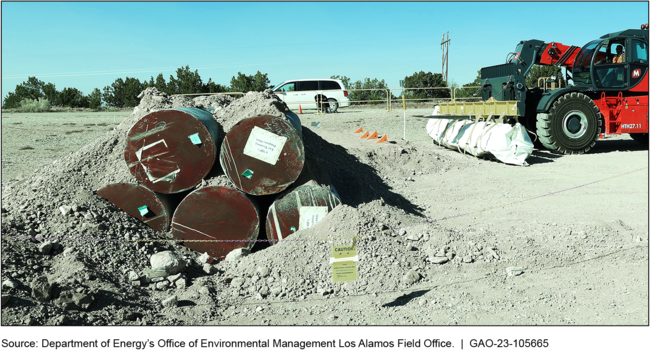
Adrian Hedden, Carlsbad Current-Argus, 21 Jul 23, https://www.currentargus.com/story/news/2023/07/21/feds-digging-up-nuclear-waste-in-los-alamos-for-disposal-at-carlsbad-area-repository/70426843007/
Workers at Los Alamos National Laboratory dug up buried nuclear waste they planned to dispose of at the federal repository near Carlsbad, amid pressure from State officials that the facility prioritize New Mexico waste.
The U.S. Department of Energy’s Los Alamos Field Office and the lab’s cleanup contractor Newport News Nuclear BWXT (N3B) Los Alamos announced Tuesday they began exhuming corrugated metal pipes containing transuranic (TRU) nuclear waste and preparing them for shipment.
At the Waste Isolation Pilot Plant near Carlsbad, TRU waste is disposed of via burial in a salt deposit about 2,000 feet underground, trucked into the site from DOE facilities throughout the country.
TRU waste is made up of irradiated clothing, equipment and other debris from nuclear research and development activities around the U.S.
Before it can be shipped to WIPP, the pipes must be cut using hydraulic sheers, allowing them to be loaded into waste boxes for shipment and disposal.
The pipes weight about 10,000 to 14,000 pounds, and measure about 20 feet long. They are cut into five pieces, with each piece loaded into a box.
It’s occurring at portion of the lab known as Dome 375, and the waste came from Los Alamos’ former radioactive liquid waste treatment facility operating during the Cold War at Technical Area 21 (TA-21).
There were 158 pipes in total transferred from TA-21, records show, containing cemented waste.
They were buried in 1986, where the waste sat until recently when worked began preparing it for final disposal.
The DOE hoped to finish digging up and preparing the pipes for disposal by spring 2024.
More: No progress to report on nuclear waste site aside from Carlsbad-area repository, feds say
The US should end its use of nuclear power plants – the intractible problem of dangerous spent fuel rods

Chicago Tribune, Jul 21, 2023 , Larry R. Eaton, Chicago
Fifty years ago, as chief of the Illinois attorney general’s Environmental Control Law Division, a relatively new field of law at that time, I had the occasion to tour an Illinois nuclear power plant. I was taken aback to see extensive pools of water containing bundles of spent nuclear fuel rods standing on end just beneath the surface of the water. I was advised that a pilot plant study had indicated that it would have an essentially closed-loop system that would not generate large amounts of spent fuel; however, once the full-scale plant became operational, the system failed to perform as anticipated. Plant workers were left with no good alternative but to store spent fuel rods in pools of water, at least temporarily, pending (hopefully) a better idea.
It appears that the nuclear power industry is still waiting for that better idea. A supporter of nuclear power production now maintains, in essence, that we have nothing to be concerned about regarding spent nuclear fuel because all we need to do is encase it in concrete and then open it up and repackage it in concrete every several decades. (In perpetuity, presumably; the radioactivity will remain unabated for a very long time indeed.) To understand how absurd this proposal is requires little more than to say it out loud.
Chernobyl and Three Mile Island were wake-up calls, but we do not appear to have fully awakened. It does not help that a nuclear power plant now sits near the front lines of a shooting war between Russia and Ukraine. Hopefully, we will somehow be lucky enough never to have a massive nuclear power plant disaster. But regardless of that, we will have radioactive spent fuel problems with us forever. We can no longer escape that fact. However, we can choose to stop making it worse.
Germany has decided to end its use of nuclear power. The U.S. should do the same. If there is anything worse than having an enormous carbon footprint, it has to be for that footprint to be radioactive too!
Corruption In Ukraine & The U.S. Mutually Rewarding
The Pentagon failed its 5th consecutive audit last year, appearing to lose track of 61% of its $3.5 trillion in assets.
Substack, LISA SAVAGE, JUL 20, 2023
“…………………………………………………………………………………………. Ukraine’s leaders are so over the top that it’s becoming impossible to ignore. Add in the fact that they have been enriched by U.S. taxpayers more or less directly despite crumbling infrastructure, catastrophic homelessness, apartheid healthcare, and a host of other problems that the U.S. could address with adequate funding.
From RT (whose editor-in-chief, Margarita Simonyan, just survived a second assassination attempt):
On July 7, US Under Secretary of Defense for Policy Colin Kahl spoke about a new package of aid from the US which includes cluster munitions – which are banned in 120 countries. The cost was $800 million.This is the 42nd delivery of aid that Ukraine has received from the US in the past year and a half.[emphasis mine] Since the beginning of Russia’s offensive, the US Congress has approved military and economic assistance to Ukraine amounting to over $70 billion – and that’s only counting direct expenses..
“Ukraine needs only one thing… To have someone come to power who won’t steal. Someone who won’t do it himself and won’t allow others to do so. Unfortunately, so far we haven’t been lucky,” [Aleksey Arestovich, former advisor to President Zelensky] said.
Ok, so Arestovich has a motive for trashing the government that used to include him. How about Pulitzer Prize-winning U.S. investigative journalist Seymour Hersh? Hersh does not approve of Russia’s entry into the war but he nonetheless published a piece on rampant corruption in Ukraine, “Trading with the Enemy,” back in April.
Zelensky has been buying fuel from Russia, the country with which it, and Washington, are at war, and the Ukrainian president and many in his entourage have been skimming untold millions from the American dollars earmarked for diesel fuel payments. One estimate by analysts from the Central Intelligence Agency put the embezzled funds at $400 million last year, at least; another expert compared the level of corruption in Kiev as approaching that of the Afghan war………………………………
Then there is President Zelensky, elected on pledges to end corruption and, incidentally, the war on the Donbas.
Pre-2022, i.e. when corporate media headlines about Ukraine did a 180, even The Guardian found he was part of the problem and not likely to be part of the solution.
Neither is the U.S. government likely to be part of the solution. The Pentagon failed its fifth consecutive audit last year, appearing to lose track of 61% of its $3.5 trillion in assets……………………….. more https://went2thebridge.substack.com/p/corruption-in-ukraine-and-the-us?utm_source=post-email-title&publication_id=1580975&post_id=135301485&isFreemail=true&utm_medium=email_medium=email
The Big Problem With Small Nuclear Reactors
The diminutive reactors are likely to be just as prone to delays and cost overruns as their behemoth predecessors.

I just read Pal Hockenos’ fine story about small nuclear reactors. But Hockenos is naive to think that Bill Gates and co. give a hoot about our future. What they do care about is their own increasing $squillions. And the coming source of new $squillions is in weaponry – that’s where all sorts of applications for SMRs lie. And Gates etc are well aware that the fixing-climate story is just a cover for the real practical purpose.
UNDARK BY PAUL HOCKENOS , 07.20.2023
IN RECENT YEARS, the nuclear power lobby and its advocates have begun to sing a new song. They have bailed on the monstrous reactors of the 20th century — not because of safety or toxic waste concerns, but because of the reactors’ exorbitant expense and ponderous rollout schedules. And they have switched their allegiance to a next generation nuclear fission technology: small modular reactors, which they claim will help rescue our warming planet, as well as the nuclear power industry— once they exist.
Respected thinkers such as former U.S. president Barack Obama, French president Emmanuel Macron, and Microsoft co-founder and philanthropist Bill Gates have toasted the idea of small modular reactors, or SMRs, as a potentially reliable, almost-emissions-free backup to intermittent renewable energy sources like wind and solar. Advocates claim that because SMRs will be smaller than the giants that currently dominate horizons, they will be safer, cheaper, and quicker to build. Although SMRs will have only a fraction of the power-generating capacity of traditional nuclear power reactors, proponents envision that they will, one day, be assembled in factories and transported as a unit to sites — like Sears’ mail-order Modern Homes of the early 1900s.
Currently, half of the states in the EU, both major political parties in the U.S, and the five BRICS nations — Brazil, Russia, India, China, and South Africa — have indicated that they want to split atoms for the purpose of generating energy. U.S. President Joe Biden included billions of dollars in tax credits for nuclear energy in the Inflation Reduction Act and the Infrastructure Investment and Jobs Act. Gates has gone so far as to invest a chunk of his fortune in a firm he founded, TerraPower, a leading nuclear innovation company. But despite the prodigious chatter, the endeavor to blanket the Earth with SMRs is a Hail Mary pass that’s very unlikely to succeed.
Granted, it is certainly a step in the right direction that most observers now see the postwar, giga-watt-scale water-cooled reactors as obsolete. When constructed new, these behemoths generate electricity at up to nine times the cost of large-scale solar and onshore wind facilities, and can take well over a decade to get up and running. Perhaps for this reason, there has been one, and only one, new nuclear power project initiated in the U.S. since construction began on the last one 50 years ago: a two-reactor expansion of the Vogtle Electric Generating Plant in Georgia. The first of the reactors came online this year — seven years behind schedule. The staggering $35 billion cost for the pair is more than twice the original projection.
But SMRs are just as likely to face similar delays and cost overruns. Currently, there are just two existing advanced SMR facilities in the world that could be reasonably described as SMRs: a pilot reactor in China and Russia’s diminutive Akademik Lomonosov. More small reactors are under construction in China, Russia, and Argentina, but all of them are proving even more expensive per kilowatt than traditional reactors.
It’s worth noting that in the U.S., and everywhere else in the world, nuclear policy relies heavily on subsidies to be economically competitive. Starting next year, utilities operating nuclear facilities in the U.S. can qualify for a tax credit of $15 per megawatt-hour — a break that could be worth up to $30 billion for the industry as a whole. However, even these giveaways won’t reduce the projected costs of SMR-generated electricity to anywhere near the going prices of wind and solar power.
In the U.S., the only SMR developer with a design approved by the Nuclear Regulatory Commission is NuScale, which plans to deploy six modules at one site in Idaho that will together generate less electricity than a smallish standard nuclear reactor. So far, however, NuScale has yet to lay a single brick. Its biggest win to date is securing $4 billion in federal tax subsidies. In January of this year, NuScale announced plans to sell electricity not at $58 per megawatt-hour, as originally pledged, but at $89 per megawatt-hour, citing higher than anticipated construction costs. The new projection is nearly twice the average global cost of utility-scale solar and onshore wind, according to calculations by BloombergNEF. And without the government subsidies, NuScale’s price tag would be that much higher.
In fact, there’s a fair chance that not a single NuScale SMR will ever be built: The company has said it will not begin construction until 80 percent of its expected generation capacity is subscribed, and currently buyers have signed up for less than a quarter of the plant’s capacity.
Gates’s TerraPower has an even longer way to go, although it too is cashing in on subsidies. The U.S. Department of Energy has pledged up to $2 billion in matching funds to construct a demonstration plant in Wyoming. Yet TerraPower recently announced it’s facing delays of at least two years because of difficulties securing uranium fuel from its lone supplier: Russia.
Even if the unlikely rollout of SMRs eventually happens, it will unfold too late to curb the climate crisis. And the reactors will face many of the same safety and radioactive waste concerns that plagued their larger counterparts, if only at smaller scales. Meanwhile, the siren song of nuclear energy is diverting critical resources from the urgent task of building out clean technologies. And the idea that nuclear reactors would serve as “backups” for wind and solar is misguided because the reactors can’t be ramped up and down quickly.
……………………………The technology of the future is already here. Clean wind and solar energy — coupled with updated smart grids, expanded storage capacity, hydrogen technology, virtual power plants, and demand response strategies — can work. Our energy systems of the future will look like a patchwork quilt, with diverse energy sources kicking in at different times during the day, and with the mix differing from one day to the next.
Bill Gates and like-minded innovators should put their minds and fortunes to work on this futuristic project of the present — and leave the 20th century relic that is nuclear power in the past, where it belongs
Is the UK Government unable to fund its promised nuclear renaissance?

- “Great British Nuclear has no legal basis – the Energy Bill has been delayed till the autumn, so it can’t do anything legally.
- “Great British Nuclear has no budget, so it can’t buy anything or commission anything.
- “Great British Nuclear has no premises.
- “Great British Nuclear has no paid staff.”
Great British Nuclear officially launched, sparks funding doubts.
Electrical Review 18th July 2023
“………………… So we’ve heard that Great British Nuclear has high hopes to kickstart a renaissance period for nuclear power in the UK, but how does it plan on achieving that? Well, thanks to the official launch, we now have more concrete information as to what the body plans to do.
The UK Government has officially launched Great British Nuclear, a new Government agency that is designed to support the growth of nuclear energy in the UK.
The official launch of Great British Nuclear was initially tipped for July 13, although the launch was pushed back due to “unforeseen circumstances.” Despite the delayed start, the Government has high hopes for the new department, with it hoping to create a renaissance for nuclear energy in the UK.
One of Great British Nuclear’s first acts will be to kickstart a competition for small modular reactor (SMR) technology, which it believes could help boost energy security, create cheaper power, and grow the economy through well-paid jobs.
Many in the industry have been calling for the UK Government to do more to encourage the construction of more nuclear power, including SMRs, as the UK transitions towards cleaner power generation. The UK Government has even gone so far as to claim that nuclear will be essential to our net zero future, noting that it will provide a ‘baseload’ to cover more intermittent renewable energy generation – something that our Gossage Gossip columnist recently described as a ‘load of cobblers’.
How will Great British Nuclear Help?
So we’ve heard that Great British Nuclear has high hopes to kickstart a renaissance period for nuclear power in the UK, but how does it plan on achieving that? Well, thanks to the official launch, we now have more concrete information as to what the body plans to do.
From today, companies can register their interest with Great British Nuclear to participate in a competition to secure funding support to develop their SMRs. Additionally, the Government body is eager to explore future sites for new large gigawatt-scale nuclear power plants, such as those at Hinkley Point C and Sizewell C.
That’s about as much as we know about Great British Nuclear’s initial plans – although the UK Government is throwing its weight behind the nuclear industry with a brand-new funding package totalling up to £157 million.
This includes:
Up to £77.1 million of funding for companies to accelerate advanced nuclear business development in the UK and support advanced nuclear designs to enter UK regulation, maximising the chance of small and advanced modular reactors being built during the next ParliamentUp to £58 million funding for the further development and design of a type of advanced modular reactor (AMR) and next generation fuel. AMRs operate at a higher temperature than SMRs and as a result they could provide high temperature heat for hydrogen and other industrial uses alongside nuclear power. This includes:
- Up to £22.5 million to Ultra Safe Nuclear Corporation UK in Warrington to further develop the design of a high temperature micro modular reactor, a type of AMR suited to UK industrial demands including hydrogen and sustainable aviation fuel production.
- Up to £15 million to the National Nuclear laboratory in Warrington to accelerate the design of a high temperature reactor, following its success in Japan.
- Up to £16 million to National Nuclear Laboratory in Preston to continue to develop sovereign coated particle fuel capability, a type of robust advanced fuel which is suitable for high temperature reactors.
A further £22.3 million from the Nuclear Fuel Fund will enable eight projects to develop new fuel production and manufacturing capabilities in the UK, driving up energy security and supporting the global move away from Russian fuel. This will include:
- Over £10.5 million to Westinghouse Springfields nuclear fuel plant in Preston to manufacture more innovative types of nuclear fuel for customers both in the UK and overseas, boosting jobs and skills in the North West.
- Over £9.5 million to Urenco UK in Capenhurst Chester, an international supplier of nuclear materials, to enrich uranium to higher levels, including LEU+ and high assay low enriched uranium (HALEU). LEU+ will allow for current reactors and SMRs to run for longer between refuelling outages, improving reactor efficiency and economics both in the UK and abroad. HALEU development will ensure that the UK remains at the forefront of fuel development for future advanced reactors.
- Over £1 million has also been awarded to Nuclear Transport Solutions, a subsidiary of the Nuclear Decommissioning Authority, to develop transport solutions to facilitate a supply chain for highly enriched uranium in the UK and internationally.
- Over £1.2 million to support MoltexFLEX, a UK molten salt reactor developer based in the North West, to build and operate rigs for the development of molten salt fuel. Molten Salt Reactors (MSRs) are an AMR type that use a molten salt as a coolant and fuel, leading to intrinsic safety compared with conventional fuels.
Is the UK Government unable to fund its promised nuclear renaissance?
Despite announcing £157 million in investment for the nuclear industry in the UK, many experts will argue that the UK Government’s funding plans are woefully inadequate to meaningfully move the needle.
Recent nuclear projects within the UK have been unable to get off the ground without significant Government intervention, including Hinkley Point C, which the Government has committed at least £679 million towards, despite the new reactor facing constant delays – with its opening date now set for September 2028.
Rolls-Royce, which is currently undergoing regulatory testing on its small modular reactor technology, has suggested that SMRs will be cheaper – although the company still believes each SMR will carry a price tag of at least £1.8 billion when they start rolling out of factories in 2030. That is expected to get you around 440 MW of generation – which for the same price, you could purchase 782 Enercon E82 onshore wind turbines, netting you up to 2346 MW of generation.
One industry insider suggested that the UK Government’s woeful funding figures was “the best example I have ever seen of what a Government on its last legs sounds like when it has nothing to say and no money to spend.” Adding that, “All this amount will buy you, literally, is a very large pile of paper and possibly a few more headlines.”
Given the Conservative Party’s performance in recent polls, it’s likely the UK Government is unwilling to commit large amounts to Great British Nuclear when it’s unlikely to be in Government for much longer. Unfortunately, large infrastructure projects of this nature require huge investment across multiple parliamentary terms – and the short-sighted nature of the country’s leaders got us into this situation in the first place. In fact, by the time Hinkley Point C comes online, it will be 20 years since the Government of the day supported a new reactor.
Will the launch of Great British Nuclear move the needle?
The UK Government is hopeful that Great British Nuclear will move the needle in the development of nuclear power technology in the UK. While it may not have the budget to invest in new nuclear reactors itself – it could potentially foster an environment that is ultimately friendly to nuclear power.
Unfortunately, as our industry insider notes:
- “Great British Nuclear has no legal basis – the Energy Bill has been delayed till the autumn, so it can’t do anything legally.
- “Great British Nuclear has no budget, so it can’t buy anything or commission anything.
- “Great British Nuclear has no premises.
- “Great British Nuclear has no paid staff.”
So, the chance of meaningfully moving the needle is essentially nil. But at least the current Government can capture headlines and act like it’s trying to help. https://electricalreview.co.uk/2023/07/18/great-british-nuclear-officially-launched-sparks-funding-doubts/
To the Pacific islands, the West’s support for Japan’s Fukushima nuclear waste ocean dumping is hypocrisy
Having been used for nuclear tests and dumping by the US and France, the Pacific islands deeply oppose Japan’s plan and see it as a ‘nuclear legacy’ issueThat the likes of Australia and the US support Japan’s plan just ups the region’s geopolitical stakes – and gives China a trump card
Kalinga Seneviratne, SCMP, 18 Jul 23
International Atomic Energy Agency (IAEA) director general Rafael Mariano Grossi, after travelling to Tokyo earlier this month to present a report endorsing Japan’s approach to discharging Fukushima’s treated nuclear waste water into the Pacific, has been trying to convince Japan’s sceptical Pacific neighbours of the authenticity of the report’s findings.
The IAEA, which has opened the door for Tokyo Electric Power Company (Tepco) to dump about 1.3 million tonnes of contaminated water into the Pacific Ocean, insists the controlled, gradual release would have a “negligible radiological impact on people and the environment”.
But the small island nations of the Pacific remain deeply concerned about Japan’s intention to dump nuclear waste into the ocean. They see this as not merely a nuclear safety issue but a “nuclear legacy issue” – the Pacific has been used as a nuclear weapon testing and dumping site since the end of the second world war………………….(Subscribers only) more https://www.scmp.com/comment/opinion/article/3228154/pacific-islands-wests-support-japans-fukushima-nuclear-waste-ocean-dumping-hypocrisy
Don’t believe the UK government’s hype about small nuclear reactors and Great British Nuclear.

In response to Energy Security Secretary Grant Shapps’ announcements
relating to ‘Great British Nuclear’, Dr Doug Parr, Chief Scientist for
Greenpeace UK, said – “As the government tries to whip up investment for
the latest generation of reactors, it is striking how many of the nuclear
industry’s speculative claims are being repeated by ministers as fact.
The hype seems to have been enough to convince our government that nuclear’s
last gasp is in fact a new dawn, but at their radioactive cores SMRs remain
the same bad bet. SMRs have no track record, but initial indications are
that the familiar problems of cost overruns and delays will be repeated,
and the accumulation of unmanageable waste will continue.
Maybe the hope is that splitting one big mistake into several smaller mistakes means each
reactor’s inevitable problems receive less scrutiny?
By continually obsessing about nuclear the government is taking its eye off the net zero
ball, which will have to be delivered through a predominantly renewable,
modern electricity grid. No number of SMRs will fix the government’s
lacklustre effort to address issues of delayed connections, smart local
grids and home efficiency.
The government may argue that renewables can
compete in the market unaided, while nuclear still needs state support to
survive, but atomic power has been showered with money and support for the
best part of a century without ever working well enough to pay its way.
This is a technology that has gone straight from adolescence to
obsolescence without passing through maturity.”
Greenpeace 18th July 2023
Ukraine Again Bombs Crimean Bridge
18, July, 2023 https://scheerpost.com/2023/07/18/ukraine-again-bombs-crimean-bridge/—
Ukrainian sources are telling media outlets it was a joint operation between the SBU and the Ukrainian Navy.
By Dave DeCamp / Antiwar.com
The Crimean Bridge that links Crimea to the Russian mainland was again targeted by Ukrainian forces in a bombing early Monday morning that killed two civilians and injured a young child.
Russian authorities said the Crimean Bridge, also known as the Kerch Bridge, was targeted by drones operating on the surface of the water. The previous attack on the bridge that took place in October 2022 was a truck bombing.
Ukrainian sources are telling media outlets that the attack was a joint operation between Ukraine’s Security Service (SBU) and Ukraine’s Navy. The government in Kyiv hasn’t officially taken credit for the attack but has hinted at responsibility, which is typical of their covert attacks on Russian territory.
Russian authorities have halted vehicle traffic on the bridge and are assessing the damage. According to RT, rail transport on the bridge was temporarily halted but has resumed.
The Crimean Bridge is a sensitive target for Russia, and the last time it was attacked, Russian President Vladimir Putin significantly escalated the war. In response, the Russian military began large-scale missile strikes on Ukrainian infrastructure, which it hadn’t done before October 2022.
Russian Foreign Ministry spokeswoman Maria Zakharova hinted at Western involvement in the Monday attack, saying that Ukrainian decisions on such operations are made “with the direct participation of American and British intelligence services and politicians.”
The Grayzone previously reported that British intelligence officials were plotting ways to blow up the Crimean Bridge before the October 2022 attack. The Grayzone obtained a presentation drawn up for British intelligence in April 2022 that reviewed options for attacking the bridge.
The document suggested using cruise missiles or divers to plant mines to blow up the bridge. The Ukrainian attacks differed operationally, but the existence of the document signals the British could have helped Ukraine plot the attacks or at least offered advice.
US turning Ukraine into ‘burial ground’ for lethal waste – Russian envoy
Rt.com 19 Jul 23
Undetonated cluster bombs will make normal life “impossible” in parts of Ukraine, Ambassador Anatoly Antonov has said.
The US is using the Ukrainian battlefield as a dump site for its outdated weapons, Russia’s ambassador to Washington has said, warning that the country will become a graveyard for “lethal waste.”
After the White House claimed it has no plans to replenish the Pentagon’s stockpiles of controversial cluster bombs, Ambassador Anatoly Antonov said the US is “plunging lower and lower in terms of observing elementary moral principles, cynically dumping the lethal waste on Ukraine.”
“Washington wants to use [Ukraine] to dispose of its old weapons, turning the once rich and fertile part of the USSR into a ‘burial ground’ where it will be simply impossible to live,” he said. “Unexploded US submunitions will remain in this territory, as well as piles of scorched metal of the German-made Leopards and other Western materiel.”
In an interview with NBC News on Sunday, White House National Security Advisor Jake Sullivan was asked whether President Joe Biden would continue supplying 155-millimeter cluster bombs to Ukraine. Though he stopped short of a direct answer, Sullivan said the administration is working to build up production capacity for standard 155mm artillery shells and is not looking to replenish its cluster munition stocks. …….
The decision to provide cluster bombs was controversial even for US allies, as more than 120 nations have agreed to ban the weapons due to their tendency to leave behind undetonated submunitions. The unexploded ordnance can remain live in former conflict zones for decades, posing a danger to anyone unfortunate enough to stumble across them.
While NBC’s Chuck Todd pressed Sullivan on whether the US should continue to provide “barbaric weapons” to Kiev, the senior official insisted on America’s “moral authority,” saying the White House would continue to “give Ukraine what it needs in order to not be defenseless in the face of a Russian onslaught.”
Moscow has repeatedly condemned foreign arms transfers to Ukraine, arguing they will only prolong the conflict and do little to deter its military aims. It has singled out weapons such as cluster munitions and depleted uranium rounds as especially problematic, noting they are likely to harm non-combatants in the region long after the fighting is over. https://www.rt.com/russia/579875-us-cluster-bombs-ukraine-graveyard/
Europe heatwave: EU sends planes to Greece as thousands flee fires. Highof 48C expected on continent as red spreads across the European weathermap.
Times 18th July 2023
https://www.thetimes.co.uk/article/europe-heatwave-weather-charon-forecast-latest-news-ffq9k9drn
A sleepy town of 8,000 located near the Sardinian capital of Cagliari,
Decimomannu is currently one of Italy’s hottest locations, and experts
had predicted record temperatures on Tuesday and Wednesday. Locals say many
have locked themselves in shuttered homes or fled to surrounding beaches.
Times 19th July 2023
Hundreds have fled as wildfires rage in Greece for a third day while
authorities brace for a new heatwave stoking tinderbox conditions across
the country. Dozens of homes were gutted in towns west of Athens, while the
fire brigade reported that a third fire had broken out on the island of
Rhodes. Firefighters worked throughout the night and four aircraft sent
from Italy and France will soon join the efforts to keep the flames at bay,
as a second heatwave is forecast to start in Greece on Thursday. Thousands
have also been evacuated in the Canary Islands and Switzerland in recent
days, as southern Europe is gripped by the ongoing wildfires and extreme
heat caused by the fossil-fuel-driven climate crisis.
Independent 19th July 2023
Great British Nuclear: High on hype, Low on substance

“How is Great British Nuclear meant to take forward the SMR competition when it has no operating budget, no legal powers, no permanent staff team, and no base from which to operate?”
“How is GBN meant to take forward the SMR competition when it has no operating budget, no legal powers, no permanent staff team, and no base from which to operate?”
https://www.nuclearpolicy.info/news/great-british-nuclear-high-on-hype-low-on-substance/ 18 Jul 23
Energy Secretary Grant Shapps finally launched ‘Great’ British Nuclear today (18 July), but whilst the minister’s announcement was big on hype, the UK/Ireland Nuclear Free Local Authorities noticed that it was short on substance.
Great British Nuclear was the new body announced by former Prime Minister Boris Johnson in April 2022 as part of his revised energy strategy. GBN is supposed to be front and centre of a ‘rapid expansion of nuclear power at an unprecedented scale and pace’, but the formal launch of the initiative has been put on hold several times, including humiliatingly at the eleventh-hour last week.
Nuclear in the UK has made little progress since April 2022. EDF Energy, which is building the only nuclear plant under construction at Hinkley Point C, has recently announced a further delay in delivery and a huge increase in costs, whilst its reactor design – the EPR-1 – has been beset with serious safety and reliability issues, with an accident at Taishan-1 in China and repeated delays to the start-up of its reactor in Olkiluoto in Finland. And the UK government has so far failed to engender any interest within the financial markets to back its Sizewell C development, meaning that the British and French governments (and ultimately taxpayers) continue to carry the can.
More faith is being placed by ministers on the development of so-called Small and Advanced Modular Reactors, with GBN’s role being to provide oversight to a competition amongst rival designs to select those deemed worthy of government funding to take forward through the regulatory approvals process and onto deployment. Such reactors would be fabricated remotely and then taken in parts for assembly on site, but all is not rosy – developments costs are rising exponentially, none of the designs are proven to be safe or reliable, none have been built, the financial position of some developers is becoming uncertain, and there remains the intractable radioactive waste problem.
NFLA Chair, Councillor Lawrence O’Neill identified some of the remaining challenges following today’s press conference:
“Like much concerning nuclear, once again when we look at GBN there is a noticeable disconnect between the upbeat speech of the Energy Secretary and the actual reality on the ground.
“Mr Shapps announced a further £157 million in government funding for nuclear, but this sum is small beer relative to the billions required to get any plant up and running, and strangely absent, yet again, was any clear indication of where the money to fund the operation of Great British Nuclear would come from. Figures of up to £500 million per year have been bandied about, and the NFLA has previously pointed out that this funding shortfall was also noticeable in the Chancellor’s Spring Budget where much was made of the ‘promise’ of GBN, but with no money to follow it.
“Furthermore, Great British Nuclear still does not have all its legal powers to function, including the power to award funding for future nuclear development. Its powers are contained within the Energy Bill currently in its Reporting Stage before the House of Commons in Parliament, and this still needs to clear its final hurdles before receiving Royal Assent and becoming legislation. As the recess is almost upon us, with MPs leaving for their summer holidays, no further progress can be made before the autumn. In addition, GBN only has an interim staff team and no real headquarters.
“How is GBN meant to take forward the SMR competition when it has no operating budget, no legal powers, no permanent staff team, and no base from which to operate?”
Mostly damningly, Emeritus Professor of Energy Policy at the University of Greenwich, Stephen Thomas, has poured scorn on the ‘promise’ of Small and Advanced Modular Reactors in his recent paper:
which includes quotes:
‘The much-hyped Small Modular Reactors are a long way from being commercially available and the claims for them being cheaper than large reactors are not credible’.
‘Advanced Modular Reactors have all been talked about for 50 years or more. However, they have either been built as unsuccessful prototypes or demonstration plants or not been built at all as power reactors. All AMR designs will require major innovations if they are to be technically viable’.
The NFLAs are at one with Professor Thomas in condemning the British Government’s continued foolhardy obsession with unproven, unreliable and potentially unsafe new nuclear, when renewable technologies already exist that can deliver affordable, sustainable electricity far more quickly and far more cheaply.
Councillor O’Neill concluded:
“Every pound spent on the vainglorious pursuit of nuclear power means a pound denied to investment in a national programme of insulation and energy efficiency measures to bring down energy usage and customer bills or a pound denied to investment in solar, wind, hydro, biomass, geothermal, tidal or wave power projects that, in combination with energy storage solutions, can provide more affordable, sustainable electricity to meet our nation’s energy needs right now.”
1 This Month
Tell Congress: Prevent Nuclear Catastrophe in Iran

Tell Congress: Prevent Nuclear Catastrophe in Iran

Read the Public Inquiry Report, the Commissioners’ report, Surrendering Australia: The AUKUS Deception is available to download for free at aukuspublicinquiry.com. Or just watch the replay of the National Press Club Luncheon.


Shut down the radiation-damaged Heysham nuclear reactors now
To see nuclear-related stories in greater depth and intensity – go to https://nuclearinformation.wordpress.com

Say No to NASA’s Reckless Nuclear Reactor on the Moon
Say No to NASA’s Reckless Nuclear Reactor on the Moon
-
Archives
- November 2026 (224)
- October 2026 (302)
- September 2026 (339)
- August 2026 (330)
- July 2026 (355)
- June 2026 (287)
- May 2026 (306)
- April 2026 (356)
- March 2026 (251)
- February 2026 (267)
- January 2026 (308)
- December 2025 (358)
-
Categories
- 1
- 1 NUCLEAR ISSUES
- business and costs
- climate change
- culture and arts
- ENERGY
- environment
- health
- history
- indigenous issues
- Legal
- marketing of nuclear
- media
- opposition to nuclear
- PERSONAL STORIES
- politics
- politics international
- Religion and ethics
- safety
- secrets,lies and civil liberties
- spinbuster
- technology
- Uranium
- wastes
- weapons and war
- Women
- 2 WORLD
- ACTION
- AFRICA
- Atrocities
- AUSTRALIA
- Christina's notes
- Christina's themes
- culture and arts
- Events
- Fuk 2022
- Fuk 2023
- Fukushima 2017
- Fukushima 2018
- fukushima 2019
- Fukushima 2020
- Fukushima 2021
- general
- global warming
- Humour (God we need it)
- Nuclear
- RARE EARTHS
- Reference
- resources – print
- Resources -audiovicual
- Weekly Newsletter
- World
- World Nuclear
- YouTube
-
RSS
Entries RSS
Comments RSS

