nuclear-news

The News That Matters about the Nuclear Industry Fukushima Chernobyl Mayak Three Mile Island Atomic Testing Radiation Isotope

  • Home
  • 1 This Month
  • ACTION !
  • Disclaimer
  • Links
  • PAGES on NUCLEAR ISSUES

Climate change disruption of the jet stream is causing more extreme weather

Global Warming Is Messing with the Jet Stream. That Means More Extreme Weather.

A new study links the buildup of greenhouse gas emissions to more frequent heat waves, floods and droughts in the Northern Hemisphere.

BY BOB BERWYN, INSIDE CLIMATE NEWS, 31 OCT 18  Greenhouse gases are increasingly disrupting the jet stream, a powerful river of winds that steers weather systems in the Northern Hemisphere. That’s causing more frequent summer droughts, floods and wildfires, a new study says.

The findings suggest that summers like 2018, when the jet stream drove extreme weather on an unprecedented scale across the Northern Hemisphere, will be 50 percent more frequent by the end of the century if emissions of carbon dioxide and other climate pollutants from industry, agriculture and the burning of fossil fuels continue at a high rate.

In a worst-case scenario, there could be a near-tripling of such extreme jet stream events, but other factors, like aerosol emissions, are a wild card, according to the research, published today in the journal Science Advances.

The study identifies how the faster warming of the Arctic twists the jet stream into an extreme pattern that leads to persistent heat and drought extremes in some regions, with flooding in other areas.

The researchers said they were surprised by how big a role other pollutants play in the jet stream’s behavior, especially aerosols—microscopic solid or liquid particles from industry, agriculture, volcanoes and plants. Aerosols have a cooling effect that partially counteracts the jet stream changes caused by greenhouse gases, said co-author Dim Comou, a climate and extreme weather researcher at the Potsdam Institute for Climate Impacts Research and the Vrije Universiteit Amsterdam.

“The aerosols forcing was a bit of a surprise to us,” Comou said. “Those emissions are expected to decrease rapidly in the mid-latitude regions in the next 10 to 30 years” because of phasing out of pollution to protect people from breathing unhealthy air.

In recent decades, aerosol pollution has actually been slowing down the global warming process across the Northern Hemisphere’s mid-latitude industrial regions. If aerosol emissions drop rapidly, as projected, these regions would warm faster.

That would change the temperature contrast between the Arctic and mid-latitudes, which would dampen the warming effect of greenhouse gases on the jet stream. By how much depends on the rate, location and timing of the reductions, and the offset would end by mid-century, when man-made aerosols are expected to be mostly gone and no longer reflecting incoming solar radiation, said Pennsylvania State University climate scientist and study lead author Michael Mann. ……….

The new study focuses on summer extremes, while other research has looked at how global warming affects the jet stream in winter.

What Happens in the Arctic Doesn’t Stay There

Daniel Swain, a climate scientist at UCLA and the National Center for Atmospheric Research who was not involved with the new research, said the study has some “compelling new evidence on the link between amplified Arctic warming and extreme mid-latitude weather during the summer months.”

What happens in the Arctic doesn’t stay there. Increased melting of reflective sea ice in summer exposes more dark-colored ocean to absorb heat, and that heats the surrounding land. As Arctic warming races ahead of the rest of the global average, the temperature contrasts that drive the jet stream are reduced, and the river of wind more frequently twists into sharp and slow-moving or stationary waves.

“When the jet stream enters this wavy state, extreme weather tends to occur on either side of the amplified ridges and troughs as the storm track becomes locked in place,” Swain said. Then, specific regions experience long periods of cool and stormy or, contrarily, hot and dry weather, he added. https://insideclimatenews.org/news/31102018/jet-stream-climate-change-study-extreme-weather-arctic-amplification-temperature

November 5, 2018 Posted by Christina Macpherson | 2 WORLD, climate change | Leave a comment

Radioactivity induced mutations in the animals of Chernobyl

What We Know About the Chernobyl Animal Mutations https://www.thoughtco.com/chernobyl-animal-mutations-4155348?utm_source=facebook&utm_medium=social&utm_campaign=shareurlbuttons&fbclid=IwAR0ML06KNkYYmozGbreM6e9ApQ9154nFmnYLxzZFUkK0pznLEi2X9FM-FHQ   by

Anne Marie Helmenstine, Ph.D.  September 10, 2018

The 1986 Chernobyl accident resulted in one of the highest unintentional releases of radioactivity in history. The graphite moderator of reactor 4 was exposed to air and ignited, shooting plumes of radioactive fallout across what is now Belarus, Ukraine, Russia, and Europe. While few people live near Chernobyl now, animals living in the vicinity of the accident allow us to study the effects of radiation and gauge recovery from the disaster.

Most domestic animals have moved away from the accident, and those deformed farm animals that were born did not reproduce. After the first few years following the accident, scientists focused on studies of wild animals and pets that had been left behind, in order to learn about Chernobyl’s impact.

Although the Chernobyl accident can’t be compared to effects from a nuclear bombbecause the isotopes released by the reactor differ from those produced by a nuclear weapon, both accidents and bombs cause mutations and cancer.

It’s crucial to study the effects of the disaster to help people understand the serious and long-lasting consequences of nuclear releases. Moreover, understanding the effects of Chernobyl may help humanity react to other nuclear power plant accidents.

The Relationship Between Radioisotopes and Mutations 

You may wonder how, exactly, radioisotopes (a radioactive isotope) and mutations are connected. The energy from radiation can damage or break DNA molecules. If the damage is severe enough, cells can’t replicate and the organism dies. Sometimes DNA can’t be repaired, producing a mutation. Mutated DNA may result in tumors and affect an animal’s ability to reproduce. If a mutation occurs in gametes, it can result in a nonviable embryo or one with birth defects.

Additionally, some radioisotopes are both toxic and radioactive. The chemical effects of the isotopes also impact the health and reproduction of affected species.

The types of isotopes around Chernobyl change over time as elements undergo radioactive decay. Cesium-137 and iodine-131 are isotopes that accumulate in the food chain and produce most of the radiation exposure to people and animals in the affected zone.

Examples of Domestic Genetic Deformities

Ranchers noticed an increase in genetic abnormalities in farm animals immediately following the Chernobyl accident. In 1989 and 1990, the number of deformities spiked again, possibly as a result of radiation released from the sarcophagus intended to isolate the nuclear core. In 1990, around 400 deformed animals were born. Most deformities were so severe the animals only lived a few hours.

Examples of defects included facial malformations, extra appendages, abnormal coloring, and reduced size. Domestic animal mutations were most common in cattle and pigs. Also, cows exposed to fallout and fed radioactive feed produced radioactive milk.

The health and reproduction of animals near Chernobyl were diminished for at least the first six months following the accident. Since that time, plants and animals have rebounded and largely reclaimed the region. Scientists collect information about the animals by sampling radioactive dung and soil and watching animals using camera traps.

The Chernobyl exclusion zone is a mostly-off-limits area covering over 1,600 square miles around the accident. The exclusion zone is a sort of radioactive wildlife refuge. The animals are radioactive because they eat radioactive food, so they may produce fewer young and bear mutated progeny. Even so, some populations have grown. Ironically, the damaging effects of radiation inside the zone may be less than the threat posed by humans outside of it. Examples of animals seen within the zone include Przewalksi’s horses, wolves, badgers, swans, moose, elk, turtles, deer, foxes, beavers, boars, bison, mink, hares, otters, lynx, eagles, rodents, storks, bats, and owls.

Not all animals fare well in the exclusion zone. Invertebrate populations (including bees, butterflies, spiders, grasshoppers, and dragonflies) in particular have diminished. This is likely because the animals lay eggs in the top layer of soil, which contains high levels of radioactivity.

Radionuclides in water have settled into the sediment in lakes. Aquatic organisms are contaminated and face ongoing genetic instability. Affected species include frogs, fish, crustaceans, and insect larvae.

While birds abound in the exclusion zone, they are examples of animals that still face problems from radiation exposure. A study of barn swallows from 1991 to 2006 indicated birds in the exclusion zone displayed more abnormalities than birds from a control sample, including deformed beaks, albinistic feathers, bent tail feathers, and deformed air sacs. Birds in the exclusion zone had less reproductive success. Chernobyl birds (and also mammals) often had smaller brains, malformed sperm, and cataracts.

The Famous Puppies of Chernobyl 

Not all of the animals living around Chernobyl are entirely wild. There are around 900 stray dogs, mostly descended from those left behind when people evacuated the area. Veterinarians, radiation experts, and volunteers from a group called The Dogs of Chernobyl capture the dogs, vaccinate them against diseases, and tag them. In addition to tags, some dogs are fitted with radiation detector collars. The dogs offer a way to map radiation across the exclusion zone and study the ongoing effects of the accident. While scientists generally can’t get a close look at individual wild animals in the exclusion zone, they can monitor the dogs closely. The dogs are, of course, radioactive. Visitors to the area are advised to avoid petting the pooches to minimize radiation exposure.

References 

  • Galván, Ismael; Bonisoli-Alquati, Andrea; Jenkinson, Shanna; Ghanem, Ghanem; Wakamatsu, Kazumasa; Mousseau, Timothy A.; Møller, Anders P. (2014-12-01). “Chronic exposure to low-dose radiation at Chernobyl favours adaptation to oxidative stress in birds”. Functional Ecology. 28 (6): 1387–1403.
  • Moeller, A. P.; Mousseau, T. A. (2009). “Reduced abundance of insects and spiders linked to radiation at Chernobyl 20 years after the accident”. Biology Letters. 5 (3): 356–9.
  • Møller, Anders Pape; Bonisoli-Alquati, Andea; Rudolfsen, Geir; Mousseau, Timothy A. (2011). Brembs, Björn, ed. “Chernobyl Birds Have Smaller Brains”. PLoS ONE. 6 (2): e16862.
  • Poiarkov, V.A.; Nazarov, A.N.; Kaletnik, N.N. (1995). “Post-Chernobyl radiomonitoring of Ukrainian forest ecosystems”. Journal of Environmental Radioactivity. 26 (3): 259–271. 
  • Smith, J.T. (23 February 2008). “Is Chernobyl radiation really causing negative individual and population-level effects on barn swallows?”. Biology Letters. The Royal Society Publishing. 4 (1): 63–64. 
  • Wood, Mike; Beresford, Nick (2016). “The wildlife of Chernobyl: 30 years without man”. The Biologist. London,UK: Royal Society of Biology. 63 (2): 16–19. 


November 5, 2018 Posted by Christina Macpherson | environment, Reference, Ukraine | Leave a comment

Trump administration heads for the dodgy science of the radiation sceptics

Is a Little Radiation Good For You? Trump Admin Steps Into Shaky Science, Discover Magazine, By Nathaniel Scharping | October 5, 2018 

For decades, studies have shown that even low doses of radiation are harmful to humans.

This week, the Associated Press reported that the Trump administration may be reconsidering that. The Environmental Protection Agency seemed to be looking at raising the levels of radiation considered dangerous to humans based on a controversial theory rejected by mainstream scientists. The theory suggests that a little radiation might actually be good for our bodies. In April, an EPA press release announced the proposal and included supporting comments from a vocal proponent of the hypothesis, known as hormesis. It prompted critical opinion pieces and sparked worry among radiation safety advocates.

EPA’s decision to move away from the radiation dose model widely accepted by the scientific mainstream. But by Friday, the EPA backed away from Calabrese’s stance in comments to Discover.

The debate cuts to the heart of the debate over the effects of low doses of radiation and reveals how difficult it is to craft clear guidelines in an area where scientific evidence is not clear cut.

Radiation Debate

When radiation damages our DNA, the body steps in to make repairs. Hormesis suggests that hitting the body with a little more radiation should kick our defensive mechanisms into overdrive. According to proponents of the theory, this results in the production of anti-oxidants and anti-inflammatory compounds that reduce our risk for cancer and heart disease, among other things. That’s why hormesis backers want the EPA to raise the level of acceptable radiation, pointing out that it would also save millions in safety costs.

It sounds convincing, and proponents have dozens of studies to point to that they say back up their claims. But, there’s never been a large-scale human study of hormesis. And while studies of low-dose radiation are very hard to do, so far, most suggest that radiation is indeed bad for us, at any dose.

“Large, epidemiological studies provide substantial scientific evidence that even low doses of radiation exposure increase cancer risk,” says Diana Miglioretti, a professor in biostatistics at the University of California, Davis in an email. “Risks associated with low-doses of radiation are small; however, if large populations are exposed, the evidence suggests it will lead to measurable numbers of radiation-induced cancers.”

Long-term studies of Hiroshima and Nagasaki bombing survivors show higher cancer risks. Marshall Islanders exposed to radiation from atomic bomb tests suffered a higher risk of thyroid disease. And patients who get CT scans, which deliver a dose of radiation equal to thousands of X-rays, saw cancer risks go up afterward. Researchers also found that radiation from childhood CT scans can triple the risk of leukemia and, at higher doses, triple the risk of brain cancers as well. Another found that low-dose radiation increased the risk of breast cancer among some some women.

And large-scale reviews of the evidence for hormesis find that it is decidedly lacking. Two studies, one in 2006 by the National Research Council, and another in 2018 by the National Council and Radiation Protection and Measurements looking at 29 studies of radiation exposure find no evidence for hormesis, and reiterate that the evidence points toward radiation being bad for us even at low doses.

Scientific Uncertainty

It’s difficult to study low doses of radiation, though, and that’s where much of the controversy comes from. At doses below a few hundred millisieverts (mSv), a radiation unit that accounts for its effects on the body, it becomes extraordinarily hard to separate out the effects of radiation from other things like lifestyle or genetics. Research on the effects of these small radiation doses often use data sets involving thousands of people to compensate for the minimal effect sizes, but even then it’s often not enough to be certain what’s happening.

“Data collected at low doses (defined by the scientific community [as] exposures less than 100 mSv) suffers from a ‘signal to noise’ problem which limits our ability to conclusively state effects one way or another,” says Kathryn Higley, head of the school of nuclear science and engineering at Oregon State University in an email.

A single CT scan delivers anywhere from 1 to 15 mSv, but some patients need many scans during the course of their treatment, increasing the total dose. Workers cleaning up after the Fukushima meltdown received radiation doses above 100 mSv in some cases. And current U.S. standards limit radiation workers to no more than 50 mSv of exposure per year.

Many studies indicate that there are dangers at that level, but it’s often an assumption. Those studies base their suppositions on what’s called the linear no-threshold model, which extrapolates more reliable data from studies of higher doses of radiation to lower doses. Though it may be an educated guess, for decades large-scale studies have indicated this is true.

……….. The EPA in recent days appeared to back away from the suggestion that it supported hormesis. The agency released a statement in response to the APstory affirming that it intends to continue using the linear no-threshold model when constructing radiation guidelines, something that contradicts Calabrese’s comments in the April press release.

“The proposed regulation doesn’t talk about radiation or any particular chemicals. EPA’s policy is to continue to use the linear-no-threshold model for population-level radiation protection purposes which would not – under the proposed regulation that has not been finalized – trigger any change in that policy,” said an EPA spokesman in response to a request for comment.

Radiologist Rebecca Smith-Bindman says the vast bulk of the evidence suggests even small amounts of radiation are harmful. We shouldn’t base our policies on an unproven theory, she adds.

“There is extensive evidence that ionizing radiation will cause cancer,” says Smith-Bindman, a professor of radiology at the University of California, San Francisco in an email exchange. “These data come from a range of different sources, including epidemiological data (such as studies of patients who have received diagnostic and therapeutic radiation and from environmental exposures and accidents), from animal studies and from basic science studies. While it is more difficult to precisely quantify the exposures — which will vary by many factors, such as age at exposure, and source of radiation, etc. — there is no uncertainty among the scientific community that radiation will cause cancer.”

She says that pointing to issues with the linear no-threshold model misses the point. Though it may not be totally accurate at very low doses, she says it’s unfair to use that uncertainty to cast doubt on data about radiation where there’s solid evidence.

…….. Miglioretti says “Based on the large body of evidence to date, I believe that revising the regulations to increase allowable radiation exposure limits will lead to an increase in the number of radiation-induced cancers in this country.”

That’s in line with what multiple experts Discover contacted believe — that radiation can harm even at low doses and raising limits would endanger the public, though the increase in risk would likely be small.

It’s not clear at the moment whether the EPA proposal to raise limits will pass, though it does follow in the footsteps of other Trump administration proposals to weaken safety standards. At the moment, it’s unclear what the effects on the public if the EPA raises radiation limits.

“Perhaps it might make nuclear power plants less expensive to build. It might lower the cost of cleanup of radioactively polluted sites,” says David Brenner, director of the Center for Radiological Research at Columbia University in an email. “But [it] begs the question of whether cleanup to a less rigorous standard is desirable.” http://blogs.discovermagazine.com/crux/2018/10/05/epa-trump-administation-radiation-guidelines/#.W99ZFtIzbGg


November 5, 2018 Posted by Christina Macpherson | radiation, Reference, spinbuster, USA | Leave a comment

“Climate change, nuclear power, and the adaptation–mitigation dilemma”

“Climate change, nuclear power, and the adaptation–mitigation dilemma”  https://nuclearexhaust.wordpress.com/2018/11/04/climate-change-nuclear-power-and-the-adaptation-mitigation-dilemma/ Natalie Kopytko and JohnPerkins The University of York, Heslington, York YO10 5DD, UK The Evergreen State College, 1806 24th Avenue NW, Olympia, WA 98502, USA, Available online 30 October 2010.

https://www.sciencedirect.com/science/article/pii/S0301421510007329?via%3Dihub

Abstract
Many policy-makers view nuclear power as a mitigation for climate change. Efforts to mitigate and adapt to climate change, however, interact with existing and new nuclear power plants, and these installations must contend with dilemmas between adaptation and mitigation. This paper develops five criteria to assess the adaptation–mitigation dilemma on two major points:

(1) the ability of nuclear power to adapt to climate change and

(2) the potential for nuclear power operation to hinder climate change adaptation.

Sea level rise models for nine coastal sites in the United States, a review of US Nuclear Regulatory Commission documents, and reports from France’s nuclear regulatory agency provided insights into issues that have arisen from sea level rise, shoreline erosion, coastal storms, floods, and heat waves. Applying the criteria to inland and coastal nuclear power plants reveals several weaknesses.

Safety stands out as the primary concern at coastal locations, while inland locations encounter greater problems with interrupted operation. Adapting nuclear power to climate change entails either increased expenses for construction and operation or incurs significant costs to the environment and public health and welfare. Mere absence of greenhouse gas emissions is not sufficient to assess nuclear power as a mitigation for climate change.

Research Highlights
►The adaptation-mitigation criteria reveal nuclear power’s vulnerabilities. ►Climate change adaptation could become too costly at many sites. ►Nuclear power operation jeopardizes climate change adaptation. ►Extreme climate events pose a safety challenge.     end quote of abstract. see original link above.

November 5, 2018 Posted by Christina Macpherson | 2 WORLD, climate change, Reference | Leave a comment

2020 Olympics as PR for the global nuclear industry? Fukushima to start the events

Abe and IOC chief to visit Fukushima Olympics venue
Disaster-stricken prefecture will host first event of the 2020 games https://asia.nikkei.com/Politics/Abe-and-IOC-chief-to-visit-Fukushima-Olympics-venue

November 05, 2018 TOKYO (Kyodo) — Japanese Prime Minister Shinzo Abe and International Olympic Committee President Thomas Bach plan to visit the venue in Fukushima for the 2020 Tokyo Olympics later this month, a government source said Sunday.With a “reconstruction Olympics” being one of the fundamental themes of the Summer Games, the government hopes the visit planned for Nov. 24 will increase momentum toward the recovery of the country’s northeastern region, devastated by the 2011 earthquake, tsunami and ensuing crisis at the Fukushima Daiichi nuclear power plant.

Bach will visit Japan to attend a two-day general assembly meeting of the Association of National Olympic Committees starting Nov. 28, followed by an IOC Executive Board session, both to be held in Tokyo.

The Olympic torch relay will start in Fukushima Prefecture on March 26, 2020, with the flame scheduled to be lit in the ancient Greek city of Olympia on March 12 the same year, a day after the ninth anniversary of the 2011 disaster.

The city of Fukushima will host six softball games including a match played by the Japan team on July 22 as the first event of the Olympic Games.

November 5, 2018 Posted by Christina Macpherson | Japan, spinbuster | Leave a comment

Extreme weather and nuclear power plants

 https://nuclearexhaust.wordpress.com/2018/11/04/extreme-weather-and-nuclear-power-plants/

https://www.researchgate.net/publication/289163143_Extreme_weather_and_nuclear_power_plants_EXWE_EXWE_summary_report

see also download at :http://safir2014.vtt.fi/finalseminar/Day_2/TR5_8_4_EXWE_SAFIR2014.pd   fKirsti Jylhä
32.05Finnish Meteorological Institute, Hanna M. Mäkelä, 24.69Finnish Meteorological Institute, Ari Venäläinen
34.18Finnish Meteorological Institute, Milla Johansson, 19.57Finnish Meteorological Institute

“This research comprehensively described the occurrence of extreme weather and climate events and aspects of sea level rise that are relevant from the view point of safety of nuclear power plants.

Studies about the frequency, intensity, and spatial and temporal variation of the extreme weather events and their combinations were carried out utilising instrumental meteorological observations, a 1 200-year long preindustrial control simulation and future climate model simulations.

In addition to the role of natural climate variability, the study clarified the influence of human-induced climate change on extreme weather events and sea level values. The longest future climate and sea level projections extend to the end of the 21st century.

According to them, the daily maximum temperatures and the length of the longest hot spells will clearly increase in Finland. The largest changes, however, are projected for the wintertime minimum temperatures. During summer there will be more intensive precipitation events and during winter more frequent precipitation days. The mean sea level is projected to rise, the change depending on the location along the Finnish coastline. Uncertainty ranges in the mean sea level scenarios are large mainly due to uncertainties in the future behaviour of the continental ice sheets.” end quote. Please see original link above.

November 5, 2018 Posted by Christina Macpherson | climate change, Finland | Leave a comment

The Twin Threats of Climate Change and Nuclear Annihilation- new documentary with Noam Chomsky

New Documentary by ChomskySpeaks.org with Noam Chomsky Challenges Establishment over Twin Threats of Climate Change and Nuclear Annihilation https://www.prnewswire.com/news-releases/new-documentary-by-chomskyspeaksorg-with-noam-chomsky-challenges-establishment-over-twin-threats-of-climate-change-and-nuclear-annihilation-300743226.html

Renowned public intellectual calls out Democrats and Republicans for escalating nuclear dangers and decries Republican Party “dedicated to the destruction of life”  NEWS PROVIDED BY
ChomskySpeaks.org 

Nov 02, 2018 BOSTON, Nov. 2, 2018 /PRNewswire/ — Executive Producer Randall Wallace and Director Patrick Jerome launch the online documentary, “Noam Chomsky: Internationalism or Extinction” on the website: http://ChomskySpeaks.org. Based on a lecture by the public intellectual who is often described as the “most quoted living intellectual,” the documentary brings both the activist energy and desperate concerns of climate change and nuclear escalation that are causing mass extinctions.

Against these dire realities, Noam Chomsky surveys “the internationalism” of inter-state cooperation and social movements as solutions. He notes the complicity of both Democratic and Republican parties in escalating nuclear tensions and nuclear proliferation.  At the same time, he condemns the Republican Party for profit-driven policies leading to climate-altering, carbon pollution. The documentary is a compelling and urgent warning explaining such ideas and tools as “the Anthropocene,” “the Doomsday Clock,” “species extinction,” “internationalism,” “denialism,” “non-proliferation,” “NATO expansion,” “climate accords,” and “climate debt” among many others.

Many non-partisan organizations collaborated in organizing the original lecture upon which the documentary is based; several also supported the production of the documentary as a starting point for further analysis. These included peace movement organizations in collaboration with the Boston-based movement-building center, encuentro5 (http://encuentro5.org) and the democracy movement’s Liberty Tree Foundation for the Democratic Revolution (http://LibertyTreeFoundation.org). The video adds to their efforts at expanding the public conversation about vital issues of the day. A grant from the Wallace Action Fund supported the documentary.

Chomsky concludes his lecture with sober reflection on the urgent challenges facing humanity: “The tasks ahead are daunting and they cannot be deferred.” Media Contact:

Suren Moodliar 
617-968-0880 
204337@email4pr.com   SOURCE ChomskySpeaks.org, Related Links   http://chomskyspeaks.org

November 5, 2018 Posted by Christina Macpherson | climate change, politics, Resources -audiovicual, USA, weapons and war | Leave a comment

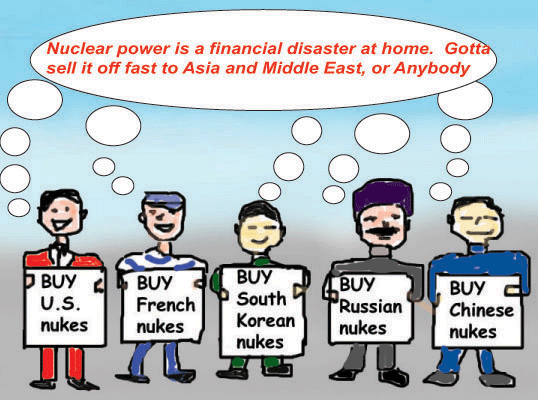
South Korean firm KEPCO keen to get $20 billion by selling nuclear reactors to Saudi Arabia

Kepco is still working to land Saudi nuclear power deal,  Korea JoongAng Daily   BY LEE HO-JEONG [lee.hojeong@joongang.co.kr], 2 Nov 18, GWANGJU – The CEO of Korea Electric Power Corporation (Kepco) said it still hopes to be picked for a $20 billion nuclear power plant project in Saudi Arabia that is expected to be decided by the end of next year. …….

“We are trying to show that we are working to become Saudi’s long-term partner,” Kim said

In July Korea was put on the shortlist for the Saudi nuclear project along with the U.S., China, Japan and Russia.

The Saudi government is planning to build two nuclear power plants with a 2.8 gigawatt capacity by 2030. The country has plans to build a total of 16 nuclear power plants in the next 20 to 25 years. …….

Kim said earnings from overseas could make it easier for Kepco not to raise domestic electricity bills. ……..http://koreajoongangdaily.joins.com/news/article/article.aspx?aid=3055054

November 5, 2018 Posted by Christina Macpherson | marketing, Saudi Arabia, South Korea | Leave a comment

U.S. Supreme Court upholds right of 21 young people to sue federal government about climate change inaction

Independent 4th Nov 2018 , The Supreme Court has refused to halt a novel lawsuit filed by young
Americans that attempts to force the federal government to take action on
climate change, turning down a request from the Trump administration to
stop it before trial.

The suit, filed in 2015 by 21 young people who argue
that the failure of government leaders to combat climate change violates
their constitutional right to a clean environment, is before a federal
judge in Oregon. It had been delayed while the Supreme Court considered the
emergency request from the government.
https://www.independent.co.uk/news/world/americas/climate-change-lawsuit-trump-us-young-people-children-supreme-court-allows-julia-olsen-a8616136.html

November 5, 2018 Posted by Christina Macpherson | climate change, legal, USA | Leave a comment

NuGen nuclear power project in Moorside, Cumbria, UK, soon to bite the dust?

Sunday Times 4th Nov 2018 Plans to build a nuclear power station to provide up to 7% of the
country’s electricity could be ditched within days after talks with a
potential buyer stalled.

The planned NuGen plant in Moorside, Cumbria, has
been in trouble since financial problems emerged in 2016 at the owner,
Toshiba, and its nuclear subsidiary Westinghouse Electric filed for
bankruptcy protection.

Toshiba has been trying to sell the project.
However, talks with South Korea’s state-owned Korean Electric Power
Corporation (Kepco) have yet to lead to a deal, and Kepco was stripped of
preferred bidder status in August.

It is thought that Toshiba’s board is
set to meet in Tokyo on Thursday, when directors will decide whether to
continue trying to find a buyer or to wind up the project, which is
believed to have been costing millions of pounds a month.

Winding up NuGen— seen as the likely outcome — would deal a big blow to the
government’s energy strategy. NuGen had been due to start powering about
6m homes from 2025. The private equity firm Brookfield, which bought
Westinghouse, was also in talks with Toshiba over the deal but it is
believed these have collapsed. China’s CGN has also been interested.
https://www.thetimes.co.uk/edition/business/crunch-talks-to-rule-on-cumbria-nuclear-plant-gvtg2ztrh

November 5, 2018 Posted by Christina Macpherson | business and costs, UK | Leave a comment

UK could be running solely on zero carbon renewable in summer months 2050.

Business Green 2nd Nov 2018 The UK power market will be able to withstand huge volumes of new renewable
generation coming on line according to new research, which suggests the
country could be running solely on zero carbon power during the summer
months by 2050.
The paper, released today by Aurora Energy Research,
explores what happens to the UK power market as it transitions to a high
level of renewable power. Aurora modelled a 2050 scenario where power
demand has risen by two-thirds from today, thanks to the rise of EVs, and
the grid now boasts 130GW of nuclear, wind and solar generation capacity.
Low power demand and a seasonal spike in renewables generation could
effectively lead to zero-carbon summers for the UK electricity grid under
this scenario, according to Aurora. But such large volumes of renewable
power would also “fundamentally alter” the workings of the power market,
with price crashes in the summer months as green power generation soars.
https://www.businessgreen.com/bg/news/3065602/aurora-er-uk-could-enjoy-zero-carbon-summer-power-by-2050

November 5, 2018 Posted by Christina Macpherson | renewable, UK | Leave a comment

Fukushima’s fishing industry threatened by plans to dump radioactive water

Radioactive water threatens Fukushima fishery’s fragile gains, Plant operator plans to dump contaminated water into the ocean, Nikkei Asian Review, TAKUMI SASAKI, Nikkei staff writer  November 04, 2018, TOKYO — Since a catastrophic nuclear accident seven years ago, Fukushima fishermen have made painstaking efforts to rebuild their livelihood, assiduously testing the radioactivity levels of their catches to ensure safety. Now, rapidly accumulating wastewater from the crippled power plant is again threatening this hard-won business recovery.

Faced with the prospect that there will be no more space to store tanks containing radioactive water leaking from the Fukushima Daiichi nuclear power plant, operator Tokyo Electric Power Co. Holdings and the Japanese government are considering diluting the water and dumping it into the ocean.

Even though Fukushima’s fishery has been recovering, the haul throughout the entire prefecture amounted to about 3,300 tons last year, just 10% of the average prior to the 2011 disaster. And even reaching there has not been easy.

Fish markets in the prefecture now house testing rooms filled with equipment. Staff members mince seafood caught every morning to screen for radioactivity. Such painstaking efforts gradually enabled fishermen to return to the sea, with all fishing and farming operations resuming in February this year.

But the trend could reverse if the government goes through with plans to release nuclear wastewater into the sea.

Tepco has been cooling down the molten fuel cores by pumping water into the ruined reactors. The tainted water is later taken out and treated, but the system in place does not filter out tritium, a radioactive hydrogen isotope.

The tritium-laced water is currently stored in tanks within the premises of Fukushima Daiichi, but space is due to run out within five years……..https://asia.nikkei.com/Economy/Radioactive-water-threatens-Fukushima-fishery-s-fragile-gains


November 5, 2018 Posted by Christina Macpherson | Japan | Leave a comment

Eastern Japan cities sign nuclear accident evacuation accord

tokai 2 npp.jpg
This July 17, 2018 file photo shows the Tokai No. 2 nuclear power plant, front, in the village of Tokai in Ibaraki Prefecture.
 
October 31, 2018
CHIBA, Japan (Kyodo) — A local government near a nuclear power plant in eastern Japan signed an accord Wednesday that will allow its residents to take shelter in six municipalities further away from the complex in the case of an accident at the plant.
The arrangement aims to enable the evacuation of about 43,000 of around 270,000 residents from Mito, Ibaraki Prefecture, which is located within 30 kilometers from the Tokai No. 2 plant, to Kashiwa and five other cities in Chiba Prefecture.
Under the accord, the six cities in Chiba are to set up shelters to be managed by the Mito municipal government. The maximum evacuation period will be one month in principle and Ibaraki Prefecture and Mito will be in charge of securing necessary supplies.
Screenings for radioactive materials and decontamination work will be carried out by the Ibaraki prefectural government.
The nuclear plant located northeast of Tokyo is operated by Japan Atomic Power Co. In September, it cleared a safety screening to resume operations under stricter rules introduced after the March 2011 nuclear disaster at the Fukushima Daiichi plant.
The conclusion of the evacuation accord met with opposition from civic groups in the six cities which claimed the cooperative partnership could be viewed as a step toward the aging plant’s resumption.
The city of Mito has concluded similar accords with municipalities in Ibaraki, Tochigi and Gunma prefectures to evacuate around 180,000 people. It is arranging an agreement to flee the remaining 40,000 residents to Saitama Prefecture.
Eight other municipalities within a 30-km radius of the Tokai No. 2 plant in the village of Tokai, Ibaraki Prefecture, have also signed evacuation accords with local authorities in nearby prefectures.
https://mainichi.jp/english/articles/20181031/p2g/00m/0dm/061000c?fbclid=IwAR11YEfJXlmDkM-f8FtY6fogT39EVNRrUHM_o83ZFUICgAlb3IbOSGOj-bY

November 3, 2018 Posted by dunrenard | Japan | Eastern Japan, Evacuation accord, nuclear | Leave a comment

Shikoku Electric restarts Ikata nuclear reactor following failed court challenges

n-ikata-a-20181028-870x786.jpg
The No. 3 unit at the Ikata nuclear power plant had been idle since October 2017 before restarting Saturday


Oct 27, 2018

MATSUYAMA, EHIME PREF. – Shikoku Electric Power Co. on Saturday restarted a reactor at its Ikata nuclear power plant after a suspension of nearly one year due to a high court order.
The restart of the No. 3 unit at the plant in the town of Ikata, Ehime Prefecture, announced by the power company overnight Friday, came after a high court accepted an appeal by the utility in a late September ruling that there are no safety risks associated with potential volcanic activity in the region.
The utility said the unit reached criticality, a controlled self-sustaining nuclear fission chain reaction, on Saturday evening as planned.
It said it will start producing and transmitting electricity on Tuesday, before possibly putting the reactor into commercial operation on Nov. 28.
The decision by the Hiroshima High Court was an about-face from its provisional injunction issued in December last year that demanded the power company halt the No. 3 unit until Sept. 30, following a request from a local opposition group. The group argued that Shikoku Electric underestimated the risk of pyroclastic flows reaching the plant if there is a major eruption at Mount Aso, about 130 km away.
The temporary suspension order was the first in which a high court banned operations at a nuclear plant since the 2011 meltdowns at the Fukushima No. 1 complex.
But the high court said on Sept. 25 that the group’s claim of a possible destructive volcanic eruption during the plant’s operating period has no satisfactory grounds and that there is a small chance of volcanic ash and rocks reaching the facility. A Hiroshima court on Friday also rejected a call from residents to have the restart blocked.
The reactor had been idle for maintenance since last October. Before that, it had gone back online in August 2016 after clearing stricter safety regulations implemented in the wake of Fukushima.
“We’d like Shikoku Electric to constantly pursue improvements in safety and reliability, and information disclosure with high transparency,” Ikata Mayor Kiyohiko Takakado said.
https://www.japantimes.co.jp/news/2018/10/27/national/shikoku-electric-restarts-ikata-nuclear-reactor-following-failed-court-challenges/?fbclid=IwAR3L3I-Zda8WlIhJ86B3kAtj0I7HkhcqMNJCVJqWffQgxpiVBw6Kq2X_FiE#.W9XEeWzQaUk

November 3, 2018 Posted by dunrenard | Japan | Ikata NPP, Reactor 3, Restart | Leave a comment

Nuclear Power Will Not Save Us From Climate Change 

The starting point of any serious discussion of climate change must be to recognize that it is not possible to limit global warming to either 1.5 or 2°C in any “resource- and energy-intensive scenario” where economic growth continues in the usual fashion. 

How the IPCC’s solutions for reversing the Earth’s warming encourage business as usual. Yes Magazine, M.V. RamanaRobert Jensen Nov 02, 2018 The Intergovernmental Panel on Climate Change’s special report released in October rightfully elicited much public commentary about global warming and its truly frightening impacts. But in those initial reactions, less attention was paid to the unnerving implications of the report’s suggested solutions, which encourage us to roll the dice on unproven technologies and double down on nuclear power.

Underlying the IPCC report’s claims is the belief that technological solutions can fix the climate problem. Yet these fixes don’t address the root cause of climate change……….

The report outlines four broad pathways to stay within that limit, all of which include large-scale deployment of various technological fixes to climate change.  ………

The scariest of the four pathways outlined in the report is a “resource- and energy-intensive scenario in which economic growth and globalization lead to widespread adoption of greenhouse-gas-intensive lifestyles, including high demand for transportation fuels and livestock products.” In other words, business as usual in a world where the usual business leads to the edge of a cliff. What could justify such an approach? The belief that technology will save us.

These technologies would have to be deployed at massive scales.The amount of carbon dioxide that would have to be captured and stored (i.e., buried) is nearly 1,200 billion tons (gigatons). To put that in perspective, the report also states that “by the end of 2017, anthropogenic CO2 emissions since the preindustrial period are estimated to have reduced the total carbon budget for 1.5°C” by the rough equivalent of 2,200 gigatons of carbon dioxide—give or take 320 gigatons. So, within 80 years, an amount that is more than half of all the CO2 emitted over two and a half centuries will have to be captured and stored using a technology that has not been demonstrated.

Along with these futuristic technologies, a more familiar savior also comes to the rescue: nuclear power. In the report’s “energy-intensive scenario,” nuclear energy has to increase by a factor of around five. Wishful thinking about unproven technologies is easier to understand than the continued faith in the failed project of nuclear energy. Nuclear energy has been generating electricity since the 1950s, with more than 400 nuclear power plants operating in the world today—long enough for us to evaluate its ecological and economic costs, risks, and benefits.

Nuclear energy has been declining, not growing, as a share of the electricity market during the period that climate change has become recognized as an important problem. In 1997, when the Kyoto Protocol was signed, nuclear power’s share of global electricity generation was about 17 percent. Twenty years later, nuclear energy contributed barely 10 percent of global electricity production in 2017. This included a period when the nuclear industry was heralding a renaissance. The downward trend is expected to continue.

Despite governments subsidizing the technology in various ways over the decades, the economics of nuclear energy is a major problem: Nuclear reactors are expensive to construct, and prone to costing more than budgeted and taking longer to build than projected. The flagship projects in Europe—Olkiluoto (Finland) and Flamanville (France)—use the latest reactor design, the EPR (which stands for either European Pressurized Reactor or Evolutionary Power Reactor). In the United States, Vogtle (Georgia) and V. C. Summer (South Carolina) use the Advanced Passive (AP1000) reactor design. What they have in common is unexpected cost increases: Costs at V. C. Summer went up so high that the utility constructing the plant abandoned it after spending billions.

One would think that these trends would lead policymakers to abandon nuclear power, but faith that these failures can be resolved is fueling government and private investments in a new generation of reactor designs—advanced reactors, small modular reactors, and Generation IV reactors. On paper, these look great, just like the EPR and the AP1000. But there is no reason to believe these new designs will prove cheaper than current reactors—unless the designers, constructors, and regulators emphasize lowered costs over safety, which increases the risk of future Chernobyls and Fukushimas.

Back to the panel’s report. The models it uses do not deal with these problems of nuclear energy. They simply assume that nuclear reactors will be built. And because of the focus on CO2 emissions, they don’t highlight the accompanying problems such as increased quantities of radioactive waste that would have to be stored and isolated from human contact for hundreds of thousands of years.

The underlying cause here is “technological fundamentalism,” the belief that the increasing use of evermore sophisticated, high-energy, advanced technology can solve any problem, including those caused by the unintended consequences of earlier technologies. This Panglossian approach allows modelers to state the climate problem can be contained without giving up a social and political system that is founded on continued and endless economic growth.

This belief also allows for the idea that the business-as-usual approach can continue, and the solution is replacing coal, gas, and nuclear plants with solar panels, wind turbines, and batteries or other storage technologies. As supporters of the fossil fuel and nuclear industries like to point out, even these technologies have environmental and social impacts. To live sustainably on this planet—and despite what folks such as Elon Musk might promise, this is the only planet available for the vast majority of the world’s inhabitants—even these more benign technologies have to be limited in scale.

The alternative is obvious. The starting point of any serious discussion of climate change must be to recognize that it is not possible to limit global warming to either 1.5 or 2°C in any “resource- and energy-intensive scenario” where economic growth continues in the usual fashion. To put it more bluntly, one cannot resolve the climate problem under capitalism, which cannot survive without endless growth.

Arguments against capitalism are at least as old as capitalism itself. If one is honest about the implications of the latest report, climate change is providing another compelling argument for fundamental economic change. https://www.yesmagazine.org/planet/nuclear-power-will-not-save-us-from-climate-change-20181102

November 3, 2018 Posted by Christina Macpherson | 2 WORLD, climate change | 1 Comment

« Previous Entries     Next Entries »

1 This Month

Tell Congress: Prevent Nuclear Catastrophe in Iran

Tell Congress: Prevent Nuclear Catastrophe in Iran

Read the Public Inquiry Report, the Commissioners’ report, Surrendering Australia: The AUKUS Deception is available to download for free at aukuspublicinquiry.com. Or just watch the replay of the National Press Club Luncheon.

​

Shut down the radiation-damaged Heysham nuclear reactors now

To see nuclear-related stories in greater depth and intensity – go to https://nuclearinformation.wordpress.com

Say No to NASA’s Reckless Nuclear Reactor on the Moon

Say No to NASA’s Reckless Nuclear Reactor on the Moon

  • Categories

    • 1
      • Arclight's Vision
    • 1 NUCLEAR ISSUES
      • business and costs
        • employment
        • marketing
      • climate change
      • culture and arts
      • ENERGY
        • renewable
          • decentralised
          • energy storage
      • environment
        • oceans
        • water
      • health
        • children
        • psychology – mental health
        • radiation
        • social effects
        • women
      • history
      • indigenous issues
      • Legal
        • deaths by radiation
        • legal
      • marketing of nuclear
      • media
        • investigative journalism
        • Wikileaks
      • opposition to nuclear
      • PERSONAL STORIES
      • politics
        • psychology and culture
          • Trump – personality
        • public opinion
        • USA election 2024
        • USA elections 2016
      • politics international
      • Religion and ethics
      • safety
        • incidents
      • secrets,lies and civil liberties
        • civil liberties
      • spinbuster
        • Education
      • technology
        • reprocessing
        • Small Modular Nuclear Reactors
        • space travel
      • Uranium
      • wastes
        • – plutonium
        • decommission reactor
      • weapons and war
        • Atrocities
        • depleted uranium
      • Women
    • 2 WORLD
      • ANTARCTICA
      • ARCTIC
      • ASIA
        • Burma
        • China
        • India
        • Indonesia
        • Japan
          • – Fukushima 2011
          • Fukushima 2012
          • Fukushima 2013
          • Fukushima 2014
          • Fukushima 2015
          • Fukushima 2016
          • Fukushima continuing
        • Malaysia
        • Mongolia
        • North Korea
        • Pakistan
        • South Korea
        • Taiwan
        • Turkey
        • Vietnam
      • EUROPE
        • Belarus
        • Bulgaria
        • Denmark
        • Finland
        • France
        • Germany
        • Greece
        • Ireland
        • Italy
        • Kazakhstan
        • Kyrgyzstan
        • Russia
        • Spain
        • Sweden
        • Switzerland
        • UK
        • Ukraine
      • MIDDLE EAST
        • Afghanistan
        • Egypt
        • Gaza
        • Iran
        • Iraq
        • Israel
        • Jordan
        • Libya
        • Saudi Arabia
        • Syria
        • Turkey
        • United Arab Emirates
      • NORTH AMERICA
        • Canada
        • USA
          • election USA 2020
      • OCEANIA
        • New Zealand
        • Philippines
      • SOUTH AMERICA
        • Brazil
    • ACTION
    • AFRICA
      • Kenya
      • Malawi
      • Mali
      • Namibia
      • Niger
      • Nigeria
      • Somalia
      • South Africa
    • Atrocities
    • AUSTRALIA
    • Christina's notes
    • Christina's themes
    • culture and arts
    • Events
    • Fuk 2022
    • Fuk 2023
    • Fukushima 2017
    • Fukushima 2018
    • fukushima 2019
    • Fukushima 2020
    • Fukushima 2021
    • general
    • global warming
    • Humour (God we need it)
    • Nuclear
    • RARE EARTHS
      • thorium
    • Reference
      • Reference archives
    • resources – print
    • Resources -audiovicual
    • Weekly Newsletter
    • World
    • World Nuclear
    • YouTube
  • Pages

    • 1 This Month
    • ACTION !
    • Disclaimer
    • Links
    • PAGES on NUCLEAR ISSUES
      • audio-visual news
      • Anti Nuclear, Clean Energy Movement
        • Anti Nuclear movement – a success story
          • – 2013 – the struggle for a nuclear-free, liveable world
          • – 2013: the battle to expose nuclear lies about ionising radiation
            • Speakers at Fukushima Symposium March 2013
            • Symposium 2013 Ian Fairlie
      • Civil Liberties
        • – Civil liberties – China and USA
      • Climate change
      • Climate Change
      • Economics
        • – Employment
        • – Marketing nuclear power
        • – Marketing Nuclear Power Internationally
        • nuclear ‘renaissance’?
        • Nuclear energy – the sick man of the corporate world
      • Energy
        • – Solar energy
      • Environment
        • – Nuclear Power and the Tragedy of the Commons
        • – Water
      • Health
        • Birth Defects in the Chernobyl Radiation Affected Region.
      • History
        • Nuclear History – the forgotten disasters
      • Indigenous issues
      • Ionising radiation
        • – Ionising radiation – medical
        • Fukushima FACT SHEET
      • Media
        • Nuclear Power and Media 2012
      • Nuclear Power and the Consumer Society – theme for December 2012
      • Peace and nuclear disarmament
        • Peace on a Nuclear Free Earth
      • Politics
        • – Politics USA
      • Public opinion
      • Religion and ethics
        • -Ethics of nuclear power
      • Resources – print
      • Safety
      • Secrets and lies
        • – NUCLEAR LIES – theme for January 2012
        • – Nuclear Secrets and Lies
      • Spinbuster
        • 2013 nuclear spin – all about FEAR -theme for June
        • Spinbuster 1
      • Technology
        • TECHNOLOGY Challenges
      • Wastes
        • NUCLEAR WASTES – theme for October 2012
        • – Plutonium
      • Weapons and war
      • Women
  • Archives

    • November 2026 (246)
    • October 2026 (302)
    • September 2026 (339)
    • August 2026 (330)
    • July 2026 (355)
    • June 2026 (287)
    • May 2026 (306)
    • April 2026 (356)
    • March 2026 (251)
    • February 2026 (267)
    • January 2026 (308)
    • December 2025 (358)
  • Categories

    • 1
      • Arclight's Vision
    • 1 NUCLEAR ISSUES
      • business and costs
        • employment
        • marketing
      • climate change
      • culture and arts
      • ENERGY
        • renewable
          • decentralised
          • energy storage
      • environment
        • oceans
        • water
      • health
        • children
        • psychology – mental health
        • radiation
        • social effects
        • women
      • history
      • indigenous issues
      • Legal
        • deaths by radiation
        • legal
      • marketing of nuclear
      • media
        • investigative journalism
        • Wikileaks
      • opposition to nuclear
      • PERSONAL STORIES
      • politics
        • psychology and culture
          • Trump – personality
        • public opinion
        • USA election 2024
        • USA elections 2016
      • politics international
      • Religion and ethics
      • safety
        • incidents
      • secrets,lies and civil liberties
        • civil liberties
      • spinbuster
        • Education
      • technology
        • reprocessing
        • Small Modular Nuclear Reactors
        • space travel
      • Uranium
      • wastes
        • – plutonium
        • decommission reactor
      • weapons and war
        • Atrocities
        • depleted uranium
      • Women
    • 2 WORLD
      • ANTARCTICA
      • ARCTIC
      • ASIA
        • Burma
        • China
        • India
        • Indonesia
        • Japan
          • – Fukushima 2011
          • Fukushima 2012
          • Fukushima 2013
          • Fukushima 2014
          • Fukushima 2015
          • Fukushima 2016
          • Fukushima continuing
        • Malaysia
        • Mongolia
        • North Korea
        • Pakistan
        • South Korea
        • Taiwan
        • Turkey
        • Vietnam
      • EUROPE
        • Belarus
        • Bulgaria
        • Denmark
        • Finland
        • France
        • Germany
        • Greece
        • Ireland
        • Italy
        • Kazakhstan
        • Kyrgyzstan
        • Russia
        • Spain
        • Sweden
        • Switzerland
        • UK
        • Ukraine
      • MIDDLE EAST
        • Afghanistan
        • Egypt
        • Gaza
        • Iran
        • Iraq
        • Israel
        • Jordan
        • Libya
        • Saudi Arabia
        • Syria
        • Turkey
        • United Arab Emirates
      • NORTH AMERICA
        • Canada
        • USA
          • election USA 2020
      • OCEANIA
        • New Zealand
        • Philippines
      • SOUTH AMERICA
        • Brazil
    • ACTION
    • AFRICA
      • Kenya
      • Malawi
      • Mali
      • Namibia
      • Niger
      • Nigeria
      • Somalia
      • South Africa
    • Atrocities
    • AUSTRALIA
    • Christina's notes
    • Christina's themes
    • culture and arts
    • Events
    • Fuk 2022
    • Fuk 2023
    • Fukushima 2017
    • Fukushima 2018
    • fukushima 2019
    • Fukushima 2020
    • Fukushima 2021
    • general
    • global warming
    • Humour (God we need it)
    • Nuclear
    • RARE EARTHS
      • thorium
    • Reference
      • Reference archives
    • resources – print
    • Resources -audiovicual
    • Weekly Newsletter
    • World
    • World Nuclear
    • YouTube
  • RSS

    Entries RSS
    Comments RSS

Site info

nuclear-news
Create a free website or blog at WordPress.com.
Privacy & Cookies: This site uses cookies. By continuing to use this website, you agree to their use.
To find out more, including how to control cookies, see here: Cookie Policy
  • Subscribe Subscribed
    nuclear-news
    Join 2,035 other subscribers

    Have a WordPress.com account? Log in now.

  • nuclear-news
    View site in Reader
    Manage subscriptionsSign upLog in
    Report this content
    Collapse this bar
Loading Comments...