 The Climate’s Already Too Hot for Nuclear Power http://nukewatchinfo.org/the-climates-already-too-hot-for-nuclear-power/Fall Quarterly 2018 By John LaForge, Nukewatch
With the summer’s record high temp’s all over the world, Andy Rowell asked this pointed question in Oil Change International: “For the last decade the nuclear industry has been telling us it is the solution to climate change. But if their reactors can’t work in our rapidly warming world, are we just building a whole new generation of expensive white elephants?”
Indeed, Reuters reported Aug. 4 that Electricity de France (EDF) in Paris shut down four nuclear reactors at three sites due to the heat summer wave. EDF, the mostly government-owned utility, ordered the shut downs because the scorching summer heat that slammed Europe drastically raised temperatures in the Rhone and Rhine Rivers. Temperatures reached 98.6°F in the Rhone valley, home to 14 reactors. Highs in Spain and Portugal in early August hovered around 104°F and reached 116.6°F.
The warming of seawater caused by Europe’s heat wave forced Finland’s two Loviisa reactors, about 65 miles outside Helsinki, to reduce power in July, just as it did before, in 2010 and 2011, Reuters reported.
The July 2006 heat wave also forced European reactor operators to reduce or halt production due to dramatic increases in the temperature of river waters. The Guardian reported back then that Spain shut down its reactor on the River Ebro. Reactor operators in Germany also cut output then, and several German and French units were allowed to temporarily violate temperature limits on the hot water the reactors return to rivers.
Nuclear reactors exacerbate global warming In 2003, temperatures in French rivers reached record highs that also forced the temporary powering down of four reactors. France’s nuclear oversight authority then gave some reactor operators permission to return the river water at temperatures not normally allowed, a move that critics said would endanger fish and add to global warming.
Meanwhile, rising sea levels threaten to shutter one-out-of-four of the world’s 460 power reactors currently built on coastlines. John Vidal reports in the Aug. 21 edition of Hakai magazinethat experts have warned that even newly built seawalls may not provide sufficient protection. Vidal interviewed Pete Roche, a former adviser to the UK government and Greenpeace, who pointed out that the seawall at the $25-billion “Hinkley Point C” nuclear station being built in southwest England “does not adequately take into account sea-level rise due to climate change.”
“In fact,” Vidal reports, research by Ensia — a nonprofit environmental magazine published at the University of Minnesota — suggests that “at least 100 US, European, and Asian nuclear power stations built just a few meters above sea level could be threatened by serious flooding caused by accelerating sea-level rise and more frequent storm surges.”
The two St. Lucie reactors in Florida are among the US coastal nuclear sites considered most vulnerable to storm surges. While no US reactors have been “in imminent danger of a meltdown because of a storm surge,” Vidal notes, there have been many close calls. “Three US reactors were temporarily shut down because of Hurricane Sandy in 2012 and a fourth, Oyster Creek in New Jersey, was put on alert when water levels rose dramatically, according to the US Nuclear Regulatory Commission.”
But the NRC is not concerned about storm surges. In August 2017, as Hurricane Harvey pummeled east Texas, environmental groups called for the immediate shutdown of the two South Texas Project reactors near Bay City. Instead, the twin, 42-year-old behemoths were kept running at full capacity throughout the disaster, the wettest tropical cyclone on record in the United States.
November 6, 2018
Posted by Christina Macpherson |
2 WORLD, climate change |
Leave a comment
 Despite sanctions, Iran unlikely to restart nuclear program—yet, Bulletin of the Atomic Scientists, By Kelsey Davenport, November 5, 2018
Iran’s commitment to the
2015 nuclear deal will face another test starting November 5, when
US sanctions targeting the country’s oil sector come back into effect. When Tehran concluded the agreement with six world powers—the United States, Russia, China, France, Great Britain, and Germany—it agreed to stringently limit nuclear activities in exchange for sanctions relief. The government of President Hassan Rouhani, and millions of ordinary Iranians, hoped this would bring major economic benefits by allowing foreign companies to do business with Iran. Despite the fact that Iran was complying with the terms of the deal—as
documented by the International Atomic Energy Agency and the
US State Department—the Trump administration decided on May 8 that it would reimpose the lifted sanctions, violating the agreement and dealing a harsh blow to Iran’s economy. That left Iran with a decision to make: Continue to comply with the agreement—known as the Joint Comprehensive Plan of Action, or JCPOA—which still had the support of the five other parties and the European Union? Or resume and expand nuclear activities the deal had restricted?
Fortunately, Washington’s unilateral decision to withdraw from the deal, and even the cut in oil exports that will kick in November 5, are unlikely to trigger a drastic shift in Iran’s approach to the nuclear agreement. Most likely it will continue to adhere to JCPOA terms—at least in the short term. It has had time to adjust to the expected cut in exports. And, given the tightening in the oil market and Iran’s willingness to sell oil at a discounted rate, it is unlikely that the Trump administration will succeed in pushing Tehran’s oil exports to zero. India and China, Iran’s two largest oil customers, communicated to the United States that a complete cut is unrealistic at this time. Additionally, Iran’s past history with sanctions demonstrates a high tolerance for economic pain, and Tehran appears poised to wait out the Trump administration.
Iran’s decision, though, is not solely dependent on sanctions, and could shift down the road. Recognizing how important it is to keep Iran from developing nuclear weapons, the European Union, Russia, and China are trying to find ways to preserve the economic benefits of the deal. Policymakers in the United States, meanwhile, still have a critical role to play. They can help keep the path open for a US return to the JCPOA, and prevent tensions from unnecessarily escalating over Iran’s nuclear rhetoric.
First, do no (more) harm. The Trump administration’s decision to reimpose sanctions—despite acknowledging Iran’s compliance with the JCPOA—dealt a serious blow to US credibility and significantly undermined the deal’s benefits to Iran. But US policymakers can still mitigate further negative impacts. This should start with reclaiming the narrative surrounding the deal and emphasizing its nonproliferation value.
The Trump administration has painted the deal as a failure because it did not “fix” Iran’s policies in areas beyond the nuclear program. But the JCPOA was only ever negotiated to block Iran’s pathways to nuclear weapons, and Tehran is clearly complying with the new restrictions and obligations. Trump’s blatant attempts to characterize the deal as a disaster must not go unchallenged, and policymakers supportive of its goals cannot wait for the next attack to defend it. The JCPOA put in place more intrusive, permanent, inspection provisions, and limits ensuring that for a decade, it would take Iran more than 12 months to produce enough fissile material for one bomb.
Furthermore, Iran may be more willing to continue adhering to the nuclear agreement—even without the full hoped-for economic benefit—if supporters of the deal in the United States continue to assert its security benefits, foreshadowing a return to US compliance under a different administration……..https://thebulletin.org/2018/11/despite-sanctions-iran-unlikely-restart-nuclear-program-yet/
November 6, 2018
Posted by Christina Macpherson |
Iran, politics, weapons and war |
Leave a comment
 Why Europe wants to sidestep US sanctions over Iran nuclear might Signatories of 2015 weapons deal disagree with Trump over the effectiveness of the pact, Guardian, Saeed Kamali Dehghan@SaeedKD– 6 Nov 2018
|
|
|
November 6, 2018
Posted by Christina Macpherson |
EUROPE, Iran, politics international |
Leave a comment
|
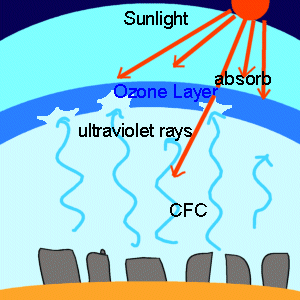
6 Nov 18, The ozone layer is showing signs of continuing recovery from man-made damage and is likely to heal fully by 2060, new evidence shows.The measures taken to repair the damage will also have an important beneficial effect on climate change, as some of the gases that caused the ozone layer to thin and in places disappear also contribute to warming the atmosphere. Phasing them out could avoid as much as 0.5C (0.9F) of warming this century.
Recovery from the holes and thinning caused by aerosol chemicals has progressed at a rate of about 1% to 3% a decade since 2000, meaning the ozone layer over the northern hemisphere and mid-latitudes should heal completely by the 2030s, if current rates are sustained.
Over the southern hemisphere and in the more problematic polar regions, recovery will take longer, until the middle of this century in the former and about 2060 in the latter case.
The results, presented on Monday in a four-year assessment of the health of the ozone layer, represent a rare instance of global environmental damage being repaired, and a victory for concerted global action by governments. Scientific evidence of the depletion of the ozone layer over the Antarctic was first presented in 1985, and in 1987 the Montreal protocol was signed, binding world governments to reduce and phase out the harmful chemicals identified as causing the problem.
Ozone in the upper layers of the atmosphere protects the earth’s surface from most of the harmful ultraviolet rays from the sun. Without it, skin and eye damage can occur, and evidence suggests a rise in skin cancers associated with the thinning of the ozone layer.
“The Montreal protocol is one of the most successful multilateral agreements in history for a reason,” said Erik Solheim, head of UN Environment. “The careful mix of authoritative science and collaborative action that has defined the protocol for more than 30 years and was set to heal our ozone layer is precisely why the Kigali amendment holds such promise for climate action in future.”
The Kigali amendment to the Montreal protocol, coming into effect at the start of next year, will help reduce future climate change, by targeting HFC gases, mostly used in refrigeration, which have a warming effect tens of thousands of times greater than carbon dioxide.
Durwood Zaelke, president of the Institute for Governance and Sustainable Development, said: “Over the last three decades, the Montreal protocol has fulfilled its original objective to heal the ozone layer. But it didn’t stop there. Because CFCs and related gases are also super climate pollutants, phasing them out has reduced the climate problem by an amount that would have equalled the contribution of carbon dioxide today – more than half of all warming – with the Kigali amendment adding even more climate protection.”
Until recently, most major sources of ozone-harming gases were thought to have been closed down, until studies showed sites in China where gases were still emerging. The Chinese government has pledged to find and close down these sites.
|
|
November 6, 2018
Posted by Christina Macpherson |
2 WORLD, climate change, Reference |
Leave a comment
We’ve never seen this’: massive Canadian glaciers shrinking rapidly
Glaciers in the Yukon territory are retreating even faster than expected in a warming climate, scientists warn, https://www.theguardian.com/world/2018/oct/30/canada-glaciers-yukon-shrinking Guardian, Leyland Cecco in Toronto
Tue 30 Oct 2018 Scientists in Canada have warned that massive glaciers in the Yukon territory are shrinking even faster than would be expected from a warming climate – and bringing dramatic changes to the region.
After a string of recent reports chronicling the demise of the ice fields, researchers hope that greater awareness will help the public better understand the rapid pace of climate change.
The rate of warming in the north is double that of the average global temperature increase, concluded the US National Oceanic and Atmospheric Administration in its annual Arctic Report Card, which called the warming “unprecedented”.
“The region is one of the hotspots for warming, which is something we’ve come to realize over the last 15 years,” said David Hik of Simon Fraser University. “The magnitude of the changes is dramatic.”
In their recent State of the Mountains report published earlier in the summer, the Canadian Alpine Club found that the Saint Elias mountains – which span British Columbia, the Yukon and Alaska – are losing ice faster than the rest of the country.
Previous research found that between 1957 and 2007, the range lost 22% of its ice cover, enough to raise global sea levels by 1.1 millimetres.
“When I first went to the St Elias range, it felt like time travel – into the past,” said Hik, who co-edited the report. “What we’re seeing now feels like time travel into the future. Because as the massive glaciers are retreating, they’re causing a complete reorganization of the environment.”
The accelerating melt of the glacier has resulted in major shifts to water sources at lower elevations.
In 2016, the meltwaters of the glacier shifted dramatically away from the Slims river, cutting off critical water supplies to Kluane Lake – a Unesco world heritage site. Since the diversion, water levels at the lake have dropped more than 6.6ft – stranding thousands of fish from their natural spawning rivers.
Dust storms have begun to flare up along sections of the well-travelled Alaska Highway – at times halting traffic, the result of a dry river bed covered in glacial silt. The events at Kluane Lake are a precursor of what can be expected elsewhere, said Hik.
The dramatic changes to the landscape come amid predictions that the Arctic region is slated to experience far quicker – and potentially devastating –warming in the coming years.
“We’re seeing a 20% difference in area coverage of the glaciers in Kluane national park and reserve and the rest of the Unesco world heritage site [over a 60-year period],” Diane Wilson, a field unit superintendent at Parks Canada, told the CBC. “We’ve never seen that. It’s outside the scope of normal.”
In the St Elias range, researchers have found warming intensifies at higher altitudes – a phenomenon they are not quite able to explain.
“These types of events aren’t isolated to glacial events in the St Elias,” said Zac Robinson, the report’s co-author and professor at the University of Alberta. “We’re slated to lose 80% of the ice cover in the Rocky Mountains over the next 50 years.”
Earlier this year, Canada’s auditor general found that none of the three northern territories were adequately prepared for the impacts of climate change.
But Robinson and Hik cautioned against an overly pessimistic view of the rapidly changing ecosystem.
“Never before in human history have mountains been revered as they are today. Mountains are landscapes people adore – and with awareness, real change can be affected,” said Robinson.
“When we have a an opportunity for early warning, we might as well take it,” said Hik.
|
|
|
November 6, 2018
Posted by Christina Macpherson |
Canada, climate change |
Leave a comment

Oceans Are Warming Up Much Faster Than Previously Thought https://e360.yale.edu/digest/oceans-are-warming-up-much-faster-than-previously-thought The world’s oceans have soaked up much more excess heat in recent decades than scientists previously thought — as much as 60 percent more, according to a new study published in the journal
Nature. The new research suggests the global could warm even faster in the coming decades than researchers originally predicted, The Washington Post reported.The researchers, led by geoscientist Laure Resplandy of Princeton University, found that oceans
absorbed 13 zettajoules — a joule, the standard unit of energy, followed by 21 zeroes — of heat energy each year between 1991 and 2016. Based on these findings, they argue, nations must reduce their greenhouse gas emissions 25 percent more than previously estimated if they hope to keep global warming below 2 degrees Celsius.“Imagine if the ocean was only 30 feet deep,” Resplandy
said in a statement. “Our data show that it would have warmed by 6.5 degrees C [11.7 degrees Fahrenheit] every decade since 1991. In comparison, the estimate of the last IPCC assessment report would correspond to a warming of only 4 degrees C [7.2 degrees F] every decade.”
Scientists have long struggled to quantify ocean warming before 2007 — the year that a network of robotic sensors known as Argo were deployed into the world’s oceans to track things like temperature and salinity. For pre-2007 data, the new research examined the volume of oxygen and carbon dioxide released from the oceans as they heated up, providing scientists an indicator for ocean temperature change.
“We thought that we got away with not a lot of warming in both the ocean and the atmosphere for the amount of CO2 that we emitted,” Resplandy told The Washington Post. “But we were wrong. The planet warmed more than we thought. It was hidden from us just because we didn’t sample it right. But it was there. It was in the ocean already.”
November 6, 2018
Posted by Christina Macpherson |
2 WORLD, climate change, oceans |
Leave a comment
 Despite Liberal claims, nuclear power will not save the environment http://rabble.ca/columnists/2018/10/despite-liberal-claims-nuclear-power-will-not-save-environment, Ole Hendrickson October 23, 2018 Want a shiny new nuclear reactor in your community? Justin Trudeau has a deal for you.
In the lead-up to the 2015 election, he said the economy and environment “go together like paddles and canoes. Unless you have both, you won’t get to where you are going.” Such vacuous statements helped him win a majority government.
Did Liberal voters think “real change” would mean maintaining fossil fuel subsidies, buying the Kinder Morgan pipeline, and promoting new nuclear reactors?
When the Liberals renamed the cabinet committee on “Environment, Climate Change and Energy” to “Environment and Clean Growth” on August 28, 2018, Trudeau’s office said this “reflects the government’s commitment to addressing climate change through growing the economy.” But putting “clean” in front of “growth” is a con job — like putting “sustainable” in front of “development.”
Behind closed doors in the “clean growth” cabinet committee, the minister of natural resources will discuss next year’s “Clean Energy Ministerial” — a gathering of energy ministers from the world’s richest nations, hosted by Canada.
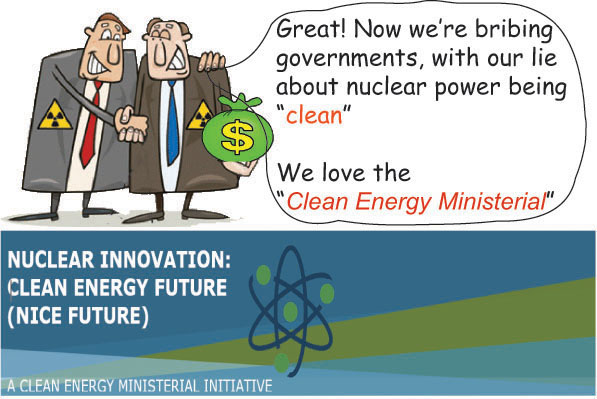
One of Canada’s objectives for this meeting, together with the U.S., is to advance plans for the “next generation” of nuclear reactors. In preparation, a federal nuclear reactor “road map” will be released next month at a Canadian Nuclear Society conference in Ottawa subsidized by the Trudeau government.
For the one-percenters, “clean growth” includes nuclear power. The military industrial complex needs nuclear power and nuclear weapons just as much as it needs fossil fuels.
Government officials and lobbyists who call nuclear power “clean energy” cannot provide a shred of evidence that a new generation of reactors will help Canada and other nations achieve the Paris Agreement greenhouse gas reduction targets.
The real point of this exercise is to perpetuate the military industrial complex.
The nuclear industry is desperately casting about for ways to attract young scientists and engineers. It promotes fantasies of reactor technologies that will provide carbon-free electricity, eliminate existing nuclear waste stockpiles, desalinate ocean water, power remote Indigenous communities, and enable travel to Mars.
But these technologies have been around for decades. They are enormously expensive. They require huge government subsidies, waste taxpayer dollars and generate budget deficits characteristic of the U.S. military industrial complex.
Climate justice incompatible with economic growth
Addressing climate change through economic growth is an ecocidal fantasy. To claim that humans can appropriate more and more of the planet’s resources, and still protect the environment and halt climate change is ludicrous.
This is business as usual — continuation of the “great acceleration” created by post-Second World War governments who transformed the war machine into the “peacetime” military industrial complex.
Politicians and corporate executives — the one-percenters — have no intention of putting the brakes on this machine. They need to fuel the nuclear sub fleets in the U.S. and U.K., and the armoured vehicles that Canada makes and sells to Saudi Arabia. They will try to extract every last gram of uranium and drop of oil. Nuclear and fossil fuels are both the means and end of war.
Ultimately, the military industrial complex is waging war against the planet, against ourselves and against all living creatures. The Earth is in great peril.
Revolution is brewing. Activists, Indigenous and non-Indigenous alike are rejecting these corporate-driven technological fantasies. Energy is changing. The capitalist system will not survive. But what will replace it?
Ole Hendrickson is a retired forest ecologist and a founding member of the Ottawa River Institute, a non-profit charitable organization based in the Ottawa Valley.
Photo: European Parliament/Flickr
November 5, 2018
Posted by Christina Macpherson |
Canada, climate change, spinbuster |
Leave a comment
Police investigation into overheated river at Paks NPP after report by MEP Benedek Jávor, ATLATSZO English OROSZI BABETT by Babett Oroszi
English version by Zsuzsanna Liptákné Horváth. 1 Nov 18 You can read the original, Hungarian-language story here. Hungarian police are investigating whether the water in the river Danube was warmer than 30 degrees at the Paks nuclear plant during the August heatwave. According to Hungarian regulations, if the water temperature reaches that point, the nuclear plant has to be shut off. It was not, but there is a suspicion that water temperature did reach 30 degrees. Hungarian MEP Jávor Benedekfiled a report at the police and now the case is being investigated.According to measurements by Átlátszó and Energiaklub, the temperature of the river Danube reached 30 °C during the August heatwave, exactly where the Paks nuclear plant’s cooling water enters the river.
According to a 2001 government decree, the Paks nuclear plant must cease operations for environmental reasons if the temperature of the Danube reaches 30 °C anywhere in the 500 meters following the point where the cooling water is deposited into the river.
The nuclear plant’s official thermometer never measured more than 30 °C in August, therefore the power plant or any of its blocks were not shut off. Concerned about the river’s ecosystem, MEP Benedek Jávor requested a police investigation.
The first step that led to the current investigation was when Átlátszó and Energiaklub, a Hungarian NGO, measured the water temperature in August. Energiaklub had requested the official data about the river’s temperature before, filing a freedom of information request. However, during the time of the heatwave Paks stopped announcing their official data. Átlátszó’s group of experts had assumed that the temperature of the water rose above 30 °C.
To prove this, and to protect wildlife in the river, we traveled to Paks and measured the water temperature. Before the point of entry of the nuclear plant’s cooling water, we measured 25-26 °C. Downstream, however, within 500 meters from the cooling water’s entry point, we measured above 30 °C at multiple locations.
We took a video of the process and published an article about our unofficial data. These show that at every single location downstream where we measured the river’s temperature, it exceeded the 30 °C.
The official numbers and Átlátszó’s findings do not match……… more https://english.atlatszo.hu/2018/11/01/police-investigation-into-overheated-river-at-paks-npp-after-report-by-mep-benedek-javor/
|
|
|
November 5, 2018
Posted by Christina Macpherson |
climate change, EUROPE, secrets,lies and civil liberties |
Leave a comment
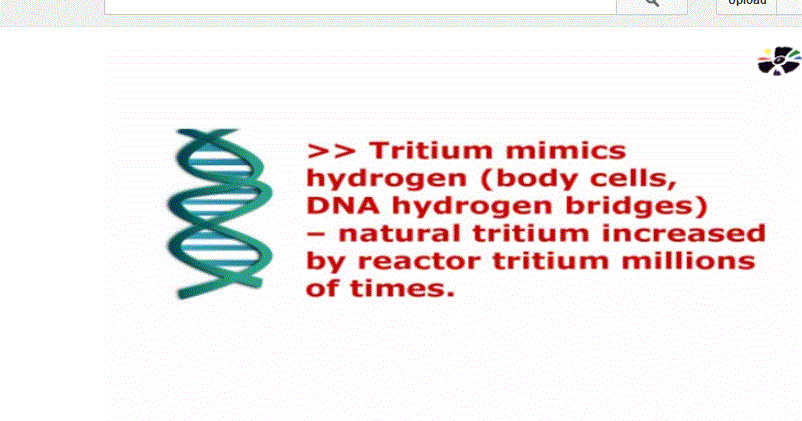
 APAG2 2nd Aug 2018 *Fusion** The nuclear lobby claims wrongly that tritium is harmless to discharge into
the environment, and that nuclear fusion, in which tritium is used as fuel,
is safe. With this consummate manipulation, the French nucleocrats are
passing ITER the nuclear fusion reactor currently under construction at
Cadarache [Bouches-du-Rhone] a carte blanche. But it is not safe.
https://apag2.wordpress.com/2018/08/02/iter-tritium-danger-%e2%80%a8larnaque-mortifere-du-lobby-du-nucleaire/
November 5, 2018
Posted by Christina Macpherson |
France, technology |
Leave a comment
 The Nation 2nd Nov 2018 *Climate** Are we doomed? It’s the most common thing people ask me when they learn
that I study climate politics. Fair enough. The science is grim, as the UN
Intergovernmental Panel on Climate Change (IPCC) has just reminded us with
a report on how hard it will be to keep average global warming to 1.5
degrees Celsius. But it’s the wrong question.
Yes, the path we’re on is ruinous. It’s just as true that other, plausible pathways are not.
That’s the real, widely ignored, and surprisingly detailed message of the
IPCC report. We’re only doomed if we change nothing. The IPCC report
makes it clear that if we make the political choice of bankrupting the
fossil-fuel industry and sharing the burden of transition fairly, most
humans can live in a world better than the one we have now.
And yet doom is what’s being amplified by seemingly every major newspaper and magazine,
and the mainstream media more broadly. A standout example was David
Wallace-Wells’s hot take on the IPCC report for New York magazine,
charmingly titled, “UN Says Climate Genocide Is Coming. It’s Actually
Worse Than That.” There’s a lot to say about the emotional texture of
this kind of reporting. But the deeper problem is how this coverage fails
to capture climate breakdown’s core cause-and-effect dynamic, thus
missing how much scope for action there still is.
https://www.thenation.com/article/mainstream-media-un-climate-report-analysis/
November 5, 2018
Posted by Christina Macpherson |
2 WORLD, climate change |
Leave a comment

 Think Progress 31st Oct 201*Yucca Mountain** One thing that unites Nevadans is opposition to President Donald Trump’s effort to turn the state into a huge nuclear waste dump. That’s why many
were surprised when Trump suggested he might abandon that policy after
touring the state recently with GOP Senator Dean Heller, who is in a tight
reelection race against Democrat Jacky Rosen.
But Trump’s Energy Secretary, Rick Perry, admitted on Friday the administration still supports
building the Yucca Mountain nuclear waste repository outside of Las Vegas.
In doing so, Perry effectively spoiled Trump’s effort to help Heller, as
Jon Ralston, editor of the Nevada Independent, explained to Bloomberg:
“Poor Rick Perry didn’t get the memo and accidentally told the
truth.”
https://thinkprogress.org/rick-perry-accidentally-told-the-truth-about-dumping-nuclear-waste-in-nevada-roiling-senate-race-c3945ba499d9/
November 5, 2018
Posted by Christina Macpherson |
politics, USA |
Leave a comment

 GDF Watch 4th Nov 2018
, The company responsible for delivering Sweden’s deep geological repository, SKB, is planning to subject their research into copper
corrosion to international peer review in the new year. SKB believe this is
the most transparent and open way in which to address concerns about the
contentious issue, which has held up final decision-making on the Swedish
national repository for higher activity radioactive waste.
Earlier this year the Swedish Environmental Court largely approved SKB’s plans for a
geological disposal facility in Osthammar. However, the Court had concerns
about the speed at which copper canisters corrode and the potential
consequential environmental impact. Conflicting scientific evidence was
presented to the Court. The Court decided that this was something the
Swedish Government needed to consider further before any approval was given
to the planned radioactive waste disposal facility. The Swedish Government
asked SKB to provide additional information by 31 March 2019.
http://www.gdfwatch.org.uk/2018/11/04/sweden-copper-corrosion-update/
November 5, 2018
Posted by Christina Macpherson |
safety, Sweden, wastes |
Leave a comment
Nuclear submarine Arihant completes first deterrence patrol mission
The success of INS Arihant gives a fitting response to those who indulge in nuclear blackmail, says Prime Minister Narendra Modi
Live Mint, Nov 05 2018. New Delhi: Prime Minister Narendra Modi on Monday said that India’s first nuclear armed submarine INS Arihant had successfully completed its first deterrence patrol, heralding India’s entry into an exclusive club of powers with land, air and sea-based nuclear weapons delivery platforms………
In comments posted on Twitter, Modi said the Arihant feat was “historic because it marks the completing of the successful establishment of the nuclear triad. India’s nuclear triad will be an important pillar of global peace and stability”, underlining India’s “No first use” policy and the role of the sea-based strategic platform as a guarantor of peace. ……“India is a land of peace,” Modi said. “Peace is our strength, not our weakness.
Our nuclear programme must be seen with regard to India’s efforts to further world peace and stability,” he said………..
https://www.livemint.com/Politics/MPSTSAYPZq855MBeczEg1N/India-says-nuclear-submarine-makes-first-patrol-PM-Modi-war.html
November 5, 2018
Posted by Christina Macpherson |
India, weapons and war |
Leave a comment
North Korea warns of returning to nuclear policy, News 24 2018-11-04 North Korea has warned the US it will “seriously” consider returning to a state policy aimed at building nuclear weapons if Washington does not end tough economic sanctions against the impoverished regime.
For years, the North had pursued a “byungjin” policy of simultaneously developing its nuclear capabilities alongside the economy.
In April, citing a “fresh climate of detente and peace” on the peninsula, North Korean leader Kim Jong Un declared the nuclear quest complete and said his country would focus on “socialist economic construction”.
But a statement issued by the North’s foreign ministry said Pyongyang could revert to its former policy if the US did not change its stance over sanctions.
“The word ‘byungjin’ may appear again and the change of the line could be seriously reconsidered,” said the statement carried by the official KCNA news agency late on Friday.
Sanctions
At a historic summit in Singapore in June, US President Donald Trump and Kim signed a vaguely-worded statement on denuclearisation.
But little progress has been made since then, with Washington pushing to maintain sanctions against the North until its “final, fully verified denuclearisation” and Pyongyang condemning US demands as “gangster-like”.
“The improvement of relations and sanctions are incompatible,” said the statement, released under the name of the director of the foreign ministry’s Institute for American Studies.
“What remains to be done is the US corresponding reply,” it added.
The statement is the latest sign of Pyongyang’s increasing frustration with Washington……..
In an interview with Fox News on Friday, US Secretary of State Mike Pompeo reiterated that sanctions will remain until Pyongyang carries out it denuclearisation commitments made in Singapore, adding he will meet with his North Korean counterpart next week. https://www.news24.com/World/News/north-korea-warns-of-returning-to-nuclear-policy-20181104
November 5, 2018
Posted by Christina Macpherson |
North Korea, politics international, USA, weapons and war |
Leave a comment
Pompeo Resuming Nuclear Talks with N. Korea This Week, VOA, November 04, 2018 Ken Bredemeier,
U.S. Secretary of State Mike Pompeo says he is resuming denuclearization talks with North Korea this week in New York, meeting with Pyongyang’s second in command, Kim Yong Chol.
Progress on ending Pyongyang’s nuclear weapons programs has slowed in the months since the Singapore summit in June between U.S. President Donald Trump and North Korean leader Kim Jong Un, when the two leaders signed a general statement calling for the denuclearization of the Korean peninsula.
But Pompeo called the coming talks “a good opportunity” to move toward specifics of when and how North Korea might end its nuclear weapons program. The United States is seeking to finalize a deal by the end of Trump’s first term in office in January 2021.
Pyongyang said Friday it would “seriously” consider resuming its nuclear testing if U.S. economic sanctions against North Korea are not lifted, but Pompeo, in an interview on Fox News Sunday, dismissed the threat……..
Pompeo said there would be “no economic relief until we have achieved our ultimate objective,” the end of North Korea’s nuclear program.
The United States has said it would maintain the sanctions against North Korea until it has reached “final, fully verified denuclearization…….https://www.voanews.com/a/pompeo-resuming-nuclear-talks-with-n-korea-this-week-/4644158.html
November 5, 2018
Posted by Christina Macpherson |
North Korea, politics international, USA |
Leave a comment