For USA the cost of not funding a nuclear waste solution is becoming greater than the cost of funding it.

Failure to Fund National Spent Nuclear Fuel Repository Leaves Decommissioning Funds Partially Unsupervised https://thesandpaper.villagesoup.com/p/failure-to-fund-national-spent-nuclear-fuel-repository-leaves-decommissioning-funds-partiall/1787983, Gina G. Scala, ggscala@thesandpaper.net Nov 07, 2018
As a result, the only option for U.S. nuclear power plants is to store spent fuel from the reactor vessels onsite. That includes decommissioned or decommissioning power plants, like the Oyster Creek Nuclear Generating Station. Just last month, the Nuclear Regulatory Commission approved an exemption request from Exelon Generation, which owns the Lacey Township-based nuclear plant, to withdrawal monies from the plant’s decommissioning trust fund for spent fuel management and site restorations costs without first obtaining NRC approval.
“We approved these changes after reviewing the fund and projected cash flow,” said Neil Sheehan, public information officer for the NRC’s Region 1 office, noting the federal agency has approved similar requests before.
Oyster Creek, once the nation’s oldest operating commercial nuclear power plant, was taken permanently offline in September. It was licensed to operate until April 2029, but under an agreement with the state of New Jersey to forgo building cooling towers, company officials agreed to close the plant by Dec. 31, 2019. Earlier this year, citing financial costs and better opportunities for employees, the decision was made to shut down plant operations in September.
In July, Exelon Generation announced it had reached a deal with Holtec International, a New Jersey-based energy technology company, to purchase the plant and take over its decommissioning duties.
“An important note is that this exemption was based on Exelon’s earlier plan to place the plant into SAFSTOR, or long-term storage, before dismantlement work begins,” Sheehan said. “Holtec will need to submit an exemption request for the same uses of the fund based on its proposed DECON, or immediate dismantlement, approach. We anticipate receiving that request in November.”
The timeline for the NRC to review Holtec’s request to use decommissioning trust funds would be similar to what it was for Exelon’s request, which was submitted on March 22, 2018, and approved on Oct. 19, 2018, according to Sheehan.
“Holtec would not be able to withdraw any money until the NRC determines if it qualifies to take over the Oyster Creek license,” he said. “If it gets the go-ahead, Holtec would be free to begin withdrawals if and when it receives approval for the exemption.”
On Aug. 31, Exelon and Holtec filed a joint application to begin the license transfer application, asking for a decision by May 1, 2019. The public has until Nov. 8 to file a request for a public hearing on the federal agency’s review of the transfer. Written comments are being accepted until Nov. 19.
From the beginning, Holtec officials have said they would like to immediately begin decommissioning Oyster Creek. It’s their intention to expedite the dismantling of the nuclear plant and return the site, located on 779 acres of land in the Forked River section of the township, to unrestricted use in less than a decade, with the exclusion of the Independent Spent Fuel Storage Installation, or spent fuel pad, on site. Exelon’s post-shutdown activity plans included taking the full 60 years permitted under federal law.
“We do track how decommissioning funds are used and where they stand,” Sheehan said. “The owners of permanently shut-down nuclear power plants must submit updates to us on an annual basis.”
While the NRC is currently reviewing applications for two potential interim sites to house spent nuclear fuel, one in Texas and the other in New Mexico, the House of Representatives earlier this year voted to revive the Yucca Mountain project to store radioactive nuclear waste.
“Electricity consumers have contributed $40 billion into the nuclear waste fund,” according to the Nuclear Energy Institute, the policy organization for nuclear technologies. “Meanwhile, taxpayers have been saddled with more than $6 billion in damages for the federal government’s inaction – an amount that grows by $800 million for every additional year the government does not act. The cost of not funding a solution is rapidly becoming greater than the cost of funding it.”
Russia warns that USA’s “limited nuclear operations” strategy could spark Word War 3
World War 3 alert: US nuclear weapon strategy will spark CATASTROPHE warns Russia, RUSSIA has warned a proposed US strategy involving the “limited” use of nuclear weapons would spark World War 3 if it is ever put into practice., Express UK, By HARVEY GAVIN, , Nov 8, 2018 |Elbridge Colby, who served as a high ranking official in Donald Trump’s administration, recently advocated the use of tactical nukes in targeted attacks to repel an attack by Russia or China. But Moscow today branded the plans “irresponsible and dangerous”, warning: “Using nuclear weapons in pinpoint attacks is tantamount to playing with the devil.” Mr Colby, a former deputy assistant secretary of defence for strategy and force development, explained the thinking behind his strategy in an article for Foreign Affairs magazine entitled ‘If you want peace, prepare for nuclear war’………
Russian Foreign Ministry Spokeswoman Maria Zakharova said any use of nukes, regardless of their size, would lead to global catastrophe.
Addressing reporters today, she said there are growing calls in Washington to “increase the role of nuclear weapons and expand the possibilities of the US nuclear arsenal” to counter the “mythical Russian threat”, according to the Moscow-based TASS news agency.
Ms Zakharova went on to demand answers on the proposed “limited nuclear operations” strategy.
She said: “I want a clarification: where would these limited operations be carried out?
“On what continent would this strategy be fulfilled, if it was fulfilled?”………https://www.express.co.uk/news/world/1042901/world-war-3-russia-usa-tactical-nuclear-weapon-strategy
NuScale and Ontario Power Generation (OPG) trying to make Small Nuclear Reactors happen in Canada
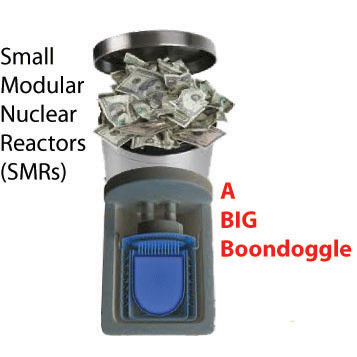 NuScale partners with Ontario Power Generation to bring small nuclear reactors to Canada, The Chemical Engineer Amanda Doyle, 9 Nov 18, NUSCALE has signed a memorandum of understanding with Ontario Power Generation (OPG) in a bid to bring NuScale’s small modular reactors (SMRs) to the Canadian market.
Prisoners in New York will learn about their radiation exposure due to body scans
 Body-scanned inmates will get radiation exposure stats, NY Post By Rich Calder and Tamar Lapin, November 8, 2018 “………The city Health Department has issued new regulations that would allow inmates to learn how much radiation they’ve absorbed from body scans in the clink.Upon request, the Correction Department would have to provide them with their “total accumulated radiation exposure,” according to a legal notice issued by the city Thursday. The regulation was in response to a new state law authorizing correction officers to again use high-powered body scanners to spot nonmetal objects — such as ceramic knives — in the possession of inmates. As part of the law, the Health Department had to implement rules to make sure the scanners are safe — including “setting annual exposure limits and mandates for training and signage.”…… The Correction Department thought it had the problem solved in 2012 and 2013, after it purchased five “airport-style” body scanners with ionizing radiation that picked up every imaginable kind of weapon and contraband. But after a year’s use, the scanners were shelved when it was discovered they violated a little-noticed state law that said “ionizing radiation” may not be “applied to human beings” except by licensed medical personnel for a medical purpose…….. The new state law wipes out the scanner-use medical restriction…….https://nypost.com/2018/11/08/body-scanned-inmates-will-get-radiation-exposure-stats/ |
|
Fukushima nuclear disaster – whiteboard reveals the chaos in March 2011
“Stop monitoring, evacuate now,” an order said.
The next line follows, “1F3 (No. 3 reactor of Fukushima No. 1 plant) hydrogen explosion.”
“Don’t return here, head west,” another directive said.
Media representatives were invited on Nov. 8 for the first time to the emergency headquarters that was set up at the prefecture-run Environmental Radioactivity Monitoring Center of Fukushima here to monitor the radiation levels around the Fukushima No. 1 nuclear plant when a massive tsunami crippled the power supply on March 11, 2011.
The center was originally constructed as a facility to monitor radiation levels in the area as well as serve as an education center for nuclear power generation.
The headquarters were abandoned on the night of March 14, 2011, after the evacuation order was issued following the explosion at the No. 3 reactor building. No one since then has returned to use or tidy up the site………http://www.asahi.com/ajw/articles/AJ201811090033.html
Britain’s Bradwell nuclear project under scrutiny- risks of flooding, water overuse, environmental degradation
BANNG 7th Nov 2018 , BANNG’s visit to the Bradwell B site (reported on in the October edition)
gave an opportunity to discuss the early site assessment undertaken by the
company.
The question in all our minds was: ‘is this a suitable site for
the Bradwell B nuclear complex?’ At this stage the developer’s answer
is nuanced: a case of we hope so but we are a long way from knowing.
The Bradwell project is currently under scrutiny by the regulatory authorities
in a process known as Generic Design Assessment. Taken together the site
assessment and the GDA provide an opportunity for BANNG to press concerns
about three key issues which, we believe, make the site wholly unsuitable
and unsustainable.
The first is the high probability risk of flooding
‘especially during the later stages of operation and decommissioning of a
potential nuclear power station’. Second, is the issue of providing the
vast quantities of water needed to cool the reactors. The third issue is
the environmental destruction this project would cause.
https://www.banng.info/news/bradwell-b-an-unsuitable-site-for-development/
? Canada’s nuclear regulator wants Small Nuclear Reactors exempted from full Environmental Assessment

Federal nuclear regulator urges government to exempt smaller nuclear
reactors from full Environmental Assessment panel review, Globe and Mail 6th Nov 2018 -(subscribers only)
https://www.theglobeandmail.com/business/article-federal-nuclear-regulator-urges-liberals-to-exempt-smaller-reactors/
Toshiba closes down its UK operations – showing that nuclear power is just not commercially viable
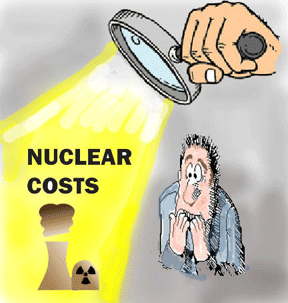 Toshiba’s failure shows business can’t deliver a nuclear future, Guardian, 9 Nov 18 Phillip Inman
As Cumbria reactor plan stalls, it is clear that huge resources are needed for such projects. If the government was keen to boost Britain’s nuclear industry, it was always clear that the private market would struggle to deliver.
The decision by Toshiba to close down its UK operations is a case in point. After the deal to build new reactors at Hinkley Point with the French firm EDF, Toshiba was favoured by ministers to design and construct a smaller power station on the Cumbrian coast.
Hinkley was a deal that appeared to be with a private company but the really meaningful talks were between Whitehall officials and their counterparts in the French government, EDF’s controlling shareholder. It took years of agonising brinkmanship to conclude the talks, much of them conducted on the French side by the then economy minister, Emmanuel Macron.
Toshiba, on the other hand, is a private company struggling on its own to navigate the complex politics surrounding nuclear power in the wake of the Fukushima disaster.
In 2006 it bought the US nuclear business Westinghouse, part of British Nuclear Fuels and home to much of the UK’s nuclear power industry. With climate change creeping to the top of the agenda and demand for new nuclear plants around the world growing, it seemed like a good idea.
However, the 2011 Fukushima disaster changed all that. Governments in Japan and other countries halted the development of new nuclear plants. Last year, cost overruns on building the first new US nuclear power plants in three decades pushed Westinghouse into bankruptcy and Toshiba into financial meltdown. The future of the Cumbrian nuclear plant has been in doubt ever since.
Earlier this year Toshiba sold Westinghouse to a private equity outfit as a services provider for existing nuclear plants. The construction of new reactors was not on the agenda. To no one’s surprise, Toshiba has now confirmed it has abandoned building any new plants in the UK.
Without entering the argument about whether nuclear is a good option – and the government advisory body, the National Infrastructure Commission, is unequivocal that renewables such as wind and solar were going to be a safer, cheaper option – it is clear huge commitments of time, resources and political capital are necessary for infrastructure projects of this scale to get off the ground and through to completion.https://www.theguardian.com/business/2018/nov/08/toshibas-failure-shows-business-cant-deliver-a-nuclear-future
Small Modular Reactors not commercially viable, but nuclear companies want the government handouts
there is no market for the expensive electricity that SMRs will generate. Many companies presumably enter this business because of the promise of government funding. No company has invested large sums of its own money to commercialize SMRs.Are Thousands of New Nuclear Generators in Canada’s Future? https://thetyee.ca/Opinion/2018/11/07/Nuclear-Generators-Canada-Future/Ottawa is pushing a new smaller, modular nuclear plant that could only pay off if mass produced. By M.V.  RamanaM. V. Ramana is the Simons Chair in Disarmament, Global and Human Security at the School of Public Policy and Global Affairs at UBC, and the author of The Power of Promise: Examining Nuclear Energy in India, Penguin Books, New Delhi (2012)
Canada’s government is about to embrace a new generation of small nuclear reactors that do not make economic sense.
Amidst real fears that climate change will wreak devastating effects if we don’t shift away from fossil fuels, the idea that Canada should get deeper into nuclear energy might seem freshly attractive to former skeptics.
For a number of reasons, however, skepticism is still very much warranted.
On Nov. 7, Natural Resources Canada will officially launch something called the Small Modular Reactor Roadmap. The roadmap was previewed in February of this year and is the next step in the process set off by the June 2017 “call for a discussion around Small Modular Reactors in Canada” issued by Canadian Nuclear Laboratories, which is interested in figuring out the role the organization “can play in bringing this technology to market.”
Environmental groups and some politicians have spoken out against this process. A petition signed by nearly two dozen civil society groups has opposed the “development and deployment of SMRs when renewable, safer and less financially, socially and environmentally costly alternatives exist.”
SMRs, as the name suggests, produce relatively small amounts of electricity in comparison with currently common nuclear power reactors. The last set of reactors commissioned in Canada is the four at Darlington. These started operating between 1990 and 1993 and can generate 878 megawatts of electricity (although, on average, they only generate around 75 to 85 per cent of that). In comparison, SMRs are defined as reactors that generate 300 MW or less — as low as 5 MW even. For further comparison, the Site C dam being built in northeastern B.C. is expected to provide 1,100 MW and BC Hydro’s full production capacity is about 11,000 MW.
Various nuclear institutions, such as Canadian Nuclear Laboratories, Canadian Nuclear Association and the CANDU Owners Group are strongly supportive of SMRs. Last October, Mark Lesinski, president and CEO of CNL announced: “Small modular reactors, or SMRs, represent a key area of interest to CNL. As part of our long-term strategy, announced earlier this year, CNL established the ambitious goal of siting a new SMR on a CNL site by 2026.”
Likewise, the CANDU Owners Group announced that it was going to use “their existing nuclear expertise to lead the next wave of nuclear generation — small modular reactors, that offer the potential for new uses of nuclear energy while at the same time offering the benefits of existing nuclear in combating climate change while providing reliable, low-cost electricity.”
A fix for climate change, says Ottawa
Such claims about the benefits of SMRs seems to have influenced the government too. Although NRCan claims to be just “engaging partners and stakeholders, as well as Indigenous representatives, to understand priorities and challenges related to the development and deployment of SMRs in Canada,” its personnel seem to have already decided that SMRs should be developed in Canada.
“The Government of Canada recognizes the potential of SMRs to help us deliver on a number of priorities, including innovation and climate change,” declared Parliamentary Secretary Kim Rudd. Diane Cameron, director of the Nuclear Energy Division at Natural Resources Canada, is confident: “I think we will see the deployment of SMRs in Canada for sure.” Such talk is premature, and unwise.
Canada is a late entrant to this game of talking up SMRs. For the most part it has only been talk, with nothing much to show for all that talk. Except, of course, for millions of dollars in government funding that has flown to private corporations. This has been especially on display in the United States, where the primary agency that has been pumping money into SMRs is the Department of Energy.
In 2001, based on an overview of around 10 SMR designs, DOE’s Office of Nuclear Energy concluded that “the most technically mature small modular reactor designs and concepts have the potential to be economical and could be made available for deployment before the end of the decade, provided that certain technical and licensing issues are addressed.” Nothing of that sort happened by the end of that decade, i.e., 2010. But in 2012 the U.S. government offered money: up to $452 million to cover “the engineering, design, certification and licensing costs for up to two U.S. SMR designs.” The two SMR designs that were selected by the DOE for funding were called mPower and NuScale.
The first pick was mPower and, a few months later, the DOE projected that a major electricity generation utility called the Tennessee Valley Authority “plans to deploy two 180 megawatt small modular reactor units for commercial operation in Roane County, Tennessee, by 2021, with as many as six mPower units at that site.”
The company developing mPower was described by the New York Times as being in the lead in the race to develop SMRs, in part because it had “the Energy Department and the T.V.A. in its camp.”
But by 2017, the project was essentially dead.
Few if any buyers
Why this collapse?
In a nutshell, because there is no market for the expensive electricity that SMRs will generate. Many companies presumably enter this business because of the promise of government funding. No company has invested large sums of its own money to commercialize SMRs.
An example is the Westinghouse Electric Co., which worked on two SMR designs and tried to get funding from the DOE. When it failed in that effort, Westinghouse stopped working on SMRs and shifted its focus to decommissioning reactors that are being shut down at an increasing rate, which is seen as a growing business opportunity. Explaining this decision in 2014, Danny Roderick, then president and CEO of Westinghouse, said: “The problem I have with SMRs is not the technology, it’s not the deployment — it’s that there’s no customers…. The worst thing to do is get ahead of the market.”
Many developing countries claim to be interested in SMRs but few seem to be willing to invest in the construction of one. Although many agreements and memoranda of understanding have been signed, there are still no plans for actual construction. Examples are the cases of Jordan, Ghana and Indonesia, all of which have been touted as promising markets for SMRs, but none of which are buying one because there are significant problems with deploying these.
A key problem is poor economics. Nuclear power is already known to be very expensive. But SMRs start with a disadvantage: they are too small. One of the few ways that nuclear power plant operators could reduce the cost of nuclear electricity was to utilize what are called economies of scale, i.e., taking advantage of the fact that many of the expenses associated with constructing and operating a reactor do not change in linear proportion to the power generated. This is lost in SMRs. Most of the early small reactors built in the U.S. shut down early because they couldn’t compete economically.
Reactors by the thousands?
SMR proponents argue that they can make up for the lost economies of scale in two ways: by savings through mass manufacture in factories, and by moving from a steep learning curve early on to gaining rich knowledge about how to achieve efficiencies as more and more reactors are designed and built. But, to achieve such savings, these reactors have to be manufactured by the thousands, even under very optimistic assumptions about rates of learning. Rates of learning in nuclear power plant manufacturing have been extremely low. Indeed, in both the United States and France, the two countries with the highest number of nuclear plants, costs went up, not down, with construction experience.
In the case of Canada, the potential markets that are most often proffered as a reason for developing SMRs are small and remote communities and mines that are not connected to the electric grid. That is not a viable business proposition. There are simply not enough remote communities, with adequate purchasing capacity, to be able to drive the manufacture of the thousands of SMRs needed to make them competitive with large reactors, let alone other sources of power.
There are thus good reasons to expect that small modular reactors, like large nuclear power plants, are just not commercially viable. They will also impose the other well-known problems associated with nuclear energy — the risk of severe accidents, the production of radioactive waste, and the linkage with nuclear weapons — on society. Rather than seeing the writing on the wall, unfortunately, NRCan and other such institutions are regurgitating industry propaganda and wasting money on technologies that will never be economical or contribute to any meaningful mitigation of climate change. There is no justification for such expensive distractions, especially as the climate problem becomes more urgent. 
Crown Prince Mohammed bin Salman launches nuclear project in Saudi Arabia
 Bin Salman launches Saudi Arabia’s first nuclear plant project, Aljazeera, 6 Nov 18
Crown Prince Mohammed bin Salman launches project to build the first nuclear research reactor in the kingdom. Saudi Arabia‘s crown prince has launched a project to build the first nuclear research reactor in the kingdom, the Saudi Press Agency reported.
Crown Prince Mohammed bin Salman, also known as MBS, launched seven strategic projects in renewable energy, atomic energy, water desalination, genetic medicine and the aircraft industry during his visit to King Abdulaziz City for Science and Technology on Monday.
The two most significant projects include a nuclear research reactor and a centre for the development of aircraft structures.
In March, MBS announced his country’s readiness to develop nuclear weapons in the event that Iran heads in that direction………
Nuclear power
Last year, the International Atomic Energy Agency said the Saudi government had invited proposals for the construction of two nuclear power reactors to boost the country’s energy mix.
The kingdom is considering building 17.6 gigawatts (GW) of nuclear capacity by 2032, the equivalent of about 17 reactors, making it one of the biggest projects globally…….https://www.aljazeera.com/news/2018/11/bin-salman-launches-saudi-arabia-nuclear-plant-project-181105192827938.html
Frazer Nash nuclear helps nuclear lobby to infiltrate academia

|
C2I 2018: South-West Nuclear Hub delivers access to nuclear skills
Category: Academic Innovator Supported by a £2.5m Catalyst Fund grant from HEFCE and £5m from the University of Bristol, the hub takes advantage of its proximity to a number of nuclear operations. These include the Magnox power station at Oldbury in Gloucestershire, decommissioning reactors at Berkeley, also Gloucestershire, Hinkley Point A in Somerset and Winfrith in Dorset, and the growing construction site for the new EPR reactor at Hinkley Point. Further afield but still within reach are another decommissioning power station at Trawsfynydd in Snowdonia and Wylfa on Anglesey. It also counts the nuclear fusion research centre at Culham in Oxfordshire, the Harwell research Centre and the nuclear submarine dismantling programme at Devonport as within its catchment area. Bristol and Oxford universities are already linked by a joint nuclear research centre (NRC) and the hub leverages this collaboration. …….Each research theme has a senior academic lead coordinating activity and identifying potential connections with other universities, including Oxford and the nearby University of the West of England……. The Nucleate centre is to be another collaboration, with partnerships between the University of Bristol, National laboratory and EDF Energy ……. Public engagement is also a key focus of the hub. It coordinates both national and regional outreach activities, which include a nuclear seminar series of public lectures. The hub acts as an independent gateway for promoting public understanding of nuclear energy, framing it within the context of climate change mitigation…….. The Headline sponsor for C2I2018 is Frazer-Nash Consultancy https://www.theengineer.co.uk/academic-innovator-south-west-nuclear-hub/
|
|
|
Local opposition to restart of Tokai nuclear station, but it is cleared to start by Japan’s nuclear watchdog
|
Aging Tokai nuclear plant outside Tokyo cleared to restart, THE ASAHI SHIMBUN, November 7, 2018 The nation’s nuclear watchdog on Nov. 7 formally approved a 20-year extension of the only nuclear reactor in the Tokyo metropolitan area, although local communities will have the final say on the restart.Operator Japan Atomic Power Co. will need the consent of the Ibaraki prefectural government, as well as six local municipalities, including the village of Tokai, where its aging Tokai No. 2 nuclear plant is located.
The company faced having to prepare to decommission the plant’s 40-year-old reactor if it failed to meet a Nov. 27 deadline on revised and more stringent safety standards implemented by the Nuclear Regulation Authority in the aftermath of the 2011 nuclear disaster in Fukushima Prefecture. After the triple meltdown at the Fukushima No. 1 nuclear plant, the operational life of nuclear reactors was set at up to 40 years in principle. But power companies can continue to operate their facilities for an additional 20 years if their reactors pass the NRA screening. So far, all requests to the NRA to extend the operating life of old reactors have been approved. The reactor at the Tokai No. 2 plant is the fourth to clear the NRA for extended operations since the Fukushima disaster. It is located about 120 kilometers from the heart of Tokyo. The 1.1-gigawatt boiling water reactor is the only unit at the Tokai No. 2 plant and is of the same design as the crippled reactors at the Fukushima No. 1 nuclear plant. The Tokai No. 2 plant was also affected by the tsunami generated by the magnitude-9.0 Great East Japan Earthquake on March 11, 2011. It is the first time for a reactor affected by the tsunami to be approved for an operational extension. It is also the first boiling water reactor to gain such approval. The NRA examined the reactor’s pressure vessel and other equipment, and concluded that the unit could operate safely until November 2038. But it remains unclear if Japan Atomic Power can restart the plant under its earliest time frame of 2021, due to local opposition. In October, Mayor Toru Umino of Naka, one of the six municipalities around the plant, announced his opposition to the extension. The city assembly of Mito, another municipality, adopted a resolution against the extension in June. About 960,000 people live within a 30-km radius of the plant, making it the most densely populated site among the nation’s nuclear facilities. After the Fukushima disaster, municipalities in close proximity to a nuclear plant were required to craft an evacuation plan to respond to a nuclear emergency. But only three of the 14 municipalities around the Tokai No. 2 nuclear plant within that range have done so due to the difficulty of arranging transportation for such a large number of people. Bringing the reactor back online is expected to cost Japan Atomic Power at least 174 billion yen ($1.54 billion), a sum that includes construction of a seawall and other safeguard measures. The company hopes to have those measures in place by the end of March 2021. It may well also have to spend tens of billions of yen in the future to meet a new requirement that nuclear facilities are able to contain damage from a terrorist attack. TIMELINE OF KEY EVENTS …….http://www.asahi.com/ajw/articles/AJ201811070061.html |
|
U.S. sailors in nuclear reactor part of USS Ronald Reagan allegedly used drug LSD
|
US Navy investigates sailors working in nuclear department of USS Ronald Reagan for taking LSD, Telegraph 7 NOVEMBER 2018 The US Navy has confirmed it is investigating 15 sailors working mainly in the nuclear reactor department of the aircraft carrier Ronald Reagan for allegations of LSD abuse.Lt. Joe Keiley, spokesman for the Seventh Fleet, based in Japan, said that two sailors are already heading to court-martial accused of using, possessing and distributing the hallucinogenic drug, while three are waiting to see whether they will be charged as well.
Another 10 sailors were administratively disciplined. Of the 15, 14 worked in the nuclear department. News of the LSD ring was first reported by The Wall Street Journal in February, but Lt Keiley confirmed that the initial investigation had resulted in charges. When the allegations were first reported, the Seventh Fleet – beset by a series of problems – issued a statement saying that “the Navy has zero tolerance for drug abuse and takes all allegations involving misconduct of our sailors, Navy civilians and family members very seriously.”…….. The Seventh Fleet has been plagued by problems over the past year. In 2017, two ships – the USS John S. McCain and the USS Fitzgerald – were involved in separate collisions with commercial vessels, killing 17 sailors. In August 2017 Vice Admiral Joseph Aucoin, commander of all US naval forces in the eastern Pacific, was fired as the result of a “loss of confidence in his ability to command,” the Navy said.https://www.telegraph.co.uk/news/2018/11/07/us-navy-investigates-sailors-working-nuclear-department-uss/ |
|
|
Pro nuclear expert urges the nuclear industry to drop its “climate change” argument !
 Steve Kidd, writing in a pro nuclear essay in Compelo Energy, 5 Nov 18, urges the global nuclear industry to improve its propaganda. He especially advises them to drop their argument about climate change!
“The climate change argument is where the industry is majoring its efforts. Industry bodies point out that some of the countries with the best records on carbon emissions use a combination of nuclear and renewables, while claiming that nuclear plants have avoided carbon dioxide emissions.
This is, at best, disingenuous. None of the nuclear reactors around the world were built to abate carbon. They were built for other reasons, such as energy security and economics. Admittedly, it was believed that their environmental impact would mainly be benign, but investments are made for what a technology does, rather than what it does not do. ”
The global nuclear industry sneaks into international governments’ “clean” energy movement
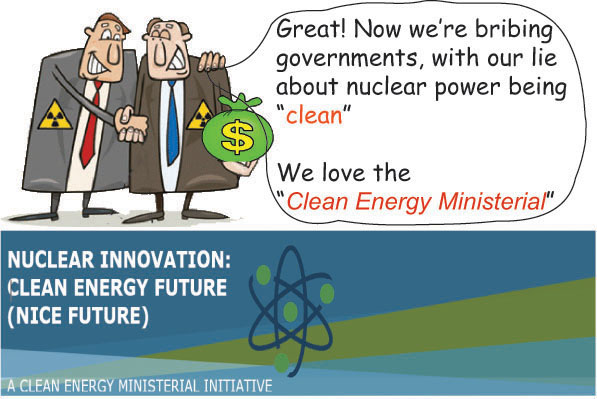
 USA – Canada – Japan – the ministerial nuclear suckers came out of the woodwork – Dan Brouillette, Kim Rudd, Masaki Ogushi, Rick Perry … and also Dr. Matar Al Neyadi, and Denis Janin, immediate past President of the International Youth Nuclear Congress, and who else – in this secretive nuclear white anting of the global movement?
|
Countries Launch a Nuclear Innovation Initiative under the Clean Energy Ministerial NICE Future initiative will address improved power system integration through innovative, integrated, and advanced energy systems and applications, such as nuclear-renewable systems, combined uses of heat and power, hydrogen production, and industrial decarbonization. It will highlight the opportunities for nuclear energy technologies to reduce emissions and air pollution from power generation, industry, and end-use sectors. “I would like to acknowledge the countries and organizations that have joined the United States, Canada, and Japan in the creation and launch of the NICE Future initiative,” said Deputy Secretary Brouillette. “Secretary Rick Perry and I are quite proud of this initiative and the ambitious program it sets forth. Having nuclear included at the Clean Energy Ministerial will create greater global recognition of its many unique benefits.” Nuclear energy is an important contributor to global clean energy supply, both as a primary source of clean energy and by enabling other clean energy sources.
“Nuclear energy’s vitally important but under-recognized contributions to clean air are made even greater by constant innovation,” said U.S. Secretary of Energy Rick Perry. “The NICE Future initiative highlights these contributions by reimagining nuclear’s advanced uses and applications. Nuclear provides a cleaner, safer, more reliable, and more resilient energy supply for our world.” “Canada is excited to be a part of this initiative. Nuclear energy is already an important part of Canada’s energy mix and innovative nuclear technologies, including Small Modular Reactors, have a key role to play in the transition to a low-carbon economy” said Kim Rudd, Parliamentary Secretary to Canada’s Minister of Natural Resources. “As a non-emitting source of energy, nuclear is, and will continue to be, an important part of our energy mix.” Japanese Parliamentary Vice-Minister of Economy, Trade and Industry Masaki Ogushi stated, “I expect this initiative would bring the wisdom of the world on nuclear innovation together, and contribute to policy making for realizing clean energy systems that solve challenges in each country. Our aim is to promote nuclear innovation utilizing out-of-the-box ideas from the private sector, pursuing the development of reactors with new concepts, including harmonization with renewable energy, combined with enhanced safety, efficiency, and flexibility.” Several NICE Future initiative participants and stakeholders gathered on the sidelines of CEM9 for a launch event, moderated by Mr. Denis Janin, immediate past President of the International Youth Nuclear Congress….. Others noted nuclear energy’s strategic benefits. “Nuclear energy in the UAE plays a strategic role as a clean energy source that will reduce greenhouse gas emissions in the energy sector, diversify our energy portfolio, and is already creating highly-skilled employment opportunities which support long-term sustainability,” pointed out Dr. Matar Al Neyadi, Undersecretary of the Ministry of Energy of the United Arab Emirates (UAE). ……… Countries participating in the NICE Future Initiative include the United States, Canada, Japan, Argentina, Poland, Romania, Russia, United Arab Emirates, and the United Kingdom. More countries have indicated strong interest. The International Energy Agency (IEA) and the OECD Nuclear Energy Agency (NEA) have noted their interest and support for the initiative. The U.S. DOE National Renewable Energy Laboratory will serve as an initiative operating agent. http://www.cleanenergyministerial.org/news-clean-energy-ministerial/countries-launch-nuclear-innovation-initiative-under-clean-energy |
|

1 This Month
Tell Congress: Prevent Nuclear Catastrophe in Iran

Tell Congress: Prevent Nuclear Catastrophe in Iran

Read the Public Inquiry Report, the Commissioners’ report, Surrendering Australia: The AUKUS Deception is available to download for free at aukuspublicinquiry.com. Or just watch the replay of the National Press Club Luncheon.


Shut down the radiation-damaged Heysham nuclear reactors now
To see nuclear-related stories in greater depth and intensity – go to https://nuclearinformation.wordpress.com

Say No to NASA’s Reckless Nuclear Reactor on the Moon
Say No to NASA’s Reckless Nuclear Reactor on the Moon
-
Archives
- November 2026 (246)
- October 2026 (302)
- September 2026 (339)
- August 2026 (330)
- July 2026 (355)
- June 2026 (287)
- May 2026 (306)
- April 2026 (356)
- March 2026 (251)
- February 2026 (267)
- January 2026 (308)
- December 2025 (358)
-
Categories
- 1
- 1 NUCLEAR ISSUES
- business and costs
- climate change
- culture and arts
- ENERGY
- environment
- health
- history
- indigenous issues
- Legal
- marketing of nuclear
- media
- opposition to nuclear
- PERSONAL STORIES
- politics
- politics international
- Religion and ethics
- safety
- secrets,lies and civil liberties
- spinbuster
- technology
- Uranium
- wastes
- weapons and war
- Women
- 2 WORLD
- ACTION
- AFRICA
- Atrocities
- AUSTRALIA
- Christina's notes
- Christina's themes
- culture and arts
- Events
- Fuk 2022
- Fuk 2023
- Fukushima 2017
- Fukushima 2018
- fukushima 2019
- Fukushima 2020
- Fukushima 2021
- general
- global warming
- Humour (God we need it)
- Nuclear
- RARE EARTHS
- Reference
- resources – print
- Resources -audiovicual
- Weekly Newsletter
- World
- World Nuclear
- YouTube
-
RSS
Entries RSS
Comments RSS

