https://www.seattletimes.com/seattle-news/u-s-to-shut-down-idaho-nuclear-waste-processing-project/December 8, 2018 With the Idaho treatment not be economically feasible to bring in radioactive waste from other states.
The U.S. Department of Energy in documents made public this week said the Advanced Mixed Waste Treatment Project that employs 650 workers will end next year.
Officials said workers are wrapping up processing 85,000 cubic yards of radioactive waste at the department’s 890-square-mile site that includes the Idaho National Laboratory.
A $500 million treatment plant handles transuranic waste that includes work clothing, rags, machine parts and tools that have been contaminated with plutonium and other radioactive elements. The U.S. Nuclear Regulatory Commission says transuranic wastes take much longer to decay and are the most radioactive hazard in high-level waste after 1,000 years.
The Energy Department said that before the cleanup began, Idaho had the largest stockpile of transuranic waste of any of the agency’s facilities. Court battles between Idaho and the federal government culminated with a 1995 agreement requiring the Energy Department to clean up the Idaho site.
The Idaho treatment plant compacts the transuranic waste, making it easier to ship and put into long-term storage at the Waste Isolation Pilot Plant in New Mexico.
Federal officials this year floated the idea of keeping the $500 million treatment plant running in Idaho with waste from other states — mostly radioactive waste from the former nuclear weapons production area in Hanford.
With the Idaho treatment plant scheduled to shut down, it’s not clear how the transuranic waste at Hanford and other sites will be dealt with.
The Energy Department “will continue to work to ensure a path forward for packaging and certification of TRU (transuranic) waste at Hanford and other sites,” the agency said in the email to the AP.
Local officials and politicians generally supported the idea because of the good-paying jobs. The Snake River Alliance, an Idaho-based nuclear-watchdog group, said it had concerns the nuclear waste brought to Idaho would never leave.
A 38-page economic analysis the Department of Energy completed in August and released this week found “it does not appear to be cost effective due to packaging and transportation challenges in shipping waste” to Idaho.
“As work at the facility will continue into 2019, no immediate workforce impacts are anticipated,” the agency said in an email to The Associated Press on Friday. The Energy Department “recognizes the contribution of this facility and its employees to DOE’s cleanup mission and looks forward to applying the knowledge gained and experience of the workforce to other key activities at the Idaho site.”
The agency said it would also consider voluntary separation incentives for workers.
December 10, 2018
Posted by Christina Macpherson |
USA, wastes |
Leave a comment
 Nuclear safety groups criticize DOE order https://www.abqjournal.com/author/mhayden, BY MADDY HAYDEN / JOURNAL STAFF WRITER, , December 8th, 2018 SANTA FE, N.M. — Nuclear safety watchdog groups around the country are calling on the Department of Energy to rescind an order they fear will limit the board tasked with overseeing operations at some of the nation’s nuclear facilities and ultimately negatively affect safety at such facilities.
The Defense Nuclear Facilities Safety Board (DNFSB) has itself raised concerns over Order 140.1, “Interface with the Defense Nuclear Facilities Safety Board,” put into place by the DOE in April.
The board held a second public hearing on the order in Washington, D.C., on Nov. 28.
The DNFSB was created by Congress in 1988 to provide oversight and provide information to the public on safety issues at some DOE nuclear facilities.
“We are deeply concerned that Order 140.1 constrains crucial oversight activities of the DNFSB and thereby endangers public health and worker safety,” said Kathy Crandall Robinson of the Alliance for Nuclear Accountability during the late-November hearing.
Chief among the concerns with the order, which the DOE says is aimed at “clarifying” the roles of the department and DNFSB, is language that limits formal DNFSB oversight to issues of public safety as those beyond facility boundaries.
The order, Robinson said, “threatens to send us on a glide path back to a careless era as if this were a time when safety concerns and dangers at nuclear weapons facilities are shrinking.”
“They are not,” she added, citing plans to ramp up plutonium pit production at Los Alamos National Laboratory.
Lydia Dennett of the non-partisan Project on Government Oversight expressed concerns over the reasoning behind the order’s implementation, namely that the decision was possibly driven by government contractors.
“This policy makes it easier for contractors to hide any information they don’t want to come to light,” she said.
The order stipulates the DNFSB may not talk to contractor employees without getting authorization from management and DOE, according to the Alliance for Nuclear Accountability.
The Alliance for Nuclear Accountability represents more than 30 organizations located near DOE and National Nuclear Security Administration sites around the country, including the Albuquerque-based Southwest Research Information Center.
Don Hancock of the Southwest Research and Information Center pointed out in a news release sent by the alliance a 2011 DNFSB report that identified fire hazards at the Waste Isolation Pilot Plant in southeast New Mexico.
Three years later, an underground fire caused the temporary closure of the facility.
December 10, 2018
Posted by Christina Macpherson |
safety, USA |
Leave a comment
https://www.armyrecognition.com/december_2018_global_defense_security_army_news_industry/tor-m2_air_defense_missile_systems_to_protect_belarus_nuclear_power_plant.html
December 2018 Global Defense Security army news industryPOSTED, 08 DECEMBER 2018 A battery of Tor-M2 SAM (Surface-To-Air defense missile system) produced by Concern Almaz-Antey will enter in service with the 1146th Guards surface-to-air missile regiment deployed near a Belarusian nuclear power plant, which is under construction, Major General Igor Golub, the commander of the Air and Air Defense Forces of the Belarusian Armed Forces, said.
“Russia will supply another battery of Tor-M2 surface-to-air missile systems soon. They will come in service with the 1146th Guards surface-to-air missile regiment,” the commander quoted by the Belorusskaya Voennaya Gazeta military newspaper said.
Previous reports said that Concern Almaz-Antey had handed over a shipment of Tor-M2 surface-to-air missiles to the Belarusian Defense Ministry ahead of time. They had been assembled a month ahead of schedule. Belarus has received the fifth SAM shipment.
The 1146th surface-to-air regiment was revived in Belarus in 2017. The four-battery regiment is armed with Tor-M2 surface-to-air missiles. It protects the Belarusian airspace in the northwest covering the Belarusian nuclear power station.
The Tor-M2 is an upgraded version of the Tor-M1 short-range air defense missile system. The TOR-M2/M2E is designed by the Russian Defense Company Almaz-Antey. The TOR-M2 / M2E is designed to destroy aircraft, helicopters, aerodynamic UAVs, guided missiles and other components of high precision weapons flying at medium, low and extremely low altitudes in adverse air and jamming environment. The Tor-M2 missile system can be mounted on wheeled or tracked chassis.
The Tor-M2 can simultaneously engage up to 48 processed targets and ten tracked targets.The TOR-M2 can engage a target at the range from 1,000 to 12,000 m and to an altitude from 10 to 10,000 m.
December 10, 2018
Posted by Christina Macpherson |
Belarus, safety |
Leave a comment

 Theberton & Eastbridge Action Group on Sizewell 16th Nov 2018 Did you know that EDF wants to build two new reactors on the Suffolk coast, next to the internationally-famous RSPB Minsmere wildlife reserve and AONB?
It is to be a twin of EDF’s new Hinkley Point plant – so what is actually coming for Sizewell? Watch, share and sign up to receive our updates, and get ready to help us hold EDF to account in caring for this special place when they share their new proposals in January.
Grateful thanks to Lush Charity Pot for their support which made this video possible, and a huge shout out to UK Aerial Photography for all the Suffolk drone photography and editing the video.
https://www.facebook.com/teags.org/videos/194650268134653/
December 10, 2018
Posted by Christina Macpherson |
opposition to nuclear, UK |
Leave a comment
David Lowry’s Blog 7th Dec 2018 , Letter to Guardian: Your energy editor’s report on the new UK-Belgium
energy interconnector (“Funding Nemo: £600m power cable now links UK to Belgium,” overlooks one crucial matter: how will any disputes arising from the joint facility be resolved once the UK has left the EU and the jurisdiction of the European Court of Justice?
This complexity was foreseen in a research paper issued by London-based think tank Chatham House 18
months ago ( “Staying Connected: Key Elements for UK–EU27 Energy Cooperation After Brexit”, 10 May 2017
https://www.chathamhouse.org/publication/staying-connected-key-elements-uk-eu27-energy-cooperation-after-brexit,
authored by Antony Froggatt, Senior Research Fellow on Energy, Environment and Resources at CH, (and his colleagues from CH Europe Programme plus the Energy Policy Group at University of Exeter). Their research paper proposed that energy – particularly electricity – should be treated as a special case in the UK’s future relationship with the EU27. They argue that “strong UK–EU27 energy cooperation could help ensure that existing and future interconnectors – physical pipes and cables that transfer energy across borders – between the UK, Ireland and the continent are used as efficiently as possible.”
http://drdavidlowry.blogspot.com/2018/12/future-regulation-of-uk-eu-energy.html
December 10, 2018
Posted by Christina Macpherson |
politics international, UK |
Leave a comment
How Radioactive Poison Became the Assassin’s Weapon of Choice, Matter, 26 Nov 2013, The mysterious life and brutal death of a Russian dissident.
TUCKED INTO THE Millennium Hotel on London’s Grosvenor Square, the Pine Bar is a place of hush and shadows. Dark wood panelling, leather seats, and black shaded chandeliers cosset those who seek discretion in style. Head barman Norberto Andrade has hidden many celebrities in its recesses during his 27 years of service, including James Bond stars Sean Connery and George Lazenby.
The three Russians who ordered drinks on the chilly afternoon of November 1, 2006 had little of the lethal glamour one might expect of spies. ………
The men eventually left, and Andrade cleared the table. As he poured the remaining tea away, he noticed that the consistency of the liquid that tipped into the sink was strange. Gooey. He couldn’t have known it as he puzzled over its weird yellow tinge, but the man who’d been sipping the tea was a 43-year-old Russian dissident called Alexander Litvinenko, and the tea itself, draining away into the London sewers, was lethally radioactive. …….
During the night, his temperature plummeted, yet he begged for the windows to be opened so he could gulp down more of the freezing November air.
“It looks like they’ve poisoned me,” he said to his wife.
The next night she called an ambulance: doctors took a cursory look, diagnosed a stomach infection, and sent him home. But two days later he was sicker yet. His doctor immediately sent him to Barnet General, a bright local hospital not far from his home. When Litvinenko told the medics his theory — that he’d been poisoned by the Russian security services — they suggested he call a psychiatrist. The probability, they thought, was that his sickness had a far more routine cause: food poisoning from an unfortunate lunchtime dose of sushi.
The doctors treated Litvinenko with a heavy dose of antibiotics. And yet his body continued to break down. ………….
Polonium-210 spits out alpha particles. Normally, alphas aren’t a problem. Their huge size means that even a barrier as thin as a few inches of air — or a layer of human skin — stops them before they can do any harm. But if a high dose finds its way inside a human body, the damage can be immense. “An alpha particle leaves the equivalent of a motorway as it goes through tissue,” says Wakeford. “Sufficient cells in your body would commit suicide that you’d die.”
Polonium-210 is unusual in another way, too: it leaves the body relatively quickly. It sheds radiation so fast that the amount of poison in the body decreases by half in less than two months. “It’s sufficiently long lived that it’ll be around for a bit, but after that will leave no trace,” says Wakeford.
Polonium-210 is very rare in that it is almost a pure alpha emitter. When it gives out alpha particles there’s hardly any chance of there being a gamma particle emitted as well. You need a special instrument to look for alpha particles, because they’re so easy to block. ”
In short, it’s deadly, hard to find and doesn’t hang around. “And that,” says Wakeford, “is why it makes such a good poison.”……….
Polonium is hugely radioactive, firing off a massive bombardment of alpha particles — and without any screening, the delicate mechanisms of the body’s internal organs get the full dose. As the atoms try to stabilize, alpha particles crash into nearby body tissue, knocking electrons from the molecules they encounter. Each time they do, the trail of wrecked cells expands; the poison turns them cancerous, or kills them off entirely.
And that is just the beginning………..
THE IDEA OF POISONING — radioactive or otherwise — is not new to Russian intelligence. According to former Russian intelligence officer Boris Volodarsky, now a historian and one-time associate of Litvinenko, the Russians have a history of substance assassination going back nearly a century. It was Lenin who ordered the establishment of their first laboratory, known simply as the ‘Special Room’, for developing new lethal toxins.
“There is also a long succession of poisonings by Russian intelligence services in different countries, starting in the early 1920s,” he says.
At its height, says Volodarsky, the Soviet Union had the largest biological warfare program in the world. Sources have claimed there were 40,000 individuals, including 9,000 scientists, working at 47 different facilities. More than 1,000 of these experts specialized in the development and application of deadly compounds. They used lethal gasses, skin contact poisons that were smeared on door handles and nerve toxins said to be untraceable. The idea, at all times, was to make death seem natural — or, at the very least, to confuse doctors and investigators. “It’s never designed to demonstrate anything, only to kill the victim, quietly and unobtrusively,” Volodarsky writes in The KGB’s Poison Factory. “This was an unbreakable principle.”
Murderous poisons come in three varieties: chemical, biological, and radiological. It’s believed that the first Soviet attempt at a radiological assassination took place in 1957. The target was Nikolai Khokhlov, a defector who had left for the United States a few years earlier. He became drastically ill after drinking coffee at an anti-communist conference he was speaking at in West Germany. After his collapse, he was successfully treated at a US army hospital in Frankfurt for what was believed to be poisoning by radioactive thallium.
In the years before Litvinenko’s murder, a series of other killings bore similar hallmarks. In 2004, Roman Tsepov, a prominent and controversial political operative from St Petersburg, died after being poisoned with an unidentified radioactive substance on a visit to Moscow. The year before, Yuri Shchekochikhin had died in similarly mysterious circumstances. An investigative journalist and member of parliament, he had exposed a series of scandals, including an FSB racket that laundered money through the Bank of New York. His death came after a brief, undiagnosed illness with familiar symptoms: hair loss, vomiting, red blotches, fatigue. He was due to fly to the United States to meet FBI agents just days later.
The Russians may not be the only ones to have used nuclear technology for targeted execution, however. East Germany’s secret police, the Stasi, are alleged to have used radioactive poisons and even deployed modified x-ray machines to irradiate and injure political prisoners. They also used radiation as a tool, surreptitiously tagging dissidents with chemicals so they could trace and track them with Geiger counters.
And in November 2013, scientists in Switzerland announced that they had found heightened levels of polonium in the remains of the former Palestinian leader, Yasser Arafat. Investigations began two years previously, when researchers discovered the strange news that some of the personal items that Arafat had been wearing shortly before his death appeared to be contaminated with high levels of polonium-210 and were emitting alpha radiation. It was a finding that raised difficult questions for those who may have wanted to get rid of him.
But still, Russia’s ability to source and use radioactive poisons seems to be pre-eminent. Only about 100 grams of polonium are manufactured each year, and just three countries are known to produce it reliably: Israel, the United States, and Russia. And 97 percent of that supply is manufactured in one place — a converted nuclear weapons facility that operates under high security, on the banks of the Volga, 450 miles south east of the Kremlin.
The case for official Russian involvement in Litvinenko’s death was growing. And there was more evidence to come: unbeknown to them, the assassins had left a trail — and it seemed to lead east…………
This story was written by Will Storr, edited by Deborah Blum, fact-checked byFangfei Shen, and copy-edited by Rupert Goodwins. The illustrations were by Ed Tucker, and the audiobook was narrated by Ian Parkinson. https://medium.com/matter/how-radioactive-poison-became-the-assassins-weapon-of-choice-6cfeae2f4b53
December 10, 2018
Posted by Christina Macpherson |
secrets,lies and civil liberties, UK |
Leave a comment
 Times 9th Dec 2018 Something that would once have been unthinkable took another step towards
becoming reality last month just 40 miles east of London on the Essex
coast.
Britain’s nuclear watchdog nudged a Chinese reactor a step closer
to being allowed to operate in the UK, sending it through the “initial
high-level scrutiny” phase. It will eventually be built at
Bradwell-on-Sea. Much tougher hurdles lie ahead, but regulators have so far
been able to find no reason to block China General Nuclear’s HPR1000.
This is the dilemma facing Britain — one that has been thrown into stark
relief by the events of the past week. The arrest of Meng Wanzhou, the
chief financial officer of telecoms giant Huawei, means all that must be
seen through a different lens. The daughter of Huawei’s founder was
arrested in Canada at the behest of the US authorities and faces charges of
fraud and breaching US sanctions on Iran.
However, the tone on Chinese investment in Britain has now changed and recalls the words of Theresa
May’s former adviser Nick Timothy in 2015, when he said the government was
“selling our national security to China”. A deep-seated suspicion of
Huawei at GCHQ has finally surfaced as open hostility, while,
coincidentally, BT is removing Huawei technology from its 4G mobile
network. Yet all this looks remarkably like shutting the stable door after
the horse has bolted. If there was a time to reject Chinese investment, it
was 20 years ago.
Now, with ministers reliant on Chinese cash to fund a
significant slice of our future power needs, do they dare bite the hand
that feeds? Plus, in a post-Brexit world, a trade deal with China is meant
to top the priority list. For all the braggadocio, I suspect there will be
much soothing talk between London and Beijing in the months ahead. Does the
government really think it can put the Chinese dragon back in the bottle?
And can it afford to?
https://www.thetimes.co.uk/article/6cfdbf12-fafc-11e8-9a07-72ebead02362
December 10, 2018
Posted by Christina Macpherson |
business and costs, politics, politics international, UK |
Leave a comment
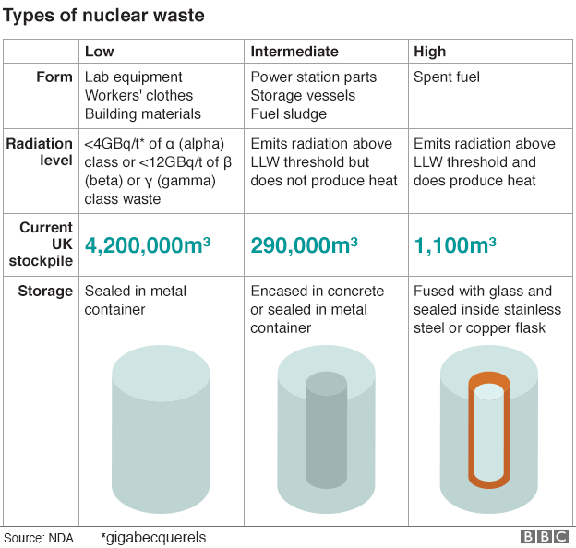
Public gets more time to consider controversial radioactive waste issue https://www.tri-cityherald.com/news/local/hanford/article222835225.html, BY TRI-CITY HERALD STAFF, December 08, 2018 RICHLAND, WA
The Department of Energy has agreed to extend the public comment period on its proposal to loosen its interpretation of what it considers high level radioactive waste.
The 60-day public comment period, which was set to end Dec. 10, has been extended until Jan. 9
The extension came at the urging of Sen. Ron Wyden, D-Ore., and 75 organizations across the nation, including Hanford Challenge, Columbia Riverkeeper, Heart of America Northwest and the Natural Resources Defense Council.
Defining less of the nation’s nuclear waste as high level could speed up environmental cleanup at places like the Hanford nuclear reservation and save billions of dollars.
It could give DOE more flexibility on how it deals with some of the 56 million gallons of waste stored in underground tanks.
The Energy Communities Alliance — which includes Hanford Communities, a coalition of local government near the Hanford Site — supports the proposal.
But critics like Hanford Challenge say it also could mean more toxic waste would be allowed to remain in the ground at Hanford.
Comments may be emailed to HLWnotice@em.doe.gov.
December 10, 2018
Posted by Christina Macpherson |
USA, wastes |
Leave a comment
North Korea warns it could revive nuclear development if U.S. does not lift sanctions, Global News, By Kim Tong-Hyung The Associated Press, 3 Nov 18
North Korea has warned it could revive a state policy aimed at strengthening its nuclear arsenal if the United States does not lift economic sanctions against the country.
The statement released by the Foreign Ministry on Friday evening said North Korea could bring back its “pyongjin” policy of simultaneously advancing its nuclear force and economic development if the United States doesn’t change its stance. The North stopped short of threatening to abandon ongoing nuclear negotiations with Washington.
Still, it accused Washington of derailing commitments made by North Korean leader Kim Jong Un and President Donald Trump at their June summit in Singapore to work toward a nuclear-free Korean Peninsula. It was the first time the North said it could potentially resume weapons tests and other development activities since Kim signalled a new state policy in April.
In an interview with Fox News’ Sean Hannity on Friday, U.S. Secretary of State Mike Pompeo said he plans to talk next week with his North Korean counterpart, apparently referring to senior North Korean official Kim Yong Chol. Pompeo did not provide the location and date for the meeting, which will likely be focused on persuading North Korea to take firmer steps toward denuclearization and setting up a second summit between their leaders……https://globalnews.ca/news/4626862/north-korea-revive-nuclear-sanctions/
December 8, 2018
Posted by Christina Macpherson |
North Korea, politics international |
Leave a comment

Reeves calls for clarity for nuclear in ‘no deal’ Brexit scenario https://utilityweek.co.uk/reeves-calls-clarity-nuclear-no-deal-brexit-scenario/ David Blackman , 7 Dec 18 Rachel Reeves has urged the government to provide greater clarity about its plans for civil nuclear power if the UK leaves the EU without a withdrawal deal.
The chair of the House of Commons Business, Energy and Industrial Strategy committee has written to Richard Harrington, who has responsibility for the nuclear industry in his portfolio as minister for busiUK
In the letter, Reeves acknowledges indications of progress on the civil nuclear relationship between the EU and the UK regarding issues like safeguards and trading arrangements.
The government passed a bill last year outlining plans to create a new safeguarding regime for nuclear material and labour once the UK has to leave its existing arrangements under the Euratom treaty.
The letter seeks more detail on the plans that the government is making to ensure that the civil nuclear sector can continue to function after next March if parliament has been unable to secure a broader separation agreement and whether a side-deal with Euratom is being pursued.
She also quizzes Harrington on whether the UK has received any signals from Euratom about whether it will be possible to maintain the “close association” that the government has said it wanted with the EU-wide nuclear co-operation arrangement.
Reeves also asks whether the government has made any arrangements to overcome possible hitches in the nuclear new build programme if the upcoming migration white paper inhibits the inflow of the migrant labour which has been “essential” for such projects.
Reeves said: “In the event of no deal and no transition period, the ongoing operation of the UK’s nuclear power stations could be put at risk. The government needs to spell out what it is doing to ensure that nuclear power stations continue to function from 29 March 2019 and whether it will seek a separate deal with Euratom in these circumstances.
“The government also needs to be clearer about its plans to facilitate the building of construction of major facilities such as Hinkley Point C if restrictions on migrant labour are introduced in the future.”
December 8, 2018
Posted by Christina Macpherson |
business and costs, politics, politics international, UK |
Leave a comment
U.S. Preparing Grounds to Scrap Key Nuclear Treaty, Lavrov Says, Bloomberg, By Stepan Kravchenko, December 7, 2018, NATO rejected Russian offer to discuss INF accord, Lavrov says. Huawei official’s arrest shows U.S. ‘arrogance,’ minister says
The U.S. is preparing to wreck the Strategic Arms Reduction Treaty (START), a key accord with Russia on limiting nuclear weapons, Russian Foreign Minister Sergei Lavrov said.
“I have the impression that they are preparing the ground to destroy this document as well,” following the U.S. decision to withdraw from another nuclear accord, the Intermediate-Range Nuclear Forces Treaty, Lavrov told a televised press conference in Milan on Friday after a meeting of OSCE foreign ministers. Russia has repeatedly sent proposals to the U.S. to begin talks on extending the START agreement but has received no response so far, he said.
The New START treaty signed in 2010, which followed on from a 1991 agreement, is due to expire in 2021. Under the accord, Russian and U.S. arsenals are restricted to no more than 1,550 strategic warheads on no more than 700 deployed strategic missiles and bombers. U.S. National Security Adviser John Bolton said during a visit to Moscow in October that Washington “does not have a position that we’re prepared to negotiate” on a new START treaty, adding that there’s “plenty of time” before the deal expires…….https://www.bloomberg.com/news/articles/2018-12-07/u-s-preparing-grounds-to-scrap-key-nuclear-treaty-lavrov-says
December 8, 2018
Posted by Christina Macpherson |
politics international, USA, weapons and war |
1 Comment

COP24 President defends participation of coal companies at climate talks, ABC, The World By Erin Handley 7 Dec 18, COP24 President Michal Kurtyka has defended displays of coal soap and jewellery at key climate change talks in Poland, saying “it’s good to have everybody on board”.
Key points:
- The climate talks drew some ridicule for putting coal on display in the foyer
- New Zealand has named climate change as its biggest security threat
- Pacific nations are facing an existential threat, Michal Kurtyka said
Conference attendees were confronted with coal displays in the foyer and greeted by a performance from the Polish Coal Miners Band during the talks designed to bring about global action on climate change.
Polish President Andrzej Duda said using coal was not in conflict with climate protection, and with the climate change talks taking place in the city of Katowice — a coal mining stronghold — some observers said the setting undermined the purpose of the talks.
Mr Kurtyka, who is also a secretary of state in the Ministry of Environment, denied that coal companies “sponsored” the event, which he said was publicly funded by Poland — but said there were several partners, including Ikea and energy companies. …….
Richie Merzian, director of the Australia Institute’s Climate and Energy Program, said the coal-heavy setting left “a sour taste in the mouths of those who are committed to climate action”.
“But at the same time it is symbolic of trying to deal with the vested interests and the long history of reliance on fossil fuels in many of these cities and countries.”
Mr Merzian added that coal companies were not on the same page as delegates seeking an ambitious plan to combat climate change.
“Their core business is directly in contrast to … the goal of the Paris Agreement, which is to transition completely away from reliance on fossil fuels,” he said, adding that the influence of coal companies on governments ran deep.
“Stopping that outright, in-your-face sponsorship would definitely help in terms of optics, but a lot of the influence is just strongly embedded into the positions that the countries bring forward.”………
Yesterday New Zealand released a defence policy statement naming climate change as its biggest security threat and stressing the impact of climate change on the Pacific.
“It identifies climate change as one of the most significant security threats of our time, and one that is already having adverse impacts both at home and in New Zealand’s neighbourhood,” said Defence Minister Ron Mark in an emailed statement to Reuters.
Australia, however, has turned its back on its Pacific neighbours in terms of climate change, Mr Merzian said.
“The Pacific are getting desperate, and instead of their friends helping, they’re hurting,” he said.
“Poland is the Australia of the EU — the largest coal user, the largest coal producer — but unlike Australia that can operate in its own bubble, Poland has to marry up its position with its EU colleagues as a bloc, and that’s why they help drag Poland to be better than what it would otherwise be.” https://www.abc.net.au/news/2018-12-07/coal-company-participation-at-climate-talks-defended/10592146
December 8, 2018
Posted by Christina Macpherson |
2 WORLD, climate change, politics international |
2 Comments
Rallies will demand that the Australian government exercise its undeniable diplomatic and legal powers to insist that the British government immediately and unconditionally allow Assange to leave the United Kingdom and return to Australia if he so chooses. The courageous journalist must be provided with a guarantee, by both the Coalition and Labor, that Canberra will categorically reject any US application for Assange’s extradition
SEP meeting and livestream on December 16: What next in the fight to free Julian Assange? WSW By the Socialist Equality Party (Australia) , 28 November 2018As this year draws to a close, WikiLeaks publisher and Australian citizen Julian Assange remains effectively imprisoned inside the Ecuadorian embassy in London, denied sunlight and medical care, and blocked from communicating with the outside world. A court document, which surfaced in November, confirms that the US government has filed and sealed criminal charges against Assange, on the basis that his media organisation, WikiLeaks, published leaked information revealing US war crimes and anti-democratic imperialist intrigues.
The information vindicates the fight waged by Assange and his defenders against an arrest warrant, issued against him in 2010, obligating him to answer “questions” over false allegations that he had committed sexual assault in Sweden. The allegations were fabricated in order to provide ammunition for various pro-US layers to discredit Assange and to create the conditions for him to be rendered to a country that could rapidly extradite him to the US. The American ruling elite is determined to make an example of Assange by putting him on trial for “espionage” or “conspiracy,” in order to intimidate every journalist and whistleblower. Continue reading →
December 8, 2018
Posted by Christina Macpherson |
AUSTRALIA, secrets,lies and civil liberties, UK |
Leave a comment
Chinese nuclear giant flags interest in NuGen’s abandoned Cumbria plant, Building, By Will Ing7 December 2018 China General Nuclear also reveals plans to speed up delivery of nuclear power plant in Essex.China General Nuclear has flagged interest in building on the Moorside site recently vacated by Toshiba subsidiary NuGen as it reveals plans to speed up development of a nuclear power plant in Essex.
China General Nuclear (CGN), who is already developing Hinkley Point C (pictured) with EDF Energy, is carrying out technical assessments with a view to building another plant with the French energy giant in Bradwell, Essex.
Speaking at the Nuclear 2018 conference in London Rob Davies, the UK chief operating officer of CGN, said: “With the demise of NuGen there is a gap in the UK’s nuclear programme; the expected sequence of reactors coming down the line has been interrupted.
“We are confident we can close that gap by bringing Bradwell into operation much sooner.”…….https://www.building.co.uk/news/chinese-nuclear-giant-flags-interest-in-nugens-abandoned-cumbria-plant/5096959.article
December 8, 2018
Posted by Christina Macpherson |
China, marketing, UK |
Leave a comment
Tohoku Electric Power Co. has decided to decommission the No. 1 reactor at the Onagawa nuclear power plant in Miyagi Prefecture.
Half of companies in the nuclear industry doubt the government’s goal of having nuclear power account for 20 to 22 percent of Japan’s energy supply by fiscal 2030, according to a survey.
The reasons for their skepticism relate mainly to difficulties restarting or building reactors under stricter safety measures taken after the Fukushima nuclear disaster in 2011.
The survey was conducted in June and July by the Japan Atomic Industrial Forum, whose members include electric power companies that operate nuclear plants.
The forum contacted 365 companies in the nuclear industry, such as equipment manufacturers, and received responses from 254, or 70 percent.
According to the results, 50 percent of the companies said the government’s nuclear energy goal for fiscal 2030 is “unachievable,” compared with only 10 percent that said it is “achievable.” Forty percent said the attainability is “unknown.”
An estimated 30 reactors must be operating to reach the target, but the resumption of reactor operations has been slow since all of them were shut down after the triple meltdown at the Fukushima No. 1 nuclear power plant.
“Only nine reactors were restarted in the more than seven years after the accident in Fukushima,” Akio Takahashi, president of the forum and former senior official at Tokyo Electric Power Co., said at a news conference. “I guess respondents think it’s difficult (to achieve the goal) given the current pace (of the restarts).”
Tougher nuclear safety standards were set after the Fukushima disaster, forcing utilities to spend more on upgrading their reactors or keeping aging units operational.
Asked why they thought the government’s nuclear goal was unrealistic, 48 percent of the companies said, “There are no plans in sight to build or replace nuclear reactors.”
Thirty-three percent cited the delays in restarting idle reactors, while 16 percent said, “No progress can be seen in regaining trust from the public.”
December 7, 2018
Posted by dunrenard |
Japan | decommissioning, nuclear plants |
Leave a comment