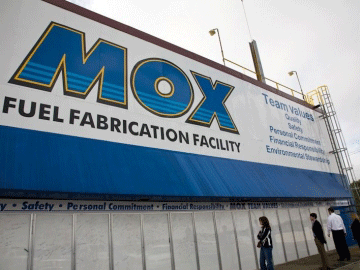
The Indy Explains: How a secret plutonium shipment exacerbated mistrust between Nevada and Department of Energy, The Nevada Independent ByDaniel Rothberg 18 Feb 19, The secretive Nevada plutonium shipment that has spawned angry rhetoric from Nevada politicians has a history that starts with Russia. In 2000, the United States entered into a pact with Russia to set aside excess weapons-grade plutonium for civilian use in nuclear reactors. Congress then passed a law that it would turn the excess 34 metric tons of plutonium into MOX, or mix-oxide fuel, at a newly built facility in South Carolina.
But that statute came with a firm deadline: If the MOX facility was not operational by 2014, the Department of Energy would be required to move one metric ton of plutonium stored at South Carolina’s Savannah River Site, a nuclear facility built in the 1950s, within two years.
After years of cost overruns and technical challenges, the Trump administration scrapped the facility. Meanwhile, the state of South Carolina obtained a court order in 2017 requiring the Department of Energy enforce the deadline and move the metric ton of plutonium by 2020.
Less than one year later, the agency said it moved a half-ton of that plutonium to the Nevada National Security Site. The action came after months of questioning from state officials, and its furtive nature has spurred a lawsuit, driving a deep chasm between the state and the agency.
Four months after South Carolina obtained the court order, Nevada officials heard that the federal government might be sending some of the plutonium to the state, according to court records. From August to November, state officials began asking questions about the potential shipment. But Nevada officials received few assurances from Department of Energy officials.
Beyond a general ‘expectation’ that any plutonium would be removed by approximately 2026-27, [a November 20] letter did not contain any of the requested assurances,” Pam Robinson, the policy director for then-Gov. Brian Sandoval, wrote in a December affidavit.
What Nevada officials didn’t know: the United States had already moved the plutonium.
Who knew what when
That surprising disclosure came months later — on January 30 — when a general counsel for the National Nuclear Security Administration (NNSA) disclosed that the agency had made a half-ton plutonium shipment from South Carolina to the Nevada Test Site prior to November.
Gov. Steve Sisolak responded to the revelation with a heated statement, pledging to continue existing litigation and keep the Department of Energy accountable.I am beyond outraged by this completely unacceptable deception from the U.S. Department of Energy,” he said to the media. “The department led the state of Nevada to believe that they were engaging in good-faith negotiations with us regarding a potential shipment of weapons-grade plutonium, only to reveal that those negotiations were a sham all along.”
Members of the state’s congressional delegation also released fiery responses.
State officials worry that the plutonium shipment to the testing facility, which is about 65 miles outside of Las Vegas and occupies an area the size of Rhode Island, could set a precedent for the federal government to send more nuclear materials to the state.
In court filings, lawyers for Attorney General Aaron Fordalso argued the federal government failed to fully inventory the environmental impacts of the size and type of plutonium being sent to the highly guarded site.
They also view the action as a backdoor move to open Yucca Mountain, the controversial nuclear waste repository that sits in the remote desert about 100 miles outside of Las Vegas.
The NNSA disputes all of these claims. ………
“Plutonium is nasty stuff,” said Allison Macfarlane, a George Washington University science and technology professor who chaired the U.S. Nuclear Regulatory Commission from 2012 to 2014. “But we’ve made so much of it on the weapons side in this country — and the civilian side in other countries — that we really need to manage it very carefully unless we eliminate it.”
Sharp rise in methane levels threatens world climate targets, Experts warn that failure to act risks spike in global temperatures, Guardian, Robin McKie, Sun 17 Feb 2019 Dramatic rises in atmospheric methane are threatening to derail plans to hold global temperature rises to 2C, scientists have warned.
In a paper published this month by the American Geophysical Union, researchers say sharp rises in levels of methane – which is a powerful greenhouse gas – have strengthened over the past four years. Urgent action is now required to halt further increases in methane in the atmosphere, to avoid triggering enhanced global warming and temperature rises well beyond 2C.
“What we are now witnessing is extremely worrying,” said one of the paper’s lead authors, Professor Euan Nisbet of Royal Holloway, University of London. “It is particularly alarming because we are still not sure why atmospheric methane levels are rising across the planet.”
Methane is produced by cattle, and also comes from decaying vegetation, fires, coal mines and natural gas plants. It is many times more potent as a cause of atmospheric warming than carbon dioxide (CO2). However, it breaks down much more quickly than CO2 and is found at much lower levels in the atmosphere.
During much of the 20th century, levels of methane, mostly from fossil fuel sources, increased in the atmosphere but, by the beginning of the 21st century, it had stabilised, said Nisbet. “Then, to our surprise, levels starting rising in 2007. That increase began to accelerate after 2014 and fast growth has continued.”
Studies suggest these increases are more likely to be mainly biological in origin. However, the exact cause remains unclear. Some researchers believe the spread of intense farming in Africa may be involved, in particular in tropical regions where conditions are becoming warmer and wetter because of climate change. Rising numbers of cattle – as well as wetter and warmer swamps – are producing more and more methane, it is argued.
This idea is now being studied in detail by a consortium led by Nisbet, whose work is funded by the Natural Environment Research Council. This month the consortium completed a series of flights over Uganda and Zambia to collect samples of the air above these countries.
“We have only just started analysing our data but have already found evidence that a great plume of methane now rises above the wetland swamps of Lake Bangweul in Zambia,” added Nisbet.
However, other scientists warn that there could be a more sinister factor at work. Natural chemicals in the atmosphere – which help to break down methane – may be changing because of temperature rises, causing it to lose its ability to deal with the gas.
The leader of Neath Port Talbot Council has said the local authority will not engage “at any level” when it comes to an upcoming consultation on possible sites where nuclear waste can be buried.
Meetings are taking place in Wales next month as part of the search for a site in which to bury the country’s most dangerous radioactive waste.
The UK Government wants to bury the lethal stockpile that has been accumulating from nuclear power stations over the last 60 years.
People in two areas – Swansea and Llandudno – are to be consulted as part of the hunt for a “willing host community”.
There are also consultations in eight parts of England.
At a full council meeting on Wednesday, February 14, council leader Rob Jones said: “There have been a number of articles in the media this week concerning public meetings to be organised, apparently, by an agency of the Nuclear Decommissioning Authority to consult on the possibility of sites being identified for the disposal of nuclear waste.
“I want to make it absolutely crystal clear that Neath Port Talbot Council will not be engaging in this process at any level.
“The Welsh Government has made it clear that they would only support such a proposal if the community concerned was willing.
“Well, ours is not as far as I’m concerned and that is the end of the matter.
“Moreover, in the unlikely event that a credible proposal emerged in any adjacent area, we would very strongly oppose that as well.”
The waste is currently stored in 20 sites around the country in specially-engineered containers but this is not seen as a long-term solution.
It is expected that the process of selecting an underground site and going through the planning and construction process will take decades with any chosen site first receiving waste in the 2040s.
The government website says that communities willing to take part on the consultation will receive £1m a year initially and up to £2.5m a year if boreholes are drilled.
Bellona 13th Feb 2019 , Norwegian authorities have reported trace amounts of radioactive iodine 131 in the atmosphere, which emerged last week in measurements taken in the country’s far northeast near the city of Tromsø. Officials with the Norwegian Radiation and Nuclear Safety Authority were at pains to emphasize that levels of the radioactive isotope were extremely low and posed no threat to human health.
Tokyo Electric Power Co.’s Fukushima No. 2 nuclear power plant
February 14, 2019
Tokyo Electric Power Co. ignored reports on fires and other problems from its nuclear power plants and didn’t even bother to share the information in-house or consider precautionary measures, the nuclear watchdog revealed.
The Nuclear Regulation Authority decided Feb. 13 it will investigate the failure by TEPCO’s headquarters to tackle the problems reported by its three facilities: the Kashiwazaki-Kariwa nuclear plant in Niigata Prefecture and the Fukushima No. 1 and No. 2 nuclear plants, both in Fukushima Prefecture.
A TEPCO official said that the company put off tackling the problems because the deadline for dealing with such matters “was not clearly stated.”
NRA safety inspectors visited the Fukushima No. 2 nuclear plant from November through December last year.
They found that the division at company headquarters in charge of dealing with safety issues and sharing that information neglected reports of four problems that had occurred at the plant.
They cited 17 cases at the Kashiwazaki-Kariwa nuclear plant; five cases at the Fukushima No. 1 nuclear plant and seven problems at the headquarters itself.
Kyushu Electric Power Co. said Wednesday it will scrap No. 2 reactor at its Genkai nuclear power plant in Saga Prefecture, seen in the forefront left of this photo taken in January
Feb 13, 2019
FUKUOKA – Kyushu Electric Power Co. said Wednesday it has decided to scrap its aging No. 2 reactor at its Genkai nuclear plant in Saga Prefecture.
The utility abandoned a plan to restart the unit, which has an output of 559 megawatts, in the face of the huge costs involved in enhancing the safety of the reactor that is already near the end of its 40-year operating life.
The reactor, which started operating in March 1981, has been idled since a routine checkup shortly before the March 2011 earthquake and tsunami disaster that triggered the Fukushima nuclear crisis.
The Genkai plant consists of four units. The utility already decided in 2015 to scrap its aging No. 1 unit, which had the same output capacity as the No. 2 reactor. Decommissioning work at the No. 1 reactor started in July 2017 and is expected to continue through fiscal 2043.
There have been a number of operational problems at the Genkai power plant. In May last year, pumps installed to control the circulation of cooling water at the No. 4 unit suffered malfunctions, following a steam leak from a pipe at the No. 3 reactor just a week after it was reactivated in March.
Some local residents have sought to stop operation of the Nos. 3 and 4 units with a temporary injunction, with doubts about the safety measures taken and citing the risk of volcanic eruptions in the region. Their case is pending at the Fukuoka High Court.
What would a nuclear war look like? And how would anyone be able to help?
What would you choose? Live or die?
The future of humanity hangs in the balance’: Why the world could not handle a nuclear attack . The Journal I.e. Órla Ryan @orlaryan, orla@thejournal.ie, 17 Feb 19
An expert explains how we could be “headed for a nuclear arms race”. NUCLEAR WEAPONS ARE probably talked about more nowadays that at any stage since the Cold War.
There are about 14,500 such weapons in the world, with nine countries owning them. The vast majority of the weapons are owned by the US (about 6,500) and Russia (about 6,800).
Tense relations between these two countries, as well as North Korea trying to increase its nuclear capability, has increased fears about a potential nuclear race.
TEPCO sat by idly on reports of fires, glitches at nuclear plants, By YUSUKE OGAWA/ Staff Writer, Asahi Shimbun 14th Feb 2019 , Tokyo Electric Power Co. ignored reports on fires and other problems from its nuclear power plants and didn’t even bother to share the information in-house or consider precautionary measures, the nuclear watchdog revealed.
The Nuclear Regulation Authority decided Feb. 13 it will investigate the failure by TEPCO’s headquarters to tackle the problems reported by its three facilities: the Kashiwazaki-Kariwa nuclear plant in Niigata Prefecture and the Fukushima No. 1 and No. 2 nuclear plants, both in Fukushima Prefecture.
A TEPCO official said that the company put off tackling the problems because the deadline for dealing with such matters “was not clearly stated.” TEPCO’s safety regulations stipulate that blazes, glitches in air-conditioning and other problems at nuclear plants must be dealt with by the main office of the operator. ttp://www.asahi.com/ajw/articles/AJ201902140054.html
Bridgwater Mercury 14th Feb 2019 , MORE than 70 children from local primary schools headed to Hinkley C last week for the official naming ceremony of three enormous tunnel boring machines.
The competition gave 215 primary schools from across Somerset the
opportunity to name the three 1,200 tonne tunnel boring machines that will
soon begin the construction of the new power station’s water inlet and
outfall tunnels. After arriving safely at the construction site by sea and
road, the trio of tunnelling machines will soon be removing 370,000 cubic
metres of earth to enable 3.3 kilometres of tunnels to be built underneath
the seabed. The tunnels will carry seawater to cool the two reactors, the
first of which will see first operation in 2025. ttps://www.bridgwatermercury.co.uk/news/17433214.huge-hinkley-c-tunnel-boring-machines-named-after-inspirational-women/
Can offshore energy replace a failing nuclear industry? The Manufacturer, 12 Feb 2019 by Maddy White
The world’s largest offshore windfarm off the Yorkshire coast is to supply its first power to the UK electricity grid this week. Could it fill the gap left by a failing nuclear industry? When fully operational next year, Hornsea One will be the largest windfarm in the world. Its 174 Siemens 7MW turbines will generate enough electricity (1.2GW) to reportedly power more than one million homes.
The electricity generated by the turbines 120km off of the Yorkshire coast will pass through one of three offshore substations, before being carried by three high voltage subsea cables (245kV).
Danish developer Ørsted’s project propels the offshore wind power sector to a new scale; Hornsea One will cover 407 sqkm – almost eight-times the size of Norwich
Rapid growth for renewables
A clean and sustainable energy supply, and reducing the impacts of climate change has become priority for countries across the globe as part of the Paris Agreement. Climate change was also found, in the World Economic Forum’s global risks report, to be the biggest concern for business in 2019.
The UK committed to reducing its greenhouse gas emissions by at least 80% by 2050, relative to 1990 levels, but the question remains just how can this be achieved?
Offshore windfarms could help fulfill this. Additionally it could aid the low carbon power gap created as a result of Hitachi and Toshiba recently scrapping nuclear plant projects in Wales and Cumbria. Hitachi followed Toshiba’s move and halted work on the Welsh site earlier this year due to rising costs………
A failing nuclear industry
Last year renewable energy supplied a record 33% of the UK’s electricity, opposed to 19% from nuclear. As technology advances, renewable energy has become cheaper and the logical energy source.
Hinkley C, the nuclear power plant in Somerset is years behind schedule, and billions over budget. Alongside Hinkley, there were five other plants with nuclear proposals: Moorside (Cumbria), Wylfa (Wales), Oldbury (West Midlands), Bradwell (Essex) and Sizewell (Suffolk).
Three have been scrapped and two are yet to be approved. Of the eight sites currently generating power, the Nuclear Industry Association (NIA) report that only one is due to be in use by 2030…….
The renewable sector is rapidly growing, its technology advancing and its costs decreasing, while nuclear remains an expensive and complex option that is becoming less appealing.
Can renewable energy be created on the same scale as nuclear? As nuclear power plants shut down and reach their operational expiry date, their contributions to the UK’s energy mix becomes increasingly irrelevant.
US will not open door to Saudi Arabia building nuclear weapons, deputy energy secretary says CNBC David Reid| @cnbcdavy 17 Feb 2019
The Trump administration wants to sell its nuclear energy technology to cash-rich Saudi Arabia.
To prevent nuclear arms development, the U.S. wants to place tight controls on how the technology can be used.
Saudi Arabia has put the U.S. on a shortlist with China, Russia and others to bid for nuclear power projects in the country.
“………….The Saudis have so far refused to rule out their right to enrich uranium for nuclear weapons, pointing to neighboring Iran’s ability to do so under the 2015 nuclear agreement that world powers struck with Tehran.
In an interview in March on CBS’s “60 Minutes” Saudi Crown Prince Mohammed bin Salman said the country wasn’t interested in developing weapons but would develop nuclear capability should Iran ever develop a working nuclear bomb.
On Sunday, Saudi Arabian Prince Turki Al-Faisal responded directly to Brouillette’s words, saying the country had more options than just U.S. technology.
“Well the nuclear energy market is open. It is not just the United States that is providing nuclear technology,” he told CNBC’s Hadley Gamble in Munich.
Nuclear Fears Haunt Leaders With U.S.-Russian Arms Pact’s Demise, Bloomberg, By Henry Meyer, Marc Champion, and Patrick Donahue, With assistance by Andrea Dudik, February 17, 2019
Arms-race specter raises alarm at global security conference
Looming standoff revives memory of 1962 Cuban missile crisis
President Donald Trump’s decision to pull out of a landmark arms control treaty with Russia is turning the worst fears of a dangerous weapons race into reality.
The U.S. and its allies are laying the groundwork to deploy new intermediate-range missiles in Europe for the first time since they were banned in a 1987 treaty, a move that would prompt a tit-for-tat Russian response. With a second nuclear pact likely to expire in two years, the risks of confrontation are growing.
Jens Stoltenberg, NATO’s top civilian, cited recent Russian deployments and evoked a Cold War-style threat of nuclear destruction at a global conference of security and defense officials this weekend in Munich, the baroque German metropolis that’s one of Europe’s richest cities.
“These missiles are mobile, easy to hide and nuclear-capable,” Stoltenberg said. “They can reach European cities, like Munich, with little warning.”
As U.S. officials accused Russia of provoking the crisis by violating the accord, German Chancellor Angela Merkel voiced a sense of alarm that’s spreading in Europe as the two big powers trade blame.
“We’re stuck with the consequences,” she said Saturday. At the same time, “blind rearmament can’t be the answer.”
Cold War Echoes
The looming standoff puts Washington and Moscow on a path back to the era of the 1950s and 1960s when the two superpowers were rapidly building up their strategic forces. It risks destroying decades of arms control efforts under which the rivals accepted limits on their arsenals in the wake of the 1962 Cuban missile crisis, which took them to the brink of a nuclear clash.
…………. Intercontinental Arsenals
The concerns about the potential for an armed build-up in Europe are amplified by the fact that New START, the last such arms control agreement still in place, looks set to expire in 2021.
Under New START, which followed from the 1991 START treaty and was signed in 2010, the Russian and U.S. arsenals are restricted to no more than 1,550 deployed strategic warheads on no more than 700 deployed strategic missiles and bombers. Each side can inspect the other’s arsenals 18 times a year.
Russian Foreign Minister Sergei Lavrov said in Munich that Russia is ready to hold talks on extending New START for another five years, while complaining that the Trump administration is unwilling to have any “meaningful consultations” on the issue.
His deputy in charge of arms control, Sergei Ryabkov, warned that the collapse of the treaty “would be another extraordinary shock for the arms control system.”
Back to the ’70s?
“The most frightening thing is when in the absence of information, the two sides will have to go back to the logic of seeking a military advantage,” said Konstantin Kosachyov, head of the foreign affairs committee of the upper house of the Russian parliament. “It means we’ll have to spend vast resources and confront the risk for each other and the entire world of a direct armed clash.”
The INF treaty was a response to a regional arms race that began with the Soviet deployment of SS-20 missiles in the European theater in 1977. The U.S. responded by deploying Pershing II missiles with a similar range. At one point, almost 3,000 intermediate-range nuclear weapons were stationed in Europe and it took a decade to end the standoff.
Closer to Russia
With the Iron Curtain gone, the difference is that now the missiles would be deployed in eastern Europe or in former Soviet republics, closer to key Russian political, military and industrial facilities.
The U.S. has proposed replacing the INF with a broader treaty bringing in other military powers, including China. That’s considered unlikely: of China’s 501 land-based missile launchers, 431 would be covered by the INF treaty, so agreeing to a ban on intermediate-range weapons would require destroying 80 percent of this arsenal, according to the London-based International Institute for Strategic Studies.
Losing the pact without any replacement would make it impossible for either side to know whether newly deployed missiles are nuclear or conventional, said Francois Heisbourg, a former French diplomat and Defense Ministry adviser.
Independent 16th Feb 2019 Replenishing the world’s forests on a grand scale would suck enough carbon dioxide from the atmosphere to cancel out a decade of human
emissions, according to an ambitious new study. Scientists have established
there is room for an additional 1.2 trillion trees to grow in parks, woods
and abandoned land across the planet. If such a goal were accomplished,
ecologist Dr Thomas Crowther said it would outstrip every other method for
tackling climate change – from building wind turbines to vegetarian
diets. https://www.independent.co.uk/environment/forests-climate-change-co2-greenhouse-gases-trillion-trees-global-warming-a8782071.html
Dept. of Justice 14th Feb 2019 The Department of Justice announced today that the United States has filed suit against CB&I AREVA MOX Services LLC (MOX Services) and Wise Services Inc. under the False Claims Act and the Anti-Kickback Act in connection with a contract between MOX Services and the National Nuclear Security
Administration relating to the design and operation of the MOX Fuel
Fabrication Facility (MFFF) at the NNSA Savannah River Site in Aiken, South
Carolina.
MOX Services is a South Carolina Limited Liability Corporation with headquarters in Aiken, South Carolina. Wise Services, which subcontracted with MOX Services, is an Ohio corporation with headquarters in Dayton, Ohio. Under the MOX Contract, MOX Services agreed to design, build, operate (and ultimately decommission) the MFFF.
The MFFF is designed to transform weapons-grade plutonium into mixed oxide fuel rods that may be irradiated in commercial nuclear power plants.
In performing the MOX Contract, MOX Services entered into a series of subcontracts with Wise Services between 2008 and 2016. Each of these subcontracts provided for
Wise Services to supply labor, materials, equipment, and supervision for unplanned construction activities (e.g. general labor, plumbing, electrical, carpentry) deemed necessary to support MOX Services’ efforts at the MFFF.
The government’s complaint alleges that Wise Services falsely claimed reimbursement under its subcontracts with MOX Services for construction materials that did not exist, and that in turn MOX Services knowingly submitted $6.4 million in claims to NNSA for the fraudulent charges submitted by Wise Services. The complaint further alleges that Wise Services’ Senior Site Representative Phillip Thompson paid kickbacks to MOX Services officials with responsibility for the subcontracts to improperly obtain favorable treatment from MOX Services. On Feb. 27, 2017, Mr. Thompson entered a guilty plea on charges of conspiring to commit theft of government funds. https://www.justice.gov/opa/pr/united-states-files-false-claims-act-lawsuit-connection-mox-fuel-fabrication-facility
Some history: Moffett says that “first use” ended World War II. That was hardly the principal cause of Japan’s surrender.
Most historians now attribute the end to the Soviet entry on Aug. 8. That immoral and illegal first use was also unnecessary. I’ve made the case in this paper many times, but I’ll merely quote Gen. Dwight Eisenhower, the supreme allied commander): “Japan was ready to surrender, and there was no need to use that awful thing.” Virtually all the top military leaders agreed.
But apart from its illegal and immoral despicability “common to Dark Age barbarians” (as Adm. William Leahy put it), that first use alienated our Soviet ally and started a long and dangerous Cold War.
What Moffett doesn’t say is that the first-use option, while not necessitating first use, does require preparation and willingness to do it. In a time of crisis, Nation X, knowing that Enemy Y has the first-use option and fearing imminent first use from Y, may pre-empt with the strike first – better to use ’em than lose ’em. This is equally dangerous with nukes kept on “hair trigger” alert, which first-use nuke nations do (but not the no-first-use nations: India, China and North Korea). It’s a recipe for an accidental nuclear launch.
–We’ve long held first use, even during the 1980s when the Soviets (and China) espoused a no-first-use policy. It was a main driver of the dangerous and often nearly catastrophic super power arms race. There were hundreds of nuclear accidents and near misses, some after the Cold War ended, as we now know from Eric Schlosser’s shocking 2014 book, Command and Control. By pure luck we survived decades of military inattention to nuclear safety and our (still ongoing) deference to the “we’re falling behind” cries of the dollar-seeking military-industrial-complex. (We are the world’s No.1 arms merchant, with many undemocratic customers.) For some frighteningly close calls see my review of Schlosser’s book: bit.ly/2SCQUO5.
First use has also been used by every president since Harry Truman as a threat to force concessions, as Daniel Ellsberg (nuke adviser to the Pentagon and several presidents in the 1960s and ’70s) has pointed out, with many examples in his recent Doomsday Machine.
Moffett also says Ronald Reagan showed “wisdom” by retaining the first-use option. Eventually Reagan wised up, but not until Mikhail Gorbachev (Nobel Peace Prize, 1990) came along in the mid-1980s. Earlier Reagan had little understanding of nukes. In fact he and his vice president, George H.W. Bush, were both insisting that a nuclear war was survivable and winnable.
By 1986, Reagan and Gorbachev, at their first summit, nearly agreed to the abolition of all nukes. But Reagan’s “Star Wars” (a proposed anti-ballistic missile system then outlawed by treaty and thought to be “pie in the sky”) killed the deal. But in 1987 we fortunately got the INF Treaty destroying 3,000 medium-range missiles – a treaty the United States is threatening to leave.
Moffett said our local leftists should “leave defense policy to national security and military experts.”
Surely Moffett knows that many such experts are today advocating exactly what the “local leftists” are – urging our state Legislature to urge Congress and the president to adopt no first use and halt funds for new low-yield nukes. They include: Gen. Lee Butler (Air Force), commander of Strategic Air Command (1984-1991) and first of the Strategic Command (1991-1994); Gen. James Cartwright (USMC), commander of the Strategic Command (2004-07) and vice chair of the Joint Chiefs of Staff (2007-2011); Secretary of State George Shultz (under Reagan); and Secretary of Defense William Perry (under Bill Clinton).
There are moral problems with nukes and even with nuclear deterrence of any form. Even deterrence (with no first use) requires the preparation for possible use and a willingness to use nukes “if necessary.” As such, all nuclear deterrence runs the risk of nuclear war and the killing of millions of innocent human beings or worse, given the possibility of nuclear winter. As science knows, but apparently not the Pentagon, even a small nuclear exchange – for example, India versus Pakistan, each firing 50 low-yield weapons – could bring on a 10-year nuclear winter and global famine killing over a billion people (2014 study by Physicians for Social Responsibility). Such a risk is morally unacceptable – a concern central to creating the Nuclear Non-Proliferation Treaty in 1968 – now with 189 parties and as important as ever.
The Non-Proliferation Treaty (Art. 6) requires a swift end to the nuclear arms race and the bringing to conclusion a treaty for “general and complete disarmament under strict and effective international control.” In 1996 the World Court rendered an opinion on the legality of nuclear weapons, saying: “The threat or use of nuclear weapons would generally be contrary to the rules of international law applicable in armed conflict.”
Meeting our treaty obligations will be a very long and difficult journey. But we must recover the progress that slowed soon after the end of the Cold War and recently threatens to stop – or worse.
In the meantime, the United States can encourage the non-proliferation treaty’s many non-nuke parties to show that the United States is still serious about its treaty obligations. We N.H. folks – as many other states are doing – can and should take the small but positive steps to support our state government to urge Congress and the president to adopt a no-first-use pledge, and to decline funding for any new costly and “more usable” low-yield nukes.
(Ray Perkins Jr. of Concord is professor of philosophy, emeritus, at Plymouth State University and vice chairman of the Bertrand Russell Society board of directors.)
Tell Congress: Prevent Nuclear Catastrophe in Iran
Read the Public Inquiry Report, the Commissioners’ report, Surrendering Australia: The AUKUS Deception is available to download for free at aukuspublicinquiry.com. Or just watch the replay of the National Press Club Luncheon.