Nuclear Regulatory Commission removes a critical safety regulation
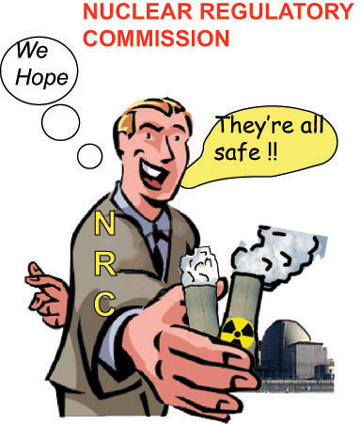 NRC Guts a Critical Safety Regulation, Recklessly Disregarding the Critical Lessons of the Fukushima Disaster https://www.ucsusa.org/press/2019/nrc-guts-critical-safety-regulation-recklessly-disregarding-critical-lessons-fukushima?fbclid=IwAR0-uToPAgtkdHj4rZ9dqJ5n7skVycU6y5UxjG_a_12lt7ZLhIwKCHfwZSM#.XGdxVOQzbGg– January 24, 2019 Decision Will Leave U.S. Nuclear Plants Dangerously Vulnerable to Major Floods and Earthquakes
WASHINGTON —The Nuclear Regulatory Commission’s (NRC) Republican majority, in a 3-2 vote, approved a stripped-down version of a rule originally intended to protect U.S. nuclear plants against extreme natural events, such as the massive earthquake and tsunami that triggered meltdowns at the Fukushima Daiichi nuclear plant in Japan in March 2011.
The commission majority struck a provision from the draft final rule the NRC staff recommended in December 2016 requiring plant owners to protect their facilities from the real-world hazards they face today instead of “design-basis” hazards that were estimated using now-obsolete information and methodologies when the plants were built decades ago.
The commission majority’s act will leave unresolved how the NRC will address new information showing that plants may experience bigger floods and earthquakes than they are now required to withstand. It is possible that the commission will not require all plant owners whose facilities face greater hazards to make structural upgrades.
“Nearly eight years after the Fukushima accident, the NRC continues to disregard a critical lesson: Nuclear plants must be protected against the most severe natural disasters they could face today—not those estimated 40 years ago,” said Dr. Edwin Lyman, senior scientist and acting director of the Nuclear Safety Project at the Union of Concerned Scientists.
After Fukushima, an NRC task force recommended that the NRC “order licensees to reevaluate the seismic and flooding hazards at their sites … and if necessary, update their design basis and SSCs [structures, systems and components] important to safety to protect against the updated hazards.”
To date, the NRC has only implemented the first part of the recommendation: Owners have reevaluated seismic and flooding hazards. What they found is not reassuring. For instance, the flooding reevaluations revealed that roughly two-thirds of U.S nuclear plants face hazards beyond what they were originally designed to handle, including higher flood levels from extreme precipitation, upstream dam failure and storm surge. The reevaluated flood height for local intense precipitation for the Palisades plant in Michigan, for example, was more than 25 feet higher than the level considered in the plant’s original design. Similar concerns were identified in many seismic risk evaluations.
Despite these findings, the NRC failed to implement the second part of the task force recommendation to require plant owners to strengthen their defenses against greater hazards. The rule that was approved today was originally intended to close that gap. The commission majority’s action today removed that requirement and will simply maintain the uncertain—and inadequate—status quo.
“The NRC must require plant owners to upgrade their facilities based on the best current information, the most realistic analyses, and the potentially devastating impacts of increased flooding from climate change,” said Dr. Lyman. “Failing to do so will leave some nuclear plants dangerously unprepared and needlessly invite disaster.”
South Korea says that Kim Jong Un is ready to accept nuclear-plant inspections
 Kim Ready to Accept Nuclear-Plant Inspections, South Korea Says, Bloomberg, By Youkyung Lee, February 16, 2019, · South Korea presidential adviser sees Trump path to compromise · Trump says ‘I’m in no rush for speed’ in talks with Kim regime North Korean leader Kim Jong Un was ready to accept the dismantlement and inspection of a high-profile nuclear plant, a South Korean presidential adviser said, suggesting a possible point of compromise in upcoming talks with President Donald Trump. Moon Chung-in, a special adviser for foreign affairs and national security, said in an interview Friday that the verified destruction of the regime’s Yongbyon nuclear complex was an achievable goal during Trump’s planned Feb. 27-28 summit with Kim. Moon said it was his “understanding” that South Korean President Moon Jae-in got Kim’s personal assurance on that when they met in Pyongyang in September. ………..Moon Chung-in said the U.S. should agree to allow economic projects between the two Koreas to proceed in exchange for inspections of Yongbyon — something the U.S. has so far been reluctant to do. Kim has railed against the international sanctions regime choking his moribund economy and called for resuming the projects, including a industrial park and a mountain resort. “Those will be doable,” Moon Chung-in said. Such an exchange would advance talks, “without undermining the overall sanctions regime by the UN Security Council, yet giving some kind of incentives to North Korea in a way the U.S. can come up with some sort of compromise,” he said. Moon Chung-in, a strong advocate of South Korea rapprochement with North Korea, said the success of the Hanoi summit hinges on how North Korea proceeds with its nuclear arms program. Satellite-imagery analysis and leaked American intelligence suggest that North Korea has been churning out rockets and warheads as quickly as ever. If North Korea continues to produce nuclear materials even after the Hanoi summit, I would say that’s the most important indicator that the Hanoi summit failed,” Moon Chung-in said. https://www.bloomberg.com/news/articles/2019-02-15/kim-ready-to-accept-inspection-of-nuclear-plant-adviser-says |
Nuclear fusion: American Association for the Advancement of Science deceived by ITER propagandists
Some content on this page was disabled on July 14, 2020 as a result of a DMCA takedown notice from New Energy Times. You can learn more about the DMCA here:
Chicago to go 100% renewable energy by 2035

|
The Windy – or maybe that should be nuclear – City will go 100% renewable https://www.pv-magazine.com/2019/02/15/the-windy-or-maybe-that-should-be-nuclear-city-will-go-100-renewable/
Chase Tower is one of the tallest skyscrapers to dominate Chicago’s skyline. But it is not the building’s height, at 869 feet, which makes it prominent but rather what’s in it: the headquarters of Exelon, the largest owner and operator of nuclear power plants in the United States. However, despite there being 11 nuclear reactors in operation in the state of Illinois, Chicago is moving to a different power source: renewable energy. Yesterday, Chicago Mayor Rahm Emanuel unveiled the Resilient Chicago plan, which with action number 38 commits to “transition to 100% clean, renewable energy in buildings community-wide by 2035”. The deadline for all city government buildings to be powered solely by renewables, first established in 2017, has been brought forward to 2025. The policy has been introduced as part of environmental group the Sierra Club’s “Ready for 100” campaign, and Chicago is the largest city to join the effort to date. (Editor’s note: While Los Angeles Mayor Eric Garcetti has announced his city is on a path to 100% renewable energy, it is not clear if the formal goal is 100% renewable or 100% zero-carbon, and LA is not included in the Sierra Club’s Ready for 100 list.) The language of the Resilient Chicago text says “clean, renewable energy”, and the Sierra Club does not include nuclear as part of its Ready to 100 campaign. The new policy is a particularly interesting move for Emanuel, once considered one of the more pro-nuclear politicians in the Democratic Party, and a man who brokered the deal that created Exelon. Were Chicago to include nuclear in a 2035 target, it would require either buying power from existing plants instead of investing in new generation, or starting new nuclear plants within six years. Given the high cost of nuclear compared to wind and solar, few decision makers are contemplating that option. The City of Chicago and stakeholders will have until December next year to come up with a plan to meet the city’s new mandate. Community solar, electric buses And there are a number of other clean energy commitments among the 50 action points in the wide-ranging Resilient Chicago report. Chicago plans to complete the electrification of its bus fleet by 2040, and the city is also making a push for community solar. Action 37 states the city will “promote greater access to community solar”, by supporting the Illinois Power Agency’s community incentive programs and by incentivizing community solar through voluntary programs, with the Chicago Renewable Energy Challenge highlighted. Since the passage of the Future Energy Jobs Act in the Illinois General Assembly, Chicago has seen a boom in community solar, with 1.8 GW of projects applying for block grants in just the last two weeks, more than ten times the amount the state had planned for in its block grant program. |
|
Thousands of young people walk out of lessons in protest at political inaction over climate crisis
Thousands of young people walk out of lessons in protest at political inaction over crisis Thousands of schoolchildren and young people have walked out of classes to join a UK-wide climate strike amid growing anger at the failure of politicians to tackle the escalating ecological crisis.Organisers said more than 10,000 young people in at least 60 towns and cities from the Scottish Highlands to Cornwall joined the strike, defying threats of detention to voice their frustration at the older generation’s inaction on the environmental impact of climate change.Anna Taylor, 17, one of the most prominent voices to emerge from the new movement, said the turnout had been overwhelming. “It goes some way to proving that young people aren’t apathetic, we’re passionate, articulate and we’re ready to continue demonstrating the need for urgent and radical climate action.”
Organisers estimated around 3,000 schoolchildren and young people gathered in London, with 2,000 in Oxford, 1,000 each in Exeter and Leeds and several hundred in Brighton, Bristol, Sheffield and Glasgow.
In London, the protesters held banners and chanted as police and onlookers watched. They blocked the roads outside parliament chanting “Turn off your engines” at passing cars, and “We want the chance for change now” before mounted police moved them away. There were three arrests in London in connection with the protests. A 19-year-old man and a 16-year-old girl were arrested for obstructing the highway, and a 17-year-old boy for a public order offence.
In Manchester, hundreds gathered outside the Central Library before marching to the Royal Northern College of Music with signs reading “Climate over capitalism” and chanting “Whose future? Our future.”
Matt Sourby, 18, said his journey from Queen Elizabeth school in Kirkby Lonsdale, Cumbria, was worth it: “This is our future and this is making a difference. The government has to listen. I feel incredibly powerful just being here.”
The protests won the backing of a former UN climate chief, who said it was “time to heed the deeply moving voice of youth”.
Christiana Figueres, who led the historic 2015 Paris agreement, said the fact that children were so worried about their future they were prepared to strike should make adults sit up and take notice.
“It is a sign that we are failing in our responsibility to protect them from the worsening impacts of climate change,” she said.
The school strike movement started in August when Greta Thunberg, then 15, held a solo protest outside the Swedish parliament. Now, up to 70,000 schoolchildren each week hold protests in 270 towns and cities worldwide.
On Friday, tens of thousands marched again, some for the sixth week in succession, through towns and cities across Europe.
For the first time up to 1,000 pupils demonstrated in Paris chanting “Don’t go breaking my earth” and “One, two, three degrees – a crime against humanity”.
In Berlin, a large crowd gathered for the sixth week in a row. “We’re here now because we want to be able to be here in 50 years’ time,” read one banner……….
Thunberg hit back at the Conservative government, saying on Twitter that political leaders had wasted 30 years by not taking action against climate change. https://www.theguardian.com/environment/2019/feb/15/uk-climate-change-strike-school-pupils-children-environment-protest
The real nuclear crisis: danger of India-Pakistan nuclear war
 Billions Dead: That’s What Could Happen if India and Pakistan Wage a Nuclear War, This is the real nuclear crisis the world is missing. National Interest, rmed with what they believe is reasonable intelligence about the locations of Pakistan’s strategic forces, highly accurate missiles and MIRVs to target them, and a missile defense that has a shot at cleaning up any Pakistani missiles that survived the first strike, Indian leaders might be tempted to launch a counterforce first strike.
With the world’s attention firmly fixated on North Korea, the greatest possibility of nuclear war is in fact on the other side of Asia.
That place is what could be called the nuclear triangle of Pakistan, India and China. Although Chinese and Indian forces are currently engaged in a standoff, traditionally the most dangerous flashpoint along the triangle has been the Indo-Pakistani border. The two countries fought three major wars before acquiring nuclear weapons, and one minor one afterwards. And this doesn’t even include the countless other armed skirmishes and other incidents that are a regular occurrence.
At the heart of this conflict, of course, is the territorial dispute over the northern Indian state of Jammu and Kashmir, the latter part of which Pakistan lays claim to. Also key to the nuclear dimension of the conflict is the fact that India’s conventional capabilities are vastly superior to Pakistan’s. Consequently, Islamabad has adopted a nuclear doctrine of using tactical nuclear weapons against Indian forces to offset the latter’s conventional superiority………https://nationalinterest.org/blog/buzz/billions-dead-thats-what-could-happen-if-india-and-pakistan-wage-nuclear-war-44682
Lockheed Martin Sued for Fraud over Washington Nuclear Site

 https://www.insurancejournal.com/news/west/2019/02/15/518025.htm
The federal civil lawsuit was filed last week in U.S. District Court in Eastern Washington.
The Seattle Times says the lawsuit also accuses Lockheed Martin of using federal money to pay millions of dollars in kickbacks.
Hanford is located near Richland, Washington, and for decades made plutonium for nuclear weapons. The site is now involved in a massive cleanup effort that costs more than $2 billion per year.
The lawsuit covers the period from 2010 to 2015.
Lockheed Martin denied the allegations and said it will defend itself vigorously.
Long haul to clean up radioactive debris in Fukushima’s shattered nuclear reactors – remote probe in use
The massive costs of USA’s stranded canisters of nuclear wastes

| These dumpsters of old nuclear waste are costing taxpayers a fortune https://www.bostonglobe.com/metro/2019/01/31/these-dumpsters-old-nuclear-waste-are-costing-you-billions/lw7aIpcWOhmn3ThjeqEnVP/story.html
They were supposed to be hauled away decades ago. They’re still here. By Joshua Miller GLOBE STAFF JANUARY 31, 2019 ROWE — The nuclear plant deep in the woods of this Western Massachusetts town stopped producing power 27 years ago when George H.W. Bush was still president. It was dismantled, piece by piece. Buried piping was excavated. Tainted soil was removed. But nestled amid steep hills and farmhouses set on winding roads, something important was left behind. Under constant armed guard, 16 canisters of highly radioactive waste are entombed in reinforced concrete behind layers of fencing. These 13-foot-tall cylinders may not be much to look at, but they are among the most expensive dumpsters in the country, monuments to government inaction. Lawyers for Rowe’s defunct plant and long-dismantled reactors in Nationally, the US government’s failure to keep its vow to dispose of spent nuclear fuel and other high-level waste is proving staggeringly expensive. So far, the government has paid out more than $7 billion in damages for violating its legal pledge to begin hauling away nuclear waste by 1998. And costs are expected to soar as more of the nation’s aging reactors close permanently: Pilgrim Nuclear Power Station in Plymouth, for instance, is slated to go offline by June. Eventually, the remaining staff may have the sole job of safeguarding the radioactive detritus. By the Department of Energy’s own optimistic estimates, the government will be forced to cough up a whopping $28 billion more in taxpayer funds as a result of litigation in coming years. Long before the 35-day partial government shutdown crippled Washington, the dug-in debate over where to dump the nation’s civilian nuclear waste set the radioactive standard for government dysfunction. For more than 60 years, government officials have tried to solve the problem, but plan after plan has collapsed amidst nationwide cries of “Not in my backyard!” So far, all officials have to show for the work is an enormous $10 billion-plus hole in Nevada that will probably never be used. Instead of consolidating waste in one place, it has left material that is toxic for thousands of years at scores of current and former civilian nuclear plants. Neighbors fear the waste will stay permanently, siphoning money from other needs, thwarting redevelopment, and eventually posing a safety risk. Senator Edward J. Markey, a longtime nuclear skeptic, said lingering nuclear waste tends to focus the attention of nearby cities and towns on a simple question: “When is this problem going to be solved? Or am I going to have a nuclear waste site in my community for the rest of my family’s life?” The promise of nuclear power burned bright in 1960 when the Yankee Atomic Electric Co. first fired up its reactor in Rowe. But, even then, proponents of the new power source knew they were creating a problem: the super-hot, super-radioactive uranium fuel rods left over from generating power. Most plants dumped them in deep pools of water, but that was only a temporary solution By the early 1980s, as waste accumulated, Congress made this pledge: The Department of Energy would haul away nuclear plants’ spent fuel and other high-level waste starting by 1998 and the owners would pick up the tab, in part through a fee in customers’ electric bills. The law was supposed to jump-start a scientific process to choose the best repository for waste. But not-in-my-backyard politics repeatedly got in the way. Who, after all, wants a national nuclear waste dump buried nearby forever? Congress later zeroed in on a remote desert site called Yucca Mountain in Nevada, about 75 miles from Las Vegas. But Nevada didn’t want the nation’s spent nuclear fuel either, and the state’s top politician, senator Harry Reid, the majority leader from 2007 to 2015, strongly opposed the plan. After the United States spent more than $10 billion drilling down into and studying the site, the Obama administration effectively killed Yucca around 2010. Congress has not restarted funding for the effort. Proposals to create a consolidated repository to store the waste for an interim period in New Mexico and West Texas are moving forward. But those, too, face huge hurdles. Meanwhile, electric ratepayers from New England, home to seven current and former nuclear power plants, have paid what is now an estimated $3 billion with interest into the fund to dispose of nuclear waste. But the account has not brought its intended benefit. Even with strong support for a permanent fix from the nuclear power industry, environmentalists, and local officials, Congress has remained deadlocked on a final resting place for spent fuel and other highly radioactive waste. So nuclear plants continue to keep the waste on hand. And they continue to get reimbursed for payroll, security, supplies, and more, because the courts have found the government is in partial breach of its contract to haul away the waste. In a twist, the government’s payments can’t come from that nuclear waste fund, a federal court ruled. Instead, it is taken from a separate pool of taxpayer dollars for court judgments and settlements of lawsuits against the government. The latest suit from Yankee Rowe and the two other fully shuttered New England plants in Wiscasset, Maine, and Haddam, Conn., is set to soon go to trial and cost taxpayers more than $100 million. And it probably won’t be the last lawsuit. Company officials say each plant spends about $10 million a year safeguarding its waste and maintaining corporate structures solely for that task. Meanwhile, soon-to-close Pilgrim is getting ready to follow in Yankee Rowe’s footsteps, moving its remaining spent fuel from cooling pools to huge concrete cylinders, known as dry cask storage, by 2022. So far, across the country, there haven’t been any serious accidents with the casks, according to the Nuclear Regulatory Commission. But as the time frame for their use stretches out indefinitely, no one can be sure how long before the waste poses a threat. The uncertainty also is forcing plant operators to plan for longer-term issues including climate change and rising sea levels. Officials at Pilgrim, which is oceanfront property, said last year that the plant will move its current cylinders to higher ground and place new ones there, too. The NRC believes the casks should be safe for years to come, licensing their use for up to 40 years at a time. The agency has ruled that, with proper inspection and maintenance, casks could last more than 100 years before the waste would have to be transferred to a new steel canister and concrete shell. But Allison M. Macfarlane, a former NRC chairwoman, said there’s no guarantee the infrastructure will be in place to monitor them for safety. “That assumes our institutions are robust and will last hundreds of years and I think that’s a poor assumption based on no evidence whatsoever,” Macfarlane said in the midst of the partial federal shutdown. That is why, experts insist, a permanent subterranean repository like the one planned for Yucca Mountain is the only real solution. “You should really put it underground where the risk is much lower and you don’t have to worry about institutional failures,” said MIT researcher Charles W. Forsberg, a chemical and nuclear engineer. In the meantime, communities that host closed and closing nuclear plants face yet another cost: prime real estate that’s potentially locked up for generations. State Senator Viriato M. deMacedo of Plymouth said, “We have a mile of oceanfront property where that plant is. Once it closes, it will never be able to be used as long as those spent fuel rods are there.” Some still hope that politicians will find a final graveyard for the nuclear waste, and the bucolic valley where Yankee Rowe stood and the beach where Pilgrim stands are redeveloped. But, after three generations of failed efforts to permanently dispose of the waste, another vision is more likely. Plymouth, where the Pilgrims made the West’s first permanent mark in New England, could be home to its last: 61 gigantic casks of nuclear waste forever overlooking the sea.
|
Focus now on Pennsylvania, in the nuclear industry’s battle to get tax-payer funding
 Pennsylvania Is Newest Nuclear Subsidy Battleground, Power Magazine, 02/14/2019 | Sonal Patel, Pennsylvania, the nation’s second-largest nuclear power-producing state, is now definitively a battleground for nuclear power subsidies.
Last week, in two memos that were circulated in the state House and Senate, seven lawmakers signaled they would soon introduce legislation that would update a 2004 state law—the Alternative Energy Portfolio Standards (AEPS)—to include nuclear power. The law currently requires that 18% of electricity sold should come from renewable sources by 2021, including at least 0.5% of solar photovoltaic power. …….
The memo specifically cites concerns about Beaver Valley and Three Mile Island, which, barring legislative remedy, will shut down soon because they cannot compete with cheaper sources of generation in PJM Interconnection’s wholesale electricity market.
FirstEnergy Solutions Banks on Reforms
FENOC, a subsidiary of FirstEnergy Solutions (FES) that sought bankruptcy protection in March 2018, last year notified PJM Interconnection it would shutter Beaver Valley in 2021 (as well as two Ohio plants, the single-unit 908-MW PWR at the Davis-Besse Nuclear Power Station in Oak Harbor by 2020, and the single-unit 1,268-MW BWR at the the Perry Nuclear Power Plant in Perry in 2021). At the time, a company executive said, “Though the plants have taken aggressive measures to cut costs, the market challenges facing these units are beyond their control.”…….
Pennsylvania Could Be Newest Victory for Exelon
Meanwhile, Exelon in May 2017 announced it would shutter Three Mile Island in September 2019 unless policy reforms are enacted in Pennsylvania. Industry observers, however, point out that the gambit is similar to one employed in Illinois to help enact the Future Energy Jobs Act in December 2016 (it went into effect in June 2017), keeping Exelon’s Clinton and Quad Cities plants running. Exelon also strongly backed New York’s Clean Energy Standard, a measure that became effective in April 2017, to preserve the at-risk Nine Mile Point, FitzPatrick, and Ginna reactors in upstate New York. And in 2018, New Jersey also enacted zero-emission credits (ZECs) to bolster profitability of the Hope Creek plant, which is owned by PSEG, and Salem, whose output Exelon owns jointly with PSEG.
As financial documents Exelon filed on Feb. 8 show, the New York and Illinois ZEC measures have proven beneficial for the company, whose 32.7 GW generation portfolio comprises a 20.3 GW nuclear fleet—the largest in the nation. In 2017, Exelon recorded ZEC revenues from New York and Illinois of $343 million. For the full year of 2018, Exelon Generation recorded a net income of $370 million, while adjusted operating earnings for 2018 soared to $1.3 billion (its net income was $2.7 billion in 2017, and adjusted operating earnings were $989 million).
The company noted that 2018 adjusted operating earnings reflect “the favorable impacts of New York and Illinois ZEC revenue (including the impact of ZECs generated in Illinois from June 1, 2017 through Dec. 31, 2017), increased capacity prices, tax savings related to the [2017 Tax Cuts and Jobs Act], realized gains on nuclear decommissioning trust (NDT) funds and decreased nuclear outage days, all of which were partially offset by lower realized energy prices and the absence of earnings from Exelon Generation Texas Power due to its deconsolidation in the fourth quarter of 2017.”……..
Widening ZEC Horizons
If Pennsylvania backs nuclear subsidies, it will become the fifth state in the U.S. to do so on a statewide basis. Along with Illinois, New York, and New Jersey, in 2017, Connecticut also enacted legislation to allow Dominion’s Millstone nuclear plant to become eligible for a state procurement process for ZECs, upon certification of financial need. ……..
The nation’s 98 licensed nuclear power reactors at 59 sites in the U.S. generate about 20% of the nation’s power. However, the nuclear sector is facing severe financial pressure from cheaper power produced by natural gas plants, growing supplies of renewables, and stagnant electricity demand. Between 2013 and 2018, seven U.S. reactors were permanently shuttered, and 12 others are planned for closure through the mid-2020s. Dismal economics have stymied plans to build up to 30 new U.S. reactors, which were announced over the past 10 years. Only two reactors are under construction today—at Plant Vogtle in Georgia, which continues to face major challenges. https://www.powermag.com/pennsylvania-is-newest-nuclear-subsidy-battleground/?pagenum=1
A headache for Britain – its reliance on China for nuclear technology

 UK’s reliance on China’s nuclear tech poses test for policymakers, Britain risks alienating Beijing if it scraps power deals over security concerns, Ft.com, 15 Feb 19,
The UK has no easy way to block China’s ambitions to export nuclear reactor technology to Britain on security grounds, despite growing public anxiety about Chinese involvement in sensitive infrastructure, according to people familiar with the situation. The government’s willingness to permit the state-owned utility, CGN, to participate in the UK’s nuclear power generation programme has raised eyebrows in recent months as Chinese investment has come under hostile scrutiny, both in Europe and the US.
In October, an assistant US secretary of state, Christopher Ashley Ford, even warned the UK explicitly against partnering with CGN, saying that Washington had evidence that the business was engaged in taking civilian technology and converting it to military uses. More recently, concerns about the Chinese telecoms company Huawei and cyber security have also prompted calls for the government to back away from closer energy ties. But government policies requiring nuclear projects to be “developer-led”, and interlocking commitments given to Chinese investors by David Cameron’s government in 2014, make it awkward for the government to reverse course………..
Is Chinese involvement really a problem? Opposition to the deal ranges from the strategic to the practical. Economist Dieter Helm said he finds it astonishing that an independent nuclear military power should be “complacent about allowing potential enemies into the core of its nuclear technologies”. Some critics also worry about the availability of fuel and spares in what will be a 60-year plant should Britain and China fall out………..
The bigger risk to CGN’s ambitions may be the UK’s waning appetite for more nuclear reactors, and the lack of competitive tension among developers in seeking new deals. A report last summer from the National Infrastructure Commission warned against “rushing” to support more nuclear stations and suggesting only one more be agreed before 2025, preferring to place bigger bets on renewable energy.
The government has been lobbied by EDF to consider a new form of financing for nuclear, known as the regulated asset base model, which would impose a charge on consumers during the construction phase, helping to reduce the project’s cost of capital, and potentially unlocking private sector investment. This could make the highly geared French group less dependent on Chinese capital to proceed with Sizewell C. According to one civil servant, the business department, BEIS, is considering these proposals “very seriously”.
In the meantime, CGN, which declined to comment on its UK operations, continues to invest heavily in the UK. The total is £2.7bn and counting on Hinkley, the design assessment for the Bradwell reactor and 340 megawatts of renewables plant. According to a source close to CGN: “This is an important year and it is important to remember that the company is a utility, not a bank.” “The Chinese see this UK deal as a strategic imperative and seem intent to do what it takes to make it happen,” said the consultant. “If the UK has changed its mind, it is going to be hard to let them down gently.” https://www.ft.com/content/7734e3be-2f6f-11e9-8744-e7016697f225
USA’s nuclear command, control and communications network (NC3) is vulnerable to electronic attacks and interference.
 Report: Updating the military’s nuclear communications systems a complex and expensive challenge, Space News, WASHINGTON — A new report released on Thursday on Capitol Hill makes the case for billions of dollars in investments in the nation’s nuclear command, control and communications network known as NC3.
The report was co-produced by the Air Force Association’s Mitchell Institute and the MITRE Corporation. It cautions that while the United States is investing in a new generation of nuclear missiles, submarines and bombers, it will lack a “credible nuclear deterrent if it does not also possess a nuclear command and control system that provides ‘no fail’ communications to nuclear forces in a future environment that will include unique threats and challenges.”
MITRE senior vice president William LaPlante, one of the authors of the report, said the NC3 system today works fine but it needs to transition to a new architecture so it can be integrated with the cutting-edge nuclear platforms that the Pentagon is developing such as the Columbia-class ballistic missile submarine and the B-21 stealth bomber. The problem essentially is that these are 21st century weapon systems whereas NC3 still uses technology from the 1970s.
The NC3 system includes warning satellites and radars; communications satellites, aircraft, and ground stations; fixed and mobile command posts; and the control centers for nuclear systems.
The report says the early warning and communications satellites that support the NC3 system are vulnerable to electronic attacks and interference. Satellite constellations such as the Space Based Infrared System and the Defense Support System are the basic tactical warning systems of the NC3 enterprise. The 1970s-vintage DSP satellites will be out of service in a few years. The newer SBIRS satellites are more advanced but the Pentagon worries that they could be targeted with counterspace weapons.
When SBIRS was conceived, the thinking was that satellites in higher geosynchronous orbits were off limits to attack. “Today, however, space, even in the geosynchronous realm, is no longer a sanctuary,” the report cautions. “Space congestion increasingly puts U.S. national security space assets at risk and has the potential to create radio interference for data transmitted to and from these assets. But most disturbing and profound is the end of space as a sanctuary domain — space is likely to be a battleground.”
The same concerns apply to communications satellites. ……. https://spacenews.com/report-updating-the-militarys-nuclear-communications-systems-a-complex-and-expensive-challenge/
Dangers in Pilgrim nuclear waste shutdown – dry waste casks becoming stranded for decades?
The Future Of Pilgrim Nuclear Power Station: Radioactive Waste And Many Questions By Sarah Mizes-Tan WGBH,
Built in 1972 on the shores of Cape Cod Bay, Pilgrim Nuclear Power Station has been the subject of controversy and concern for decades. Now it’s scheduled to close in the next few months. This is part three of a three-part series on the plant as it heads towards permanent shutdown in mid-2019. Read parts one andtwo.
Pilgrim Nuclear Power Station is nearly 50 years old. It’s moving toward a permanent shutdown in four months, but there are still concerns about safety. When a nuclear power plant closes, it leaves radioactive waste, and a lot of unanswered questions……..
As the plant ages, nuclear opponents are increasingly worried that an accident similar to the one in this drill could lead to a nuclear meltdown. Harwich resident Diane Turco, a longtime critic of the plant, is concerned that the consequences of a nuclear explosion would have far-reaching effects. She has overlaid an image of the radioactive plume generated after the 2011 Fukushima Daiichi plant explosion on a map of New England.
“We superimposed that data over Pilgrim, and you can see where it goes,” she said.
The plume she points to would stretch from Long Island to Maine. And though the plant is closing soon, the risk for a nuclear meltdown still remains, even after it’s stopped generating power. One morning, Turco visited the plant to point out what she’s really worried about: the dry cask storage units, a cluster of concrete cylinders sitting next to the plant.
“We should not be able to be here. If somebody had bad intent, there’s the dry casks right there,” she said.
She’s worried that the casks, which contain radioactive material from the reactor, are too easily accessible and unprotected. An attack on the casks could result in a nuclear explosion.
“You could jump over here and be over there in two minutes,” she said. She pointed out a lack of security surveillance of the road passing by the storage casks.
To add to existing concerns, Entergy is now looking to sell the power plant to Holtec, a company that specializes in nuclear decommissioning — basically, shutting nuclear power plants down. It’s the same company that manufactured the dry cask storage cylinders that Turco pointed out. The company claims that it can decommission Pilgrim Nuclear in less time and for less money than Entergy is able to……https://www.wgbh.org/news/local-news/2019/02/12/the-future-of-pilgrim-nuclear-power-station-radioactive-waste-and-many-questions
Nuclear modernisation in America – should go along with maintaining arms control treaty
|
Is there a way to save the ‘fraying’ nuclear consensus in Congress? Defense News WASHINGTON — Following the 2010 Nuclear Posture Review, which called for long-term investment in modernizing America’s nuclear arsenal, Congress seemed to strike a general consensus on nukes: New investments in weapons would go hand in hand with arms reduction efforts such as the New START treaty.
|
|
Legality of Holtec’s Interim Spent Fuel Repository Application Called Into Question
— Gina G. Scala, Sandpaper, Feb 13, 2019, Opponents of an interim spent nuclear fuel repository proposed by Holtec International, the Camden-based company seeking to jump start the Oyster Creek Nuclear Generating Station decommissioning should a license transfer be granted by the feds, say the company is putting the cart before the horse when it comes to seeking approval for the southeast New Mexico site. In fact, Caroline Reiser, a fellow with Emory Law School’s Turner Environment Law Clinic who appeared on behalf of Beyond Nuclear at an Atomic Safety and Licensing Board legal proceeding last month, called the application illegal.
“This adjudicatory body does not have the authority to review a license application that is based on an illegal premise,” she said during the first day of a two-day legal proceeding on the application. “Although Holtec presents it as an alternative, the mere inclusion of the Department of Energy as an option to be responsible for spent nuclear fuel transported to and stored at the proposed facility is illegal.”
Citing the Nuclear Waste Policy Act, Reiser said the federal government cannot take title to privately produced spent nuclear fuel until a final repository is operational.
“The law is clear,” she said. “There is no dispute that no final repository is operational, let alone even licensed; thus Holtec’s application is based on an illegal presumption, and application should be dismissed.”
Indeed, the DOE unceremoniously rejected its own plans for a federal repository at Yucca Mountain in Nevada almost a decade ago. It was the same site the DOE selected in 2002 as its long-term solution for housing spent nuclear fuel from the nation’s commercial nuclear power plants as well as U.S. Navy reactors.
“The interim repositories are viewed as a storage bridge until a permanent repository is opened,” Neil Sheehan, Nuclear Regulatory Commission public information officer for Region 1, said recently. “At this point, it is not clear when, or if, that will occur.”
He said the federal agency isn’t actively reviewing the Yucca Mountain application because more funding to do so is needed.
“We need to conduct a hearing on the proposal,” Sheehan said.
In the meantime, Reiser said Holtec’s application attempts to skirt the issue of who may legally own nuclear waste it proposes to store.
“The Nuclear Waste Policy Act is Congress’ comprehensive scheme for the interim storage and permanent disposal of high-level radioactive waste generated by civilian nuclear power plants,” she said. “It is the result of brilliant and wise balancing on the part of Congress that establishes distinct responsibilities for the federal government and private generators regarding spent fuel with the ultimate goal that nuclear waste will end up underground in a permanent repository.”………..
Holtec and its opponents had until Feb. 11 to provide additional information for consideration. There is no time frame for a decision from the ASBL on the proceedings.
Three administrative judges from the NRC’s Atomic Safety and Licensing Board presided over the session. The board may hold adjudicative hearings on major licensing actions by the NRC, but is independent of the NRC staff. A board’s rulings may be appealed to the commission, a five-member board that sets NRC policy.
gscala@thesandpaper.net https://thesandpaper.villagesoup.com/p/legality-of-holtecs-interim-spent-fuel-repository-application-called-into-question/1800897
1 This Month
Tell Congress: Prevent Nuclear Catastrophe in Iran

Tell Congress: Prevent Nuclear Catastrophe in Iran

Read the Public Inquiry Report, the Commissioners’ report, Surrendering Australia: The AUKUS Deception is available to download for free at aukuspublicinquiry.com. Or just watch the replay of the National Press Club Luncheon.


Shut down the radiation-damaged Heysham nuclear reactors now
To see nuclear-related stories in greater depth and intensity – go to https://nuclearinformation.wordpress.com

Say No to NASA’s Reckless Nuclear Reactor on the Moon
Say No to NASA’s Reckless Nuclear Reactor on the Moon
-
Archives
- November 2026 (238)
- October 2026 (302)
- September 2026 (339)
- August 2026 (330)
- July 2026 (355)
- June 2026 (287)
- May 2026 (306)
- April 2026 (356)
- March 2026 (251)
- February 2026 (267)
- January 2026 (308)
- December 2025 (358)
-
Categories
- 1
- 1 NUCLEAR ISSUES
- business and costs
- climate change
- culture and arts
- ENERGY
- environment
- health
- history
- indigenous issues
- Legal
- marketing of nuclear
- media
- opposition to nuclear
- PERSONAL STORIES
- politics
- politics international
- Religion and ethics
- safety
- secrets,lies and civil liberties
- spinbuster
- technology
- Uranium
- wastes
- weapons and war
- Women
- 2 WORLD
- ACTION
- AFRICA
- Atrocities
- AUSTRALIA
- Christina's notes
- Christina's themes
- culture and arts
- Events
- Fuk 2022
- Fuk 2023
- Fukushima 2017
- Fukushima 2018
- fukushima 2019
- Fukushima 2020
- Fukushima 2021
- general
- global warming
- Humour (God we need it)
- Nuclear
- RARE EARTHS
- Reference
- resources – print
- Resources -audiovicual
- Weekly Newsletter
- World
- World Nuclear
- YouTube
-
RSS
Entries RSS
Comments RSS

