Doctors want UK to be at the forefront of international nuclear disarmament.
Nuclear war and a new arms race , Guardian, Bruce Kent, Vice-president, Campaign for Nuclear Disarmament, 5 Apr 19
We write as members of Medact, an organisation of health professionals working to make the world a safer place by drawing attention to the links between nuclear disarmament, the environment and social justice.
Medact is the British affiliate of IPPNW, International Physicians for the Prevention of Nuclear War, set up in 1980 by two eminent cardiologists, one American and one Soviet, and both doctors to their heads of state. Last week we met with the director of programmes for IPPNW and heard first-hand just how worried people in the US are about the potential use – deliberate or inadvertent – of nuclear weapons.
The BMA produced a report in 1983 entitled The Medical Effects of Nuclear War, describing the humanitarian catastrophe that would result. The World Medical Association and the International Red Cross and Red Crescent Movement have echoed these sentiments.
It is worth noting that 122 nations voted in favour of the 2017 UN treaty on the prohibition of nuclear weapons. The UK was not among them. Having heard from our American colleagues just how dangerous the current situation is, we urge people to encourage their political representatives to push for the UK to engage with the treaty and be at the forefront of international nuclear disarmament.
Dr Lesley Morrison GP
Dr Duncan McIntyre Retired physician
Dr Michael Orgel Retired clinician
Dr Judith McDonald GP
Dr Danuta Orlowska Clinical psychologist
Dr Georgina Race Junior doctor
Dr Margaret Craig GP
Dr Cath Dyer Retired GP
Dr Richard Dyer Retired GP
Dr Guy Johnson GP
• May I urge the dean of Westminster Abbey to cancel the ceremony planned for 3 May. It is to be held in thanksgiving for 50 years of continuous at-sea (nuclear weapon) deterrence. That means 50 years of being ready and wiling to commit mass murder. Is this something to thank God for?
Nuclear weapons are supposedly there to ensure our security. They actually have precisely the opposite effect, and are, of course, a standing invitation to other countries to copy our example. As Robert McNamara, a former US defence secretary, said: “It was luck that prevented nuclear war.”
We are rarely told about the many accidents and miscalculations that have taken us, too often, to the brink of disaster. Perhaps it would be better to hold a day of prayer for the success of the current UN nuclear weapon abolition treaty, which this country has yet to support. https://www.theguardian.com/world/2019/apr/05/nuclear-war-and-a-new-arms-race
Challenges in Nuclear Verification- IAEA
IAEA Director General Yukiya Amano, Washington, DC, USA Center for Strategic and International Studies, 5 Apr 19 “………Despite positive developments such as the introduction of the additional protocol, we face some challenges in our nuclear verification work.
The world in which the IAEA implements safeguards today is very different from that envisaged by our founding fathers in 1957. Nuclear proliferation is now easier than it has ever been. Globalization, new technology and modern communications have made it possible to access knowledge, materials and expertise that were previously not widely available.
Many countries, both developed and developing, have made great technological progress. Technology that could be used for the development of nuclear weapons is no longer out of reach.
The steady increase in the amount of nuclear material and the number of nuclear facilities under IAEA safeguards, and continuing pressure on our regular budget, are among the key challenges facing the Agency today.
The amount of nuclear material in the world is growing every year as countries make more use of nuclear power and other peaceful applications of nuclear technology. Nuclear material no longer in use, and nuclear facilities that have been shut down, also remain under safeguards……….
for some years, the IAEA has had to undertake verification activities against a background of close to zero budget increases. This year, our budget has actually been cut.
Pressure on the regular budget is a particularly serious problem for the IAEA. ………
Our safeguards budget last year was around 142 million euros. Since 2010, it has increased by only 6.3 percent in real terms.
However, in the same period, the number of nuclear facilities under safeguards rose by 12 percent to just over 1,300, while the number of so-called significant quantities of nuclear material under safeguards – that means enough material to make a nuclear explosive device – grew by 24% to 213,000. The number of nuclear material accounting reports from Member States which we process has gone up by more than a third since 2010 to 880,000……… https://www.iaea.org/newscenter/statements/challenges-in-nuclear-verification
4 Sound reasons why Blackwater Against New Nuclear Group opposes Sizewell nuclear project
BANNG 2nd April 2019 BANNG’s primary purpose is to oppose the development of new nuclear power
at Bradwell in Essex. We also have an interest in generic and specific
processes and proposals for new nuclear developments which may have a
bearing on the Bradwell development.
Our response to the Sizewell application reflects a number of common concerns. One, is that Sizewell and
Bradwell are projects being developed by a partnership between EDF and CGN.
Although Sizewell is based on the UK EPR while Bradwell is intended for the
UK HPR1000, both comprise reactors, waste stores and other buildings which
must be accommodated on coastal sites.
A second feature is that the sites
are hemmed in by areas of environmental significance with many
designations, the most notable being the Suffolk Coast and Heaths AONB and
Minsmere RSPB reserve in Suffolk and the Marine Conservation Zone in Essex.
Thirdly, both are close to substantial populations with Leiston (Suffolk)
and West Mersea (Essex) within two to three miles from the sites.
Fourth,
both sites are vulnerable to coastal processes, in the case of Sizewell,
coastal erosion and at Bradwell flooding and storm surges, problems which
will only get worse as climate change wreaks havoc on the fragile and
low-lying east coast while the operation and decommissioning of the plants
continues into the next century and beyond. And, fifth, as the UK’s
nuclear strategy collapses, Sizewell and Bradwell are the two remaining
sites which puts enormous pressure on government, developers, regulators
and the IPC to ensure the delivery of the two new nuclear power stations.
Indeed, CGN has responded to the opportunity presented by stating that,
‘In simple terms, we have ramped up. We are bringing forward [the
Bradwell project]’1.
https://www.banng.info/news/sizewell-c-stage-3-pre-application-consultation-banng-paper-no-40/
A ‘Small’ Nuclear War? It just takes one nuclear weapon to start Armageddon.
n the event of a rapidly escalating conflict with the Russians, should the United States conduct a “limited” nuclear strike to coerce the enemy to back down? Or, in Cold War nukespeak, should the United States “escalate to deescalate” the situation?
Believe it or not, that is a real question that is being debated in the Pentagon today. And the answer is no. Thinking we can use nuclear weapons in a “limited” way without inviting nuclear catastrophe is a dangerous fantasy.
Here is the hypothetical scenario. Russia decides to annex part, or all of, NATO ally Latvia, much like it did with the Crimean Peninsula. Russian forces cross the border, and NATO is forced to respond with a mixed force of U.S. Army brigades, U.S. Marines, air wings, special forces and allied personnel.
All of the sudden, a full-fledged war is threatening to engulf Northern Europe.
Fearing that the fighting will spill over into the rest of Europe, or even break out in Poland or the Ukraine, the United States launches a “tactical” nuclear strike against Russian forces on the border of Latvia.
The hope is that this will cause Russian commanders to pause amidst the destruction, and take a second to reconsider their options now that nuclear force has been used.
In theory, that pause would be enough time for cooler heads to prevail — and for the State Department to cable the Kremlin and hammer out some kind of ceasefire.
To Pentagon planners, this scenario is a legitimate one.
The Air Force already has plans to field a new, low-yield, air-launched nuclear cruise missile that it refers to as the Long Range Standoff Weapon, which critics argue is tailored for limited nuclear war fighting.
“Beyond deterrence, an LRSO-armed bomber force provides the president with uniquely flexible options in an extreme crisis, particularly the ability to signal intent and control escalation,” Frank Kendall, the Pentagon’s top weapons-buyer, told Congress.
But once we’ve opened Pandora’s Box, is it possible to close it again? With thousands of Russian soldiers dead or dying on the Latvian border, would the Russians really just stand down?
Would the United States?
There’s no way to know for sure. But the little data that exists suggests no………..
After being briefed on the operational need for the new nuclear cruise missile, Sen. Dianne Feinstein, a California Democrat, told her colleagues in Congress that “the so-called improvements to this weapon seemed to be designed, candidly, to make it more usable, to help us fight and win a limited nuclear war. I find this a shocking concept.”
The notion that nuclear weapons can be used for anything “beyond deterrence” is reckless and dangerous thinking. It is an option that should be taken off the table entirely. Reagan recognized as much after witnessing the disastrous results of Proud Prophet.
“A nuclear war cannot be won and must never be fought,” Reagan said in his subsequent state-of-the-union address.
Even contemporary American officials recognize as much, albeit indirectly. At a hearing where he criticized the Russian doctrine of “escalate to de-escalate,” Deputy Secretary of Defense Robert Work noted that “anyone who thinks they can control escalation through the use of nuclear weapons is literally playing with fire. Escalation is escalation, and nuclear use would be the ultimate escalation.”
Yet that is precisely the capability that American defense planners are seeking to enhance with the new air-launched nuclear cruise missile……….
It just takes one nuclear weapon to start Armageddon. We maintain an arsenal of nearly 7,000. Let’s make sure we avoid building the more “usable” ones.
Geoff Wilson is a Research Associate at Ploughshares Fund, a global security foundation that has supported War Is Boring in the past. Will Saetren is the author of Ghosts of the Cold War: Rethinking the Need for a New Cruise Missile, and an alumnus of the Roger L. Hale Fellowship at Ploughshares Fund. https://nationalinterest.org/blog/buzz/dumbest-idea-ever-small-nuclear-war-50642
Explosion at Vulcan nuclear submarine site at Dounreay
which occurred at the Vulcan nuclear submarine site at Dounreay. Alexander
Glasgow believes the incident could have caused serious injuries and is
critical of the lack of information provided by the Ministry of Defence
(MoD) which operates the facility. He raised the issue at the latest
meeting of the Thurso community council and said he is “still chasing it
up” but colleagues wondered why he was asking questions when Vulcan is not
within the community council boundary. Mr Glasgow said: ” I find it
extraordinary that this isn’t considered within our bailiwick. As well as
the local economy, a great many employees live in Thurso. We could have had
multiple serious injuries here.”
Scottish National Party demands public inquiry into the decommissioning of nuclear-powered submarines
nuclear-powered submarines, following the publication of a damning report
on how the Ministry of Defence (MoD) has handled the process. The National
Audit Office (NAO) found the MoD still does not know how it will finally
dispose of 20 decommissioned vessels, several of which remain laid up
afloat at Rosyth Dockyard in Fife. The UK now has twice as many submarines
in storage as it does in service, and has not disposed of any of the boats
decommissioned since 1980. The estimated cost of disposing of a submarine
is £96 million, the NAO found, while the MoD has put its total future
liability for maintaining and disposing of the 20 stored and 10 in-service
nuclear-powered boats at £7.5 billion over the next 120 years. SNP defence
spokesman Stewart McDonald has now called on UK Government ministers to be
held to account and “face up to the consequences of their actions”.
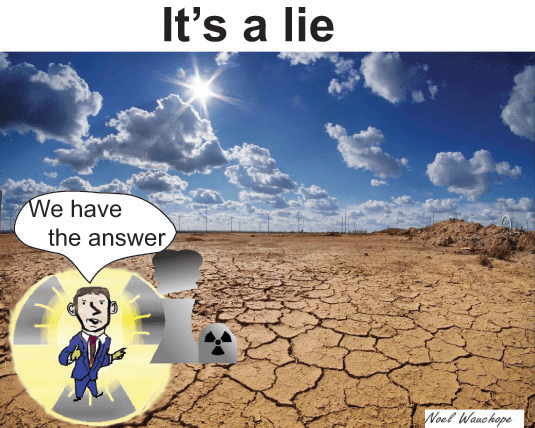
Green New Deal must not include nuclear power, which is not a viable solution to climate change
|
Nuclear power is not a viable solution for Green New Deal https://thehill.com/opinion/energy-environment/437003-nuclear-power-is-not-a-viable-solution-for-green-new-deal, BY DAMON MOGLEN, — 04/02/19 The Green New Deal resolution is a bold and necessary path forward to tackle the climate crisis. To be successful, it must leave nuclear power behind. With just a decade left to stop the worst effects of climate change, we must dramatically transform how we produce, use and pay for energy. And as momentum around the Green New Deal turns into concrete proposals, we must recognize why nuclear power is a discredited and dishonest distraction, not a solution. To reduce global greenhouse gas emissions by 40 to 60 percent by 2030, and down to zero by 2050, we need cost-effective, proven energy generation technology that can be scaled up to meet these benchmarks. Nuclear power does not and will not ever meet these criteria. After 60 years, despite massive subsidies, the nuclear industry is dying of its own accord. Why? Because it’s too expensive, too dangerous and dirty, and takes too long to deploy. Reactors are closing across the country, and major corporations have declared bankruptcy. Nuclear power simply cannot compete against safer, cleaner and cheaper renewable energy. Nuclear power is also expensive. Nuclear’s subsidies have been buried in hundreds of spending bills, it’s costs externalized to the environment and future generations, and its bills literally unpaid, defaulted on or passed to taxpayers. Conservative estimates suggest that the nuclear industry has received more than $85 billion in subsidies. A centrist estimate might double that. For 60 years, nuclear power has posed a serious risk to people and our planet. It will be the same for the next 10,000 years. Our children and generations of their children will be forced to endure the radioactive pollution and fallout from devastating accidents like 3 Mile Island, Fukashima and Chernobyl, and the permanent waste that no one can safely store. The risks of nuclear proliferation and the spread of dangerous weapons and technology only adds to this. Nuclear power is too slow to scale up to our current challenge. Far too slow. In 1997, when the historic Kyoto Protocol was signed, nuclear power’s share of electricity generation globally was around 17 percent. Now, after two decades, the aging fleet of reactors account for barely 10 percent of global electricity generation and about 4.4 percent of global commercial primary energy consumption. Even the nuclear industry’s grandiose and preposterously expensive proposal to build two new nuclear reactors a month, from now to 2050, would be far too little and far too late. The endless talk of a new nuclear technology that will magically transform this problem is a pipe dream that has a proven record of failure. Hundreds of billions were spent on “breeder” reactors and other esoteric designs and not a single one has yielded a commercial scale reactor. And continuing to subsidize and retool current reactors will re-direct massive resources that should be put into renewables, while doing nothing to slow global warming. The task ahead is indeed daunting if we are to turn around global greenhouse gas emissions in the time we have. We must move from a 20th-century energy system based on dirty, dangerous and expensive fossil fuel and nuclear power to a 21st-century energy system based on renewables. The solution is a massive commitment to ramping up renewable energy coupled with energy storage while applying modern energy efficiency technologies to decrease demand. Wind and solar are cheap, clean and proven to work. We must focus all resources on scaling those up. Some have suggested that climate change is so dire that all options must be on the table. But that’s an ideology, not a strategy. We must choose the technologies that will not produce greenhouse gases and can be scaled up quickly, safely and at lowest cost. That means the path ahead must be based on renewable energy. If we want to stop the worse of the climate crisis and pull humanity back from the apocalypse, this is the only way forward. Damon Moglen is a senior strategic advisor to Friends of the Earth, with over 30 years experience campaigning on climate and nuclear issues. |
|
Britains nuclear submarines, intended to harm foreign lands, now pose grave danger at home!
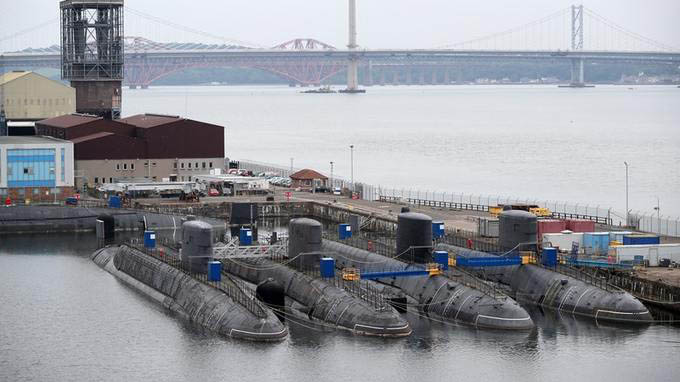
Britain’s ageing nuclear submarines are dangerous, Morning Star 3rd April 2019
https://morningstaronline.co.uk/article/britain%E2%80%99s-ageing-nuclear-submarines-are-dangerous
REVELATIONS that the Ministry of Defence has failed to dispose of any of the 20 nuclear submarines it has decommissioned in nearly 40 years underlines the unique risks associated with nuclear weapons.
What passes for debate in Parliament on our nuclear arsenal is deeply frustrating.
Ministers airily dismiss concerns about the staggering cost of Trident renewal (over £200 billion), ignore advice from top brass that these “useless” weapons swallow up money that would be better spent on conventional equivalents, sidestep questions about whether the ability to incinerate whole cities at the push of a button is a relevant deterrent to modern threats from terrorism to climate change.
Even Tony Blair has said the utility of a nuclear arsenal was “non-existent in terms of military use,” admitting in his memoirs that he only supported renewal when PM because he felt foreigners would see it as “too big a downgrading of our status as a nation” if we voluntarily abandoned it.
Yet his successors portray any attempt to discuss these questions rationally as evidence of being soft on Britain’s security.
They could not be more wrong, as the National Audit Office’s investigation into how we dispose of decommissioned submarines attests.
We have not disposed of a single one since 1980. The MoD has not been in a position to remove radioactive fuel from retired submarines since 2004, when the Office for Nuclear Regulation ordered it to stop as its facilities for doing so — at the Devonport naval base in Plymouth — were not safe enough.
An original plan to have a new disposal process operational by 2011 has now been postponed to 2026; the MoD stores twice as many mothballed nuclear subs as it operates and some have been cooling off in retirement for longer than they ever roamed the seas.
This is not simply a matter of bad organisation or rising costs.
Dr Philip Webber of Scientists for Global Responsibility (SGR) warned in 2017 that of the 12 retired submarines docked at Devonport, eight still contained fuelled nuclear reactors.
These “have to be continually cooled using external power and water to avoid overheating, which could lead to a fire, meltdown or a release of radioactive particles and gases.”
The risks involved in defuelling nuclear reactors are considerable – that’s why the MoD has felt unable to do so safely for 15 years — and older reactors (as we would expect to find on vessels that haven’t been operational for up to 40 years) tend to pose a greater risk of igniting, exploding or releasing radiation if anything goes wrong in the process than newer ones.
In an excellent article published in the SGR newsletter of winter 2017, Dr Webber points out that the MoD is actually aware of how dangerous keeping decommissioned subs knocking around is: following freedom of information requests, minutes of a Defence Board Meeting of 2011 were released.
The MoD’s senior nuclear safety regulator Commodore Andrew McFarlane notes that “all pressurised water reactors are potentially vulnerable to … structural failure,” which could lead to “release of highly radioactive fission products outside the reactor core.”
This would be a public safety hazard “out to 1.5 kilometres” (almost a mile) from the submarine.
Dr Webber estimates that 32,000 residents of Plymouth would fall within that range.
Safely defuelling and disposing of these radioactive hulks should be a priority for any government that takes public
safety seriously.
The enormous difficulties of doing so are a warning of exactly what risks we take on by blithely opting to renew our nuclear weapons programme.
It’s tragic that for most of our politicians “national security” rests on our ability to harm the peoples of other nations, rather than keep people on these shores safe.
“Deadly Dust – Made in the USA: Uranium Weapons Contaminating the World”
 Deadly Dust: US Spreading Radiation and No One Wants to Raise the Issue – Author https://sputniknews.com/analysis/201904031073767110-us-radiation-spread/ In a new book named “Deadly Dust – Made in the USA: Uranium Weapons Contaminating the World” German author Frieder Wagner gives a detailed account of how the US has contaminated vast territories using depleted uranium (DU) ammunition and the cover-up strategy of the military, industry and governments, as well as those in the media and politics.
Sputnik: Mr Wagner, in your book “Deadly Dust — Made in the USA: Uranium Weapons Contaminating the World” you talk about the use of uranium ammunition. What is especially dangerous about these weapons?
Frieder Wagner: Weapons containing uranium are produced from nuclear industry’s waste (byproducts of uranium enrichment). If, for example, you want to produce a ton of natural uranium fuel rods for nuclear power plants, you get about eight tons of depleted uranium. It is a source of alpha radiation — radioactive and, moreover, very poisonous. It needs to be stored somewhere, and it is not very cheap.
Sputnik: How can it be used in weapons?
Frieder Wagner: About 30-40 years ago, military scientists made a discovery: uranium is almost twice as dense as lead. If you turn depleted uranium into a projectile and give it proper acceleration, then within a fraction of a second it will pierce through tank armor, concrete or cement.This, of course, was an important discovery. Furthermore, when a shell hits an armored tank the impact produces dust caused by the detonation and the subsequent release of heat energy causes it to ignite and it explodes at a temperature of 3000 to 5000 degrees — incinerating the tank’s interior and destroying it.
Sputnik: But what happens afterwards is also a problem — after the use of DU ammunition, isn’t it?
Frieder Wagner: Yes! After its use depleted uranium, which, as I have already said, is a source of alpha radiation (that is, a radioactive and very toxic substance), burns down to nano-particles that are a hundred times smaller than a red blood cell.
This way, I would say, a sort of metallic gas forms that people can inhale, and which is released in the atmosphere and can be carried anywhere by wind. People who inhale it are at risk for developing cancer.These nano-particles can also penetrate the body of a pregnant woman, overcoming the barrier between a child and a mother, and affect the health of an unborn baby, can infiltrate the brain and by travelling through the bloodstream end up in any human or animal organ. Everything that goes around the planet, sooner or later settles and, of course, contaminates, in particular, drinking water and everything else.
Sputnik: In what wars have DU weapons been used so far?
Frieder Wagner: It was actively used during the first Gulf war in 1991 against Iraq. The military has admitted that about 320 tons were used. Then in the second war in Iraq in 2003 over 2,000 tons were used. In between, it was used during the war in Kosovo, in Yugoslavia (1999), and in Bosnia in 1995, and after 2001 in Afghanistan, where it still used today.
Sputnik: Your book title says Made in the USA, were these weapons only used by the United States?
Frieder Wagner: They were being developed in several countries at the same time. In Germany, they were also working on these weapons, as, of course, in Russia. However, it was used and on such a large scale, only by the US. They were reckless and they did not pay attention to any possible side effects — just as it was back when the first atomic bombs were used. That’s why I called the book: “Deadly Dust — Made in the USA”.
Sputnik: How did you manage to prove the use of these ammunitions in the course of your research?
Frieder Wagner: For example, the Serbs gave us maps where they showed the locations where depleted uranium was used. When we were in Iraq, we talked to the locals. We traveled to places where large tank battles took place and took soil samples there, as well as dust samples from tanks. Looking at the tank, you can see whether it was hit by an ordinary projectile or a uranium munition.
Uranium munition leaves dust that burns everything around the hole made by the projectile. So you can determine the use of uranium ammunition. In all soil samples, we found depleted uranium. Unfortunately, uranium-236 was also found in most of the soil and dust samples — it is even more intense and poisonous. Its radiation is even stronger and does not occur in nature. It can only be produced artificially during reprocessing of fuel rods. This means that we were able to prove that the military, the United States and its coalition allies used uranium munitions made from spent uranium fuel rods.
Sputnik: Your book is based on the films The Doctor, the Depleted Uranium, and the Dying Children of Basra (Der Arzt und die verstrahlten Kinder von Basra, 2004) and Deadly Dust (Todesstaub, 2007). What did you see in Basra during your work on the documentary?
Frieder Wagner: It was horrific and still sometimes haunts me in my dreams. These were children with deformities, which we saw in orphanages in Basra and Baghdad. Some of them had such deformities that they had almost nothing human anymore.
There were children without a head or a nose, either with one eye or without eyes at all, with internal organs in a kind of “sack” outside their body. These ‘creatures’ can live only for a few hours, experiencing terrible pain, and then die.
putnik: The film “Deadly Dust” is linked to the book, but it is no longer distributed. WDR channel after this film did not make any more orders? Why is that?
Frieder Wagner: My exposes which I sent to WDR, as well as to the ZDF channels were rejected. Then I contacted an editor at WDR, for which I always made good films and with which I always had good relations with, because these films had doubled or trippled their ratings, and asked him: “What’s going on here?”” And after some hesitation he said: “Yes, Frieder Wagner, someone must tell you this. WDR considers you a ‘difficult’ person. And most importantly, the topics you suggest are especially hard. Right now I’ve got nothing more to tell you.” And that when I understood everything. It was in 2005.
I can also tell you the story of how, for example, a female editor at ZDF offered the TV channel a story on the use of these weapons during the war in Yugoslavia and also in Croatia. She wanted to talk about it with me prior so I could share my experiences. But when her boss found out that she wanted to talk to Frieder Wagner, he refused to pay for her trip — without any further explanation.
Sputnik: The so-called “deadly dust” is, as you have already described it, is spread by the wind. So should the use of uranium ammunition, in fact, be considered a war crime and banned?
Frieder Wagner: This is definitely a war crime. The dust from southern Iraq is carried to the north by the constant storms, the so-called desert storms — for example, to Erbil, where it meets the mountains and can’t travel further as the mountains make it difficult for it to go past towards Turkey. So this huge mass of dust settles in Erbil.We, for example, took samples of beef from around Erbil, and this is what we found out: depleted uranium used in ammunition has a characteristic atomic “fingerprint”. In northern Iraq we found the same “uranium fingerprint” as in the south. This means that the uranium dust that had originally settled in the south of Iraq is now also in the north, and children are now getting sick there and are born with deformities. It is now spreading all over the world.
Sputnik: Have the victims of uranium munition use in Kosovo or, for example, in Iraq, tried to go to court?
Frieder Wagner: So far no such attempts have been made in Kosovo or Iraq. Now in Kosovo, a whole group of lawyers are working on a lawsuit against NATO, because after the war they unleashed, people were injured, fell ill and died. The morbidity rate has increased by 20 to 30 percent, and there are more effected each year. So there will be an attempt to file a lawsuit.
Out of the approximately two thousand Italian soldiers stationed in Iraq and Kosovo, 109 have later developed cancer and died — this is proven information. 16 families, out of the 109 dead, filed lawsuits and won their cases. The courts ordered the Italian state or the country’s Ministry of Defence to pay them compensation. Since each cancer was of a different type, the payout amounts differed. But they ranged between 200,000 and 1,4 million euros.
Sputnik: How are things in Germany? Have there been lawsuits filed by the soldiers of the Bundeswehr?
Frieder Wagner: The German Ministry of Defense constantly denies any connection to this. Our soldiers are stationed in Afghanistan and Kosovo. About 100,000 soldiers served in Afghanistan, and we found out that about 30% of those who returned got sick, although at first, of course, they do not notice this. If they subsequently marry and have children, then there’s a great risk that their children will have disabilities.
These children will have the same toxic substances in their DNA as their parents. And this will be passed on for several generations — from children to grandchildren and to great-grandchildren.
Sputnik: But none of these people ever filed a lawsuit?
Frieder Wagner: In Germany there were no such precedents. About 600 servicemen went to court in the United States who could not appeal on their own behalf, but they filed lawsuits on behalf of their children who were born with developmental disabilities. And we’re not talking about a mere 90 or even 900 million pay out, but about billions of dollars now. The United States, of course, will try to delay the adoption of a ruling as much as it is possible and hope for a “biological” resolution of the situation — that is, that the plaintiffs will simply die.
Senators from both parties want details on USA nuclear co-operation with Daudi Arabia

 US Senators Seek Details on Nuclear Power Cooperation with Saudi Arabia VOA News, https://www.voanews.com/a/us-senators-seek-details-on-nuclear-power-cooperation-with-saudi-arabia-/4859672.html 3 Apr 19, U.S. senators from both parties on Tuesday asked Energy Secretary Rick Perry for details about recent approvals for companies to share nuclear energy information with Saudi Arabia, with the lawmakers expressing concern about possible development of atomic weapons.
Saudi Arabia has engaged in “many deeply troubling actions and statements that have provoked alarm in Congress,” Senators Bob Menendez, a Democrat, and Marco Rubio, a Republican, told Perry in a letter, a copy of which was seen by Reuters.
The senators said Congress was beginning to re-evaluate the U.S.-Saudi relationship, and they believe Washington should not be providing nuclear technology or information to Saudi Arabia now.
The Trump administration has been quietly negotiating a deal that would potentially help Saudi Arabia build two reactors.
Last week news reports revealed that since November 2017, Perry has authorized so-called Part 810 approvals allowing U.S. companies to share sensitive nuclear information with the kingdom. The approvals were kept from the public and from Congress.
The senators asked Perry to provide them by April 10 with the names of the companies that got the 810 approvals, what was in the authorizations, and why the companies asked that the approvals be kept secret. U.S. Representative Brad Sherman, a Democrat, also asked the Energy Department in a separate letter what was in the approvals.
While 810 agreements are routine, the Obama administration made them available for the public to read at Energy Department headquarters. Lawmakers say the department is legally required to inform Congress about the approvals.
Perry approved the seven recent authorizations as the administration has tried to hash out nonproliferation standards with Saudi Arabia. Such a pact, known as a 123 agreement, would have to be agreed before U.S. companies can share physical exports of materials and equipment to build reactors.
The kingdom has resisted standards on reprocessing spent fuel and enriching uranium, two potential paths to making nuclear weapons.
The United States has been competing with South Korea, France, Russia and China on a potential deal to help build reactors in Saudi Arabia. The kingdom is expected to announce the winner this year.
Lawmakers from both parties have been concerned about Saudi Arabia’s bombing campaigns in Yemen, which is on the brink of famine, and the killing of journalist Jamal Khashoggi, a U.S. resident, last October in the Saudi consulate in Istanbul.
Concern in Congress grew last year after the kingdom’s Crown Prince Mohammed bin Salman told CBS that “Saudi Arabia does not want to acquire any nuclear bomb, but without a doubt if Iran developed a nuclear bomb, we will follow suit as soon as possible.”
Perry has said the 810 approvals were kept from the public for corporate proprietary reasons……….
At another Senate hearing, the five members of the Nuclear Regulatory Commission, including Chairman Kristine Svinicki, would not say whether the NRC raised any concerns over the 810 approvals in a required consultation with the Energy Department.
Svinicki said the NRC’s consulting role on the approvals is narrow and delegated to staff.
Senator Chris Van Hollen, a Democrat who asked the question of the NRC at the hearing, told Reuters in an interview that the commissioners’ lack of knowledge about the approvals was “stunning.”
“It’s kind of scary because we do rely on them to provide input into this process and not a single commissioner knew anything about what input they may or may not have provided.” https://www.voanews.com/a/us-senators-seek-details-on-nuclear-power-cooperation-with-saudi-arabia-/4859672.html
Research on gene mutations caused by nuclear radiation – Kazakhstan
 Over the years, those who sought care from Dispensary No. 4 or the IRME were logged in the state’s medical registry, which tracks the health of people exposed to the Polygon tests. People are grouped by generation and by how much radiation they received, on the basis of where they lived. Although the registry does not include every person who was affected, at one point it listed more than 351,000 individuals across 3 generations. More than one-third of these have died, and many others have migrated or lost contact. But according to Muldagaliev, about 10,000 people have been continually observed since 1962. Researchers consider the registry an important and relatively unexplored resource for understanding the effects of long-term and low-dose radiation2.
Geneticists have been able to use these remaining records to investigate the generational effects of radiation…….
In 2002, Dubrova and his colleagues reported that the mutation rate in the germ lines of those who had been directly exposed was nearly twice that found in controls3. The effects continued in subsequent generations that had not been directly exposed to the blasts. Their children had a 50% higher rate of germline mutation than controls had. Dubrova thinks that if researchers can establish the pattern of mutation in the offspring of irradiated parents, then there could be a way to predict the long-term, intergenerational health risks.
The nuclear sins of the Soviet Union live on in Kazakhstan https://www.nature.com/articles/d41586-019-01034-8 – 3 Apr 19, Decades after weapons testing stopped, researchers are still struggling to decipher the health impacts of radiation exposure around Semipalatinsk. The statues of Lenin are weathered and some are tagged with graffiti, but they still stand tall in the parks of Semey, a small industrial city tucked in the northeast steppe of Kazakhstan. All around the city, boxy Soviet-era cars and buses lurch past tall brick apartment buildings and cracked walkways, relics of a previous regime.Other traces of the past are harder to see. Folded into the city’s history — into the very DNA of its people — is the legacy of the cold war. The Semipalatinsk Test Site, about 150 kilometres west of Semey, was the anvil on which the Soviet Union forged its nuclear arsenal. Between 1949 and 1963, the Soviets pounded an 18,500-square-kilometre patch of land known as the Polygon with more than 110 above-ground nuclear tests. Kazakh health authorities estimate that up to 1.5 million people were exposed to fallout in the process. Underground tests continued until 1989.
Much of what’s known about the health impacts of radiation comes from studies of acute exposure — for example, the atomic blasts that levelled Hiroshima and Nagasaki in Japan or the nuclear disaster at Chernobyl in Ukraine. Studies of those events provided grim lessons on the effects of high-level exposure, as well as the lingering impacts on the environment and people who were exposed. Such work, however, has found little evidence that the health effects are passed on across generations.
People living near the Polygon were exposed not only to acute bursts, but also to low doses of radiation over the course of decades (see ‘Danger on the wind’). Kazakh researchers have been collecting data on those who lived through the detonations, as well as their children and their children’s children. Continue reading
Local Councils in England, Northern Ireland and Wales reject any involvement in nuclear waste dumping.
NFLA 1st April 2019 The Nuclear Free Local Authorities (NFLA) has submitted its comments of the
Radioactive Waste Management’s (RWM) ‘Site Evaluation’ criteria.
These criteria are supposed to assist RWM in the process to deliver a
suitable site for a deep underground radioactive waste repository should
prospective volunteer communities / Councils interested come forward.
The RWM consultation has been mired in two parallel processes that have led to
considerable concern and even anger expressed by a number of Councils,
particularly in Wales and Northern Ireland – these include a letter from
the UK Government that has gone to all Councils in England, Wales and
Northern Ireland seeking ‘expressions of interest’ in taking part in a
process to find a volunteer location for a deep underground repository; and
RWM placing downloadable films on their website considering the regions of
the three nations and generic geology that may be suitable for such a
facility.
A number of Councils, such as Newry, Mourne and Down and
Fermanagh and Omagh Council in Northern Ireland, and Swansea, Ceredigion
and Powys County Councils in Wales, have passed resolutions expressing
their opposition to such a development in their or neighbouring areas.
Risk of nuclear weapons use is now at a record high

Prospect of nuclear weapons use ‘higher than it has been in generations,’ U.N. disarmament chief says, Japan Times, KYODO. APR 3, 2019
NEW YORK – The head of disarmament at the United Nations warned the international community on Tuesday that the threat of nuclear weapons use has increased because the headway made in the post-Cold War era toward denuclearization has “come to a halt.”
“The disarmament and arms control framework upon which the gains of the post-Cold War era were made is eroding, but we have nothing else yet with which to replace it,” Izumi Nakamitsu, the U.N. undersecretary general and high representative for disarmament affairs, told Security Council members.
The warning was issued at a meeting to discuss the 1970 Nuclear Non-Proliferation Treaty ahead of the next NPT review conference to be held in 2020, when the landmark pact marks the 50th year since its entry into force. The NPT is reviewed every five years.
“As a result, the prospect of the use of nuclear weapons is higher than it has been in generations,” Nakamitsu said.
In February, the United States said it is withdrawing from the 1987 bilateral Intermediate-Range Nuclear Forces Treaty with Russia in response to alleged violations by Moscow, a move that could fuel concerns about a new arms race possibly involving other parties such as China.
The situation has been further exacerbated by the trend of nations increasingly modernizing their nuclear arsenals, as well as relying more on rapidly emerging technology that makes acquiring the dangerous weapons easier, the undersecretary general said………
In the run-up to the NPT review conference to be held for a month from April 2020, a preparatory meeting through May 10 will get underway later this month at the U.N. headquarters. https://www.japantimes.co.jp/news/2019/04/03/world/prospect-nuclear-weapons-use-higher-generationsu-n-disarmament-chief-says/#.XKUUKVUzbGg
USA’s campaign to criminalise whistle-blowing – targets Chelsea Manning and Julian Assange
Collateral Murder?
Chelsea Manning and the New Inquisition Truth Dig, Chris Hedges, 3 Apr 19
The U.S. government, determined to extradite and try Julian Assange for espionage, must find a way to separate what Assange and WikiLeaks did in publishing classified material leaked to them by Chelsea Manning from what The New York Times and The Washington Post did in publishing the same material. There is no federal law that prohibits the press from publishing government secrets. It is a crime, however, to steal them. The long persecution of Manning, who on March 8 was sent back to jail for refusing to testify before a grand jury, is about this issue.
If Manning, a former Army private, admits she was instructed by WikiLeaks and Assange in how to obtain and pass on the leaked material, which exposed U.S. war crimes in Afghanistan and Iraq, the publisher could be tried for the theft of classified documents. The prosecution of government whistleblowers was accelerated during the Obama administration, which under the Espionage Act charged eight people with leaking to the media—Thomas Drake, Shamai Leibowitz, Stephen Kim, Manning, Donald Sachtleben, Jeffrey Sterling, John Kiriakou and Edward Snowden. By the time Donald Trump took office, the vital connection between investigative reporters and sources inside the government had been severed.
Manning, who worked as an Army intelligence analyst in Iraq in 2009, provided WikiLeaks with over 500,000 documents copied from military and government archives, including the “Collateral Murder” video footage of an Army helicopter gunning down a group of unarmed civilians that included two Reuters journalists. She was arrested in 2010 and found guilty in 2013.
The campaign to criminalize whistleblowing has, by default, left the exposure of government lies, fraud and crimes to those who have the skills or access, as Manning and Edward Snowden did, needed to hack into or otherwise obtain government electronic documents. This is why hackers, and those who publish their material such as Assange and WikiLeaks, are being relentlessly persecuted. The goal of the corporate state is to shroud in total secrecy the inner workings of power, especially those activities that violate the law. Movement toward this goal is very far advanced. The failure of news organizations such as The New York Times and The Washington Post to vigorously defend Manning and Assange will soon come back to haunt them. The corporate state hardly intends to stop with Manning and Assange. The target is the press itself………
Manning has always insisted her leak of the classified documents and videos was prompted solely by her own conscience. She has refused to implicate Assange and WikiLeaks. Earlier this month, although President Barack Obama in 2010 commuted her 35-year sentence after she served seven years, she was jailed again for refusing to answer questions before a secret grand jury investigating Assange and WikiLeaks ……
The New York Times, Britain’s The Guardian, Spain’s El País, France’s Le Monde and Germany’s Der Spiegel all published the WikiLeaks files provided by Manning. How could they not? WikiLeaks had shamed them into doing their jobs. But once they took the incendiary material from Manning and Assange, these organizations callously abandoned them. No doubt they assume that by joining the lynch mob organized against the two they will be spared. They must not read history. What is taking place is a series of incremental steps designed to strangle the press and cement into place an American version of China’s totalitarian capitalism……….
“The internet, our greatest tool of emancipation,” Assange writes, “has been transformed into the most dangerous facilitator of totalitarianism we have ever seen.”
That is where we are headed. A few resist. Assange and Manning are two. Those who stand by passively as they are persecuted will be next. https://www.truthdig.com/articles/chelsea-manning-and-the-silencing-of-the-press/
Anger at UK’s Ministry of Defence over mucking about with submarine nuclear waste disposal
The Ferret. Rob Edwards, 2nd April 2019 Plans by the Ministry of Defence (MoD) to rethink the disposal of radioactive waste from 27 defunct nuclear submarines have come under fierce fire from campaigners.
A recent meeting of local authority advisors was told that the MoD is “considering alternative options for the management of the waste”. This is despite previous decisions made after an exhaustive, 16-year public consultation process.
Those who were involved in the consultations are alarmed that the MoD is thinking of changing what has been agreed – and are pressing for more information. It was “incredibly frustrating”, said one critic.
Since the 1980s seven aged nuclear-powered submarines have been taken out of service and laid up at the Rosyth naval dockyard in Fife. Since the 1990s, thirteen more have been laid up at Devonport naval dockyard in Plymouth, nine of them still containing radioactive fuel.
A further three reactor-driven submarines are due to be retired in the next few years. They will be followed by the four Vanguard-class submarines, currently armed with Trident nuclear missiles and based at Faslane on the Clyde.
The MoD began a public submarine dismantling project in 2000. It announced in 2016 that a nuclear plant at Capenhurst in Cheshire had been chosen as an “interim storage site” for radioactive waste.
A proposal to store the waste on a former nuclear site at Chapelcross near Annan in south west Scotland was rejected after objections from the Scottish Government. The Ferret revealed in December that in the past the MoD has contemplated dumping the submarines on the seabed near Scotland.
Work on dismantling the first “demonstrator” submarine, Swiftsure, began at Rosyth in 2016. The MoD said in December 2018 that over 70 tonnes of radioactive and non-radioactive waste had been removed, and that dismantling of a second submarine, Resolution, would start in 2019.
But now future plans have been thrown into confusion by the MoD reportedly having second thoughts. The change of heart was disclosed by the Nuclear Legacy Advisory Forum (NuLeAF), an expert group working with 113 local planning authorities in England and Wales.
A report posted online for a steering group meeting on 20 March outlined NuLeAF’s role in previous submarine dismantling consultations. “The Ministry of Defence, working with the regulators, has now indicated it is considering alternative options for the management of the waste,” it said.
“It is understood that they are in discussion with the Nuclear Decommissioning Authority who will be managing an engagement process to gain stakeholder input.”…….
Campaigners have reacted angrily. “Given the amount of time, effort and public money that went into the consultation process, it is alarming to hear that the MoD now appear to be changing its mind,” said Jane Tallents, who was an advisor to the MoD’s submarine dismantling project.
“I can only guess that in the three years that they have been dismantling the first submarine they have come across problems not anticipated by all the experts who informed the public during the consultation.”
She and others had urged the MoD to extend its “unprecedented openness” on the submarine dismantling project to other areas of policy-making. “It would be disappointing if the project itself does not come clean and tell us what alternative options they are now looking at.”
Edinburgh-based nuclear consultant and critic, Pete Roche, accused the MoD of undermining its prolonged public consultations. “Communities and environmentalists thought the MoD had pulled off the impossible and come up with a consensus on what to do with nuclear waste from submarines,” he told The Ferret.
“Now it seems they want to pour all this hard work down the drain. This is incredibly frustrating and makes you wonder if banging your head against a wall would be more fruitful than getting involved in these consultation processes.”
In January a group including former naval staff campaigning to “Save The Royal Navy” described the failure to promptly deal with submarine waste as “a national scandal”. Progress had been “painfully slow” because “successive governments have avoided difficult decisions and handed the problem on to their successors,” it argued.
An article on the group’s website warned that maintaining the submarines safely while they awaited dismantling was “a growing drain on the defence budget”. It estimated the total cost of disposing of 27 submarines to be at least £10.4 billion over 25 years………. https://theferret.scot/mod-rethink-nuclear-submarines-waste/
1 This Month
Tell Congress: Prevent Nuclear Catastrophe in Iran

Tell Congress: Prevent Nuclear Catastrophe in Iran

Read the Public Inquiry Report, the Commissioners’ report, Surrendering Australia: The AUKUS Deception is available to download for free at aukuspublicinquiry.com. Or just watch the replay of the National Press Club Luncheon.


Shut down the radiation-damaged Heysham nuclear reactors now
To see nuclear-related stories in greater depth and intensity – go to https://nuclearinformation.wordpress.com

Say No to NASA’s Reckless Nuclear Reactor on the Moon
Say No to NASA’s Reckless Nuclear Reactor on the Moon
-
Archives
- November 2026 (215)
- October 2026 (302)
- September 2026 (339)
- August 2026 (330)
- July 2026 (355)
- June 2026 (287)
- May 2026 (306)
- April 2026 (356)
- March 2026 (251)
- February 2026 (267)
- January 2026 (308)
- December 2025 (358)
-
Categories
- 1
- 1 NUCLEAR ISSUES
- business and costs
- climate change
- culture and arts
- ENERGY
- environment
- health
- history
- indigenous issues
- Legal
- marketing of nuclear
- media
- opposition to nuclear
- PERSONAL STORIES
- politics
- politics international
- Religion and ethics
- safety
- secrets,lies and civil liberties
- spinbuster
- technology
- Uranium
- wastes
- weapons and war
- Women
- 2 WORLD
- ACTION
- AFRICA
- Atrocities
- AUSTRALIA
- Christina's notes
- Christina's themes
- culture and arts
- Events
- Fuk 2022
- Fuk 2023
- Fukushima 2017
- Fukushima 2018
- fukushima 2019
- Fukushima 2020
- Fukushima 2021
- general
- global warming
- Humour (God we need it)
- Nuclear
- RARE EARTHS
- Reference
- resources – print
- Resources -audiovicual
- Weekly Newsletter
- World
- World Nuclear
- YouTube
-
RSS
Entries RSS
Comments RSS

