Britains nuclear submarines, intended to harm foreign lands, now pose grave danger at home!
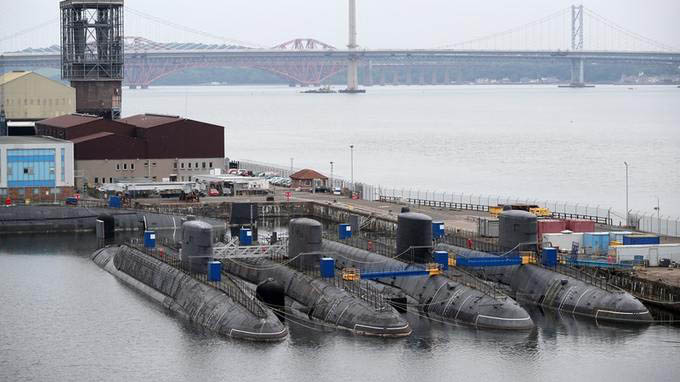
Britain’s ageing nuclear submarines are dangerous, Morning Star 3rd April 2019
https://morningstaronline.co.uk/article/britain%E2%80%99s-ageing-nuclear-submarines-are-dangerous
REVELATIONS that the Ministry of Defence has failed to dispose of any of the 20 nuclear submarines it has decommissioned in nearly 40 years underlines the unique risks associated with nuclear weapons.
What passes for debate in Parliament on our nuclear arsenal is deeply frustrating.
Ministers airily dismiss concerns about the staggering cost of Trident renewal (over £200 billion), ignore advice from top brass that these “useless” weapons swallow up money that would be better spent on conventional equivalents, sidestep questions about whether the ability to incinerate whole cities at the push of a button is a relevant deterrent to modern threats from terrorism to climate change.
Even Tony Blair has said the utility of a nuclear arsenal was “non-existent in terms of military use,” admitting in his memoirs that he only supported renewal when PM because he felt foreigners would see it as “too big a downgrading of our status as a nation” if we voluntarily abandoned it.
Yet his successors portray any attempt to discuss these questions rationally as evidence of being soft on Britain’s security.
They could not be more wrong, as the National Audit Office’s investigation into how we dispose of decommissioned submarines attests.
We have not disposed of a single one since 1980. The MoD has not been in a position to remove radioactive fuel from retired submarines since 2004, when the Office for Nuclear Regulation ordered it to stop as its facilities for doing so — at the Devonport naval base in Plymouth — were not safe enough.
An original plan to have a new disposal process operational by 2011 has now been postponed to 2026; the MoD stores twice as many mothballed nuclear subs as it operates and some have been cooling off in retirement for longer than they ever roamed the seas.
This is not simply a matter of bad organisation or rising costs.
Dr Philip Webber of Scientists for Global Responsibility (SGR) warned in 2017 that of the 12 retired submarines docked at Devonport, eight still contained fuelled nuclear reactors.
These “have to be continually cooled using external power and water to avoid overheating, which could lead to a fire, meltdown or a release of radioactive particles and gases.”
The risks involved in defuelling nuclear reactors are considerable – that’s why the MoD has felt unable to do so safely for 15 years — and older reactors (as we would expect to find on vessels that haven’t been operational for up to 40 years) tend to pose a greater risk of igniting, exploding or releasing radiation if anything goes wrong in the process than newer ones.
In an excellent article published in the SGR newsletter of winter 2017, Dr Webber points out that the MoD is actually aware of how dangerous keeping decommissioned subs knocking around is: following freedom of information requests, minutes of a Defence Board Meeting of 2011 were released.
The MoD’s senior nuclear safety regulator Commodore Andrew McFarlane notes that “all pressurised water reactors are potentially vulnerable to … structural failure,” which could lead to “release of highly radioactive fission products outside the reactor core.”
This would be a public safety hazard “out to 1.5 kilometres” (almost a mile) from the submarine.
Dr Webber estimates that 32,000 residents of Plymouth would fall within that range.
Safely defuelling and disposing of these radioactive hulks should be a priority for any government that takes public
safety seriously.
The enormous difficulties of doing so are a warning of exactly what risks we take on by blithely opting to renew our nuclear weapons programme.
It’s tragic that for most of our politicians “national security” rests on our ability to harm the peoples of other nations, rather than keep people on these shores safe.
1 Comment »
Leave a comment
1 This Month





PLEASE OPPOSE HR 8255 AND S.3639 – bills would accelerate satellite deployment, with no environmental review or safeguards – https://ncstd5li.quorum.us/campaign/169331/
To see nuclear-related stories in greater depth and intensity – go to https://nuclearinformation.wordpress.com
-
Archives
- October 2026 (49)
- September 2026 (339)
- August 2026 (330)
- July 2026 (355)
- June 2026 (287)
- May 2026 (306)
- April 2026 (356)
- March 2026 (251)
- February 2026 (267)
- January 2026 (308)
- December 2025 (358)
- November 2025 (359)
-
Categories
- 1
- 1 NUCLEAR ISSUES
- business and costs
- climate change
- culture and arts
- ENERGY
- environment
- health
- history
- indigenous issues
- Legal
- marketing of nuclear
- media
- opposition to nuclear
- PERSONAL STORIES
- politics
- politics international
- Religion and ethics
- safety
- secrets,lies and civil liberties
- spinbuster
- technology
- Uranium
- wastes
- weapons and war
- Women
- 2 WORLD
- ACTION
- AFRICA
- Atrocities
- AUSTRALIA
- Christina's notes
- Christina's themes
- culture and arts
- Events
- Fuk 2022
- Fuk 2023
- Fukushima 2017
- Fukushima 2018
- fukushima 2019
- Fukushima 2020
- Fukushima 2021
- general
- global warming
- Humour (God we need it)
- Nuclear
- RARE EARTHS
- Reference
- resources – print
- Resources -audiovicual
- Weekly Newsletter
- World
- World Nuclear
- YouTube
-
RSS
Entries RSS
Comments RSS


This is a very good article. What if all the countries with nuclear bombs and nuclear powered vessels gave them up? The world would be so much safer.