nuclear-news

The News That Matters about the Nuclear Industry Fukushima Chernobyl Mayak Three Mile Island Atomic Testing Radiation Isotope

UK’s love-in with “an innovative funding model” does not hide the hideous expense of nuclear power

Guardian 23rd July 2019 Let’s face it: nuclear power is hideously dear and far from ideal. The
government should be backing renewables, not tying itself to an expensive
nuclear future. That bill-payers got stuffed in the deal that brought the
Hinkley Point C project into existence is beyond dispute these days.

Even government ministers barely quibble with the National Audit Office’s
assessment that consumers will be paying through the nose for 35 years.

Instead, the defence has tended to run along these lines: don’t worry,
we’ve triggered a “resurgence” in the nuclear industry in the UK and
the next reactors will be relative bargains.

Now here’s the government’s latest effort to resurrect the show – “an innovative
funding model”. Of course, it’s not really innovative. The “regulated
asset base” (RAB) approach, which could be used at Sizewell B in Suffolk,
and is intended to copy the design of Hinkley, is common in other parts of
the utility world.

Aside from exposing consumers to the cost of overruns,
RAB in effect also requires them to provide financing at zero interest, a
point made by the National Infrastructure Commission last year. Little
wonder, then, that the juice should be cheaper than Hinkley’s – some of
the costs will be hidden from view.

The same NIC report said: “There is limited experience of using the RAB model for anything as complex and risky as nuclear.” Second, no financing model can disguise the core truth about
nuclear – the technology is hideously expensive. Even after recognising
the need to have secure “baseload” supplies, it recommended
commissioning only one more nuclear plant, on top of Hinkley, before 2025.

That remains a commonsense analysis. Renewables are winning the price race.
Let us pray, then, that a love-in with RAB does not reignite ministerial
fantasies about a “resurgence” in nuclear. We don’t want a
resurgence. We want to build as few new reactors as possible.

https://www.theguardian.com/business/nils-pratley-on-finance/2019/jul/23/lets-face-it-nuclear-power-is-hideously-dear-and-far-from-ideal

July 25, 2019 Posted by | business and costs, politics, UK | Leave a comment

Climate change’s impacts on the nuclear industry – wildfires shut down parts of Idaho nuclear research site

Idaho nuclear research site shuts down some operations because of wildfire
The public has not been threatened as the 90,000-acre blaze burns near the Idaho National Laboratory, NBC News, July 24, 2019, By Phil Helsel

A brush fire that has burned about 90,000 acres in Idaho has curtailed much of the staff at one of the nation’s leading nuclear research facilities, officials said Tuesday.

No injuries have been reported, and there has been no damage or threats to buildings at the Idaho National Laboratory since the fire was sparked in grassland near the center about 6:30 p.m. Monday.

“The public has not been threatened at all,” Juan Alvarez, chief operations officer for the national lab, said at a news conference Tuesday…….. https://www.nbcnews.com/news/us-news/idaho-nuclear-research-site-shuts-down-some-operations-because-wildfire-n1033266

July 25, 2019 Posted by | climate change, USA | Leave a comment

UK government commits to ordering mini nuclear reactors from Rolls Royce

Rolls-Royce gets government commitment for mini nuclear reactors UK aero-engine maker seeks to spearhead development of export-led industry https://www.ft.com/content/32ee2100-ad43-11e9-8030-530adfa879c2 Sylvia Pfeifer in London, 24 July 19, 

Although the initial commitment is just £18m, it will allow the consortium to mature the design of the reactors. The move, which is subject to a final sign-off, would still require significant levels of additional investment before the reactors can become a commercial reality. The UK aero-engine maker has long argued that its technology in this sphere should be regarded as a “national endeavour” to develop nuclear skills that can be used to create an export-led industry.

A consortium spokesperson said on Tuesday that the £18m investment would be used to “mature the design, address the considerable manufacturing technology requirements and to progress the regulatory licensing process”. He added: “We believe with early co-investment by the government, this power station design is a compelling commercial opportunity.”

Rolls-Royce and its team, which includes Laing O’Rourke and Arup, was one of several consortiums that bid in an initial government-sponsored competition launched in 2015 to find the most viable technology for a new generation of small nuclear modular reactors (SMRs). Most of these will not be commercial until the 2030s

Supporters argue that they can deliver nuclear power at lower cost and reduced risk. They will draw on modular manufacturing techniques that will reduce construction risk, which has plagued larger-scale projects. However, when a nuclear sector deal was finally unveiled last June, the government allocated funding only for more advanced modular reactors.

MRs, which typically use water-cooled reactors similar to existing nuclear power stations, were omitted from funding even though they were closer to becoming commercial. Rolls-Royce threatened last summer that it would shut down the project if there was no meaningful support from the government.

Ministers have in recent months scrambled to recast Britain’s energy policy after the collapse of plans to build several large reactors and on Monday evening published proposals to finance new nuclear plants by having taxpayers pay upfront through their energy bills. The government added that, as part of its plans to fund advanced nuclear technologies, it would make an “initial award” of up to £18m under the industrial strategy challenge fund to the Rolls-Royce-led consortium in the autumn. The consortium has said any government funding will be matched in part by contributions from the companies as well as by raising funds from third-party organisations.

July 25, 2019 Posted by | business and costs, politics, Small Modular Nuclear Reactors, UK | Leave a comment

Danger in Using Commercial Satellites To Control Nuclear Weapons

Using Commercial Satellites To Control Nuclear Weapons Is A Bad Idea — But
It’s Being Discussed Forbes, Loren Thompson 24 July 19, “……. With the collapse of the Soviet Union and the appearance of new
threats, though, the sense of urgency about nuclear security has waned. The
infrastructure supporting nuclear deterrence has decayed to a point where all three
legs of the strategic “triad”—land-based missiles, sea-based missiles and long-range
bombers—need to be replaced. Meanwhile, the architecture used to command and
control nuclear forces has changed little since the Reagan era.
Against this backdrop, the Chief of Staff of the U.S. Air Force said something curious at a meeting of
the Mitchell Institute on June 26. The institute recently produced a report focused on the need to
modernize technology for nuclear command and control. General David Goldfein opined that ongoing
efforts to network the Air Force were as relevant to control of nuclear forces as conventional forces.
In particular, he mentioned the “rapid and exciting expansion of commercial space”
as a trend that might facilitate the creation of resilient links for communicating with
nuclear forces. I was unaware of the chief’s comments until I saw a story by Mandy
Mayfield of National Defense Magazine entitled, “Air Force Wants To Utilize
Commercial Satellites For Nuclear Command, Control.” The Air Force is responsible
for most of the 200 systems comprising the nuclear command and control system, so
General Goldfein’s thoughts have to be taken seriously even if they are just random
musings.
This particular idea is dangerous.
Commercial satellites lack virtually all of the security features that would be
necessary to assure control of the nuclear arsenal in a crisis. First of all, they are not
survivable against a wide array of threats that China and Russia have begun posing
to U.S. orbital assets, ranging from kinetic attacks to electronic jamming to
electromagnetic pulse. Second, they are susceptible to cyber intrusion via their
ground stations that could impede their performance. Third, they frequently contain
foreign components, including in-orbit propulsion technology made in Russia, which
might be manipulated in a crisis or simply become unavailable during wartime.
Air Force planners presumably know all this, so why would General Goldfein suggest
relying on commercial satellites to execute the military’s most fateful decisions?
Perhaps for the same reason that the Army is backing into reliance on commercial
satellites for its next-generation battlefield networks. There are so many commercial
constellations in operation that it seems unlikely America’s enemies could shut them
all down in wartime, and they are a lot cheaper to use than orbiting dedicated military
satcoms with the requisite capacity and redundancy.
“Resilience” has become the watchword for modernizing military space activities, and
one way of creating resilience is to proliferate the pathways available for vital
communications to a point where adversaries can’t keep up with all the possible

options available to U.S. commanders. The same logic is leading technologists to
propose large numbers of cheap satellites in low-earth orbit as an adjunct to existing
military satcoms.
These “cheapsats” wouldn’t be anywhere near as capable as the secure
communications assets that Washington has placed in geostationary orbits, but there
would be so many that links could be sustained even in highly stressed
circumstances, such as the “trans-attack” phase of a nuclear war.
Or at least, so the reasoning goes.
……But the idea of relying on commercial satellites for command and control of
nuclear forces takes this reasoning a step too far, because market forces preclude
any of the hardening and other protective features that might be required in dedicated
military birds
……… think of all the ways an adversary like China might seek to interfere with
commercial satellites through their ground stations and uplinks, such as insertion of
malware via hacking and jamming of signals. ……..

https://www.forbes.com/sites/lorenthompson/2019/07/23/using-commercial-satellites-to-control-nuclear-
weapons-is-a-bad-idea-but-its-being-discussed/#2da6f0751dfa

July 25, 2019 Posted by | USA, wastes, weapons and war | Leave a comment

In Texas oil town Andrews , there’s support for hosting nuclear waste dump

July 25, 2019 Posted by | politics, USA, wastes | 2 Comments

USA’s Sensible, Timely Relief for America’s Nuclear Districts Economic Development (STRANDED) Act

Wiscasset could get $8 million for storing nuclear waste  https://www.pressherald.com/2019/07/24/wiscasset-could-get-8-million-for-storing-nuclear-waste/   A bill before Congress would compensate communities who store spent nuclear fuel that the federal government has failed to remove.

July 25, 2019 Posted by | politics, USA, wastes | Leave a comment

UK consumers to start paying for nuclear reactors before they are built

Guardian 23rd July 2019 The government has confirmed plans for consumers to begin paying for new nuclear reactors before they are built, and for taxpayers to pay a share of
any cost overruns or construction delays. In a consultation document
launched on Monday night, officials said the model is “essential” to
attract private investors to back the UK’s new nuclear ambitions at a
price that is affordable for bill payers. The public purse would also
compensate nuclear investors if the project was scrapped. The new funding
structure could be used to prop up EDF Energy’s £16bn plans for a new
nuclear reactor at Sizewell B in Suffolk, which was left in doubt after
fierce criticism of the costs surrounding the Hinkley Point C project in
Somerset.

https://www.theguardian.com/business/2019/jul/23/new-uk-nuclear-plants-government-cost

July 25, 2019 Posted by | business and costs, politics, UK | Leave a comment

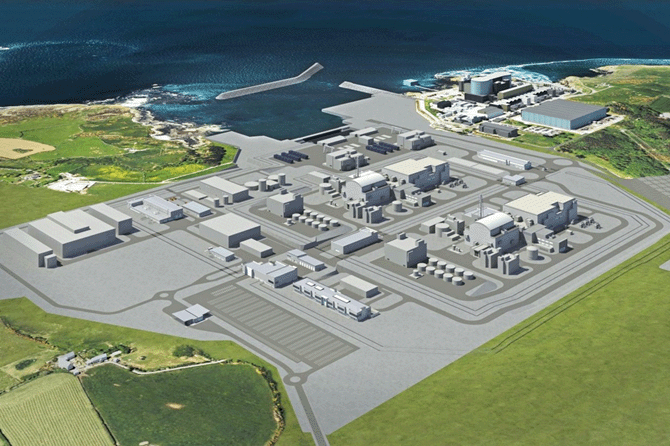
Nuclear developer Horizon says UK government funding essential for restarting Wylfa

Nuclear funding proposal ‘essential’ for restarting Wylfa, BBC, 23 July 2019  

New ways to fund nuclear projects could be an “essential step” to restarting the shelved Wylfa Newydd scheme, developer Horizon has said.

Proposals announced by the UK government include electricity customers paying for part of nuclear schemes’ costs upfront through bills.

The £15bn scheme on Anglesey was suspended in January because of rising costs.

A Horizon spokesman said it “warmly welcomed” the announcement. He added: “As we said when we announced the suspension of our projects, a new funding and financing model is one of the essential steps if we are to potentially restart our development activities.

“We will now look in detail at what the government has set out and continue our engagement with them on this issue.”

The suggested model, known as RAB (Regulated Asset Base), has already been used to finance some large infrastructure projects, including the £4.2bn Thames Tideway “super-sewer”.

It allows investors to receive returns before the projects have been completed. The government said RAB had “the potential to attract significant investment for new nuclear projects at a lower cost to customers.”

But it said “significant challenges” remained, including raising capital and creating appropriate risk sharing arrangements.

The government has invited responses to the proposals, set out in a consultation paper. A White Paper on energy is expected later in the year……https://www.bbc.com/news/uk-wales-49085776

July 25, 2019 Posted by | business and costs, politics, UK | Leave a comment

UK Ministers insist on new nuclear plants, on the premise of ‘climate action’

Leaked government analysis reveals UK demand for new nuclear power plants, Times, 23 July 19,  Britain needs to build a fleet of nuclear or carbon-capture power plants equivalent to a dozen Hinkley Point Cs to hit climate change targets, a leaked government analysis suggests.

Up to 40 gigawatts of non-intermittent low carbon power stations could be needed in 2050 to reduce Britain’s emissions to “net zero”, ministers believe.

Just one is under construction: EDF’s 3.2-gigawatt Hinkley Point C nuclear power station in Somerset.
Greg Clark, the business secretary, disclosed the estimates to industry in a private meeting on Monday as his department published plans for a new funding model to support such plants.

The proposed “regulated asset base” (RAB) model would see consumers pay for the plants on their bills during construction, but would expose them and taxpayers to the… (subscribers only)  https://www.thetimes.co.uk/article/reforms-in-funding-planned-to-meet-demand-for-nuclear-power-plants-j3n0mln0l

July 25, 2019 Posted by | politics, UK | Leave a comment

North Korea’s new submarine

North Korea just revealed one of its most potentially dangerous weapons yet

The revelation is clearly a message for Trump.

July 25, 2019 Posted by | North Korea, weapons and war | Leave a comment

In UK, consumers on hook for cost overruns at nuclear plants

Consumers on hook for cost overruns at nuclear plants, Emily Gosden, Times 23rd July 2019 ,Energy consumers and taxpayers could have to pay for cost overruns at new nuclear plants after the government backed a funding model proposed by EDF.

The business department said last night it believed the “regulated asset
base” model that the French energy giant wants for its proposed Sizewell
plant in Suffolk could reduce consumer bills compared with the subsidy
contract used to back the £20 billion Hinkley Point plant EDF is building
in Somerset.
A consultation document published last night confirms that
consumers would, however, be asked to start paying for the plants on energy
bills while they were still under construction and to share in the risks of
cost overruns.
In the case of an extreme overrun, the government –
effectively the taxpayer – could either have to step in and pay the extra
cost or scrap the project and pay compensation to investors. Under the
regulated asset base model, the developer would receive a regulated price
to give it a return on its investment expenditure, including during the
construction period, and this would be levied on energy bills.

https://www.thetimes.co.uk/article/17cbe1b8-acbd-11e9-b657-11944f524f2a

July 25, 2019 Posted by | business and costs, politics, UK | Leave a comment

Push to speed up decommissioning of Three Mile Island Nuclear Plant

TMI nuclear plant can’t go away fast enough, some neighbors and ’79 accident survivors say, Penn Live Jul 23,   By 

As jarring as the closure of the Three Mile Island One nuclear power station is to longtime Harrisburg-area residents, a cadre of them told Nuclear Regulatory Commission officials Tuesday they’d like the plant’s planned decommissioning to take a faster track.

It’s known in NRC lingo as DECON, and it can allow for the deconstruction, clean-up and re-use of closed nuclear plants in less than a decade, as opposed to the six decade-plus track Three Mile Island Unit One’s owners, Exelon Generation, has started planning for.

Several longtime TMI watchdogs, born of the notorious 1979 partial meltdown at the adjacent Three Mile Island Two reactor, said the desire for speed is partly a matter of good riddance, and a world-weary resignation that past promises about the troubled plant have not panned out.

“How many dog and pony shows can you (the NRC) bring to Harrisburg over the last 40 years?” asked longtime TMI activist Gene Stilp, bemoaning the fact that under the current safe storage plan the island would be a nuclear waste dump long past the lifetimes of any current residents.

Stilp called on Exelon, and elected officials who fought for TMI’s economic preservation over the last two years, to put the decommissioning on a faster track to preserve more of the region’s existing nuclear-related jobs in the short term and allow for a faster rehabilitation of the site.

“You could start getting jobs for clean-up right now,” Stilp said. “Get retrained in some fashion and set up things for that. But you could actually have jobs right now and start on that. Not just monitoring the site… Start providing jobs right now, by starting the clean-up right now.

“This bargain with the devil to store it (spent nuclear fuel) on the Susquehanna River is an abomination to the river, an abomination to the citizens who live here…. and it provides more terrorist targets in a big way.”

NRC officials noted Tuesday it is ultimately the licensee’s decision whether to put a plant into safe storage or rapid decontamination.

Exelon’s current timeline calls for the site to spend most of the next 60 years in a “dormancy” stage, in which most activity will center around storage of spent fuel, and a wait for residual contamination levels to naturally break down until major reactor buildings and components can be dismantled.

Exelon, however, has recently changed paths with other retired nuclear plants – including one in New Jersey this year……..

There are other ways to join the TMI decommissioning conversation. Written comments on the report can be submitted through Oct. 9 either:

July 25, 2019 Posted by | decommission reactor, USA | Leave a comment

Lack of documentation on environmental impact – call for scrapping Sizewell nuclear project

TASC 22nd July 2019 Together Against Sizewell C (TASC) has called for plans for a twin nuclear
reactor development at Sizewell to be scrapped after the fourth
consultation documentation reveals no new data upon which to judge the true
environmental, social or infrastructure impact.

Having reviewed the documentation, TASC expressed extreme disappointment, although not
surprise, at the lack of extra detail included. Chris Wilson, TASC Press
Officer, said “Many respondents to the stage 3 consultation asked for
more environmental information.

Yet, despite EDF promising that the
Environmental Impact Assessment (EIA) would play a “key role” in
finalising their proposals, we now know that these will not be available
until the Development Consent Order (DCO) is submitted to the Planning
Inspectorate. Therefore, the environmental impact on people, places, flora
and fauna, will not be available for public consultation before EDF submit
their DCO. This makes the job of making an accurate assessment of EDF’s
plans impossible”.

https://www.tasizewellc.org.uk/

July 25, 2019 Posted by | environment, opposition to nuclear, UK | Leave a comment

A dangerous idea to abandon nuclear arms treaties with Russia

Abandoning nuclear arms treaties with Russia is bad idea  https://www.yorkdispatch.com/story/opinion/contributors/2019/07/22/op-ed-abandoning-nuclear-arms-treaties-russia-bad-idea/1795240001/

Ivo Daalder, Chicago Tribune  July 22, 2019  For more than 50 years, the United States and Russia have agreed that their own security required negotiating agreements limiting their nuclear weapons deployments and capabilities. In that time, the two countries have successfully concluded seven major agreements to reduce their nuclear arsenals. The last of these, the New Strategic Arms Reduction Treaty, or New START, was signed in 2010 and capped each side’s deployed warheads at 1,550.

Yet, the nuclear arms control edifice that was built up over half a century is in danger of coming apart. The Trump administration has decided to withdraw from one major agreement, the Intermediate-range Nuclear Forces (INF) Treaty, citing Russian violations. And it has shown no interest in extending New START before it expires 18 months from now.

Behind both decisions is the idea that U.S.-Russian arms control has become an anachronism, and that future arms control efforts must now also include Chinese capabilities. While Russia’s apparent deployment of a banned ground-based nuclear missile provided the formal reason for abandoning the INF Treaty, President Donald Trump also cited China’s unconstrained deployment of intermediate-range missiles as a justification for ending the agreement. And rather than extending New START for five years, administration officials suggest that any future accord must also limit Chinese nuclear weapons.

After more than 50 years of U.S.-Russian arms control negotiations and agreements, there is scope for thinking anew about how best to reduce nuclear dangers. But abandoning long-standing agreements and conditioning any new negotiations on including China are not the best way to do that.

It took the United States and Soviet Union standing at the very brink of nuclear war, at the height of the Cuban missile crisis in 1962, to understand the importance of managing their nuclear capabilities through negotiations.

After the crisis, both countries instituted a hotline so they could communicate to avert misunderstandings. They agreed to ban above-ground nuclear testing and negotiated a treaty to limit the spread of nuclear weapons. And they began the effort to limit and ultimately reduce the number and type of weapons each side could deploy. As important, both accepted intrusive inspection regimes designed not only to verify compliance with the terms of the agreements but to enhance mutual confidence that neither side was seeking a decisive nuclear advantage.

The true lesson of the Cuban missile crisis was that countries could miscalculate each other’s actions and intentions, raising the very real risk of nuclear confrontation. The commitment to dialogue, to engage in extensive talks on strategic stability and negotiate real limits on capabilities, and to open each country up to foreign inspectors, helped create confidence that for all the differences between them, the United States and Russia shared an overriding need to avoid a nuclear war.

That effort has proven exceedingly successful. Nuclear arsenals, though still far too large, have been sharply reduced. Nuclear crises like Cuba have been avoided. And while there have been questions about compliance, none of the violations ever constituted a threat so dire as to heighten the risk of nuclear confrontation.

U.S.-Russian arms control has worked in its most fundamental aim — to reduce the chance of war, especially nuclear war. That is why the decision to withdraw from the INF Treaty next month is a mistake. The new Russian missile deployment is a violation and has to be addressed, and the treaty contains procedures for doing so. If the violation persists, there are ways to punish Russia, through sanctions and other means. But withdrawing from a treaty that has served the United States and its European allies well for decades risks an arms race that is destabilizing and unwinnable.

The same is true for New START. Russia has indicated it is willing to extend its terms for five years. The United States has nothing to lose by agreeing to its extension, thus limiting Russian nuclear deployments and extending the highly intrusive inspection measures that provide real insight into Russian capabilities.

There is a case to be made for including China in future nuclear negotiations, though its nuclear deployments of some 200 weapons is but a small fraction of what the United States and Russia still possess. Russia, moreover, will no doubt also insist on including the similarly-sized French and British nuclear forces in such a multilateral negotiation, a prospect that neither Paris nor London is likely to welcome.

It will no doubt take time, and real effort, to decide on a new negotiating framework beyond the two major nuclear powers. Until such time, both Washington and Moscow will be much better off if the nuclear framework they have developed over the past 50 years remains in place.

— Ivo Daalder is the president of the Chicago Council on Global Affairs and a former U.S. ambassador to NATO.

July 23, 2019 Posted by | 2 WORLD, politics international, weapons and war | Leave a comment

40 years, $2.5bn costs for 4 Fukushima Daini nuclear reactors to be shut down

Tepco to retire remaining reactors in Fukushima  https://asia.nikkei.com/Business/Companies/Tepco-to-retire-remaining-reactors-in-Fukushima  Decommissioning is expected to take 40 years and cost $2.5bn JULY 20, 2019  TOKYO — Tokyo Electric Power Co. Holdings will scrap the four Fukushima Prefecture reactors that escaped damage in the 2011 earthquake and tsunami, moving to decommission all of the nuclear power plants the public utility owns in the disaster-stricken region.

The shutdown of the Fukushima Daini plant, which is located just 12km away from the Daiichi Plant crippled by fuel meltdowns, will be formally authorized at the company’s board meeting at the end of the month. This marks the first decision by the utility, known as Tepco, to decommission nuclear reactors apart from the Daiichi facilities.

Costs for decommissioning Fukushima Daini are estimated to exceed 270 billion yen ($2.5 billion). While Tepco’s reserves are not enough to cover them, the government adopted new accounting rules allowing operators to spread a large loss from decommissioning over multiple years. The company also believes it has secured enough people with necessary expertise to move forward.

Tepco soon will inform Fukushima Gov. Masao Uchibori of its decision. The utility intends to submit the decommissioning plan to Japan’s Nuclear Regulation Authority by March next year.

The decision means all 10 reactors in Fukushima will be scrapped. The Daini reactors will be decommissioned in roughly 40 years, sharing the same timetable as the Daiichi site. Tepco owns one other nuclear plant, the Kashiwazaki-Kariwa facility in Niigata Prefecture.

The Daini plant, where each reactor produced 1.1 gigawatts of power, served the Tokyo area for about three decades. Japan’s central government sought to restart the complex but faced withering opposition from local residents in Fukushima.

Including the Fukushima Daini facilities, a total of 21 reactors across Japan are now slated for decommissioning. Recent additions include two units at the Ikata plant in Ehime Prefecture and one reactor at the Onagawa facility in Miyagi Prefecture.

July 23, 2019 Posted by | decommission reactor, Japan | Leave a comment





