Emergency talks on nuclear deal constructive but inconclusive, Iranian minister says WP, By Adam Taylor, July 28
DUBAI — Iran’s deputy foreign minister said Sunday that an emergency meeting in Vienna between Tehran and its partners in the Iran nuclear deal had yielded positive developments but had not “resolved everything.”
“The atmosphere was constructive, and the discussions were good,” Abbas Araghchi told reporters.
Araghchi said he and his partners from Germany, France, Britain, China, Russia and the European Union remain determined to save the deal.
The fate of the agreement remains uncertain after the Trump administration pulled out last year and reimposed sanctions on Iran. That move prompted Tehran to scale back its commitments under the pact.
Iran said this month it had breached a stockpile limit for low enriched uranium allowed under the deal and was enriching uranium at a higher levelthan permitted. Officials have said they will continue to reduce their obligations if the remaining parties to the deal do not help alleviate Iran’s economic isolation.
Salehi also said Iran was moving to restart activity at the heavy-water nuclear reactor at its Arak facility, according to the reports.
Iran’s uranium enrichment capabilities and its heavy-water nuclear reactor were restricted under the 2015 deal, formally known as the Joint Comprehensive Plan of Action, for fear that they could be used by Iran to pursue a nuclear weapons program.
To be used in nuclear weapons, uranium must be highly enriched. The JCPOA placed a limit on the amount of enriched uranium Iran could possess and the level to which it could be enriched.
The claim that Iran’s enriched-uranium stockpile had exceeded the 300-kilogram limit was subsequently confirmed by the International Atomic Energy Agency. But in Iranian media on Sunday, Salehi was reported to have said that it went further than this………
The IAEA did not immediately respond to a request for comment.
Analysts see Arak’s heavy-water reactor as a risk for proliferation because it could allow Iran to produce weapons-grade plutonium. The nuclear deal required Iran to pour concrete into the pipes of the reactor’s core as part of a redesign.
Salehi said last week that the redesign, in partnership with China and Britain, was making progress. Britain replaced the United States in the project after the Trump administration pulled out of the nuclear deal.
In his meeting with lawmakers on Sunday, Salehi was reported to have said that the developments were not indicative of an intent to produce nuclear weapons.
“We do not intend to produce nuclear weapons because of religious reasons,” lawmaker Mehrdad Lahouti quoted Salehi as saying, according to the Iranian Students News Agency.
Though Iran and Britain are working together on the heavy-water reactor, relations between the countries have been tense in recent weeks, since British marines helped seize an Iranian-flagged tanker near Gibraltar and Iran seized a British-flagged tanker that was passing the Strait of Hormuz in the Persian Gulf.
https://www.washingtonpost.com/world/iran-has-24-tons-of-enriched-uranium-and-is-preparing-to-restart-heavy-water-nuclear-reactor-official-claims/2019/07/28/485d387e-b111-11e9-b071-94a3f4d59021_story.html?utm_term=.5388ca6823bf
July 29, 2019
Posted by Christina Macpherson |
EUROPE, Iran, politics international |
Leave a comment
Barreling Toward a Nuclear and Ballistic Missile Arms Race in the Middle East By Dr. James M. Dorsey BESA Center Perspectives Paper No. 1,239, July 28, 2019 EXECUTIVE SUMMARY: The Middle East is barreling toward a nuclear and ballistic missile arms race. That race is being aided and abetted by a US policy that views the region through the dual prism of the need to stop an aggressive, expansionary, and destabilizing Islamic Republic that seeks to dominate it, and the view of the region as a lucrative market for the US defense and nuclear industry.
US policy is not the only factor feeding the burgeoning nuclear and ballistic missile arms race in the Middle East. It is also being enabled by the inability or unwillingness of the other major powers – Europe, Russia, and China – to counter crippling US sanctions against Iran in ways that would ensure that Tehran maintains an interest in adhering to the 2015 international agreement that curbed its nuclear program despite last year’s US withdrawal from the deal.
With the Middle East teetering on the brink of a military confrontation, Iran has vowed to start breaching the agreement next month if the international community, and particularly Europe, fails to shield it from US sanctions.
Former International Atomic Energy Agency (IAEA) deputy director general Olli Heinonen, a hardliner when it comes to Iran, asserted recently during a visit to Israel that Iran would need six to eight months to enrich uranium in the quantity and quality required to produce a nuclear bomb.
US and Chinese willingness to lower safeguards in their nuclear dealings with Saudi Arabia further fuels Iranian doubts about the value of the nuclear agreement and potentially opens the door to a nuclear arms race.
US Secretary of State Mike Pompeo recently visited Saudi Arabia and the UAE before joining President Trump for visits to India and South Korea and talks with world leaders at a G20 summit in Japan.
“We’ll be talking with them about how to make sure that we are all strategically aligned, and how we can build out a global coalition, a coalition not only throughout the Gulf states, but in Asia and in Europe…to push back against the world’s largest state sponsor of terror,” Pompeo said as he departed Washington.
Trump detailed the prism through which he approaches the Middle East in a wide-ranging interview with NBC News. He deflected calls for an FBI investigation into last October’s murder by Saudi government agents of journalist Jamal Khashoggi in the kingdom’s consulate in Istanbul.
“Iran’s killed many, many people a day. Other countries in the Middle East ― this is a hostile place. This is a vicious, hostile place. If you’re going to look at Saudi Arabia, look at Iran, look at other countries,” Trump said, suggesting that crimes by one country provide license to others…….. https://besacenter.org/perspectives-papers/middle-east-arms-race/
July 29, 2019
Posted by Christina Macpherson |
MIDDLE EAST, weapons and war |
Leave a comment
 Individuals must get involved to help rid world of nuclear weapons, Asahi Shimbun , By ROY K. AKAGAWA/ AJW Staff Writer. July 28, 2019 HIROSHIMA--With a treaty to ban medium-range, ground-based nuclear missiles ending in less than a week, an international symposium here on July 27 addressed stopping a new Cold War from breaking out.
The International Symposium for Peace: The Road to Nuclear Weapons Abolition was sponsored by the Hiroshima city government, the Hiroshima Peace Culture Foundation and The Asahi Shimbun. The theme for this year’s event was “Stop the New Cold War.”
In his keynote speech, Masaru Sato, an author and former Foreign Ministry intelligence analyst, said that the high level of nationalism and realism demonstrated by leaders around the world in terms of nuclear weapons and defense policy represented a risk that had to be changed.
He explained that history often swung like a pendulum between realism and idealism as well as between nationalism and international cooperation.
“Military escalation usually occurs when the pendulums swing in the direction of realism and nationalism,” Sato said. “But such escalation eventually spreads a sense of crisis among the leaders of those nations that have been building up their military arsenals and have led to courageous efforts to stop a nuclear disaster.”
He cited as an example the Intermediate-Range Nuclear Forces Treaty agreed to in 1987 by U.S. President Ronald Reagan and Soviet Union General Secretary Mikhail Gorbachev to remove intermediate-range nuclear missiles from Europe. ……
“We as citizens must demand of our own leaders that they enter seriously into dialogue that leads to the abolition of nuclear weapons.”
Meanwhile, the other participants in the panel discussion touched upon the importance of moving toward actual implementation of the Treaty on the Prohibition of Nuclear Weapons (TPNW), which was passed in July 2017 with the approval of 122 nations, although none of the nuclear states as well as those protected by a nuclear umbrella, such as Japan, took part.
Bonnie Docherty, a lecturer at the Harvard Law School International Human Rights Clinic who was actively involved in the TPNW, said the principles of humanitarian disarmament were the key in leading to the passage of the treaty after years of little, if any, progress on eliminating nuclear weapons.
“Emphasizing the humanitarian threat made nuclear weapons a matter of global concern and motivated countries to look beyond their national interests,” Docherty said about the treaty. “In so doing, it helped break down the barriers to diplomatic action that had stalled nuclear disarmament.”
She addressed the concerns of some that the TPNW appears to have provisions that do not make it compatible with other international obligations. In Japan’s case, that would be the Nuclear Nonproliferation Treaty (NPT) to which it is a party as well as the nuclear umbrella provided by the United States.
By joining the TPNW, Japan would comply more fully with the NPT’s Article VI obligation (to work toward reducing nuclear weapons) and advance that treaty’s purported goal of general and complete disarmament,” she said.
She added that the treaty does not prohibit the alliance Japan has with the United States and noted that the Security Treaty between the two nations makes no mention of nuclear weapons.
Moreover, she said, Japan joining the TPNW would have a huge symbolic effect and place Japan in a leadership role in nuclear disarmament because it is the only nation that has been hit in war by atomic bombs. She added that as a nuclear umbrella state, Japan joining the treaty could have a domino effect on other nations that are also currently under a similar umbrella……… http://www.asahi.com/ajw/articles/AJ201907280029.html
July 29, 2019
Posted by Christina Macpherson |
2 WORLD, weapons and war |
Leave a comment
At crisis talks, Iran links tanker row to nuclear deal, Aljazeera 29 Jul 19
Envoys from UK, Germany, France, Russia, China and Iran met in Vienna to discuss how to salvage historic 2015 pact. Iran considers Britain’s seizure of an Iranian oil tanker a breach of the 2015 nuclear deal, a senior official said on Sunday, as remaining signatories to the ailing accord met in the Austrian capital for emergency talks.
Britain, France, Germany, Russia, China and Iran have been trying to salvage the landmark pact since the United States withdrew from it in May 2018 and re-imposed sanctions on Tehran, crippling an already weak economy.
Iran-Europe ties are under strain, however, after British authorities detained an Iranian oil tanker carrying two million barrels of crude off the coast of Gibraltar earlier in July. They cited alleged violations of European Union sanctions against Syria for the move.
Days later, Iranian forces impounded a British-flagged ship in the Strait of Hormuz. …….. https://www.aljazeera.com/news/2019/07/crisis-talks-iran-nuclear-deal-set-kick-vienna-190728072008700.html
July 29, 2019
Posted by Christina Macpherson |
Iran, politics international |
Leave a comment
River of radiation: Life in the area of the world’s 3rd-worst nuclear disaster Rt.com 28 Jul, 2019 Before Fukushima and Chernobyl, the worst-ever nuclear disaster was a massive leak from a plant in the eastern Urals. RT went to see how people live in areas affected by the fallout from the USSR’s risky rush to the nuclear bomb.
Chernobyl and Fukushima are the two names that are most likely to come to mind when one thinks about nuclear disaster, and rightfully so. People in the US will likely recall the Three Mile Island accident, while Britons may say the “Windscale fire.”
The name “Kyshtym” will probably mean nothing to the wider public, despite it belonging to the third-worst nuclear accident in history. An RT Russian correspondent traveled to the area to speak with locals, some of whom personally witnessed the 1957 disaster, to find out what living in such a place feels like.
Bomb at any cost
Kyshtym is the name of a small town in what is now Chelyabinsk Region in Russia, located in an area dotted by dozens of small lakes. A 15-minute car ride east will bring you to another town called Ozyorsk. Six decades ago, you wouldn’t find it on any publicly available map because it hosted a crucial element of the Soviet Union’s nascent nuclear weapons program, the Mayak plant.
The Soviet leadership considered building up a stockpile of weapons-grade plutonium to be a high priority, while environmental and safety concerns came as an afterthought. Some of the less-dangerous radioactive waste from Mayak was simply dumped into the Techa River, while the more-dangerous materials were stored in massive underground tanks.
The sealed steel containers, reinforced with meter-thick concrete outer walls, were considered strong enough to withstand pretty much anything. In September 1957 this assumption was proven wrong, when one of the tanks exploded with an estimated power of 70-100 tons of TNT. This happened due to an unrepaired cooling system, which allowed radioactive waste to build heat and partially dry up, forming a layer of explosives, an investigation later found. An accidental spark was then enough to blow off the 160-ton lid of the tank, damage nearby waste storages, and shatter every window pane within a 3km radius.
A plume of radioactive waste was ejected high into the air. Some 90 percent of the material fell right back, contaminating the area and adding to the pollution in the Techa River, but some was atomized and traveled northeast with the wind. A 300km long, 10km wide stretch of land running through three Russian regions is what’s left by the fallout. The worst-affected part of it was designated a natural reserve a few years after the disaster.
Cover up
The disaster was covered up in the Soviet media, which reported that the strange lights in the night sky – actually a glow caused by ionization from radioactive waste – was a rare event related to the aurora. The locals knew something was wrong, of course, due to the evacuation of two dozen nearby villages and the large-scale decontamination work that was to be carried out over the next several years.
Later, the military came to get radiation readings in it. Afterwards, soldiers demolished the banya and took away not only the house but even the layer of soil on which it was built.
Officially, the scale of the disaster remained a state secret until the late 1980s.
Poisoned river
The Techa River remains contaminated now, long after Mayak stopped dumping waste in it. The radiation is relatively low, however: standing next to it is no worse than traveling on an airplane. Thousands of people cross it every day via a bridge road that connects Chelyabinsk and Ekaterinburg – the two nearest provincial capitals.
The only inhabited village down the river is called Brodokalmak and is about 85km downstream from Ozyorsk, and 50km away from the bridge crossing …….
Ghost village
Halfway between the bridge and Brodokalmak is another village, Muslyumovo. It was inhabited until about a decade ago, when Rostatom, the Russian nuclear monopoly, offered to relocate its 2,500 residents. Now it’s a ghost village………
Triple exposure
Another place that had a close brush with Mayak’s waste is Metlino, a town about 25 minutes east from Ozyorsk. Some residents were unfortunate enough to have been exposed to radiation three times in their lives, according to Lyudmila Krestinina, who heads a lab at a local radiation research medical center.
First, they lived on the Techa River when it was used to dump waste. Then the disaster happened, and the cloud went past, close enough for some fallout but not close enough for it to become a major risk. The third time happened in 1967.
“There was drought and the Karachay bog, where waste was dumped from the Mayak, caught fire. The wind brought radioactive smoke over Metlino,” she said. “Now the contamination level has decreased several times, but it’s still higher than background radiation.”
The bog used to be a lake in the early days of Mayak, which started to dry up in the 1960s. The 1967 incident prompted major landscaping work to cover its shallow parts with earth and provide greater water supply. This solution was ultimately deemed unfeasible, so the rest of the lake was covered as well. The work ended just four years ago. ……. https://www.rt.com/russia/465243-kyshtym-nuclear-disaster-mayak/
July 29, 2019
Posted by Christina Macpherson |
environment, incidents, Reference, Russia |
Leave a comment
A Dead Man Was Cremated in Arizona Without Anyone Realising He Was Radioactive, Science Alert PETER DOCKRILL, 28 JUL 2019
In 2017, a 69-year-old man with pancreatic cancer went to hospital with abnormally low blood pressure. Sadly, he died only two days later, and his remains were cremated.
What nobody at the hospital or the crematorium knew, was that this hadn’t been the man’s only recent trip to hospital. ust one day earlier, in fact, he had been injected with a radioactive compound at another hospital to treat his tumour – and when his mortal remains were incinerated, this radioactive and potentially dangerous dose of lutetium Lu 177 dotatate was still inside his body.
This alarming case, reported in a research letter published in February this year, illustrates the collateral risks potentially posed by on average 18.6 million nuclear medicine procedures involving radiopharmaceuticals performed in the US every year.
While rules regulate how these drugs are administered to living patients, the picture can become less clear when those patients die, thanks to a patchwork of different laws and standards in each state – not to mention situations like the 69-year-old man, whose radioactive status simply slipped through the cracks.
“Radiopharmaceuticals present a unique and often overlooked postmortem safety challenge,” researchers from the Mayo Clinic explained in a case note.
“Cremating an exposed patient volatilises the radiopharmaceutical, which can then be inhaled by workers (or released into the adjacent community) and result in greater exposure than from a living patient.”……..
Given more than half of all Americans eventually get cremated, postmortem management of individuals who receive radioactive drugs is an area the US health system needs to work on, the researchers say.
This includes better ways of evaluating radioactivity in deceased patients (prior to them being cremated), and also standardising ways of notifying crematoriums about their clients.
After all, nobody really has any idea how often this is happening.
As nuclear scientist Marco Kaltofen from the Worcester Polytechnic Institute in Massachusetts, who wasn’t involved with the research, told BuzzFeed News: “They only happened to catch this one case because normally they don’t look.”
The findings were reported in JAMA. https://www.sciencealert.com/a-dead-man-was-cremated-in-arizona-without-anyone-knowing-he-was-radioactive
July 29, 2019
Posted by Christina Macpherson |
radiation, USA |
Leave a comment
 UK’s new premier promises boost for nuclear power, WNN. 26 July 2019
Boris Johnson expressed his “passionate” support for nuclear power when he addressed the House of Commons for the first time as UK prime minister yesterday. Seven of the country’s eight existing nuclear plants are set to be retired by 2030, while new-build projects have faced financial uncertainty over the last two year………On 22 July, the day that Johnson was elected leader of the Conservative Party and two days before he officially replaced Theresa May as prime minister, the government launched a consultation into funding large-scale nuclear power plants and a proposed GBP18 million (USD22 million) investment into small modular reactors.
Greg Clark, secretary of state for the Department for Business, Energy and Industrial Strategy (BEIS) – who Johnson replaced this week with Andrea Leadsom – announced in June 2018 that the government would review the viability of a Regulated Asset Base (RAB) model for new nuclear projects. The consultation states that, as the cost of renewable technologies continues to fall, they are likely to provide the majority of the country’s low-carbon generating capacity in 2050. It adds however there will still be a crucial role for low-carbon ‘firm’ – always available – power in 2050.
The RAB model would not apply to Hinkley Point C (HPC), which is currently under construction by EDF Energy in Somerset, England, but would apply to future plants. As many as five more new-build projects had been planned – by EDF Energy together with China General Nuclear (CGN); NuGeneration (NuGen); and Horizon Nuclear Power……… http://world-nuclear-news.org/Articles/UKs-new-premier-promises-boost-for-nuclear-power
July 29, 2019
Posted by Christina Macpherson |
politics, UK |
Leave a comment
Editorial: Self-regulation of nuclear power plants? What could go wrong? St Louis Post Dispatch. 28 July 19, The idea of self-policing and minimizing government regulatory oversight worked so well for Boeing and its still-grounded 737 Max 8 jetliner fleet, the Trump administration now wants to expand those same powers to the nation’s
aging nuclear power plants. What could possibly go wrong?
The industry insists that self-policing can work and that operators of the 90-plus nuclear plants across the country don’t need the kind of rigorous federal inspections that have been required annually or once every two years under previous administrations. Under plans now being contemplated, inspections would be reduced to as little as once every three years.
A Nuclear Regulatory Commission staff report, recently made public, recommends cutting back on nuclear reactor inspections to improve efficiency and save money. Competition in the energy-generating industry has grown much stiffer with the increased use of cheaper natural gas and renewable sources…….
Rare is the industry that welcomes heavy regulation and rigorous federal inspections. But history is rife with examples of how badly things can go wrong when the government steps back and allows companies in high-risk industries to police themselves.
Boeing faces billions of dollars in losses after two of its 737 Max 8 jetliners crashed. The Federal Aviation Administration’s acting administrator, Daniel Elwell, acknowledged before Congress in May that the agency had cut back on staff inspections and relied on manufacturers like Boeing to conduct their own inspections.
After the 2010 Deepwater Horizon disaster in the Gulf of Mexico, Congress imposed heavy regulations on the offshore oil industry to prevent any repeat of the explosion that killed 11 and sent millions of barrels of oil spewing into the Gulf of Mexico. The Trump administration is working to cut those regulations back so the industry can return to policing itself.
Likewise, the administration worked with Republicans in Congress to reverse banking-industry regulations imposed after the 2007-2008 financial-industry meltdown that prompted the Great Recession — again on the premise that the industry is better off self-regulating.
July 29, 2019
Posted by Christina Macpherson |
safety, USA |
Leave a comment
Nevadans say no to nuclear waste, https://lasvegassun.com/news/2019/jul/28/nevadans-say-no-to-nuclear-waste/ By Valentina Spatola, Henderson, Sunday, July 28, 2019
Brian Greenspun hit the nail on the head in his July 14 column “Why Yucca Mountain rattles us should be no surprise.”
Countless hours have been spent debating a shortsighted attempt to restart the nuclear waste repository at Yucca Mountain and, to put it simply and succinctly, Nevadans have said no, time and again, to becoming the nation’s nuclear waste dump.
The Trump administration and the president’s many enablers may not understand the meaning of the word no, but hopefully they hear this loud and clear: The families of Las Vegas do not want to store nuclear waste less than 100 miles from their homes.
The families of Nevada have been lied to repeatedly by people like Energy Secretary Rick Perry, whose department recently shipped nuclear waste into the state. This sort of ineptitude is inexcusable at any level of the federal government, but especially so when hazardous nuclear waste is being mishandled.
I urge Nevadans to thank Sens. Catherine Cortez Masto and Jacky Rosen, as well as Gov. Steve Sisolak, for opposing the shipments and attempts to reopen Yucca Mountain. We should also support Rep. Steven Horsford’s call for Perry’s resignation.
July 29, 2019
Posted by Christina Macpherson |
opposition to nuclear, USA |
Leave a comment
Govt prohibits mining of atomic minerals by private entities https://www.thehindubusinessline.com/economy/govt-prohibits-mining-of-atomic-minerals-by-private-entities/article28732945.ece July 27, 2019
Atomic minerals zirconium, monazite and thorium are found in abundance along several beaches of the country
The government has prohibited mining of atomic minerals by private entities and will grant operating rights to only state-run companies to “safeguard” strategic interest of the country, according to a gazette notification issued on Saturday.
Atomic minerals zirconium, monazite and thorium are found in abundance along several beaches of the country.
Zircon have potential applications in the strategic, defence and hi-tech sectors as it contains an important strategic element, called hafnium, which is used in the field of atomic energy.
Monazite is a mineral of thorium, uranium and rare earths and it has a high percentage of neodymium which has several hi-tech applications.
Zirconium, hafnium and thorium are very important strategic elements used in different stages of the country’s nuclear power programme, and since monazite and zircon occur in beach sand minerals, any loss or pilferage of these minerals at any stage of mineral handling or processing “shall affect the larger national interest”, the notification said.
“In offshore areas and their strategic importance, it is imperative that the mineral concessions in offshore areas be brought at par with the onshore areas in their treatment and therefore, in order to safeguard the strategic interest of the nation, it is expedient in larger national interest to prohibit the grant of operating rights in terms of any reconnaissance permit, exploration license or production lease of atomic minerals” in any offshore areas to anyone, except a government owned or controlled company, it stated.
“The central government hereby prohibits grant of operating rights in respect of atomic minerals in any offshore areas in the country…to any person, except the government or a government company or a corporation owned or controlled by the government, under the Offshore Areas Mineral (Development and Regulation) Act, 2002,” it said.
The government also “rescinded” any action taken by it earlier in this regard.
July 29, 2019
Posted by Christina Macpherson |
business and costs, India, RARE EARTHS |
Leave a comment
Utility Week 26th July 2019 , Boris may not need the nuclear option to reach net zero. The proposal to use the regulated asset base model to fund new nuclear projects this week
was given a mixed reaction. SSE chief executive Alistair Phillips-Davies
writes exclusively for Utility Week about why he believes the government
should now be showing the same level of support for renewable electricity
if it is serious about reaching net-zero emissions by 2050.
https://utilityweek.co.uk/boris-may-not-need-nuclear-option-reach-net-zero/
July 29, 2019
Posted by Christina Macpherson |
climate change, politics, UK |
Leave a comment
Times 27th July 2019 As French existential jokes go, little beats building a nuclear power plant
at a place called Flammable. OK, it’s actually Flamanville. But who cares
about that sort of nicety – not least when the project’s proving so
incendiary?
It was due to be up and running in 2012 at a cost of €3.3
billion. Not only that. Flaming Ville was to be the showcase for the
European Pressurised Reactor, the wizzy new tech developed by the
state-backed EDF. True, it’s living up to the pressurised bit, at least for
EDF boss Jean-Bernard Lévy.
He’s just been forced to announce another
delay: a howitzer, even by usual standards, of “more than three years”. The
end of 2022 is now the earliest start date; a delay bound to jack up
project costs that have already exploded to €10.9 billion
The reason?
France’s spoilsport nuclear safety authority has ordered EDF to repair
eight bits of dodgy welding: who’d have thought nukes had to be welded
together properly? And, yes, the whole thing is turning into a nice French
farce. Except for one thing, of course: the joke’s on us.
Flamanville is the prototype for our very own nuclear disaster: the £20 billion Hinkley
Point C. It’s being built by EDF and the Chinese in return for the
contractual right to fleece UK consumers for 35 years: an index-linked,
guaranteed £92.50 per megawatt hour that’s twice the wholesale price. Even
better, the 3,200MW Hinkley is the planned forerunner for a fleet of new
nukes.
Indeed, so thrilling is the prospect that Greg Clark spent his dying
days as business secretary agonising over whether it might actually be
better to fleece consumers upfront instead, via his “regulated asset base”
funding model, before the plant was built. His verdict? A “consultation”,
the sort of non-decision-making for which he was deservedly sacked. Surely
someone in government can see the big picture here.
It’s not just
Flamanville that’s proving new nuclear so radioactive; a heady mix of
last-century tech, uncontrollable costs, endless delays and a dirty great
clean-up bill. EDF’s sister project, at Olkiluoto in Finland, has proved a
similar disaster. And didn’t ministers notice while their mooted plant at
Moorside was imploding that the project’s promoter, Japan’s Toshiba, was
blowing itself in the US with subsidiary Westinghouse?
No bribe was big enough, either, for Hitachi at Wylfa: no big shock when the group’s from
Fukushima-land. True, nuclear accounts for a fifth of Britain’s energy
needs. But its costs keep going up, while those of wind, solar, battery
power and carbon capture are falling. And they don’t require dangerous
clean-ups. Yes, maybe it’s too late to stop Hinkley. But someone in Boris’s
new team must see that new nuclear’s a route to torching money. Flammable
is all the evidence they need.
https://www.thetimes.co.uk/article/5268801e-afd9-11e9-84cf-31ddba0e0fae
July 29, 2019
Posted by Christina Macpherson |
politics, UK |
Leave a comment
Huge Arctic fires have now emitted a record-breaking amount of CO2, 25 July 2019 By Adam VaughanHuge
wildfires are continuing to burn across the Arctic, and have now released more carbon dioxide in 2019 than in any year since satellite records began nearly two decades ago.
Temperatures have been well above average in the region, and fires erupted in boreal peatlands across Siberia around 9 June. Normally the fires would last a few days, but this year some vegetation and peatland has been ablaze for a month and a half.
The result is the rapid release … (subscribers only) https://www.newscientist.com/article/2211013-huge-arctic-fires-have-now-emitted-a-record-breaking-amount-of-co2/#ixzz5v1ZsBrij
July 29, 2019
Posted by Christina Macpherson |
ARCTIC, climate change |
Leave a comment
a contentious report published by members of the Russian Academy of Sciences indicates that there could have been as many as 830,000 people in the Chernobyl clean-up teams. They estimated that between 112,000 and 125,000 of these – around 15% – had died by 2005. Many of the figures in the report, however, were disputed by scientists in the West, who questioned their scientific validity.
The Ukrainian authorities, however, kept a registry of their own citizens affected by the Chernobyl accident…… In Ukraine, death rates among these brave individuals has soared, rising from 3.5 to 17.5 deaths per 1,000 people between 1988 and 2012. Disability among the liquidators has also soared. …… In Belarus, 40,049 liquidators were registered to have cancers by 2008 along with a further 2,833 from Russia.
Viktor Sushko, deputy director general of the National Research Centre for Radiation Medicine (NRCRM) based in Kiev, Ukraine, describes the Chernobyl disaster as the “largest anthropogenic disaster in the history of humankind”. The NRCRM estimate around five million citizens of the former USSR, including three million in Ukraine, have suffered as a result of Chernobyl, while in Belarus around 800,000 people were registered as being affected by radiation following the disaster.
Even now the Ukrainian government is paying benefits to 36,525 women who are considered to be widows of men who suffered as a result of the Chernobyl accident.

|
Springtime was always the busiest time of year for the women working at the wool processing plant in Chernihiv, northern Ukraine. More than 21,000 tons of wool passed through the factory from farms all across the country during the annual sheep shearing period. The April and May of 1986 were no exception.
The workers pulled 12-hour shifts as they sorted the piles of raw fleece by hand before they were washed and baled. But then the women started getting sick.
Some suffered nosebleeds, others complained of dizziness and nausea. When the authorities were called to investigate, they found radiation levels in the factory of up to 180mSv/hr. Anyone exposed at these levels would exceed the total annual dose considered to be safe in many parts of the world today in less than a minute.
Fifty miles away was the Chernobyl nuclear power plant. On 26 April 1986 reactor number four at the power plant suffered a catastrophic explosion that exposed the core and threw clouds of radioactive material over the surrounding area as a fire burned uncontrollably. But Chernihiv was regarded to be well outside the exclusion zone that was hastily thrown up around the stricken plant and readings elsewhere in the town had shown it to have comparatively low levels of radiation.
“The area was yellow on the radiation maps which means the town didn’t get hit very hard,” says Kate Brown, a science historian at the Massachusetts Institute of Technology (MIT). “Yet there were 298 women in this factory who were given liquidator status, which was normally reserved for those who had documented exposures during the early days of the clean-up after the accident.”
Brown uncovered the story of the Chernihiv wool workers as part of her research into the impact of the Chernobyl disaster. Her determination to unravel the true cost of the disaster has seen her travel to many parts of Ukraine, Belarus and Russia, to interview survivors, trawl through official archives and search old hospital reports.
According to the official, internationally recognised death toll, just 31 people died as an immediate result of Chernobyl while the UN estimates that only 50 deaths can be directly attributed to the disaster. In 2005, it predicted a further 4,000 might eventually die as a result of the radiation exposure. Brown’s research, however, suggests Chernobyl has cast a far longer shadow.“When I visited the wool factory in Chernihiv, I met some of the women who were working at the time,” she says. “There were just 10 of these women still there. They told me that they were picking up bales of wool and sorting them on tables. In May 1986, the factory was getting wool that had radiation readings of up to 30Sv/hr. The bales of wool the women were carrying were like hugging an X-ray machine while it was turned on over and over again.”
Thousands of animals were slaughtered in the area around Chernobyl as it was being evacuated. Brown believes fleeces from some of these animals appear to have found their way to the factory in Chernihiv along with other contaminated wool from farms enveloped in the clouds of radioactive material that spread out across northern Ukraine.
When Brown spoke to the 10 “liquidators” at the wool factory, their stories gave a grim picture of what appears to have happened all across the region as ordinary people who had nothing to do with the clean-up of the disaster were exposed to radioactive material.
“They pointed to different parts of their bodies that had aged more than the rest and where they had health problems,” says Brown. “They knew all about which radioactive isotopes had lodged in their organs.” The other 288 women, they told her, had either died or had taken pensions for ill health.
In the weeks and months that followed the Chernobyl disaster, hundreds of thousands of firefighters, engineers, military troops, police, miners, cleaners and medical personnel were sent into the area immediately around the destroyed power plant in an effort to control the fire and core meltdown, and prevent radioactive material from spreading further into the environment.
These people – who became known as “liquidators” due to the official Soviet definition of “participant in liquidation of the Chernobyl nuclear power plant accident consequences” – were given a special status that meant they would receive benefits such as extra healthcare and payments. Official registries indicate that 600,000 people were granted liquidator status.
But a contentious report published by members of the Russian Academy of Sciences indicates that there could have been as many as 830,000 people in the Chernobyl clean-up teams. They estimated that between 112,000 and 125,000 of these – around 15% – had died by 2005. Many of the figures in the report, however, were disputed by scientists in the West, who questioned their scientific validity.
The Ukrainian authorities, however, kept a registry of their own citizens affected by the Chernobyl accident. In 2015 there were 318,988 Ukrainian clean-up workers on the database, although according to a recent report by the National Research Centre for Radiation Medicine in Ukraine, 651,453 clean-up workers were examined for radiation exposure between 2003 and 2007. A similar register in Belarus recorded 99,693 clean-up workers, while another registry including included 157,086 Russian liquidators.
In Ukraine, death rates among these brave individuals has soared, rising from 3.5 to 17.5 deaths per 1,000 people between 1988 and 2012. Disability among the liquidators has also soared. In 1988 68% of them were regarded healthy, while 26 years later just 5.5% were still healthy. Most – 63% – were reported to be suffering from cardiovascular and circulatory diseases while 13% had problems with their nervous systems. In Belarus, 40,049 liquidators were registered to have cancers by 2008 along with a further 2,833 from Russia.
The International Atomic Energy Agency, however, says that health studies on liquidators have “failed to show any direct correlation between their radiation exposure” and cancer or other disease.
Another group who bore the brunt of the radiation exposures in the hours and days after the explosion were those living in the nearby town of Pripyat and the surrounding area. It took a day and a half before the evacuation began and led to 49,614 people being evacuated. Later a further 41,986 people were evacuated from another 80 settlements in a 30km (18.7 mile) zone around the power plant, but ultimately some 200,000 people are thought to have been relocated as a result of the accident.
Some of those living closest to the power plant received internal radiation doses in their thyroid glands of up to 3.9Gy – roughly 37,000 times the dose of a chest x-ray – after breathing radioactive material and eating contaminated food. Doctors who have been studying the evacuees report that mortality among the evacuees has gradually increased, reaching a peak in 2008-2012 with 18 deaths per 1,000 people.
But this still represents a small proportion of the people affected by Chernobyl.
Brown has found evidence hidden in hospital records from around the time of the accident that show just how widespread problems were.
“In hospitals throughout the region and as far away as Moscow, people were flooding in with acute symptoms,” she says. “The accounts I have indicate at least 40,000 people were hospitalised in the summer after the accident, many of them women and children.”
Political pressure is widely thought to have led to the true picture of the problem to be suppressed by the Soviet authorities, who were keen not to lose face on the international stage. But following the collapse of the USSR and as people living in the areas that were exposed to radiation begin to present with a wide range of health problems, a far clearer picture of the toll taken by the disaster is emerging.
Viktor Sushko, deputy director general of the National Research Centre for Radiation Medicine (NRCRM) based in Kiev, Ukraine, describes the Chernobyl disaster as the “largest anthropogenic disaster in the history of humankind”. The NRCRM estimate around five million citizens of the former USSR, including three million in Ukraine, have suffered as a result of Chernobyl, while in Belarus around 800,000 people were registered as being affected by radiation following the disaster.
Even now the Ukrainian government is paying benefits to 36,525 women who are considered to be widows of men who suffered as a result of the Chernobyl accident.
As of January 2018, 1.8 million people in Ukraine, including 377,589 children, had the status of victims of the disaster, according to Sushko and his colleagues. There has been a rapid increase in the number of people with disabilities among this population, rising from 40,106 in 1995 to 107,115 in 2018.
Interestingly, Sushko and his team also report that the number of Chernobyl victims in Ukraine has decreased by 657,988 since 2007 – a fall of 26%. Although they don’t explain why, this is likely to be partly due to migration as victims have left the country, reclassification of victim status and, inevitably, some deaths.
Mortality rates in radiation contaminated areas have been growing progressively higher than the rest of the Ukraine. They peaked in 2007 when more than 26 people out of every 1,000 died compared to the national average of 16 for every 1,000.
In total some 150,000sq km (57,915 sq miles) of Belarus, Russia and Ukraine are considered to be contaminated and the 4,000sq km (1,544 sq miles) exclusion zone – an area more than twice the size of London – remains virtually uninhabited. But radioactive fallout, carried by winds, scattered over much of the Northern Hemisphere. Within two days of the explosion, high levels of radiation were picked up in Sweden while contamination of plants and grasslands in Britain led to strict restrictions on the sale of lamb and other sheep products for years.
In areas of Western Europe hit by Chernobyl fallout there have also been indications that the rates of neoplasms – abnormal tissue growths that include cancers – have been higher than in areas that escaped contamination.
But Brown believes some of the actions of those attempting to deal with the aftermath of the disaster also led to contamination spreading far further than it otherwise would. In an archive in Moscow she found records that indicated that meat, milk and other produce from contaminated plants and animals were sent all over the country.
“They came up with manuals for the meat, wool and milk industries to classify produce as high, medium and low in terms of radiation,” she says. “Meat with high levels, for example, was shoved into a freezer so they could wait until it fell. Medium and low-level meat was supposed to be mixed with clean meat and turned into sausage. It was labelled as normal and sent all over the country, although they were told not to send it to Moscow.”
Brown, who has written a book about her findings called Manual for Survival: A Chernobyl Guide to the Future, also discovered similar stories of blueberries that were over the accepted radiation limit being mixed with cleaner berries so the whole batch would fall under the regulatory limit.
It meant people outside Ukraine would “wake up to a breakfast of Chernobyl blueberries” without even knowing it, she says.
Establishing the links between radiation exposure and long-term health effects, however, is a difficult task. It can take years, even decades before cancers appear and attributing them to a particular cause can be difficult.
One recent study, however, identified problems in the genomes of children who were either exposed during the disaster, or were born to parents who were exposed. It found increased levels of damage and instability in their genomes.
“Genome instability represents a significant risk of cancer,” says Aleksandra Fučić, a genotoxicologist at the Institute for Medical Research and Occupational Health in Zagreb, Croatia. The daughter of a Ukrainian woman herself, she has been working with Russian scientists to study the effects of Chernobyl’s radiation on children from the region. “In Chernobyl cases, time is not healing. Time is a latency period for cancer development.”
There have been other impacts too, she says. Suicide rates among people involved in the clean up at Chernobyl are higher than in the general population. Studies have also found that people who reported living in the Chernobyl affected zones in Ukraine had higher rates of alcohol problems and poorer levels of mental health.
Putting a figure on exactly how many deaths around the world may result from the Chernobyl disaster is almost impossible. But despite the grim picture much of the research paints, there are some stories of hope too.
Three engineers who volunteered to drain millions of gallons of water from tanks beneath the burning reactor in the days immediately after the explosion waded through highly radioactive water and debris to reach the release valves. Their heroics are one of the most dramatic moments in HBO’s recent dramatisation of the disaster.
Astonishingly, two of the three men are still alivedespite having minimal protection from the radiation during their mission. The third man, Borys Baranov, survived until 2005.
|
|
July 27, 2019
Posted by Christina Macpherson |
health, Reference, Ukraine |
Leave a comment
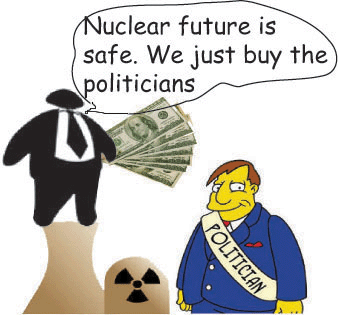
The Ohio legislation reads as if it were designed specifically to undermine the planet’s continued capacity to support a steady human population.
It even ends programs aimed at encouraging Ohio residents to reduce power consumption, through upgrades to appliances or heating and cooling systems
 OHIO REPUBLICANS BALKED AT A NUCLEAR BAILOUT, SO THE INDUSTRY ELECTED NEW REPUBLICANS — AND WALKED AWAY WITH $1.1 BILLION The Intercept, Ryan Grim, , Akela Lacy 25 July 19 ON TUESDAY, a dark-money effort linked primarily to the Ohio nuclear industry delivered an audacious payoff, as a newly elected state legislature overcame years of opposition to shower a $1.1 billion bailout on two state nuclear plants.
Several dark-money groups spent millions to replace key Republican state legislators in the spring of 2018, followed by a furious lobbying campaign to make sure those new lawmakers elected a new House speaker — one who was amenable to the subsidy. The nuclear industry in Ohio has been on the brink of failure for several years, but previous legislatures had objected to a bailout, reading the writing on the wall: Nuclear power is neither a cost-effective solution for power nor an effective response to climate change, despite hopes for its success.
In April 2018, two nuclear plants, both owned by the electric utility FirstEnergy, filed for bankruptcy and have been threatening to cease operations if not bailed out. They were under increasing pressure to compete with cheaper alternatives, ranging from natural gas to wind and solar. The bankruptcy filings give a glimpse into the company’s political spending: more than $30 million from 2018-2019 on lobbying and campaigns in Ohio and Pennsylvania (where the company also sought a bailout, so far unsuccessfully).
The dark-money effort deployed a variety of vehicles that went by names like the Conservative Leadership Alliance and the Ohio Clean Energy Jobs Alliance. Murray Energy, a coal company, also gave heavily to current state House Speaker Larry Householder and his allied candidates, and the bailout from Ohio also includes subsidies to prop up failing coal plants in the state.
The payoff is extraordinary in degree Continue reading →
July 27, 2019
Posted by Christina Macpherson |
politics, USA |
Leave a comment