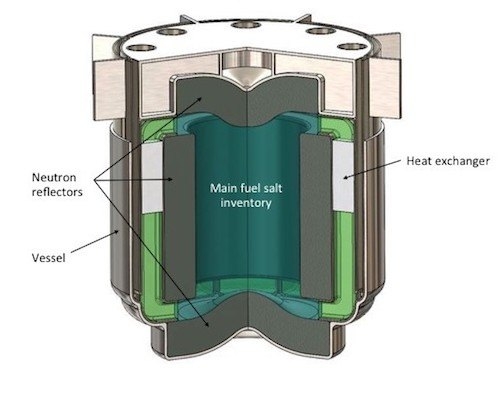
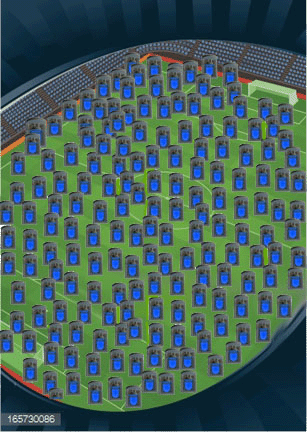
A Brief Study of Molten Salt Reactors https://nonuclearpowerinaustralia.wordpress.com/2020/03/01/a-brief-study-of-molten-salt-reactors/ 3 Mar 20,
Source:
Burning waste or playing with fire? Waste management considerations for non-traditional reactors, Lindsay Krall &Allison MacfarlanePages 326-334 | Published online: 31 Aug 2018 Bulletin of the Atomic Scientists, Volume 74, 2018. Issue 5 at https://www.tandfonline.com/doi/abs/10.1080/00963402.2018.1507791?scroll=top&needAccess=true&journalCode=rbul20
Author information:
Lindsay Krall is a post-doctoral Macarthur fellow at the George Washington University Institute for International Science and Technology Policy. Her research focuses on policies for the back end of the nuclear fuel cycle, particularly as they pertain to radionuclide transport in the environment, systems and organizations for waste storage and disposal, and the long-term behavior of spent fuels from advanced reactors. Allison Macfarlane is Professor of Public Policy and International Affairs at the George Washington University’s Elliott School of International Affairs. She directs the school’s Institute for International Science and Technology Policy Program and is the former chairman of the US Nuclear Regulatory Commission. Macfarlane was a member of the Blue Ribbon Commission on America’s Nuclear Future from 2010-2012.
“Abstract:
Nuclear energy-producing nations are almost universally experiencing delays in the commissioning of the geologic repositories needed for the long-term isolation of spent fuel and other high-level wastes from the human environment. Despite these problems, expert panels have repeatedly determined that geologic disposal is necessary, regardless of whether advanced reactors to support a “closed” nuclear fuel cycle become available. Still, advanced reactor developers are receiving substantial funding on the pretense that extraordinary waste management benefits can be reaped through adoption of these technologies. Here, the authors describe why molten salt reactors and sodium-cooled fast reactors – due to the unusual chemical compositions of their fuels – will actually exacerbate spent fuel storage and disposal issues. Before these reactors are licensed, policymakers must determine the implications of metal- and salt-based fuels vis a vis the Nuclear Waste Policy Act and the Continued Storage Rule.” end quote.Emphasis added for clarity. Mr. O’Brien and Mr. Bernardi need to consider the scientific and technical reality behind the gloss they want to disseminate.
March 2, 2020
Posted by Christina Macpherson |
2 WORLD, Small Modular Nuclear Reactors |
Leave a comment
 New Scientist 26th Feb 2020, Paul Dorfman, University College London Energy Institute, UK; Tom Burke,E3G; Steve Thomas, University of Greenwich, UK; Jonathan Porritt,
environmental campaigner; and David Lowry, Institute for Resource and
Security Studies. Reporting the decline of nuclear power generation, you quote Michael Shellenberger’s view that nuclear power is necessary to prevent climate change (8 February, p 20).
This view is truly dangerous. Climate change poses a number of unique challenges to humanity. One of the most difficult is that the world not only needs to get to a specific place
– a carbon-neutral global energy system – but also must get there by a specific time – the middle of the century. Otherwise the policy fails.
You simply couldn’t build enough nuclear reactors fast enough, even to
replace the existing reactors that will reach the end of their life by
2050, let alone to replace fossil fuels in the existing electricity system
or in the more electricity-intensive global economy we are currently
building. This would be true even if we were willing and able to overcome
all the other unsolved problems that nuclear reactors face. These include
their affordability, accidents, waste management, nuclear weapons
proliferation, the scarcity of talent and system inflexibility.
https://www.newscientist.com/letter/mg24532710-200-editors-pick-you-simply-couldnt-build-enough-nuclear-reactors/
March 2, 2020
Posted by Christina Macpherson |
2 WORLD, climate change |
Leave a comment
|
 Row over MoD River Clyde nuclear waste dump plans By Herald Scotland Online 1 Mar 20, Scotland’s national environment watchdog has denied claims the Ministry of Defence (MoD) is planning to increase discharges of radioactive waste into the River Clyde.Under the plans, liquid waste from reactors which power Royal Navy submarines at the Faslane and Coulport nuclear bases would be drained into the Gare Loch via a new pipeline.
Campaigners warned the rising discharges could have a devastating effect on surrounding wildlife and communities after a report by investigative journalism platform The Ferret stated emissions of one byproduct, cobalt-60, could rise by more than 50 times. ……..
The Ferret reported the discharge of cobalt-60 would rise to 23.4 million units of radioactivity annually – around 52 times the current level.
It added emissions of a second substance, known as tritium, would increase by 30 times to around 175,000 units, or ‘megabecquerels’, every year……..
SEPA’s public consultation is open until 13th Match and we welcome all responses. All responses will be reviewed in detail to ensure we continue to safeguard the environment and human health.”
The bases are due to receive at least five more submarines in the coming years, including an ageing Trafalgar vessel and three new Astute submersible.
The Ferret said a 50-strong group of Nuclear-Free Local Authorities (NFLA) had objected to the discharges.
NFLA Scotland convener, Glasgow SNP councillor Feargal Dalton told The Ferret: “NFLA is particularly concerned about the considerable uncertainties in modelling doses and an under-appreciation of the effects of tritium”.
“There are effective alternatives to nuclear powered submarines, as pioneered by the likes of Japan, and the Ministry of Defence should make a serious attempt to look at them.” https://www.heraldscotland.com/news/18272691.mod-planning-dump-50-times-nuclear-waste-river-clyde/
|
|
March 2, 2020
Posted by Christina Macpherson |
UK, wastes |
Leave a comment
Paul Richards 2 Mar 20 ,
Of course, the United Nations Security Council P5 nuclear nations:
China , France , Russia , UK , and the USA, oversee the IAEA – International Atomic Energy Agency, this was expected.
UN SC P5 nuclear nations is a fully integrated system inclusive of the Military-Industrial Complex.
An ecosystem that includes weapons of mass destruction, for peace, a leadership group in a state of cultural cognitive dissonance.
Who as a group know gene sheering radionuclides, have an effect on DNA X10 times half-life of any alpha particles out of nuclear reactors.
IAEA backs release of Fukushima water into sea, AsiaTimes, 27 Feb 20,
Most of the radioactive isotopes have been filtered out, but one – tritium, which has long half-life – remains, The world’s nuclear watchdog gave its backing Thursday to Japanese plans to release contaminated water from the damaged Fukushima nuclear plant into the ocean.
Japan has around a million tonnes of contaminated water stored in tanks at the site of the Fukushima Daiichi plant, whose reactors went into meltdown after a huge tsunami in 2011.
A government panel last month recommended the water be released into the ocean or vaporized, but no final decision has been taken, with all solutions deeply unpopular with sections of the Japanese public.
International Atomic Energy Agency (IAEA) director Rafael Grossi told journalists in Tokyo the panel’s recommendations both appeared suitable…….
“Releasing into the ocean is done elsewhere, it’s not something new, there is no scandal here,” Grossi added.
“But what is important is to do it in a way that is not harmful and you need somebody to monitor before, during and after release, to check that everything is okay.”
The radioactive water comes from several different sources – including water used for cooling at the plant, and groundwater and rain that seeps into the plant daily – and is put through an extensive filtration process.
Most of the radioactive isotopes have been removed by the filtration system, but one – tritium, which has a long half-life – remains…….. https://asiatimes.com/2020/02/iaea-backs-release-of-fukushima-water-into-sea/
March 2, 2020
Posted by Christina Macpherson |
Fukushima continuing |
Leave a comment
Antarctic ice walls protect the climate, EurekAlert 27 Feb, UNIVERSITY OF GOTHENBURG Inland Antarctic ice contains volumes of water that can raise global sea levels by several metres. A new study published in the journal Nature shows that glacier ice walls are vital for the climate, as they prevent rising ocean temperatures and melting glacier ice.The ocean can store much more heat than the atmosphere. The deep sea around Antarctica stores thermal energy that is the equivalent of heating the air above the continent by 400 degrees.
Now, a Swedish-led international research group has explored the physics behind the ocean currents close to the floating glaciers that surround the Antarctic coast.
“Current measurements indicate an increase in melting, particularly near the coast in some parts of Antarctica and Greenland. These increases can likely be linked to the warm, salty ocean currents that circulate on the continental shelf, melting the ice from below,” says Anna Wåhlin, lead author of the study and professor of oceanography at the University of Gothenburg.
“What we found here is a crucial feedback process: the ice shelves are their own best protection against warm water intrusions. If the ice thins, more oceanic heat comes in and melts the ice shelf, which becomes even thinner etc. It is worrying, as the ice shelves are already thinning because of global air and ocean warming”, says Céline Heuzé, climate researcher at the Department of Earth Sciences of Gothenburg University.
The stability of ice is a mystery
Inland Antarctic ice gradually moves towards the ocean. Despite the ice being so important, its stability remains a mystery – as does the answer to what could make it melt faster.
Since the glaciers are difficult to access, researchers have been unable to find out much information about the active processes.
More knowledge has now been obtained from studying the measurement data collected from instruments that Anna Wåhlin and her researcher colleagues placed in the ocean around the Getz glacier in West Antarctica.
The ice’s edge blocks warm seawater……https://www.eurekalert.org/pub_releases/2020-02/uog-aiw022720.php
|
|
March 2, 2020
Posted by Christina Macpherson |
ANTARCTICA, climate change |
Leave a comment
 People protest Wednesday in Tokyo over the Nuclear Regulation Authority giving its approval for the safety measures implemented at the No. 2 unit of the Onagawa nuclear power plant in Miyagi Prefecture.
February 26, 2020
A nuclear reactor in Miyagi Prefecture damaged by the 2011 earthquake and tsunami disaster formally cleared screening by a national nuclear watchdog on Wednesday, paving the way for it to restart after anti-disaster measures are completed by the end of March next year.
The No. 2 unit of Tohoku Electric Power Co.’s Onagawa plant won the approval of the Nuclear Regulation Authority, becoming the second disaster-damaged reactor, after the Tokai No. 2 power plant in Ibaraki Prefecture, to pass stricter safety standards introduced after the Fukushima nuclear crisis.
Construction of an 800-meter seawall is among anti-disaster measures that still need to be completed at the plant, which straddles the town of Onagawa and the city of Ishinomaki. The operator also needs to obtain consent from local residents before it can restart the plant.
On March 11, 2011, all three reactors at the Onagawa complex shut down when a massive earthquake rocked northeastern Japan and a 13-meter tsunami hit the area, flooding the underground floors of the No. 2 unit.
However, the facility’s emergency cooling system operated correctly and there was no meltdown of the type that occurred at Tokyo Electric Power Company Holdings Inc.’s Fukushima No. 1 plant.
Tohoku Electric applied for safety screening for the No. 2 unit in December 2013 and has been constructing the seawall that will top out at 29 meters above sea level. It expects to spend about ¥340 billion ($3.08 billion) in total on the anti-disaster measures.
The company has already decided to scrap the No. 1 reactor, which began operations in 1984, and is considering applying for the restart of the No. 3 unit, which started power generation in 2002.
When it restarts, the Onagawa No. 2 reactor, which began commercial operations in 1995, will be the first boiling water reactor — the same type used at the Fukushima No. 1 plant — to resume operations since the 2011 earthquake and tsunami hit. The disaster claimed nearly 16,000 lives and left more than 2,500 missing.
Other boiling water reactors at Tepco’s Kashiwazaki-Kariwa plant in Niigata Prefecture and the Tokai No. 2 plant of Japan Atomic Power Co. have already secured approval to resume operations from the regulator, but have yet to obtain local consent.
https://www.japantimes.co.jp/news/2020/02/26/national/miyagi-nuclear-reactor-safety/#.Xlare0pCeUk
February 27, 2020
Posted by dunrenard |
Japan | Onagawa NPP, Safety measures approval |
Leave a comment

February 20, 2020
In a promotional video featuring Japanese tennis superstar Naomi Osaka, as well as fans of different nationalities, the organizing committee for the Tokyo 2020 Olympic and Paralympic Games revealed on Feb. 17 the event’s official motto: United by Emotion.
Yet if there’s one emotion linking the world today, it might be fear. The COVID-19 outbreak shows little sign of weakening. As of Feb. 19, the disease has infected more than 75,000, killed 2,014 and prompted over 50 countries and territories to close their borders to arrivals from China. The “devil” virus, as Chinese President Xi Jinping has called it, has already surpassed the combined death toll of SARS and MERS and lies on the cusp of becoming a pandemic that spreads around the globe. The next few weeks will determine whether containment efforts can prevent COVID-19 becoming the “black swan event” that Alibaba CEO Daniel Zhang has warned may derail the global economy.
The economic repercussions already look severe. According to analysis by research firm Capital Economics, COVID-19 will cost the world economy over $280 billion in the first quarter of this year, meaning that global GDP will not grow from one quarter to the next for the first time since 2009. China’s growth is expected to slow to 4.5% over the same period. Some 5 million companies have Chinese suppliers, according to data company Dun & Bradstreet, and all are under threat from slashed manufacturing capacity.
Korean automaker Hyundai has shut its huge factory in Ulsan due to a shortage of parts. Apple has told investors it will fail to meet quarterly revenue targets and warned of global “iPhone supply shortages” from the shutting of Chinese factories. The slowdown may also undermine U.S. plans to massively boost exports of agricultural goods, energy and services to China, hampering any potential recovery in farming communities and the Rust Belt.
Travel in and around the region has ebbed significantly. Some 21 airlines have cancelled all flights to mainland China. Hong Kong-based Cathay Pacific has cut 40% of network capacity and asked 27,000 employees to take unpaid leave to help it stay afloat. Events from the Hong Kong Rugby Sevens to K-Pop concerts have been cancelled or postponed.
Now, speculation is mounting about one of the year’s biggest events due to take place directly in the orbit of the outbreak—the 2020 Olympic Games, which are to be held in Tokyo beginning July 24. Japan has the second highest rate of COVID-19 infections after China, with 695 people testing positive for the virus, most of them on a cruise ship docked at the city of Yokohama. Yet the Olympics torch relay is due to begin next month and traverse to all of Japan’s 47 prefectures over 121 days, coinciding with its popular cherry blossom bloom.
The chill on visitor numbers across Asia already risk making the Games a subdued affair. Japan received 9.6 million visitors from China in 2019, accounting for a third of foreign tourist expenditure, but Chinese arrivals have virtually ceased since the outbreak. According to Japanese public broadcaster NHK, Tokyo 2020 organizing committee chief executive Toshiro Muto said on Feb.5 he was “extremely worried that the spread of the infectious disease could throw cold water on the momentum toward the Games.”
Officials have since closed ranks as speculation about the Games has increased. Organizing committee president Yoshiro Mori insisted Feb. 13, “we are not considering a cancelation or postponement of the Games—let me make that clear.” As he spoke, some 3,700 people remained quarantined on the Diamond Princess cruise liner, anchored less than two miles from Yokohama Baseball stadium, a key Tokyo 2020 venue. (Those uninfected were scheduled for release beginning Feb. 19.)
Four days later, the city canceled the Tokyo Marathon due to take place on March 1 for all except elite runners. Dick Pound, a former Olympian swimmer and member of the International Olympic Committee, told TIME the organisation was monitoring the situation closely but said no one was talking about relocation or cancelation with five months still to go. “If there’s a legitimate pandemic that is potentially a lot more lethal than normal illnesses of flu, that’s when you need to start thinking about it. But not at this stage.”
Mori’s confidence is in line with projections that COVID-19 will fade during warmer and more humid summer months, as SARS did in 2003. But it’s still not clear why SARS declined as temperatures rose. Some coronavirus strains—like MERS—thrive in the heat, says Prof. Michael Osterholm, an epidemiologist at the University of Minnesota. The theory of COVID-19’s summer regress is simply “based on wishful thinking,” he says. “There is no data to support it.”
It’s hard to overstate the economic impact on Japan were the Olympics forced to be canceled or relocated. The investment surrounding the event is staggering; the Games are set to cost $25 billion, according to latest predictions, nearly four times the original estimate. According to hospitality research firm CBRE Hotels, 80,000 hotel rooms were forecast to open across Japan’s nine major cities between 2019 and 2021. Tokyo’s Okura hotel reopened in September after a $1 billion renovation. In May, national carrier Japan Airlines is due to launch a low cost subsidiary, Zipair Tokyo, at a cost of around $200 million, to meet increased demand surrounding the Olympics. It will be based at Tokyo Narita International Airport, which is currently undergoing an expansion to nearly double capacity. (Tokyo’s other main airport, Haneda, is also due to boost capacity by 70%.)
The coronavirus is already keeping international visitors away beyond China. Capital Economics research suggests tourism arrivals in Japan will fall by 40% this quarter due to COVID-19, knocking off 0.4 percentage points from growth. The U.N.’s International Civil Aviation Organization forecasts that Japan could lose $1.29 billion in tourism revenue over the same period. Koichiro Takahara, CEO of Tokyo-based ride-sharing app nearMe, says he fears the Olympics could get cancelled if the outbreak worsens. That, he says, “would have a big impact on my business, so I am keeping my fingers crossed.”
It would also impose a political cost on Japan’s Prime Minister Shinzo Abe. Already, his insistence during the bidding process that radiation from the 2011 Fukushima Daiichi Nuclear Power Plant meltdown would be tackled has been called out after Greenpeace found radiation hotspots in December near where the Olympic torch relay will pass. Similar assurances that COVID-19 will not disrupt the Games will be treated with skepticism, says Jules Boykoff, a politics professor at Pacific University, Oregon who studies the Olympics and played soccer for Team USA. “For many, when they hear Abe and other officials saying that COVID-19 will not affect the Olympics, they hear the unmistakable ring of previous empty promises.”
But it’s unclear what a Plan B might look like. Simon Chadwick, professor of the Eurasian Sport Industry at France’s Emlyon business School, suggests a networked event held across different countries is a more likely alternative. (The 2020 UEFA European Soccer Championships and 2022 Commonwealth Games are slated for such a format.) Yet there will be considerable resistance from sponsors and broadcasters who have already ploughed vast resources into securing rights deals and promotional activities. NBC alone spent $1.4 billion on broadcasting rights for Tokyo 2020. In this regard, both host and business interests will be furiously resisting any deviation. “The Japanese government is surely lobbying the IOC hard as it seeks to protect its multitude of investments,” says Chadwick.
That might explain an apparent unwillingness to address the uncertainty. Asked what contingency plans were in place for moving or postponing the Games, the Tokyo Metropolitan Government told TIME, “We cannot provide a definitive answer to a hypothetical situation.” Yet as the virus spreads its tendrils further into the Asia region, the risks are only becoming more tangible
https://time.com/5786657/tokyo-olympics-coronavirus-asia-china/?fbclid=IwAR34KxB2bZoXlN1s8vBhoDGADn_iN8dQRzUoEOrWPTxZZj0MEqmF8yfsgTA
February 27, 2020
Posted by dunrenard |
Japan | 2020 Olympics, Coronavirus |
Leave a comment
|
 The waste problem continues to weigh down nuclear power Trump is using Yucca Mountain to drum up Republican votes in the 2020 elections, Nevada Democrat says, By Benjamin J. Hulac
Roll Call February 26, 2020
The U.S. has more than 90,000 metric tons of nuclear waste that needs to be disposed, the vast majority of which is so-called spent fuel from commercial reactors, meaning it is no longer efficient for power generation.
Generally, all this waste is sitting where it was created: at 76 sites in 35 states. And while the tally of waste is only going to grow, there is no long-term national storage solution, and this month the Trump administration may have put the final nail in the coffin of a long-studied effort to build a permanent repository for high-level waste at Yucca Mountain in Nevada……
President Donald Trump’s fiscal 2021 budget proposal released this month does not include funding for licensing of Yucca Mountain as a nuclear waste repository located about 100 miles northwest of Las Vegas, an abrupt reversal of his administration’s policy.
“Nevada, I hear you on Yucca Mountain and my Administration will RESPECT you!” Trump tweeted on Feb. 6, four days before the budget proposal was released. “Congress and previous Administrations have long failed to find lasting solutions — my Administration is committed to exploring innovative approaches — I’m confident we can get it done!”
The president is using Yucca to drum up Republican votes in the 2020 elections, says Nevada Democratic Rep. Dina Titus. “I think he’s looking at the numbers,” Titus says. “He sees this as a swing issue.”…….
There are more than 76 commercial reactors in the U.S. that are idling with spent nuclear fuel on site, NEI says. The Nuclear Waste Policy Act of 1982 calls for waste to be stored deep in the ground, and amendments to that law bound the Department of Energy to study sites for such a repository in just one place: Yucca Mountain in the Mojave Desert.
While the Bush administration greenlighted storage at Yucca, the Obama administration reversed course and established a commission, which, in 2012, called for a “consent-based” process to the problem. ……
Nevada’s congressional delegation and governor firmly oppose Yucca…….
An interim-storage pilot program worth $22.5 million and sponsored by Sens. Dianne Feinstein, a California Democrat, and Lamar Alexander, a Tennessee Republican, held some promise, but it was stripped out of the latest budget deal…..
https://www.rollcall.com/2020/02/26/the-waste-problem-continues-to-weigh-down-nuclear-power/
|
|
February 27, 2020
Posted by Christina Macpherson |
election USA 2020 |
2 Comments
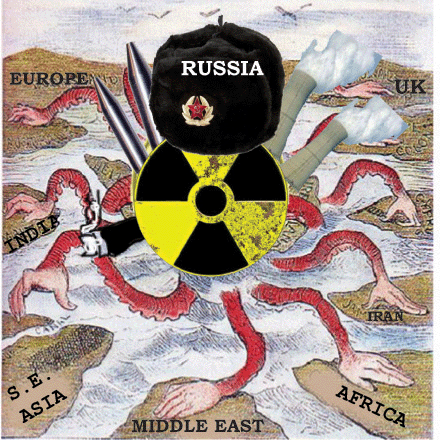
Russia lends Egypt $25 billion for Dabaa nuclear power plant, AL-Monitor, 26 Feb 20, CAIRO — Atomstroyexport, a subsidiary of Russia’s State Atomic Energy Corporation, or Rosatom, announced Feb. 17 that three Egyptian companies were awarded a tender offer for constructing the first phase of Egypt’s Dabaa nuclear power plant.
The three Egyptian companies, competing among 10 others, are Petrojet, Hassan Allam and the Arab Contractors.
The Egyptian government intends to start negotiations within the next few days with the Egyptian Nuclear and Radiological Regulatory Authority to obtain permission to start implementing the Dabaa nuclear plant project. The plant will be constructed in the Dabaa area of Marsa Matrouh governorate in the west of the country.
The Dabaa plant is the first nuclear plant for peaceful uses, with a total capacity of 4.8 gigawatts. The project is financially supported by Rosatom through a Russian loan amounting to $25 billion………….
Yemen al-Hamaki, a professor of economics at Ain Shams University said that under this agreement Egypt will use the loan to finance 85% of the total value of the building, construction, insurance and all other related works. Egypt would bear the remaining 15% in the form of installments. The loan is for 13 years at a 3% annual interest rate. If Egypt fails to repay any of the annual interest within 10 working days, it shall be subject to arrears of 150% of the interest rate calculated on a daily basis
Hamaki also warned that this massive Russian loan of $25 billion could blow up Egypt’s foreign debts. “This loan is a great risk to the future because it burdens the state and should be settled from the wealth and economic assets of the future generations,” she said, adding, “Egypt’s resorting to many loans foretells its inability to attract foreign investments, while tourism revenues continue to decline.” ….. https://www.al-monitor.com/pulse/originals/2020/02/power-plant-nuclear-egypt-russia-loan.html#ixzz6F5iQcolQ
February 27, 2020
Posted by Christina Macpherson |
Egypt, marketing, Russia |
Leave a comment
 The New Republic
A report from two economists at JP Morgan Chase pushes back against traditional economic wisdom on climate change. By KATE ARONOFF, February 25, 2020
JP Morgan Chase is the world’s leading financer of fossil fuel projects. And according to a report from within the company, recently leaked to the press, the world is seriously underestimating the adverse effects of climate change. The 22-page report, entitled “Risky Business: the climate and the macroeconomy” and dated January 14, 2020, has been reported by multiple outlets since Friday as containing a gloomy assessment of the risk presented by climate change in the near future. But it also offers a withering takedown of how economists in particular have tended to think about the climate crisis, criticizing findings from several of the field’s experts by name, including a recent winner of the Nobel Prize in economics.
“We cannot rule out catastrophic outcomes where human life as we know it is threatened,” the report concludes. It’s a stunning bit of cognitive dissonance from a bank that is doing so much to fuel the crisis. It also shows a growing push for a more grounded assessment of the crisis than mainstream economics has offered in recent decades….
Essentially an informational document, the report—written by U.K.-based JP Morgan economists David Mackie and Jessica Murray—reviews a battery of academic literature on climate change. It examines several predictions of climate change’s impact on gross domestic product, including economist Richard Tol’s 2018 survey of 26 different climate models—one of the more comprehensive recent works. While Tol has links to organizations that have cast doubt on the scientific consensus around the climate crisis, as his own research has, the findings listed are not especially controversial. But the JP Morgan Chase report authors push back on those and other prominent predictions. “Most likely,” the authors conclude, “these estimates of the income and wealth effects of unmitigated climate change are far too small.”…….. The JP Morgan report doesn’t include clear recommendations for what the company’s own risk analysts should do with the information presented. “Most likely,” it states, “business as usual will be the path that policymakers follow in the years ahead”—something its authors say “opens the earth to a greater likelihood of a catastrophic outcome” than previously estimated. The report does not discuss the bank’s support for polluting industries, which have spent handsomely to block climate action at virtually every level of government.
“It is depressing that JP Morgan are trying to evade responsibility for this thorough and useful report that restates what climate scientists, Greta Thunberg, and Extinction Rebellion alike have been saying for some time now: that our very future as a species is at stake,” Rupert Read, who originally obtained the report, wrote in an email. “It would be so much better if they owned up fully to what is in this report. But then, that would of course require them to completely transform their business model.”
|
|
February 27, 2020
Posted by Christina Macpherson |
2 WORLD, business and costs, climate change |
Leave a comment

|
Pentagon Plan Calls for a $9 Billion Surge in Nuclear Spending by 2025, TIME, BY TONY CAPACCIO / BLOOMBERG, FEBRUARY 26, 2020
The Pentagon’s five-year nuclear weapons plan calls for requesting at least $167 billion through 2025 — building from the $29 billion sought for next year to $38 billion, according to previously undisclosed figures.
The commitment includes research, development, procurement, sustainment and operations. It reflects a major boost to an effort started under President Barack Obama to replace aging nuclear systems, such as Minuteman III missiles and command and control systems.
It doesn’t include funding for the Energy Department’s National Nuclear Security Administration, which is requesting $19.8 billion for fiscal 2021, including $15.6 billion for nuclear weapons activities.
Congressional Democrats have been generally supportive of increased nuclear weapons spending, but Defense Secretary Mark Esper is likely to be questioned about the size and scope of the five-year plan when he testifies Wednesday before the House Armed Services Committee.
Esper is also likely to face bipartisan opposition from the defense-focused committee on President Donald Trump’s plan to shift $3.8 billion from Pentagon programs to his wall on the Mexican border.
The Defense Department’s five-year plan on nuclear programs calls for $29 billion for fiscal 2021, $30 billion in 2022 and $33 billion in 2023, before jumping to $37 billion in 2024 and $38 billion in 2025.
The plan includes $25 billion for research and procurement — but not support and operations for — the new Columbia-class intercontinental ballistic missile submarine that begins construction this year, $24 billion for improved nuclear command and control and $23 billion for the Air Force’s B-21 bomber. ….. https://time.com/5790901/pentagon-nuclear-weapons-spending/
|
|
February 27, 2020
Posted by Christina Macpherson |
business and costs, USA, weapons and war |
Leave a comment
|
The US government insurance scheme for nuclear power plant accidents no longer makes sense, Bulletin of the Atomic Scientists, By Victor Gilinsky, February 26, 2020 The Japan Center for Economic Research, a source sympathetic to nuclear power, recently put the long-term costs of the 2011 Fukushima accident as about $750 billion. Contrast that with the maximum of $13 billion that could be available after a catastrophic US nuclear accident under the plant owners’ self-insurance scheme defined by the Price-Anderson Act. The Act will have to be renewed before 2025; Congress should seize the opportunity not only to reflect on the lack of insurance in the event of a catastrophic accident, but also to reconsider our approach to nuclear power plant safety altogether.
Price-Anderson frees nuclear plant operators and all firms involved in nuclear construction and maintenance of any liability for offsite accident damage. The only chance for additional compensation lies in the act’s declaration that if accident damages exceed the legal limit “Congress will thoroughly review the particular incident” and will “take whatever action is determined to be necessary” to provide full compensation to the public. In short, a Fukushima-level accident would toss the costs of compensation and cleanup unto the lap of Congress. ……….
The main public risk of nuclear power plants comes from rare but devastating nuclear accidents. Because data on such accidents is sparse, the probability of their occurrence has to be calculated on the basis of a model, rather than obtained from experience. Moreover, the extent of an accident and its monetary consequences are postulated on the basis of models that are limited by analysts’ imagination. Who would have imagined, for example, that the Fukushima accident would involve several reactors? Or that Japan would subsequently shut down all its other nuclear power plants?……….
Curiously, from the chairman on down, the NRC misstates the legal standard for its safety decisions. The NRC and its staff claim their job is to provide “reasonable assurance of adequate protection,” whereas the standard in the Atomic Energy Act is “adequate protection.” Under the law, their job is to provide adequate protection, period. Do the commissioners think the extra cushion of “reasonable assurance” justifies weaker regulation?
To return to the Price-Anderson Act: As we’ve seen, a catastrophic accident would render the US self-insurance scheme for nuclear power plants pretty much irrelevant. But the indemnification of all industry participants would remain highly relevant: The industry would be free of any liability for offsite death or damage, whereas the victims would have to go hat in hand to Congress for restitution. This is an enormous subsidy—consider, again, the $750 billion and counting tab for Fukushima—that the federal government provides the nuclear industry, one without which not a single US nuclear power plant would or could operate. Freedom from liability also has had a perverse effect on nuclear safety. Without the liability protection of Price-Anderson, industry incentives to develop nuclear designs safer than light water reactors would surely have been higher.
Freedom from liability was put into law in the 1950s to get the US commercial nuclear power industry off the ground. It was meant to be temporary, until industry and insurers got some experience with the new technology. But even as time went on, industrial organizations like General Electric and Westinghouse would not participate in the civilian nuclear program if they risked responsibility for offsite damage from a nuclear plant accident………
What is clear is that the nuclear firms—the largest of which possess an understanding of nuclear safety far beyond that of the public—do not believe the NRC safety conclusions that the risk of a catastrophic nuclear accident is infinitesmal. Nor do they accept that probable risk—probability of an accident times the consequences, were one to occur—as the right measure of risk to their companies. They don’t want to risk their companies, period.
If they don’t believe the NRC numbers, why should the rest of us accept them?
Why shouldn’t we have the same protection from physical harm that the nuclear industry has from financial liability? And just as the nuclear vendors will not participate on terms that do not include indemnification from the overwhelming cost of a severe accident, so should the public have the analogous power to only accept future nuclear designs that can demonstrate that they preclude offsite harm. And the designs should demonstrate that level of safety in a clear way, based on physical principles, not on complicated probabilistic calculations put forward by interested parties.
Such new designs would eliminate the current dilemma of a federal nuclear self-insurance scheme that cannot, as a practical matter, cover the financial consequences to the public of catastrophic nuclear power plant accidents. But how to get there? One of the disincentives is the Price-Anderson Act’s limitations on industry liability for offsite accident consequences. That should get phased out. https://thebulletin.org/2020/02/the-us-government-insurance-scheme-for-nuclear-power-plant-accidents-no-longer-makes-sense/#
|
|
February 27, 2020
Posted by Christina Macpherson |
business and costs, Legal, Reference, USA |
Leave a comment
|
Iran Nuclear Accord Parties Meet to Try to Salvage Deal https://www.voanews.com/middle-east/voa-news-iran/iran-nuclear-accord-parties-meet-try-salvage-deal
By RFE/RL, February 26, 2020 The remaining members of the floundering Iran nuclear deal are set to meet in Vienna Wednesday for the first time since Germany, France, and Britain initiated dispute procedures that could reimpose U.N. sanctions on Tehran.
The talks come as the signatories try to rescue the landmark 2015 accord, which has been faltering since U.S. President Donald Trump unilaterally withdrew from it in 2018 and enforced crippling sanctions on Iran.
It will be attended by senior diplomats from Iran, Britain, France, Germany, China, Russia, and the EU.
They have promised to uphold the deal that saw Iran agree to reduce its program of developing nuclear weapons in exchange for an easing of sanctions, even without Washington’s support.
However, since the U.S. withdrawal, Iran has stepped up its program in defiance of Washington’s “maximum pressure” campaign.“
This is a chance — though not of 100 percent — to stop escalation before it’s too late,” Russian Foreign Minister Sergei Lavrov was cited as saying by the Russian Embassy in Vienna on Twitter.
Why EU Powers Rejected Trump’s Call to Leave Iran Nuclear Deal
EU foreign policy chief Josep Borrell said Friday the 28-nation bloc will keep trying to save the Iran nuclear deal despite Trump’s call on EU to join US in breaking away from it
This is a chance — though not of 100 percent — to stop escalation before it’s too late,” Russian Foreign Minister Sergei Lavrov was cited as saying by the Russian Embassy in Vienna on Twitter.
Iran has since breached its main limitations, exceeding the stockpiles of heavy water and uranium allowed, the number and types of centrifuges it can operate to enrich uranium, and the purity of uranium.
As a result, in mid-January, the three European countries said they had “no choice” but to trigger a dispute mechanism in the accord, citing reduced compliance.
The process for ultimately reimposing U.N. sanctions consists of several steps, the final one of which is to notify the U.N. Security Council. The restrictive measures would then automatically be reinstated after 30 days unless the Security Council voted to keep them lifted.
Trump has called the deal “fatally flawed,” in part because it did not restrict Tehran’s ballistic-missile program or address its support for terrorist groups in the Middle East.
Iran insists its nuclear program is for civilian purposes only and that the Joint Comprehensive Plan of Action (JCPOA) allows the country to run reactors to generate power.
|
|
February 27, 2020
Posted by Christina Macpherson |
EUROPE, Iran, politics international |
Leave a comment
|
Nuclear agency finds radioactive substances in South Tangerang house, News Desk. The Jakarta Post Jakarta / Tue, February 25, 2020 A joint team from the Nuclear Energy Regulatory Agency (Bapeten) and the National Police has discovered illegally owned radioactive substances in a house in the Batan Indah housing complex in South Tangerang, Banten.
“The radioactive sources contain caesium-137 and other radioactive isotopes,” Bapeten spokesperson Indra Gunawan said in a press release on Monday.
Indra said the team would further investigate the matter to ascertain whether the illegally owned substances were linked to the recent discovery of caesium-137 radioactive waste in the complex.
Bapeten first detected high levels of radiation in the Batan Indah complex during a routine check at the end of January. Between Feb. 7 and Feb. 8, a joint Bapeten and National Nuclear Energy Agency (Batan) team discovered several radioactive fragments in a vacant lot next to a volleyball court in the housing complex.
The fragments contained caesium-137, which is commonly used for industrial purposes. ….. https://www.thejakartapost.com/news/2020/02/25/nuclear-agency-finds-radioactive-substances-in-south-tangerang-house.html
|
|
February 27, 2020
Posted by Christina Macpherson |
Indonesia, secrets,lies and civil liberties |
Leave a comment
|
Otherwise, the U.S. Department of Energy has concluded the structures on the Hanford Nuclear Reservation could fail and release radioactive contamination, the Tri-City Herald reported Tuesday.
“A number of structures are over-stressed and at risk of age-related failure, which could result in a release of contamination with impacts to human health and the environment,” DOE said in a letter last week to the Environmental Protection Agency, which regulates nuclear waste at Hanford.
The Hanford site, located near Richland, Washington, for decades made plutonium for nuclear weapons. The sprawling site for the past 30 years has been engaged in cleaning up a massive amount of radioactive waste left over from making plutonium.
Two of the underground structures, a trench and a tank, are estimated to be contaminated with a combined 170 to 255 pounds of plutonium.
DOE could award a contract for grouting as soon as March, according to the letter.
After the partial collapse of a waste storage tunnel at Hanford’s PUREX plant in 2017, DOE and its contractor CH2M Hill Plateau Remediation Co. analyzed other old and contaminated structures to determine if they were at risk of collapsing.
They determined that the three below-ground structures at the Plutonium Finishing Plant presented the highest risk.
Hanford Challenge, a Seattle-based Hanford watchdog group, does not object to the grouting as a short-term solution, but it should not be a substitute for complete cleanup, said Tom Carpenter, executive director..
|
|
February 27, 2020
Posted by Christina Macpherson |
safety, USA |
Leave a comment