Pentagon’s latest scam for tax-payers’ money; dangerous, costly portable nuclear reactors

Pentagon hands out contracts for PORTABLE nuclear reactors… yet  another gold vein for cash-savvy military? https://www.rt.com/news/482942-us-military-nuclear-microreactor/ 13 Mar, 2020 There’s no shortage of hefty defense deals awarded by the US Department of Defense, but the $40 million contract for micro-reactors definitely stands out, as it hides safety risks and raises doubts over its economic efficiency.
The nuclear device that the DoD strategists want must have the capability to be safely and rapidly transported by road, rail, sea or air (sic!) as well as swiftly set up and shut down. The project split between three companies — BWX Technologies, Westinghouse Government Services and X-energy — calls for a “safe, mobile and advanced nuclear micro-reactor.”
The safety part sounds particularly soothing, but how would it look on the ground? What if those miniature reactors, when moved by land, become targets of high-profile terrorist attacks? And will it prove to be a real alternative (which means cheaper price, of course) to conventional energy sources?
‘The more reactors — the greater the danger’
“Any nuclear reactor attracts terrorists,” Andrey Ozharovsky, nuclear scientist, program expert at the Russian Social Ecological Union, told RT. “It doesn’t matter if it’s located at a nuclear power plant [or inside a portable device]… if you remember, the terrorists planned directing one of the planes at a nuclear plant during 9/11.”
The logic here is simple, he pointed out: “the more reactors are out there — the greater the danger.” If the US builds hundreds, or even dozens of such devices, it’ll be really hard for them to properly defend them all.
Another vital safety issue is the reliability of the nuclear micro-reactors. Interestingly enough, the US military had already experimented with them back in the 1950s and 1960s — and it ended in a tragedy.
Several portable reactors were built and setup in Greenland and Panama, but one of them blew up in 1961, killing three operators. The Army Nuclear Power Program was shut down shortly after that.
“There were eight US micro-reactors and one of them exploded. That’s how safe they are,” Ozharovsky said, adding that the Pentagon’s idea of bringing them back will “likely create more risks instead of solving any problems.”
‘Micro-reactors yet to prove their economic efficiency’
But even if the portable reactors will be shielded from the perils of the battlefield and operate without failure, what’s the Pentagon’s rationale behind bringing the radioactive fuel to their military bases? For decades, the army had been successfully running on gasoline, diesel and fuel oil; when going off-grid, it would switch to generators and high-power accumulators.
“The main problem has nothing related to safety,” Anton Khlopkov, director of Energy and Security Center and member of Russian Security Council’s Scientific Council argued.
Micro-reactors must prove their viability from the economic point of view, since such plants always have alternatives.
It is yet to be proven that micro-reactors won’t be “many times more” expensive than other conventional sources of energy. Electricity produced by such devices should be at least comparable in cost to the one produced by diesel generators, he said.
‘Some kind of a soap bubble’
If micro-reactors are such a questionable solution, why is the Pentagon pushing for their development? The answer isn’t lying on the surface, but it isn’t buried too deep.
“They work against the trends,” Ozharovsky suggested. And those trends are that the world is giving up on the use of civilian nuclear energy due to being too expensive.
Washington may be trying to “support the US the nuclear industry that’s dying out with the use of the military budget; sponsor their research and development — which is an expensive thing.”
Ozharovsky didn’t rule out the possibility that the whole thing “is some kind of a soap bubble.” The research will be made, some prototypes may even be put together, but no actual mini-reactors will be ordered by the Pentagon, he said.
The DoD’s was never shy to spend the US taxpayer dollars: its F-35 program was worth a whopping $1.4 trillion in procurement and operating costs over its lifetime, while Pentagon also acquired such items of prime necessity as… $640 toilet seats and $7,600 coffee makers. The micro-reactors may well become another entry in this wasteful list.
Starting the Olympic torch relay in Fukushima should remind us of the dangers of nuclear power
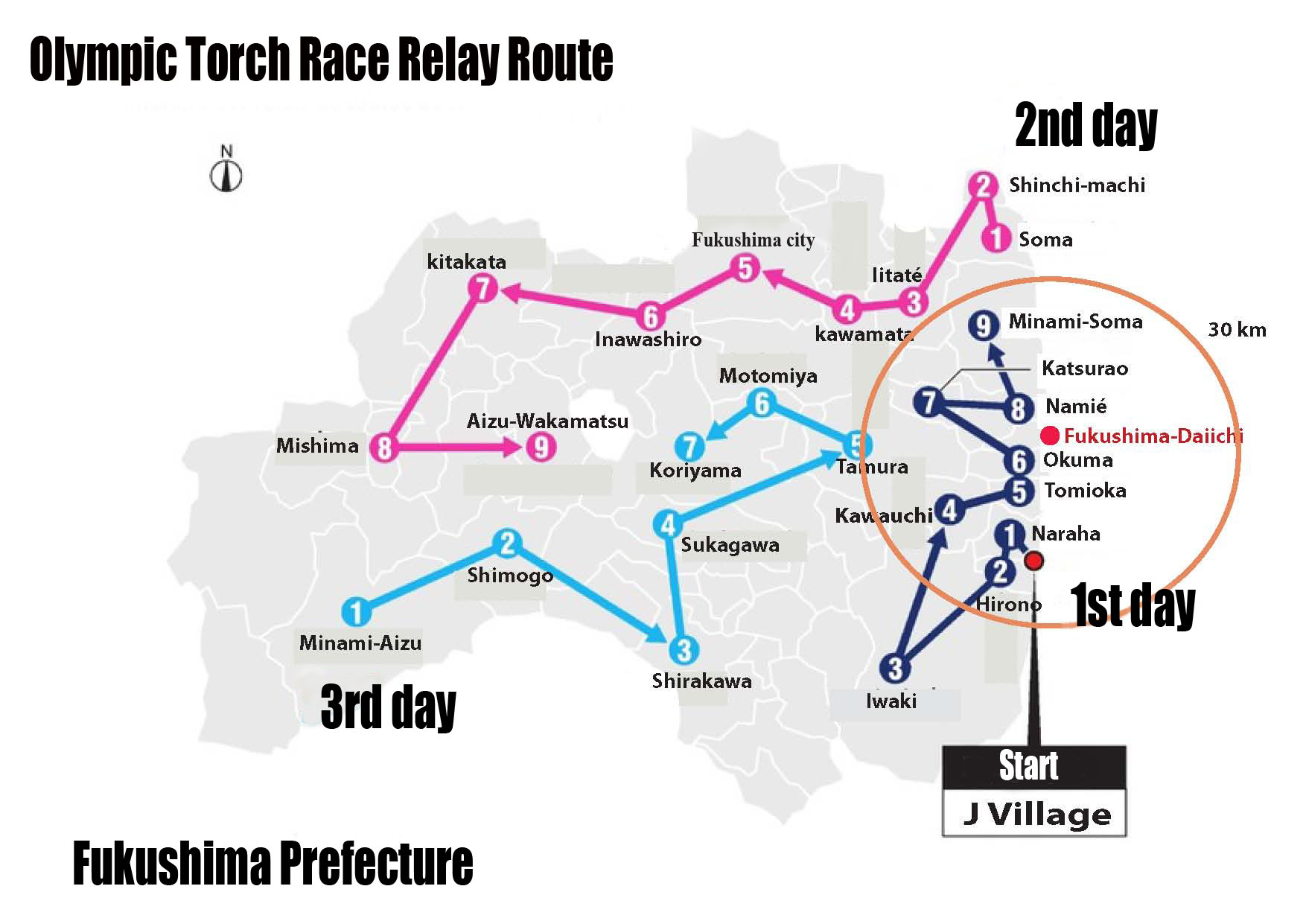 Starting the Olympic torch relay in Fukushima should remind us of the dangers of nuclear power https://www.japantimes.co.jp/opinion/2020/03/13/commentary/japan-commentary/starting-olympic-torch-relay-fukushima-remind-us-dangers-nuclear-power/#.XmvxdqgzbIU
BY CASSANDRA JEFFERY AND M. V. RAMANA 13 Mar 20, If the Tokyo Olympics are held on schedule, thousands of athletes will soon come to Japan. Considering the multiple reactors that melted down there nine years ago, in March 2011, the government’s decision to start the ceremonial torch relay in Fukushima Prefecture seems a bit odd, to say the least.
While radiation levels may have declined since 2011, there are still hot spots in the prefecture, including near the sports complex where the torch relay will begin and along the relay route. The persistence of this contamination, and the economic fallout of the reactor accidents, should remind us of the hazardous nature of nuclear power.
Simultaneously, changes in the economics of alternative sources of energy in the last decade invite us to reconsider how countries, including Japan, should generate electricity in the future.
Japan is not alone in having experienced severe nuclear accidents. The 1986 Chernobyl accident also contaminated very large areas in Ukraine and Belarus. As in Japan, many people had to be evacuated; about 116,000, according to the 2000 report of the U.N. Scientific Committee on the Effects of Atomic Radiation. Many of them never did return; 34 years after the accident, thousands of square kilometers remain closed off to human inhabitation.
Events such as these are, naturally, traumatic and result in people viewing nuclear power as a risky technology. In turn, that view has led to persistent and widespread public opposition around the world.
This is evident in Japan too, where opinion polls show overwhelming opposition to the government’s plans to restart nuclear plants that have been shut down. One poll from February 2019 found 56 percent of respondents were opposed to, with only 32 percent in favor of, resuming nuclear operations. Other polls show significant local opposition, one example coming out of Miyagi Prefecture. Even the Japan Atomic Energy Relations Organization, which aims to promote nuclear power, finds that only 17.3 percent prefer nuclear energy, with much larger majorities preferring solar, wind and hydro power.
There is also the immense cost of cleaning up after such accidents. Estimates for the Fukushima disaster range from nearly $200 billion to over $600 billion. In 2013, France’s nuclear safety institute estimated that a similar accident in France could end up costing $580 billion. In Japan, just the cost of bringing old nuclear power plants into compliance with post-Fukushima safety regulations has been estimated at $44.2 billion.
Even in the absence of accidents and additional safety features, nuclear power is already very expensive. For the United States, the Wall Street firm Lazard estimates an average cost of $155 per megawatt-hour of nuclear electricity, more than three times the corresponding estimates of around $40 per MWh each for wind and solar energy. The latter costs have declined by around 70 to 90 percent in the last 10 years. In the face of the high costs of nuclear power — economic, environmental and public health — and overwhelming public opposition, it is puzzling that the government would persist in trying to restart nuclear power plants.
To explain his support for the technology, Prime Minister Shinzo Abe claims that the country cannot do without nuclear power, especially in view of climate change concerns. The claim about the necessity of nuclear power makes little sense. Since 2011, the country has been generating only a fraction of the nuclear electricity it used to generate, and yet the lights have not gone off. Further, starting in 2015, Japan’s total greenhouse gas emissions have fallen below the levels in 2011, because of “reduced energy consumption” and the increase in “low-carbon electricity.” The latter, in turn, is because of an increasing fraction of renewable energy in electricity generation, a factor that could play an important role in the future.
Some, including the Global Energy Network Institute and a group of analysts led by Stanford University’s Mark Jacobson, argue that Japan could be 100 percent powered by renewable energy. Regardless of whether Japan reaches that goal, there is little doubt that Japan could be expanding renewable energy, and that increased reliance on renewables makes economic and environmental sense.
Instead, the Abe government seems to be involved in lowering incentives for the development of solar energy, and promoting nuclear power. Efforts by Abe to support the failing and flailing nuclear sector in Japan are indicative of the significant political power wielded by the “nuclear village,” the network of power companies, regulators, bureaucrats and researchers that controls nuclear and energy policy.
Moreover, Abenomics involves exports of nuclear components and technology, as well as conventional arms, as an important component. So far, despite many trips by Abe to various countries, Japan has yet to export any reactors in the last decade; a project with the most likely client, Turkey, collapsed because of high costs.
This suggests one possible explanation: Perhaps Abe realizes that before exporting nuclear reactors, he first has to shore up the domestic nuclear industry and prove that Japan has fully recovered from the 2011 nuclear disaster. But is that worth the risk?
Restarting nuclear reactors or constructing new ones, should that ever happen, only increases the likelihood of more nuclear accidents in the future and raises the costs of electricity. Regardless of who we cheer for at the Olympic Games, nuclear power does not deserve our applause.
Steps to nowhere on nuclear disarmament – USA’s “Creating an Environment for Nuclear Disarmament” (CEND)

The Virus of Nuclear Proliferation https://www.commondreams.org/views/2020/03/12/virus-nuclear-proliferation, March 12, 2020, by In Depths News
Rather than addressing the promising path forward provided by the new Treaty for the Prohibition of Nuclear Weapons to finally ban the bomb, the U.S. launched a new initiative, by Alice Slater
Ironically, it is not nearly so well-reported, that the 50-year old NPT is threatening the world with an even worse illness then the new terrifying coronavirus.
The NPT’s critical requirement that the nuclear armed states, which signed the treaty in 1970, must make “good faith efforts” for nuclear disarmament is virtually moribund as nations are developing new nuclear weapons, some characterized as more “usable” and destroying treaties that contributed to a more stable environment.
These include the 1972 Anti-Ballistic Missile Treaty which the U.S. negotiated with USSR and walked out of in 2002, and its repeated rejections of offers from Russia and China to negotiate a treaty to keep weapons out of space, and from Russia to ban cyberwar, all of which would contribute to “strategic stability” which would enable the fulfillment of the NPT’s nuclear disarmament promise.
Further, this year the U.S. withdrew from the Intermediate Nuclear Force agreement it made with Russia in 1987, left the nuclear deal it had negotiated with Iran as well, and just announced it would not meet with Russia to discuss a renewal of the Strategic Arms Control Treaty (START), due to expire this year, which limits nuclear warheads and missiles.
It also created a whole new branch of its military, the Department of Space, which was formerly housed in the U.S. Airforce. And in an obvious breach of “good faith” [i] ,this February the US staged a “limited” nuclear battle against Russia in a war game!
It cannot be denied that the NPT contributes to even more burgeoning nuclear proliferation by extending its misbegotten “inalienable right” to “peaceful” nuclear power, currently promoting this lethal technology to Saudi Arabia, UAE, Belarus, Bangladesh and Turkey which are all constructing their first nuclear power plants — expanding the keys to the bomb factory in more and more countries, while almost all of the current nuclear weapons states have new nuclear weapons under development.
The U.S., for example, is planning to spend over a trillion dollars over the next 10 years and is working with the UK to replace Britain’s Trident nuclear warheads.
Rather than addressing the promising path forward provided by the new Treaty for the Prohibition of Nuclear Weapons to finally ban the bomb, the U.S. launched a new initiative, Creating an Environment for Nuclear Disarmament (CEND), to develop yet another set of possible new steps to comply with its 50 year old “good faith” promises for nuclear disarmament.
At a recent meeting in Stockholm with fifteen of its allies, new measures were announced for nuclear disarmament now being described as “stepping stones”, having graduated from various commitments over the years for “steps” and “an unequivocal commitment” to those steps, since the NPT was extended in 1970, indefinitely and unconditionally.
These new “stepping stones” bring to mind M.G. Escher’s stunning drawing of a series of steps to nowhere with people endlessly trudging up a staircase, never to reach their destination!
Polar ice melting at an accelerating rate

Polar ice caps melting six times faster than in 1990s https://www.theguardian.com/environment/2020/mar/11/polar-ice-caps-melting-six-times-faster-than-in-1990s
Losses of ice from Greenland and Antarctica are tracking the worst-case climate scenario, scientists warn Damian Carrington Environment editor @dpcarrington,Thu 12 Mar 2020 The polar ice caps are melting six times faster than in the 1990s, according to the most complete analysis to date.
The ice loss from Greenland and Antarctica is tracking the worst-case climate warming scenario set out by the Intergovernmental Panel on Climate Change (IPCC), scientists say. Without rapid cuts to carbon emissions the analysis indicates there could be a rise in sea levels that would leave 400 million people exposed to coastal flooding each year by the end of the century.
Rising sea levels are the one of the most damaging long-term impacts of the climate crisis, and the contribution of Greenland and Antarctica is accelerating. The new analysis updates and combines recent studies of the ice masses and predicts that 2019 will prove to have been a record-breaking year when the most recent data is processed.
The previous peak year for Greenland and Antarctic ice melting was 2010, after a natural climate cycle led to a run of very hot summers. But the Arctic heatwave of 2019 means it is nearly certain that more ice was lost last year.
The average annual loss of ice from Greenland and Antarctica in the 2010s was 475bn tonnes – six times greater than the 81bn tonnes a year lost in the 1990s. In total the two ice caps lost 6.4tn tonnes of ice from 1992 to 2017, with melting in Greenland responsible for 60% of that figure.
The IPCC’s most recent mid-range prediction for global sea level rise in 2100 is 53cm. But the new analysis suggests that if current trends continue the oceans will rise by an additional 17cm.
“Every centimetre of sea level rise leads to coastal flooding and coastal erosion, disrupting people’s lives around the planet,” said Prof Andrew Shepherd, of the University of Leeds. He said the extra 17cm would mean the number of exposed to coastal flooding each year rising from 360 million to 400 million. “These are not unlikely events with small impacts,” he said. “They are already under way and will be devastating for coastal communities.”
Erik Ivins, of Nasa’s Jet Propulsion Laboratory, in California, who led the assessment with Shepherd, said the lost ice was a clear sign of global heating. “The satellite measurements provide prima facie, rather irrefutable, evidence,” he said.
Almost all the ice loss from Antarctica and half of that from Greenland arose from warming oceans melting the glaciers that flow from the ice caps. This causes glacial flow to speed up, dumping more icebergs into the ocean. The remainder of Greenland’s ice losses are caused by hotter air temperatures that melt the surface of the ice sheet.
The combined analysis was carried out by a team of 89 scientists from 50 international organisations, who combined the findings of 26 ice surveys. It included data from 11 satellite missions that tracked the ice sheets’ changing volume, speed of flow and mass.
About a third of the total sea level rise now comes from Greenland and Antarctic ice loss. Just under half comes from the thermal expansion of warming ocean water and a fifth from other smaller glaciers. But the latter sources are not accelerating, unlike in Greenland and Antarctica.
Shepherd said the ice caps had been slow to respond to human-caused global heating. Greenland and especially Antarctica were quite stable at the start of the 1990s despite decades of a warming climate.
Shepherd said it took about 30 years for the ice caps to react. Now that they had a further 30 years of melting was inevitable, even if emissions were halted today. Nonetheless, he said, urgent carbon emissions cuts were vital. “We can offset some of that [sea level rise] if we stop heating the planet.”
The IPCC is in the process of producing a new global climate report and its lead author, Prof Guðfinna Aðalgeirsdóttir, of the University of Iceland, said: “The reconciled estimate of Greenland and Antarctic ice loss is timely.”
She said she also saw increased losses from Iceland’s ice caps last year. “Summer 2019 was very warm in this region.”
Renewables surpass coal and nuclear says USA’s Federal Energy Regulatory Commission (FERC)
US: Renewables to rise above coal and nuclear says FERC https://www.smart-energy.com/renewable-energy/us-renewables-to-rise-above-coal-and-nuclear-says-ferc/ Renewables are estimated to add nearly 50,000 MW, being more than a quarter of the total capacity according to a review by the SUN DAY Campaign of data, issued last week by the Federal Energy Regulatory Commission (FERC). 13 Mar 20,
According to the report, the mix of renewable energy sources (i.e., biomass, geothermal, hydropower, solar, wind) provided 57.26% of new U.S. electrical generating capacity added in 2019 – swamping that provided by coal, natural gas, oil, and nuclear power combined.
FERC’s latest monthly “Energy Infrastructure Update” report (with data through to December 31, 2019) reveals renewable sources (i.e. biomass, geothermal, hydropower, solar, wind) accounted for 11,857 megawatts (MW) of new generating capacity by the end of the year. That is a third more (33.97%) more than that of natural gas (8,557 MW), nuclear (155 MW), oil (77 MW), and coal (62 MW) combined.
Renewables have now also surpassed 22% (i.e., 22.06%) of the US’ total available installed generating capacity – further expanding their lead over coal capacity (20.89%). Among renewables, wind can boast the largest installed electrical generating capacity – 8.51% of the U.S. total, followed by hydropower (8.41%), solar (3.49%) [2], biomass (1.33%), and geothermal (0.32%). Thus, wind and solar combined now account for 12.0% of the nation’s electrical generating capacity.
Moreover, the FERC foresees renewables dramatically expanding their lead over fossil fuels and nuclear power in terms of new capacity additions during the coming three years (i.e., by December 31, 2022). Net generating capacity additions (i.e., “proposed additions under construction” minus “proposed retirements”) for renewable sources total 48,254 MW: wind – 26,403 MW, solar – 19,973 MW, hydropower – 1,460 MW, biomass – 240 MW, and geothermal – 178 MW.
By comparison, net additions for natural gas total 21,090 MW while the installed capacities for coal, nuclear, and oil are projected to drop by 18,857 MW, 3,391 MW, and 3,085 MW respectively. In fact, FERC reports no new coal capacity in the pipeline over the next three years.
Thus, while net new renewable energy capacity is projected to be nearly 50,000 MW greater within three years, that of fossil fuels and nuclear power combined will decline by over 4,200 MW. Between now and the end of 2022, new wind capacity alone will be greater than that of natural gas while that of wind and solar combined will more than double new gas capacity.
Moreover, if FERC’s data prove correct, then by the end of 2022, renewable sources will account for more than a quarter (25.16%) of the nation’s total available installed generating capacity while coal will drop to 18.63% and that of nuclear and oil will decrease to 8.29% and 2.95% respectively. Natural gas will increase its share — but only slightly – from 44.67% today to 44.78%.
As the Executive Director of the SUN DAY Campaign, I believed that the rapid growth of renewables and corresponding drop in electrical production by coal and oil in 2019 provides a glimmer of hope for slowing down the pace of climate change. In addition, renewables’ continued expansion in the near future – as forecast by FERC – suggests that with supportive governmental policies, these technologies could provide an even greater share of total U.S. electrical generation.
Statistics presented in this article can be found here. Read the full FERC report.
Bradwell BNuclear power plant consultations cancelled amid coronavirus fears
 Nuclear power plant consultations cancelled amid coronavirus fears, East Anglian Daily Times, 13 Mar 20, Public consultations for the proposed Bradwell B power plant in Essex have been cancelled amid growing coronavirus uncertainty.
Project partners EDF and China General Nuclear (CGN) took the decision to cancel the stage one events in the interest of public safety.
In total, 10 of the events will no longer take place, including exhibitions in Brightlingsea, Great Barrow and South Woodham Ferrers.
A spokesman for the project said: ‘The Bradwell B project has been closely monitoring the rapidly changing situation relating to Covid-19 and listening both to advice from Public Health England and to the concerns of the public, our staff and other stakeholders……
Those who wish to have their say on the plans can still do so until May 27, with consultation documents still available online and at various libraries and council offices in the county. ……
So far, 590 people have been diagnosed with the virus – including six in Essex.
Those who wish to obtain hard copies of the documents or have questions about the proposals can contact developers on 01621 451451 or by email here. https://www.eadt.co.uk/news/bradwell-b-events-cancelled-amid-coronavirus-fears-1-6559799
Coronavirus poses threat to climate action
IEA warns that Covid-19 could cause a slowdown in world’s clean energy transition, Guardian, Jillian Ambrose, Fri 13 Mar 2020 The coronavirus health crisis may lead to a slump in global carbon emissions this year but the outbreak poses a threat to long-term climate action by undermining investment in clean energy, according to the global energy watchdog.The International Energy Agency (IEA) expects the economic fallout of Covid-19 to wipe out the world’s oil demand growth for the year ahead, which should cap the fossil fuel emissions that contribute to the climate crisis.
But Fatih Birol, IEA’s executive director, has warned the outbreak could spell a slowdown in the world’s clean energy transition unless governments use green investments to help support economic growth through the global slowdown……..https://www.theguardian.com/environment/2020/mar/12/coronovirus-poses-threat-to-climate-action-says-watchdog
Nuclear modernisation, cyber operations, raise a dilemma for nuclear deterrence
As the character Dr. Strangelove makes clear in the eponymous classic movie, nobody is frightened of capabilities that are kept secret.
Nuclear capabilities must be revealed to be useful for deterrence. Nuclear deterrence works because nuclear weapons states can deliberately reveal their nuclear capabilities and thus signal the potential consequences for crossing red lines. By contrast, offensive cyber operations against sensitive targets cannot be revealed if they are to be useful at all.

Digital Strangelove: The Cyber Dangers of Nuclear Weapons, https://www.lawfareblog.com/digital-strangelove-cyber-dangers-nuclear-weapons By Jon Lindsay Thursday, March 12, 2020, : This post article is part of a series exploring the findings and recommendations of the U.S. Cyberspace Solarium Commission.
The crucial strategic conundrum, therefore, is how to manage the interaction of two domains with dangerously opposed strategic characteristics. If opponents do not agree on the balance of power in a crisis bargaining situation, for whatever reason, bargaining is more likely to fail. Offensive cyber operations targeting NC3 create just such an information asymmetry. Cyber capabilities that are needed only in the event that deterrence fails can thus make it more likely that deterrence will fail in the first place. Precisely because cyber conflict takes place below the threshold of armed conflict, the dangerous combination of offensive cyber operations and NC3 can, in effect, lower the nuclear threshold.
Translating defensive capacity into deterrence requires taking the additional, and politically difficult, step of advertising NC3 redundancy and resilience to potential adversaries, even in a cyber-degraded environment. Perhaps the most important thing to be done is to sensitize operators, nuclear policy makers and allied counterparts throughout the NC3 enterprise to the risks of cyber-nuclear interaction. Human interpretation and intervention will be the key to mitigating many of these scenarios as they emerge. It is thus important for governments to develop and exercise concepts and methods for noticing and evaluating the likelihood of different types of cyber-nuclear risks as they emerge in various scenarios.
Hypocrisy: new commitments to Non-Proliferation of Nuclear Weapons (NPT) include push for nuclear power
While reaffirming their “commitment to the NPT in all its aspects”, the five Foreign Ministers say: “The NPT has provided the essential foundation for international efforts to stem the looming threat – then and now – that nuclear weapons would proliferate across the globe. In so doing, it has served the interests of all its Parties.”
The five Foreign Ministers are: Wang Yi, State Councillor and Minister of Foreign Affairs of China; Jean-Yves Le Drian, Minister for Europe and Foreign Affairs, France; Sergey Lavrov, Minister of Foreign Affairs of Russia; Dominic Raab, Secretary of State for Foreign and Commonwealth Affairs of Britain and Northern Ireland; Michael R. Pompeo, Secretary of State of the U.S.
 The Foreign Ministers adds: “We also celebrate the astonishingly diverse benefits of the peaceful uses of the atom, whether for electricity, medicine, agriculture, or industry. We reiterate our strong support for broadening access to the benefits of nuclear energy and its applications for peaceful purpose. This boon to humanity thrives because the NPT, and the nuclear nonproliferation regime built around the Treaty, has helped provide confidence that nuclear programs are and will remain entirely peaceful.” ……https://www.indepthnews.net/index.php/armaments/nuclear-weapons/3376-five-nuclear-weapon-states-pledge-commitment-to-npt
They’ve licensed Exelon’s Peach Bottom Nuclear Plant for 80 Years – but it mightn’t last
Exelon’s Peach Bottom Nuclear Plant Licensed for 80 Years—Will It Make It? Power, Mar 12, 2020, by Aaron Larson The U.S. Nuclear Regulatory Commission (NRC) granted a 20-year license extension for Peach Bottom Atomic Power Station Units 2 and 3. The extension authorizes the two reactors—both of which began commercial operation in 1974—to continue operating through 2054…….
Exelon, which operates the largest fleet (21 reactors) of nuclear plants in the U.S., has lobbied strongly for years to obtain government support for nuclear power. The company was successful in getting legislation passed in Illinois and New York that provides financial incentives for some of its plants. Government investigations, however, have put Exelon under a microscope as a result of its lobbying activities.
Exelon received a grand jury subpoena in the second quarter of 2019 from the U.S. Attorney’s Office for the Northern District of Illinois, requiring production of information concerning the company’s lobbying activities in the state. On Oct. 4, 2019, Exelon received a second grand jury subpoena, requiring production of records of any communications with certain individuals and entities. On Oct. 22, 2019, the U.S. Securities and Exchange Commission (SEC) notified Exelon that it had also opened an investigation into the company’s lobbying activities. ……..
Other units have also been retired long before their licenses expired, including Kewaunee, Vermont Yankee, Fort Calhoun, and Pilgrim, so obtaining a license extension is no guarantee of long-term operation for the Peach Bottom facility. ………https://www.powermag.com/exelons-peach-bottom-nuclear-plant-licensed-for-80-years-will-it-make-it/
Indonesia warned on dangers of nuclear power, advantages of renewable energy
|
Indonesia should focus on renewable energy, not nuclear, activists say
A. Muh. Ibnu Aqil, The Jakarta Post, Jakarta / Fri, March 13, 2020
Activists are warning the government to steer clear of building nuclear power plants, citing safety concerns and urging Indonesia to focus on renewable energy instead. A Greenpeace Indonesia official, Satrio Swandiko, said Indonesia should heed the lessons of the Fukushima Daiichi nuclear power plant disaster in Japan, which was caused by an earthquake and tsunami in March 2011. Greenpeace’s Japan chapter surveyed Fukushima city, as well as the nearby towns of Naraha and Okuma in Fukushima prefecture in October and November 2019. In Fukushima’s city center, Greenpeace found at least 45 radioactive hot spots — 11 of which had radiation levels equal to and even above the Japanese government’s decontamination target of 0.23 microSieverts per hour. It showed that the impact of the nuclear meltdown continued years after the incident. “Indonesia has a high risk of… (subscribers only) https://www.thejakartapost.com/news/2020/03/12/indonesia-should-focus-on-renewable-energy-not-nuclear-activists-say.html |
|
Bulletin of the Atomic Scientists warns on doomsday
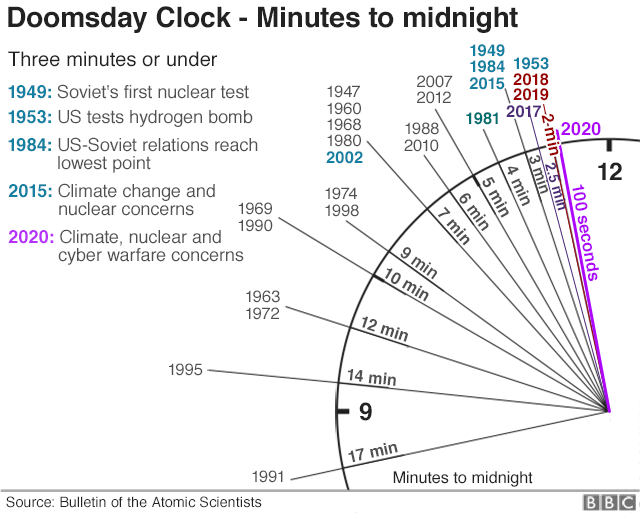 Nuclear scare sparks doomsday debate http://thepioneeronline.com/40529/features/nuclear-scare-sparks-doomsday-debate/ March 12, 2020 By Antonio Aguilar,
In mid-Jan., the Bulletin of Atomic Scientists announced that “we are closer to a nuclear climate or technological disaster.”
Our government’s actions and foreign relations situation further influence the Bulletin of Atomic Scientists’ decision to move the hands forward. Each year, the bulletin collectively evaluates whether we have moved forward or back.
Currently, we are at 100 seconds until doomsday, or “midnight”. The doomsday clock was created to symbolize how dire our current situation is. 100 seconds until midnight means that we are approaching the tipping point or the worst-case scenario. This could mean nuclear war or global warming becoming irreversible.
The bulletin takes a holistic approach in order to move the hands forward or back.
The bulletin was founded in 1945 and created by the same scientists that worked on the Manhattan Project.
“People are tired and desensitized to those images and the thought of duck-cover drills during the cold war… but that summarizes very much the old generation,” says Posner. “So we have seen in the past year, a reduction in global treaty-making and the global sense of treaties.”
We are in a high tension situation dealing with the threat of nuclear weapons and it does not help the situation when the government releases new low yielding nuclear weapons, the first time in decades.
In Tokyo, a growing sense of angst over possible virus-hit Olympics
 A man walks in front of the Tokyo Metropolitan Government building on Feb. 25.
Mar 11, 2020
For weeks, Olympic organizers have relentlessly pushed a consistent message: The Summer Games in Tokyo will not be canceled or postponed.
On Wednesday, Olympic Minister Seiko Hashimoto called postponement “inconceivable,” pushing back on a Wall Street Journal report in which Haruyuki Takahashi, a member of the executive board for the Japanese organizing committee, suggested that the games could be delayed by one or two years if unable to be held as scheduled due to the coronavirus outbreak.
“With the star athletes in the middle of preparations for this event which happens only once every four years, a cancellation or delay to the Tokyo games is inconceivable,” Hashimoto said in a parliamentary committee. “A delay is not under consideration.”
But behind the scenes, sponsors who have pumped billions of dollars into the games have grown increasingly nervous about how the coronavirus outbreak will impact the event.
When organizers and sponsors met privately to discuss preparations last Wednesday, the companies learned there had been no decision on whether — or when — there would be any changes to the games.
“A lot of people are starting to worry, but there’s nothing much we can do,” a representative of an Olympic sponsor, who was present at the previously unreported meeting, said.
“If this continues into April, May, June, it will be an issue, but we’re still waiting to see what will happen,” added the representative, who was not authorized to speak to the media and spoke on condition of anonymity.
The meetings between the Tokyo 2020 organizing committee and “partner companies,” including sponsors, take place regularly. There were dozens of people present at the one last week.
“Nothing has been decided. On the inside, it’s a mess,” said a person briefed on the meeting, speaking on condition of anonymity because of the sensitivity of the matter.
The final decision belongs to the powerful International Olympic Committee chief, Thomas Bach. Companies such as Coca-Cola Co., Bridgestone Corp, Canon Inc., Toyota Motor Corp. and Panasonic Corp. sponsor the games, and Japanese brands have for decades been some of the most generous.
The IOC said on Wednesday that “the preparations for the Olympic Games Tokyo 2020 are continuing as planned.”
Tokyo 2020 organizing committee did not respond to a request for comment.
The meeting last week brought into focus the scale of what organizers are grappling with: pressure to avoid a coronavirus crisis among 600,000 expected overseas spectators and athletes at an event that could see $3 billion in sponsorships and at least $12 billion spent on preparations evaporate.
Takahashi, one of more than two dozen members of the board of the Tokyo 2020 organizing committee, said it has just started working on scenarios for how the virus could affect the games. But a sponsor representative present at the meeting last week said those plans are not being shared with the companies.
Prime Minister Shinzo Abe has staked his legacy as the longest-serving Japanese leader on staging a successful games and bringing a massive jolt, estimated at $2.3 billion, to the stagnant economy with tourism and consumer spending.
Some Olympic qualifiers and test events have been relocated or delayed. The games themselves don’t start until late July, leaving some time for the organizers to make the final call.
Neal Pilson, the former head of CBS Sports, who was involved in broadcasting rights negotiations for three Winter Olympics said he expected organizers to assess the situation by early May at the latest, when they “will have a better fix on whether the epidemic is tapering down or continuing to expand.”
Hashimoto said the end of May was a possible time frame for a decision.
Organizers have begun to modify their tone. At a news conference last week, Tokyo 2020 chief Yoshiro Mori vehemently denied that the games would be canceled, but added that planners were “listening to various opinions” and responding “flexibly because the situation changes day by day.”
Last week, Hashimoto was questioned in parliament on the clause in the contract between the IOC and the organizers in Japan that determines when the Olympic committee could terminate the games.
One of the scenarios is the inability of the host city to hold the Olympics in 2020.
The mention of the clause touched off speculation that the minister was hinting at a delay, which sponsors at last week’s meeting were told sparked the ire of the IOC.
As a result, Hashimoto called senior members of the Tokyo 2020 organizing committee to explain how she was “misunderstood.”
According to the contract, the Tokyo metropolitan government, the Tokyo 2020 organizing committee and the Japanese Olympic Committee signed away any right to indemnity, damages or compensation from the IOC.
The contract says the IOC may scrap the games when safety is “seriously threatened,” among other reasons.
Those three bodies have formed a task force on the virus that consults closely with the World Health Organization, which last week warned against “false hopes” that the virus would disappear with warmer summer weather.
Many sports in Japan, such as rugby and sumo, have held recent matches without spectators.
Although keeping spectators away would cost estimated $800 million in lost ticket sales, it could still provide billions in revenue from broadcast and marketing rights.
But experts said it would still be difficult to organize safe games with thousands of athletes living in close proximity.
“In the Olympic village alone, you’re bringing together 17,000-18,000 people, they’re living in close quarters, interacting with each other, coming from all over the world,” said Andrew Zimbalist, an economist at Smith College specializing in sports economics.
A Tokyo 2020 official involved in the discussions on Olympics and the virus said that delaying the games until later in the year would be difficult.
Takahashi, of the organizing committee, said a one- or two-year delay would better accommodate professional sports schedules, which are planned years in advance.
“We need to start preparing for any possibility. If the games can’t be held in the summer, a delay of one or two years would be most feasible,” Takahashi said.
Japan’s Olympic Games propaganda really tops the lies that cover up the Fukushima nuclear catastrophe
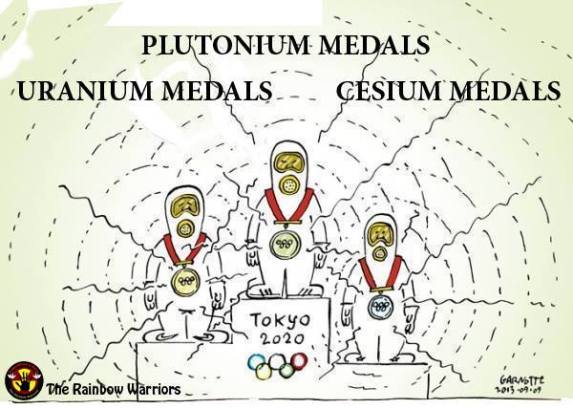
Japan’s Nuclear Cover-up Continues, Nine Years after the Fukushima Disaster, Fairewinds Energy Education, March 10, 2020 by Arnie Gundersen “……. 2020 Olympics
In order for Japan to win its Olympic bid in 2013, two years later, Japan’s next Prime Minister Abe stated that the Fukushima disaster was ‘under control’. This statement was also a blatant lie that succeeded in winning the bid to hold the 2020 Olympics in Tokyo at the expense of the taxpayers and residents of Japan. Don’t take Fairewinds word for it! Read what Japan’s former Prime Minister, Junichiro Koizumi said to Reuters in September 2016. Entitled Abe’s Fukushima ‘under control’ pledge to secure Olympics was a lie: former PM, Reuters wrote,
Japanese Prime Minister Shinzo Abe’s promise that the crippled Fukushima nuclear plant was “under control” in his successful pitch three years ago for Tokyo to host the 2020 Olympic Games “was a lie”, former premier Junichiro Koizumi said on Wednesday.
Frequent readers of the Fairewinds newsletter will remember last year’s posts entitled Atomic Balm 1 and Atomic Balm 2 in which Fairewinds Energy Education described in detail the path of deception that Japan has used to take the world’s attention off of the lives of its own people, who are still being compromised by the Fukushima Daiichi nuclear tragedy. The 2020 Olympics puts the media focus onto something else – so that the world continues to believe that nuclear power reactors are still a safe form of generating electricity.
This nine year legacy of lies by the government of Japan, nuclear incentivized governments worldwide, and the atomic industry are a harbinger for the seemingly inevitable approach of the 2020 Tokyo Olympics. Hopefully mainstream media covering the summer games will finally see through this glamorous marketing scam and identify the fact that Fukushima Prefecture remains severely radiologically contaminated. Real people, who are citizens of Japan, are seeing their health and that of their families being compromised for generations as they are forced to return to radiologically contaminated areas. Entire families and their communities are facing significant health risks simply to enable corporate profiteering of those investors, energy producers, banks, and government officials associated with the ongoing operation of nuclear power plants in Japan and around the world. https://www.fairewinds.org/demystify/japans-nuclear-cover-up-continues-nine-years-after-the-fukushima-disaster
Fukushima, and the ocean’s history of nuclear waste dumping

|
Fukushima: How the ocean became a dumping ground for radioactive waste, DW, 11 Mar 20, The nuclear disaster at Fukushima sent an unprecedented amount of radiation into the Pacific. But, before then, atomic bomb tests and radioactive waste were contaminating the sea — the effects are still being felt today.
Almost 1.2 million liters (320,000 gallons) of radioactive water from the Fukushima nuclear power plant is to be released into the ocean. That’s on the recommendation of the government’s advisory panel some nine years after the nuclear disaster on Japan’s east coast. The contaminated water has since been used to cool the destroyed reactor blocks to prevent further nuclear meltdowns. It is currently being stored in large tanks, but those are expected to be full by 2022. Exactly how the water should be dealt with has become highly controversial in Japan, not least because the nuclear disaster caused extreme contamination off the coast of Fukushima. At the time, radioactive water flowed “directly into the sea, in quantities we have never seen before in the marine world,” Sabine Charmasson from the French Institute for Radiological Protection and Nuclear Safety (IRSN) tells DW. Radiation levels in the sea off Fukushima were millions of times higher than the government’s limit of 100 becquerels. And still today, radioactive substances can be detected off the coast of Japan and in other parts of the Pacific. They’ve even been measured in very small quantities off the US west coast in concentrations “well below the harmful levels set by the World Health Organization,” according to Vincent Rossi, an oceanographer at France’s Mediterranean Institute of Oceanography (MIO). But that doesn’t mean there’s no risk, says Horst Hamm of the Nuclear Free Future Foundation. “A single becquerel that gets into our body is enough to damage a cell that will eventually become a cancer cell,” he says. A study from the European Parliament reached a similar conclusion. The research found that “even the smallest possible dose, a photon passing through a cell nucleus, carries a cancer risk. Although this risk is extremely small, it is still a risk.” And that risk is growing. Radioactive pollution in the ocean has been increasing globally — and not just since the disaster at Fukushima. Atomic bomb tests In 1946, the US became the first country to test an atomic bomb in a marine area, in the Pacific Bikini Atoll. Over the next few decades, more than 250 further nuclear weapons tests were carried out on the high seas. Most of them (193) were conducted by France in French Polynesia, and by the US (42), primarily in the Marshall Islands and the Central Pacific. But the ocean wasn’t just being used as a training ground for nuclear war. Until the early 1990s, it was also a gigantic dump for radioactive waste from nuclear power plants. From 1946 to 1993, more than 200,000 tons of waste, some of it highly radioactive, was dumped in the world’s oceans, mainly in metal drums, according to the International Atomic Energy Agency (IAEA). Several nuclear submarines, including nuclear ammunition, were also sunk during this time. Is the ocean a perfect storage site? The lion’s share of dumped nuclear waste came from Britain and the Soviet Union, figures from the IAEA show. By 1991, the US had dropped more than 90,000 barrels and at least 190,000 cubic meters of radioactive waste in the North Atlantic and Pacific. Other countries including Belgium, France, Switzerland and the Netherlands also disposed of tons of radioactive waste in the North Atlantic in the 1960s, 70s and 80s. “Under the motto, ‘out of sight, out of mind,’ the dumping of nuclear waste was the easiest way to get rid of it,” says Horst Hamm. To this day, around 90% of the radiation in the ocean comes from barrels discarded in the North Atlantic, most of which lie north of Russia or off the coast of Western Europe. “The barrels are everywhere,” says ecologist Yannick Rousselet of Greenpeace France. He was present in 2000 when the environmental organization used submarines to dive for dumped drums a few hundred meters off the coast of northern France, at a depth of 60 meters (196 feet). “We were surprised how close they were to the coast,” Rousselet says. “They are rusty and leaking, with the radiation clearly elevated.” Germany also implicated In 1967, Germany also dumped 480 barrels off the coast of Portugal, according to the IAEA. Responding to a 2012 request for information from the Greens about the condition of those barrels, the German government wrote: “The barrels were not designed to ensure the permanent containment of radionuclides on the sea floor. Therefore, it must be assumed that they are at least partially no longer intact.” Germany and France don’t want to salvage the barrels. And even Greenpeace activist Yannick Rousselet says he sees “no safe way to lift the rusted barrels” to the surface. That means nuclear waste will likely continue to contaminate the ocean floor for decades to come. For Horst Hamm, the long-term consequences are clear. The radiation will be “absorbed by the marine animals surrounding it. They will eventually end up caught in fishing nets, and come back to our plates,” he says. In its 2012 response to the Greens, however, the German government described the risk to humans from contaminated fish as “negligible.” Rousselet sees things differently: “The entire area along the coast is contaminated by radiation — not just in the sea, in the grass, in the sand, you can measure it everywhere.” Radioactive dumping ground The main reason behind the radiation along the northern French coastline isn’t the underwater barrels, but rather the nuclear fuel reprocessing plant at La Hague. It is located directly on the coast and “legally discharges 33 million liters of radioactive liquid into the sea each year,” says Rousselet. He thinks it’s scandalous. In recent years, La Hague has also been the scene of several incidents involving increased radioactivity levels. The dumping of nuclear waste in drums was banned in 1993 by the London Convention on the Prevention of Marine Pollution. But discharging liquid contaminated with radiation into the ocean is still permitted internationally. Spike in cancer rates According to a study by the European Parliament, statistics show cancer rates are significantly higher in the region surrounding La Hague. Cancer rates are also high near the nuclear processing plant in Sellafield in northern England. A study from 2014 concluded that the total amount of radioactivity discharged into the sea from the Sellafield plant over the years is equivalent to the amount released by the nuclear meltdown at Fukushima. The report say a link to health effects “cannot be ruled out” even if there is no clear evidence to date of a link between illness and radioactive discharges from nuclear facilities. “The exact effects of radioactive radiation are extremely difficult to measure and prove. We only know that it has an impact,” says Rousselet, adding that it’s crucial to walk away from everything that causes radioactive waste. https://www.dw.com/en/fukushima-how-the-ocean-became-a-dumping-ground-for-radioactive-waste/a-52710277 Dumping more waste at Fukushima In Fukushima, the operating company of the Tokyo Electric Power Company nuclear plant claims that before the cooling water is discharged into the sea as planned, all 62 radioactive elements will be filtered down to safe levels — except for the isotope tritium. The advisory panel in Tokyo considers discharging the cooling water into the sea to be “safer” than other alternatives, such as evaporating the water. Just how harmful tritium is to humans is a source of controversy. According to the plant operator, the concentration of tritium in the collection tanks is sometimes much higher than that of conventional cooling water from nuclear power stations. “The local fishermen and residents cannot accept the discharge of water,” Takami Morita of the National Research Institute of Fisheries Science said in a press release. While fish pollution levels are below the harmful limit, demand for fish from the region has dropped to one-fifth of what it was before the disaster. Releasing the cooling water into the sea “is a good method because of the diluting properties of the water,” Sabine Charmasson of the IRSN says. “There aren’t any real problems on the security side, but it’s difficult, because there are also social implications. It might be an appropriate method, but it’s never easy to release radioactive substances into the environment.” In a press release, Greenpeace said: “There is no justification for additional, deliberate radioactive pollution of the marine environment or atmosphere.” https://www.dw.com/en/fukushima-how-the-ocean-became-a-dumping-ground-for-radioactive-waste/a-52710277 |
|
1 This Month

Tell Congress: Prevent Nuclear Catastrophe in Iran

Tell Congress: Prevent Nuclear Catastrophe in Iran

Read the Public Inquiry Report, the Commissioners’ report, Surrendering Australia: The AUKUS Deception is available to download for free at aukuspublicinquiry.com. Or just watch the replay of the National Press Club Luncheon.

19 November – Webinar – The Reality of Reprocessing
Time: 11:00 AM Pacific Time (US & Canada) / 2:00 PM Eastern / 7:00 PM UK / 8:00 PM CET
Register for the Zoom Event Here


Shut down the radiation-damaged Heysham nuclear reactors now
To see nuclear-related stories in greater depth and intensity – go to https://nuclearinformation.wordpress.com

Say No to NASA’s Reckless Nuclear Reactor on the Moon
Say No to NASA’s Reckless Nuclear Reactor on the Moon
-
Archives
- November 2026 (156)
- October 2026 (302)
- September 2026 (339)
- August 2026 (330)
- July 2026 (355)
- June 2026 (287)
- May 2026 (306)
- April 2026 (356)
- March 2026 (251)
- February 2026 (267)
- January 2026 (308)
- December 2025 (358)
-
Categories
- 1
- 1 NUCLEAR ISSUES
- business and costs
- climate change
- culture and arts
- ENERGY
- environment
- health
- history
- indigenous issues
- Legal
- marketing of nuclear
- media
- opposition to nuclear
- PERSONAL STORIES
- politics
- politics international
- Religion and ethics
- safety
- secrets,lies and civil liberties
- spinbuster
- technology
- Uranium
- wastes
- weapons and war
- Women
- 2 WORLD
- ACTION
- AFRICA
- Atrocities
- AUSTRALIA
- Christina's notes
- Christina's themes
- culture and arts
- Events
- Fuk 2022
- Fuk 2023
- Fukushima 2017
- Fukushima 2018
- fukushima 2019
- Fukushima 2020
- Fukushima 2021
- general
- global warming
- Humour (God we need it)
- Nuclear
- RARE EARTHS
- Reference
- resources – print
- Resources -audiovicual
- Weekly Newsletter
- World
- World Nuclear
- YouTube
-
RSS
Entries RSS
Comments RSS

