Georgia’s Vogtle nuclear project way over budget, way behind time, and now Coronavirus hits

First coronavirus case reported at Georgia nuclear plant project, William Freebairn Editor, Richard Rubin 6 Apr 20,
- Too early to say if completion delayed: Southern Company
- Additional worker test results pending
Washington — The first coronavirus infection has been confirmed at Georgia Power’s Vogtle nuclear plant construction site, the utility said Monday.There was one confirmed positive test result out of 69 people at the site tested, the company said in a statement. There were 54 negative test results, with 14 results still pending, it added.
Georgia Power and three partners are completing two 1,150-MW nuclear units at Vogtle, near Augusta, with the first new unit scheduled to enter commercial operation in November 2021. The project is the largest industrial construction site
in Georgia, with 9,000 workers, most of them contractors, at the plant, trade union officials have said.
There is a risk the coronavirus pandemic could delay the completion and testing of the two new reactors, although it is too soon to tell for certain, Southern Co., Georgia Power’s parent company, said in a financial filing April 1, before the positive test result.
Construction of the project is about five years behind schedule and has exceeded the initial budget by more than $10 billion as the result of first-of-a-kind design, licensing and construction issues.
The company notified and sent home those who worked with the person who tested positive, Georgia Power said.
“Construction work continues at the site under continuing enhanced protocols designed to reduce worker-to-worker contact and keep areas that workers frequent cleaned and sanitized,” the company said.
In a filing with the Georgia Public Service Commission April 1, Georgia Power officials said the construction site had established an expanded on-site medical clinic and put in place “aggressive” measures to keep workers in the field further apart.
More delay in planning application for UK’s Wylfa Newydd nuclear project
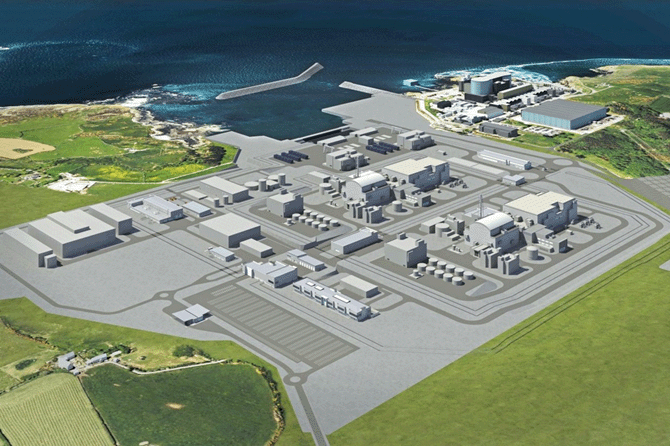
Wylfa Newydd planning decision delayed again, NEI, 6 April 2020 A planning decision over the Wylfa Newydd nuclear power plant in Anglesey has been deferred, the UK Government has confirmed.
The Wylfa Newydd project, which envisaged the construction of two UK advanced boiling water reactors (ABWRs), was suspended in January 2019 after Hitachi, failed to reach a funding deal with the UK government. However, the government had been expected to grant a Development Consent Order to construct the £12 billion power station on 31 March…… The Secretary of State (Alok Sharma) has decided to re-set the statutory deadline for this application to 30 September 2020….'”
…..EDF Energy announced last month that it was delaying submission of its planning application for Sizewell C by a “few weeks” due to the coronavirus crisis. Construction work at Hinkley Point C has also been scaled back. https://www.neimagazine.com/news/newswylfa-newydd-planning-decision-delayed-again-7859280
USA has helped Israel to develop a mighty armory of nuclear missiles

 Israel’s Nuclear Missiles Could Smash You Back to the Stone Age, And that’s just for starters. National Interest, by Caleb Larson 6 Apr 20, Israel’s missile capabilities are perhaps among the most advanced in the Middle East. Through extensive aid from the United States and Europe, as well as collaboration in developing missiles, Israel has been able to nurture a mature domestic missile production capability that has been successful as exports.
Most of Israel’s missiles are relatively short- to medium-range, they also have several missiles in the Jericho family that can reach out into the 1,500 to 4,800-kilometer range (930 to 3000 miles). …… https://nationalinterest.org/blog/buzz/israels-nuclear-missiles-could-smash-you-back-stone-age-141242
277,700 Vietnamese support “Appeal of the Hibakusha ” – call to eliminate nuclear weapons
 Over 277,700 signatures collected in Hanoi supporting elimination of nuclear weapons https://en.vietnamplus.vn/over-277700-signatures-collected-in-hanoi-supporting-elimination-of-nuclear-weapons/171278.vnp Hanoi (VNA) – Over 277,700 signatures have been collected in Hanoi in the first phase of a campaign called “Appeal of the Hibakusha (atomic bomb survivors)”, which calls for the elimination of nuclear weapons. VNA Monday, April 06, 2020
Collected by the Hanoi Union of Friendship Organisations (HUFO), the signatures have been handed over to the Vietnam Peace Committee (VPC), HUFO said on April 6. According to HUFO Vice President Tran Thi Phuong and Hanoi Peace Committee President Tran Thi Ngoc Thanh, the signatures were collected from people at government offices and residential zones as well as at bus stations and public spaces around Hanoi. They expect to gain more signatures from students in the capital during subsequent phases, when local schools and universities re-open after the COVID-19 pandemic ends. VPC Secretary General Dong Huy Vuong spoke highly of HUFO and the Hanoi Peace Committee’s contributions to the campaign./.
|
|
The Carbon Brief Profile: South Korea
 COUNTRY PROFILES 6 April 2020 The Carbon Brief Profile: South Korea, 6 Apr 20,
As part of its series on how key emitters are responding to climate change, Carbon Brief looks at South Korea’s attempts to balance its high-emitting industries with its “green”aspirations.
the nation has drawn criticism for not always matching its green-growth rhetoric with action. Proposed phaseouts of coal and nuclear have been prompted primarily by concerns about air pollution and safety,as opposed to climate.
With an election approaching, many environmental groups joined together to call for more action from the major parties, which they claimed have prepared virtually “no countermeasures” against climate change.
In March, a group of Korean youth activists sued the government over its climate framework, which they deemed insufficient to meet the nation’s Paris Agreement targets.
According to a 2019 study by the Pew Research Centre, South Koreans place climate change highest in their list of potential national threats…….. Recent polling suggests 77% of voters would vote for political parties promising to respond to the threat of climate change in the general election……
This year, nations are expected – though not strictly required – under the Paris Agreement to come forward with updated plans that scale up the ambition of their original target. South Korea has yet to indicate whether it intends to meet this expectation. …….
Finally, South Korea is home to the Green Climate Fund (GCF), a UN body based in the “international business district” of Songdo, near the north-western city of Incheon. The fund is the main mechanism set up for mobilising $100bn every year “by 2020” from richer countries to finance climate mitigation and adaptation in the developing world…….
‘Green growth’ policies
In keeping with South Korea’s rapid industrialisation over the past few decades, the nation’s approach to climate and energy is best summarised by the principle of “green growth”.
Upon the inauguration of President Lee Myung-bak in 2008, he made it clear his overarching philosophy would be based on clean-energy technologies and environmentally friendly development in order to fuel long-term economic growth. In a speech at the time, he said:
“If we make up our minds before others and take action, we will be able to lead green growth and take the initiative in creating a new civilisation.”
This was reflected in the flagship Framework Act on Low Carbon, Green Growth (pdf), which was passed in 2009 and provided the legislative framework for emissions targets and renewable energy expansion, as well as the basis for a carbon trading system.
A five-year plan implemented the same year saw South Korea commit 2% of its GDP through to 2013 to invest in the green economy, which included investing in renewable energy, smart grids and green homes.
According to the World Bank, this focus on green investment is partly credited with the nation’s early recovery from the global financial crisis…….
there are concerns that this system still does not make it attractive enough for private entities to invest in renewables, with insufficient subsidies for solar and wind while coal is still being incentivised .
Another issue with the current Korean system concerns the electricity grid, with renewable energy facilities facing delays in being connected due to inadequate substations.
The government-owned KEPCO controls the grid and has a monopoly on electricity generation. The International Energy Agency (IEA) has identified restructuring of KEPCO as a key recommendation for energy reform.
There are also concerns in South Korea that expanding renewable capacity only benefits foreign companies that already dominate these markets. Earlier this year, the Ministry of Trade, Industry and Energy issued a press release reassuring people that reports of Chinese companies dominating the Korean solar market were “not true”.
Despite all these issues, the SFOC has identified the “biggest problem” facing renewable expansion as conflicts arising with local communities, when trying to construct new renewable facilities in their vicinity.
Conservatives politicians and news outlets, often with a pro-nuclear slant, have been blamed for “tarnishing” the reputation of renewables by stating that solar projects in particular are the cause of “environmental destruction”. According to SFOC:
“As a result, there is an increasing number of local governments autonomously establishing ordinances and rules restricting the sites for solar PV and wind power.”
Nuclear
Around a quarter of South Korea’s electricity comes from its 24 nuclear reactors, placing it “among the world’s most prominent nuclear energy countries”, according to the World Nuclear Association. Its nuclear power output is the fifth largest in the world…….
However, the nation has been shaken by two events that have, ultimately, left the future of South Korea’s
First came the Fukushima nuclear disaster in 2011. Most reactors in South Korea are located close nuclear energy looking highly uncertain.together, often near major population centres, and the accident in neighbouring Japan galvanised anti-nuclear movements across the country who feared a similar event closer to home.
The impact of the disaster on South Korea is reflected in the country’s NDC, which states:
“Given the decreased level of public acceptance following the Fukushima accident, there are now limits to the extent that Korea can make use of nuclear energy, one of the major mitigation measures available to it.”
Next, the industry was hit by a major scandal in which 100 people were indicted for corruption after fake safety certificates were issued at nuclear facilities.
This “mafia-style behaviour”, as one government official put it, led to several reactors being shut down so that cabling could be replaced after it emerged it had received certification through the corrupt operation.
The culmination of this was President Moon and his Democratic Party coming to power in 2017 with a pledge to phase out nuclear energy in South Korea.
While new reactors are still being constructed, Moon said they would not extend the operation of ageing reactors which will be decommissioned in the 2020s and 2030s. This is in line with “deliberative polling” conducted by the government to give a sense of the Korean population’s views on nuclear energy.
Analysis by SFOC found that South Korean public financial institutions have provided around $17bn (£13.7bn) of financial support for coal-power projects since 2008, around half of which was for schemes overseas.The group concludes that without this “easily available financing…such proliferation of coal-fired power plants would not have been possible”.
Another report by Carbon Tracker questions the economic viability of South Korean coal power, identifying the country as having “the highest stranded asset risk in the world” due to market structures which effectively guarantee high returns for coal.
It concludes that South Korea “risks losing the low-carbon technology race” by remaining committed to coal. A newer report from the thinktank says it is already cheaper to invest in new renewables than build new coal in South Korea and it will be cheaper to invest in new renewables than to operate existing coal in 2022. ………
https://www.carbonbrief.org/the-carbon-brief-profile-south-korea
U.S. taxpayers might cough up for a private company’s new “Small Nuclear” space travel gimmick
 Private companies find role in developing nuclear power for space travel, Space.com By JoAnna Wendel – Space.com contributor 6 Apr 20,
Nuclear-powered spacecraft could cut our travel time to Mars in half. Space is abouto go nuclear — at least if private companies get their way.
At the 2 t3rd annual Commercial Space Transportation Conference (CST) in Washington, D.C., in January, a panel of nuclear technology experts and leaders in the commercial space industry spoke about developments of the technology that could propel future spacecraft faster and more efficiently than current systems can.
Nuclear technology has powered spacecraft such as NASA’s Mars rovers, the Cassini mission and the two Voyagers that are currently exploring the outer reaches of our solar system. But those fuel sources rely on the passive decay of radioactive plutonium, converting heat from that process into electricity to power the spacecraft.
Instead, the CST panelists discussed Nuclear Thermal Propulsion (NTP), a technology developed in the 1960s and ’70s that relies on the splitting, or fission, of hydrogen atoms. Although fission is associated with more warlike images, the panel’s experts emphasized the safety of nuclear thermal propulsion, which would use low-enriched uranium.
An NTP-powered spacecraft would pump hydrogen propellant through a miniature nuclear reactor core. Inside this reactor core, high energy neutrons would split uranium atoms in fission reactions; those freed neutrons would smack into other atoms and trigger more fission. The heat from these reactions would convert the hydrogen propellent into gas, which would produce thrust when forced through a nozzle.
This chain reaction is the key to NTP’s power, panelist Venessa Clark, CEO of Atomos Space, a company that’s developing thermonuclear propulsion powered spacecraft to provide in-space transportation options to satellite operators, told Space.com. A soda-can-size fission reactor could propel humans to Mars in just three to four months, she said, about twice as fast as the currently estimated time it could take a chemically propelled ship to carry humans to the Red Planet. …..
But the government still has to play some role, both Clark and Thornburg said. Government agencies like NASA and the military branches may be the first clients for these commercial companies. Clark noted NASA’s recent pushes to partner with the private sector, such as its commercial lunar payload services program and its commercial crew program.
“Government players, NASA and also now the Air Force are looking at procuring services rather than funding the development of technology, which is really exciting for us,” Clark said…. https://www.space.com/commercial-nuclear-power-for-faster-space-travel.
COMMENT. newtons_laws 06 April 2020 14:47
Coronavirus question mark still hangs over Tokyo Olympics in 2021
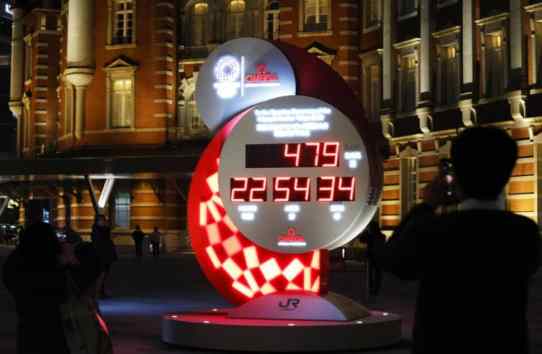 A passerby takes photos of a countdown clock in front of Tokyo Station on Monday showing the adjusted days and time for the start of the postponed Tokyo Olympic Games, which are now set to begin on July 23, 2021.
March 31, 2020
Although this summer’s Tokyo Olympics and Paralympics were postponed by about a year due to the new coronavirus pandemic, the lingering question is whether the global health crisis will be under control by then.
The capital is facing a mounting challenge following the first Olympic postponement in history, with local organizers confronted with the task of reworking the preparations of the last six years.
The International Olympic Committee and the local organizers agreed Monday that the Tokyo Olympics, originally set to open on July 24 this year, will run between July 23 and Aug. 8, 2021, followed by the Paralympics from Aug. 24 to Sept. 5.
The IOC has stressed the importance of holding the Tokyo Games in 2021, with President Thomas Bach saying the sporting event can be a “celebration of humankind after having overcome the unprecedented challenge of the coronavirus.”
However, even as the organizers try to settle one problem after another, ranging from securing venues and lodging for athletes and officials, gathering volunteers and figuring out how to shoulder the additional costs, the key to hosting a successful Tokyo Games is something they cannot control by themselves.
On March 24, Prime Minister Shinzo Abe and Bach agreed to hold the Tokyo Olympics in the summer of 2021 at the latest after they were pressured by athletes to make changes to the schedule to prevent a further spread of the coronavirus and to provide them a chance to prepare fully.
Yoshiro Mori, president of the Tokyo Organising Committee, said at a press conference shortly after the agreement was reached that the virus is their “top concern” but that he expects the situation will change due to medical advancements.
Kazuhiro Tateda, who heads the Japanese Association for Infectious Diseases, says whether infections of COVID-19, the respiratory disease caused by the new coronavirus, could be drastically curtailed by next summer is still unknown, but predicts the pace of the spread will decelerate.
“The new coronavirus has been spreading at a very rapid pace,” Tateda said. “In the next few months, the virus will spread in both the northern and southern hemispheres. If those people who recovered become immune to the virus, we can say that the outbreak will settle down.”
“But we can’t tell what the situation is like in a year,” he said.
Speaking at the press conference with Mori, the organizing committee’s CEO, Toshiro Muto, said a one-year postponement was a “reasonable” decision at a time when no health experts can say for sure when the pandemic will end.
The March 24 decision came just two days before the initial start of the 121-day torch relay in Japan and exactly four months ahead of the opening of the Olympics.
It was also made on the day Tokyo overtook Hokkaido as the region with the most infections.
“If I’m asked whether the coronavirus (situation) settles in the summer of next year, I can’t say that it will be absolutely fine,” Muto said. “But if something like that happens, not only Japan but also the rest of the world will be in a devastating situation. I predict people to come up with new drugs if that’s the case.”
Tateda, a member of the government’s panel of experts, said the organizers made a “rational” choice, but they need to monitor the situation throughout their preparation period and make changes to the schedule if necessary.
Meanwhile, Koji Wada, a professor at the International University of Health and Welfare, says staging the Olympics next summer could be “difficult,” given that the pneumonia-causing virus has spread to all of the world’s seven continents except Antarctica since it broke out in China late last year.
“I think it’s a little too optimistic to assume that many people will become immune to the virus in one year and three months and be able to travel back and forth,” he said in a recent interview.
“Two years might have been better, but barely possible. Even then, there will be cases of infections around the world, and the games will have to go ahead under tough circumstances,” he said.
Wada said staging the Olympics and Paralympics will be different from any other event because a huge number of athletes and spectators from all over the world will gather, and the development of vaccinations and medications will be unlikely in a year.
“It is difficult to place countermeasures against infections to athletes,” he said. “What are they going to do with athletes who come from countries that still have cases of infection? People will suggest putting them under quarantine for about two weeks, but what would happen if that athlete tests positive?”
The European Union’s disease control body released a report on March 25 saying that the summer heat and humidity will be unlikely to prevent the virus from spreading, adding there is no evidence that COVID-19 displays a marked seasonality.
“Based on preliminary analyses of the COVID-19 outbreak in China and other countries, high reproductive numbers were observed not only in dry and cold districts but also in tropical districts with high absolute humidity, such as Guangxi (China) and Singapore,” the European Centre for Disease Prevention and Control said in the report.
Wada warns that holding the Summer Games when the virus situation is not under control will take away from the fairness of the sporting extravaganza.
In particular, it would be difficult for athletes competing in contact sports, such as wrestling and judo.
The Tokyo Games are not the first games to be threatened by global health issues.
The 2010 Vancouver Winter Games were held following the outbreak of swine flu the previous year, while the previous Summer Games in Rio de Janeiro were held amid fears over the mosquito-transmitted Zika virus.
However, Wada said the new virus is not like any other, characterizing it as “nothing we have experienced in recent history.”
“The coronavirus is very difficult compared to other viruses because it spreads through people who do not show symptoms. And since none of us are immune to it, it can spread all over the world,” he said.
Tokyo Olympics and Paralympics: New dates confirmed for 2021
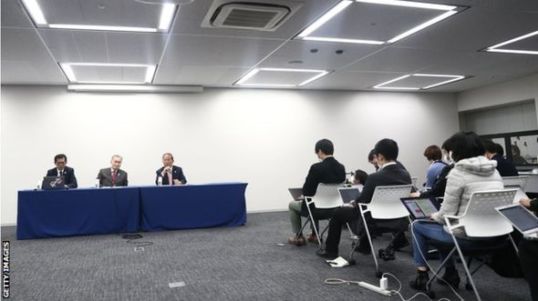 Tokyo 2020 president Yoshiro Mori (centre, at table) made the announcement at a news conference on Monday
30 March 2020
The Tokyo Olympic Games will start on 23 July, 2021 and run to 8 August after being postponed for a year because of the coronavirus pandemic.
The International Olympic Committee’s (IOC) executive board met on Monday to make the decision.
The Olympics will still be called Tokyo 2020 despite taking place in 2021.
The Paralympic Games, originally due to start on 24 August, 2020, will now take place between 24 August and 5 September, 2021.
IOC president Thomas Bach said: “I am confident that, working together with the Tokyo 2020 Organising Committee, the Tokyo Metropolitan Government, the Japanese Government and all our stakeholders, we can master this unprecedented challenge.
“Humankind currently finds itself in a dark tunnel. These Olympic Games Tokyo 2020 can be a light at the end of this tunnel.”
International Paralympic Committee president Andrew Parsons added: “When the Paralympic Games do take place in Tokyo next year, they will be an extra-special display of humanity uniting as one, a global celebration of human resilience and a sensational showcase of sport.
“With the Tokyo 2020 Paralympic Games 512 days away, the priority for all those involved in the Paralympic movement must be to focus on staying safe with their friends and family during this unprecedented and difficult time.”
If that is moved back exactly a year it would clash with the Commonwealth Games in Birmingham which is set to take place between 27 July and 7 August.
“We support the new 2021 dates for the Tokyo 2020 Olympic Games. This gives our athletes the time they need to get back into training and competition,” World Athletics said in a statement.
“Everyone needs to be flexible and compromise and to that end we are now working with the organisers of the World Athletics Championships in Oregon on new dates in 2022.
“We are also in discussions with the Commonwealth Games Federation (CGF) and the European Championships.”
Chief executive of the CGC David Grevemberg said his organisation is “fully committed to hosting a successful Commonwealth Games in Birmingham, England, during 2022”.
He added: “Over the coming days, we will continue to work collaboratively with our international federation partners to ensure the XXII Commonwealth Games maintains its position and stature on the global sporting calendar.”
Olympic organisers hope the delay will allow sufficient time to finish the qualification process which will follow the same mitigation measures planned for 2020.
It has previously been confirmed that all athletes already qualified and quota places already assigned will remain unchanged.
Purchased tickets would be valid for rescheduled events or a refund could be requested when the new dates were set, organisers previously confirmed.
On 24 March, Japan’s Prime Minister Abe Shinzo said the Games would be held in their “complete form” and no later than summer 2021.
Tokyo 2020 organising committee president Yoshiro Mori said he had proposed the 23 July to 8 August timeframe to the IOC, and that Bach had agreed, following consultations with the international sports federations.
“A certain amount of time is required for the selection and qualification of athletes and for their training and preparation, and the consensus was that staging the rescheduled Games during the summer vacation in Japan would be preferable,” Mori said.
“In terms of transport, arranging volunteers and the provision of tickets for those in Japan and overseas, as well as allowing for the Covid-19 situation, we think that it would be better to reschedule the Games to one year later than planned, in the summer of 2021.”
It is the first time in the Olympic Games’ 124-year modern history that they have been delayed, though they were cancelled altogether in 1916 because of World War One and again in 1940 and 1944 for World War Two. Cold War boycotts affected the summer Games in Moscow and Los Angeles in 1980 and 1984 respectively.
BPA “praises speed” of decision
The British Paralympic Association (BPA) has “praised the speed” with which the Tokyo 2020 Games have been rescheduled and hopes it will give athletes the “certainty they need to refocus on achieving their goals”.
Mike Sharrock, chief executive of the BPA, said: “”We recognise many challenges still lie ahead in the battle with the global Covid-19 pandemic and athletes will not be able to return to their training schedules for some time yet.
“The clear priority now is stemming this public health crisis and ensuring people follow the Government advice to stay safe and well.”
Sharrock added he believes Tokyo 2020 “has the potential to be the biggest and best Paralympics in history”.
Warship crews—from nuclear aircraft carriers to submarines—are falling victim to COVID-19.


|
Some Nuclear Submarine Crews May Not Even Know About the Pandemic, Meanwhile, ship crews face a menace that has ravaged navies for centuries. Popular Mechanics, BY KYLE MIZOKAMI, MAR 31, 2020,
Warship crews—from aircraft carriers to submarines—are falling victim to COVID-19.
|
|
EDF’s hypocrisy -Hinkley C nuclear construction continued, despite pandemic, as “essential” work

Bridgwater Mercury 4th April 2020 Roy Pumfrey: WHILE EDF has gone halfway by reducing the number of workers on the Hinkley C (HPC) site, the company seems reluctant to shut HPC down completely (‘HPC construction continues’, Mercury, March 24) due to the Coronavirus pandemic.
An EDF statement talked about reducing worker numbers ‘further as work already in progress is completed’, but was not specific about which work was so critical that it couldn’t be terminated now and how much longer it would carry on.
This is in stark contrast to the situation at Flamanville in France (HPC’s sister station) where EDF has stopped all but essential tasks. EDF hides behind the fig leaf of HPC being ‘a project of critical national importance’.
This is simply no longer justified. If it was okay to stop work for three weeks
over Christmas and the New Year, it must be done now when the stakes are
much higher than a holiday. At the same time, EDF promised to take more
effective measures on social distancing. Photographs of workers grouped in
bus queues and using the canteen but clearly less than 2m apart show that
this is all but impossible.
https://www.bridgwatermercury.co.uk/news/18351121.letter-shut-hinkley-c-now/
A Roosevelt salutes as Hero – the Captain of Theodore Roosevelt nuclear aircraft carrier
 This story says nothing about this being a nuclear-powered ship. But underlying this whole thing is the fact of the (probably necessary) culture of secrecy that surrounds all things nuclear. This is yet another example of how the nuclear culture means that it is “preferable” for people to die, rather than have the truth get out.

Captain Crozier Is a Hero, Theodore Roosevelt, my great-grandfather, would agree. By Tweed Roosevelt, Mr. Roosevelt is a great-grandson of Theodore Roosevelt and the chairman of the Theodore Roosevelt Institute at Long Island University. April 3, 2020
On Monday, Capt. Brett Crozier, the commander of the aircraft carrier Theodore Roosevelt, sent a letter to the Navy pleading for permission to unload his crew, including scores of sailors sickened with Covid-19, in Guam, where it was docked. The Pentagon had been dragging its feet, and the situation on the ship was growing dire. “We are not at war,” he wrote. “Sailors do not need to die. If we do not act now, we are failing to properly take care of our most trusted asset — our sailors.”
After the letter was leaked to The San Francisco Chronicle, the Navy relented. But on Thursday, it relieved Captain Crozier of his command.
In removing Captain Crozier, the Navy said that his letter was a gross error that could incite panic among his crew. But it’s hard to know what else he could have done — the situation on the Theodore Roosevelt was dire.
Ships at sea, whether Navy carriers or cruise ships, are hotbeds for this disease. Social distancing is nearly impossible: The sailors are practically on top of one another all day, in crowded messes, in cramped sleeping quarters and on group watches.
It is thought that a sailor caught the virus while on shore leave in Vietnam. Once on board, the virus took its now predictable course: First a sailor or two, then dozens, and all of a sudden more than 100 were sick.
Captain Crozier received orders to take the ship to Guam, but he was not given permission to offload most of the sailors. The virus was threatening to overwhelm the small medical crew aboard. There was not much time before sailors might start dying.
The captain felt he had to act immediately if he was to save his sailors. He chose to write a strong letter, which he distributed to a number of people within the Navy, demanding immediate removal from the ship of as many sailors as possible. Perhaps this was not the best approach for his career, but it got results…….
The acting secretary of the Navy, Thomas Modly, summarily fired the captain, not for leaking the letter (for which he said he had no proof), but for showing “extremely poor judgment.” Many disagree, believing that Captain Crozier showed excellent judgment. He left the ship Thursday night to a rousing hero’s sendoff……… https://www.nytimes.com/2020/04/03/opinion/coronavirus-crozier-roosevelt.html
The current crisis aboard the USS Roosevelt lays bare the dangers of blind obeisance to President Trump.
 TRUMP BROKE FAITH WITH CAPT. CROZIER AND ALL OUR SAILORS, Crooked, KEN HARBAUGH / APR.3.20 More than a dozen members of Congress on Friday condemned the U.S. Navy’s decision to dismiss the Commanding Officer of the USS Theodore Roosevelt. Earlier this week, in a memo leaked to the San Francisco Chronicle, Capt. Brett Crozier accused the Navy of jeopardizing the lives of his crew, by failing to take swift action to mitigate an outbreak of COVID-19 aboard his ship. “Keeping over 4000 young men and women aboard the TR,” he wrote, “is an unnecessary risk and breaks faith with those Sailors entrusted to our care.” ….
President Trump has demonstrated, time and again, that he has no qualms about using the military to advance his personal political ends. He routinely stages uniformed personnel as props for partisan speeches. He treats deployments like political theater, as when he dispatched elements of the 82nd Airborne to the southern border to stoke fears of an immigrant invasion. And he undermines discipline and unit cohesion, pardoning war criminals convicted by military juries.
The rot may start at the top, but it reaches downwards………..
The current crisis aboard the USS Roosevelt lays bare the dangers of blind obeisance to President Trump. When the COVID-19 virus first began to impact the military’s overseas operations, Secretary of Defense Mark Esper warned commanders not to take any action that might surprise or embarrass the White House, or challenge the president’s messaging about the crisis. For those on board the USS Roosevelt, the downstream effect of that order may well be deadly. …….
How do we support these leaders, those with the courage to challenge blatantly political directives that needlessly endanger the lives of those they lead? To begin with, we must acknowledge what civilian control of the military actually means. It is not simply allegiance to the president. It requires Congress to perform effective oversight. Now, more than ever, America needs its elected representatives to hold military leaders accountable.
By law, every service member has a right to alert any member of Congress about issues within the military, provided no classified information is exchanged. For those in uniform who may not trust their own representatives, there are plenty of young veterans now in Congress (including one bad-ass female Navy pilot), who have no patience with the sycophancy infecting the Pentagon. Many of these representatives have come to the defense of Capt. Crozier.
Most importantly, the American public must do its part. We must remain alert whenever our armed forces are misused by the president. The American military belongs to us, not him. In his letter, Capt. Crozier alludes to the absurd politics behind the catastrophe unfolding aboard the USS Roosevelt. “This will require a political solution,” he writes, “but it is the right thing to do. Sailors do not need to die.” ………..
Ken Harbaugh is a former Navy pilot and nominee for the U.S. House of Representatives. Follow him on Twitter at @Team_Harbaugh. https://crooked.com/articles/trump-betrayed-crozier-sailors/
Despite propaganda from nuclear/coal front group, NOW IS the time to talk about climate change
This is exactly the time to be talking about climate change, Joel Makower, Chairman & Executive Editor, Green Biz Group, Green Biz, March 31, 2020 – I rarely get exasperated from reading environmental business media, but a quote last week in a Bloomberg article about sustainability and the U.S. economic crisis got me headed in that direction.
 The quote came from Ted Nordhaus, co-founder of the Breakthrough Institute, a research group whose founders, self-described environmentalists, have made a career out of being gadflies — for example, arguing in favor of nuclear power and natural gas, arguing against putting a price on carbon emissions and claiming that there’s no real limit to the earth’s carrying capacity, or that energy efficiency doesn’t work because of something called the “rebound effect.”
I’ll leave it to you to proceed down the wormhole of websites critiquing the group’s analyses. Suffice to say that the Breakthrough Institute has become a darling of the anti-science, pro-pollution conservative right, which frequently cites its work in order to attack environmentalists and climate scientists and their fact-based policy recommendations.
Here’s last week’s quote, in reference to the notion of integrating climate measures into congressional appropriations as we rebuild the economy reeling from the coronavirus pandemic:
…… he says. “It would be tone-deaf to talk about climate change now.”
It’s a specious ploy often used by conservatives. Following a mass shooting, it’s not the right time to talk about gun control. Following a hurricane, it’s not the right time to talk about climate-exacerbated weather events. Following the police shooting of an unarmed black man, it’s not the right time to talk about race relations and inequality.
Of course, later on, when it’s presumably “the right time,” the public’s fickle attention likely has moved on to other front-burner topics.
Just because a problem isn’t in the news doesn’t mean it somehow has been solved. All of the above challenges remain, pandemic or not. And, to varying degrees, they all need to be kept alive, even amid other pressing priorities.
So, Nordhaus is dead wrong: This is exactly the right time to be talking about climate change.
In fact, we need to be talking unapologetically about climate, the clean economy, renewable energy, resilient food systems, sustainable mobility, the circular economy and the Sustainable Development Goals with more vigor than ever…….https://www.greenbiz.com/article/exactly-time-be-talking-about-climate-change
Trump blasts the fired navy captain, Brett Crozier
‘He shouldn’t be talking that way’: Trump rips ousted Navy captain, Politico, 5 Apr 20
The president criticized Capt. Brett Crozier in harsh terms for a letter he wrote to Navy leaders notifying them of a spike in coronavirus cases among sailors on his carrier. Trump said he fully supported Crozier’s removal….
“I thought it was terrible, what he did, to write a letter. I mean, this isn’t a class on literature. This is a captain of a massive ship that’s nuclear powered. And he shouldn’t be talking that way in a letter,” Trump said……
More than 150 Roosevelt crew members have so far tested positive for Covid-19, the Navy said on Saturday. Forty-four percent of the crew has been tested, while more than 1,500 sailors have moved ashore as a smaller crew remains on board to sanitize the ship and keep its essential systems running.
Democrats in the House and Senate are now asking the Pentagon’s top watchdog to investigate whether Modly acted improperly [in firing Captain Crozier]. In a letter to acting Pentagon Inspector General Glenn Fine, 17 Senate Democrats, led by Sens. Richard Blumenthal of Connecticut and Chris Van Hollen of Maryland, requested a probe of both Crozier’s firing and the carrier’s outbreak……. ……https://www.politico.com/news/2020/04/04/trump-brett-crozier-letter-165020
President Trump supports Navy decision to fire Captain Crozier
Trump Backs Dismissal of USS Roosevelt Captain President criticized Capt. Brett Crozier for writing memo pleading for help dealing with coronavirus outbreak at sea, By Andrew Restuccia, April 5, 2020,
WASHINGTON—President Trump said he agreed with the Navy’s decision to fire Capt. Brett Crozier, the commanding officer of the USS Theodore Roosevelt, after a memo in which the captain pleaded for help with a coronavirus outbreak at sea leaked to the media.
The president said Saturday that it was inappropriate for Capt. Crozier to write the four-page memo in which he demanded that superiors allow him to take the carrier to the port in Guam to offload sailors stricken with Covid-19, the pneumonialike disease caused by the virus….(subscribers only) https://www.wsj.com/articles/trump-backs-dismissal-of-uss-roosevelt-captain-11586042319
1 This Month

Tell Congress: Prevent Nuclear Catastrophe in Iran

Tell Congress: Prevent Nuclear Catastrophe in Iran

Read the Public Inquiry Report, the Commissioners’ report, Surrendering Australia: The AUKUS Deception is available to download for free at aukuspublicinquiry.com. Or just watch the replay of the National Press Club Luncheon.

19 November – Webinar – The Reality of Reprocessing
Time: 11:00 AM Pacific Time (US & Canada) / 2:00 PM Eastern / 7:00 PM UK / 8:00 PM CET
Register for the Zoom Event Here


Shut down the radiation-damaged Heysham nuclear reactors now
To see nuclear-related stories in greater depth and intensity – go to https://nuclearinformation.wordpress.com

Say No to NASA’s Reckless Nuclear Reactor on the Moon
Say No to NASA’s Reckless Nuclear Reactor on the Moon
-
Archives
- November 2026 (147)
- October 2026 (302)
- September 2026 (339)
- August 2026 (330)
- July 2026 (355)
- June 2026 (287)
- May 2026 (306)
- April 2026 (356)
- March 2026 (251)
- February 2026 (267)
- January 2026 (308)
- December 2025 (358)
-
Categories
- 1
- 1 NUCLEAR ISSUES
- business and costs
- climate change
- culture and arts
- ENERGY
- environment
- health
- history
- indigenous issues
- Legal
- marketing of nuclear
- media
- opposition to nuclear
- PERSONAL STORIES
- politics
- politics international
- Religion and ethics
- safety
- secrets,lies and civil liberties
- spinbuster
- technology
- Uranium
- wastes
- weapons and war
- Women
- 2 WORLD
- ACTION
- AFRICA
- Atrocities
- AUSTRALIA
- Christina's notes
- Christina's themes
- culture and arts
- Events
- Fuk 2022
- Fuk 2023
- Fukushima 2017
- Fukushima 2018
- fukushima 2019
- Fukushima 2020
- Fukushima 2021
- general
- global warming
- Humour (God we need it)
- Nuclear
- RARE EARTHS
- Reference
- resources – print
- Resources -audiovicual
- Weekly Newsletter
- World
- World Nuclear
- YouTube
-
RSS
Entries RSS
Comments RSS

