People’s trust in the governments of the Asia-Pacific rose, following a global pattern, except for Japan, according to the Edelman Trust Barometer Spring Update.
Trust in the government rose in China, India and South Korea, but declined by 5 points in Japan to 38 per cent, in Edelman’s Trust Barometer Spring Update report.
“The outlier in Asia, and indeed the world, is Japan,” noted Mr Stephen Kehoe, president and chief executive officer of Edelman’s Asia Pacific operations.
“Forced to reckon with early global attention due to the cruise ship stranded in the port of Yokohama, Japan appears to have learned few lessons from this crisis, or indeed, in the nine years since Fukushima,” he said in an article on Edelman’s website, referring to the coronavirus-hit Diamond Princess stranded in Yokohoma in February, with 3,700 people and crew on board. In the end, slightly over 700 people were found to be infected while 13 died, earning the government criticism for the delay in handling those infected.
“This, perhaps combined with the delayed decision to impose a state of emergency and subsequent reported missteps in the distribution of personal protective equipment, has resulted in a near-total collapse of confidence by the Japanese in their government to handle the ongoing crisis,” he added.
The March 2011 triple disaster in Fukushima of a tsunami, earthquake and an accident at the Daiichi nuclear power plant left more than 20,000 people dead or missing.
Japanese Prime Minister Shinzo Abe has been rapped for his handling of the coronavirus situation. A poll by public broadcaster NHK from May showed his approval rating had dropped to 37 per cent while another poll by Mainichi Shimbun showed his approval rating was only 27 per cent.
Elsewhere in Asia, people showed more trust in their governments, with the level in China up five points to 95 per cent, India (up 6 points to 87 per cent), and South Korea (up 16 points to 67 per cent).
Those surveyed also showed a high tolerance of government surveillance for public safety. The level in China was 30 points ahead of the global average (at 61 per cent), while in India it was 17 points over, and in South Korea, it was in line with the global average.
“Japan’s appetite for surveillance is the lowest in our sample at 44 per cent, continuing to reflect long-held beliefs around constitutional freedom, which date back to the aftermath of World War II,” noted Mr Kehoe.
In the East Asian democracies, nuclear energy is tied to an increasingly unpopular political and economic model.
Workers at the Fukushima Daiichi nuclear power plant pose for portraits on Feb. 23, 2016, in Okuma, Japan.
June 17, 2020
Western discussions about nuclear energy in East Asia usually start with the Fukushima disaster and end with efforts to address climate change. But anti-nuclear sentiment in Asia looks nothing like that in the West, where it was birthed during the Jane Fonda era and is still based on long-debunked claims about the intrinsic dangers of accidents and nuclear waste. The techno-angst and apocalyptic fears that have always animated Western environmentalism are largely foreign to Asian discussions of nuclear energy, climate change, and similar environmental concerns.The techno-angst and apocalyptic fears that have always animated Western environmentalism are largely foreign to Asian discussions of nuclear energy and climate change. After all, following the 2011 earthquake and tsunami in Japan that led to a meltdown at the Fukushima Daiichi nuclear plant, it was Germany—not Japan—that immediately decided to permanently phase out nuclear power, even if it meant that its carbon emissions would rise.
Japan, South Korea, and Taiwan may nonetheless take a decisive turn against nuclear power. The reasons have little to do with public fears of nuclear energy but are tied to long-standing demands for political and economic reform. That’s because the nuclear industry in each of these three countries is tied to a highly contested political and economic model that the reformers are pressing to change.
In April, the anti-nuclear Democratic Party of Korea swept to the most dominating electoral victory in South Korean history. In January, Taiwan’s reform-minded Democratic Progressive Party, which has proposed phasing out the country’s nuclear power stations, also won by a landslide. Meanwhile, both Japanese Prime Minister Shinzo Abe and his ruling Liberal Democratic Party (LDP), the country’s last major pro-nuclear party, face worsening poll numbers as a major election approaches in 2021.
The proximate causes of these political shifts have little to do with nuclear or environmental policies. South Korean President Moon Jae-in’s smashing victory followed his exemplary management of the national response to the COVID-19 pandemic. In Taiwan, it was China’s brutal crackdown on dissent in Hong Kong that heavily tipped the scales in favor of the Democratic Progressive Party, which has taken a far more defiant position on relations with China than its main rival, the Kuomintang. Japan’s LDP is languishing in the polls because of its failure to revitalize the country’s long-stagnant economy, a task made all the more challenging by the pandemic.
Dig a little deeper, however, and the same underlying political dynamics have undermined support for nuclear energy. In all three nations, the nuclear power sector has become closely identified with long-entrenched political parties and the power of state bureaucracies and industry groups over economic life. Fukushima undoubtedly amplified anti-nuclear sentiment in the region, but opposition to nuclear power has been a proxy for political and economic reform for decades.
In all three nations, state-led nuclear energy development took place during prolonged periods of political dominance by conservative parties with strong ties to industry and business interests. In the aftermath of the Chinese Civil War in the 1940s and the Korean War in the 1950s, respectively, South Korea and Taiwan were led by authoritarian governments that focused on economic development while severely restricting political freedoms. South Korea only held its first free elections in 1988; Taiwan followed in 1992. While Japan has conducted democratic elections since the 1950s, the LPD has maintained nearly continuous control.
The nuclear industries of Taiwan, South Korea, and Japan are thus the product of authoritarian or de facto one-party states, where the ruling party passed control over the energy sector (and many other parts of the economy) to state-owned corporations, government-issued monopolies, or quasi-cartels of favored companies. State-owned Taiwan Power Company controlled Taiwan’s power sector until the electricity market became more liberalized after 1995. In South Korea, the government-operated Korea Electric Power Corporation still holds a monopoly on power generation and grid infrastructure; one of its subsidiaries, Korea Hydro and Nuclear Power, operates all nuclear reactors. In Japan, the power sector consists of 10 regional monopolies that operate in close coordination with the powerful Ministry of Economy, Trade, and Industry.
And just as the nuclear establishment was part and parcel of postwar economic planning by what were effectively one-party states, opposition to that establishment has become a cause for those who demand political and economic reform.
Evolving nuclear policies in East Asia reflect a changing balance of power that is likely to persist. In Taiwan, the conservative Kuomintang’s aging demographic base and support for closer ties with mainland China now appears out of touch with a younger electorate increasingly distrustful of China and hostile to reunification. In South Korea, demographic shifts and evolving public opinion have favored reforms on issues ranging from diplomacy with North Korea to checks on powerful corporations. In both South Korea and Taiwan, successful responses to the COVID-19 pandemic have boosted the credibility of reformist leaders.
Even as the nuclear issue is taken up by reform parties, public support for nuclear energy remains strong in South Korea and Taiwan, and has been growing again in Japan.The political situation in Japan, by contrast, is more uncertain. With the pandemic set to erase the LDP’s recent successes in controlling the national debt and boost the economy, the party also faces a leadership transition when Abe steps down after his current term as prime minster, as he must according to LDP rules. But anti-nuclear opposition parties remain weak and have almost no record of winning national elections, let alone governing—an enormous disadvantage at a moment when the economy is struggling, China has reemerged as the region’s dominant power, and the public health crisis is far from over.
Even as the nuclear issue is taken up by reform parties, public support for nuclear energy remains strong in South Korea and Taiwan, and has been growing again in Japan. In Taiwan, 59 percent of voters supported a 2018 referendum to retain the nation’s nuclear power stations. In South Korea, support for nuclear energy dipped in the wake of Fukushima but has since rebounded to around 70 percent. Opinion in Japan remains divided, but support has slowly rebounded since the Fukushima accident.
U.S. conversion factory’s equipment is on the auction block
After $8 billion spent, critics see sale at ‘giveaway prices’
Need some parts for a nuclear plant? The government has a few to spare.
Electrical transformers, motors, and pieces of special glove boxes designed to safely handle radioactive material are available as the government auctions off equipment from a now-abandoned nuclear project that was supposed to turn weapons-grade plutonium into fuel for commercial nuclear reactors.
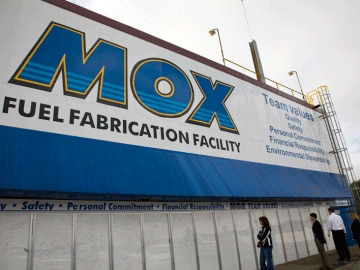
The online fire sale, which ended Thursday evening, is part of an effort to recoup some of the nearly $8 billion taxpayers spent on the so-called Mixed Oxide (MOX) Fuel Fabrication Facility in Aiken, South Carolina, which sits partially finished.
The Trump administration pulled the plug on the project in 2018 following years of ballooning cost estimates and delays. Envisioned in 1999 with a price-tag of $620 million, it swelled to nearly $48 billion with an estimated completion date in the 2040s. Metric tons of plutonium transferred to the site for conversion remain there.
The thousands of items up for grabs are in their original packaging and “present a rare opportunity to acquire brand new equipment that is top nuclear grade,” said Diana Peterson, president of the auction company AW Properties Global, which has been awarded the subcontract to sell off the goods.
Plutonium Handling
Among the items are 101 pallets of glove box assembly kits — sealed boxes with two arm-length gloves attached to holes in the side, used to handle plutonium and other radioactive materials. The high bid was $20,000 as of Thursday afternoon.
A pair of 3,750 kilo-volt-ampere transformers is going for $70,000. Also available are 300,000 pounds of ventilation equipment, as well as reams of switches, control panels, valves, and electrical equipment.
To critics, the sale is a fitting capstone to a project they say has been beset by waste from the start.
“This give-away sale of equipment from the MOX debacle highlights the massive waste of money spent on equipment that was stockpiled willy-nilly just to spend annual budgets and enrich contractors,” said Tom Clements, director of Savannah River Site Watch, a non-profit public-interest group that monitors work at the sprawling site that made nuclear bomb materials in the 1950s.
There should be a “full accounting to the public about how much was spent on stockpiled MOX equipment, how much has been given away or scrapped, and how much is being sold at pennies on the dollar,” Clements said.
The National Nuclear Security Administration, the Energy Department arm responsible for the site, said the auction was being held in accordance with all government property regulations.
“Any inventory that could not be reused by our government, is going to auction as part of our commitment to recapitalize project value,” the agency said in a statement.
One of the coldest towns on Earth clocks a potentially record-breaking — and worrying — temperature. By Zeeshan Aleem@ZeeshanAleem Jun 21, 2020,A small town in Siberia reached a temperature of 100.4 degrees Fahrenheit on Saturday, which, if verified, would mark the hottest temperature ever recorded north of the Arctic Circle.
The town of Verkhoyansk is one of the coldest towns on Earth — temperatures dropped to nearly 60 degrees below zero there this past November — and the average June high temperature is 68 degrees.
The Washington Post reports that while there are questions about the accuracy of the record temperature, a Saturday weather balloon launch that found unusually high temperatures in the lower atmosphere supports the reading. And on Sunday, the town reached 95.3 degrees, according to the Post.
CBS News meteorologist and climate specialist Jeff Berardelli wrote on Saturday that 100-degree temperatures in or near the Arctic are “almost unheard of.”
Before Saturday, Siberia was already experiencing an extraordinary heat wave. Surface temperatures in Siberia were 18 degrees higher than average in May, making it the hottest May in the region since record-keeping began in 1979, according to the Copernicus Climate Change Service.
“It is undoubtedly an alarming sign, but not only May was unusually warm in this region,” said Freja Vamborg, a senior scientist at the Copernicus Climate Change Service, in a statement about the finding. “The whole of winter and spring had repeated periods of higher-than-average surface air temperatures.”
Climate scientist Martin Stendel said on Twitter that the temperatures recorded in northwestern Siberia last month would be a 1-in-100,000-year event — if not for climate change.
Berardelli said the average heat across Russia between January and May actually matches what current models project to be normal for the region in 2100, if carbon emissions continue.
“Due to heat trapping greenhouse gases that result from the burning of fossil fuels and feedback loops, the Arctic is warming at more than two times the average rate of the globe,” he explained in his analysis of the Verkhoyansk reading. “This phenomenon is known as Arctic Amplification, which is leading to the decline of sea ice, and in some cases snow cover, due to rapidly warming temperatures.”
He noted that if the climate continues to heat up, extreme heat waves will become more of the norm.
New film helps us find it, measure it and understand it, By Linda Pentz Gunter,
There are many ways to teach people about radiation. But if you want to make that lesson accessible, compelling and even moving, then this film is the way to do it.
Let’s go on a journey. A journey to learn about radiation exposure from fallout after a nuclear power plant accident. We have the perfect guide. It is the independent French radiation research laboratory known as CRIIRAD, and its director, Dr. Bruno Chareyron.
The organization’s full name in French is Commission de Recherche et d’Information Indépendantes sur la RADioactivité, hence the acronym. In English it is translated as Commission for Independent Research and Information about RADiation.
For those not familiar with CRIIRAD, our journey begins with a little history, and so does CRIIRAD’s brilliant new 45-minute film — Invisible Fallout (Invisibles retombées is the French title), which can be viewed in its entirety on YouTube and above. The film, written and produced by CRIIRAD staff and directed by Cris Ubermann, is in French and Japanese with English subtitles.
When the Chernobyl nuclear disaster hit in April 1986, the French government engaged in a notorious cover-up, claiming that France “has totally escaped any radioactive fallout.” The whole thing was a lie. Five days before the government denial, Chernobyl’s radioactive cloud had covered all of France.
As Invisible Fallout recounts, after Chernobyl, it took 15 years until the French government published fallout maps of France. But the CRIIRAD laboratory, formed right after Chernobyl precisely to establish that France’s immunity was a myth, had already done the work that debunked the official line that the disaster was just a Soviet problem. French citizens not only got dosed by Chernobyl fallout, but would live in perpetual danger of a similar catastrophe at home, with a country almost 80% reliant on nuclear-generated electricity from its 58 reactors.
But Invisible Fallout does not linger long in the past. It segues quickly to the next nuclear catastrophe — the 2011 Fukushima-Daiichi meltdowns in Japan — and it is there that the CRIIRAD team, led by Chareyron, take us to learn about the effects of radiation exposure from nuclear power plants.
Just sixteen days after the Fukushima disaster, Japanese citizens began to detect fallout. They desperately needed to do independent monitoring but found it hard to get their hands on Geiger counters. The downplays and cover-ups by Japanese authorities, attempting to minimize the dangers and avoid mass evacuations, meant official figures could not be trusted.
An unlikely leader stepped forward in the person of composer and artist, Wataru Iwata, who, one month after the disaster, asked CRIIRAD for Geiger counters. They sent them, along with email tutorials on radioactivity, its health risks and how to protect against them. The laboratory also prepared a series of simple, clear, instructional “emergency” videos in English, designed for non-specialists, which they put online for everyone to access. This included an instructional segment on how to use a Scintillometer, one of the dozen devices CRIIRAD had sent to the Japanese activists.
We then get a short instructional video of our own on exactly how the Scintillometer is able to rapidly detect Gamma radiation in counts per second, and what those measurements mean. It glides into clarity for us, abetted by the smooth tones of the film’s excellent French narrator, Nicolas Planchais. We forget completely we are in class. Everything is, indeed, illuminated.
And we see Iwata taking his device into Fukushima Prefecture where he helps others measure the radiation levels. At a restaurant 55km away from the destroyed reactors, where people were going about their daily lives, he is shocked to record radiation levels that are 50 times higher than normal. In other areas, levels are 1,000 times higher.
Two months after the accident, CRIIRAD decided to show up in person, and Japan’s Citizens Radioactivity Monitoring Stations (CRMS), were born. CRIIRAD set up nine CRMS in Fukushima Prefecture and one in Tokyo.
Quickly realizing that ingestion of radioactively contaminated foodstuffs was as much of a threat as external exposure, Iwata asked for ways to measure radiation in food. This would help the people who had stayed — or who had been forced to remain — in contaminated areas to make informed choices about the food they consumed. CRIIRAD brought over a device sensitive enough to detect radiation in food, then conducted a seminar for residents of Fukushima City on on how to use it. We too, as viewers, get the tutorial.
Indeed, all of these lessons in science are subtly woven into the film, but cleverly attached to the lived experiences of real people in Japan, making it relevant and relatable.
And then, as we learn how to measure radiation levels and what they mean, we start to meet the people to whom it matters the most. We encounter a farmer who abided by the rules not to sell contaminated crops but whose family ate the food themselves so it would not go to waste. And we watch his palpable emotion as he recounts his attachment to the land and the known risks he and his family took.
CRIIRAD and its Japanese partners begin to find radioactive particles everywhere— on rooftops, in soil and vegetation, at the foot of trees, in the cracks of tarmac, even inside greenhouses.
At a school which, in denial, refused to have radiation measurements taken, Iwata is shown taking readings in the school grounds. They start at 6,000 to 7,000 counts per second, but rise to 27,000 counts per second at ground level.
The CRIIRAD team encounter what they describe as their most difficult moment when an elderly peasant farmer asks them to conduct measurements on her land just 30km away from the nuclear site. She herself was forced to evacuate, but her farm was not in the zone designated for permanent evacuation. So she came back with CRIIRAD to assess the situation.
We watch them take measurements, then gently show the results to her. She begins to sob. Then she tells them, “Thank you for coming all this way. I was in darkness and you have brought me light.” But, she knows she must now abandon the farm forever.
After an interlude for another lesson, this time on gamma rays, we are back to some chilling truths about their effects. In Fukushima City, we learn that at an elementary school there, children are asked to frequently change places in class so that the same children are not always sitting by the window where the radiation levels are higher.
This prompts CRIIRAD to remind us that, “when it comes to radiation protection, there is no threshold below which it is harmless.” And they point out that the Japanese decision to raise the annual allowable radiation dose from 1mSv to 20mSv, “means accepting a risk of cancer 20 times higher, and this applies equally to children and pregnant women” for whom such doses present a far higher risk.
CRIIRAD warns that people living in the contaminated region will be exposed for decades and across vast areas. They will be exposed to external radiation from powerful gamma rays emitted by the soil and contaminated surfaces. They will be exposed through inhalation of radioactive dust suspended every time the wind blows, and by activities such as sowing crops, ploughing and construction work. And they will be exposed through eating foodstuffs cultivated on contaminated land in contaminated soil.
But thanks to CRIIRAD, many of them will now know how to measure these levels, what they mean and how to protect themselves. It’s a lesson that’s well worth learning for all of us.
For more information, please see the CRIIRAD website, in its original French, and in English.
Debunking Trump and Corporate Media’s WHO/China Coverup Conspiracy Theories FAIR
JOSHUA CHOFAIR has criticized the plausibility of various origin theories regarding Covid-19 (4/17/20, 5/7/20), and of unfounded allegations of a Chinese cover-up laundered by corporate media (4/2/20, 4/9/20). Other persistent myths are allegations of Chinese manipulation of the World Health Organization (WHO), and blaming Chinese secrecy for the lack of early action on containing the coronavirus.
The Trump administration suspended funding to WHO in April—the UN’s primary infectious disease–fighting body—accusing it of “severely mismanaging and covering up the spread of the coronavirus,” and of taking China’s allegedly deceptive claims about its handling of Covid-19 at “face value.” But corporate media had already been boosting these same talking points.
The Wall Street Journal’s “The World Health Organization Draws Flak for Coronavirus Response” (2/12/20) effectively accused WHO of being “too deferential to China in its handling of the new virus,” and criticized WHO Director-General Tedros Ghebreyesus for “bending to Beijing” after lauding China’s unquestionably effective swift quarantine of 60 million people, and for declaring that “China is actually setting a new standard for outbreak response” and identifying the virus in “record time.” The Journal further expounded the conspiracy theory of a seemingly omnipotent China having WHO under its thumb:
Over its decades of battling epidemics, the WHO has rarely had to deal with an entity as politically and economically powerful as China today. It can’t afford to alienate the country’s leadership, whose clout and financial largess it aims to attract to global health causes. It needs Beijing’s cooperation in preventing a full-blown pandemic—and this may not be the last time. China is the source of many emerging pathogens, which jump from animals to humans in its teeming live markets and can cause deadly epidemics.
According to the Journal’s logic, when WHO praises China for an effective response containing Covid-19 and giving the rest of the world ample time to take health precautions, it is “compromising its own epidemic response standards, eroding its global authority, and sending the wrong message to other countries that might face future epidemics.” When Dr. Bruce Aylward—a Canadian medical expert with 30 years of experience combating polio, Ebola and other global health emergencies—concluded that he “didn’t see anything that suggested manipulation of numbers,” after leading a team of experts visiting China for WHO, that can’t be an accurate observation. For corporate journalists, it can only be because he was duped by the devious Chinese government “underreporting both total cases and deaths it’s suffered from the disease” (Bloomberg, 4/1/20).
The Journal flimsily explained that China wields such formidable control over the WHO because China is a “future source of funds and a partner with which to tackle the biggest global health problems,” and not as a “current donor.” That would be because a cursory examination of WHO’s funding would reveal that the US donated more than 10 times more money to WHO ($893 million) than China ($86 million), despite the US having almost $200 million in arrears before suspending payments (Axios, 4/15/20).
Neither does the Journal explain how or why WHO could possibly withhold information from Western nations even if it wanted to, when its leadership is stacked with Americans and Europeans, and 15 US officials were embedded with the WHO in Geneva, given that the US is the most “politically and economically powerful” nation on Earth. This makes the Trump administration’s declaration of the US terminating its membership in WHO after threats to permanently cut funding especially egregious.
Nor can the Journal explain the source of China’s fearsome influence over independent and prestigious medical journals like Nature (5/4/20), Science (3/28/20) and the Lancet (3/7/20), which also credited the effectiveness and transparency of China’s response for saving thousands of lives (CGTN, 5/1/20, 5/10/20). Does China’s mysterious and awe-inspiring influence extend over Western medical journals as well?
When Foreign Policy (5/12/20) reported on the exclusive scoop of a leaked dataset of coronavirus cases and deaths from the Chinese military’s National University of Defense Technology, it confirmed that the leaked information “matches” the publicly available numbers the Chinese government posts online—which poses an inconvenience to those spouting conspiracy theories of a Chinese government coverup. Corporate media accounts of Chinese deception and fake statistics also fail to explain how the Chinese government possesses the fantastical ability to deceive governments and independent medical experts around the world, even if it wanted to. As FAIR’s Jim Naureckas (4/2/20) pointed out earlier:
The reality is that it’s very hard to hide an epidemic. Stopping a virus requires identifying and isolating cases of infection, and if you pretend to have done so when you really haven’t, the uncaught cases will grow exponentially. Maintaining a hidden set of real statistics and another set for show would require the secret collusion of China’s 2 million doctors and 3 million nurses—the kind of improbable cooperation that gives conspiracy theories a bad name…. If China is merely pretending to have the coronavirus under control, the pathogen will rapidly surge as people resume interacting with their communities. Once international travel is restored, it will be quite obvious which countries do and don’t have effective management of Covid-19.
Countries revising their figures upon receiving new information is to be expected, and is not necessarily evidence of deceit, as plenty of nations besides China revise their data upwards. Yet only China is singled out as being exceptionally deceptive. For example, in the same week New York revised its death toll upwards by nearly 3,800, China’s adding almost 1,300 dead to its Wuhan data was presented as a possible coverup (Politico, 4/14/20; Guardian, 4/17/20). The Moon of Alabama blog (4/1/20) explained some of the complexities in reporting numbers during a pandemic in real-time:
Does one include co-morbids or not in the count? What about casualties of a car accident that also test positive for Covid-19 when they die? What about those who died with Covid-19 symptoms but could not be tested for lack of test kits? Are the tests really working reliably?… What about asymptomatic cases that test positive. Are these false positives, or do these people really have the virus? One can only know that by testing them a month later for antibodies………
this manipulation of public opinion by the US government and corporate media appears to be working. According to a recent Ipsos survey, more than 30% of Americans have witnessed someone blaming Asian people for the coronavirus pandemic (even though new research indicates that travel from New York City was the primary source of the US outbreak, with New York’s outbreak originating in Europe). Pew Research (4/21/20) found that around two-thirds of Americans have an unfavorable view of China, which is the most negative rating for the country since Pew began asking the question in 2005. This suggests that public opinion has been turned against China, despite it being the first to detect the virus, alert the world and provide a model for containing it.https://fair.org/home/debunking-trump-and-corporate-medias-who-china-coverup-conspiracy-theories/
Anti-nuclear resistance in Russia: problems protests, reprisals
The following is a report from the Russian Social Ecological Union (RSEU)/ Friends of the Earth Russia, slightly edited for length. You can read the report in full here. It is a vitally important document exposing the discrimination and fear tactics used against anti-nuclear organizers in Russia and details their courageous acts of defiance in order to bring the truth of Russia’s nuclear sector to light.
Rosatom is a Russian state-owned corporation which builds and operates nuclear power plants in Russia and globally. The state-run nuclear industry in Russia has a long history of nuclear crises, including the Kyshtym disaster in 1957 and Chernobyl in 1986. Yet Rosatom plans to build dozens of nuclear reactors in Russia, to export its deadly nuclear technologies to other countries, and then to import their hazardous nuclear waste.
This report is a collection of events and details about the resistance to Russian state nuclear corporation, Rosatom, and other activities that have led to the pollution of the environment and violation of human rights. Social and environmental conflicts created by Rosatom have been left unresolved for years, while at the same time, environmental defenders who have raised these issues, have consistently experienced reprisals.
“So, we have to get away from our obsession with economic growth – we really need to start managing our economies in a way that protects our climate and natural resources, even if this means less, no or even negative growth.”
21 June, 20, , Scientists’ warning on affluence, UNIVERSITY OF NEW SOUTH WALES, A group of researchers, led by a UNSW sustainability scientist, have reviewed existing academic discussions on the link between wealth, economy and associated impacts, reaching a clear conclusion: technology will only get us so far when working towards sustainability – we need far-reaching lifestyle changes and different economic paradigms.
In their review, published today in Nature Communications and entitled Scientists’ Warning on Affluence, the researchers have summarised the available evidence, identifying possible solution approaches.
“Recent scientists’ warnings have done a great job at describing the many perils our natural world is facing through crises in climate, biodiversity and food systems, to name but a few,” says lead author Professor Tommy Wiedmann from UNSW Engineering.
“However, none of these warnings has explicitly considered the role of growth-oriented economies and the pursuit of affluence. In our scientists’ warning, we identify the underlying forces of overconsumption and spell out the measures that are needed to tackle the overwhelming ‘power’ of consumption and the economic growth paradigm – that’s the gap we fill.
“The key conclusion from our review is that we cannot rely on technology alone to solve existential environmental problems – like climate change, biodiversity loss and pollution – but that we also have to change our affluent lifestyles and reduce overconsumption, in combination with structural change.”
During the past 40 years, worldwide wealth growth has continuously outpaced any efficiency gains.
“Technology can help us to consume more efficiently, i.e. to save energy and resources, but these technological improvements cannot keep pace with our ever-increasing levels of consumption,” Prof Wiedmann says.
Reducing overconsumption in the world’s richest
Co-author Julia Steinberger, Professor of Ecological Economics at the University of Leeds, says affluence is often portrayed as something to aspire to.
“But our paper has shown that it’s actually dangerous and leads to planetary-scale destruction. To protect ourselves from the worsening climate crisis, we must reduce inequality and challenge the notion that riches, and those who possess them, are inherently good.”
In fact, the researchers say the world’s affluent citizens are responsible for most environmental impacts and are central to any future prospect of retreating to safer conditions.
“Consumption of affluent households worldwide is by far the strongest determinant – and the strongest accelerator – of increased global environmental and social impacts,” co-author Lorenz Keysser from ETH Zurich says.
“Current discussions on how to address the ecological crises within science, policy making and social movements need to recognize the responsibility of the most affluent for these crises.”
The researchers say overconsumption and affluence need to be addressed through lifestyle changes.
“It’s hardly ever acknowledged, but any transition towards sustainability can only be effective if technological advancements are complemented by far-reaching lifestyle changes,” says co-author Manfred Lenzen, Professor of Sustainability Research at the University of Sydney.
“I am often asked to explain this issue at social gatherings. Usually I say that what we see or associate with our current environmental issues (cars, power, planes) is just the tip of our personal iceberg. It’s all the stuff we consume and the environmental destruction embodied in that stuff that forms the iceberg’s submerged part. Unfortunately, once we understand this, the implications for our lifestyle are often so confronting that denial kicks in.”
No level of growth is sustainable
However, the scientists say responsibility for change doesn’t just sit with individuals – broader structural changes are needed.
“Individuals’ attempts at such lifestyle transitions may be doomed to fail, because existing societies, economies and cultures incentivise consumption expansion,” Prof Wiedmann says.
A change in economic paradigms is therefore sorely needed.
“The structural imperative for growth in competitive market economies leads to decision makers being locked into bolstering economic growth, and inhibiting necessary societal changes,” Prof Wiedmann says.
“So, we have to get away from our obsession with economic growth – we really need to start managing our economies in a way that protects our climate and natural resources, even if this means less, no or even negative growth.
“In Australia, this discussion isn’t happening at all – economic growth is the one and only mantra preached by both main political parties. It’s very different in New Zealand – their Wellbeing Budget 2019 is one example of how government investment can be directed in a more sustainable direction, by transforming the economy rather than growing it.”
The researchers say that “green growth” or “sustainable growth” is a myth.
“As long as there is growth – both economically and in population – technology cannot keep up with reducing impacts, the overall environmental impacts with only increase,” Prof Wiedmann says.
One way to enforce these lifestyle changes could be to reduce overconsumption by the super-rich, e.g. through taxation policies.
“‘Degrowth’ proponents go a step further and suggest a more radical social change that leads away from capitalism to other forms of economic and social governance,” Prof Wiedmann says.
“Policies may include, for example, eco-taxes, green investments, wealth redistribution through taxation and a maximum income, a guaranteed basic income and reduced working hours.”
Modelling an alternative future
Prof Wiedmann’s team now wants to model scenarios for sustainable transformations – that means exploring different pathways of development with a computer model to see what we need to do to achieve the best possible outcome.
“We have already started doing this with a recent piece of research that showed a fairer, greener and more prosperous Australia is possible – so long as political leaders don’t focus just on economic growth.
“We hope that this review shows a different perspective on what matters, and supports us in overcoming deeply entrenched views on how humans have to dominate nature, and on how our economies have to grow ever more. We can’t keep behaving as if we had a spare planet available.”
June 21, 2020 President Donald Trump wholeheartedly endorsed a potential Israeli military attack targeting Iran’s nuclear installations, according to the controversial new book of his former former national security advisor.In “The Room Where It Happened: A White House Memoir,” the famously hawkish Bolton wrote that “On Iran, I urged that he press ahead to withdraw from the nuclear agreement and explained why the use of force against Iran’s nuclear program might be the only lasting solution. ‘You tell Bibi [Israel’s Prime Minister Benjamin Netanyahu] that if he uses force, I will back him. I told him that, but you tell him again,’ Trump said, unprompted by me.”
Clacton Gazette 20th June 2020,CAMPAIGNERS fighting plans for a new nuclear power station at Bradwell are calling for the proposals to be scrapped. Opposition group Banng – Blackwater Against New Nuclear Group – has prepared a 13,000-word response to the stage one public consultation.
It says the Bradwell site is “unsustainable, unsuitable and unacceptable”. The Bradwell B project is
a joint operation between CGN and EDF Energy. Banng chairman Andy Blowers said: “This is not a done deal as CGN would have us believe. A new nuclear power station is not needed, and especially it is not needed at this site.”
Campaigners say the site is not sustainable because climate change and rising sea levels leave it at risk of flooding. They also say it will destroy the landscape. Mr Blowers said: “The blunt truth is that we cannot tell what conditions will be like by the end of the century let alone beyond, when highly radioactive spent fuel and other nuclear wastes will still be on a site that could be unviable.
Nuclear powers, a disputed border and an uneasy truce: Explaining the India-China conflict
A border clash between the two nuclear armed neighbors has drawn the world’s gaze to a disputed region in the Himalayas NBC News, June 20, 2020, By Saphora Smith
High up in the Himalayas, Indian and Chinese armed forces warily eye each other across a disputed border region that has become the scene of a tense standoff between the two nuclear powers.
The conflict in the remote Galwan Valley that spans their shared border sparked into life Monday with the killing of 20 Indian soldiers, the first reported deaths in 45 years. China has not disclosed whether its forces suffered any casualties, according to a report in its state-run newspaper, the Global Times.
The deaths have drawn the world’s gaze to a region that the two most populous countries have been contesting for decades. The implications go far beyond the lonely snowcapped mountains of this geopolitically complex region.
………Thousands of troops have been camped either side of the Galwan Valley, in the mountainous region of Ladakh, for weeks.
The tense standoff started in early May, when Indian officials said Chinese soldiers crossed the boundary in Ladakh at three different points, erecting tents and guard posts and ignoring verbal warnings to leave, according to The Associated Press. That triggered shouting matches, stone-throwing and even fistfights between the two sides, much of it replayed on television news channels and social media, the news agency reported…….
A heavy chunk of the San Onofre nuclear plant is slowly moving to Utah, San Diego Tribune,
The 770-ton reactor pressure vessel from Unit 1 is part of the plant’s decommissioning efforts, By ROB NIKOLEWSKI, JUNE 19, 2020
A 770-ton portion of the now shuttered San Onofre Nuclear Generating Station, known as SONGS for short, is slowly making its way to a final resting place at a disposal facility in Utah.
A reactor pressure vessel that helped Unit 1 at SONGS generate electricity left the plant’s premises May 24 via railand is now at an industrial park in North Las Vegas, Nevada, about to be taken some 450 miles north on roads, accompanied by a pair Nevada Highway Patrol trooper pilot cars, to the Utah border.
The shipment will then continue, reaching the Energy Solutions disposal site in the town of Clive, Utah, located about 75 miles west of Salt Lake City.
The old reactor vessel and its contents are designated as Class A low-level waste, considered by the U.S. Nuclear Regulatory Commission as the least hazardous of radioactive waste classifications. Encased in a carbon steel cylinder for the trip, the vessel contains pieces of radioactive metal and grout.
The vessel will be loaded onto a trailer 122 feet long, with 45 axles. The trailer’s eight pieces are being put together with cranes at the Apex Industrial Park. Once assembled, the trailer will then take to the road, avoiding Interstate 15 by traveling on U.S. Highway 93, state Route 318, U.S. Highway 6, back to Highway 93 and eventually taking Interstate 80 into Utah.
Six heavy-duty Class 8 trucks with combined 4,000-horsepower will haul the vessel. The entire configuration will use 460 tires that are 18 inches wide to prevent damaging roads, bridges and public infrastructure. Emmert International will use hydraulic jacks to reinforce drainage culverts.
Turkey’s Russian nuclear power project hits legal hurdle,Ahval, Jun 21 2020
Russia’s $20 billion nuclear power project located in Mersin on Turkey’s Mediterranean coast has long come under fire over safety and environmental concerns, including claims of large cracks in the concrete foundations due to loose and unstable ground in the area.
Officials broke ground on the Akkuyu power plant in 2018, which is set to be Turkey’s first nuclear power station and is due to come online in 2023 – the 100th anniversary of the Republic of Turkey.
But engineers and workers began ringing alarm bells over a potential nuclear disaster soon after its inception, and a group of NGOs filed a lawsuit with a Turkish court demanding for construction to be halted…….
A Turkish court in the southern province of Mersin ruled on Friday to accept a request by the NGOs for relevant ministries and the National Security Council (MGK) to be able to intervene in the project, Cumhuriyet newspaper reported.
The court said the case would be reported to the MGK, which has no obligation to intervene in construction, but may now choose to do so. Lawyers involved in the case hd also said that the Russian power power plant could pose a national security threat to Turkey.
The court also gave the green light to a request by the NGOs for the involvement of a number of Turkish ministries in the case, including the Health Ministry, the Treasury and Finance Ministry, as well as the Food, Agriculture and Livestock Ministry.
[Andreas Kluth] Nuclear arms race worse than last one Korea Herald, By Bloomberg 21 June 20, As long as the pandemic rages, the world’s leaders are understandably preoccupied with the threat of disease. But there are other dangers to humanity that demand attention. One of the most frightening is nuclear war. Unfortunately, the risk of that happening keeps rising.
The headline numbers are misleading. Yes, the global stockpile of nuclear warheads decreased slightly last year, according to the latest report by the Stockholm International Peace Research Institute. But that’s only because the US and Russia, the two countries that still account for more than 90 percent of global nuclear stocks, dismantled some of their obsolescent warheads.
Meanwhile, all nine countries with nukes are modernizing their other warheads and delivery systems. In a test just last week, France successfully fired, from a submarine, a nuclear missile that can travel between continents at 20 times the speed of sound. Other countries, most notably China, are adding to their nuclear stashes as fast as they can.
Even more worryingly, states are reviewing their strategies for using these weapons. Gone is the amoral but logical stability of the Cold War, when two superpowers kept each other and the world in check with a credible threat of “Mutual Assured Destruction.”
Russia, for instance, increasingly sees smaller “tactical” warheads as a possible way to compensate for weaknesses in its other military forces. It’s conceivable that a conflict starting with hybrid warfare — ranging from disinformation campaigns to soldiers in unmarked uniforms — could escalate to a conventional war and a limited nuclear strike, inviting a counter strike and so forth.
There’s also speculation that India could soften its policy, adopted in 1998, never to be the first to use a nuclear weapon. Such thought experiments are no small matter for a country with two hostile and nuclear-armed neighbors, Pakistan and China. Just this week, India and China clashed again over their disputed border in the Himalayas. What North Korea could get up to in a crisis that it itself provokes is anybody’s guess.
Meanwhile, all efforts to limit or reduce nuclear weapons have ground to a halt. A treaty between the US and the Soviet Union that eliminated land-based missiles with short and intermediate ranges collapsed last year, after the US accused Russia of cheating.
And the two old foes aren’t even close to extending their only remaining arms-control agreement, called New START, which expires in February. One reason for that failure was America’s insistence that the third and rising superpower should join the negotiations. But China, which sees itself as merely catching up with the two nuclear kingpins, balks at accepting any limits.
Progress has also stalled in updating the Treaty on the Non-Proliferation of Nuclear Weapons, exactly 50 years after it took effect. It sought to keep additional countries from making bombs by encouraging them to use fissile material (uranium or plutonium) only for civilian purposes such as generating electricity. But five countries have gone nuclear since it was signed. Worse, game theory suggests that it’s rational for more states to follow. Iran could be next.
The only international agreement to ban these evil weapons altogether, the Treaty on the Prohibition of Nuclear Weapons passed by the United Nations in 2017, has the same chance as a snowball in a fission event. No member of the nuclear club intends to ratify it, nor do many other countries……….
But they must rise above themselves. If they can’t, the rest of us, from voters to the military brass, should force them. Only patient multilateralism, as unsexy as that polysyllabic Latin word may sound to alpha males, can save us in the long run. Otherwise, to use a Cold War metaphor, the nations of the world will find themselves standing in a room awash with gasoline, each counting who has how many matches, until one is lit. http://www.koreaherald.com/view.php?ud=20200621000020
PUBLISHED: 10:28 AEST, 21 June 2020 | UPDATED: 15:01 AEST, 21 June 2020
New details about a U.S. plan to blow up a nuclear bomb on the moon as a Cold War ‘show of dominance’ have been revealed in a recently-published book.
The secret mission, code-named Project A119, was conceived at the dawn of the space race by an Air Force division located at New Mexico‘s Kirtland Air Force Base.
A report authored in June 1959 entitled ‘A Study of Lunar Research Flights’ explained plans to explode the bomb on the moon’s ‘terminator’ – the area between the part of the surface that is illuminated by the sun, and the part that’s dark.
The explosion would have likely been visible with the naked eye from Earth because the military had planned to add sodium to the bomb, which would glow when it exploded
A nuclear bomb on the surface of the moon was definitely one of the stupider things the government could do,’ said John Greenewald, Jr., author of Secrets from the Vault.
The book, published in April, details some of the more surreal suggestions made in history.
Tell Congress: Prevent Nuclear Catastrophe in Iran
Read the Public Inquiry Report, the Commissioners’ report, Surrendering Australia: The AUKUS Deception is available to download for free at aukuspublicinquiry.com. Or just watch the replay of the National Press Club Luncheon.
19 November – Webinar – The Reality of Reprocessing
Time: 11:00 AM Pacific Time (US & Canada) / 2:00 PM Eastern / 7:00 PM UK / 8:00 PM CET