Standard nuclear designs are still too costly, and safety features are only a third of nuclear costs.
Ars Technica 21st Nov 2020, Should any discussion of nuclear power go on for long enough, it becomes inevitable that someone will rant that the only reason they’ve become unaffordable is a proliferation of safety regulations. The argument is rarely (if ever) fleshed out—no specific regulation is ever identified as problematic, and there seems to be no consideration given to the fact that we might have learned something at, say, Fukushima that might merit addressing through regulations.
But there’s now a paper out that provides some empirical evidence that safety changes have contributed to the cost of building new nuclear reactors. But the study also makes clear that they’re only one of a number of factors, accounting for only a third of the soaring
costs. The study also finds that, contrary to what those in the industry seem to expect, focusing on standardized designs doesn’t really help matters, as costs continued to grow as more of a given reactor design was built.
Slowly moving lawsuit on the health impacts of a national nuclear laboratory
 BNL lawsuit and the impacts of national nuclear laboratory
Brookhaven National Laboratory “continues to show almost no regard for its neighbors…Is this any way for a government-funded agency to treat its neighbors?” Nation of Change, By Karl Grossman, November 20, 2020
BNL after negotiations agreed to settlements of approximately $600,000 for the first two groups of plaintiffs, each with about 18 persons. However, last month a settlement was not agreed to involving the final group of 18 plaintiffs, and New York State Supreme Court Justice Joseph Farneti ordered that a trial be scheduled.
It accuses BNL of “failure to observe accepted relevant industry standards in the use, storage and disposal of hazardous and toxic substances” and says BNL itself had been “improperly located” by the U.S. Atomic Energy Commission “on top of an underground aquifer which supplies drinking water to a large number of persons.”
Lead attorneys are A. Craig Purcell of Smithtown, Long Island who is a former president of the Suffolk County Bar Association, and Richard J. Lippes, whose Buffalo, New York law firm successfully represented residents of the Love Canal neighborhood near Niagara Falls, severely polluted by the Hooker Chemical Co.
The lawsuit’s title is Osarczuk, et. al, vs. Associated Universities. Barbara Osarczuk had lived in North Shirley, just outside the BNL boundaries, for 28 years and attributed her thyroid and breast cancer to BNL.
A book on radioactive pollution from BNL causing health impacts to residents of Shirley was published in 2008. Welcome to Shirley: A Memoir from an Atomic Town was authored by Kelly McMasters of Hofstra University, who grew up in Shirley. The book was the basis of the 2012 TV documentary Atomic States of America.
As Professor McMasters has related in an interview: “I do believe there was a watershed moment in 1960, after the first radioactive leaks occurred, that the federal government or the scientists themselves should have realized that Shirley was the fastest growing town in the county, with a population that doubled within ten years, and that the middle of one of the largest sole-source drinking water aquifers in the country was not the best place for a nuclear laboratory.” http://www.smithmag.net/memoirville/2008/05/11/interview-kelly-mcmasters-welcome-to-shirley-a-memoir-from-an-atomic-town/
Purcell declares that the lawsuit, “now, nearly 25 years later…has still not been resolved despite Judge Farneti’s urging that the interests of justice would be better served by a fair and final resolution.” BNL and its lawyers “continue to nickel and dime their neighbors to this very day.” He charges that BNL “continues to show almost no regard for its neighbors…Is this any way for a government-funded agency to treat its neighbors?” https://www.nationofchange.org/2020/11/20/bnl-lawsuit-and-the-impacts-of-national-nuclear-laboratory/?fbclid=IwAR0Q0RKD6eJuJL4jNn19c-afztaMbdVNA2btXEzW16z0My0KtQW6TiWPKJY
How a nuclear weapons officer came to support the Treaty Prohibiting Nuclear Weapons
If Reagan were still alive, he would be taking a leadership role, along with Pope Francis, in trying to get other nations, especially those with nuclear weapons to ratify the TPNW.
 How I Came to Support the Treaty Prohibiting Nuclear Weapons, https://www.justsecurity.org/73430/how-i-came-to-support-the-treaty-prohibiting-nuclear-weapons/, by Lawrence Korb, November 19, 2020 About three years ago, in November 2017, I was honored to be one of about a 100 people invited by the Vatican to an international symposium, “Prospects for a World Free of Nuclear Weapons and for Integral Disarmament.” It was the first global gathering conducted after 120 nations at the United Nations approved the Treaty on the Prohibition of Nuclear Weapons (TPNW).This treaty, which is the first legally binding international agreement to comprehensively prohibit nuclear weapons, was adopted by the U.N. on July 7, 2017, and needed 50 countries to ratify it in order for it to come into force. The purpose for the treaty was to get world leaders and citizens to consider nuclear weapons as immoral and illegal as chemical and biological weapons, whose use the U.N had previously prohibited. Pope Francis himself was very invested in the issue. He gave the keynote address in which he condemned not only the threat of their use, but also the possession of nuclear weapons and warned that nuclear deterrence policies offered a false sense of security. He also personally thanked each of the attendees individually. The majority of those attending the conference, especially those who had personal experience with these weapons, including survivors of nuclear attacks, found it hard to believe that the majority of nations would not move in the direction of ratifying and implementing the treaty. However, approximately three years later, and in spite of opposition by several major powers, including the United States, that is exactly what happened,. Earlier this year, on Oct. 24, Honduras became the 50th nation, of the 85 who had signed the treaty, to ratify it. This brought the treaty to the legal threshold required for TPNW to enter into force. As a result, on January 22, 2021, some 75 years after nuclear weapons were first used, TPNW will become international law and prohibit participating nations from developing, possessing, testing, using or threatening to use nuclear weapons, or allow them to be stationed on their territory or assist others to do so. While this is a step in the right direction, there is much more work to be done. None of the nine nuclear States, including the United States, have signed the treaty, let alone ratified it. The United States not only did not sign the treaty, but the Trump administration actually sent a letter to other governments that have signed or ratified it urging them to reverse their decision for making what they labeled a strategic error. Moreover, the United States has still not ratified the Comprehensive Nuclear Test Ban Treaty (CTBT) passed about 15 years ago. The U.S. position on this issue is not surprising. For too long, too many people in the U.S. military, in government, and in the general public have not fully contemplated how disastrous using these weapons was and could be. I saw this myself in and outside of government. Growing up in New York City in the 1950s, I and my fellow classmates routinely participated in duck-and-cover drills to prepare us for a nuclear attack, but did not think much about them. These drills were so routine that they did not appear to be any more important than our physical education classes in the gym. I joined the Navy in the summer of 1962 and was halfway through Officer Candidate School (OCS) when the Cuban Missile Crisis occurred. Although we now know how close the United States came to actually having a nuclear exchange with the former Soviet Union, the seriousness of the crisis did not appear to register on me or my fellow servicemembers. After getting my commission and wings in 1963, I was undergoing training in San Diego to get ready to join Patrol Squadron One.who carried out maritime patrol, anti-submarine warfare, and other responsibilities. A speaker at one of our sessions was Navy Admiral Frederick Ashworth, who was the atomic weaponeer onboard the B-29 carrying the Batman nuclear weapon in 1945. According to the admiral, the crew of the B-29 had to have a visual sighting of the target before dropping it. But when the B-29 Superfortress went to its first target, Kokuna, it was shrouded in clouds and haze, so they diverted to Nagasaki, the backup target. When they arrived there, this city was also covered in clouds. Since they had to drop the bomb by 11 a.m. or abort the mission, the situation raised concerns among the crew. None of them wanted to return to their base still carrying the bomb or drop it under these conditions. However, during his talk, the admiral jokingly claimed that just before 11 a.m. the heavens opened up and they had enough visual sighting to enable them to drop the bomb on the intended target. Unfortunately, neither myself, nor my colleagues, showed much concern about the admiral speaking so cavalierly about dropping a nuclear weapon in the wrong place on such a large city. When I got to my squadron, I was assigned as the nuclear weapons duty officer for my crew and routinely had to supervise loading dummy, or inert, nuclear weapons on our plane. My squadron mates and I never thought much about it. Moreover, we were never told where the real bombs were or what our targets might be. Nor did we seem to care. When my squadron deployed to Iwakuni, Japan, in 1964, I decided to visit Hiroshima but could not get any of my squadron mates to come along. Seeing that city even 19 years after the bombing was overwhelming. I followed it up with a visit to Nagasaki, where I discovered that despite what the admiral had said, the bomb did not come anywhere close to its intended target. In fact, it exploded almost on top of a Catholic church, about two miles from where it was supposed to hit. During my time serving in the Reagan administration, I came to realize that the only nuclear strategy we had was massive retaliation, which would have made the attacks on Hiroshima and Nagasaki seem almost trivial. But my admiration for President Ronald Reagan on this issue grew when I realized that his often-mocked Strategic Defense Initiative (SDI or Star Wars), was an attempt by him not to have to rely on massive retaliation to respond to a Soviet nuclear attack, even if it involved a small number of weapons. In fact, the president decided that he needed SDI during the 1980 presidential campaign when he discovered that the only option a president had to even a small nuclear attack was Mutually Assured Destruction (MAD). My admiration for him on this issue was further enhanced when he and Mikhail Gorbachev, the former leader of the Soviet Union, almost agreed to get rid of all nuclear weapons at their conference in Reykjavík, Iceland, a position that was openly criticized by many members of the nuclear priesthood, the group of strategists in government who actually contemplate how best to use nuclear weapons. They did agree to the elimination of all intermediate range nuclear weapons and laid the foundation for the Strategic Arms Reduction Treaty (START). In many ways Reagan was actually following in the footsteps of some of his predecessors, going back to President Dwight Eisenhower. Unfortunately, our current president does not seem to realize how disastrous a nuclear bomb attack can be. Not only is he tearing up all of our nuclear agreements but he reportedly contemplated restarting nuclear testing. Too bad he’s never visited Hiroshima or Nagasaki. If Reagan was still alive, he would be taking a leadership role, along with Pope Francis, in trying to get other nations, especially those with nuclear weapons to ratify the TPNW. And, at a minimum, to get the United States back into the arms control agreements from which the Trump administration has withdrawn, something President-elect Joe Biden has pledged to do. Like the framers of TPNW, Reagan believed, and said publicly, that a nuclear war cannot be won and must never be fought. The world needs to listen to the words of Reagan and the Pope in order to accelerate progress toward eliminating nuclear weapons. |
|
Boris Johnson’s UK government adding nuclear power to its long list of failures
|
Why we should oppose nuclear power, https://morningstaronline.co.uk/article/dr-ian-fairlie-feature 22 Nov 20, Boris Johnson just recites ad nauseam the common myth that the renewables will be unable to supply all our electricity needs, writes Dr Ian Fairlie
Hinckley Point C. The carbon footprint from nuclear’s fuel chain — including uranium mining, milling, U-235 enrichment, fuel fabrication, irradiation, radioactive-waste conditioning, storage, packaging and final disposal — is astronomical
ON WEDNESDAY, Boris Johnson announced £525 million support for new nuclear power. In the coming weeks, he is expected to approve a major new nuclear power station at Sizewell in Suffolk. This government seems to have an unwavering commitment to making the wrong calls, and more support for nuclear power is now the next item on the long list of its failures. There are many options available to decarbonise the grid and meet Britain’s energy needs, but the Prime Minister has chosen to stick with the most expensive option: nuclear. He has ignored advice to the contrary from many advisors, including the Oxford energy expert Dieter Helm, the World Bank, the Office for Budget Responsibility, and the National Audit Office. He has also ignored the fact that several large multinationals including Hitachi, Westinghouse, Toshiba and Siemens have abandoned nuclear on the grounds that it is overly expensive and uncompetitive compared with renewables such as wind, solar, biofuels, and hydro power. The reality of the matter is that we are in the midst of a technological revolution that encompasses new forms of renewable energy, new ways of managing the Grid, new methods of energy storage and new ways of energy conservation. As a result, the cost of the renewables just keeps on falling, while nuclear becomes inexorably more expensive. To give just one example: offshore wind is already getting built at about £40 per megawatt hour (MWh), while the Hinkley C plant, were it ever completed, would deliver electricity at about £93/MWh. The Prime Minister often repeats the myth that nuclear will curb carbon emissions. But the carbon footprint from nuclear’s fuel chain — including uranium mining, milling, U-235 enrichment, fuel fabrication, irradiation, radioactive-waste conditioning, storage, packaging and final disposal — is astronomical. A recent study by Mark Jacobson, professor of civil environmental engineering at Stanford, estimates nuclear’s carbon footprint to be 10 to 18 times greater than those from renewable-energy technologies. Boris Johnson would do well to heed the views of the public. Some 46 per cent of participants in the UK Climate Assembly, a group of British citizens convened by six Parliamentary Select Committees, strongly disagreed that nuclear could play a role in reaching net zero carbon emissions by 2050, with a further 18 per cent undecided. Among the reasons for their scepticism were “cost, safety, and issues around waste storage and decommissioning.” Johnson recites the common myth that the renewables will be unable to supply all our electricity needs. But more than 100 academic studies indicate that this view is out-of-date and incorrect: the renewables can indeed supply all our electricity needs. There is simply no need for nuclear. Beyond this, nuclear power cannot be separated from the problem of nuclear proliferation, as fissile materials for nuclear weapons originate from civil nuclear reactors and nuclear facilities. Countries like Pakistan, India and Israel obtained their nuclear weapons from civilian reactors. This is merely one problem, albeit a serious one. Nuclear is also an extremely unsustainable energy source. This is partly due to uranium mining which creates mine and mill tailings resulting in pollution and despoilation problems. And although nuclear power has existed for about 70 years, not a single licensed facility exists to deal with these radioactive wastes which will remain dangerous for millennia. The one such facility currently under construction, in Finland, will cost more than the revenue generated by the nuclear fuel it will store. Apart from the problems of proliferation and unsustainability, we must never forget the serious nuclear accidents at Windscale (now Sellafield) in 1957, Kyshtym in the former USSR also in 1957, Three Mile Island (US) in 1979, Chernobyl (USSR) in 1986, and Fukushima (Japan) in 2011. Renewable energy sources, especially offshore wind, are cleaner, safer, more sustainable and much cheaper than nuclear. We need urgently to decarbonise Britain’s economy and create millions of well-paid, unionised green jobs while doing so. But this can only be done through mass investment in renewables, and keeping fossil fuels in the ground. More nuclear means dither, delay, and another potential cause of catastrophe. Dr Ian Fairlie is vice-president of CND. |
|
Concerns in Utah cities about costs and safety of NuScam’s small nuclear reactor scheme
|
Following the withdrawal of seven Utah cities from the Carbon Free Power Project before the October deadline, the Southern Utah cities have passed resolutions to cap financial obligation for the first phase of licensing…….. Not all are completely sold on the safety of this power plant. Scott Williams, the executive director of Healthy Environment Alliance of Utah, told St. George News that one of the major issues with this project has to do with the lack of transparency, as UAMPS is exempt from the Open and Public Meetings Act. “We don’t get minutes. We don’t get agendas.” he said……. The next off-ramp for cities to withdraw will be near the end of the 2021 or early 2022 after the next licensing phase. UAMPS has also talked about possibly downsizing the project from 12 modules to four or six modules……. Environmentally devastating’ When it comes to potential environmental impacts, Williams said the number one problem is highly radioactive waste. “We’ve been building nuclear reactors around the country since the 60s, and all of that highly radioactive fuel is just sitting at those power plants with nowhere to go.”….. “We just think we shouldn’t generate anymore high-level nuclear waste until we have a safe, environmentally responsible way to deal with it.” Second to this, he said, is the whole process of creating nuclear fuel. All of the stages – mining, milling and enrichment – present health hazards to people. “Southeastern Utah is full of abandoned uranium mines that create radioactive exposure to the populations down there, and they’re not being cleaned up,” he said, adding that these mines are almost all in San Juan County. “The entire Navajo Nation is full of them. In fact, we’re just putting a map together; There’s hundreds of them on the Navajo Reservation.” Much of the mine tailings were put near Moab, he added, and for some 40 years they have been in the process of moving these tailings away from the Colorado River up to a place near Interstate 70, which has cost billions of dollars of taxpayers’ money. This project, the Moab Uranium Mill Tailings Remedial Action Project, is being administered by the U.S. Department of Energy and is about 68% complete with efforts to move 16 million tons of uranium tailings from the banks of the Colorado River to a permanent disposal site 32 miles north, near Crescent Junction. The final possible implication of the project, Williams said, would be in the case of an accident at the facility, which would be “environmentally devastating.” “UAMPS and NuScale say this plant is meltdown-proof, but they’ve never actually built one of these modules before, so it’s all theoretical at this point.” So if not nuclear, what’s the best option? Aside from wind, solar and hydro (that’s already established), he said there is new technology coming to the scene that will be here before this power plant is finished. This technology includes utility-scale or home-based battery storage for intermittent power sources. Investing in energy efficiency is also integral, as well as making use of wasted power through grid integration. But what it really comes down to, he said, is a shift in public perception. “A lot of the people who are proponents of this nuclear plant are still thinking about energy the way we’ve been producing it in the past, and they say, ‘Battery storage will never be economically competitive.’ But they said that about solar 10 years ago, and it’s become cheaper faster than any of them could have predicted.”https://www.stgeorgeutah.com/news/archive/2020/11/21/asd-environmentally-devastating-or-really-really-safe-southern-utah-cities-set-financial-caps-for-nuclear-power-project/#.X7rBxGgzbIU |
30 more years for Wisconson’s old nuclear power station? Is this a good idea?
NextEra Energy has submitted an application to the Nuclear Regulatory Commission seeking to add 20 years to the licenses for the Point Beach Nuclear plant in Two Rivers, according to a document filed with state regulators…….
Hundreds of casks of nuclear waste are being stored at sites across Wisconsin and neighboring states, costing taxpayers millions of dollars as the federal government struggles to open a permanent storage facility.
Under the agreement, the utility is paying $52.66 per megawatt-hour this year, about 1.8 times the average wholesale price for electricity in the Midwest, according to data from the Energy Information Administration. By 2023, the cost rises to $122.45 per megawatt hour……
Point Beach is the only one of Wisconsin’s three nuclear power plants still in operation.
Decommissioning is nearly complete at the La Crosse Boiling Water Reactor, a 50-megawatt demonstrator plant built by the federal government in 1967 and shut down in 1987. The 1,772-megawatt Kewaunee Power Station was shut down in 2013. Decommissioning is scheduled to begin in 2069, according to the NRC.
As of April, there were 50 dry casks of radioactive waste being stored at Point Beach until the federal government can develop a permanent storage plan. https://journaltimes.com/news/state-and-regional/wisconsins-nuclear-power-plant-operator-seeks-30-more-years/article_da04bd52-ca1b-5401-92a7-d860ab058602.html
Iran slams European criticism on expanding nuclear programme
Iran slams European criticism on expanding nuclear programme https://www.aljazeera.com/news/2020/11/21/iran-slams-european-statement-on-expanding-nuclear-programme
Tehran says European concern is unwarranted since nations involved are not fully committed to the nuclear deal.
Iran’s nuclear water reactor of Arak, south of the capital Tehran [File: Atomic Energy Organization of Iran via AFP]
By Maziar Motamedi 21 Nov 2020
Tehran, Iran – Iran has condemned a statement by three European powers expressing concern over its scaling back of commitments under the landmark 2015 nuclear deal. In a statement on Saturday, the Iranian foreign ministry’s spokesman called a statement by France, Germany, and the United Kingdom – together known as the E3 – “irresponsible”.
Iran slams UN human rights resolution on anniversary of protestsIran urges US’s Biden to lift sanctions, rejoin nuclear dealIran nuclear deal parties meet in Vienna amid US pressureIran nuclear deal 5 years on: Uncertainty after US withdrawal
Saeed Khatibzadeh called on the E3 to fulfil its commitments under the Joint Comprehensive Plan of Action (JCPOA), the 2015 nuclear deal signed between Iran and world powers that put curbs on Iran’s nuclear programme in exchange for the lifting of multilateral sanctions.
“The peaceful nuclear activities of the Islamic Republic of Iran are fully within the framework of international laws and completely legal and legitimate, and in line with countries’ intrinsic legal rights,” Khatibzadeh said in a statement.
However, the three countries said they “continue to be extremely concerned by Iran’s actions, which are hollowing out the core nonproliferation benefits of the deal”.
After remaining committed to the nuclear deal for one year under new US sanctions, Iran started gradually scaling back its commitments in moves it said are quickly reversible.
But the European powers said they are concerned about Iran enriching uranium above the 3.67 percent threshold set in the
“Contrary to the JCPOA, Iran is using advanced centrifuges for the production of low-enriched uranium,” the E3 said, adding
The E3 also expressed concern over Iranian research and development of several types of advanced centrifuges and feeding uranium hexafluoride to its IR2m cascade of centrifuges.
In his statement, Khatibzadeh said Iran is acting based on provisions of the nuclear deal in scaling back its commitments
“This is completely in line with the JCPOA and Iran has always stressed that if other parties fully implement the JCPOA,
Resident against Japanese nuclear reactor OK’d for restart says safe evacuation impossible
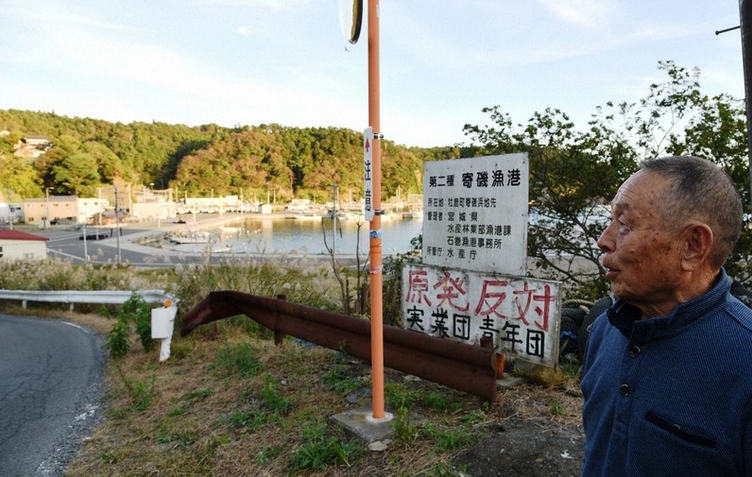
Former fisherman Yukitoshi Watanabe maintains that resuming operation of Tohoku Electric Power Co.’s Onagawa Nuclear Power Plant would be dangerous. In the Yoriisohama district of Ishinomaki, Miyagi Prefecture, as seen in this photo taken on Oct. 21, 2020, many signs protesting nuclear power have been set up by groups comprising youth in the community.
November 12, 2020
ISHINOMAKI, Miyagi — While the governor of Miyagi Prefecture, where the Onagawa Nuclear Power Plant is located, gave “local consent” on Nov. 11 to the restart of a reactor at the plant, those who live in the area remain anxious as local municipalities’ evacuation plans in the case of a major incident are said to be insufficient by residents and local assemblies alike.
The go-ahead to resume the operation of a reactor at Tohoku Electric Power Co.’s Onagawa nuclear power station came after Miyagi Gov. Yoshihiro Murai attended a meeting with the mayors of the Miyagi prefectural town of Onagawa and city of Ishinomaki, which the plant straddles.
About 1 kilometer away from the Onagawa Nuclear Power Plant is Ishinomaki’s Yoriisohama district, where residences surround a fishing harbor. Three aging signs that are set up alongside the one road that links the district to the outside world declare objections to nuclear power. They were put up by an organization of youth and others in the district.
Yukitoshi Watanabe, 80, is a former local fisherman who participated in an anti-nuclear demonstration by boat more than 40 years ago when the community wavered between hosting a nuclear power plant or not.
“Despite the incident at Daiichi Fukushima Nuclear Power Plant, in 10 years we’re back to where we were. The evacuation plan is absolutely unrealistic, and escaping safely is impossible,” Watanabe said angrily.
In August of this year, the Miyagi Prefectural Government invited officials from the Nuclear Regulation Authority (NRA), the Cabinet Office, and Tohoku Electric Power Co., and held sessions for residents to inform them of safety measures and evacuation plans that would be put into place. During the question-and-answer session, Watanabe raised his hand and asked, “Are you able to keep your head held high and tell your children and grandchildren (about restarting a nuclear reactor)?”
Including his great-grandchild, who is about to turn a year old, Watanabe lives in a family of 10 people spanning four generations. Living in the Yoriisohama district, which sticks out further east into the Pacific Ocean than the nuclear power plant, there’s no way to evacuate on land except by heading in the direction of the plant. It is unclear whether the national or prefectural government will build and maintain a highly safe evacuation route, and Watanabe says, “(An evacuation) route should be a prerequisite for deciding whether to restart the nuclear plant, and it shouldn’t have to be the local community’s responsibility to build one.”
Watanabe is considering a possible evacuation by boat, if such a measure is needed. He knows the dangers of the ocean, but he is more scared of his children and grandchildren being exposed to radiation.
“If something happens, we will have to leave this land, where our family has lived for generations, and fishing, and our home, throwing our hands up in despair. We must not leave any fears or anxieties to the future.”
(Japanese original by Nobuyuki Hyakutake, Ishinomaki Local Bureau)
The US has a unique opportunity to put the world back on the path to nuclear weapons zero

|
Restoring Momentum Toward Nuclear Zero, https://fellowtravelersblog.com/2020/11/16/restoring-momentum-toward-nuclear-zero/ON NOVEMBER 16, 2020 BY FELLOWTRAVELERSFPBLOGIN ARTICLES, POLICY BRIEF 2020, Second in a series of policy briefs laying out clear steps to re-think and re-orient US foreign policy. By John Carl Baker
Takeaway: Pass the No First Use Act, cancel the new ICBM, and begin negotiating with Russia toward deep reductions in both countries’ outsized arsenals. The world faces a renewed nuclear arms race. All nine nuclear-armed states–China, France, India, Israel, North Korea, Pakistan, Russia, the United Kingdom, and the US—are modernizing their arsenals and adding new capabilities. Nuclear superpowers the US and Russia control 91% of the world’s 13,000 nuclear warheads and together keep well over 3,000 deployed – more than enough to end human civilization. The US nuclear posture needlessly inflames this volatile international situation. The president holds unilateral launch authority and the US still reserves the right to launch a nuclear first strike. The US possesses hundreds of ground-based Intercontinental Ballistic Missiles (ICBMs) that are kept on alert in anticipation of a completely unrealistic surprise attack. These ICBMs drastically reduce presidential decision time (approximately ten minutes) and increase the chance of a mistaken launch. Close calls have happened in the past. US policy has also done little to keep the guard rails from falling off the international arms control regime. The US left the Anti-Ballistic Missile Treaty (ABM) in 2002 and the Intermediate Nuclear Forces Treaty (INF) in 2019. It announced its intent to leave the Open Skies Treaty the following year. If New START is not extended by February 2021, there will be no constraints on the US and Russian arsenals for the first time since 1972. At the same time, the United Nations review process created by the Treaty on the Nonproliferation of Nuclear Weapons (NPT) remains broken. Article 6 of the NPT obligates the nuclear-armed signatories to pursue disarmament, a provision they are not upholding. Global frustration with the lack of progress has led in part to the United Nations Treaty on the Prohibition of Nuclear Weapons (TPNW), which will ban nuclear weapons under international law in January 2021. Renewing US Leadership on Disarmament The US can increase nuclear stability and lead the world back toward disarmament by taking the following bold actions: Reform the Nuclear Posture: The US should declare that deterrence—not warfighting—is the sole purpose of the nuclear arsenal. Congress should establish that the US will never use nuclear weapons first by passing the No First Use Act introduced by Rep. Adam Smith and Sen. Elizabeth Warren. Congress can also develop legislation to distribute launch authority among more individuals than just the US president. Nearly any alternative is preferable to the current unilateral arrangement. Negotiate Arsenal Reductions: The US and Russia should extend New START and immediately begin negotiations toward a follow-on agreement that seeks major mutual reductions. There is simply no reason for each country to have thousands of warheads when their nearest peer competitor (China) has only a few hundred. Addressing this disparity could bring China into the arms control regime and would demonstrate to the world that the US takes its disarmament obligations under the NPT seriously. Retire Missiles: Congress should cancel the new ICBM, also called the Ground-Based Strategic Deterrent (GBSD), and begin phasing out land-based missiles for good. This will save substantial public dollars (an estimated $264 billion over the lifetime of the GBSD) and dramatically lower the risk of nuclear war. A system without land-based ICBMs will be far more stable, with increased decision time if there are reports of an incoming attack. Submarines and bombers will still be available to launch retaliatory strikes if need be. Phasing out ICBMs is also popular: a University of Maryland study found that 61% of Americans, including 53% of Republicans, support the idea. The US has a unique opportunity to put the world back on the path to nuclear zero. Through common sense policy changes, the US can lower nuclear risks, demonstrate a commitment to disarmament, and repair relations with the international community. The stakes could not be higher and the time for action is now. John Carl Baker is a senior program officer at Ploughshares Fund. Baker’s writing on nuclear weapons issues has appeared in the Bulletin of the Atomic Scientists, New Republic, Defense One, and elsewhere. Follow him on Twitter at @johncarlbaker. |
|
Inaccuracies in Boris Johnson’s document supporting nuclear power development
Dave Lowry’s Blog 19th Nov 2020, Prime Minister Boris Johnson is not a details man; and he often plays fast-and-loose with the truth. So it should not really come as a surprise that the document he issued in support of his ‘Ten Point Plan for a GreenIndustrial Revolution’ contains inaccuracies. I am sure he did not write it himself, so specialist officials who prepared it, have been prepared to write in his happy-go-lucky casual relation with the truth in the text they crafted.
The section covering Point 3: Delivering New and Advanced Nuclear Power, is a good exemplar of a perpetuated inaccuracy by nuclear
cheerleaders, who rewrite history for modern convenience. In the second paragraph of this section, its states: “The UK was home to the world’s first full-scale civil nuclear power station more than sixty years ago…”
The nuclear plants in question are not named, but sixty years ago there were only four nuclear power reactor plants operating in the UK. Two were experimental reactors in Scotland: the Dounreay Materials Test Reactor (DMTR) that went critical in May 1958; and the Dounreay Fast Reactor (DFR), which achieved criticality on 14 November 1959. The only other two reactors operating were the Chapel Cross Magnox production reactor in Annan, Dumfries and Galloway, in 1959, which did generate electricity, but primarily was used to produce weapons-useable plutonium, and tritium from inserted lithium, to enhance hydrogen nuclear warhead explosions
http://drdavidlowry.blogspot.com/2020/11/broris-johnson-plays-truth-or-dare-with.html
Ohio likely to require nuclear reactor audit before renewing bailout
 Ohio likely to require nuclear reactor audit before renewing bailout -analysts https://uk.reuters.com/article/instant-article/idUKL1N2I61D0 Banking and Financial News Scott DiSavino, NEW YORK, Nov 20 (Reuters) – Ohio’s legislature will likely require the owner of two nuclear power reactors to prove they need financial assistance to remain in service following a bribery scandal related to passage of the state’s 2019 nuclear bailout, analysts said on Friday.FirstEnergy Corp lobbied state officials to provide more than $1 billion to fund the continued operation of its Davis-Besse and Perry reactors. The Ohio reactors are now owned by Energy Harbor, which emerged from the bankruptcy of FirstEnergy’s FirstEnergy Solutions unit in February. The reactors likely still need financial help to keep operating. FirstEnergy was not alone in seeking state funding for its reactors. Nuclear plants in Illinois, New York, New Jersey and Connecticut also received subsidies in recent years. n Ohio, however, the U.S. Federal Bureau of Investigation (FBI) arrested Larry Householder, Speaker of the Ohio House of Representatives, in July, alleging bribery related to the passage of the state’s nuclear subsidy law, known as House Bill 6 (HB6). In an effort to undue damage done by the scandal, Ohio politicians have proposed new legislation that could remove or reduce the nuclear subsidies in HB6. “Ultimately, the subsidies may be reduced following the audit but we are skeptical they’ll go to zero when all is said and done,” said Josh Price, senior analyst at Height Capital Markets. FirstEnergy shares fell over 3% on Friday to their lowest since September. Earlier this week, the FBI also raided a home owned by Sam Randazzo, chairman of the Public Utilities Commission of Ohio (PUCO). Randazzo resigned on Friday, according to the state governor’s office. Officials at the PUCO had no comment. Energy Harbor was not immediately available for comment. FirstEnergy said its “Board will continue to take decisive action to address this matter,” noting it is in the “best interest” of Ohio and the nation to maintain clean and reliable nuclear power. Reporting by Scott DiSavino Editing by Marguerita Choy |
A New U.S. Missile Defense Test May Have Increased the Risk of Nuclear War
A New U.S. Missile Defense Test May Have Increased the Risk of Nuclear War, Carnegie Endowment for International Peace
A November 2020 U.S. missile defense test stands to upend strategic stability and complicate future arms control. The test marks a crossing of the Rubicon, with irreversible implications.
Ultimately, the consequences of the technical demonstration in FTM-44 will be challenging to reverse. This genie has left the bottle and the consequences for future arms control and strategic stability will be significant. https://carnegieendowment.org/2020/11/19/new-u.s.-missile-defense-test-may-have-increased-risk-of-nuclear-war-pub-83273
The creeping carbon costs of digital communication
|
Everyone has done it – sending a quick email to say ‘thanks’ or ‘no problem’ to a work colleague. But the millions of unnecessary messages sent every day are pumping thousands of tonnes of carbon into the atmosphere, researchers say. This is all down to the power they consume, and contributes more than 23,000 tonnes of carbon a year to the UK’s footprint. While emails are an integral form of communication, if we all cut back on just one ‘thank you’ email per day could save over 16,000 tonnes of carbon a year, according to a study. This is the equivalent of 81,152 flights from London to Madrid or taking 3,334 diesel cars off the road. The research, carried out by OVO Energy at the end of last year, found 49 per cent of Brits confessed to sending unnecessary emails every day. …. Sending any email creates a carbon footprint from a combination of the electricity used to power the devices on which it is written and read, the networks that transmit the data and the data centres that store it. Data centre account for less than 0.1 per cent of the world’s carbon footprint, experts say, but this figure is expected to grow with increasing use of video calls, games and streaming……. https://www.msn.com/en-us/news/technology/sending-just-one-email-less-every-day-could-save-1000-tonnes-of-co2/ar-BB1baWzz?li=BBnbfcL |
|

UK government’s plans for Sizewell and Wylfa nuclear stations are wavering, with doubts about costs
 Carbon Brief 18th Nov 2020, Media reaction: Boris Johnson’s ‘10-point’ net-zero plan for climatechange. In the lead up to the plan, expectations were running high for a major announcement on nuclear power, after weeks of stories about a “green light” for the Sizewell C plant and Rolls-Royce planning to build up to 16 mini-nuclear plants. In an article published at the start of November, the i newspaper said “Johnson…is expected to commit to building a new nuclear power station at Sizewell in Suffolk”. **************
The Daily Mail’s Ruth Sunderland said new nuclear will “have to be” part of the UK’s energy mix and suggested that Johnson was posed to give approval to the new Sizewell facility, despite opposition “by protesters who say it threatens ecology and wildlife”. The reality was less specific. The plan included a fund of £525m “to help develop large and smaller-scale nuclear plants, and research and develop new advanced modular reactors”, but did not mention a specific project.
**************
A government consultation last year concluded that the UK “will…require” new nuclear power to meet its
net-zero emissions target. An analysis by environment correspondent Fiona Harvey in the Guardian noted that with proposals for new nuclear in the UK from Sizewell to Wylfa wavering “if the government wishes to expand nuclear power, it will have to prove that it can be economical”.https://www.carbonbrief.org/media-reaction-boris-johnsons-10-point-net-zero-plan-for-climate-change |
Lack of safety documents in Los Alamos National Laboratory’s handling of radioactive wastes.
  CCNS Asks Why LANL’s Area G Waste Handling Lacks Proper Safety Documents, http://nuclearactive.org/ 20 Nov 20, On Wednesday, Chris Roscetti, the Technical Director for the Defense Nuclear Facilities Safety Board, raised more red flags about the fact that Los Alamos National Laboratory (LANL) handles, treats and stores radioactive and hazardous waste without the proper paperwork in place. He was speaking during a virtual meeting of the Northern New Mexico Citizens’ Advisory Board. DNFSB POWERPOINT . Some paperwork has remained unresolved for years. For example, since at least 2016, LANL does not have compliant safety documents for nuclear facilities, such as the Area G dump. These documents, called documented safety analysis, serve to identify and analyze the hazards associated with the work. Nuclear facilities are required to respond to the analyses in ways that will protect workers, the public and the environment. Some elements of safety documents include fire protection calculations, computer modeling for the dispersion of contaminants, and analyses of the efficiency of the operating controls to prevent releases. The Area G safety documents have languished since 2016 – even though LANL continues to handle, treat, and store plutonium-contaminated and hazardous waste there. Roscetti said there are about 3,100 drums containing radioactive and hazardous waste sitting above ground at Area G. These wastes are destined for the Waste Isolation Pilot Plant (WIPP), but need to be treated or repackaged before shipment. In fiscal year 2020, LANL sent 54 shipments to WIPP. Most of these shipments were newly-generated waste from the fabrication of the triggers for nuclear weapons, or plutonium pits. Each shipment to WIPP can hold 42 55-gallon steel drums
Based on the current shipping rate, if all 3,100 above-ground drums were sent to WIPP at a maximum of 42 drums per shipment, it would take about 18 months. But the amount of radioactivity in each drum dictates how many drums make up each shipment. In the meantime, newly generated waste would be shipped into Area G. In recent virtual meetings, LANL officials have been announced its plans to begin retrieving thousands of buried containers at Area G. Those drums would most likely need to be repackaged before shipment to WIPP. But again, the safety documents have not been developed and approved. Safety documents address not only the repackaging and shipping operations, but also the delicate retrieval operations. There is evidence that some drums have corroded.
CCNS asks why LANL is allowed to continue to operate Area G when safety basis documents have not been properly updated – in the case of Area G, nearly five years…….. http://nuclearactive.org/
|
|
1 This Month

Read the Public Inquiry Report, the Commissioners’ report, Surrendering Australia: The AUKUS Deception is available to download for free at aukuspublicinquiry.com. Or just watch the replay of the National Press Club Luncheon.



19 November – Webinar – The Reality of Reprocessing
Time: 11:00 AM Pacific Time (US & Canada) / 2:00 PM Eastern / 7:00 PM UK / 8:00 PM CET
Register for the Zoom Event Here



Shut down the radiation-damaged Heysham nuclear reactors now
To see nuclear-related stories in greater depth and intensity – go to https://nuclearinformation.wordpress.com

Say No to NASA’s Reckless Nuclear Reactor on the Moon
Say No to NASA’s Reckless Nuclear Reactor on the Moon
-
Archives
- November 2026 (109)
- October 2026 (302)
- September 2026 (339)
- August 2026 (330)
- July 2026 (355)
- June 2026 (287)
- May 2026 (306)
- April 2026 (356)
- March 2026 (251)
- February 2026 (267)
- January 2026 (308)
- December 2025 (358)
-
Categories
- 1
- 1 NUCLEAR ISSUES
- business and costs
- climate change
- culture and arts
- ENERGY
- environment
- health
- history
- indigenous issues
- Legal
- marketing of nuclear
- media
- opposition to nuclear
- PERSONAL STORIES
- politics
- politics international
- Religion and ethics
- safety
- secrets,lies and civil liberties
- spinbuster
- technology
- Uranium
- wastes
- weapons and war
- Women
- 2 WORLD
- ACTION
- AFRICA
- Atrocities
- AUSTRALIA
- Christina's notes
- Christina's themes
- culture and arts
- Events
- Fuk 2022
- Fuk 2023
- Fukushima 2017
- Fukushima 2018
- fukushima 2019
- Fukushima 2020
- Fukushima 2021
- general
- global warming
- Humour (God we need it)
- Nuclear
- RARE EARTHS
- Reference
- resources – print
- Resources -audiovicual
- Weekly Newsletter
- World
- World Nuclear
- YouTube
-
RSS
Entries RSS
Comments RSS

