Republican lawmaker reintroduces Bill to repeal Ohio’s corrupt nuclear bailout law
 Ohio Lawmaker Reintroduces Bill To Repeal Nuclear Bailout  Law https://radio.wosu.org/post/ohio-lawmaker-reintroduces-bill-repeal-nuclear-bailout-law#stream/0 By ASSOCIATED PRESS 8 Feb 21, • A bill to repeal a bailout of two aging nuclear power plants at the heart of a federal $60 million bribery probe has been re-introduced in the Ohio House by its Republican sponsor.
State Rep. Laura Lanese (R-Grove City) introduced a repeal bill last week similar to the one she introduced last year. That died after some fellow Republicans in the GOP-controlled House disagreed on whether a repeal was necessary. “A full repeal of House Bill 6 would protect consumers from predatory pricing, restore our renewable energy policy, and instill public confidence in the legislative process,” Lanese said in a statement. The legislation known as HB6 was signed into law by GOP Gov. Mike DeWine in 2019. The Justice Department accused five individuals, including former Republican House Speaker Larry Householder, of shepherding $60 million in energy company money for personal and political use in exchange for passing the law and then derailing an attempt to place a rejection of the bailout on the ballot. Two of those five have pleaded guilty, and a plea deal has also been reached with a nonprofit that authorities believe was used to funnel payments from the scheme. Householder, who pleaded not guilty to the rackteering charges, was removed as Speaker over the summer but won re-election to his House seat in November. |
|
Israel’s military threat to Iran. Iran calls on U.N. to respond.
|
Iran calls for UN response over Israeli military action threat
An Israel general said its military is preparing ‘operational plans’ in reaction to Iran boosting its nuclear programme. Aljazeera Maziar Motamedi, 7 Feb 2021 Tehran, Iran – Iran’s representative to the United Nations has protested recent Israeli military action threats against the country, calling on the intergovernmental organisation to interfere.
In a letter to UN Secretary-General Antonio Guterres, Majid Takht-Ravanchi said Israel has not only increased “provocative and warmongering rhetoric” against Iran, but is also actively making plans to act on its threats. The latest example, he said, came in late January when top Israeli general Aviv Kochavi said Israel’s military is preparing “a number of operational plans, in addition to those already in place” in reaction to Iran boosting its nuclear programme in recent months. Iran’s UN representative said the threat violates article two of the UN charter and requires a “proportionate response by the global community” due to Israel’s history of attacking other nations in the region……. Takht-Ravanchi said Israel must take responsibility for its hostile actions and the UN must counter the country’s “destabilising and warmongering policies” as the entity in charge of securing international peace. The representative also called for his letter to be registered as a formal document in the UN Security Council…….https://www.aljazeera.com/news/2021/2/7/iran-calls-for-un-response-over-israeli-military-action-threat |
|
How the United States can chart a new path that avoids war with China


How the United States can chart a new path that avoids war with China https://thebulletin.org/2021/02/how-the-united-states-can-chart-a-new-path-that-avoids-war-with-china/?utm_source=Newsletter&utm_medium=Email&utm_campaign=ThursdayNewsletter02042021&utm_content=NuclearRisk_NewPath_02032021
By Henry Bienen, Jeremiah Ostriker | February 3, 2021 The Biden administration has said that it will conduct a full review of trade and economic relations with China. It needs, actually, to conduct a review of all aspects of Sino-American relations: trade; technology; cultural, student, and scientific exchanges; and above all, security. There is room for vast improvement in all these realms, but the most pressing (and potentially dangerous) area involves security.
Relations between China and the United States have degenerated so far that some foreign policy experts now believe that war between the countries is possible. While this is a minority view, it is a dangerous one.
In the past, a US-China war was often considered unlikely for reasons of mutual economic interdependence and nuclear deterrence, not to mention the huge costs of war. Moreover, it has been said, ideological conflict and regional and international striving for advantage are not reasons enough for war. But now more pessimistic voices are also being heard. Citing pre-World War I analogies, in which it was (quite inaccurately) said that economic interdependence among European powers made war impossible, and noting what Harvard University’s Graham Allison has called the “Thucydides Trap,” in which there is a drift towards war when an emerging power threatens to displace an existing leading power, some believe war between China and the United States is becoming more conceivable and even probable.
We are concerned with the current direction of US-China’s policies, but we believe that the pessimists both overstate the possibility of a US-China war and understate the consequences of possible armed conflict. The production of so-called “small” nuclear weapons is given as a reason for the possibility of war without massive destruction. Nuclear war among nuclear powers has not occurred since the spread of nuclear weapons precisely because destruction would be huge and ghastly. But even lower-yield nuclear weapons nonetheless are quite deadly; each has the destructive potential of thousands of WWII airplane bombs. We cannot tell how limited the use of such weapons would be in advance of armed conflict, and, since Chinese missiles can reach our shores, we do not know if such a conflict could be contained.
There are other reasons for thinking war between China and the United States not only should be but will be avoided. We have past experience to warn us. The United States and China fought in the Korean War when US forces pushed to the Yalu River on China’s border. We know how that turned out. We also note that the United States did not send a land army to North Vietnam after China warned that the first US troops in North Vietnam would be met by Chinese “volunteers.” Lesson learned.
What points of conflict does the United States have with China that could actually lead to war? We can find only one, and it has nothing to do with trade, economic competition, ideology, human rights violations by China, or struggle for relative power in Asia or elsewhere. Taiwan is the critical point of conflict. China asserts its historical right to Taiwan as an integral part of China. The United States is committed to the principle that Taiwan’s relationship with China cannot be changed by force. Thus, how much military assistance to give to Taiwan, if China uses blockades or applies military force, is a critical issue for US policy. How and in what way to defend Taiwan loom as large questions. To do nothing in the face of Chinese military threats would not only call into question US commitments everywhere but might well lead to nuclear proliferation in Asia. What lessons would Japan, the Republic of Korea, Australia, perhaps Vietnam and Indonesia take? Taiwan itself has the capacity to build nuclear weapons and could do so, if the United States made clear that it would not respond to threats against Taiwan.
We do not minimize the difficulty of the Taiwan issue. There needs to be both clarity and ambiguity in how the United States deals with Taiwan. The United States needs to make clear that if China uses force against Taiwan there will be severe consequences. But we cannot in advance specify the consequences. We do not think war with China is probable over Taiwan. But we admit to the difficulties of finding the right policies in this area. We propose the following: As Joseph Nye noted recently in the Wall Street Journal, in consultation with China, the Biden administration should review policies for accident avoidance, crisis management, and high-level communications. Military-to-military relations already exist, and we do not know the details of them. But we suspect that the Trump administration let lapse, or weakened, constant communications and accident-avoidance protocols. These must be maintained and strengthened.
Arms sales to Taiwan are sensitive. Our aim is to avoid an invasion of Taiwan, and thus sales of missiles and technologies for defensive purposes seem right. We must make clear that we would work to circumvent a blockade of Taiwan. But obviously, Taiwan is not Berlin during the Cold War, and airlifts would have limited utility. Thus, it is the avoidance of a blockade that must be worked toward. And here, we need allies and friends in Asia and beyond to support the position that such a blockade would be disastrous for China’s economy and trade worldwide.
We can find no other issues where war could plausibly arise between China and the United States. And we reassert that any armed conflict could lead to a global catastrophe. In a more positive vein, the United States should be finding new paths to both cooperate and compete with China. The demonization of China—as per Donald Trump’s “China virus” and Secretary of State Pompeo’s bellicose language—are misguided and counterproductive. The two countries need to cooperate on climate and environmental issues and on the pandemic and other health matters.
Decoupling the economies of the United States and China would be very difficult, very expensive, and very foolish, as the Trump administration found out. It continued to want to export agricultural goods to China, and where it imposed tariffs, they raised costs to US consumers and manufacturers. We need to challenge China over its trade policies, but the best way to do that is to strengthen the US domestic economy and invest in education and technology innovation and research. So much of our vaunted technological progress has come from government investment. We should renew our government support for advanced research and technology, rather than faulting the Chinese for imitating our past actions. For but one example, consider how the internet was developed in the 1970s.
The United States has benefitted from an infusion of Chinese undergraduates, graduate students, and faculty. Undergraduates pay tuition; graduate students and post-grad medical and science researchers have strengthened the quality of universities and research centers. Most universities do not host classified research on their main campuses. Of course, there are dual-use technologies that can be copied or stolen. But the United States has gained from having Chinese scholars and students and researchers come to our shores. Many stay as productive and important citizens. As was the case with students and researchers from other countries in the past, many who return home see themselves as friends of the United States and hope for a more positive turn in Sino-American relations.
We now should join the Trans-Pacific Partnership. And we should form alliances and cooperative endeavors with China’s neighbors on trade, climate, health and regional conflict issues. And here we include Vietnam, Thailand, Indonesia, as well as India, Australia, New Zealand, Japan, and Korea. China’s push into Asia and Africa via its Road and Belt Initiative has not been a huge success. But here too the US could be more active and constructive with its own health and development policies abroad. The most useful thing that we could do to combat climate change would be to help the underdeveloped world move from coal and oil to renewable energy.
Above all, a strong and confident United States can compete and cooperate with China without conjuring up new enemies, or creating a new Cold War.
Crimea to demolish dangerous, (and never operational), nuclear power station
Decommissioned Crimea nuclear plant to be demolished: government , S and P Global, Vladislav Vorotnikov , EditorSteven Dolley 8 Feb 21, Moscow — The government of Crimea has decided to fully demolish the Crimean Atomic Energy station near Shcholkine, construction of which was halted after the Chernobyl accident in 1986, the government said in a statement on its website Feb. 5.
Construction of the plant and its one 1,000-MW VVER-1000 started in 1976, and by 1986 was nearly complete. However, a Soviet government inspection after the Chernobyl accident found the plant to be located on a geologically volatile site and construction was canceled in 1989.
By the end of 2021, the authorities plan to demolish two diesel generator stations, the turbine hall, machine block foundation, pumping station, and the nuclear power plant’s reactor compartment, the government said Feb. 5.
“These objects are unsuitable for operation,” Daniil Pidaev, spokesperson for the Crimean Architecture and Building Ministry, told to the Russia Gazette, the Russian government’s in-house publication. “They have lost their properties, are in a dilapidated state, and there is a threat of collapse,” posing a threat to those who visit the facilities, Pidaev said………… https://www.spglobal.com/platts/en/market-insights/latest-news/electric-power/020821-decommissioned-crimea-nuclear-plant-to-be-demolished-government
Fukushima to Triple Wind Power Generation
|
Fukushima to Triple Wind Power Generation https://www.nippon.com/en/news/yjj2021020801101/ Feb 8, 2021 Tokyo, (Jiji Press)–Japan’s industry ministry announced a plan on Monday to triple wind power generation in Fukushima Prefecture to 360 megawatts in fiscal 2024 from four years before.The plan highlighted the use of renewable energy as a pillar of efforts to accelerate the recovery of the northeastern prefecture from the March 2011 nuclear accident.
Under the plan, the Fukushima and national governments aim to construct an industrial complex running solely on renewable energy sourced within the prefecture, by fiscal 2030. The national government will provide financing to build some 30 kilometers out of the over 80 kilometers of a grid that will supply electricity in the prefecture from renewable sources. All 10 nuclear reactors in the prefecture are set to be decommissioned, following the triple meltdown at Tokyo Electric Power Company Holdings Inc.’s <9501> disaster-hit Fukushima No. 1 nuclear plant. |
|
UK universities partnering with Chinese technology companies may be breaching national security rules
affairs committee, to alert Manchester University to the fact that a
Chinese company with which it was collaborating was implicated in
Beijing’s persecution of the Uighurs.
its partner’s role in providing surveillance technology used to spy on
China’s Muslim minority.
universities cut off links with CETC in 2019 after similar warnings. But
what is more troubling is that Manchester appears to be far from alone in
partnering with Chinese companies with defence links on cutting-edge
scientific research. Indeed the Foreign Office is investigating more than a
dozen universities for possible breaches of national security rules.
Drone swarms: coming (sometime) to a war near you. Just not today

Drone swarms: coming (sometime) to a war near you. Just not today. Bulletin of the Atomic Scientists, By Maaike Verbruggen | February 3, 2021 The world got a sneak peek at the future of war last fall when two former Soviet republics in the Caucasus Mountains launched a high-tech barrage of loitering munitions as well as Turkish-, Israeli-, and locally-made drones at each other during a six-week fight over a region disputed by Azerbaijan and Armenia. Media and think-tank writers covering the battle frequently conveyed an eye-popping assessment: Warring factions had used futuristic swarms of drones in the skies over Nagorno-Karabakh. But does this apparent technological leap in warfare mean that such swarms will be a mainstay in conflict?
To spoil the surprise: No, don’t expect a swarm buzzing over your head any time soon.
While militaries are developing the technology, we shouldn’t call the drone formations on the contemporary battlefield swarms. Unlike true swarms, which use artificial intelligence (AI) to operate autonomously, today’s swarms are pre-programmed or remotely controlled. The individual drones neither communicate within the swarm nor do they adapt to their environment. However, at a time of fast-paced drone proliferation, militaries around the world are actively pursuing research and development in swarms.
Even though no one has developed true, autonomous drone swarms yet, we should still be concerned about their humanitarian implications. Just as militaries are preparing for the future of war by developing counter-swarm technologies, the arms control community should start thinking about where to draw the boundaries around their use.
The swarm is coming. In 2017, the US Department of Defense launched a swarm of micro-drones over California where more than 100 vehicles made decisions without human help. The year before, a Chinese academic and corporate partnership reportedly pulled off a similar feat with 67 drones. There is no doubt that the people behind the US Strategic Capabilities Office’s swarm of Perdix drones or the Chinese partnership’s aerial drones do hope to develop fully-fledged swarms—but they are not there yet. We can say the same about the United Kingdom’s drone swarm squadron, Russia’s Flock 93, Chinese naval swarms, and a Turkish “swarm concept,” as well.
According to the swarm robotics literature, swarms are a group of systems that operate as a collective. In a swarm, the individual units interact with each other and have common goals. They execute them as a collective while responding to their environment. “They are going to do their own thing,” a US Air Force official who oversaw the Perdix program told reporters, according to Air Force Magazine. …………….
Swarms and arms control. Swarms pose several potential humanitarian problems. First there is the issue of whether people will have meaningful control over the multiple units in a swarm. Commanding a swarm will be cognitively complex for the operator……….
|
Swarms don’t exist yet, despite frequent claims in the media. But militaries are clearly making advances. It’s time for the arms control community to deal with the potential problems that swarms might pose. Most arms control treaties aim at controlling individual weapons, but the harm of swarms does not stem from the units themselves, but rather from their indirect and collective nature. Arms controllers will need a new conceptual toolkit to think about and deal with the risks. Militaries have long moved away from valuing only military assets that are individual, physical, and weaponized and toward a network-based frame. Maybe the arms control community should follow suit. |
|
|
Nuclear reactors, big or small, useless to combat climate change, because of slowness to develop.
Just under 15 minutes on how nuclear power — far from presenting a “solution” — has actually contributed to climate change.
In 1952 the US government was advised to go solar. Instead, we got “Atoms for Peace”.
If the solar recommendation had been taken, and we had chosen the solar instead of the nuclear path, we might not have had climate change at all.
But solar had no military utility, while nuclear reactors made an important “by-product”: plutonium. This is a pre-recorded version of a talk Inrecently gave for Helensburgh, Scotland CND’s Beyond Nuclear conference.
Not in this video is a section I added during the conference presentation about how nuclear power still gets in the way of much needed and urgent nrenewable energy and energy efficiency development. This is well laid out by Amory Lovins who notes that, to protect the climate, we must save the most carbon at the least cost and in the least time.
 Since nuclear power isthe most expensive way to generate a megawatt hour of electricity, and
plants take years to build, it is out of the running even before evaluating its carbon footprint. As Lovins points out, costly options save less carbon per dollar than cheaper options. Slow options save less carbon per year than faster options. So in the case of nuclear power, whether it is “low carbon” or not instantly becomes irrelevant because it is already useless
for climate change due to its cost and slowness.
https://www.youtube.com/watch?app=desktop&v=6gWXFcFfN7E&feature=youtu.be
Planning inspectors recommended against Wylfa Newydd project on Anglesey
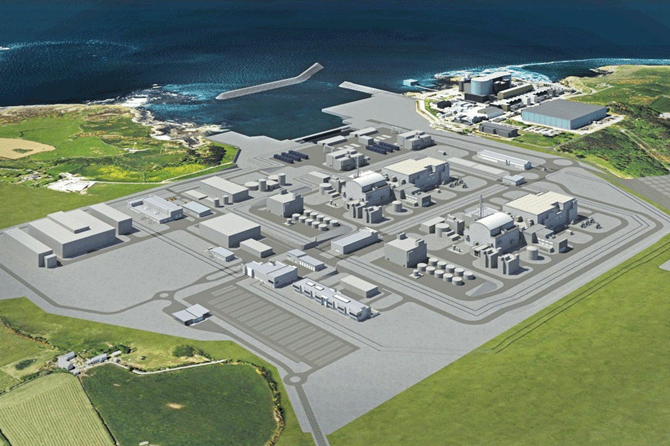
Planning inspectors recommended refusal for new nuclear power plant, Nation Cymru Gareth Williams, local democracy reporter
Plans to build a new nuclear power station were likely to be refused even before the project was shelved by backers.
UK Government appointed planning inspectors had recommended that the Wylfa Newydd project on Anglesey be rejected over a number of concerns from experts.
The application has since been withdrawn after Hitachi, the company behind the project, decided that the power plant was too expensive to build without a funding deal with the UK Government in place.
Energy company Horizon – a subsidiary of Hitatchi – needed an Approval of the Development Consent Order (DCO) to allow the £16bn project to go ahead.
DCOs are needed for any planning application regarded as a major UK infrastructure project and DCO process for Wylfa Newydd had been underway since 2018.
The Planning Inspectorate’s conclusion, which was made public for the first time on Thursday, was intended to be considered as a recommendation – with the final decision down to the UK Government.
But expert planning officers felt that the scheme would fail to meet some of the United Nations’ biological diversity standards.
Inspectors also told UK Government ministers it had concerns over the project’s impact on the local economy, housing stock and the Welsh language…..
The findings of the planning inspectors’ report, which were made public for the first time on Thursday, said there was a lack of scientific evidence put forward by developers to demonstrate that the Arctic and Sandwich tern populations around the Cemlyn Bay area, where the plant was set to be built, would not be disturbed by construction.
There were fears that these birds would subsequently abandon nearby Cemlyn Bay as a result.
It also raised wider concerns over the general impact on Cemlyn Bay, the Cae Gwyn site of special scientific interest and Tre’r Gof……..
It went on to conclude: “Having regard to all the matters referred in this report, the ExA’s conclusion is that, on balance, the matters weighing against the proposed development outweigh the matters weighing in favour of it.
“The ExA therefore finds the case for development is not made and it recommends accordingly.”
‘Pulling the plug’
Before pulling the plug on the DCO application last month, Hitachi confirmed that talks had been taking place with potential new investors. But with no concrete offer forthcoming, Hitachi announced it would wind up its Horizon Nuclear Power subsidiary by March 2021……… https://nation.cymru/news/planning-inspectors-recommended-refusal-for-new-nuclear-power-plant/
Daily Post 5th Feb 2021, The UK’s Planning Inspectorate has released its report into Wylfa Newydd –
showing they had recommended refusal over biodiversity issues.
USA ramps up production of nuclear bomb cores
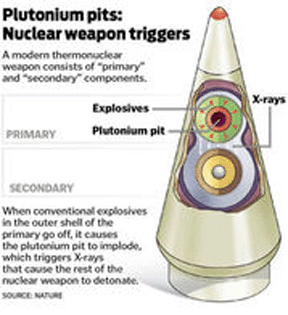 The U.S. is Boosting Production of Nuclear Bomb Cores (For More Nuclear Weapons), The National Interest. Thanks, arms race. by Michael Peck, 7 Feb 21, In another sign that the nuclear arms race is heating up, the U.S. is ramping up production of nuclear bomb cores. The National Nuclear Security Administration (NNSA) has announced that it plans to increase the production of plutonium pits to 80 per year. The grapefruit-sized pits contain the fissile material that give nuclear weapons such tremendous power. Production will center on the Mixed-Oxide Fuel Fabrication Facility at Savannah River site in North Carolina, which would be modified to manufacture at least 50 pits per year, and Los Alamos National Laboratory in New Mexico, which would generate at least 30, by 2030. America’s nuclear weapons cores are aging, with some pits dating back to the 1970s, leading to concerns about the reliability of the U.S. nuclear stockpile……… In its 2018 Nuclear Policy Review, the Trump administration called for 80 new plutonium pits per year. Congress has also allocated large sums, with $4.7 billion alone allocated in FY 2019 for maintenance and life extension of the nuclear stockpile. The NNSA says it is legally mandated to ensure a capacity of at least 80 pits per year. ……. Anti-nuclear groups are furious. “Expanded pit production will cost at least $43 billion over the next 30 years,” argues the Natural Resources Defense Council and other groups. Yet the Defense Department and NNSA have never explained why expanded plutonium pit production is necessary. More than 15,000 plutonium pits are stored at NNSA’s Pantex Plant near Amarillo, Texas. Independent experts have concluded that plutonium pits have reliable lifetimes of at least 100 years (the average pit age is less than 40 years). Crucially, there is no pit production scheduled to maintain the safety and reliability of the existing nuclear weapons stockpile. Instead, proposed future pit production is for speculative new-design nuclear weapons, but those designs have been canceled.” Introducing a new generation of nuclear weapons “could adversely impact national security because newly produced plutonium pits cannot be full-scale tested without violating the global nuclear weapons testing moratorium.” Michael Peck is a contributing writer for the National Interest. He can be found on Twitter and Facebook. https://nationalinterest.org/blog/reboot/us-boosting-production-nuclear-bomb-cores-more-nuclear-weapons-177825 |
|
The dangers and uncertainties in Andra’s radioactive waste disposal project in Bure (Meuse)
 Le Monde 5th Jan 2021, Environmentalists and unionists combine against the radioactive waste landfill project in Bure (Meuse). In a forum at the ”World”, they stated their concern at the dangers and uncertainties of the project. Their opinion is bolstered by a recent statement issued on January 13 by the Environmental Austhority, which stressed the uncertainties surrouding the waste disposal plan.
Vigorous opposition has never ceased to alert the public, since 1987, to the immense risks of the geological disposal of radioactive waste. The opinion of the Environmental Authority corroborates what thousands of citizens, elected officials and independent scientists have been denouncing for years, without being truly heard.
As outdated nuclear power closes down, pro nuclear shills viciously attack critics
 Uzbek & Rica 4th Feb 2021, No, nuclear power is not the medium-term solution to fight against global warming. France must stop its pharaonic investments in nuclear installations such as EPR reactors, which accumulate late delivery and explosion in costs, Julien Tchernia , co-founder andpresident of the renewable energy supplier ekWateur tells us in this forum.
When an article or a post is published about renewable energies, you will always find, following
it, a series of derogatory comments from nuclear advocates. Even if the content in question does not mention or refer to nuclear power, its aficionados take up pens to denigrate renewable production methods (but why so much hatred?)
And, incidentally, to write about their favorite mode of production. Why do they feel so threatened? Is the risk of this mode of production disappearing very real? And if so, would it not be less linked to the course of the political battle between pro and anti-nuclear than to
the complexity, to the costs of building and producing new nuclear power plants?
So, aren’t nuclear power stations shutting down on their own? In a manner analogous to the transition that took place for photography in the 2000s between film and digital, isn’t it time to let nuclear power stopquietly and fully accept the shift towards renewable energy?
What is the ”acceptable” death toll for China (and others) in planning for nuclear war?

|
Nuclear numbers: Assessing China’s threshold of ‘unacceptable damage’, TSG Sunday Guardian Live , Manpreet Sethi, February 6, 2021 Contemporary China appears to have a far lower threshold for taking damage than it once projected.Nuclear deterrence works on the principle of causing unacceptable damage in response to nuclear use. But what kind of damage do nations find unacceptable? How does one calculate what would be unacceptable to another? Answers to these questions are difficult, but important because a fair assessment of what the adversary would find unacceptable can help to right-size one’s own nuclear arsenal. Different countries, like different individuals, have disparate thresholds of damage absorption. For instance, during the Cold War, the US concluded that the USSR would be deterred if 50% of Soviet industry and 25% of its population were to be destroyed. Meanwhile, President Kennedy’s hesitation to lose even one American city during the Cuban missile crisis revealed America’s low damage threshold. Interestingly, in the case of Communist China, Premier Mao had created the image that his country had a high damage-taking capacity. Dismissing nuclear weapons as a “paper tiger”, he suggested that American nuclear use could not deter China because even if 50 million Chinese died, an equal number would survive to carry the country forward. But is this assumption true even today? How does modern China perceive damage? ……… Amongst the many factors that can help assess damage tolerance thresholds, five are particularly relevant. The first is to understand the historical experiences since a country that has been through more wars and experienced losses is expected to have a higher damage tolerance threshold. …….. Secondly, damage acceptability depends on the nature of the political system, with the assumption being that a closed, authoritarian system would be able to take more damage than a democracy…………damage acceptability depends on the nature of the political system, with the assumption being that a closed, authoritarian system would be able to take more damage than a democracy. While China is authoritarian, the Chinese Communist Party is extremely careful to sustain an image of legitimacy based on popular support. This, however, is not as easy to maintain today as it once was owing to society having become better educated, expressive and digitally connected. Therefore, the Party decision-making cannot afford to be insulated and ignore the mood of the masses. The third factor is the level of economic development, since an economically well-off and materially aspirational society is believed to have a low stomach for damage. ……….. Fourthly, the damage threshold varies depending on the value a country places on the objective it seeks. The more a country is politically, economically and emotionally invested in the objective, the greater its willingness to bear damage. For instance, in case of a conflict over Taiwan, which China considers an existential threat, its threshold of damage is likely to be higher than in case of conflict in high Himalayas or over areas disputed with India. Contemporary China, therefore, appears to have a far lower threshold for taking damage than it once projected. ……. These, and more such insights, should help India to calculate the “right” size of its nuclear arsenal in order to signal credible deterrence ……..https://www.sundayguardianlive.com/opinion/nuclear-numbers-assessing-chinas-threshold-unacceptable-damage |
|
Increasing risk of nuclear cataclysm , with today’s new technology weapons
 The risk of nuclear cataclysm is increasing, https://www.japantimes.co.jp/opinion/2021/02/07/commentary/world-commentary/us-russia-china-nuclear-weapons-arms-control/, BY ANDREAS KLUTH, BLOOMBERG, Feb 7, 2021
The world can breathe a small sigh of relief this week. The last remaining arms control treaty between the United States and Russia, called New START, will not expire on Feb. 5 after all, as recently feared.
In the nick of time, Russian President Vladimir Putin offered his new American counterpart an extension of the treaty for five years, an option stipulated in its text. Joe Biden agreed — after giving Putin the requisite talking to about Russia’s massive cyberattack on the United States, its jailing of the activist Alexey Navalny and other recent outrages.
In the short term, a new nuclear arms race between the two biggies has thus been avoided. Sort of. But not really — and there’s the rub. A wider glance at the world’s nuclear landscape reveals that the danger of cataclysm, by design or accident, keeps growing.
New START only covers the stockpiles of Russian and American “strategic” weapons. This refers to those warheads the two adversaries point at each other’s homeland. The treaty says nothing about “tactical” nukes, the more flexible and usually smaller warheads built for potential use in a war zone to win or avoid losing a conventional conflict.
But in that tactical category an arms race is already underway. Both the United States and Russia, in the name of upgrading their arsenals, have been designing new tactical nukes and deployment technologies. These include things that were science-fiction during the Cold War, such as nukes delivered by drones from submarines.
This race is thus fundamentally different from the one between the United States and the Soviet Union. Back then, the contest ultimately came down to a count of each side’s warheads. What ultimately stabilized that competition was the macabre but compelling logic of deterrence through “mutual assured destruction” (MAD).
Today’s competition is instead between newfangled technologies and, crucially, the military strategies thus made possible. This multiplication of scenarios and permutations undermines traditional calculations of strategy, which were largely based on the tools of game theory developed during the Cold War.
One upshot is that it’s becoming even more important for all nine of the nuclear powers to “signal” their “postures,” in the jargon. They should explain their intentions and make themselves as predictable as possible to others. And yet the most recent such signaling was hardly reassuring. In Article 4 of its Basic Principles issued last summer, Russia asserts that one purpose of its nuclear arsenal is “the prevention of an escalation of military actions and their termination on conditions that are acceptable for the Russian Federation.”
Translated, this wording suggests that Russia could respond to a conventional conflict with a tactical nuclear strike, as opposed to reserving nukes purely for retaliation in kind. But that makes any altercation potentially explosive in the fissile sense.
A conflict could, for instance, start with hybrid warfare (of the sort Russia used in its 2014 annexation of Crimea), or with cyberwar (as waged during last year’s Russian hack of some 18,000 U.S. computer systems) or with a strike in space against an adversary’s satellites. If the conflagration escalates and becomes “unacceptable,” the next step could be nukes. And then?
The first strike would still detonate somewhere — perhaps in the Baltic region, according to one hypothetical conflict between Russia and NATO. For the local population that would be far from “tactical,” and indeed terminal. It would also demand a response from the alliance.
But should that response be a nuclear counterstrike? At what scale? Against Russian forces, or a city? Moreover, how would Russia, in this hypothetical scenario, react to this “limited” NATO counterstrike? With missiles flying at supersonic speeds, all involved would have at most minutes to decide.
To make the global matrix even more complex, there are also the other seven nuclear powers to consider, and perhaps additional ones in future. Of these North Korea may appear to be the most unhinged. But China is the most ambitious. It could have 350 warheads already, according to some estimates. The Pentagon assumes China will double its arsenal in the coming decade.
China is the main reason why the United States and Russia couldn’t agree on properly renegotiating New START. Donald Trump, Biden’s predecessor, insisted on bringing Beijing into the talks. The Chinese refused. Sarcastically, they wondered aloud whether the Americans and Russians would prefer to let China raise its arsenal to their size or to cut their own down to China’s.
That makes for a good news conference zinger in Beijing. But it won’t help humanity get to grips with its conundrum: More actors are getting more weapons with more technological and tactical applications. The risk that somebody, somewhere pulls a trigger, intentionally or inadvertently, keeps rising.
In a gesture of global protest against this insanity, 86 non-nuclear countries have signed a Treaty on the Prohibition of Nuclear Weapons, with a goal of totally banning these satanic arms. It took effect on Jan. 22. But these — mainly smaller and poorer — states don’t hold the future in their hands.
The big nuclear powers do. They must put their daunting other differences aside and begin comprehensive talks to prevent the worst. And the best placed to extend the invitation is the leader who’s newest in office, and yet has the most experience with disarmament: Biden.
Zarif: compensation not pre-condition for reviving Iran nuclear deal
WASHINGTON — Iranian Foreign MinisterMohammad Javad Zarif said on Sunday that Iran receiving compensation from the United States for the U.S. withdrawal from the 2015 Iranian nuclear deal was not a “pre-condition” forreviving the agreement. (Reporting By Arshad Mohammed; Editing by Daniel Wallis)
1 This Month

Read the Public Inquiry Report, the Commissioners’ report, Surrendering Australia: The AUKUS Deception is available to download for free at aukuspublicinquiry.com. Or just watch the replay of the National Press Club Luncheon.


19 November – Webinar – The Reality of Reprocessing
Time: 11:00 AM Pacific Time (US & Canada) / 2:00 PM Eastern / 7:00 PM UK / 8:00 PM CET
Register for the Zoom Event Here



Shut down the radiation-damaged Heysham nuclear reactors now
To see nuclear-related stories in greater depth and intensity – go to https://nuclearinformation.wordpress.com

Say No to NASA’s Reckless Nuclear Reactor on the Moon
Say No to NASA’s Reckless Nuclear Reactor on the Moon
-
Archives
- November 2026 (109)
- October 2026 (302)
- September 2026 (339)
- August 2026 (330)
- July 2026 (355)
- June 2026 (287)
- May 2026 (306)
- April 2026 (356)
- March 2026 (251)
- February 2026 (267)
- January 2026 (308)
- December 2025 (358)
-
Categories
- 1
- 1 NUCLEAR ISSUES
- business and costs
- climate change
- culture and arts
- ENERGY
- environment
- health
- history
- indigenous issues
- Legal
- marketing of nuclear
- media
- opposition to nuclear
- PERSONAL STORIES
- politics
- politics international
- Religion and ethics
- safety
- secrets,lies and civil liberties
- spinbuster
- technology
- Uranium
- wastes
- weapons and war
- Women
- 2 WORLD
- ACTION
- AFRICA
- Atrocities
- AUSTRALIA
- Christina's notes
- Christina's themes
- culture and arts
- Events
- Fuk 2022
- Fuk 2023
- Fukushima 2017
- Fukushima 2018
- fukushima 2019
- Fukushima 2020
- Fukushima 2021
- general
- global warming
- Humour (God we need it)
- Nuclear
- RARE EARTHS
- Reference
- resources – print
- Resources -audiovicual
- Weekly Newsletter
- World
- World Nuclear
- YouTube
-
RSS
Entries RSS
Comments RSS

