Opinion poll – 77% of Ayshire public support a total ban on all nuclear weapons.
Ayrshire CND are greatly encouraged by recent polllling which shows that 77 per cent of the public support a total ban on all nuclear weapons.
1 March 2021 Anti-nuclear campaigners across Ayrshire have been given a huge boost in their battle to force an end to the arms race, writes Stewart McConnell.
Ayrshire CND are greatly encouraged by recent polling which shows that 77 per cent of the public support a total ban on all nuclear weapons.
The survey also showed that almost 60 per cent of people want Britain to sign up to the United Nations Treaty on the Prohibition of Nuclear Weapons which came into force last month.
Group secretary Arthur West, pictured, said: “This recent polling was organised by CND at UK level in conjunction with the professional polling company Survation and the results are hugely encouraging for our campaign to rid this country and our world of the scourge of nuclear weapons.”
“The government’s own figures show that the cost of maintaining Britain’s nuclear weapons based at Faslane is an eye watering 2 billion pounds a year.
“This is frankly money which could be better spent on decent things like health and education and creating quality jobs in areas such as renewable energy and affordable house building.”
The opinion poll referred to was organised by CND at UK level in conjunction with polling company Survation and was conducted on January 12-13.
Biden’s illegal bombing of Iranian-backed militias in Syria jeopardises nuclear negotiations
|
Biden “Illegally” Bombs Iranian-Backed Militias in Syria, Jeopardizing Nuclear Talks with Tehran, DEMOCRACY NOW, MARCH 01, 2021 The Biden administration is facing intense criticism from U.S. progressives after carrying out airstrikes on eastern Syria said to be targeting Iranian-backed militia groups. The London-based Syrian Observatory for Human Rights reports at least 22 people died. The Pentagon called the assault a response to recent rocket attacks on U.S. forces in northern Iraq. Those attacks came more than a year after Iraq’s parliament voted to expel U.S. troops — an order ignored by both the Trump and Biden administrations.
“Very quickly the Biden administration is falling into the same old patterns of before, of responding to this and that without having a clear strategy that actually would extract us from these various conflicts and actually pave the way for much more productive diplomacy,” says Trita Parsi, executive vice president of the Quincy Institute. We also speak with California Congressmember Ro Khanna, who says President Biden’s recent airstrikes in Syria lacked legal authority. “This is not an ambiguous case. The administration’s actions are clearly illegal under the United States’ law and under international law,” says Khanna.
|
|
China to ramp up its nuclear weapons, in the interests of its own survival
|
China said to speed up move to more survivable nuclear force
By ROBERT BURNS, WASHINGTON (AP) 1 Mar 21, — China appears to be moving faster toward a capability to launch its newer nuclear missiles from underground silos, possibly to improve its ability to respond promptly to a nuclear attack, according to an American expert who analyzed satellite images of recent construction at a missile training area.
Hans Kristensen, a longtime watcher of U.S., Russian and Chinese nuclear forces, said the imagery suggests that China is seeking to counter what it may view as a growing threat from the United States. The U.S. in recent years has pointed to China’s nuclear modernization as a key justification for investing hundreds of billions of dollars in the coming two decades to build an all-new U.S. nuclear arsenal. There’s no indication the United States and China are headed toward armed conflict, let alone a nuclear one. But the Kristensen report comes at a time of heightened U.S.-China tensions across a broad spectrum, from trade to national security. A stronger Chinese nuclear force could factor into U.S. calculations for a military response to aggressive Chinese actions, such as in Taiwan or the South China Sea. The Pentagon declined to comment on Kristensen’s analysis of the satellite imagery, but it said last summer in its annual report on Chinese military developments that Beijing intends to increase the peacetime readiness of its nuclear forces by putting more of them in underground silos and operating on a higher level of alert in which it could launch missiles upon warning of being under attack. The PRC’s nuclear weapons policy prioritizes the maintenance of a nuclear force able to survive a first strike and respond with sufficient strength to inflict unacceptable damage on an enemy,” the Pentagon report said. More broadly, the Pentagon asserts that China is modernizing its nuclear forces as part of a wider effort to build a military by mid-century that is equal to, and in some respects superior to, the U.S. military. China’s nuclear arsenal, estimated by the U.S. government to number in the low 200s, is dwarfed by those of the United States and Russia, which have thousands. The Pentagon predicts that the People’s Liberation Army Rocket Forces will at least double the size of its nuclear arsenal over the next 10 years, still leaving it with far fewer than the United States. China does not publicly discuss the size or preparedness of its nuclear force beyond saying it would be used only in response to an attack. The United States, by contrast, does not rule out striking first, although President Joe Biden in the past has embraced removing that ambiguity by adopting a “no first use” policy………. https://apnews.com/article/china-moving-faster-nuclear-f711665a7ebb3a58d6c5bb7ce899ff1d |
|
Fukushima nuclear containment system failed. This kind of disaster will happen again

The supposedly failsafe containment system at Fukushima Dai-ichi Unit Three failed and released massive amounts of radioactivity into the local environment and the worldwide atmosphere. Such an enormous human tragedy will happen again at an atomic power reactor somewhere in the world.
Think about that. No nuke in the world can withstand a supersonic shockwave, and here is the evidence on international TV and across the Internet that it occurred in 2011, as Fairewinds said.
Japan’s Fukushima Meltdowns (New Video): Much Still Unknown 10 Years Later, https://www.fairewinds.org/demystify/japans-fukushima-meltdowns-10-years-later-new-video-shows-much-still-unknown February 17, 2021 By The Fairewinds Crew
As we approach the 10th commemoration of Japan’s March 11, 2011, Fukushima Dai-ichi triple meltdowns, organizations around the globe, including environmental groups, nonprofits (like Fairewinds Energy Education), engineering and pronuclear organizations, and media organizations like Japan’s Nippon TV, will release new information.
Some of this information is really new and recently uncovered. Other media events will bring people together to share and discuss what these major meltdowns meant to the people of Japan and communities worldwide. And sometimes, these media events are just a corporation or an agency marketing new nukes by putting their positive spin on nuclear power rather than acknowledging its dangers. For example, nuclear zealots continue to claim that atomic power reactors are safer for workers than working at Toys R Us, and reactors cannot meltdown and certainly will never blow up. The Fukushima disaster proved them wrong, but yet they persist!
As Fukushima Daichi Units One, Two, and Three were melting down, Nippon TV, the largest and flagship station of the Nippon Television Network System, dispatched television film crews to monitor the events as they unfolded. No one in the world has ever captured the core melting down, but Nippon TV captured two meltdown-induced explosions on film.
Now, Nippon TV has just released a new digital copy of the Fukushima Dai-ichi Unit One and Unit Three explosions (see video below ). Fukushima Centralt TV/NipponTv
At Fairewinds, we congratulate Nippon for the excellent work they did to create the original initial explosion footage in 2011 and on this essential remastered copy just completed in 2021. Nippon’s newly released digital footage is important historically and technically.
That said, the new video footage and Nippon’s ensuing interview with Tokyo Electric Company (TEPCO), the atomic power corporation that owns all six Fukushima Dai-ichi nuclear power plants, contain three glaring technical errors.
- First, Fairewinds continues to have significant concerns about TEPCO’s technical interpretations of these explosions’ cause.
- Second, TEPCO is blaming newly uncovered lethal radioactivity sitting at the top of the containment structure on the supersonic shockwave.
- Third, TEPCO does not discuss that there likely was a second explosion that occurred 3 seconds after the first.
Understanding the mechanics behind explosions is critical to understanding what happened at Fukushima and what such a danger means to nuclear power anywhere in the world.
- There are two explosion methods: a deflagration shock wave, which happened at Fukushima Unit One and Three Mile Island in Middletown, Pennsylvania, in the United States. While still destructive, a deflagration shockwave travels at subsonic speeds (less than 760 miles an hour, the speed of sound).
-
- The second type of explosion is called a detonation shockwave. It is much more destructive because it travels at supersonic speeds.
In 2011, with Geoff Sutton’s assistance from the United Kingdom, Fairewinds clearly showed that the Unit Three explosion was the more destructive detonation shockwave while Unit One’s was a deflagration.
Does it matter whether or not an explosion at Fukushima was a detonation or a deflagration? Absolutely! Hydrogen gas at room (atmospheric) pressure cannot create a supersonic shockwave. Fairewinds’s 2011 findings that a detonation shockwave occurred should have changed the scientific and nuclear engineering analyses of such events worldwide.
No nuclear power radioactive release containment system built anywhere in the world will withstand a detonation shockwave!
The fact that a detonation shockwave did occur is something the nuclear industry has ignored since Fairewinds’ Arnie Gundersen and Geoff Sutton identified it did happen at Fukushima Unit Three in 2011.
The nuke industry and its regulatory handlers do not believe that a supersonic shockwave explosion will ever happen in a nuclear power plant. If they admitted that an atomic reactor containment system would fail by detonation, the nuke industry would also have to acknowledge that nuke plants’ containment systems are not failsafe. Nuclear power containment systems will fail when there is a supersonic shockwave explosion.
The supposedly failsafe containment system at Fukushima Dai-ichi Unit Three failed and released massive amounts of radioactivity into the local environment and the worldwide atmosphere. Such an enormous human tragedy will happen again at an atomic power reactor somewhere in the world.
Think about that. No nuke in the world can withstand a supersonic shockwave, and here is the evidence on international TV and across the Internet that it occurred in 2011, as Fairewinds said.
- The second type of explosion is called a detonation shockwave. It is much more destructive because it travels at supersonic speeds.
- Fairewinds second area of concern about TEPCO’s analysis on this latest NIPPON video is the linkage of recently discovered lethal radiation levels at the top of the containment to the supersonic detonation. Ten years ago, immediately following the three meltdowns at Fukushima in 2011, Fairewinds identified superheated highly radioactive gases escaping from this same area that TEPCO suddenly claims it has just uncovered in 2021. The containment was leaking before the explosion and continued to spread radioactivity after the blast. Still, no nuclear engineer or scientist is surprised that significant contamination continues to leak from the damaged containment system. The containment was breached, which allowed this radiation to leak! However, there is no evidence to suggest that the explosion is the cause of that leak since the containment was leaking before the supersonic shockwave.
- Finally, Nippon’s remastered video vividly shows Fairewinds’ third concern. The eye is drawn to the detonation’s sudden flash and the ensuing upward-moving black cloud of rubble. Now, look again. About three seconds after the initial vertical blast, a white cloud suddenly moves horizontally at ground level to the north. (see picture on original -comparing the first and second plumes)
- Community-volunteer citizen-scientists Arnie met while collecting radioactive samples in Fukushima prefecture say they heard more than one explosion. They said it sounded like the snapping of bamboo burning in a fire. This new video shows that there were at least two explosions, one vertically and one horizontally. As more data becomes available, Fairewinds Energy Education will put forward the reasons why, but as of now, the entire explosion sequence at Fukushima Unit Three is something the nuclear industry zealots want to ignore. They continue to hope that history will not repeat itself while they continue to build and operate more lethally radioactive and highly risky atomic reactors.
- Throughout the Nippon video, the announcer reverentially refers to TEPCO and the Japanese Regulators as “the authorities” and “officials”. This kind of public propaganda occurs because TEPCO, the Japanese Government and its regulators, and the International Atomic Energy Agency (IAEA) have successfully captured the Japanese media.
What was called for in 2011 and is still desperately required in 2021 are independent experts. These would be people from outside TEPCO, its captive regulators, or its allies embedded in the nuclear industry. Once again, Fairewinds calls for an independent consortium of experts who would be able to give a frank assessment of the magnitude and extent of the problems that lie ahead for the failed Fukushima cleanup.
Did you know that in 2013, Fairewinds and 16 other international experts coauthored a letter to the United Nations (UN) asking it to establish this independent panel? The UN never had the courtesy even to acknowledge that it received these serious requests and recommendations. Such machinations by TEPCO, the Japanese Government, and the international nuclear industry are indeed a human rights and environmental injustice issue!
Ten years have passed, yet Japan’s citizens still wait for independent oversight of the Fukushima disaster. The people of Japan deserve better than the authorities covering up the truth and lying to them.
Nuclear power-not clean, not renewable – Bill Gates is wrong
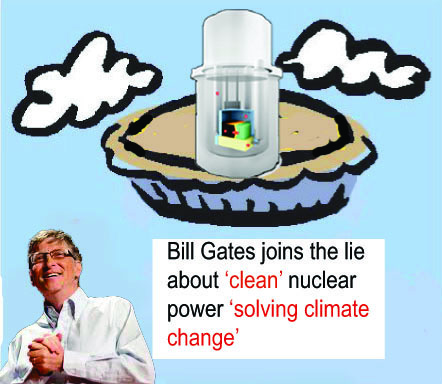
Bill Gates is wrong about nuclear power http://english.hani.co.kr/arti/english_edition/english_editorials/984773.html
By Cho Chun-ho, professor of atmospheric sciences at Kyung Hee University Feb.28,2021 To prevent the climate crisis, we need to reorient our energy grids from fossil fuels to solar and wind power. Some argue we should also expand nuclear power, since nuclear plants don’t emit carbon dioxide.
Automobile accidents cause many fatalities, but people keep driving cars because of social inertia. But an accident at a nuclear plant would create damage on a scale that would exceed whatever benefits we derive from nuclear power.
As of 2018, cleanup from the disaster at the Fukushima nuclear plant had cost 236 trillion won (US$213.37 billion). But even that wasn’t enough to deal with the radioactive wastewater that Japan now intends to dump into the ocean. Most of that cost is being borne not by the company operating the nuclear plant but by taxpayers.
 There’s not a government on earth that can deal competently with an accident at a nuclear plant. Even Japan’s meticulously designed safety net was helpless before such an accident.
 Furthermore, the cost of generating nuclear power has gone up 26% in the past ten years. Part of that price hike results from the need to prevent previously unconsidered risks, such as the Fukushima accident. Another issue is that demand for nuclear reactors has been recently falling around the world, pushing nuclear power out of the market.
In the book “How to Avoid a Climate Disaster: The Solutions We Have and the Breakthroughs We Need,” Bill Gates argues that nuclear power is ideal for responding to climate disaster because it’s the only emissions-free source of energy that can be supplied continuously around the clock.
In 2020, a team of researchers led by Benjamin Sovacool, a professor at the University of Sussex, published a paper in the journal Nature Energy analyzing renewable energy and nuclear energy’s impact on reducing carbon dioxide emissions. The relationship between renewable energy and nuclear power is mutually exclusive: one tends to crowd out the other.
Over the past ten years, the cost of solar and wind power has fallen by 89% and 70%, respectively. That’s because renewables have been the focus of technological innovation, which has entailed a huge amount of investment.
In 2020, the International Energy Agency declared that solar power was the cheapest source of electricity. In countries that have focused investment on renewables, renewable energy holds an advantage in the market even when governments reduce or totally eliminate subsidies.
Solar and wind power accounted for 72% of power capacity added around the globe in 2019. As renewables’ share of the energy mix increases, nuclear power — which is inflexible because output cannot be adjusted — has become a headache for the energy regime.
Multinational firms such as Apple, Google and Microsoft are pushing their suppliers to provide parts that are completely made with renewable energy — which doesn’t include nuclear power.
Nuclear power may be a low-carbon source of energy, but it’s not renewable because of the nuclear waste it produces. We can’t have both nuclear power and renewable energy because they rely on different paradigms. So which one are we going to choose?
USA’s continuing nuclear waste debacle blamed on government contractors
 Steven Chu Blames Government Contractors For Ongoing Nuclear Waste Debacle, https://www.forbes.com/sites/jeffmcmahon/2021/02/28/steven-chu-blames-government-contractors-for-ongoing-nuclear-waste-debacle/?sh=4ec11b8131eb Jeff McMahonSenior ContributorThe United States continues to struggle with legacy military nuclear waste, former Energy Secretary Steven Chu said, because the contractors making billions from it have opposed a better solution. “If you had a small R&D program that could find a much better, cost-effective way of doing it wouldn’t it be worth it?” Chu asked during a Stanford University webinar last month. “Okay, $6 billion—What’s a good R&D program? Ten percent? Five percent? “It was being nibbled down to $100,000,” he said of his effort to fund R&D during his tenure as Obama’s first energy secretary. “It’s like in the third or fourth decimal place because the contractors who had these huge grants didn’t want better ways, and they just wanted the billion per year coming to the State of Washington, going into Tennessee, going to South Carolina, literally, because it greased the economy.” Chu doesn’t identify the contractors by name, but major contractors in those states include Bechtel, managing the Hanford Nuclear Site in Washington; UCOR, managing cleanup at the Oak Ridge Reservation in Tennessee; and Areva, which absorbed the company that during Chu’s tenure pursued the Mixed Oxide Fuel Fabrication Facility (MFFF) designed to process waste in South Carolina. Bechtel, Areva and UCOR’s parent company, Amentum—have extensive lobbying activities recorded in disclosure forms. I was able to reach representatives from Bechtel and Areva, but they were unable to offer comment on the weekend.
Chu is a professor of physics and molecular and cellular physiology at Stanford University and was president in 2020 of the American Association for the Advancement of Science. He won the 1997 Nobel Prize in physics and is credited by President Obama with designing on a napkin the technology that capped the Deepwater Horizon oil spill. |
|
|
Influence of Biden administration brings peaceful push between India, China, Pakistan
 India’s sudden peace push with nuclear rivals China, Pak shows Biden impact, Business Standard, 27 Feb 21, The detente in South Asia shows all three countries responding to initiatives from the Biden administration After a year of some of the worst fighting on India’s frontiers with Pakistan and China, all three countries are suddenly talking peace as they wait to see how President Joe Biden will shift policy in the region.
India and China’s top diplomats on Thursday discussed plans to disengage troops from their Himalayan border, which last year saw the deadliest clashes since the 1970s. The phone call between Subrahmanyam Jaishankar and his Chinese counterpart Wang Yi, which stretched for more than an hour, came shortly after India and Pakistan released a rare joint statement by senior army officials announcing a halt in operations along their border.
The moves reduce tensions in one of Asia’s top flashpoints, where three nuclear-armed countries regularly challenge each other’s territorial claims. While India and Pakistan have fought three wars since Britain left the subcontinent and barely have any trade, tensions between New Delhi and Beijing escalated last year to the point where Prime Minister Narendra Modi banned hundreds of Chinese apps and slowed investment approvals.
The Biden administration welcomed the announcement on reimplementing the 2003 ceasefire agreement, which it had advocated. “When it comes to the US role, we continue to support direct dialogue between India and Pakistan on Kashmir and other issues of concern,” US State Department spokesman Ned Price told reporters.
Previous moves toward peace between India and Pakistan, including a statement in May 2018 after an escalation of cross-border shelling, have dissipated quickly. Whether they can actually build on this and move toward a more permanent peace remains an open question, but at least for the moment the shifting geopolitical winds are providing a seemingly rare opportunity to talk instead of fight.
“It eases the pressure,” Najmuddin Shaikh, Pakistan’s former foreign secretary and ambassador to nations including the U.S., said by phone when asked about the ceasefire. “Essentially what needs to come ahead is what has been proposed — that there be a resumption of dialogue.” https://www.business-standard.com/article/current-affairs/india-s-sudden-peace-push-with-nuclear-rivals-china-pak-shows-biden-impact-121022600628_1.html
Labour’s nuclear weapons stance needs a rethink
Labour’s nuclear weapons stance needs a rethink, Guardian, Richard Norton-Taylor
London 28 Feb 21,
Readers respond to the shadow defence secretary’s announcement that his party’s commitment to Trident is ‘non-negotiable’
You report (Labour to state ‘non-negotiable’ support for UK’s nuclear weapons, 25 February) that the shadow defence secretary, John Healey, says his party’s commitment to nuclear weapons is “non-negotiable”, seemingly taking a harder line even than successive Conservative governments, which have at least supported talks on multilateral nuclear disarmament.
The new Labour leadership in its rhetoric seems more frightened of being accused at home of being weak on defence than a nuclear attack by a foreign power. For years, Whitehall analysts have considered a pandemic more likely than any real threat of a nuclear attack. Yet for years, ministers and opposition frontbenchers ignored the former while exaggerating the latter. Trade union leaders, meanwhile, back a new Trident missile programme and spending more than £200bn on unusable weapons, citing the need to preserve highly skilled jobs. Yet Britain has had to bank on French engineers for civil nuclear power stations of which Britain now appears to be in dire need. https://www.theguardian.com/world/2021/feb/28/labours-nuclear-weapons-stance-needs-a-rethink
Jeremy Corbyn – Britain Should Join Nuclear Ban Treaty and Scrap Nukes.
 Jeremy Corbyn – Britain Should Join Nuclear Ban Treaty & Scrap Nukes. https://labouroutlook.org/2021/02/27/jeremy-corbyn-britain-should-join-nuclear-ban-treaty-scrap-nukes/, 27th February 2021 “From coronavirus to environmental destruction to economic inequality, we face threats that the war machine cannot fix, & can only worsen.”
Jeremy Corbyn used a speech at the Stop the War Coalition AGM today to make the case for the labour movement taking a stand against nuclear weapons and US-led wars of intervention.
Speaking to Labour Outlook he said, “The public consensus is changing. One hundred and twenty countries have signed the Treaty on the Prevention of Nuclear Weapons at the UN this year.”
In his speech at the AGM, Jeremy pointed out how three out of five people in the UK think we should join them, and four out of five people support a total ban on all nuclear weapons globally.
Jeremy added, “Something else has happened. People have begun to understand where the real threats to our security are.
From coronavirus to environmental destruction to economic inequality, we face threats that the war machine cannot fix, and can only worsen.”
Yesterday saw Labour members across the country oppose the Party’s leadership decision to say support for nuclear weapons was not negotiable, including Emma Dent Coad and Diane Abbott MP in interviews with this publication.
Lawsuit to prevent dangerous dismantling of San Onofre nuclear power station

Lawsuit looks to block dismantlement of Southern California’s San Onofre nuclear plant, Herald Mail Media Rob Nikolewski The San Diego Union-Tribune (TNS) 26 Feb 21, SAN DIEGO — An advocacy group based in Del Mar is taking the California Coastal Commission to court, looking to stop the dismantlement work underway at the now-shuttered San Onofre Nuclear Generating Station.
Officials with the Samuel Lawrence Foundation say the commission should not have granted a permit to Southern California Edison, the majority owner of the plant, to take down buildings and infrastructure at the plant.
“We felt compelled to file this lawsuit because the Coastal Commission really didn’t do what they are supposed to do as an agency to protect the public interest, to protect the environment and the coast,” said Chelsi Sparti, Samuel Lawrence Foundation associate director.
The nine-page suit has been filed in Los Angeles County Superior Court and assigned to Judge Mitchell L. Beckloff. An opposition brief from the Coastal Commission is expected to be filed in May and a trial is anticipated to begin in late June………
Among the issues Edison critics had with the permit centered on the planned demolition of two spent storage pools. Highly radioactive fuel rods were placed into the 40-feet-deep pools to be cooled before they being put into stainless steel canisters and then slowly moved to a “dry storage” facility at the north end of the plant.
Edison says the pools are not necessary now that all the canisters have been transferred to the dry storage facility but the Samuel Lawrence Foundation says the pools should remain in case something goes wrong.
“We need the ability to replace storage canisters as they degrade from age or damage,” foundation President Bart Ziegler said in a statement. “The only available facility is the spent fuel pool and the Coastal Commission is permitting the utility to destroy it.”

The storage pools have not yet been demolished.
The utility complied and last July, the commission approved the program on a 10-0 vote.
Starting in 2024, Edison agrees to inspect two spent fuel storage canisters every five years and inspect a test canister every 2 1/2 years. The program also calls for Edison to apply a metallic overlay on canisters, using robotic devices, in case canisters get scratched.
The permit, which lasts 20 years, includes a special condition that allows the commission by 2035 to revisit whether the storage site should be moved to another location in case of rising sea levels, earthquake risks, potential canister damage or other scenarios.
Despite the added measures, Coastal Commission members reluctantly approved the permit, saying their options were limited because the federal government has never opened a site where waste from commercial nuclear plants can be sent. About 80,000 metric tons of spent fuel has piled up at 121 sites in 35 states…….
The lawsuit says the commission’s decision violates the Coastal Act and “maximizes risk to life and property and threatens geologic stability along the bluffs” along the beach at San Onofre. The plant sits on an 85-acre chunk of Marine Corps Base Camp Pendleton owned by the Department of the Navy, overlooking the Pacific to its west and Interstate 5 to its east. https://www.heraldmailmedia.com/news/nation/lawsuit-looks-to-block-dismantlement-of-southern-californias-san-onofre-nuclear-plant/article_e7b541ce-cfc4-5cb9-a923-cbb8263e728e.html
Jennifer Granholm. new leader of USA’s Department of Energy gives clearly pro nuclear answers

26 Feb 21, Don Hancock of Southwest Research Information Center (SRIC) in Albuquerque, NM, has extracted Granholm’s answers to questions from U.S. Senators on nuclear weapons, nuclear power, and radioactive waste, during her confirmation to become President Biden’s Energy Secretary.
Radioactive dust over Europe – from France’s nuclear bomb tests in the Sahara!
The Fukushima nuclear catastrophe – far from over, 10 years later

10 years since the Fukushima nuclear disaster, Briefing paper by Dr. Philip White, Feb. 2021 https://nuclear.foe.org.au/wp-content/uploads/White-2021-Fukushima10-BackgroundBriefing.pdf
From the introduction:
Ten years ago, three of the nuclear reactors at the Fukushima Daiichi Nuclear Power Station suffered melt downs in the days following a Magnitude 9 earthquake that struck off the northeast coast of Japan on 11 March 2011. Along with the 1986 nuclear accident at the Chernobyl Nuclear Power Station in the former Soviet Union, it was one of the two worst nuclear power accidents in history.
On the tenth anniversary, it is important that we remember what happened then and what has happened since. It is in the interests of those who caused the accident that we forget. We must refuse to do so, for the sake of the victims and to prevent more disasters in future.
The most important take-home message is that the disaster is far from over. In order to win the bid for the (now postponed) 2020 Olympics, then Prime Minister Abe asserted that the nuclear accident was ‘under control’. The government now calls the games (if they are ever held) ‘the recovery Olympics’, with the torch relay route running through Fukushima Prefecture. But despite the efforts of the Japanese Government and the nuclear industry to lull the Japanese public and the world into a false sense of security, the fact is that radioactive contamination remains and many people continue to suffer. Even where compensation is available, nothing can undo the damage done to people’s lives and to the environment.
It is also important to understand that the Fukushima Daichi nuclear accident was by no means the worst-case scenario for nuclear power. But for a few remarkable pieces of good fortune, the disaster could have been far worse.
This paper summarises some of the key issues. In brief:
- thousands of people are still classified as evacuees;
- they have not been adequately compensated;
- the radioactive fallout is still a major problem;
- decommissioning of the nuclear reactors will take decades and has barely begun;
- the total cost of decommissioning, decontamination and compensation is astronomical;
- the culprits have not been punished; and
- nuclear vested interests are back in charge of Japan’s energy policy.
Dr Helen Caldicott: the truth about nuclear power — neither clean nor green.
|
By Helen Caldicott | 26 February 2021, While nuclear power is considered clean by many, there are several harmful and long-lasting consequences resulting from its use, writes Dr Helen Caldicott.
AN ENORMOUS AMOUNT of fossil fuel is used to mine and mill uranium, to enrich and fashion the nuclear fuel rods, to build the enormous concrete reactor, let alone decommission the radioactive mausoleum at the end of its active life of 40-60 years. Finally, but not least, to transport millions of tons of intensely radioactive waste to some as-yet-to-be-constructed storage site in the U.S. to be kept isolated from the ecosphere for one million years according to the U.S. Environmental Protection Agency. We all know to our detriment that the combustion of oil, gas and coal creates CO2, the main global warming gas. According to a definitive study by Jan Willem Storm van Leeuwen and Philip Smith titled ‘Nuclear Power: the Energy Balance’, the use of nuclear power causes, at the end of the road, approximately one third as much CO2 as gas-fired electricity production. The rich uranium ores required for this reduction are limited and the remaining poorer ores in reactors would produce more CO2 than burning fossil fuels directly. Nuclear reactors are best understood as complicated expensive and inefficient gas burners. Setting aside the above energetic costs and accepting the nuclear industry’s claim that it is clean and green, and assuming a 2% growth in global demand, all present-day reactors – 440 – would have to be replaced by new ones. Half the electricity growth would be provided by nuclear power and half the world’s coal fire plants replaced by nuclear plants requiring the construction over 50 years of 2,000 to 3,000 1,000-megawatt reactors — one per week for 50 years. The International Atomic Energy Agency estimates already there are 370,000 tons of high-level radioactive waste in the world awaiting disposal, containing over 100 radioactive elements such as:
Dr John Gofman MD, the discoverer of uranium-233, estimated that if 400 reactors operated for 25 years at 99 per cent perfect containment, caesium loss would be equivalent to 16 Chernobyls. A half-life is multiplied by ten or 20 to give the total dangerous radiological life. There is no containment that lasts 100 years let alone one million. As these radioactive elements inevitably escape and leak into the environment, they will concentrate at each step of the food chain tens to hundreds of times, for instance through algae, then crustaceans, then small fish, then big fish, then us. They are tasteless, invisible and odourless. Once deposited in human or animal organs, they irradiate a small volume of cells over many years inducing mutation of regulatory genes which control the rate of cell division, thus inducing uncontrolled cell division which is cancer. Leukemia takes five to ten years to appear post contamination, solid cancers 15 to 80 years. Genetic abnormalities will take generations to manifest. Animals and plants are similarly affected. In effect, by creating more and more nuclear waste, we humans will be inducing random compulsory genetic engineering for the rest of time. That’s what clean, green nuclear power means. You can follow Dr Caldicott on Twitter @DrHCaldicott. Click here for Dr Caldicott’s complete curriculum vitae. |
|

Why is the media fawning over nuclear businessman Bill Gates?
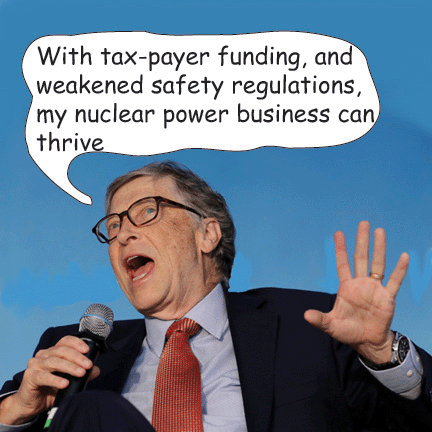
In a much-publicised interview he did on 60 Minutes Gates hyped up “advanced nuclear” fusion, SMRs and all the other tech marvels he is promoting. His interviewer, Anderson Cooper, completely ignorant of the subject, lapped it up, and failed to point out that none of these are proven technologies.
|
Why Bill Gates can’t save the world, The Fifth Estate, BY DAVID THORPE / 23 FEBRUARY 2021 Why don’t these billionaire philanthropists like Gates just stop their foundations and pay their fair share of taxes?
The media everywhere has been fawning over Bill Gates and his new book, How To Avoid A Climate Disaster. But should we really be listening to the world’s third wealthiest man for advice? If his suggestions and plans of action were wise and useful then maybe… Microsoft founder Bill Gates has an estimated net worth of $129 billion. His incalculable possessions, hugely destructive habits, and the massive investments of his opaque charitable trust, do everything to contradict his message that he’s the man with the plan to solve climate change. The fundamental point is that the richer you are, the bigger your ecological footprint. There’s no escaping it. The Gates’ fossil footprint……..Among the many $22.34 billion investments of Bill & Melinda Gates Foundation Trust, most of them are decidedly not in low carbon enterprises:
This is just scratching the surface. Journalist Tim Schwab, who has made it a mission to investigate Gate’s wealth and influence, has discovered his investments in fossil fuel companies: Gates claims to have divested from fossil fuel companies in 2019, but his foundation’s tax filing from that year shows millions of dollars in direct investments in companies like Exxon, Chevron, and Japan Petroleum Exploration. Billions more are invested in fossil-fuel-dependent industries like airlines, heavy machinery and automobiles. There’s a $1.6 billion stake in Caterpillar, for example, which makes diesel-guzzling plant used in mining. He is chairman of TerraPower, a nuclear reactor design company which has put no energy into the power grid. In October 2020, the United States Department of Energy gave TerraPower a grant of $400 million rising to $4 billion over the next seven years towards building a demonstration reactor. For reasons like this, Schwab calls Gates’ book “a long-winded advertisement for his investments”. Gates uses it to appeal to the US government to become a co-investor in TerraPower. The blind spotWhat is astonishing is the uncritical attitude of the media to Gates’ outpourings. The Financial Times last Saturday devoted the front page and a half of its Life & Arts supplement, to his “Green Manifesto”, without comment or criticism: it was free advertorial. Who else would get this treatment? Not long into the piece Gates pontificates, “The problem is simple. We can’t afford to release more greenhouse gasses.” Naturally, he doesn’t include himself in this “we” because if he did he would have to completely change his behaviour and lifestyle, something that he seems incapable of doing. This massive blind spot to his vision is also a blind spot to the media. The vast majority is in denial about his wealth. We want someone to come and lead us to salvation from the dire future we appear to be heading for. Of course, it should be a rich white man! Who else? But just as an alcoholic can’t rely on a whiskey distillery for a cure, we shouldn’t put our faith in the super-rich – because they are a huge part of this problem. Like most of the industrial-business sector, Gates imagines that the solution to climate change is technological. It can never be just that, it’s system change, it’s behavioural. In a much-publicised interview he did on 60 Minutes Gates hyped up “advanced nuclear” fusion, SMRs and all the other tech marvels he is promoting. His interviewer, Anderson Cooper, completely ignorant of the subject, lapped it up, and failed to point out that none of these are proven technologies. Gates the philanthropistBeing one of the top philanthropists in the USA, having donated billions to charity, gives Gates a powerful platform for his views. He sits on world stages amongst experts in the field who have been either democratically elected or appointed because they are experts. What is Gates’ experience or qualifications to talk about climate change? Charles Dickens used his writings to attack injustice in Victorian times. He was especially scathing of rich individuals who styled themselves as philanthropists but whose charitable acts did more to serve their own vanity than deserving causes. Nowhere is this better exemplified than in his novel Bleak House, where he puts in the mouth of one character the following aphorism: “There were two classes of charitable people; one, the people who did a little and made a great deal of noise; the other, the people who did a great deal and made no noise at all.” He satirises the former with Mrs Jellyby and Mrs Pardiggle, both of whom practice philanthropy – but at the expense of others. For both, philanthropy is more of a profession than born of genuine motivations to help. Philanthropy has become Gates’ profession, and his motivation is to assuage his guilt at the size of his wealth and ecological footprint, and to wield power. Dickens would have a field day. Can it be a coincidence that his charitable donations and investments in finding vaccines for the coronavirus, have seen his personal fortune rise $20 billion dollars as a result. That’s not philanthropy, it’s profiteering. Tim Schwab again, in the above article, quotes Anthony Rogers-Wright, director of environmental justice for the New York Lawyers for the Public Interest, as saying “These billionaires, the best they could do, some would say, would be to be stop their foundations and pay their fair share of taxes”. He observes how new tax revenues could help fund democratically devised solutions. “If Gates really wants to be effective and in a way that lifts up equity, he should be really listening to people who are being impacted the most and scaling up their solutions, rather than coming in with a parachute and with an air of white saviour-ism that actually in some cases causes more harm than good.” Christine Nobiss, founder of the indigenous people’s Great Plains Action Society, claims that Bill Gates has become the largest farmland owner in the United States. He owns nearly 100,000 hectares and is not farming it regeneratively or even sustainably. “He’s basically participating in the never-ending cycle of colonisation,” Nobiss says. The world’s most frequent flyer?Flying is one of the worst things you can do for the climate change, right? In a 2019 study of 10 celebrities and their flying habits, Celebrities, air travel, and social norms, Gates came top with the most emissions, beating Jennifer Lopez, Paris Hilton, and Oprah Winfrey. No wonder he would like the sustainable aviation fuel he dreams of in his book, and a neat way of offsetting all his carbon guilt. Let’s face it, would you rely on McDonald’s to make the world go vegan, or Putin to bring world peace? So why listen to Bill Gates, a man with a carbon footprint the size of a small country? Then there is the question of climate justice. In his book he never questions the political systems and economic models that result in climate change’s greatest impacts being on the poor and people of colour. There would be only one way for him to escape these financial conflicts of interest: let him lead by example. Let him give away all his money to the world’s poor with no strings attached. Let him live in a small apartment on $100 a week. Let him see the world from the point of view of a climate refugee – and say nothing about it. When he’s done all that, I’ll follow him. https://www.thefifthestate.com.au/urbanism/climate-change-news/why-bill-gates-cant-save-the-world-and-why-these-billionaire-philanthropists-might-do-best-to-simply-pay-fair-share-of-taxes/ |
|
1 This Month

Read the Public Inquiry Report, the Commissioners’ report, Surrendering Australia: The AUKUS Deception is available to download for free at aukuspublicinquiry.com. Or just watch the replay of the National Press Club Luncheon.


19 November – Webinar – The Reality of Reprocessing
Time: 11:00 AM Pacific Time (US & Canada) / 2:00 PM Eastern / 7:00 PM UK / 8:00 PM CET
Register for the Zoom Event Here



Shut down the radiation-damaged Heysham nuclear reactors now
To see nuclear-related stories in greater depth and intensity – go to https://nuclearinformation.wordpress.com

Say No to NASA’s Reckless Nuclear Reactor on the Moon
Say No to NASA’s Reckless Nuclear Reactor on the Moon
-
Archives
- November 2026 (103)
- October 2026 (302)
- September 2026 (339)
- August 2026 (330)
- July 2026 (355)
- June 2026 (287)
- May 2026 (306)
- April 2026 (356)
- March 2026 (251)
- February 2026 (267)
- January 2026 (308)
- December 2025 (358)
-
Categories
- 1
- 1 NUCLEAR ISSUES
- business and costs
- climate change
- culture and arts
- ENERGY
- environment
- health
- history
- indigenous issues
- Legal
- marketing of nuclear
- media
- opposition to nuclear
- PERSONAL STORIES
- politics
- politics international
- Religion and ethics
- safety
- secrets,lies and civil liberties
- spinbuster
- technology
- Uranium
- wastes
- weapons and war
- Women
- 2 WORLD
- ACTION
- AFRICA
- Atrocities
- AUSTRALIA
- Christina's notes
- Christina's themes
- culture and arts
- Events
- Fuk 2022
- Fuk 2023
- Fukushima 2017
- Fukushima 2018
- fukushima 2019
- Fukushima 2020
- Fukushima 2021
- general
- global warming
- Humour (God we need it)
- Nuclear
- RARE EARTHS
- Reference
- resources – print
- Resources -audiovicual
- Weekly Newsletter
- World
- World Nuclear
- YouTube
-
RSS
Entries RSS
Comments RSS

