Fukushima evacuees on return visits find radiation signs confusing
Radiation criteria sow confusion for evacuees, https://www.japantimes.co.jp/news/2021/02/26/national/fukushima-radiation-criteria/—, 25 Feb 21, New Year holiday, with people avoiding traveling back to see their relatives due to the novel coronavirus pandemic.
Roadside signs show the radiation levels of areas near the no-go zones put in place after meltdowns in 2011 at the Fukushima No. 1 nuclear plant, reflecting the fact that, even after 10 years, Fukushima residents are unable to return to their homes.
The no-go zones, which are considered uninhabitable for the foreseeable future due to high radiation levels, stretch through six Fukushima towns and villages: Tomioka, Okuma, Futaba, Namie, Katsurao and Iitate. Parts of those zones are now designated as special reconstruction districts, where the government will concentrate its decontamination efforts so that residents can return to their homes in the future.
A decade after the tsunami-triggered nuclear disaster, decontaminating the areas damaged by the fallout is a crucial part of the reconstruction that will pave the way for evacuees to come back to their homes and resume the life they had before the disaster.
But two figures of radiation exposure levels — 20 millisieverts a year and 1 millisievert a year — that the government provides as safety criteria are causing confusion among residents, triggering criticism of what could be called a double standard.
One of the criteria for the government to lift evacuation orders is whether the area’s annual cumulative radiation level has become 20 millisieverts or below, based on a recommendation from the nongovernmental International Commission on Radiological Protection.
When there is a nuclear disaster similar to that at the Fukushima No. 1 nuclear power plant, the ICRP recommends that annual radiation exposure should be limited to between 20 to 100 millisieverts immediately after the disaster. It then recommends the exposure is lowered to between 1 to 20 millisieverts during the reconstruction period.
As the minimum recommended exposure level right after a disaster, the 20 millisieverts mark became the radiation level yardstick for the central government to order the evacuation of a certain area after the nuclear meltdowns.
Meanwhile, the government has set up a long-term decontamination goal of reducing the radiation levels of contaminated areas to an annual 1 millisievert and below. This is to keep a lifetime exposure level below 100 millisievert — the level at which it starts to affect one’s health.
Therefore, the government stipulated the annual 1 millisievert exposure level in its reconstruction policy plan for Fukushima approved by the Cabinet in July 2012. The Environment Ministry aims to keep radiation levels in the special reconstruction district under 1 millisievert as a long-term goal.
However, the no-go zones had been above 50 millisieverts on an annual basis immediately after the nuclear meltdowns. The radiation level is on the decline with natural attenuation of radioactive cesium as well as weathering effects, but there are still patches with high radiation levels.
Even within the no-go zones, there is no easy way to carry out decontamination. Typically it is done by mowing lawns, raking up fallen leaves, washing down roads and other surfaces with a high-pressure water hose, and wiping off the walls and roofs of buildings and housing.
“It’s not easy to bring down radiation levels to 1 millisievert or below just with decontamination,” said an Environment Ministry official in charge.
In Article 1 of the radiation decontamination legislation established after the nuclear disaster, it is stipulated that the purpose of decontamination is to “minimize the health risks of radioactive exposure as much as possible.”
Despite the criteria for easing evacuation orders and the long-term goal on bringing down radiation levels, it is unclear how the government can lower radiation levels to 1 millisievert after evacuation orders are lifted for no-go zones.
The two figures are creating a confusion among local residents, who are torn between the desire to return to their homes and concerns over the radiation level.
“I won’t feel safe until annual radiation levels are below 1 millisievert,” one resident said, while another said, “Can you say for sure that an annual exposure of 20 millisieverts won’t affect our health in the future?”
Jennifer Granholm becomes U.S. Energy Secretary: the nuclear lobby is pleased, but not certain
 Granholm becomes US energy secretary, WNN 26 February 2021 Jennifer Granholm has been sworn as the 16th US secretary of energy. ….. Maria Korsnick, president and CEO of the US Nuclear Energy Institute, said Granholm will play a pivotal role…….
Judi Greenwald, executive director of the Nuclear Innovation Alliance, said the think tank is looking forward to working with Granholm and her team on the development, demonstration and deployment of the advanced nuclear reactors …
Granholm made no mention of nuclear power……in the article, nor in a video address released to coincide with the swearing-in…… https://www.world-nuclear-news.org/Articles/Granholm-becomes-US-Energy-Secretary
Yakama Nation, state of Washington and environmental groups call on Jennifer Granholm to reconsider nuclear waste rule

|
Coalition Calls on DOE to Reconsider Nuclear Waste Rule February 26, 2021 WASHINGTON – The Yakama Nation, state of Washington and environmental groups joined together in an unprecedented request to the Department of Energy today that it rescind a harmful Trump-era regulation that could allow millions of gallons of radioactive waste to be abandoned at the Hanford Site.
Remediating and removing this toxic waste, which is a legacy of the early U.S. nuclear bomb program, is essential to protecting the Yakama people – and millions more who live downstream along the Columbia River basin. “This rule lays the groundwork for the Department to abandon significant amounts of radioactive waste in Washington state precipitously close to the Columbia River, which is the lifeblood of the Pacific Northwest,” the letter says. This creates “a long-term risk of harm to the residents of the Pacific Northwest and the natural resources critical to the region.” The Energy department’s 2019 so-called “interpretative rule” ignores the science that underpins the Nuclear Waste Policy Act, and gives the department unilateral authority to redefine dangerous high-level radioactive waste as something else – with no opportunity for input, oversight, or consent by state regulators or the public. The letter was sent to Energy Secretary Jennifer Granholm and signed by: The State of Washington Department of Ecology, Washington Attorney General’s Office, Confederated Tribes and Bands of the Yakama Nation, NRDC (Natural Resources Defense Council), Hanford Challenge, and Columbia Riverkeeper. “This rule lays the groundwork for the Department to abandon significant amounts of radioactive waste in Washington state precipitously close to the Columbia River, which is the lifeblood of the Pacific Northwest,” the letter says. This creates “a long-term risk of harm to the residents of the Pacific Northwest and the natural resources critical to the region.” The Energy department’s 2019 so-called “interpretative rule” ignores the science that underpins the Nuclear Waste Policy Act, and gives the department unilateral authority to redefine dangerous high-level radioactive waste as something else – with no opportunity for input, oversight, or consent by state regulators or the public. The letter was sent to Energy Secretary Jennifer Granholm and signed by: The State of Washington Department of Ecology, Washington Attorney General’s Office, Confederated Tribes and Bands of the Yakama Nation, NRDC (Natural Resources Defense Council), Hanford Challenge, and Columbia Riverkeeper. |
|
Fukushima nuclear mess 2021 – the tasks ahead

“………..Decommissioning and contaminated water management
The work to decommission the plants, deal with contaminated water and solid waste, and remediate the affected areas is immense. A “Mid-and-Long Term Roadmap”2 was developed soon after the disaster to set out how this will be achieved. Also, to facilitate decommissioning units 1-6, and dealing with contaminated water, TEPCO announced, at the end of 2013 the establishment of an internal entity: the Fukushima Daiichi Decontamination & Decommissioning Engineering Company, which commenced operations in April 2014. The entire decommissioning process will take 30–40 years, and, as noted above, the volume of tasks is gigantic. Therefore, the Government of Japan and TEPCO have prioritised each task and set the goal to achieve them. Essentially, it is a continuous risk reduction activity to protect the people and the environment from the risks associated with radioactive substances by:
- removing spent fuel and retrieval of fuel debris from the reactor buildings;
- establishing measures to deal with contaminated water; and
- establishing measures to deal with radioactive waste material.
Fuel removal from the reactor buildings
In the Fukushima Daiichi design of reactor, used and new fuel rod assemblies are stored in the upper part of the reactor. The used fuel rods are highly radioactive and continue to generate heat, and thus require continued cooling.
Depending on the degree of damage, the process of removing the fuel assemblies presents different challenges in each of the reactors. For example, one of the significant challenges is to firstly remove the large quantities of rubble caused by the hydrogen explosions. As noted above, reactors 5 and 6 were shut down at the time of the accident. The reactor cores were successfully cooled, and thus suffered no damage. Given that the conditions of the buildings and the equipment for storing the fuel are stable, and risks of causing any problem in the decommissioning process are estimated to be low compared to the other units, the fuel assemblies of units 5 and 6 continue to be safely stored in the spent fuel pool in each building for the time being. The next step will be to carefully remove the fuel from the fuel pools in units 5 and 6 without impact on fuel removal from units 1, 2 and 3.
All the remaining units are going through a number of stages to achieve fuel removal. They differ slightly for each unit, but essentially the stages are: survey of internal state, removal of rubble, installation of fuel handling facility, and removal of fuel. By way of example, the position regarding unit 3 is shown in Figure 3 [on original].
At unit 3, rubble removal and other work at the upper part of the reactor building, together with installation of a cover for fuel removal was completed in February 2018.
After all preparations were in place, work to remove the 566 fuel rod assemblies, including 52 non-irradiated fuel assemblies, began in April 2019. The process of fuel removal is shown diagrammatically in Figure 4.
The four stages are:
- Fuel rod assemblies stored on fuel racks in the spent fuel pool are transferred in the water one at a time to transport casks, using fuel handling equipment;
- after closing the cask cover and washing, a crane is used to lower the cask to ground level and load into a trailer;
- the cask is transported to a common pool on the site; and
- the fuel in the cask is stored in the common pool.
As of 8 January 2021, 468 assemblies including the 52 non-irradiated fuel assemblies had been removed from unit 3. Measurements of airborne contamination levels are being monitored in the surrounding environment throughout the fuel removal operations. The plan is that all fuel will have been removed from all of the reactor units by sometime during 2031.
Retrieval of fuel debris
At the time of the accident, units 1–3 were operating and had fuel rods loaded in the reactors. After the accident occurred, emergency power was lost, preventing further cooling of the cores. This resulted in overheating and melting of the fuel, together with other substances. Fuel debris refers to this melted fuel and other substances, which have subsequently cooled and solidified, and, of course, still remains dangerously radioactive. This clearly poses a very complex and difficult decommissioning challenge.
Currently the state inside the containment vessel is being confirmed, and various kinds of surveys are being conducted prior to retrieval of the debris. The current aim is to begin retrieval from the first unit (unit 2), and to gradually enlarge the scale of the retrieval. The retrieved fuel debris will be stored in the new storage facility that will be constructed within the site.
The distribution of debris between the pressure and containment vessels differs in each of the 3 units. By way of example, Figure 5 [on original] shows the current position in unit 2. Large amounts of debris are located in the bottom of the pressure vessel, with little in the containment vessel.
The investigation to capture the location of fuel debris inside unit 2 was conducted from 22 March–22 July 2016. This operation applied the muon transmission method, of which effectiveness was demonstrated in its appliance for locating the debris inside unit 1. (Muon transmission method is a technique that uses cosmic ray muons to generate three-dimensional images of volumes using information contained in the Coulomb scattering of the muons.) These operations used a small device developed through a project called “Development of Technology to Detect Fuel Debris inside the Reactor’’.
- establishing measures to deal with contaminated water; and
- establishing measures to deal with radioactive waste material.
…….. Understanding of the situation inside the stricken reactors was urgently needed following the accident in order to prevent the spread of damage and to mitigate
Purification treatment of contaminated water and management of treated water…….
The storage management plan is updated once a year, while reviewing the waste generation forecasts, taking account of progress of the decommissioning work.
For example, the latest edition of the roadmap estimates the amount of solid waste which will be generated over the next 10 years to be 780,000 m3
Jennifer Granholm seems more muted in her support for nuclear, compared to previous Energy Secretaries
Recent USA Energy Secretaries in USA have been strong promoters of the nuclear industry. Up until January 2021 it was Dan Brouillette, very keen on nuclear power. The two Energy Secretaries before that , Rick Perry, Ernest Moniz pretty well used the job as if they were employees of the nuclear industry
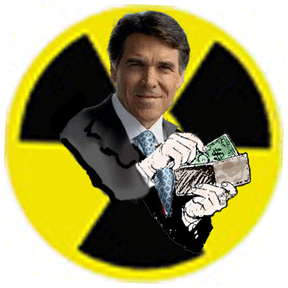

In that context, Biden’s new pick for Energy Secretary, Jennifer Granholm, seems much more muted in her support for nuclear
Jennifer Granholm’s nuke priorities remain hazy, https://www.postandcourier.com/aikenstandard/news/jennifer-granholms-nuke-priorities-remain-hazy/article_2c6c6f36-6240-11eb-9f33-b745c10da3cf.html By Colin Demarest cdemarest@aikenstandard.com Feb 3, 2021
-
- In written testimony provided to a Senate panel Wednesday, the new president’s pick to lead the Department of Energy said she would prioritize, among other things, American safety and security.
Doing so, Jennifer Granholm explained in a single paragraph, would mean focusing on the department’s offensive-and-defensive arm, the National Nuclear Security Administration, as well as the cleanup of Cold War artifacts – pockets of toxic waste, for example, trapped at sprawling installations like the Savannah River Site south of Aiken.
During her confirmation hearing this week, before the Senate Energy and Natural Resources Committee, the latter was discussed at decent length; the Hanford Site in Washington, notoriously difficult and expensive to remediate, was brought up several times, and Granholm pledged not to kick the can down the road. Some might argue such remarks are a rite of passage for Energy Department executives.
In written testimony provided to a Senate panel Wednesday, the new president’s pick to lead the Department of Energy said she would prioritize, among other things, American safety and security.
Doing so, Jennifer Granholm explained in a single paragraph, would mean focusing on the department’s offensive-and-defensive arm, the National Nuclear Security Administration, as well as the cleanup of Cold War artifacts – pockets of toxic waste, for example, trapped at sprawling installations like the Savannah River Site south of Aiken.
During her confirmation hearing this week, before the Senate Energy and Natural Resources Committee, the latter was discussed at decent length; the Hanford Site in Washington, notoriously difficult and expensive to remediate, was brought up several times, and Granholm pledged not to kick the can down the road. Some might argue such remarks are a rite of passage for Energy Department executives.
The former – the National Nuclear Security Administration, its hefty budget and its myriad missions – was sparsely touched, even with Granholm cracking open the door.
The disconnect, though, didn’t catch observers off guard.
“Given the committee in which the confirmation hearing took place and the fact that she’s not yet up to speed on nuclear weapons issues, it’s no surprise that Gov. Granholm was not asked about key NNSA issues,” said Tom Clements, the director of Savannah River Site Watch, an organization that monitors a host of energy- and nuclear-related issues. “I assume she is receiving briefings on NNSA matters and will soon be fully conversant and able to make informed, sound decisions.”
The committee that handled Granholm’s nomination has jurisdiction over nuclear waste, not nuclear weapons – exactly why Sens. Maria Cantwell of Washington and Ron Wyden of Oregon broached Hanford and why Sen. Catherine Cortez Masto of Nevada railed against Yucca Mountain.
“I wouldn’t want to read the tea leaves too much,” said Marylia Kelley, the executive director of Tri-Valley CAREs, which tracks Lawrence Livermore National Laboratory and the nuclear-weapons complex, more broadly. “I do know that after the hearing I was left with questions.”
The hearing Wednesday, shy of three hours, served as a digestible introduction to Granholm, a two-time governor of Michigan, auto-industry adept and clean-energy advocate. The conversation was heavy on energy sources and fuels, climate change and job losses, a major concern for some lawmakers as President Joe Biden signs a flurry of environmental executive orders. Kelley, though, is anxious to see where the nominee stands on nuclear-weapons issues: new warheads, new cores, modernization spending and the like. Such topics are a rarity on governors’ desks.
“I am hopeful that our new energy secretary will bring a set of skills that will help her make difficult decisions under pressure in a logical and organized fashion,” Kelley said. She later added: “Of course, from my organization’s perspective, I will be looking toward the Energy Department being more skeptical about expanding pit production, both on the question of what we need and on the question of when we need it, and how much we’re going to spend on it and how we’re going to accomplish it. I’m looking for her to be skeptical.”
Indications of priority – what’s important, and how much – will unfurl in budget requests and related budget hearings, said Nickolas Roth, the director of the nuclear security program at the Stimson Center, headquartered in Washington, D.C.
“That’s where you usually get more into the weeds on this kind of stuff,” Roth said. His hope, he explained, “is that the Biden administration will look for ways to curtail a very expensive nuclear-weapons modernization program” and strike a better balance with the nonproliferation portfolio.
If confirmed, Granholm would take the reins at a department very much devoted to the U.S. nuclear arsenal.
“The National Nuclear Security Administration is the largest part of the budget when you figure that environmental management is related to the nuclear weapons mission,” Kelley said. “It’s the lion’s share of the budget, by far.”
The Energy Department’s fiscal year 2021 budget request added to $35.4 billion; the National Nuclear Security Administration earmark totaled $19.8 billion. Of that sum, a vast majority was for weapons activities. (Daryl Kimball, the executive director of the Arms Control Association, has branded the DOE as the NWD: Nuclear Weapons Department.)
In the weeks before the 2021 blueprint was unveiled, dozens of lawmakers, including three Palmetto State Republicans, lobbied then-President Donald Trump to funnel more money to the NNSA and its weapons work. Insufficient funding, the elected officials wrote, would risk U.S. national security and embolden “anti-nuclear Democrats who oppose your effort to rebuild our military,” a red meat appeal.
Clements, who leads SRS Watch, anticipates Granholm “will make tough decisions reshaping U.S. nuclear weapons policy in a way that increases our collective security while reducing financial costs and reducing reliance on nuclear weapons.”
That remains to be seen.
Well-funded pro nuclear lobby has wishlist for Joe Biden
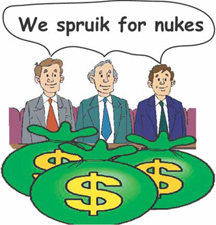



Is the Biden government going to buy these lies? Nuclear – clean? renewable?
|
Reports Envision a Leading Role for Nuclear in this Administration, JDSUPRA, 25 Feb 21, On February 16, the Nuclear Innovation Alliance (NIA) and the Partnership for Global Security (PGS) issued a report to help guide the Biden Administration in its support of nuclear amidst the President’s ambitious climate agenda. The report, U.S. Advanced Nuclear Energy Strategy for Domestic Prosperity, Climate Protection, National Security, and Global Leadership, provides detailed recommendations to promote advanced reactor development that could garner bipartisan support if implemented. It discusses federal, state-level, and international goals for advancing nuclear. The next day, February 17, the American Nuclear Society (ANS) published a report on Public Investment in Nuclear Research and Development that requests an additional $10.3B by 2030 in funding for demonstration reactors and projects aimed to streamline commercialization of advanced nuclear. While the NIA and PGS report establishes a roadmap for advanced reactor development, the purpose of the ANS report is to make a case for increased federal investment in nuclear. Here are some of the recommendations from the NIA/PGS report:
|
|
The JCPOA nuclear deal from the point of view of Iran
 Fool me once: How Tehran views the Iran nuclear deal https://ecfr.eu/article/fool-me-once-how-tehran-views-the-iran-nuclear-deal/Europe and the US should focus their efforts on swiftly returning to the original nuclear agreement with Iran rather than holding out for the unlikely prospect of better terms Ali Reza Eshraghi 25 February 2021 In Tehran, the initial hopes for what the Biden administration could offer Iran – particularly in terms of a revived economy – are fading. Iranian leaders recognise that, although the new president in the White House says he wants to rejoin the 2015 nuclear deal, there has been little tangible shift away from the Trump-era maximum pressure campaign against Iran. While there is still a possibility that the agreement will be revived, it increasingly appears to Tehran that the process will be a marathon and not a sprint.
It is often difficult to find a consensus between Iranian leaders on the benefits of diplomacy with the West, but there is one point on which they agree: Tehran must end its “strategic patience” in the implementation of the nuclear deal. The rhetoric for public consumption varies between different camps in Iran, who differ on the extent and method of the response. However, political elites now generally agree that Iran should not allow itself to be ‘duped’ by the United States again – and that Tehran should not reverse any steps to accelerate its nuclear programme until Washington is certain to ease sanctions in return. THE MOOD IN TEHRANSince the November 2020 US presidential election, Tehran has left the door open for the US to return to its commitments under the Joint Comprehensive Plan of Action (JCPOA). And it has offered several pathways for achieving this. Iran’s foreign minister, Javad Zarif, suggested that the European Union, as the coordinator of the Joint Commission established under the agreement, could choreograph a return to compliance – indicating a shift away from Tehran’s original position that Washington should lift all sanctions first before Iran reversed any elements of its nuclear programme. For now, the response on the US side seems less flexible – with Biden administration officials continuing to insist that Iran must return to full compliance with the deal before it receives any economic relief. Last week, the Iranian authorities announced that, as of 23 February, they would implement a law requiring the government to further reduce compliance with the JCPOA. This would involve, most importantly, the suspension of voluntary implementation of some international inspections. It was only after this announcement that the US made a series of symbolic gestures to soften its attitude towards Tehran. For instance, President Joe Biden stated that the US is “prepared to reengage in negotiations” with parties to the JCPOA. The hardline-leaning Kayhan Daily and a government-affiliated newspaper credited Iran’s ultimatum with prompting these last-minute US moves. Rather than worrying about their domestic rivals, power players in Iran are currently more concerned about how splits within Biden’s team are slowing down decision-making on the JCPOA in the US. Even the Rouhani administration has become more cautious than it once was about Biden’s willingness to return to the original nuclear agreement, fearing that his recent offer of talks is designed to force Iran to accept a broader set of terms. It is true that Iran’s latest decision to reduce inspections by the International Atomic Energy Agency (IAEA) was engineered by a parliament controlled by the so-called “Principlists” – a group comprising roughly equal numbers of hardliners and radical hardliners. But, even if the parliament did not have such a composition, the Rouhani administration would have felt that it had no choice but to send a strong signal against the United States’ indecision over how and when to return to the JCPOA. So far, Iran has been waiting for moves from the Biden administration that indicate it is serious about rejoining the JCPOA. The measures the US has taken in recent days – such as easing travel restrictions on Iranians diplomats in New York and rescinding the Trump administration’s failed attempt to snap back UN sanctions – are largely viewed in Tehran as symbolic rather than substantive. In recent days, Iran has reportedly made progress in its talks with Asian countries over gaining access to its frozen offshore accounts. If these discussions do indeed move forward, it could suggest that the Biden administration is showing some flexibility, by providing Iran with access to these funds for humanitarian trade. Iran may regard such moves by Biden as a reasonable way to start a technical dialogue on how to implement the nuclear deal – one facilitated by the EU. DIPLOMACY AND DOMESTIC POLITICSEven as Iran sets deadlines for its JCPOA compliance, the clock is ticking in its domestic politics – with a presidential election scheduled for June. The Principlists hope for an easy win in the contest, counting on the kind of relatively low voter turnout seen in the 2020 parliamentary election. Disillusioned with the futility of choosing the best bad option, the average Iranians needs a strong incentive to turn up at the polling station. But the hardliners’ optimism may be premature. In 2013 they were as confident that they would win as they are now. Yet, less than two months before that election, the tide turned. Iranians often do not decide who to vote for until the last few weeks before an election. In an undisclosed national poll conducted by ISPA in December 2020, more than 38 per cent of respondents said that they might consider voting “if economic conditions improve”. As such, there is some concern among hardliners that a swift US return to the JCPOA, and sanctions relief, would improve the chances of Rouhani-affiliated candidates. This is why some commentators speculate that Principlists feel it is necessary to obstruct Rouhani’s efforts to persuade the US to ease sanctions before the election. In theory, this is a sound Machiavellian move. However, it does not necessarily correspond with Iran’s current political dynamics. Most Iranian elites of all political leanings want to reduce the pressure on the economy, and recognise that US sanctions have a role to play in this. In their opinion, it is better for it to happen today than tomorrow, as highlighted in a recent string of interviews published on the supreme leader’s website. Media outlets affiliated with the Islamic Revolutionary Guard Corps (IRGC) are not cheering for Zarif and his team, but they are not lambasting him either. The editor-in-chief of Javan, the flagship IRGC daily, has even called Rouhani’s recent technical arrangement with IAEA a “smart” move. And the Kayhan Daily has also cautiously supported the arrangement. At present, only a radical minority in the Iranian political system are against the revival of the JCPOA. Saeed Jalili, the former chief Iranian nuclear negotiator (and a possible contender in the upcoming election), represents this minority. Yet, more broadly, Rouhani’s rivals prefer not to bet too heavily against the JCPOA. For one thing, they do not want the blame for Iran’s economic troubles to shift onto them. For another, they believe that public disapproval of Rouhani and his allies is so intense that even the revival of the JCPOA will not reverse it – and, as such, there may be little point in campaigning against the agreement. Finally, they have other tools at their disposal to weaken the pro-Rouhani coalition – which is extremely fragile – before the election. One such tool is parliamentary manipulation of the government’s proposed budget bill for next year – which, if implemented, would increase the dollar exchange rate and, accordingly, the price of staple goods in the months leading up to the election. This could make voters resent the Rouhani camp even more. Iran’s electoral cycle could have an influence on the political space in Tehran for engaging with the US and Europe, but it is unlikely to be the most significant factor in whether diplomacy on the JCPOA succeeds. There is now a general consensus in Iran that the country should stabilise the nuclear deal with the Biden administration, thereby rebooting the economy through benefits granted under the deal. A more pressing issue for Iran’s leaders is whether the US will rejoin the agreement without seeking to change its terms. It is highly unlikely that the US and Europe will be able to strike a broader agreement with Iran unless they first rejoin the original JCPOA – under either the current or next government in Tehran. The longer the US takes to rejoin the JCPOA, the greater the support in Tehran for accelerating the Iranian nuclear programme. In the coming weeks, European and US efforts should focus on a swift return to the JCPOA rather than holding out for the unlikely prospect of a new nuclear formula with Iran. Ali Reza Eshraghi is the projects director of the Institute for War and Peace Reporting’s MENA division and a visiting scholar at the UNC Center for Middle East and Islamic Studies. |
|
Israel should come clean about the expansion at its secret nuclear weapons plant
France slow to leave nuclear power, (cheaper to extend lives of reactors)

France to extend lifetime of old nuclear power plants https://au.finance.yahoo.com/news/france-extend-lifetime-old-nuclear-102331756.html
Thu, 25 February 2021, French safety officials on Thursday gave the green light to extend the lifetime of the country’s oldest nuclear power plants as it seeks to boost the share of renewables in its power mix.
Nuclear energy currently provides nearly 70 percent of French electricity, more than in any other country.
France, hoping to reduce that share to 50 percent by 2035 — a target pushed back from an earlier 2025 date — with the help of renewables, has been holding off from building new reactors.
The number of French reactors, at 56, is second in the world only to the United States which operates 85.
French safety officials on Thursday gave the green light to extend the lifetime of the country’s oldest nuclear power plants as it seeks to boost the share of renewables in its power mix.
Nuclear energy currently provides nearly 70 percent of French electricity, more than in any other country.
France, hoping to reduce that share to 50 percent by 2035 — a target pushed back from an earlier 2025 date — with the help of renewables, has been holding off from building new reactors.
The number of French reactors, at 56, is second in the world only to the United States which operates 85.
The safety of French nuclear plants is checked every decade.
ASN asked state-controlled electricity provider EDF, which manages the country’s nuclear plants, to undertake any necessary work to safeguard their security.
The main target was to “limit the consequences of any accident, especially any serious accident involving the meltdown of a reactor”, ASN’s deputy director-general Julien Collet told AFP.
Another objective was to improve the resistance of the plants to outside shocks including earthquakes, floods, extremely hot weather, or a fire in the reactor.
Anti-nuclear campaigners have long demanded the closure of veteran nuclear power stations, and last year obtained the decommissoning of France’s oldest plant at Fessenheim in the east of the country.
“Active French nuclear power plants were built to operate for 30 or 40 years. Beyond that, nuclear reactors enter an unknown ageing phase,” said NGO Greenpeace, calling for more plants to be closed.
ASN president Bernard Doroszczuk told the Ouest France newspaper that there were still “weak points” in the stations’ security equipment, requiring “vigilance”, but that there had been improvements.
France’s nuclear reactors, grouped in 18 sites, are all second-generation pressurised water reactors.
EDF in 2015 estimated the cost of dismantling all the reactors at 75 billion euros ($92 billion) but a parliamentary report said the real cost would be more.
A third-generation reactor called EPR and under construction since 2007 in Flamanville in northern France was supposed to go online in 2012, but the launch date has been delayed repeatedly and is now fixed for next year.
Flamanville’s cost has run over 10 billion euros, more than three times the initial estimate. Once operational, it will have an estimated life span of 60 years.
France’s nuclear reactors’ lives to be extended beyond 40 years
Le Monde 25th Feb 2021, The oldest nuclear reactors extended by ten years. EDF’s 32 900-megawatt reactors are the oldest in operation in France. They were originally designed to operate for forty years. This is a decision that officially opens the way to extending the life of the oldest reactors in France’s nuclear fleet beyond forty years. In an opinion published Thursday, February 25, the Nuclear Safety Authority (ASN) considers that “all the planned provisions open the prospect” of a continuation of the activity of the 32 French 900 megawatt (MW) reactors for a ten-year period. While French regulations do not provide for a maximum “lifespan” for reactors, an assumption of forty years of operation was adopted during their design.
The media revels in rockets to Mars, ignores the horrible risk of plutonium pollution
 Plutonium, Perseverance and the Spellbound Press https://www.dailykos.com/stories/2021/2/24/2017916/-Plutonium-Perseverance-and-the-Spellbound-Press, Karl Grossman
With all the media hoopla last week about the Perseverance rover, frequently unreported was that its energy source is plutonium—considered the most lethal of all radioactive substances—and nowhere in media that NASA projected 1-in-960 odds of the plutonium being released in an accident on the mission.
“A ‘1-in-960 chance’ of a deadly plutonium release is a real concern—gamblers in Las Vegas would be happy with those odds,” says Bruce Gagnon, coordinator of the Global Network Against Weapons and Nuclear Power in Space.
Indeed, big-money lotteries have odds far higher than 1-in-960 and routinely people win those lotteries.
Further, NASA’s Supplementary Environmental Impact Statement (SEIS) for the $3.7 billion mission acknowledges that an “alternative” power source for Perseverance could have been solar energy. Solar energy using photovoltaic panels has been the power source for a succession of Mars rovers.
For an accident releasing plutonium on the Perseverance launch—and 1 in 100 rockets undergo major malfunctions on launch mostly by blowing up—NASA in its SEIS described these impacts for the area around the Cape Kennedy under a heading “Impacts of Radiological Releases on the Environment.” Continue reading
Assange’s partner exposes ongoing denial of his legal and democratic rights,
|
Moris provided a succinct summary of the issues of democratic principle at stake, in the US attempt to prosecute Assange for lawful publishing activities that exposed war crimes, and updated his supporters on the current stage of the legal campaign to secure his freedom. The January 4 verdict, forbidding extradition, had “taken into account” the “extensive medical evidence” presented during last year’s trial, Moris explained. Assange’s dispatch to the US had been blocked on the grounds that it would be “oppressive.” His health issues, including serious depression, and the brutal character of the US prison system, meant there would be a great risk of Assange taking his own life if he were extradited. The US immediately responded, in the final days of the administration of President Donald Trump, by formally signalling an appeal. Trump’s Democratic Party successor, President Joe Biden, in his first weeks in office, rejected calls by civil liberties and press freedom organisations for the US Department of Justice to drop its pursuit of Assange, demonstrating the bipartisan character of the persecution. The High Court will decide after March 29 whether prosecutors, acting on behalf of the US state, will be permitted to proceed with their appeal. Moris stated that the next stage for the defence was to submit a response to the US grounds of appeal. She then reviewed the anti-democratic implications of Judge Vanessa Baraitser’s January 4 ruling. It had denied Assange’s extradition on health grounds, but “did not side with him on the wider public interest arguments.” Baraitser had upheld virtually all of the prosecution’s substantive arguments, effectively green-lighting future attempts by governments to prosecute journalists and publishers for exposing material that they deem to be “classified” and of “national security” significance, regardless of the public interest of what is exposed. Continue reading |

Former SCANA nuclear executive pleads guilty to fraud
 Former SC utility CEO pleads guilty to nuclear plant fraud
The utility executive who spent billions of dollars on two South Carolina nuclear plants that never generated a single watt of power pleaded guilty in two courts, By MICHELLE LIU Associated Press/Report for America, 25 February 2021, COLUMBIA, S.C. — The utility executive who spent billions of dollars on two South Carolina nuclear plants that never generated a single watt of power pleaded guilty to federal conspiracy charges Wednesday.
Former SCANA Corp. CEO Kevin Marsh will likely spend two years in prison and pay $5 million back to ratepayers, per the plea agreement prosecutors presented to U.S. District Judge Mary Geiger Lewis in Columbia.
Marsh’s formal acknowledgement of his role in the conspiracy to commit wire and mail fraud comes more than three years after the project imploded publicly and federal and state agencies began investigating.
Marsh, 65, will be free on bond as he cooperates with federal authorities until he is formally sentenced. He headed to Spartanburg in the afternoon to plead guilty on a state charge tied to the investigation. Officials said he will serve any state sentence he receives concurrently with his federal sentence.
A judge will hand down the final sentence after the investigation concludes. Prosecutors haven’t given indication of when that might be.
Marsh and other executives insisted the project to build the two reactors at the V.C. Summer site north of Columbia was on track ever since it started in 2008. The company hiked rates on customers nine times between 2009 and 2017 to help fund the project.
Prosecutors said that as the project lagged, Marsh lied repeatedly to investors, regulators and the media, claiming the reactors would be making power by a 2020 deadline to get $1.4 billion in federal tax credits needed to keep the $10 billion project from overwhelming SCANA and its subsidiary, South Carolina Electric & Gas.
An independent report commissioned by SCANA in 2015 estimated the reactors would not be finished in 22 years. Executives fought to get the estimate removed from the copy of the report shared with state-owned utility Santee Cooper, which held a 45% stake in the new reactors, prosecutors said.
Santee Cooper ended up $4 billion in debt from the project. Lawmakers are still arguing over whether to sell or reorganize the utility.
Dominion Energy of Virginia bought out SCANA in 2019 after the former Fortune 500 company was crippled by the nuclear debacle.
In December, the Securities and Exchange Commission said both SCANA and its subsidiary agreed to settle a civil lawsuit filed by the SEC in February for $137.5 million, including a $25 million civil penalty.
Former SCANA Executive Vice President Stephen Byrne pleaded guilty to federal charges similar to Marsh’s in July. He is also awaiting sentencing. AT TOPhttps://abcnews.go.com/Technology/wireStory/sc-utility-executive-plead-guilty-courts-76084865
Move in Ohio Senate to repeal nuclear bailout law
|
By ANDY CHOW • 24 Feb 21, A measure to repeal part of Ohio’s controversial nuclear power plant bailout, and stop the increase to monthly electric bills, is gaining momentum in the Ohio Senate.
The Republican-backed bill, SB44, would repeal the nuclear subsidies created through 2019’s HB6. It’s now on its way to a possible full Senate vote after being unanimously passed by the energy and public utilities committee. Investigators say a utility, believed to be FirstEnergy, funneled millions of dollars to a dark money group controlled by Rep. Larry Householder (R-Glenford). They say Householder used those funds to become House Speaker, and in return pass FirstEnergy’s legislative agenda in the form of HB6, which in part subsidized two nuclear plants formerly owned by the company. Most Democrats and several Republicans want a full repeal of HB6, which would also have the effect of reviving green energy standards that the 2019 law eliminated. However, doing away with just the nuclear subsidies seems to be the option with the most traction. The extra charge on electric bills to generate $150 million a year for Ohio’s two nuclear power plants has been stalled through a court injunction, which will remain in place while the federal investigation continues. Three defendants in the bribery case, including the dark money group Generation Now, have plead guilty to racketeering charges. |
|

Luxembourg’s continued fight against nuclear power in Europe
How do you remember the nuclear incident at Fukushima?
Some countries still see it as a cheap, emissions-free source of power. What will it take to change their minds?
It’s a constant battle. Some countries, also in Europe, see nuclear energy as a solution to the climate crisis. That is a fallacy. First, it’s not cheap. Hinkley Point in the UK, for example, will only work out economically at a fixed tariff that is higher than the price for renewable energy. The waste problem hasn’t been solved.
The European Commission is technology neutral, leaving it up to member countries to decide whether to use nuclear power. What challenges does this pose?
Luxembourg still uses nuclear energy in its network. By when would you like to see this phased out?
You came out strongly against Belgium exploring nuclear waste storage sites near Luxembourg, with the Belgian environment minister citing a “serious diplomatic incident”. Would you react in the same way again today?
France is in the process of exploring lengthening the lifespan of some of its reactors. What do you hope will happen with the Cattenom site in the next ten years?
Obviously, I want Cattenom to close and for there to be no extension. If I look towards the future, the best solution would be a switch to renewables, to new jobs and in favour of a circular economy. It’s about enabling a transition for the people working in this sector, too. Cattenom is a big power station.
1 This Month

Read the Public Inquiry Report, the Commissioners’ report, Surrendering Australia: The AUKUS Deception is available to download for free at aukuspublicinquiry.com. Or just watch the replay of the National Press Club Luncheon.


19 November – Webinar – The Reality of Reprocessing
Time: 11:00 AM Pacific Time (US & Canada) / 2:00 PM Eastern / 7:00 PM UK / 8:00 PM CET
Register for the Zoom Event Here



Shut down the radiation-damaged Heysham nuclear reactors now
To see nuclear-related stories in greater depth and intensity – go to https://nuclearinformation.wordpress.com

Say No to NASA’s Reckless Nuclear Reactor on the Moon
Say No to NASA’s Reckless Nuclear Reactor on the Moon
-
Archives
- November 2026 (103)
- October 2026 (302)
- September 2026 (339)
- August 2026 (330)
- July 2026 (355)
- June 2026 (287)
- May 2026 (306)
- April 2026 (356)
- March 2026 (251)
- February 2026 (267)
- January 2026 (308)
- December 2025 (358)
-
Categories
- 1
- 1 NUCLEAR ISSUES
- business and costs
- climate change
- culture and arts
- ENERGY
- environment
- health
- history
- indigenous issues
- Legal
- marketing of nuclear
- media
- opposition to nuclear
- PERSONAL STORIES
- politics
- politics international
- Religion and ethics
- safety
- secrets,lies and civil liberties
- spinbuster
- technology
- Uranium
- wastes
- weapons and war
- Women
- 2 WORLD
- ACTION
- AFRICA
- Atrocities
- AUSTRALIA
- Christina's notes
- Christina's themes
- culture and arts
- Events
- Fuk 2022
- Fuk 2023
- Fukushima 2017
- Fukushima 2018
- fukushima 2019
- Fukushima 2020
- Fukushima 2021
- general
- global warming
- Humour (God we need it)
- Nuclear
- RARE EARTHS
- Reference
- resources – print
- Resources -audiovicual
- Weekly Newsletter
- World
- World Nuclear
- YouTube
-
RSS
Entries RSS
Comments RSS

