Waihopai is a Secret U.S. Spy Base in New Zealand Designed for War-fighting
Global Peace and Justice A0TEAROA) By Murray Horton, August 29, 2024
Murray Horton is organiser of the Campaign Against Foreign Control of Aotearoa (CAFCA) and an advocate of a range of progressive causes for the past five decades.
He can be reached at: cafca.
Reprinted from Covert Action Magazine
The news that the Waihopai spy base was going to be built led to the birth of the Anti-Bases Campaign (ABC) in 1987. ABC has campaigned for the closure of Waihopai ever since (our most recent protest there was in 2023).
We have consistently said that it is a U.S. spy base in all but name, i.e., that the New Zealand Government Communications Security Bureau (GCSB, NZ’s spy agency in the Five Eyes international spy alliance) works as directed by the U.S. National Security Agency (NSA). We have also consistently said that it is a war-fighting base, not just a spy base. The powers that be in New Zealand’s covert state, and their political mouthpieces, have always denied this and/or asked for evidence?
Soothing Reassurances from GCSB Bosses
For example, this from The New Zealand Herald, (April 9, 2010), with the eye-catching title “It’s ours and it’s not evil, say spy-base masters”:
“New Zealand’s secret spies emerged from the shadows yesterday to deny their Waihopai station is an American spy base contributing to torture and war. Present and past Directors of the Government Communications Security Bureau took the unusual step of commenting publicly on allegations made during and after last month’s trial in which a jury acquitted teacher Adrian Leason, 45, Dominican friar Peter Murnane, 69, and farmer Sam Land, 26, of charges of burglary and willful damage after they broke into the base in Marlborough.”
“Father Murnane said after the verdict: ‘We have shown New Zealanders there is a U.S. spy base in our midst.’ In court, he said the trio felt strongly about the evil caused by activities of spy bases, such as torture, war and use of weapons of mass destruction such as depleted uranium. Air Marshal Sir Bruce Ferguson, the Bureau’s Director, and his predecessor, Dr. Warren Tucker, said the allegations demanded a response because they brought into question the integrity of New Zealand’s security and intelligence apparatus. ‘The Waihopai station is not a U.S.-run spy base,’ they said. ‘It is totally operated and controlled by New Zealand, through the GCSB as an arm of the New Zealand Government.’”
Waihopai Hosted U.S. NSA Spying/War-Fighting System for Nearly a Decade
Case closed? Not so fast. The year 2024 has unearthed fresh revelations. According to RNZ News, “The operation—that the Government Communications Security Bureau (GCSB) did not tell government ministers about—ran from 2013-20, but was only exposed by an official watchdog last month [March 2024)]. Intelligence documents strongly suggest the bureau hosted—but exercised virtually no oversight over—a system run by the U.S. National Security Agency [NSA] to help acquire targets classified as terrorists for killer drones, bombs and raids using GCSB data.”
The article continued: “An important aspect of the deal document—called a memorandum of understanding (MOU)—was that it dealt with concerns that arose within the GCSB about the system’s military capabilities. The Inspector-General of Intelligence and Security (IGIS) said the system was ‘largely controlled by the partner agency,’ even though the bureau could have vetoed operations it did not like under the MOU. It chose instead not to keep track of them, the inspector-general’s report last month showed.”
“The public report did not identify the foreign agency, and the inspector-general later told RNZ he did not ask if the system was used for military operations. His report revealed the MOU was signed with the foreign agency in March 2012 by a GCSB deputy director. An internal GCSB document from 2012 showed it signed an MOU with the NSA that year to host the APPARITION system.”
“‘The decision to host the capability on the terms set out in the MOU was significant, particularly given the potential uses of the capability to support military operations,’ said the inspector-general report. The MOU was poorly implemented, it said. A subsequent policy requires the bureau to get ministerial approval for an international agreement that deals with new policy. The inspector-general said this should be triggered if the bureau looked at a hosting deal like this again.”
Nicky Hager Explains APPARITION
So, what was this all about? Fortunately, we could rely on Nicky Hager to flesh out the details. Here’s what he wrote: “The IGIS [Inspector-General of Intelligence and Security] report said the GCSB decision to host a foreign system from 2012-2020 was ‘improper’ and that the GCSB ‘could not be sure the tasking of the capability was always in accordance with…New Zealand law.’ The Inspector-General said: ‘I have found some of the GCSB’s explanations about how the capability operated and was tasked to be incongruous with information in GCSB records at the time.’”
Hager continued: “But the Inspector-General could not reveal details of the system to the public because they are ‘highly classified.’ The name and function of the foreign spy spying equipment, the identity of the ‘foreign partner agency’ and the location of the ‘GCSB facility’ where foreign equipment was hosted all remained secret.”
“The mystery spy equipment appears strongly to be a top-secret U.S. surveillance system that was installed at the GCSB’s Waihopai base at the same time as the equipment in the IGIS investigation was installed at a ‘GCSB facility.’ The top-secret NSA spy equipment had the ghostly codename ‘APPARITION’ and fits with all the details presented in the IGIS report.”
“APPARITION was owned by and controlled by the U.S. National Security Agency—the world’s largest intelligence gathering agency and head of the Five Eyes intelligence alliance that includes the GCSB. A[n] NSA internal report, written after the launch of the APPARITION system in 2008, said that it ‘builds on the success of the GHOSTHUNTER prototype…a tool that enabled a significant number of capture-kill operations against terrorists.’”
“Capture-kill operations involve lethal attacks on targeted people using drones, bombs and special forces raids. Human rights organisations have documented numerous deaths of civilians during capture-kill operations—many of them ‘algorithmically targeted’ by electronic surveillance systems such as APPARITION. They are also criticised as being ‘extra-judicial killings.’”……………………………………………………………………………………………………………………………………………….
Waihopai Domes Gone But It Continues Spying
RNZ News reported that “[t]he various NSA and GCSB reports quoted were part of the trove of top secret reports released by the U.S. whistleblower Edward Snowden in 2013. The APPARITION documents do not say what the NSA used the Waihopai-based APPARITION equipment to target. However GCSB used the equipment for its own targeting as well.”
“Another 2012 Snowden document suggests that the Waihopai base was intercepting VSAT communications in the Pacific by targeting the NSS-9 satellite, which was located at 183 degrees east. The 2012 report discusses technology changes affecting Waihopai’s ‘South Pacific mission’ including the ‘ViaSat Skylink VSAT links,’ the NSS-9 satellite. It’s unclear whether this VSAT surveillance involved APPARITION.”…………………………………………………..
In 2022 the GCSB announced ‘Removal of Waihōpai spy base surveillance domes begins’ and media reported that the ‘virtually obsolete’ Waihopai spy domes were being dismantled.” “Some people, including journalists, assumed that the Waihopai station was ceasing to be an intelligence base. However Waihopai continues to intercept a range of satellites with more modern antennas and processing equipment as part of the Five Eyes intelligence alliance.”
New Zealand Has Blood on Its Hands. Shut Waihopai and GCSB
So, there we have it. While the GCSB spy bosses have been making reassuring noises all along, the reality is that, for nearly a decade (and a very recent decade at that), the GCSB was hosting, at Waihopai, a U.S. NSA system over which the GCSB had no control—by choice—and which was not known to the various Ministers who were nominally “in charge” of the GCSB. This period spanned both the Key National government and the Ardern Labour government, so both major parties were equally ignorant and culpable.
Furthermore, this NSA system was not only for spying but for capturing and/or killing targets via drones, missiles, bombs or attacks by special forces in countries far removed from New Zealand. Such military strikes inevitably kill family members, neighbors, bystanders and innocent civilians in general. This means that New Zealand very much has blood on its hands.
As the ABC has said from the outset, Waihopai is a U.S. spy base and a war-fighting one. The GCSB is a willingly complicit junior partner of the NSA. This is the proof. And it makes even more urgent the case for shutting down both Waihopai and the GCSB. https://gpja.org.nz/2024/08/29/waihopai-is-a-secret-u-s-spy-base-in-new-zealand-designed-for-war-fighting/
Pacific leaders, Japan, agree on Fukushima nuclear wastewater discharge (not everyone is happy)
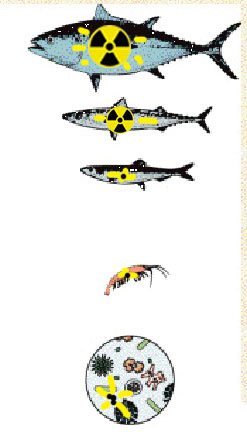
“The discharge, planned to continue for decades, is irreversible. Radionuclides bioaccumulate in marine organisms and can be passed up the food web, affecting marine life and humans who consume affected seafood,”
“The discharge, planned to continue for decades, is irreversible. Radionuclides bioaccumulate in marine organisms and can be passed up the food web, affecting marine life and humans who consume affected seafood,”
RNZ 19 July 2024 , By Pita Ligaiula in Tokyo
Consensus has been reached by Pacific leaders with Japan to address the controversial release of treated nuclear wastewater from the Fukushima nuclear power plant into the Pacific Ocean.
In August last year, Japan began discharging waste from about 1000 storage tanks holding 1.34 million metric tons of contaminated water collected after an earthquake and tsunami in 2011 that caused the meltdown of the Fukushima nuclear plant.
The agreement came at the Japanese hosted 10th Pacific Island Leaders Meeting (PALM10) on Thursday in the capital Tokyo attended by most of the Pacific Islands Forum (PIF) country leaders…………………………..
Pacific leaders emphasised the importance of a shared commitment to safeguarding the health, environment, and marine resources of the Pacific region and a need for transparency from Japan………………………………………….
TEPCO uses a process known as Advanced Liquid Processing System involving special filters which remove from the contaminated water most of the 62 types of radioactive materials, radionuclides such as cesium, strontium, iodine and cobalt but not tritium.
The leaders agreed to keep the ALPS treated water issue as a standing agenda item for future PALM meetings with Japan, supported by an ongoing review process. Their decision reflects concerns about addressing the long-term implications and ensuring continuous monitoring and evaluation.
While consensus was reached at the summit, the wastewater release continues to be questioned by some scientists.
Director of the Kewalo Marine Laboratory at the University of Hawaii, Research Professor Robert Richmond, said concerns remain regarding the efficacy of the ALPS treatment and the contents of the thousands of storage tanks of radioactive wastewater.
“The long-term effects of this discharge on Pacific marine ecosystems and those who depend on them are still unknown. Even small doses of radiation can cause cancer or genetic damage,” Richmond said in a statement to BenarNews after the agreement.
He criticised the current monitoring program as inadequate and poorly designed, failing to protect ocean and human health.
“The discharge, planned to continue for decades, is irreversible. Radionuclides bioaccumulate in marine organisms and can be passed up the food web, affecting marine life and humans who consume affected seafood,” Richmond said……………………………………………… https://www.rnz.co.nz/international/pacific-news/522582/pacific-leaders-japan-agree-on-fukushima-nuclear-wastewater-discharge—
Philippines Says US Will Pull Out Controversial Mid-Range Missile System
The US deployed the Typhon missile system for annual military drills
by Dave DeCamp July 4, 2024 ore https://news.antiwar.com/2024/07/04/philippines-says-us-will-pull-out-controversial-mid-range-missile-system/
On Thursday, the Philippines said the US was pulling out a new missile system it deployed to the Southeast Asian country for annual military exercises.
The US sent the Typhon missile system for the Balikatan exercises, which were held in April and May. The Typhon is a controversial launcher since it would have been banned by the Intermediate-Range Nuclear Forces (INF) Treaty, a treaty between the US and Russia that the Trump administration withdrew from in 2019.
The INF prohibited land-based missile systems with a range between 310 and 3,400 miles. The Typhon can launch nuclear-capable Tomahawk missiles, which have a range of about 1,000 miles. It can also fire SM-6 missiles, which can hit targets up to 290 miles away.
Philippine Col. Louie Dema-ala told AFP that the US planned to withdraw the Typhon from the Philippines following the military exercises. “As per plan… it will be shipped out of the country in September or even earlier,” he said. “The US Army is currently shipping out their equipment that we used during Balikatan and Salaknib (exercises).”
China strongly condemned the deployment of the Typhon system, which US officials have acknowledged was developed to prepare for a future conflict with Beijing over Taiwan or the South China Sea.
Russian President Vladimir Putin also recently mentioned the deployment. He made the comments when calling for Moscow to follow the US and develop missile systems previously banned by the INF.
“We need to start production of these strike systems and then, based on the actual situation, make decisions about where — if necessary to ensure our safety — to place them,” Putin said last week.
“Today it is known that the United States not only produces these missile systems, but has already brought them to Europe for exercises, to Denmark. Quite recently it was announced that they are in the Philippines,” the Russian leader added.
Guam’s fight for radiation exposure compensation ‘far from over’
RNZ, By Mar-Vic Cagurangan, Pacific Island Times, 17 June 24
Despite nearly two decades of relentless lobbying, Guam’s hopes to finally be included in the Radiation Exposure Compensation Act (RECA) crumbled anew when the US House Republican leadership let the program expire without extension or expansion.
While the RECA extension and expansion proposal received bipartisan support in the US Senate, House Speaker Mike Johnson shunned its inclusion in the 2025 National Defense Authorization Act.
Guam Delegate James Moylan said the House Rules Committee ruled his amendment to incorporate the RECA expansion language into the defense spending policy bill “out of order”. As a result, the language didn’t make it to the floor for the House vote.
“The primary reason was that offset costs were not provided, which were estimated at around US$50 billion,” Moylan said in a statement.
“This mirrors the message from House leadership when referencing the RECA measure passed by the Senate, and many in the House, including myself, have been requesting for a vote to take place on the floor.”
RECA, the 1990 legislation that provided financial compensation for atomic test downwinders in three states and pre-1971 uranium miners, expired on June 10.
The expanded version would have added Guam, Colorado, Idaho, Missouri, Montana and New Mexico to the list of areas currently included in RECA, namely Nevada, Arizona and Utah.
“The Republican leadership’s policy is that any new spending measure must have an offset provided, to prevent uncontrolled spending or an unfunded mandate,” Moylan said.
“There are others who believe the measure should be passed regardless, and thus allow the executive branch to identify the funds. We believe a combination of both is needed.”
The Pacific Association of Radiation Survivors led by Robert Celestial has been fighting for Guam’s inclusion in RECA, backed by the National Research Council’s 2005 report declaring the territory’s eligibility for compensation under the program.
“Guam did receive measurable fallout from atmospheric testing of nuclear weapons in the Pacific between 1946 and 1958,” read the council’s report, which recommended that people living on island during that period be compensated under RECA “in a way similar to that of persons considered to be downwinders.”
Despite the latest defeat, Moylan said the advocacy “is far from over” and “building more support along the way”.
He is banking on the Senate to include the language in its version of the NDAA in the coming weeks………………………………………… more https://www.rnz.co.nz/international/pacific-news/519741/guam-s-fight-for-radiation-exposure-compensation-far-from-over
In Nuclear Crosshairs, Guam Still Doesn’t Control Its Own Affairs
… because its inhabitants are not fully considered Americans when it matters.
WORDS: APRIL ARNOLD, PICTURES: JAZMIN SMITH, MAY 20, 2024, https://inkstickmedia.com/in-nuclear-crosshairs-guam-still-doesnt-control-its-own-affairs/
At the core of Guam’s indigenous CHamoru culture are the concepts of inafa’maolek – inafa meaning “to make together” and maolek meaning “good.” It is the idea that something was once bad or broken and is in need of repair, and that repair comes from doing good together and restoring harmony. If there is one thing the CHamoru have known for nearly 500 years, it is how to make the best of broken circumstances.
In recent years, Guam has found itself at the center of tensions between the United States and countries in the Pacific. As the tiny island sits on the frontlines of the competition for influence in the region, Guam has increasingly come under threat of being a prime target for nuclear attack by China or North Korea.
In 2022, North Korea confirmed a test launch of an intermediate-range ballistic missile that could reach Guam. In 2023, the country confirmed launching spy satellites that targeted military installations in Japan, on the US mainland and on Guam. Equally concerning was North Korea’s response that attempts to interfere with their satellites would be considered a declaration of war. In April 2024, North Korea conducted a test launch of another intermediate-range ballistic missile that could also reach Guam.
“Guam Killer”
As for China, during a military parade in September 2015, the Chinese government unveiled a new missile that quickly became known as the “Guam Killer.” Following the introduction of this new missile, the US-China Economic Security Commission published a 2016 report detailing China’s military expansion and its implications for Guam.
Yet, despite the threat to the island, it still does not have a full say over many aspects of its strategic role in international affairs. Its citizens are not allowed to vote in US presidential elections, with straw polls showing that voting trends of the territory do not guarantee one political party leverage over the other.
Nor does Guam have full representation in US Congress, limiting its ability to lobby for the island’s interests, despite being in harm’s way militarily and environmentally. As the US promotes democracy worldwide, it should start at home by affording Guam statehood. This, in turn, could help temper the aggression and rhetoric China and North Korea have directed at the island, giving the US an even stronger foothold in the region.
History of Foreign Rule
Guam has been under foreign rule since 1565 and foreign aggression since 1521 when Ferdinand Magellan landed on the island. As a strategic trade outpost for Spain for over 300 years, the CHamoru were forced to convert to Catholicism by the Jesuits and subservient to Spanish governance that ravaged the island’s natural resources and culture. In the book “Destiny’s Landfall,” author Robert F. Rogers detailed stories of the abuse the CHamoru people experienced at the hands of governors who had a recurring penchant for excessive greed and virile priests seeking to exact their purportedly divine authority.
Then, as a concession of the Spanish-American War, Spain transferred Guam to the US under the Treaty of Paris of 1898. This was a controversial transaction at the time as Congress was amid the throes of the debate over Manifest Destiny and expansion into the Pacific.
Much to the surprise of the citizens of Guam, the transfer did not result in its incorporation into the country as a state, despite establishing a local democratic government to aid this effort.
Military Oversight
Instead, the island was placed under the oversight of the Department of the Navy for 52 years, where military governance had absolute authority. As a result of the treaty, the US government faced a new hurdle of incorporating these newly-acquired territories.
Through a series of Supreme Court rulings known as the Insular Cases, the US decided that Guam among other islands such as Puerto Rico, Hawaii, and the Philippines, would be considered territories without full citizenship rights.
Language from one of the Insular Cases, Downes vs. Bidwell, states, in part, the following about foreign territories: “If those possessions are inhabited by alien races, differing from us in religion, customs, laws, methods of taxation, and modes of thought, the administration of government and justice, according to Anglo-Saxon principles, may for a time be impossible.”
Taking Advantage
In short, even though Guam had been under Catholic influence and rule for more than 300 years and had adopted many Catholic practices, it was not enough to be accepted into the US as more than an “alien race.”
Meanwhile, the US had begun taking full advantage of Guam’s position in the Pacific, constructing military bases starting in WWII. It wasn’t until 1950 that the Department of the Navy would transfer its oversight of Guam to the Department of the Interior, designating the island as an unincorporated territory through the Guam Organic Act.
With the steady military buildup of US forces on Guam over the decades, the US would gain more influence in the Pacific while pushing CHamoru off their lands and creating waste management nightmares that now include two Superfund sites used to dispose of hazardous chemicals.
Military Buildup
Even as tensions have grown, military officials have called for increased investment in a missile defense capability on the island to counter China’s capabilities development and aggression in the region. This includes relocating 5,000 US Marines to Camp Blaz on Guam later in 2024, with some concerned over impacts to the local ecosystem and historical sites.
Meanwhile, Guam continues to wrestle with the US government on waste management funding to clean up the Superfund site, Ordot Landfill. The landfill was formerly owned and used by the Department of the Navy during WWII, with some of its contents allegedly being toxic chemicals such as Agent Orange. Even upon returning the landfill to the island after Congress passed the Guam Organic Act in 1950, the Navy continued to use the dump until the 1970s.
After its closure in 2011, Guam’s local government began clean-up efforts and filed a lawsuit under the Superfund Act to seek financial help from the US government on the $160 million estimated cost. A lower court ruled that Guam’s lawsuit surpassed the statute of limitations under the Comprehensive Environmental Response, Compensation and Liability Act. As one article states, “Shouldering the cost alone would be unduly difficult for the small island, as the bill exceeds the combined annual budget of its health, social services, police, fire, public works, solid waste and environmental departments.”
In May 2021, the Supreme Court reversed the ruling, and in September 2023 the US government agreed to pay $48.9 million in cleanup costs that were incurred prior to Aug. 10, 2022. The remaining $110 million in costs will still have to be covered by Guam’s local government.
Self-Determination
The conversation of Guam’s self-determination starts at the local level. Guam’s Commission on Decolonization was formed in 1997 to promote domestic education and outreach on the island’s options for self-determination. These options include statehood, free association, or independence. The first step in this process is the self-determination vote, where voters decide which of the decolonization options to pursue. Yet, efforts for a referendum have already run into issues at the federal level.
Before conducting the vote, Guam’s government needs to decide who is included in the definition of self-determination, which it has already done. According to the commission’s website, the right of self-determination belongs to those who were colonized, with the definition of “native inhabitants of Guam,” referring to people who became US citizens through the 1950 Guam Organic Act, as well as their descendents.
In 2020, the Supreme Court declined to review Guam’s appeal of a previous lower court ruling on conducting a nonbinding plebiscite to determine whether native inhabitants preferred statehood, free association, or independence because the vote was discriminatory on the grounds of race.
In February 2024, Guam’s government began looking into better defining the term so that it meets expectations in local law and was not “considered again a ‘proxy for race’ and therefore unconstitutional.”
On May 13, 2024, Guam’s Attorney General published an opinion that there was “no room” for Guam’s definition of the phrase that would be deemed constitutional. Instead, the AG recommended Guam’s Governor take other legal routes, such as lobbying Congress to recognize Guam’s unique history and work with the island to develop a path towards self-determination as well as petition support from the United Nations.
Reluctance
Separately, politicians on Guam are also reluctant to pursue tribal classification for the CHamoru people, especially after the US federal government sued Guam over land trust issues.
In 2017, Madeleine Bordallo, then the Guam delegate to the US House of Representatives, expressed concerns over the implications of enrolling the CHamoru as a tribe when the island would have to transfer ownership of the tribal lands to the federal government.
Each of these issues has made it difficult for Guam to gain traction in pursuing any form of self-determination, let alone statehood.
While it is unlikely that the majority of US elected officials would support anything other than statehood for Guam, leaving the island in a position that forces them to either lobby Congress for any self-determination support or solicit help from the United Nations could strain the relationship at a delicate time internationally.
Path Forward
After a referendum favoring statehood, all that is required for Guam to become a state is a simple majority vote on a joint resolution in both houses of Congress and approval by the President. The biggest hurdle is often lobbying Congress for the votes. The CHamoru have had their land taken from them to support US military demands with little-to-no reconciliation efforts from the US government.
Yet, the tiny island finds itself in the crosshairs of growing tensions between multiple nuclear weapons states, with barely a voice to hold the US government accountable for its actions. Many arms control and nonproliferation experts lament the lack of US public interest in the threat of nuclear war. Perhaps, it is because those most at risk are not fully considered Americans when it matters. If the US truly cares about ensuring democracy around the world, it should start at home.
US, Philippines, Japan, and Australia Conduct First Joint Military Exercise in South China Sea
China launched patrols in the South China Sea in response
by Dave DeCamp April 7, 2024
https://news.antiwar.com/2024/04/07/us-philippines-japan-and-australia-conduct-first-joint-military-exercise-in-south-china-sea/
The US, Japan, the Philippines, and Australia conducted joint military exercises in the South China Sea on Sunday in a provocative show of force aimed at China.
According to Japan’s Kyodo News, the drills marked the first “full-scale exercise” between the four nations. The US has been looking to increase military cooperation between its treaty allies in the region as part of its military build-up to prepare for a future war with China.
The four countries released a joint statement that made clear the drills were meant to push back on China’s claims to the South China Sea. “We stand with all nations in safeguarding the international order based on the rule of law that is the foundation for a peaceful and stable Indo-Pacific region,” the statement said.
According to The South China Morning Post, the drills included two Philippine vessels, one American ship, one Australian ship, and a Japanese ship and focused on anti-submarine warfare training, tactical exercises, and photo exercises.
China launched patrols in the South China Sea on the same day in what appeared to be a response to the drill. “The Southern Theatre Command of the People’s Liberation Army will conduct a joint air and sea combat patrol in the South China Sea on April 7,” the Chinese military’s Southern Theater Command said.
The joint drills come as tensions are soaring between China and the Philippines over disputed rocks and reefs in the South China Sea. Chinese and Philippine vessels frequently have tense encounters in the waters, which often end in collision. In the most recent incident, a Chinese vessel fired a water cannon at a Philippine supply boat, injuring several crew members.
The incidents in the South China Sea could potentially spark a major war as the US has repeatedly affirmed that the US-Philippine Mutual Defense Treaty applies to attacks on Philippine vessels in the disputed waters.
President Biden is hosting Philippine President Ferdinand Marcos Jr. and Japanese Prime Minister Fumio Kishida in Washington this Thursday for the first-ever trilateral summit between the three nations. They’re expected to announce the launch of regular joint patrols in the South China Sea.
Pacific wants open discussion on AUKUS to ensure region is nuclear free
Eleisha Foon, RNZ Pacific Journalist, @eleishafoon, more https://www.rnz.co.nz/international/pacific-news/508948/pacific-wants-open-discussion-on-aukus-to-ensure-region-is-nuclear-free 12 Feb 24
Keeping the Pacific nuclear-free, in line with the Rarotonga treaty, was a recurring theme from the leaders of Tonga, Cook Islands and Samoa to New Zealand last week.
The New Zealand government’s Pacific mission wrapped up on Saturday with the final leg in Samoa.
Over the course of the trip, defence and security in the region was discussed with the leaders of the three Polynesian nations.
In Apia, Samoan Prime Minister Fiamē Naomi Mataʻafa addressed regional concerns about AUKUS.
New Zealand is considering joining pillar two of the agreement, a non-nuclear option, but critics have said this could be seen as Aoteroa rubber stamping Australia acquiring nucelar-powered submarines.
“We would hope that both administrations will ensure that the provisions under the maritime treaty are taken into consideration with these new arrangements,” Fiamē said.
New Zealand’s previous labour government was more cautious in its approach to joining AUKUS because it said pillar two had not been clearly defined, but the coalition government is looking to take action.
Prime Minister Fiamē said she did not want the Pacific to become a region affected by more nuclear weapons.
She said the impact of nuclear weapons in the Pacific was still ongoing, especially in the North Pacific with the Marshall Islands, and a semblance of it is still in the south with Tahiti.
She said it was crucial to “present that voice in these international arrangements”.
“We don’t want the Pacific to be seen as an area that people will take licence of nuclear arrangements.”
The Treaty of Rarotonga prohibits signatories – which include Australia and New Zealand – from placing nuclear weapons within the South Pacific.
Cook Island’s Prime Minister Mark Brown said Pacific leaders were in agreement over the security matter.
“I think our stance mirrors that of all the Pacific Island countries. We want to keep the Pacific region nuclear weapons free, nuclear free and that hasn’t changed.”
Reflecting on dicussions during the Pacific Islands Forum in 2023, he said: “A review and revisit of the Rarotonga Treaty should take place with our partners such as New Zealand, Australia and others on these matters.”
“It’s timely that we have them now moving forward,” he said.
Last year, Fiji’s Prime Minister Sitiveni Rabuka proposed a Pacific peace zone which was discussed during the forum leaders’ meeting Rarotonga.
This year, Tonga will be hosting the forum and matters of security and defence involving AUKUS are expected to be a key part of the agenda.
Tonga’s Acting Prime Minister Samiu Vaipulu acknowledged New Zealand’s sovereignty and said dialogue was the way forward.
“We do not interfere with what other countries do as it is their sovereignty. A talanoa process is best,” Vaipulu said.
Foreign Minister Winston Peters and Health and Pacific People’s Minister Shane Reti reiterated that they care and have listened to the needs outlined by the Pacific leaders.
They said New Zealand would deliver on funding promises to support improvements in the areas of health, education and security of the region.
Fijian youths condemn Japan’s discharge of radioactive water
Global Stringer, 22-Jan-2024, https://news.cgtn.com/news/2024-01-22/We-Talk-Fijian-youths-condemn-Japan-s-discharge-of-radioactive-water-1qz4wGtqnkc/p.html
The fourth round of discharge of nuclear-contaminated water from the Fukushima Daiichi nuclear power plant will begin in late February 2024, with a total release of 7,800 tonnes, local media reported on December 18. Japan has so far completed three rounds of nuclear discharge, sending more than 23,000 tonnes of nuclear wastewater into the Pacific Ocean in less than three months.
CGTN Stringer took to the streets of Fiji and asked many local college students for their opinions on this matter. The students expressed their strong opposition, noting that the islanders depend on the sea for a living. The discharge of nuclear-contaminated water into the sea will pollute the Pacific Ocean and destroy coral groups. It will seriously affect the living resources of the islanders, endanger the health of the people of the island country, and cause immeasurable damage to ecosystems.
Halt the US-Philippines Nuclear Deal
Sign on to Letter to US Congress
Full statement and sign on: tinyurl.com/haltUSPHdeal
While thousands gathered in San Francisco to protest the Asia Pacific Economic Cooperation (APEC) and Philippine President Ferdinand Marcos Jr.’s presence at its meetings, United States Secretary of State Anthony Blinken signed a new Section 123 Nuclear Agreement with the Philippine Energy Secretary Raphael Lotilla. This agreement would allow the United States to export nuclear technology and material to Manila. Negotiations for the agreement began upon Kamala Harris’ November 2022 trip to the Philippines, making it the fastest Section 123 agreement ever signed, according to Blinken.
President Marcos Jr. portends the so-called “peaceful nuclear cooperation,” to be an alternative energy solution for the Philippines. The agreement must now go before the US Congress for approval.Here are five reasons why we must act now to oppose it:
- In a country already prone to climate disaster, vulnerable communities in the Philippines will be further at risk. Located in the notoriously active seismic zone known as the “ring of fire,” the Filipino people are among those that climate change and natural disasters most endanger, seen in the yearly typhoons and major disasters such as Typhoon Haiyan in 2013, which some estimate affected around 16 million people. History meanwhile provides no doubt about the potential disasters that can come with nuclear energy; we are already witness to the devastation caused by the nuclear accidents in Chernobyl and Fukushima. US-based nuclear companies are pivoting their projects to the Philippines, making the country a guinea pig for their untested and risky technologies.
2 Nuclear energy poses a threat to the health and safety of communities in the Philippines. Exposure to toxic nuclear waste is linked to increased rates of cancer, cardiovascular disease and other adverse health effects, particularly in sensitive populations including children. The Philippines is highly abundant in safer forms of renewable energy, and it is better to use precautionary principles than put already vulnerable communities at further risk. There is no confidence in the Philippine government to handle this type of radiation processing of energy, especially if they are privatized and the main objective is profit.
3 Fashioned in the style of the Marcos Sr. Dictatorship, this deal benefits only the US and Philippine elite. This is not the first attempt of the Philippine government to prioritize nuclear energy with the United States. Marcos Sr., following his declaration of Martial Law, worked with US companies to begin the building of the Bataan Nuclear Plant. The Bataan Plant, a point of protest for activists in the Philippines, quickly failed and was mothballed when the Marcos dictatorship, full of corruption and plundering of public funds for personal use, could not complete the construction. Now, Marcos Jr., known for his lavish spending on global travel, has sought to revive a nuclear project like his father’s to earn foreign investment. House of Representatives Member Mark Cojuangco, a billionaire and long-time supporter of the Marcos family, has been a proponent of nuclear projects. These families support said nuclear project because it benefits their widespread power over land and profit in the Philippines Creating a deal with the US and foreign corporations will serve their business interests, not those of the Filipino people. For the US and US based corporations, it gives the opportunity to control and profit further from the resources in the Philippines, a country which, since 2022, has allowed 100 percent foreign ownership over “clean” energy projects.
4 The so-called “peaceful transfer” of nuclear materials thwarts the Filipino people’s right to peace, development and self-determination. Known as the deadliest country for land defenders, environmental activists, indigenous people, farmers and people in rural areas of the Philippines are currently facing brutal attacks under the Marcos’ counterinsurgency program – recently documented by UN Special Rapporteur Ian Fry. In its attempts to squash the CPP-NPA-NDF, the Marcos regime has continued the US-designed counterinsurgency policy of Duterte and many presidents before him that result in the militarization of indigenous and rural communities, indiscriminate aerial bombings, forced surrender of civilians and mass displacement of people from their homelands. At the roots of the armed conflict in the Philippines is the Filipino people’s struggle for land and sustainable, national development, free from foreign intervention and control. The transfer of nuclear materials paves the way for more displacement of indigenous people, land grabbing for the sake of foreign corporations and further militarization of the countryside. The potential monopoly of foreign ownership over energy in the Philippines further aggravates the people’s aspiration to control and determine the development of their own economy. The US agreement with the Marcos regime gives further approval of Marcos’s policies and rewards his family for their ongoing plunder and exploitation of the Filipino people.5 As tensions with China escalate, the storage of nuclear materials will set a precedent for the US to allow a nuclear arsenal to be stored in the Philippines. The required technology and infrastructure for facilities to hold nuclear materials will open up the door for conversations to allow for the potential storage of US nuclear weapons on Philippine soil. President Marcos has already allowed the ongoing Kamandag war game exercises between the US, Philippines, South Korea, and Japan, only serving to escalate tensions in the region and drag the Philippines into conflict between the US and China. By allowing the US to store nuclear materials in the Philippines, Marcos is setting the stage to welcome US nuclear weapons as an opportunity to advance his foreign affairs relationship with US President Biden.
For these reasons, we, members of the Filipino community and allies in solidarity, demand that members of US Congress halt the Section 123 US-PH Nuclear Deal.
Nuclear energy in Philippines? Group says there’s not even a Filipino expert on safety, radiation.
By: Cristina Eloisa Baclig – Content Researcher Writer / @inquirerdotnet, INQUIRER.net / 03:08 PM November 27, 2023
MANILA, Philippines—In a convergence of scientific and environmental dissent, progressive groups, scientists, and climate activists expressed strong opposition to the newly signed nuclear deal between the Philippines and the United States (US).
Last Nov. 17, Energy Secretary Raphael Lotilla and US Secretary of State Anthony Blinken signed the 123 agreement, or the “peaceful nuclear cooperation agreement,” on the sidelines of the Asia-Pacific Cooperation (Apec) Summit.
It took a year to negotiate the breakthrough agreement between the two countries. Blinken described it as “the fastest that the United States has ever negotiated this kind of agreement.”
The deal, which awaits approval by the US Congress, establishes a legally binding framework allowing the transfer of nuclear material and the export of nuclear fuel, reactors, and equipment from the US to the Philippines…………………………
A ‘reckless decision’
The group Advocates of Science and Technology for the People (AGHAM) said the government’s decision to “impulsively” enter into the agreement was a “reckless decision that lacks careful consideration.”
The group explained that despite its promised and expected benefits, there is still no detailed study on whether nuclear power is necessary and appropriate for the country.
“This omission leaves the Marcos administration without a solid foundation to justify their nuclear aspirations, as the International Atomic Energy Agency (IAEA) emphasizes the importance of such studies in assessing a country’s needs and potential for nuclear energy,” the group added.
AGHAM argued that nuclear energy will only worsen the energy crisis in the country, where, according to the group, other indigenous sources of energy remain largely untapped or with inefficient and incomplete distribution systems.
It also described the agreement as “dangerously premature,” considering that the science and technology sector in the country remains severely underfunded and understaffed.
“To illustrate, as of this moment, there is no Filipino expert in nuclear safety or in radiological environmental impact assessment in the country,” the group explained.
“This means that we will have to disproportionately rely on the US nuclear regulatory mechanism, which will lead to us being clueless guinea pigs for their new nuclear technologies; since we do not have our own way of technically assessing future implementations.”
Not a solution for clean energy security
President Ferdinand “Bongbong” Marcos Jr., who witnessed the signing of the pact, said the deal would ensure a “more energy secure and green Philippines.”
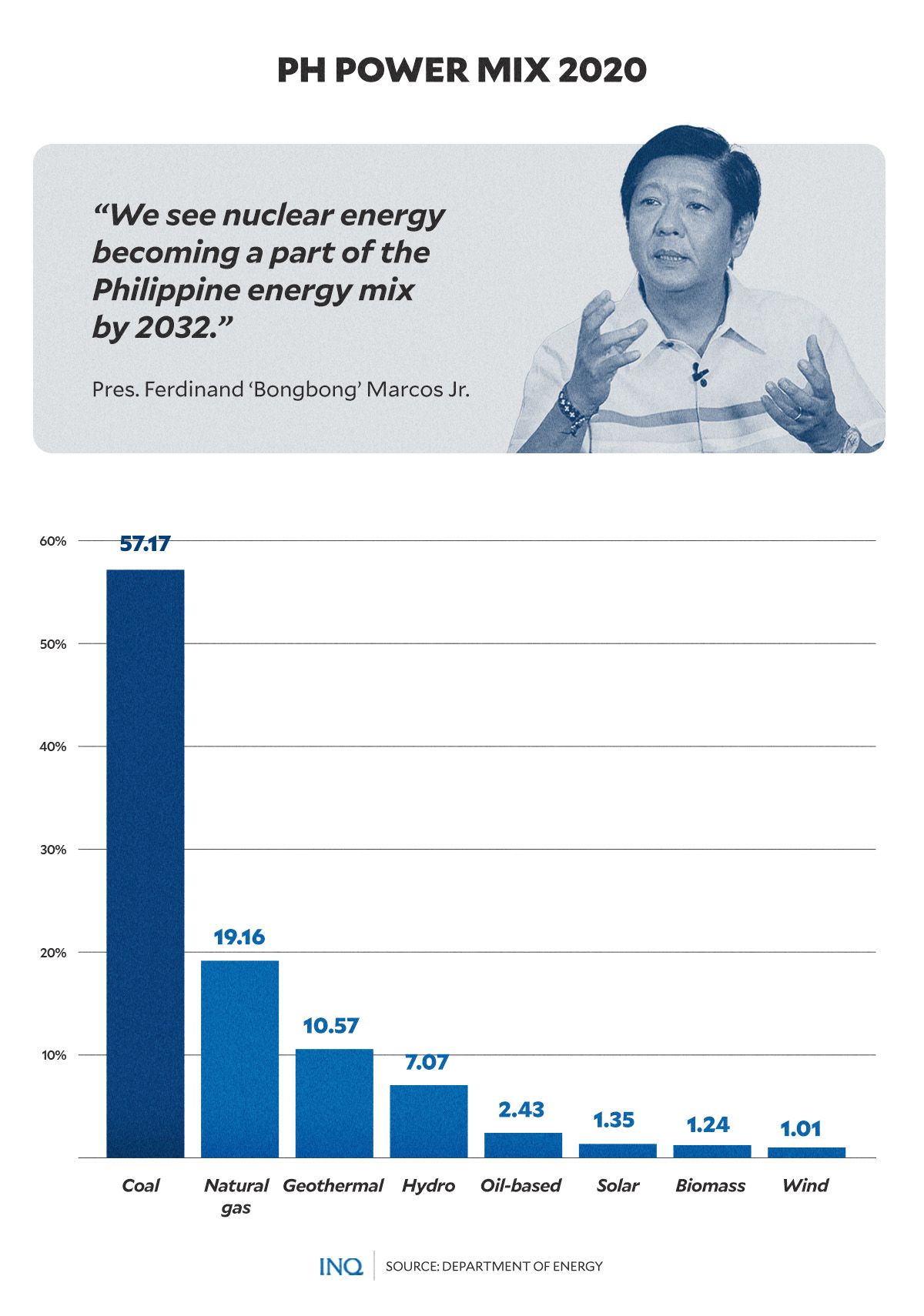
“We see nuclear energy becoming a part of the Philippine energy mix by 2032, and we would be more than happy to pursue this path with the United States as one of our partners,” said Marcos Jr. in a speech.
“The signing of the Philippines-United States Agreement for Cooperation Concerning Peaceful Uses of Nuclear Energy, or the 123 Agreement, is the first major step in this regard, taking our cooperation on capacity building further and actually opening the doors for U.S. companies to invest and participate in nuclear power projects in the country,” he added.
However, according to the Philippine Movement for Climate Justice (PMCJ), the 123 Agreement poses a threat by acquiring risky nuclear technologies, misleadingly promoted as a remedy for clean energy security.
“[T]he agreement’s purported benefits are debunked. Nuclear energy, touted for clean energy, releases pollutants worsening the planet’s temperature. The resulting radioactive waste persists for years, often irresponsibly dumped or stored, lacking proper technology for disposal,” PMCJ said in a statement.
PMCJ said that it “vehemently opposes nuclear energy in the country, advocating for a shift towards sustainable solutions.”
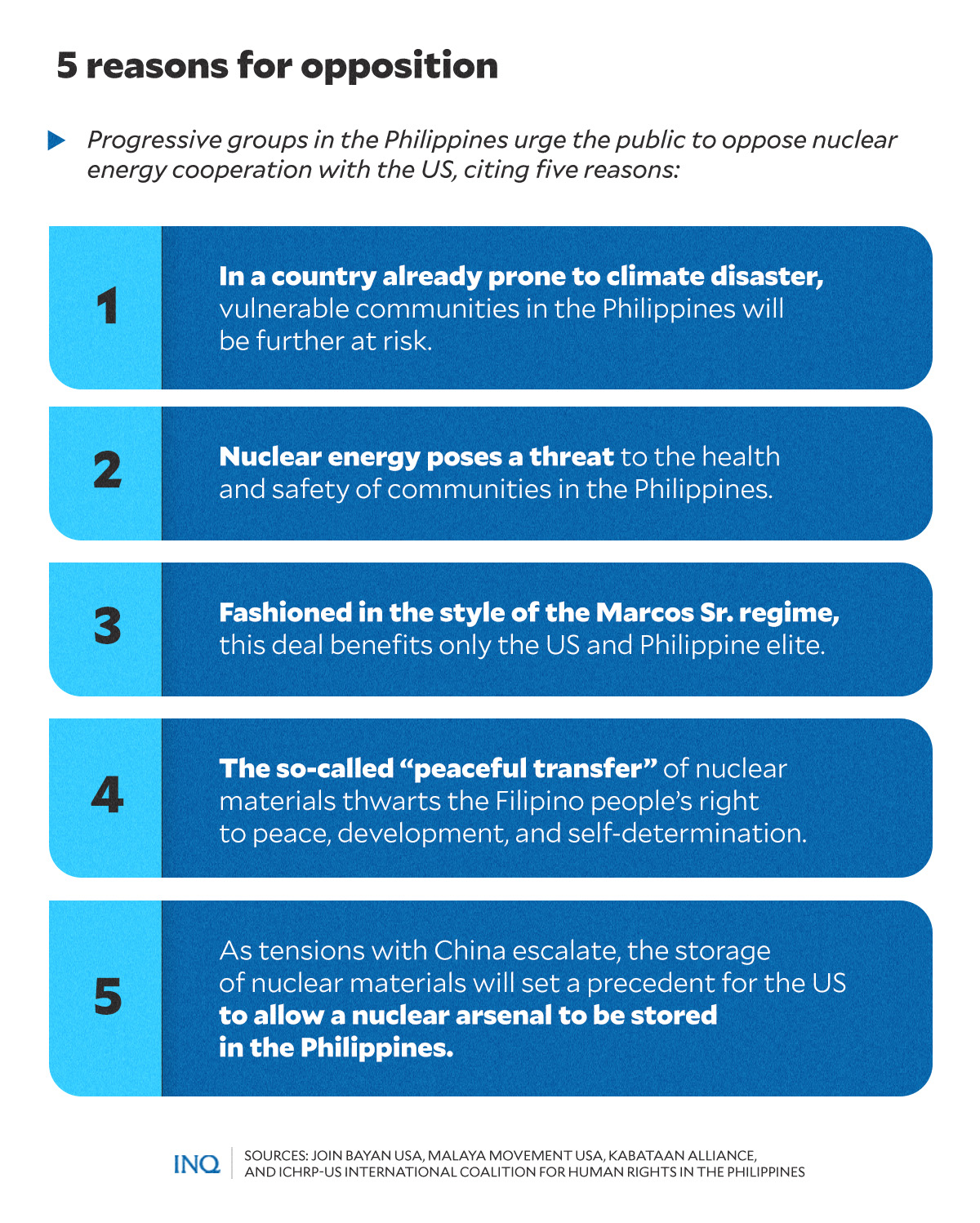
Despite the supposed benefits, the International Coalition for Human Rights in the Philippines (ICHRP-US), along with progressive groups — Bayan USA, Malaya Movement USA, Kabataan Alliance — demanded that members of the US Congress halt the nuclear deal, citing five reasons:
- In a country already prone to climate disaster, vulnerable communities in the Philippines will be further at risk.
- Nuclear energy poses a threat to the health and safety of communities in the Philippines.
- Fashioned in the style of the Marcos Sr. regime, this deal benefits only the US and Philippine elite.
- The so-called “peaceful transfer” of nuclear materials thwarts the Filipino people’s right to peace, development, and self-determination.
- As tensions with China escalate, the storage of nuclear materials will set a precedent for the US to allow a nuclear arsenal to be stored in the Philippines.
Renewable vs nuclear energy
Both PMCJ and AGHAM questioned Marcos Jr. and his administration’s plans to use more renewable energy while also pushing for the use of nuclear power……………………………………………………………………………………………………………..
“As with his other policies, this will just be an edifice to be used as a talking point for the purposes of extending the Marcoses’ cling to power; with no real positive contribution, and even potentially dangerous, to the Filipino people,” the group continued.
Environmental group Greenpeace Philippines has previously called out Marcos Jr. for showing mixed signals on his stance on energy.
“He used renewable energy when he ran for president, and continues to talk about it like he means it, but it’s all a game of pretend. If you look at his actions, he’s actually out to promote nuclear energy and fossil gas–both of which will block major RE development,” said Greenpeace Philippines country director Lea Guerrero.
“Greenpeace believes this is climate hypocrisy at its most dangerous,” she added.
https://newsinfo.inquirer.net/1866612/nuclear-energy-in-ph-group-says-theres-not-even-a-filipino-expert-on-safety-radiation#ixzz8KL4mjfe6
Follow us: @inquirerdotnet on Twitter | inquirerdotnet on Facebook
A four-decade-old Pacific treaty was meant to preserve the ‘peaceful region’. Now experts say it’s being exploited
“We regret that the Aukus agreement … is escalating geopolitical tensions in our region and undermining Pacific-led nuclear-free regionalism,” says the Pacific Elders’ Voice,
the US and the UK will increase rotations of nuclear-powered submarines to Australia,
Pacific countries rushed to join the TPNW six years ago, reflecting their longstanding concerns about nuclear testing legacies. It’s the same regional sentiment that spurred the earlier Treaty of Rarotonga.
Daniel Hurst in Rarotonga
Nearly 40 years after the Treaty of Rarotonga came into force, the region is on edge about another rise in geopolitical tension
…………………………………………………………………………….heightened concerns permeated the region in the months leading up to the crucial meeting in the Cook Islands in August 1985 where leaders endorsed a nuclear-free zone.
Hawke, the Australian prime minister at the time, hailed the negotiations as a “dramatic success” that would send “a clear and unequivocal message to the world”, with the treaty leaving major powers in no doubt about the region’s desire to preserve “the South Pacific as the peaceful region which its name implies”.
But nearly 40 years after the Treaty of Rarotonga came into force, the region is on edge about another rise in geopolitical tensions – and critics say gaps in the treaty’s coverage are now being exploited.
“The treaty was really important to a lot of people, especially for grassroots activists,” says Talei Mangioni, a Fijian-Australian board member of the International Campaign to Abolish Nuclear Weapons Australia.
But it was quite watered down. And so even though we celebrate it today, what activists were saying in the 1980s and what progressive states like Papua New Guinea, Solomon Islands and Vanuatu were saying was that it wasn’t comprehensive enough.”
Mangioni, who researches the legacy of the Nuclear Free and Independent Pacific Movement, adds: “That’s what’s left us now with things like Aukus exploiting certain loopholes that have remained in the treaty.”
A hotbed of great-power competition?
When leaders met last week in the Cook Islands for the annual meeting of the Pacific Islands Forum (Pif), the Treaty of Rarotonga was once again on everyone’s lips.
The host of the summit, prime minister Mark Brown of the Cook Islands, argued the region “should rediscover and revisit our Rarotonga treaty to ensure that it reflects the concerns of Pacific countries today, and not just what occurred back in 1985”.
The treaty – signed on the 40th anniversary of the US atomic bombing of the Japanese city of Hiroshima – reflected “the deep concern of all forum members at the continuing nuclear arms race and the risk of nuclear war”.
Also known as the South Pacific Nuclear Free Zone Treaty, it designated a vast area from the west coast of Australia to Latin America where its parties must prevent the “stationing” (critics say this was always a deliberately ambiguous word) of nuclear weapons.
“The treaty prohibits the use, testing or stationing of nuclear explosive devices in the South Pacific,” the Cook Islands News explained on 7 August 1985.
“It does not prohibit countries from transporting nuclear devices through the zone nor does it prohibit nuclear-powered or equipped ships from calling in ports within the area.”
Today the parties to this treaty are Australia, Cook Islands, Fiji, Kiribati, Nauru, New Zealand, Niue, Papua New Guinea, Samoa, Solomon Islands, Tonga, Tuvalu and Vanuatu.
Once again, many of these nations are worried about the Pacific becoming a hotbed of great-power competition and the risk of that spiralling into conflict. Aukus feeds into some of those fears.
“We regret that the Aukus agreement … is escalating geopolitical tensions in our region and undermining Pacific-led nuclear-free regionalism,” says the Pacific Elders’ Voice, a group of former leaders whose members include Anote Tong, the ex-president of Kiribati.
The legality of a treaty – and the spirit of it
Under the Aukus plan, Australia will buy at least three Virginia class nuclear-powered submarines from the US in the 2030s, before Australian-built boats enter into service from the 2040s.
In the meantime, the US and the UK will increase rotations of nuclear-powered submarines to Australia, all aimed at deterring China from unilateral action against Taiwan or destabilising activities in the increasingly contested South China Sea.
One point of sensitivity is that it will be the first time a provision of the Nuclear Non-Proliferation Treaty regime has been used to transfer naval nuclear propulsion technology from a nuclear weapons state to a non-weapons state.
The Australian government has worked assiduously behind the scenes to reassure Pacific leaders on a key point about Aukus.
“Certainly when I was talking to people about it I would explain how it was consistent with the Treaty of Rarotonga,” says the Australian minister for the Pacific, Pat Conroy.
Donald Rothwell, a professor of international law at the Australian National University, concurs. The treaty, he notes, does not deal with nuclear-propelled submarines.
“My view is that Aukus is consistent with Australia’s Treaty of Rarotonga obligations,” Rothwell says.
“Pacific states may have concerns about the potential stationing of US and UK nuclear-armed warships in Australian ports under Aukus. The stationing of such vessels, as opposed to port visits, would be contrary to the treaty.”
The Australian prime minister, Anthony Albanese, sought to allay any Aukus-related concerns when he briefed Pacific leaders during the Pif meetings last week and appears to have held off any open rebellion.
Albanese insists the treaty remains “a good document” and “all of the arrangements that we’ve put in place have been consistent with that”.
But anti-nuclear campaigners point to the planned new aircraft parking apron at the Tindal base in the Northern Territory that will be able to accommodate up to six US B-52 bombers.
The US refuses to confirm or deny whether the aircraft on rotation would be nuclear-armed, in line with longstanding policy.
“We should delineate between a legalistic interpretation of the Treaty of Rarotonga and the spirit of it,” says Marco de Jong, a Pacific historian based in Aotearoa New Zealand.
“Pacific nations are growing increasingly frustrated at Australia’s reliance on loopholes and technicalities.”
Australia: the regional outlier
The Nobel prize-winning International Campaign to Abolish Nuclear Weapons says a good way for Australia to reassure the region about its long-term intentions would be to sign the newer Treaty on the Prohibition of Nuclear Weapons (TPNW).
This is an idea Albanese previously supported enthusiastically but which appears stalled.
One potential problem is that the US has warned that the TPNW – which includes a blanket ban on helping others to use or threaten to use nuclear weapons – wouldn’t allow for close allies like Australia to enjoy the protection of the American “nuclear umbrella”.
Documents obtained by the Guardian under freedom of information laws show the Australian defence department has warned the Labor government that the TPNW is “internationally divisive” because the nuclear weapons states “are all opposed”.
But Mangioni, a member of the Youngsolwara Pacific movement of activists, counters that Pacific countries rushed to join the TPNW six years ago, reflecting their longstanding concerns about nuclear testing legacies. It’s the same regional sentiment that spurred the earlier Treaty of Rarotonga.
“I would say that Australia is indeed the outlier compared to the rest of the Pacific states,” Mangioni says.
“Australia depends on nuclear deterrence as its policy but the rest of the Pacific states are nuclear abolitionists.” https://www.theguardian.com/world/2023/nov/19/a-40-year-old-pacific-treaty-was-meant-to-maintain-the-peaceful-region-now-experts-say-its-being-exploited
Collective calls on Pacific leaders to oppose Fukushima nuclear wastewater discharge
The Pacific Collective on Nuclear Issues has denounced once again the dumping of radioactive wastewater from the damaged Fukushima nuclear power plant into the Pacific Ocean, calling on Pacific leaders to suspend Japan’s status as a Pacific Islands Forum (PIF) dialogue partner.
The Collective, composed of civil society groups, non-governmental organizations and movements in the Pacific, issued a statement this week, during which the 52nd Pacific Islands Forum Leaders Meeting was held in the Cook Islands.
The statement condemned the Japanese government and the facility operator, Tokyo Electric Power Company (TEPCO), for insisting on this flawed and dangerous course of action.
“The findings of the independent panel of scientific experts commissioned by the Pacific Islands Forum were unequivocal – the data provided so far, to support Japan’s claim that the treated wastewater is safe, is inconsistent, unsound and therefore far from reliable,” the statement said, adding that “if the Japanese government and TEPCO believe the radioactive wastewater is safe, they should be prepared to safely dispose of it within terrestrial Japan.”
The Collective also declared that such dumping into the Pacific Ocean is a direct violation of human rights.
Aside from being a brazen violation of international law, the Collective said, Japan’s behavior and handling of this matter is an affront to the very sovereignty of Pacific states and unbecoming of a dialogue partner of the PIF.
Founded in 1971, the PIF is the region’s premier political and economic policy organization which comprises 18 members.
The Collective called on the Pacific leaders to reaffirm the long-held position of the Pacific to keep their region nuclear-free and to review diplomatic relations with Japan at the next Pacific Islands Forum Leaders Meeting in 2024.
They also called on the international community not to turn a blind eye to the threat that dumping radioactive wastewater into the Pacific Ocean poses to Pacific peoples, their livelihoods, safety, health and well-being.
Japan conducted the third round of release of nuclear-contaminated wastewater from the crippled Fukushima Daiichi Nuclear Power Plant into the Pacific Ocean earlier this month, despite numerous and repeated objections by governments and communities, environmental groups, NGOs, and anti-nuclear movements in Japan and the Pacific
Pacific island nations express concern over Fukushima water release
Japan Times, AVARUA, COOK ISLANDS – 11 Nov 23
Leaders of Pacific island nations expressed strong concerns over the release of treated radioactive water from Japan’s wrecked Fukushima No. 1 nuclear plant into the Pacific Ocean during a regional summit, according to Cook Islands Prime Minister Mark Brown.
Brown, who currently chairs the Pacific Islands Forum, said Thursday there were “strong concerns” raised by “our forum leaders for the significance of potential threats of contamination to the health and security of the blue Pacific.”
The bloc’s 18 members have expressed differing views on the treated wastewater discharge from the Fukushima No. 1 nuclear power plant, which began in late August, after extensive dialogue between the member states and Japan………………………………………………….
The leaders’ meeting began in the Cook Islands Monday, with the main talks taking place Wednesday and Thursday on Rarotonga, the country’s most populous island, and Aitutaki.
The Pacific Islands Forum comprises Australia, the Cook Islands, Micronesia, Fiji, French Polynesia, Kiribati, the Marshall Islands, Nauru, New Caledonia, New Zealand, Niue, Palau, Papua New Guinea, Samoa, the Solomon Islands, Tonga, Tuvalu and Vanuatu. https://www.japantimes.co.jp/news/2023/11/11/japan/politics/japan-pacific-island-nations-fukushima-water-release/
Pacific Islands Forum – time to reinvigorate the Treaty of Rarotonga, the nuclear weapons-free pact ?

Pacific backs Australian climate policy: Albanese
St George and Sutherland Shire Leader, Australian Associated Press 9 Nov 23
“…………………………………………………………………………………………………. Joining climate as one of the top issues at the gathering are nuclear concerns, with Pacific leaders showing their resolve to keep the region nuclear-free.
The Pacific is stridently nuclear-free, a legacy of the region’s painful history with testing of nuclear weapons by the United States, United Kingdom and France.
Australia’s AUKUS deal to obtain nuclear-powered submarines raises concern among many, given the sensitivity of nuclear issues.
Leaders in Kiribati, Tuvalu, Solomon Islands and Fiji have previously expressed reservations on different fronts, including the extravagant cost, which exceeds the entire annual GDP of PIF members excepting Australia and New Zealand.
PIF chair and Cook Islands Prime Minister Mark Brown has suggested the time could have come to “reinvigorate” the Treaty of Rarotonga, the nuclear weapons-free pact signed during the Cold War.
Mr Albanese was less forthcoming on whether reform was needed, declining to respond to questions on whether he supported Mr Brown’s calls.
“We support the Treaty of Rarotonga. It is a good document. It has stood the test of time, all of the arrangements that have been in place, we’ve been consistent with that, and it retains our support,” he said.
The legacy of another nuclear incident – the 2011 Fukushima power plant disaster – also hangs over the Pacific.
Japan is releasing treated wastewater from the power plant, insisting it is safe to do so, with an International Atomic Energy Agency report as proof.
Australia and New Zealand accept those guarantees, but a growing number of Pacific nations hold concerns, including Polynesian and Melanesian blocs.
At the PIF summit, Fiji Prime Minister Sitiveni Rabuka is championing another initiative: declaring the Pacific an “ocean of peace”.
That proposal, the nuclear concerns and the Suva Agreement regional unity pact are late inclusions onto the agenda of the leaders retreat. https://www.theleader.com.au/story/8417306/pacific-backs-australian-climate-policy-albanese/
#nuclear #antinuclear #nuclearfree #NoNukes #radioactive #Israel #Palestine
Short film explores nuclear legacy through the lens of the Marshallese community
Hawaii Public Radio | By Cassie Ordonio. October 27, 2023, https://www.hawaiipublicradio.org/local-news/2023-10-27/short-film-explores-nuclear-legacy-through-the-lens-of-the-marshallese-community
Several decades after the United States detonated 67 nuclear bombs on the Marshall Islands, many Marshallese in the diaspora are longing to return home.
“In Exile,” which explores the nuclear legacy in the Pacific told through the experience of the Marshallese community in Arkansas, premiered at the Hawai’i International Film Festival this month.
Brooklyn-based director Nathan Fitch said the nuclear migration of the Marshallese is a blind spot in American history.
“The film is partly intended for an American audience who just doesn’t know anything about the Marshall Islands, let alone that piece of American history,” Fitch said. “Also, the fact that the (Marshallese) people have been in exile for nearly 70 years and still dream of going home.”
The Marshall Islands is located roughly 2,000 miles southwest of Hawaiʻi. It’s a sovereign nation comprising over 1,200 islands and chains of coral atolls, including its most populous Majuro and Kwajalein. The U.S. conducted a series of nuclear tests in Bikini and Enewetak Atolls during the Cold War between 1946 and 1958.
The radioactive fallout from the tests impacted people’s health, and many experienced birth defects and cancer. Descendants of the Bikini islands have lived in exile since 1946, and much of the island today is still unlivable.
Thousands of Marshallese have lived in the U.S. under the Compacts of Free Association. This agreement allows the Marshallese to migrate visa-free to the U.S. and its territories in exchange for the U.S. military having strategic denial rights of vast swaths of water in the surrounding islands.
The film follows the story of the Marshallese in Springdale, Arkansas, who gather annually to commemorate the Nuclear Victims Remembrance Day. Arkansas has one of the largest populations of Marshallese in the U.S., with a population of roughly 15,000.
Also, the film revealed that many Marshallese only knew the nuclear history once they were older. This was eye-opening for Angela Edward, a film producer and a Pohnpeian podcaster.
“They were never told about the nuclear testing their whole lives, almost until they were adults,” Edward said. “For them, it was almost a survival thing because they felt like it was their way of coping with this humongous tragedy that happened historically. “
The debut of “In Exile” is in juxtaposition with the negotiations of the Compacts of Free Association, according to Fitch. Recently, the U.S. and the Marshall Islands have renewed their agreement to extend economic assistance for another 20 years.
Fitch said he hopes the film will give an audience an understanding of why Marshallese, as well as other COFA citizens, migrated to the U.S.
“In Exile” sold out tickets at the Hawaiʻi International Film Festival. It recently won the Reel South Award at the Hot Springs Documentary Film Festival.
The short film is part of a larger film project called “Essential Islanders,” which Fitch said is still in the works.
“In Exile” will be available online next year. #nuclear #antinuclear #NoNukes #radiation
1 This Month
23-25 October – on Zoom – World BEYOND War’s annual global conferenc


Shut down the radiation-damaged Heysham nuclear reactors now
To see nuclear-related stories in greater depth and intensity – go to https://nuclearinformation.wordpress.com

Say No to NASA’s Reckless Nuclear Reactor on the Moon
Say No to NASA’s Reckless Nuclear Reactor on the Moon

-
Archives
- October 2026 (247)
- September 2026 (339)
- August 2026 (330)
- July 2026 (355)
- June 2026 (287)
- May 2026 (306)
- April 2026 (356)
- March 2026 (251)
- February 2026 (267)
- January 2026 (308)
- December 2025 (358)
- November 2025 (359)
-
Categories
- 1
- 1 NUCLEAR ISSUES
- business and costs
- climate change
- culture and arts
- ENERGY
- environment
- health
- history
- indigenous issues
- Legal
- marketing of nuclear
- media
- opposition to nuclear
- PERSONAL STORIES
- politics
- politics international
- Religion and ethics
- safety
- secrets,lies and civil liberties
- spinbuster
- technology
- Uranium
- wastes
- weapons and war
- Women
- 2 WORLD
- ACTION
- AFRICA
- Atrocities
- AUSTRALIA
- Christina's notes
- Christina's themes
- culture and arts
- Events
- Fuk 2022
- Fuk 2023
- Fukushima 2017
- Fukushima 2018
- fukushima 2019
- Fukushima 2020
- Fukushima 2021
- general
- global warming
- Humour (God we need it)
- Nuclear
- RARE EARTHS
- Reference
- resources – print
- Resources -audiovicual
- Weekly Newsletter
- World
- World Nuclear
- YouTube
-
RSS
Entries RSS
Comments RSS