Multiple radionuclides detected in Fukushima nuke wastewater planned for 3rd round of ocean discharge
Xinhua 21 Oct 23 https://www.chinadaily.com.cn/a/202310/21/WS65339e99a31090682a5e9ef2.html
TOKYO — The third batch of Fukushima nuclear-contaminated water to be released during Japan’s next round of ocean discharge contains carbon-14, cobalt 60, strontium-90 and other radionuclides, according to pre-discharge test results released by the Tokyo Electric Power Company (TEPCO).
Despite mounting concerns and opposition among local fishermen as well as from other countries, TEPCO said that preparations for the third round of ocean discharge will begin after the second round of discharge is completed and relevant maintenance and confirmation operations are carried out.
The nuclear-contaminated wastewater from the crippled Fukushima Daiichi nuclear power plant, after advanced liquid processing system (ALPS) treatment, must enter the measurement and confirmation facility and wait for pre-discharge test results before being discharged into the ocean.
The measurement and confirmation facility is split into three groups of 10 tanks with each of the groups used on a rotating basis as receiving tanks, measurement and confirmation tanks, and discharge tanks.
At present, the 10 tanks in Group B were emptied in the first round of discharge starting on Aug 24. Meanwhile, the 10 tanks in Group C were confirmed to meet the discharge standards on Sept 21, and the discharge started on Oct 5.
The sampling of the nuclear wastewater stored in Group A tanks for the third round of discharge was completed on July 10. The analysis results showed that they contained trace amounts of carbon-14, cobalt 60, strontium-90, iodine-129 and cesium-137, of which strontium-90 was not detected in the second round of discharge from Oct 5, according to reports released on Thursday by TEPCO.
TEPCO claims that its ALPS facility, a multi-nuclide removal system, can remove 62 radioactive substances except tritium, but it was found that about 70 percent of the water in the storage tanks contained non-tritium radionuclides at a concentration exceeding the regulatory standards applicable for discharge into the environment. #nuclear #antinuclear #nuclearfree #NoNukes
Question from Jamaica: are we being the world’s guinea pig for SMR nuclear power?
Oct 15, 2023 Dennis A Minott, PhD, is a physicist and energy specialist. https://www.jamaicaobserver.com/columns/are-we-being-the-worlds-guinea-pig-for-smr-nuclear-power/
Hard Question #1:
If a small modular nuclear reactor (SMR) in the Caribbean goes wrong, who can physically, or by financial means, stop it before it causes widespread harm in our relatively small archipelagic crescent of geographical space?
This question is hard because it forces us to confront the reality of nuclear incidents and accidents, which can be catastrophic and irreversible. Even if we or the owner can summarily replace the top managers of an SMR plant with more “experienced experts”, it may not be enough or in time to avert a disaster. SMRs are a new and unproven technology, and there is no guarantee that they will be safe or that the new hires know anything appropriate to do since the technology would be absolutely novel to them.
How do you fix something like a getaway hazardous process that you do not quite understand when, even at your quickest and brightest, you have no time to learn because “things” are so immediate?
In the event of a nuclear accident the consequences could be devastating for the Caribbean. The islands are densely populated and rely heavily on tourism, which would be severely disrupted by even a hint of a nuclear disaster. The region is also certainly vulnerable to earthquakes, hurricanes, and other natural disasters, which could make it difficult to contain a nuclear accident. Jamaican and all Caribbean people deserve a serious and honest assessment of the risks and benefits of SMRs. They need to know that if something goes wrong, there may be no way to stop it.
Hard Question #2: How can we ensure that SMRs are safely designed, built, and operated in the Caribbean?
Hard Question #3: What are the long-term risks of nuclear waste disposal in the region?
Hard Question #4: What are the economic and social costs of nuclear accidents?
Hard Question #5: Are there better proven and practically risk-free green alternatives to SMRs for meeting the Caribbean’s energy needs?
Hard Question #6: Can any Caribbean terrorist gang/insurgents or group of enemy combatants gain the capacity to hold citizens or any governing authority to ransom by occupying or targeting an SMR from 200 Ukraine-like kilometres?
These are just six of the hard questions that need to be answered before any decision is made about whether to deploy SMRs in the Caribbean.
As I recall, Jamaica is still within the Caribbean where even a little 5.0-magnitude shaker near Hope Bay vibrated The Turks & Caicos, Cuba, Florida, and Hispaniola. Within exactly three minutes of 7:31 pm that Thursday, one of my friends in America was calling to know if I was OK.
I hate to break it this way: My friend understands geophysics. My daughter is a Yale teaching fellow geophysics specialist, and my late wife was an ODPEM senior director who understood these matters very well as she taught the stuff at university level for many years, up to months before she died of cancer. As a physicist who communicates with my tribe I would be dishonest if I pretended ignorance of the true reason for my friend’s call. Here it is:
The Enriquillo-Plantain Garden fault zone is a major fault system that extends through Haiti and the Dominican Republic into Jamaica. It is a strike-slip fault where the motion is primarily horizontal, with the Caribbean plate moving eastward relative to the Gonâve microplate. This fault has been associated with significant earthquakes in the past, including the devastating 2010 Haiti earthquake which laid claim to 0.25 million human lives in minutes.
Both Jamaica and Haiti are located in seismically active regions, and understanding the fault lines and tectonic activity in these areas is crucial for assessing and mitigating seismic risks to even the best-designed SMR touted by our wealthiest citizens who know money movements but, respectfully, not the deadly movements of neighbourhood tectonic plates. My learned friend in America does, and called me immediately.
Flow’s cables remained unbroken — one more time. #nuclear #antinuclear #NuclearFree #NoNukes #NuclearPlants
Byron Blake Critical assessment of nuclear energy in Jamaica’s future
October 1, 2023 https://jamaica-gleaner.com/article/focus/20231001/byron-blake-critical-assessment-nuclear-energy-jamaicas-future
In an article published in the Sunday Gleaner of July 30, titled ‘The Potential of Nuclear Energy as Part of the Future Energy Mix in Jamaica’, Oshane Hamilton explored the viability of integrating nuclear energy into Jamaica’s energy landscape. While his exposition on this nuclear prospect may be persuasive at first glance, a more critical evaluation is warranted.
Hamilton’s central argument for nuclear energy in Jamaica is predicated on the promise of Small Modular Reactors (SMRs), an emerging design stage technology. Approximately 85 per cent of the article is dedicated to extolling the merits of nuclear power as a low-greenhouse-gas-emissions, highly available energy source, and emphasising the advantages of SMRs over conventional nuclear power plants.
Positioned as an apt solution for a small island nation, SMRs are presented as a “burgeoning technology”. But, that burgeoning is all “on paper”, as it is still at the design stage. In that regard, it is important to note Hamilton’s concession in his article’s closing lines that the deployment and validation of SMRs are yet to be realised.
FALLS SHORT
One key advantage highlighted by Hamilton is the small spatial footprint of SMRs. However, the article falls short of clarifying the required number of units to establish a substantial power-generating facility. Procuring upwards of 35 acres of suitable, flat, remote, and uninhabited land, and possibly several pieces, in Jamaica, could be a formidable challenge, given the island’s limited available space and topography.
The article seems to dismiss concerns about nuclear plant safety by arguing that SMRs are safer than conventional nuclear plants, which, in turn, are supposedly safer than alternative energy sources. But, to be safer than the alternative does not make a technology safe. Further, this perspective sidesteps the perpetual challenge of nuclear waste disposal and management, radiation hazards, and the long-term implications. One significant apprehension in Jamaica and the Caribbean pertains to nuclear material usage and the required safe disposal of waste. Considering the region’s high dependence on tourism and the Caribbean Sea’s extensive traffic, coupled with the presence of geographical parts of nuclear-armed states, a nuclear-free stance has been advocated and rigorously pursued.
DEFICIENCY
We do well to remind ourselves that, while illogical, parts of the US, France, and UK are within the Caribbean. These realities have underpinned historical efforts to establish the Caribbean as a nuclear-free zone and the region’s consistent protests against the trans-shipment of nuclear waste through the Caribbean Sea. The unbroken collaboration within the Caribbean underlines the importance of thorough consultation before any action to alter this stance.
A notable deficiency in Hamilton’s article lies in its treatment of renewable energy sources. In the brief segment addressing renewables, he acknowledges Jamaica’s abundant renewable resources, which could substantially diminish reliance on costly, environmentally detrimental fossil fuels. However, the subsequent section titled ‘Problems with Renewable Energy’ focuses disproportionately on the limitations of solar and wind power. While it is true that these sources are subject to natural variability, entail high initial costs, and require extensive land, a comparative analysis should encompass both financial and economic costs and benefits. It is crucial to recognise that the costs of these technologies have been falling, economic costs escalate with global climate change, and many of the financial costs are localised, thus reducing foreign currency demands. Moreover, innovative placement of wind turbines at sea or in remote areas, as well as efficient land use in solar project spaces, have demonstrably enhanced their overall viability.
Curiously, Hamilton’s article omits any mention of biomass-based energy, which holds, perhaps, the greatest potential in the Caribbean’s humid tropical environment. Biomass offers the added advantage of capturing greenhouse gases from the atmosphere and sequestering them, while serving numerous other agricultural, economic, and environmental purposes. It is, for example, a means of enhancing the rediscovered importance of agriculture in national development.
In conclusion, the article has a discernible inclination to validate a preconceived notion. The exploration moved quickly to the advancement of viability. The rigour in interrogating an unproven technology and the consequent cautions are absent. The case of potential alternatives, in particular the alternative for which Jamaica is best endowed, is superficial. These shortcomings notwithstanding, Oshane Hamilton’s piece could serve as a valuable catalyst for serious deliberation on a subject with far-reaching policy implications for both Jamaica and the wider Caribbean. It is hoped that the opportunity will spark substantial discourse among stakeholders and policymakers before commitments are given and investments made which will bind Jamaican citizens and taxpayers.
Byron Blake is former assistant secretary general of the Caribbean Community (CARICOM), based in Kingston, Jamaica. Send feedback to ambassadorblake@gmail.com
US Pacific Security Deal With Marshall Islands at Risk Over #Nuclear Payments Description
VOA News, 1 Oct 23, #antinuclear #nuclear-free #NoNukes
The United States struck security agreements this week with Pacific Island nations seen as a key part of U.S. plans to counter China’s territorial expansion. But after three years of negotiations, one of those Pacific nations — the Marshall Islands — still has not reached a deal with Washington.
A member of the U.S. negotiating team blames the State Department’s legal team for the holdup, saying they object to how the agreement describes money for compensation from U.S. nuclear testing in the Marshall Islands some 60 years ago.
The agreement — known as the Compacts of Free Association — gives Washington exclusive access to large parts of the Pacific Ocean surrounding Micronesia, Palau and the Marshall Islands. Funding runs out on September 30.
“You would have to say that there was mission failure,” said Howard Hills in an exclusive interview with VOA.
Hills negotiated those compacts alongside presidential envoy Ambassador Joseph Yun but left his position September 7. Deals with Micronesia and Palau have been reached, while talks with the Marshall Islands have stalled.
In a speech before the United Nations General Assembly on September 20, President David Kabua laid out the Republic of the Marshall Island’s remaining demand.
“What the United States must realize is that Marshallese people require that the nuclear issue be addressed.”
Kabua was referring to the environmental and health impacts of the 67 atomic bomb tests conducted in the Marshall Islands between 1946 and 1958.
But Hills says the State Department won’t let Yun officially designate the funds as compensation for the effects of American nuclear tests in the Marshalls………………………………………………………………………………………. more https://www.voanews.com/a/7290553.html
 | |||
| |||
If Fukushima water is safe, store it in Japan, says Prime Minister of Solomon Islands
Solomon Islands acknowledges ‘inconclusive,’ IAEA report on Japan nuclear waste
If Fukushima water is safe, store it in Japan, says Prime Minister Manasseh Sogavare
Riyaz ul Khaliq |23.09.2023 ISTANBUL https://www.aa.com.tr/en/asia-pacific/solomon-islands-acknowledges-inconclusive-iaea-report-on-japan-nuclear-waste/2999123
The Solomon Islands acknowledged a Friday that a report released by the UN nuclear watchdog on Fukushima radioactive water was “inconclusive,” but launched into a scathing criticism about Japan for the release of nuclear waste into the sea.
“We note IAEA’s (International Atomic Energy Agency) assessment report is inconclusive and that the scientific data shared remains inadequate, incomplete and biased,” Prime Minister Manasseh Sogavare told the 78th session of the UN General Assembly in New York.
“Solomon Islands stands with like-minded Pacific islanders and is appalled by Japan’s decision to discharge over a million tons of treated nuclear wastewater into the ocean,” he said.
Tokyo began releasing nuclear waste from the crippled Fukushima power plant last month, triggering severe reaction from China, which banned seafood imports from Japan.
Ahead of Japan’s release of nuclear waste, the IAEA released a report that claimed Tokyo’s move would have no effect on human and marine life.
But it neither recommended nor backed Japan’s decision.
Sogavare said “concerns were ignored.”
“If this nuclear waste water is safe, it should be stored in Japan. The fact that is dumped into the ocean shows that it is not safe,” he told the UN.
He urged Japan to stop the release of the radioactive water and said: “The effect of this act is transboundary and intergenerational and is
an attack on global trust and solidarity.”
“The increased warming and acidification of the ocean against the discharge of treated nuclear water over a period of 30 plus years poses worrying risks for our people’s wellbeing and future,
“If we are to rebuild trust and reignite global solidarity, we must be honest and frank in protecting our oceans which is the lifeblood of our people,” said Sogavare.
Guam residents inch closer to compensation for US nuclear testing

By Marian Faa, 11 Sept 23, https://www.abc.net.au/pacific/programs/pacificbeat/guam-nuclear-compensation-us-government-testing/102838844
Guam residents are one step closer to being eligible for compensation from the US government if they’ve suffered exposure to nuclear testing.
The US Senate recently endorsed a major expansion to the Radiation Exposure Compensation Act, which would include Guam and New Mexico.
President of the Pacific Association for Radiation Survivors, Robert Celestial, has spent years lobbying for compensation to include Guam.
His campaign started when he was researching de-classified US documents to understand his own exposure to radiation as an army veteran who worked in the Marshall Islands.
Small island nations take high-emitting countries to court to protect the ocean
Countries threatened by rising sea levels are asking a tribunal to decide on responsibility for pollution of the marine environment
In a landmark hearing, small island nations disproportionately affected by
the climate crisis will take on high-emitting countries in a court in
Hamburg, Germany, on 11 September, in what is being seen as the first
climate justice case aimed at protecting the ocean.
During the two-day hearing, the nations – including the Bahamas, Tuvalu, Vanuatu, Antigua and Barbuda among others – will ask the International Tribunal for the Law of
the Sea (Itlos) to determine whether greenhouse gas emissions absorbed by
the marine environment should be considered pollution.
As one of the planet’s greatest carbon sinks, the ocean absorbs 25% of carbon dioxide
emissions, captures 90% of the heat caused by those emissions and produces
half the world’s oxygen.
Most countries have obligations under the legally
binding UN convention on the law of the sea to take measures to prevent,
reduce and control marine pollution. If the case, brought by the Commission
of Small Island States on Climate Change and International Law (Cosis), is
successful, these obligations would include carbon-emission reduction and
protection of marine environments already damaged by CO2 pollution.
Guardian 10th Sept 2023
Crew sailing ‘original peace boat’ reflect on mission to promote end of nuclear weapons

the issue boils down to the human heart.
The problem isn’t the nuclear weapons themselves or the countries that have them,” …… “The problem is the way of thinking that it’s okay to annihilate people to accomplish your goals. So, change that, and nuclear weapons can go away on their own.”
The Golden Rule has visited 92 cities across the world through the non-profit Veterans for Peace.
The visiting voyagers said they’re building on the legacy of sailors before them, who sailed the Golden Rule in 1958 from Hawaii towards a nuclear test zone in the Marshall Islands in protest.
By: Tahleel Mohieldin, Sep 05, 2023 https://www.tmj4.com/news/local-news/crew-sailing-original-peace-boat-reflect-on-mission-to-promote-end-of-nuclear-weapons
MILWAUKEE — Slicing through the windy waters of Lake Michigan, and taking up residence on the 65-year-old sailboat known as the Golden Rule, Captain Kiko Johnston-Kitazawa and his crew have plenty to keep them busy Labor Day weekend.
“It’s a very seaworthy vessel,” Johnston-Kitazawa said. “It’s not extremely fast but it can handle rough water and protect the crew.”
As they near the end of a 13-month 11,000-mile journey through the Great Loop, to raise awareness about the dangers of nuclear weapons, it’s more than a love of sailing that unites the crew.
“It’s nice to be able to sail on a boat that has a purpose,” said crew member Tamar Elias. “So much power, so much history.”
The visiting voyagers said they’re building on the legacy of sailors before them, who sailed the Golden Rule in 1958 from Hawaii towards a nuclear test zone in the Marshall Islands in protest.
Elias said though they never made it to the Marshall Islands, because they were arrested, their message got people’s attention and ultimately led to the end of atmospheric testing.
“Now in the last six or seven years there’s been a lot of going backward,” Johnston-Kitazawa said. “I won’t say all but the larger nuclear powers boasting about their capabilities and threatening directly or indirectly, subtly to use them so it’s time again.”
As he sails on what has come to be known as the original peace boat that started a movement Captain Johnston-Kitazawa said he’s come to realize the issue boils down to the human heart.
The problem isn’t the nuclear weapons themselves or the countries that have them,” he explained. “The problem is the way of thinking that it’s okay to annihilate people to accomplish your goals. So, change that, and nuclear weapons can go away on their own.”
The Golden Rule has visited 92 cities across the world through the non-profit Veterans for Peace.
Through Labor Day weekend people in Milwaukee were invited to view the sailboat which temporarily took up residence near Lakeshore State Park.
Guam nuclear energy ban focus of Tuesday hearing

By Joe Taitano II – For Variety, Sep 4, 2023 https://www.mvariety.com/news/regional_world/guam-nuclear-energy-ban-focus-of-tuesday-hearing/article_4a573368-4abf-11ee-aaa0-4335e65acd7f.html
HAGÅTÑA (The Guam Daily Post) — Residents can weigh in Tuesday morning on a proposal to ban nuclear energy from Guam’s shores.
Bill 151-37, sponsored by Sen. Sabina Perez, would ban nuclear reactors, from conventional reactors large enough to provide for the island’s entire energy consumption in one site to microreactors that can provide about as much power as the Dandan Solar Farm in a package that can fit on an airplane.
The hearing is scheduled for 9 a.m. Tuesday at the Guam Congress Building.
Perez said while nuclear power is becoming more popular in response to climate change, her bill intends to protect the community and environment from the inherent dangers of nuclear power.
“The main concerns are the likelihood of radiation exposure in a typhoon and an earthquake-prone region that could exacerbate recovery efforts. Additionally, our community is suffering from increasing rates of cancer compared to the continental U.S., which is experiencing declining rates,” Perez said.
She said adequate storage and disposal of nuclear waste could be a concern, given the limited space and growing population on island.
“As Pacific Islanders who are on the front lines of climate change, our future should not be built on risk but on responsible innovation for a sustainable future,” she said.
The text of the bill also weighs the strategic military importance of the island.
While federal officials planning a 360-degree missile defense system for the island have shot down ideas that nuclear microreactors could be used to power the new systems, both Andersen Air Force Base and Naval Base Guam were identified as candidates for portable nuclear power plants in a study commissioned by the Army in 2018.
The Pentagon last year announced plans to deploy portable nuclear reactors to remote forward operating bases, though Guam hasn’t been officially announced as a candidate site.
The hearing will be livestreamed on GTA Channel 21, Docomo Channel 117 and the Guam Legislature Media YouTube channel.
Marshall Islands sea turtle found to have nuclear contamination
Radio New Zealand, Christina Persico, RNZ Pacific Bulletin Editor 28 Aug 23
Scientists studying tortoise and turtle shells near the Marshall Islands have found they contain nuclear contamination.
An article in the journal PNAS Nexus considered ‘Anthropogenic uranium signatures in turtles, tortoises, and sea turtles from nuclear sites’.
The scientists studied a sea turtle collected at Enewetak Atoll in the Marshall Islands [RMI] in 1978.
“In May 1977, one year prior to the collection of this sea turtle in 1978, cleanup activities began at Enewetak Atoll resulting in the creation of the Runit Dome containment structure,” the report on the study said.
Green sea turtles are migratory, but live, forage, and nest at Enewetak Atoll, the researchers said.
“The presence of uranium contamination in this green turtle [approximately] 20 years after nuclear testing ended in the RMI – thus suggests the potential that cleanup activities disturbed contaminated sediments which (re)input small quantities of local fallout products into the surrounding environment.”
It also notes that eating contaminated algae or seagrass, or ingesting contaminated sediments during nesting, are all potential sources of uranium for this green turtle.
“It is also possible that legacy contamination present in the Enewetak Atoll lagoon occurred in substantive quantities to contaminate this turtle at some point during its lifetime, regardless of potential impacts during the cleanup for Runit Dome,” the report said…………………………………….
They said turtles inhabiting locations with significant nuclear deployment histories, such as Japanese pond turtles; nuclear test histories like the Kazakhstan steppe tortoise; or nuclear processing, production, and accident histories like Ukrainian pond turtles will undoubtedly clarify the extent to which these reptiles bioaccumulate and reflect anthropogenic contamination in the environment.
“We anticipate that our green sea turtle results may influence future sea turtle-based environmental monitoring and tracking of contaminates at Runit Dome in the RMI, and potentially long-term releases of radioactive water from the Fukushima Daiichi reactors, into the Pacific Ocean.” https://www.rnz.co.nz/international/pacific-news/496730/marshall-islands-sea-turtle-found-to-have-nuclear-contamination
Endless fallout: the Pacific idyll still facing nuclear blight 77 years on
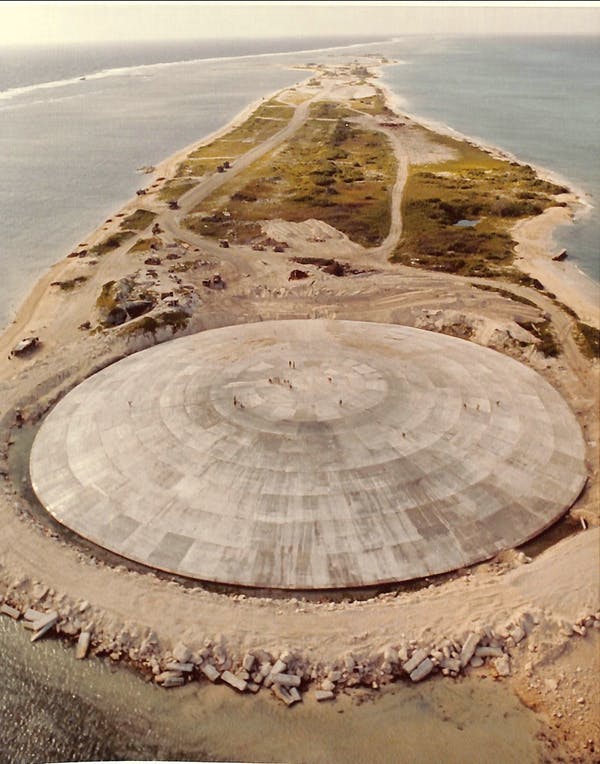
The film Oppenheimer has shone a global spotlight on the dawn of US nuclear weapons tests. In the Marshall Islands, where 23 of those earth-shattering blasts happened, people have never been able to forget
by Lucy Sherriff, 25 Aug 23, https://www.theguardian.com/environment/2023/aug/25/endless-fallout-marshall-islands-pacific-idyll-still-facing-nuclear-blight-77-years-on
t first glance, the aquamarine waters that surround the Marshall Islands seem like paradise. But this idyllic Pacific scene hides a dark secret: it was the location of 67 nuclear detonations as part of US military tests during the cold war between 1946 and 1958.
The bombs were exploded above ground and underwater on Bikini and Enewetak Atolls, including one device 1,100 times larger than the Hiroshima atom bomb. Chernobyl-like levels of radiation forced hundreds from their homes. Bikini Atoll remains deserted. At the US government’s urging, residents have begun returning slowly to Enewetak.
Today, there is little visible evidence of the tests on the islands except for a 115-metre (377ft)-wide cement dome that locals nickname the Tomb – for good reason.
Built in the late 1970s and now aged and cracking, the huge concrete lid on Runit Island covers more than 90,000 cubic metres (3.1m cubic ft) – or roughly 35 Olympic-sized swimming pools – of radioactive soil and nuclear waste. Unbeknown to the Marshallese people, the US shipped the waste from Nevada, where it was testing nuclear weapons on Native American land.
The legacy of America’s nuclear testing on Indigenous communities both on the US mainland and its territories has come under renewed scrutiny with the release of Oppenheimer, the blockbuster film about the physicist who led development of the atomic bomb.
Although his team tested the nuclear weapons on Native American land – there were 928 large-scale nuclear weapons tests in Nevada, Utah and Arizona during the cold war, dispersing huge clouds of radioactive material – the film never mentions the impact of the testing on the local Native Americans.
The legacy of America’s nuclear testing on Indigenous communities both on the US mainland and its territories has come under renewed scrutiny with the release of Oppenheimer, the blockbuster film about the physicist who led development of the atomic bomb.
Although his team tested the nuclear weapons on Native American land – there were 928 large-scale nuclear weapons tests in Nevada, Utah and Arizona during the cold war, dispersing huge clouds of radioactive material – the film never mentions the impact of the testing on the local Native Americans.
“The film completely ignores the experiences of our people,” says Ian Zabarte, principal man of the Western Bands of the Shoshone Nation – who have been described as “the most bombed nation on earth”
Zabarte is attempting to forge connections with those Pacific Islanders who were similarly affected by nuclear testing. Earlier this year, he met representatives from the Marshall Islands when they visited Nevada to discuss the effects on their health from nuclear weapons testing.
“The health impacts on our people have never been investigated,” Zabarte says. “We have never received an apology, let alone any kind of compensation.”
Separately, a band of Marshallese activists are now sailing around the country’s 29 atolls, along with artists and climate scientists, on a 12-day tour that aims to raise awareness of nuclear testing on the archipelago.
The 520-mile ocean voyage is being operated by Cape Farewell, a cultural programme founded by the British artist David Buckland and funded by the Waverley Street Foundation, Laurene Powell Jobs’s climate charity.
“Cancers continue from generation to generation,” says Alson Kelen, a master navigator and community elder who grew up on Bikini Atoll and is joining the expedition.
“If you ask anyone here if there’s a legacy of nuclear impact on their health, the answer would be yes. The Marshall Islands Nuclear Claim Tribunal has a list of cancers that are related to nuclear throughout our people. These cancers are hereditary.”
The US maintains that the Marshall Islands are safe. It seized them from Japan in 1944, and eventually granted the islands independence in 1979, but the fledgling nation remained in “free association” with the US. Under this system, along with Micronesia and Palau, the Marshall Islands are self-governing but economically remain largely dependent on Washington, which also retains a military presence. Today it continues to use the US dollar, and American aid still represents a large percentage of its GDP.
In 1988, an independent international tribunal was established to adjudicate between the two countries, and it later ordered the US to pay $2.3bn (£1.8bn) to the Marshall Islands in healthcare and resettlement costs.
The US government has refused, arguing that its liabilities ended when it paid $600m in the 1990s. In 1998, the US stopped providing medical care for cancer-stricken islanders, leaving many in financial hardship.
The agreement is up for renegotiation this year, and the Marshallese hope they will have stronger negotiating power with the US now that China is showing an interest in the islands due to their strategic location. The islanders are pushing for the $2.3bn they feel they are owed, and a cleanup of the Runit Dome, which is at risk of collapsing due to rising sea levels and the natural ageing of concrete structures.
“Of course it’s going to break,” says Stephen Palumbi, a Stanford University marine scientist who led a research trip to the islands in 2016. “What else can you expect? You can’t just build something like that and walk away from it and expect it to stay there. You wouldn’t do that with your patio.”
According to a 2019 investigation by the LA Times, many US military personnel present at the construction of Runit Dome realised that radioactive material was leaking from it, and would continue to do so – yet did not alert the Marshallese government.
The threat to the Tomb is particularly acute because the islands, which lie just 2 metres above sea level on average, are very vulnerable to rising sea levels. The country’s capital, Majuro, is highly likely to be at risk of frequent flooding, according to a World Bank study.
The US says it has discharged its responsibilities to the Marshall Islands, and because the dome is on Marshallese land, the onus is not on Washington to fix it.
It is not clear what will happen to the environment when the Tomb crumbles, and has also been hard to track how the ecosystem has behaved over time as “there’s just not many people” on Bikini Atoll to even casually monitor changes, Palumbi says.
But a 2012 United Nations report said the effects of radiation on the Marshall Islands are long-lasting and have caused “near-irreversible environmental contamination”.
On Palumbi’s visit, locals warned his team not to eat the coconuts – which are radioactive due to the contaminated groundwater – or the coconut crabs that feed on them. “You do not grow crops, you do not eat coconut, you do not drink the water,” Palumbi says.
In general, it has been shown that nuclear blasts represent an extreme threat to local biodiversity. A 1973 US government-funded study on nuclear testing in Alaska found both immediate harm and long-term damage to marine species: fish exploded when their gas-filled swim bladders reacted to the change in pressure underwater, and hundreds of sea otters were also killed instantly.
Researchers have recently found that sea turtle shells can be used to study nuclear contamination, with traces of uranium found in animals not born when testing in the Pacific Islands ended. The turtles are thought to accumulate human-made radionuclides in their bony outer shell, which is usually made of keratin, through the food chain by eating uranium-contaminated algae.
Japan recently announced it would start dumping waste from the Fukushima nuclear power plant, which had meltdowns in 2011, into the ocean. Although the UN’s nuclear watchdog says it is safe to do so, there are fears that there is still not enough understanding of how radioactive nuclear waste affects the ecosystem to be sure of this.
Palumbi notes that the resilience of the ocean is impressive, with corals regrowing on the Marshall Islands as soon as 10 years after the bombs were exploded. “This is the most destructive thing we have ever done to the ocean, dropping 23 atomic bombs on it, yet the ocean is really striving to come back to life.”
There are, however, eerie reminders of what happened decades ago, including a fine talcum powder-like sediment covering the reefs – and still-visible damage to the reef itself. “On the inside of the lagoon, where the actual bombs were, it’s still an amazing mess,” Palumbi says. “The reef has cracked in half, and you realise that it was the bomb.”
Kelen says he would not trust anyone who says releasing nuclear material into the water is safe. “Everybody who has talked to me about nuclear has been lying,” he says. This, he says, includes the US “who promised our islands were safe to live in. This continues. I do not trust politicians who say this will be OK.”
Zabarte, who has numerous family members who have died of cancer, is similarly concerned about the long-term impacts of radiation. “My people have nowhere to go,” he says. “We have to stay there, exposing ourselves on a daily basis. We have no choice.”
“We have to keep repeating this story,” says Kelen. “We have forever been moved around by people who make decisions over us, telling us our lives will be safe and how to live. But no matter what life has thrown at us, from nuclear testing to rising sea levels, our home and life are very much still here.
“We live this story, and it informs us culturally, but we do not let it define who we are.”
Concrete tomb filled with deadly nuclear waste is leaking as it’s starting to crack
Joe Harker, 12 August 2023 https://www.unilad.com/news/world-news/qin-xi-huang-tomb-china-emperor-terracotta-army-345786-20230809
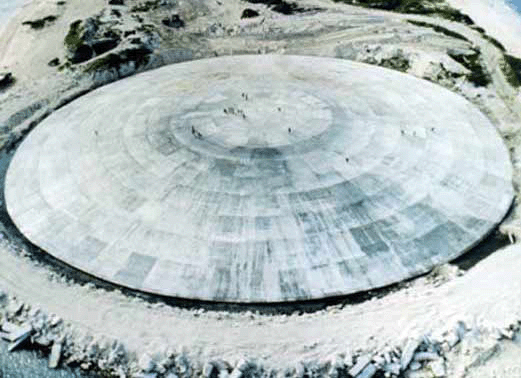
43 years ago a concrete container of nuclear waste was constructed on a tiny island in the Pacific Ocean, but there’s a big problem with that, it’s leaking.
During the Cold War, the US used islands in the Pacific to test nuclear weapons, and between 1946 and 1958 carried out a series of tests on Enewetak Atoll.
Of course, nuclear bombs poison the ground around them and the waste from these weapons is a dangerous commodity in and of itself. So between 1977 and 1980, a concrete dome was built to store the nuclear waste from the bomb tests.
That ended up being called the Runit Dome, because it was located on Runit Island, though it was also referred to as ‘the tomb’.
Housing radioactive debris, including poisonous plutonium, thousands of people scraped nuclear waste into a blast crater and covered it over with concrete to stop it from getting out.
Unfortunately that plan isn’t going quite so well as, according to IFL Science, a report from 2019 warns that changing conditions on the island are causing the concrete dome to crack.
Increasing temperatures are not helping the problem, while a rise in sea levels is also compounding the problem as the dome is not elevated off the ground, and the lapping waters of the sea are eroding it further.
This is all resulting in radioactive material bleeding out into the ground on the rest of the island and leaking out into the sea as well.
As long as the plutonium stays within the crater covered by the dome then it won’t be a major new source of contamination into the ocean.
That could all change if the cracking dome were to give way and seawater was able to flow in and out of the crater.
This concrete tomb could be a cracking nuclear coffin with a monster inside just waiting to be released, but for now things are still within acceptable levels.
According to the Woods Hole Oceanographic Institution, marine radioactivity expert Dr Ken Buesseler said they’d ‘known for years that the dome is leaking’, but for now only a ‘small amount of radioactivity’ was getting out.
For context, this isn’t putting the surrounding area beyond safety standards just yet, and the plutonium sealed beneath the Runit Dome is only a fraction of what was released during nuclear testing.
While he said things were alright at the moment, he warned that they ‘hadn’t considered sea level rise in the 1970s when they built this’, and said the dome would be ‘at least partially submerged by the end of this century’.
Bringing the Pacific people together in solidarity to address nuclear legacy issues in the Pacific – Lesuma
By Ema Ganivatu, Thursday 10/08/2023 https://www.fijivillage.com/news/Bringing-the-Pacific-people-together-in-solidarity-to-address-nuclear-legacy-issues-in-the-Pacific–Lesuma-r84xf5/
We try bringing together Pacific people and groups, in unity and solidarity so that we have one united way against nuclear waste dumping, nuclear testing and addressing nuclear legacy issues in the Pacific.
This was highlighted by Pacific Network on Globalisation (PANG) in Fiji Nuclear Justice campaigner Epeli Lesuma in an interview with fijivillage News about the environmental issues surrounding the Pacific.
Lesuma says they are trying to clean the nuclear waste that colonial powers have left behind.
He says this issue refers to the testing that was undertaken by the UK, USA, France, Christmas Island, and the Marshall Islands and the Nuclear Justice in the Pacific campaign for PANG and similarly for other regional NGOs is largely based around addressing this issue in the Pacific.
He adds this campaign is also around addressing justice for indigenous communities, and affected communities in those countries.
Lesuma says it is important for us to prioritize the Pacific Island Forums panel of experts because they were a panel appointed by Pacific leaders and provided by small Pacific countries with Pacific people and concerns at heart.
He says Fiji was the chair of the forum when this panel of experts was appointed so Fijians need to continue to support the PIFs panel of experts over the International Atomic Energy Agency (IAEA) because PIFs are not swayed by their interests or the interest of more developed countries like Japan or America or France.
Lesuma says there is power in numbers and the old saying ‘United we stand, divided we fall’ comes into place at this time, so part of PANG’s work is ensuring that the campaign has one voice and one message in advocating for Nuclear Free Pacific.
Philippines House panel OKs bill outlining nuclear damage compensation
By: Gabriel Pabico Lalu – Reporter / @GabrielLaluINQ INQUIRER.net August 07, 2023
MANILA, Philippines — A proposed measure that outlines civil liability and compensation in case of nuclear damage was approved by a House of Representatives panel on Monday.
During the hearing of the House Special Committee on nuclear energy, House Bill (HB) No. 8623, or the proposed Philippine Nuclear Liability Act, was approved, subject to discussions on the plenary.
A technical working group was also formed to reconcile differences between the original bill, authored by committee chairman and Pangasinan 2nd District Rep. Mark Cojuango, and the changes that would be made on the floor.
If enacted, the base version of the bill places that operators of nuclear installations would be liable for nuclear damage if there is proof that the incident was caused:
- in such nuclear installation or involving nuclear material coming from or originating in such nuclear installation
- involving nuclear material sent to such nuclear installation
It also specifies what conditions would require a joint liability — or when there is more than one operator handling the installation that caused the damage.
………………………………………………………………………………………………….. In a statement last May, the House of Representatives said IAEA informed lawmakers who hosted a forum on nuclear energy and international legal instruments that the law should contain the following provisions:
- regulatory control
- safe and secure uses
- offenses and penalties
- international cooperation
- peaceful uses
- compensation and liability
The IAEA said this after the House panel invited the Vienna-based organization to help Filipino lawmakers trying to come up with the necessary legal framework and policies for nuclear energy use.
https://newsinfo.inquirer.net/1813407/fwd-panel-oks-bill-outlining-compensation-in-case-of-nuclear-damage#ixzz89luKgXEL
1 This Month
23-25 October – on Zoom – World BEYOND War’s annual global conferenc


Shut down the radiation-damaged Heysham nuclear reactors now
To see nuclear-related stories in greater depth and intensity – go to https://nuclearinformation.wordpress.com

Say No to NASA’s Reckless Nuclear Reactor on the Moon
Say No to NASA’s Reckless Nuclear Reactor on the Moon

-
Archives
- October 2026 (247)
- September 2026 (339)
- August 2026 (330)
- July 2026 (355)
- June 2026 (287)
- May 2026 (306)
- April 2026 (356)
- March 2026 (251)
- February 2026 (267)
- January 2026 (308)
- December 2025 (358)
- November 2025 (359)
-
Categories
- 1
- 1 NUCLEAR ISSUES
- business and costs
- climate change
- culture and arts
- ENERGY
- environment
- health
- history
- indigenous issues
- Legal
- marketing of nuclear
- media
- opposition to nuclear
- PERSONAL STORIES
- politics
- politics international
- Religion and ethics
- safety
- secrets,lies and civil liberties
- spinbuster
- technology
- Uranium
- wastes
- weapons and war
- Women
- 2 WORLD
- ACTION
- AFRICA
- Atrocities
- AUSTRALIA
- Christina's notes
- Christina's themes
- culture and arts
- Events
- Fuk 2022
- Fuk 2023
- Fukushima 2017
- Fukushima 2018
- fukushima 2019
- Fukushima 2020
- Fukushima 2021
- general
- global warming
- Humour (God we need it)
- Nuclear
- RARE EARTHS
- Reference
- resources – print
- Resources -audiovicual
- Weekly Newsletter
- World
- World Nuclear
- YouTube
-
RSS
Entries RSS
Comments RSS

