The Australia-Tuvalu climate migration treaty is a drop in the ocean

Australia has offered a lifeline to the people of Tuvalu, whose island is threatened by rising sea levels. But the deal comes with strings attached – and there will be millions more climate migrants in need of refuge by 2050
By New Scientist, 2 July 2025, https://www.newscientist.com/article/mg26635502-900-the-australia-tuvalu-climate-migration-treaty-is-a-drop-in-the-ocean/
A lifeline has been extended to the people of Tuvalu, a low-lying Pacific nation where rising sea levels are creating ever more problems. Each year, Australia will grant residency to 280 Tuvaluans. The agreement could see everyone currently living in Tuvalu move within just a few decades.
Effectively the world’s first climate migration agreement, the Australia-Tuvalu Falepili Union will also provide adaptation funds to help those who stay behind.
Is this a model for how climate migration can be managed in an orderly way, before disaster strikes? Far from it. To get this deal, Tuvalu must allow Australia a say in future security and defence matters. Few other countries are likely to agree to similar terms.
Tuvalu’s population is also very small. Taking in around 10,000 climate migrants would be inconsequential for a country of 28 million like Australia. Worldwide, it is estimated that between 25 million and 1 billion people might be forced to move by 2050 because of climate change and other environmental factors. Where will they go?
Many argue that the wealthy countries that emitted most of the carbon dioxide that is warming the planet have a moral duty to help people displaced by climate change. But these kinds of discussions have yet to be translated into the necessary legal recognition or acceptance of forced climate migrants. On the contrary, many higher-income nations seem to be becoming more hostile to migrants of any kind.
There has been a little progress in setting up “loss and damage” funds to compensate lower-income countries for the destruction caused by global warming. This could help limit the need for climate migration in the future – but the money promised so far is a fraction of what is required.
The most important thing nations should be doing is limiting future warming by cutting emissions – but globally these are still growing. Sadly, the Falepili Union is a drop in the ocean, not a turning of the tide.
Plutonium Levels in Sediments Remain Elevated 70 Years After Nuclear Tests

June 24, 2025,
https://www.marinetechnologynews.com/news/plutonium-levels-sediments-remain-650328
Researchers from Edith Cowan University (ECU) in Australia have confirmed plutonium levels in sediment up to 4,500 times greater than the Western Australian coastline.
Three plutonium-based nuclear weapons tests were conducted at the Montebello Islands in the 1950’s, which introduced radioactive contamination to the surrounding environment. The first nuclear test, coded Operation Hurricane, had a weapon’s yield of some 25kT, and formed a crater in the seabed, while the second and third tests, dubbed Operation Mosaic G1 and G2, had weapons yields of around 15kT and 60kT, respectively.
The three tests released radioactive isotopes including plutonium, strontium (90Sr) and caesium (137Cs) into the surrounding marine environment.
“Plutonium is anthropogenic, which means that it doesn’t exist on its own in nature. The only way it is introduced into an environment is through the detonation of nuclear weapons and from releases from nuclear reprocessing plants and, to a lesser extent, accidents in nuclear power plants,” said ECU PhD student and lead author Madison Williams-Hoffman.
“When plutonium is released into a coastal setting in the marine environment, a significant fraction will attach to particles and accumulate in the seabed, while some may be transported long distances by oceanic currents.”
The region is not inhabited by humans and has not been developed, however it is visited by fishing boats, so collecting data on the levels of contamination in the marine environment is important.
Currently, the protected island archipelago and surrounding marine areas also reside within the Montebello Islands Marine Park (MIMP). The MIMP is ecologically significant due to the presence of numerous permanent or migratory species, and its high-value habitat is used for breeding and rearing by fish, mammals, birds and other marine wildlife.
The water and sediment quality within the MIMP are currently described as ‘generally pristine’, and it is fundamental to maintain healthy marine ecosystems in the region.
The concentrations of plutonium at Montebello Islands were between 4 to 4,500 times higher than those found in sediment from Kalumburu and Rockingham from the Western Australian coastline, with the northern area of the archipelago, close to the three detonation sites, having four-fold higher levels than the southern area.
The concentrations of plutonium found in the sediment at Montebello Islands were similar to those found in the sediment at the Republic of Marshall Islands (RMI) test sites, despite 700-fold higher detonation yields from nuclear testing undertaken at RMI.
Plutonium is an alpha emitter so, unlike other types of radiation, it cannot travel through the skin and is most dangerous when ingested or inhaled.
The research was undertaken by Williams-Hoffman, under the co-supervision of Prof. Pere Masqueand at ECU and Dr Mathew Johansen at ANTSO.
Legacy of US nuclear weapons tests in the Marshall Islands created global radiation exposure: new study
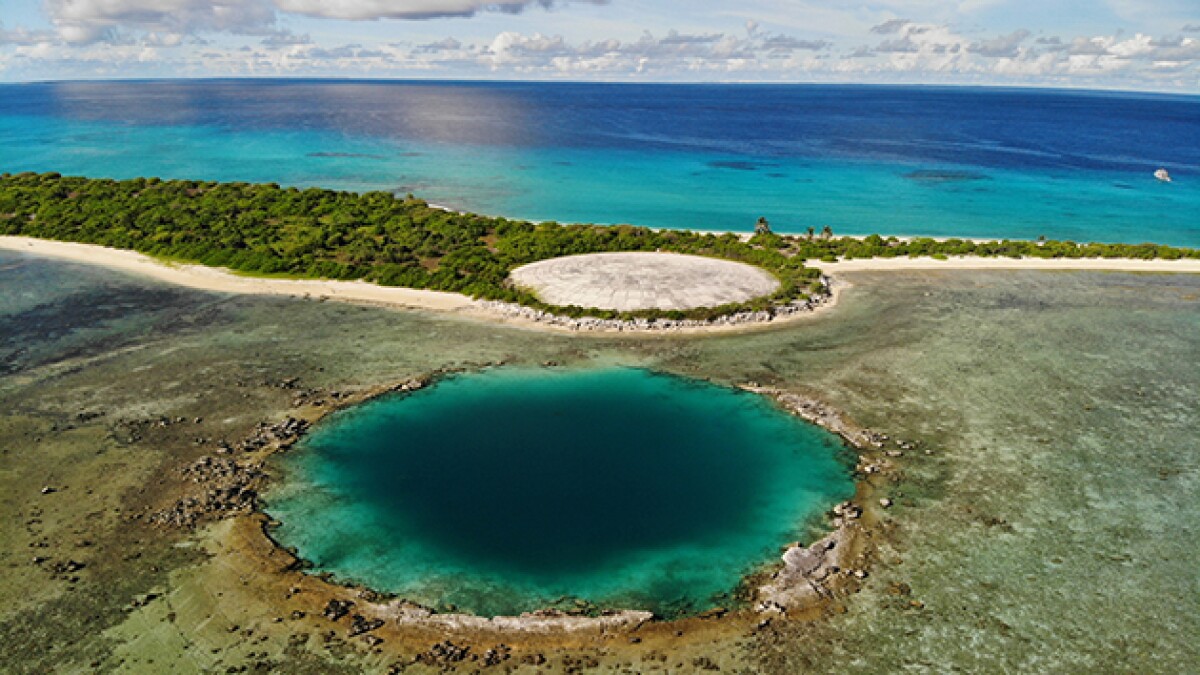
Hamburg, Germany – Nearly seven decades since the US government ended nuclear weapons testing in the Marshall Islands, a new study has revealed the impacts were far greater than what the US government has so far publicly acknowledged. According to a new study, all atolls, including the southern atolls, received radioactive fallout, but only three of the 24 atolls, all northern and inhabited at the time of fallout, received medical cancer screening.[1]
“The Legacy of U.S. Nuclear Testing in the Marshall Islands” by the Institute for Energy and Environmental Research (IEER) and commissioned by Greenpeace Germany, has comprehensively analyzed official documents from US government military and energy archives, scientific analyses, and medical sources from 1945 to the present day.
“Among the many troubling aspects of the Marshall Islands’ nuclear legacy is that the United States had concluded, in 1948, after just three tests that the Marshall Islands was not ‘a suitable site for atomic experiments’ because it did not meet the required meteorological criteria. Yet testing went on,” said Arjun Makhijani, report author and President of IEER.
Among the key findings of the study:
- U.S. government radioactivity measurements and dose estimates show that the entire country was impacted by fallout.
In the immediate aftermath of Castle Bravo – the US government’s largest ever nuclear weapons test – its capital, Majuro, was officially considered a “very low exposure” atoll. However, radiation levels were tens of times, and up to 300 times more, relative to background gamma radiation levels - Nuclear testing in the Marshall Islands created radiation exposures globally, with “hotspots” detected as far west of the Marshall Islands as Colombo, Sri Lanka and as far east as Mexico City.
The total explosive force detonated on the Marshall Islands was 108 megatons – the equivalent of dropping a Hiroshima bomb every single day for twenty years. On a proportional basis, the nuclear fall out is estimated to result in roughly 100,000 excess cancer deaths worldwide (rounded).[2] - Remediation of contaminated areas is complex and costly. The Marshall Islands lacks technical capacity in a number of fields crucial to health, environmental protection, and possible resettlement. The history of damage by, and distrust of the United States is compounded by Marshallese dependence on the United States for funds and for scientific and medical expertise. As an example, the Runit Dome, which houses decades of nuclear waste, has been deemed “safe” by the US Department of Energy despite cracks and the impact of climate change and sea level rise.
“The tests on the Marshall Islands are exemplary of an inhumane, imperial policy that deliberately sacrificed human lives and ignored Pacific cultures. As a result of this nuclear legacy, the Marshallese have been robbed of their land, traditions, and culture, with the people of Bikini and Rongelap forever displaced,” said Shiva Gounden, Head of Pacific at Greenpeace Australia Pacific. “The US still fails to acknowledge the full extent of the deep impact. However, these atomic bomb tests are not a closed chapter and they are still having an impact today. Reparations that fit the extent of the harms caused by testing are long overdue.”
In March and April, Greenpeace and its flagship vessel, the Rainbow Warrior, completed a six-week mission with radiation specialists and independent scientists to conduct research across the atolls to support the Marshall Island’s government in its ongoing fight for nuclear justice and compensation.[3] It also marked 40 years (May 1985) when Greenpeace helped answer a call and evacuated the people of Rongelap Island to Mejatto due to nuclear fallout from Castle Bravo, which rendered their home uninhabitable.
In July, Greenpeace and the Rainbow Warrior will mark another 40 year anniversary – the bombing of the Rainbow Warrior I by the French secret service, who were attempting to halt Greenpeace’s campaign against nuclear testing in French Polynesia (Maohi Nui).
The health impact of nuclear tests in French Polynesia – archive, 1981
there is mounting, though not yet definitive evidence of cancer and brain tumours in the area, especially among the young.
France spent €90,000 countering research into the effects of its Pacific nuclear tests in the 1960s and 70s. Learn how the Guardian reported early accounts of sickness and contamination
Guardian, Compiled by Richard Nelsson, 28 May 25
The health impact of nuclear tests in French Polynesia – archive, 1981
France spent €90,000 countering research into the effects of its Pacific nuclear tests in the 1960s and 70s. Learn how the Guardian reported early accounts of sickness and contamination
Compiled by Richard NelssonWed 28 May 2025
Pacific islanders agitate in the shadow of the bomb
By Christopher Price
17 September 1981
A recent Canard cartoon shows Adam and Eve looking at an H-bomb. “Look, H for Hernu,” (the new Socialist defence minister), says Adam. “Yes and for Horror, Holocaust, Hecatomb and Hiroshima,” adds Eve.
French Socialists have never hitherto allowed the nuclear issue to dominate their politics. If it is beginning to do so now it is partly because keeping their independent nuclear deterrent, which they continue to test underground in Muroroa atoll in French Polynesia, implies continuing colonial domination of the islands of the South Pacific – an issue which is very much alive, both among the Indigenous people of the Pacific and in the rank and file of the Socialist party in France.
The official position – “auto-determination” – as stated by Mr Henri Emmanuelli, the French Colonial minister when he visited France’s Pacific colonies was that he would discuss anything if a democratic majority wanted to. But he also said that recent election results made a referendum on the subject unnecessary.
That none of these three groups of islands (Polynesia, New Caledonia, and Wallis and Futuna) can immediately prove a majority for independence is partly due to strenuous French efforts over the years to stamp on emerging independence movements. More powerful than anything else [influencing the calls for independence] are the pollutant effects of nuclear tests on the human and natural environment. They are now beginning to make themselves felt. Hitherto everything that happens on Mururoa has been officially secret. But Mr Hernu has now a new “frankness” about the tests in an effort to allay anxiety; and immediately after he left the Centre d’Expérimentation du Pacifique issued its first-ever admission of an accident; it was not safe to swim off Mururoa.
In fact, authoritative reports state that there is now a crack 15 to 19 inches wide and over half a mile long in the atoll below sea level; that radioactive leaks into the Pacific have been taking place for many years; that a neighbouring atoll, Fangataufa, has been literally blasted out of the sea.
It is not yet possible to gauge the effect of such leaks, but coupled with the profound disquiet about Japanese plans to use the Pacific as a nuclear waste dumping ground, fears about pollution of fish and other marine life and consequently poisoning of the whole ocean, island populations will undoubtedly put further pressure on the Mitterrand government to reconsider its nuclear testing policy.
“Why don’t they do it in Nice?” was the one constant question put to me by the Polynesians. It echoed “Mururoa and Auvergne”, the most telling of the posters in the campaign which forced the French, eight years ago, to put the tests underground. Now there is a new twist to the story. It’s not just H-bombs the French are exploding inside Mururoa.
It was confirmed by Mr Giscard in June 1980 that France had been undertaking feasibility studies of neutron bombs since 1976, and this week Mr Mauroy, the Socialist prime minister, committed his government to strengthening France’s strategic nuclear arsenal and to the development of the neutron bomb. The knowledge that France is as keen as the US on upping the nuclear option can only add to the disquiet.
On top of this there is mounting, though not yet definitive evidence of cancer and brain tumours in the area, especially among the young. The French authorities counter that there is still less radioactivity in Polynesia than in the Massif Central. Maybe, but the fact that they go to quite extraordinary lengths of security in the treatment of such cases in French hospitals, suggesting a pathological desire to suppress such evidence as exists. One Actuel reporter, Mr Luis González-Mata, who tried to investigate the issue in Polynesia and in France, met continuous hostility.
So far the French government’s response to the political pressure has been to offer that decentralisation of local government to its overseas territories which the towns and cities of France are soon to enjoy. But it will be pressed to go further. The Pacific Forum comprising all independent Pacific countries, decided in Vanuatu in August to send a delegation to Mr Mitterrand demanding to know his intentions.
This is an edited extract. Read the article in full.
Testimonies from the atoll
Mururoa has been the centre of French nuclear tests for decades, largely in secret and often with scant regard for the people who live nearby. For the first time the native workers and their families tell their side of the story.
7 September 1990
Manutahi started work as a welder on Mururoa in 1965 at the age of 32. That was before the tests had started. He worked on the construction of the blockhouses Dindon and Denise.
In 1965 and at the beginning of 1966, we were allowed to eat all the fish in the lagoon but when we returned in 1967, we were forbidden to eat any. ……………………………………………………………………………………………………………………………………………………………………………………………………………https://www.theguardian.com/theguardian/2025/may/28/the-health-impact-of-nuclear-tests-in-french-polynesia-1981
France spent €90,000 countering research into impact of Pacific nuclear tests
Radiation-related thyroid, breast and lung cancers, as well as leukaemia and lymphoma, are prevalent across the islands.
Documents suggest campaign to discredit revelation that tests contaminated many more people than acknowledged
Jon Henley Guardian, 27 May 25
France’s Atomic Energy Commission (CEA) has spent tens of thousands of euros in an effort to counter research revealing that Paris has consistently underestimated the devastating impact of its nuclear tests in French Polynesia in the 1960s and 1970s.
Days before a parliamentary inquiry presents its report on the tests, documents obtained by the investigative outlet Disclose, and seen by Le Monde and the Guardian, suggest the CEA ran a concerted campaign to discredit the revelations.
A 2021 book, Toxique, which focused on just six of the 193 nuclear tests that France carried out from 1966 to 1996 at Moruroa and Fangataufa atolls, drawing on 2,000 pages of declassified material and dozens of interviews, concluded that they contaminated many more people than France has ever acknowledged.
The latest documents show that a year after the book’s publication, the CEA published 5,000 copies of its own booklet – titled “Nuclear tests in French Polynesia: why, how and with what consequences?” – and distributed them across the islands.
As part of an operation costing more than €90,000, the commission also flew a four-man team by business class to French Polynesia, where they stayed at the Hilton hotel, to meet local dignitaries and give interviews to the media.
The CEA’s booklet, printed on glossy paper, claimed to provide “scientific responses” to the “allegations” contained in Toxique, whose authors it said did not have “the same level of expertise”. It claimed contamination had been limited and that France always behaved transparently and with respect for local inhabitants’ health.
The publication of Toxique – based on the investigation by Disclose, Princeton University’s science and global security programme and Interprt, an environmental justice research collective – caused a furore in France, prompting visits to French Polynesia by a minister and the president, Emmanuel Macron, who acknowledged France’s “debt” to the region.
In one 1974 test alone, the scientific research found, 110,000 people – the population of Tahiti and its nearby islands – could have received a radiation dose high enough to qualify them for compensation if they later developed one of 23 different cancers.
Toxique alleged the CEA has long underestimated the radiation levels involved, significantly limiting the numbers eligible for compensation: by 2023, fewer than half the 2,846 compensation claims submitted had even been judged admissible.
The parliamentary inquiry, which has so far called more than 40 politicians, military personnel, scientists and victims, is due to report before the end of May on the social, economic and environmental impact of the tests – and whether France knowingly concealed the extent of contamination.
The CEA’s military division, CEA/DAM, the inventor of France’s atomic bomb, has repeatedly called this a “false assertion”. But France’s nuclear safety body, the ASNR, has since acknowledged “uncertainties associated with [the CEA’s] calculations” and confirmed to the parliamentary inquiry that it was impossible to prove people received radiation doses lower than the compensation threshold.
The CEA said in a statement that the aim of its booklet “was to provide Polynesians in particular with the elements to understand” the tests and their impact. It said the booklet applied “the necessary scientific rigour” to explain “the health and environmental consequences of the tests” in a “factual and transparent manner”……………………..
The inquiry has heard that the CEA/DAM has so far declassified only 380 documents in the four years since Macron demanded “greater transparency” around the tests and their consequences – compared with 173,000 declassified by the army.
Jérôme Demoment, the director of CEA/DAM, told the parliamentary inquiry earlier this year that it was “highly likely, if we were to have to manage [nuclear tests] today, that the system put in place would respond to a different logic”.
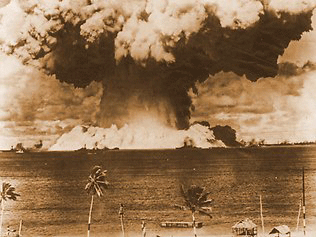
Forty-six of France’s nuclear tests were atmospheric, exposing the local population, site workers and French soldiers who were stationed in Polynesia at the time to high levels of radiation before the testing programme was moved underground in 1974.
Radiation-related thyroid, breast and lung cancers, as well as leukaemia and lymphoma, are prevalent across the islands. For its part, the French army has said up to 2,000 military personnel could have been exposed to enough radiation to cause cancer.
“The notion of a ‘clean bomb’ has generated controversy, which I fully understand,” Demoment told the parliamentary inquiry. “No nuclear test generating radioactive fallout can be considered clean.” https://www.theguardian.com/world/2025/may/27/france-spent-90000-countering-research-into-impact-of-pacific-nuclear-tests
Tracing radiation through the Marshall Islands: Reflections from a Greenpeace nuclear specialist
Greenpeace, Shaun Burnie, 30 April 2025
We’ve visited ground zero. Not once, but three times. But for generations, before these locations were designated as such, they were the ancestral home to the people of the Marshall Islands.
As part of a team of Greenpeace scientists and specialists from the Radiation Protection Advisors team, we have embarked on a six-week tour on-board the Rainbow Warrior, sailing through one of the most disturbing chapters in human history: between 1946 and 1958, the United States detonated 67 nuclear bombs across the Marshall Islands — equivalent to 7,200 Hiroshima explosions.
During this period, testing nuclear weapons at the expense of wonderful ocean nations like the Marshall Islands was considered an acceptable practice, or as the US put it, “for the good of mankind”. Instead, the radioactive fallout left a deep and complex legacy—one that is both scientific and profoundly human, with communities displaced for generations.
Between March and April, we traveled on the Greenpeace flagship vessel, the Rainbow Warrior, throughout the Marshall Islands, including to three northern atolls that bear the most severe scars of Cold War nuclear weapons testing:
- Enewetak atoll, where, on Runit Island, stands a massive leaking concrete dome beneath which lies plutonium-contaminated waste, a result of from a partial “clean-up” of some of the islands after the nuclear tests
- Bikini atoll, a place so beautiful, yet rendered uninhabitable by some of the most powerful nuclear detonations ever conducted;
- And Rongelap atoll, where residents were exposed to radiation fallout and later convinced to return to contaminated land, part of what is now known as Project 4.1, a U.S. medical experiment to test humans’ exposure to radiation.
This isn’t fiction, nor distant past. It’s a chapter of history still alive through the environment, the health of communities, and the data we’re collecting today. Each location we visit, each sample we take, adds to a clearer picture of some of the long-term impacts of nuclear testing—and highlights the importance of continuing to document, investigate, and attempt to understand and share these findings.
These are our field notes from a journey through places that hold important lessons for science, justice, and global accountability……………………………………………………………………………………………………
Stop 1: Enewetak Atoll – the dome that shouldn’t exist
At the far western edge of the Marshall Islands is Enewetak. The name might not ring a bell for many, but this atoll was the site of 43 U.S. nuclear detonations. Today, it houses what may be one of the most radioactive places in the world: the Runit Dome
Once a tropical paradise thick with coconut palms, now Runit Island is capped by a massive concrete structure the size of a football field. Under this dome—cracked, weather-worn, and only 46 centimeters thick in some places—lies 85,000 cubic meters of radioactive waste. These substances are not only confined to the crater—they are also found across the island’s soil, rendering Runit Island uninhabitable for all time. The contrast between what it once was and what it has become is staggering. We took samples near the dome’s base, where rising sea levels now routinely flood the area.
We collected coconut from the island which will be processed and prepared in the Rainbow Warrior’s onboard laboratory. Crops such as coconut are a known vector for radioactive isotope transfer, and tracking levels in food sources is essential for understanding long-term environmental and health risks. The local consequences of this simple fact are deeply unjust. While some atolls in the Marshall Islands can harvest and sell coconut products, the people of Enewetak are prohibited from doing so because of radioactive contamination. They have lost not only their land and safety but also their ability to sustain themselves economically. The radioactive legacy has robbed them of income and opportunity.
One of the most alarming details about this dome is that there is no lining beneath the structure – it is in direct contact with the environment – while containing some of the most hazardous long lived substances ever to exist on planet earth. It was never built to withstand flooding, sea level rise, and climate change. The scientific questions are urgent: how much of this material is already leaking into the lagoon? What are the exposure risks to marine ecosystems and local communities?
We are here to help answer questions with new, independent data, but still, being in the craters and walking on this ground where nuclear Armageddon was unleashed, is an emotional and surreal journey.
Stop 2: Bikini – a nuclear catastrophe, labeled “for the good of mankind”
Unlike Chernobyl or Fukushima, where communities were devastated by catastrophic accidents, Bikini tells a different story. This was not an accident. The nuclear destruction of Bikini was deliberate, calculated, and executed with full knowledge that entire ways of life were going to be destroyed.
Bikini atoll is incredibly beautiful and would look idyllic on any postcard. But we know what lies beneath: the site of 23 nuclear detonations, including Castle Bravo, the largest ever nuclear weapons test conducted by the United States.
Castle Bravo alone released more than 1,000 times the explosive yield of the Hiroshima bomb. The radioactive fallout massively contaminated nearby islands and their populations together with thousands of U.S. military personnel. Bikini’s former residents were forcibly relocated in 1946 before nuclear testing began, and with promises of a safe return. But the atoll is still uninhabited and most of the new generations of Bikinians have never seen their home island. As we stood deep in the forest next to a massive concrete blast bunker, reality hit hard – behind its narrow lead-glass viewing window, U.S. military personnel once watched the evaporation of Bikini lagoon.
On our visit we notice there’s a spectral quality to Bikini. The homes of the Bikini islanders are long gone. In its place now stand a scattering of buildings left by the U.S. Department of Energy: rusting canteens, rotting offices, sleeping quarters with peeling walls, and traces of the scientific experiments conducted here after the bombs fell.
On dusty desks we found radiation reports, notes detailing crop trials, and a notebook meticulously tracking the application of potassium to test plots of corn, alfalfa, lime, and native foods like coconut, pandanus, and banana. The potassium was intended to block the uptake of caesium-137, a radioactive isotope, by plant roots. The logic was simple: if these crops could be decontaminated, perhaps one day Bikini could be repopulated.
We collected samples of coconuts and soil—key indicators of internal exposure risk if humans were to return. Bikini raises a stark question: what does “safe” mean, and who gets to decide? The U.S. declared parts of Bikini habitable in 1970, only to evacuate people again eight years later after resettled families suffered from radiation exposure. The science is not abstract here. It is personal. It is human. It has real consequences.
Stop 3: Rongelap – setting for Project 4.1

The Rainbow Warrior arrived at the eastern side of Rongelap atoll anchoring one mile from the center of Rongelap Island, the church spire and roofs of “new” buildings reflecting the bright sun. In 1954, fallout from the Castle Bravo nuclear detonation on Bikini blanketed this atoll in radioactive ash—fine, white powder that children played in, thinking it was snow. The U.S. government waited three days to evacuate residents, despite knowing the risks. The U.S. government declared it safe to return to Rongelap in 1957 – but it was a severely contaminated environment. The very significant radiation exposure to the Rongelap population caused severe health impacts: thyroid cancers, birth defects such as “jellyfish babies”, miscarriages, and much more.
In 1985, after a request to the US government to evacuate was dismissed, the Rongelap community asked Greenpeace to help relocate them from their ancestral lands. Using the first Rainbow Warrior, and over a period of 10 days and three trips, 350 residents collectively dismantled their homes bringing everything with them – including livestock, and 100 metric tons of building material – where they resettled on the islands of Mejatto and Ebeye on Kwajalein atoll. It is a part of history that lives on in the minds of the Marshallese people we meet in this ship voyage – in the gratitude they still express, the pride in keeping the fight for justice, and in the pain of still not having a permanent, safe home.
Now, once again, we are standing on their island of Rongelap, walking past abandoned buildings and rusting equipment, some of it dating from the 1980s and 1990s – a period when the U.S. Department of Energy launched a push to encourage resettlement declaring that the island was safe – a declaration that this time, the population welcomed with mistrust, not having access to independent scientific data and remembering the deceitful relocation of some decades before.
Here, once again we sample soil and fruits that could become food if people came back. It is essential to understand ongoing risks—especially for communities considering whether and how to return.
This is not the end. It is just the beginning
Our scientific mission is to take measurements, collect samples, and document contamination. But that’s not all we’re bringing back.
We carry with us the voices of the Marshallese who survived these tests and are still living their consequences. We carry images of graves swallowed by tides near Runit Dome, stories of entire cultures displaced from their homelands, and measurements of radiation showing contamination still persists after many decades. There are 9,700 nuclear warheads still held by military powers around the world – mostly in the United States and Russian arsenals. The Marshall Islands was one of the first nations to suffer the consequences of nuclear weapons – and the legacy persists today.
We didn’t come to speak for the Marshallese. We came to listen, to bear witness, and to support their demand for justice. We plan to return next year, to follow up on our research and to make results available to the people of the Marshall Islands. And we will keep telling these stories—until justice is more than just a word…….. https://www.greenpeace.org/international/story/74328/tracing-radiation-through-the-marshall-islands-reflections-from-a-greenpeace-nuclear-specialist/
Pearl Harbor update brings nuclear risk
Star Advertiser March 30, 2025, Lynda Williams
Kevin Knodell’s recent article highlights the significance of Dry Dock 5 at Pearl Harbor, but omits a critical detail: this facility is set to host the U.S. Navy’s most lethal nuclear-powered and nuclear-armed submarines (“‘An emphasis on lethality,’” Star-Advertiser, March 23).
This will likely transform Hawaii’s role in the U.S. nuclear arsenal by accommodating Ohio-class and, eventually, Columbia-class ballistic missile submarines, each capable of carrying Trident missiles with multiple nuclear warheads.
The detonation of even a single modern warhead could result in millions of deaths and potentially trigger a nuclear winter, devastating the global biosphere.
An accident on such a submarine near Pearl Harbor would be catastrophic and could cause widespread contamination across Hawaii. Hawaii’s residents were not consulted about housing nuclear-armed submarines in Honolulu. Please do not whitewash or sugarcoat the dangers associated with housing these submarines in our community……………………………………….. https://lyndalovon.blogspot.com/2025/03/my-op-ed-in-honolulu-star-advertiser.html?m=1&fbclid=IwY2xjawJYOxdleHRuA2FlbQIxMQABHXmnePII2HU6StRh1n7LgFionyc9TcmHIMLXETxISQeaZWtElxJvUl_axg_aem_RhuD_LZZLNNZDjuYWl-yGg
‘Never forget’: Pacific countries remember nuclear test legacy as weapons ban treaty debated.
Supporters of the UN treaty prohibiting nuclear weapons gathered this month in New York to call for wider ratification
Jon Letman, Guardian, 21 Mar 25
Growing up in the Pacific nation of Kiribati, Oemwa Johnson heard her grandfather’s stories about nuclear explosions he witnessed in the 1950s. The blasts gave off ferocious heat and blinding light. He told her people were not consulted or given protective gear against bombs detonated by the US and UK at Kiritimati Island, now part of Kiribati, decades ago.
People in Kiribati suffered grave health consequences as a result of exposure to radiation from the tests in the late 1950s and early 1960s, a legacy they say continues to this day. Johnson says there’s a lack of accountability and awareness of how nuclear testing by foreign countries has harmed her people and homeland.
“It doesn’t matter if they’re very small island nations, their stories matter,” the 24-year-old says.
Between 1946 and 1996, the US, the UK and France conducted more than 300 underwater and atmospheric nuclear tests in the Pacific region, according to Pace University International Disarmament Institute. Kiribati, French Polynesia, and the Republic of the Marshall Islands were among the most affected.
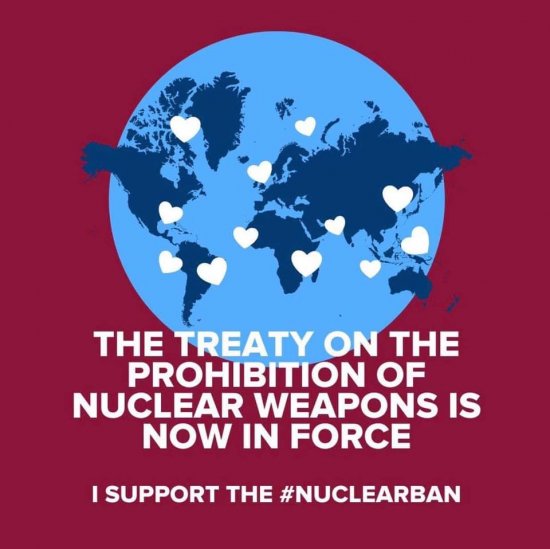
For decades the countries have called for justice for the ongoing environmental and health impacts of nuclear weapons development. The push intensified this month as supporters of the UN treaty on the prohibition of nuclear weapons (TPNW) – including many from Pacific nations – met to discuss the treaty and call for wider ratification.
The treaty imposes a ban on developing, testing, stockpiling, using or threatening to use nuclear weapons – or helping other countries in such activities. It entered into force in 2021 and has 98 countries as parties or signatories. In the Pacific region 11 countries have backed the treaty. Treaty supporters want universal global support but many countries – including the US, the UK and France – oppose the treaty.
The nine nuclear armed countries argue that nuclear weapons are critical to their security. Likewise, Nato nations, Japan, South Korea and others are not yet party to the treaty. Australia, where the UK conducted nuclear tests in the 1950s, has not ratified the TPNW despite the prime minister, Anthony Albanese, saying in 2018 that Australia would do so the treaty when his party was in power…………………………..
‘Nuclear risks rising’
Against this backdrop, politicians, activists and other representatives gathered at UN headquarters in New York this month for week-long discussions on how to secure more support for the TPNW.
Hinamoeura Morgant-Cross, a representative of the French Polynesia assembly, was among the parliamentarians. She says her family was significantly affected by French nuclear detonations at Moruroa and Fangataufa atolls between 1966 and 1996. Morgant-Cross told the forum high rates of radiation-induced cancer in her family had motivated her to become an anti-nuclear activist and assembly member.
“It started with my grandma with thyroid cancer,” she said. “Then her first daughter – my auntie – with thyroid cancer. She also got breast cancer. My mom and my sister have thyroid disease. I got chronic leukemia when I was 24 years old. I’m still fighting against this leukemia.”
New Zealand’s UN representative in Geneva, Deborah Geels, stressed the treaty’s “special importance in the Pacific”, warning: “Tensions between nuclear-armed states and nuclear risk are rising, and no region is immune – even the South Pacific.”……………………………….. more https://www.theguardian.com/world/2025/mar/21/never-forget-pacific-countries-remember-nuclear-test-legacy-as-weapons-ban-treaty-debated
Air Force picks remote Pacific atoll as site for cargo rocket trials.

COMMENT. Dressed up as “humanitarian aid” blah blah. They never give up until they’ve wrecked every beautiful indigenous home.
By SETH ROBSON STARS AND STRIPES • March 4, 2025
The Department of the Air Force has tagged an isolated Pacific island as a test site for landing rockets capable of delivering tons of cargo anywhere on the planet at lightning speed. The department signaled its intent Monday to build two rocket landing pads on Johnston Island within Johnston Atoll, an unincorporated U.S. territory 717 nautical miles southwest of Honolulu, according to a notice in the Federal Register.
……………………………………………………………In October 2020, Army Gen. Stephen Lyons, at the time the head of the U.S. Transportation Command, told the National Defense Transportation Association that officials were working with Elon Musk’s Space X on rocket cargo deliveries. The Federal Register notice does not mention Space X participation in the trial.
………………..U.S. forces are preparing to disperse across the Indo-Pacific in the expectation of missile attacks on established bases in a conflict with China over Taiwan or in the South China Sea.
To sustain forces across a vast swathe of territory the Air Force has been renovating World War II-era airfields from Micronesia to the Philippines.
………………………..Officials also considered Kwajalein Atoll, Midway Island and Wake Island as rocket landing sites, according to the Federal Register notice states. March 4, 2025
More powerful than Hiroshima: how the largest ever nuclear weapons test built a nation of leaders in the Marshall Islands.
Shiva Gounden and Shaun Burnie , Greenpeace 28th Feb 2025, https://www.greenpeace.org/international/story/65565/nuclear-victims-remembrance-day-united-states-must-comply-with-marshall-islands-demands-for-recognition-and-nuclear-justice/
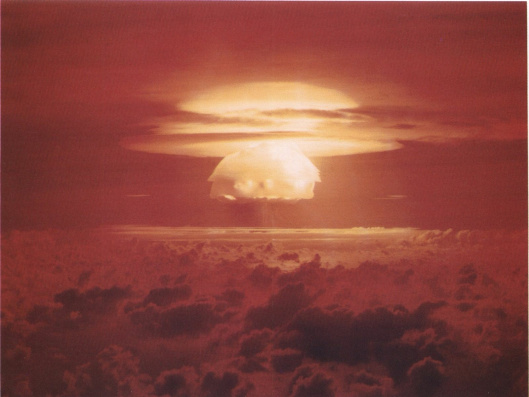
71 years ago, on Bikini Atoll in the Marshall Islands, a nuclear bomb with the codename “Castle Bravo”, exploded with an energy of 15 megatons. The mushroom cloud reached 40 kilometres into the atmosphere, resulting in thousands of square kilometres of the Pacific Ocean being contaminated by radioactivity. Its explosive yield was 1000 times more powerful than the Hiroshima bomb; and within four hours of the explosion, radioactive fallout made up of crushed coral, water, and radioactive particles, rained down over inhabited atolls, including Rongelap Atoll, which was 150 kilometres away. A fine white ash landed on the heads and bare arms of people standing in the open, dissolving into water supplies and drifting into houses. Witnesses of the Bravo nuclear fireball described seeing a second sun rising in the west, just before the terrifying shock waves hit them.
For the people of the Marshall Islands, that day on March 1 1954 will forever be known as Remembrance Day – the anniversary of Castle Bravo, the largest ever nuclear weapons ‘test’ conducted by the United States military.
In the 1950s, after the explosion, U.S. government scientists warned that the people of Marshall Islands were subjected to “high sub-lethal dose of gamma radiation, extensive beta burns of the skin, and significant internal absorption of fission products”. They were subjected to decades of medical experiments run by secretive U.S. laboratories, later to be discovered as “Project 4.1”.
71 years after the detonation, there remains no cancer clinic in the whole country. Many of the citizens still live in permanent exile, with some of the islands vaporised by nuclear weapons, while others remain too radioactive for safe return. The consequences of Castle Bravo have echoed through generations of the people in the Marshall Islands who have been denied the right to justice, proper medical care, and full reparation for loss and damage.
“After centuries of colonial rule, the people of the Marshall Islands and the wider Pacific, were made 20th century victims of a nuclear arms race which for them was never a ‘Cold War’,” said Shiva Gounden, Head of Pacific at Greenpeace Australia Pacific. “But all through this, their decades of resilience, resistance and refusal to be silenced in their quest for nuclear justice, has been an inspiration across generations. The proud people of the Marshall Islands have retained their profound and deep connection to their Pacific home, despite all efforts to destroy that connection through displacement and contamination. That same determination is now evident in their response to the devastating impacts of climate change. The refusal of the U.S. to meet in full their obligations, is matched today by the neo-colonial forces which deny the right of Pacific islanders to climate justice, funds for climate adaptation and mitigation, and financing for loss and damage. Today, we pay our deepest respects to the people of the Marshall Islands and their demands for nuclear and climate justice.”
The Marshall Islands government continues its strenuous efforts to secure compensation and justice from the U.S. government. It received US$150 million in nuclear compensation under its 1986 Compact of Free Association (COFA) with the U.S. The COFA established a tribunal to adjudicate compensation claims. The tribunal sought over US$3 billion in today’s dollars that the U.S. has never paid. In addition the US government has left the Marshallese with a “ticking time bomb” – the Runit Dome. After years of nuclear testing, a concrete dome measuring 114 meters in diameter and filled with radioactive waste has been left to the Marshallese. Climate change and rising sea levels have caused cracks to appear; and since the Marshall Islands independence in the late 70s, the US has absolved all responsibility of the maintenance of the Dome and have left it to the Marshall Islands government.
Like the resilient people of the Marshall Islands who refuse to give up, Greenpeace stands in genuine and deep solidarity by elevating the voices and stories of the communities impacted by the testing of nuclear weapons and the dangers it imposes. As their people are today pursuing those responsible for their suffering through the human rights institutions of the United Nations, Greenpeace will also continue to highlight this injustice. Jimwe im Maron
This article was originally published in 2024, to mark the 70 year anniversary of the Castle Bravo test. In 1957, just three years after the detonation, the people of Rongelap were told by the US government their island was deemed safe and asked to return. Decades later, after experiencing too many health complications and finding the island unsafe to live in, the people of Rongelap asked for assistance from Greenpeace; and in 1985, the Rainbow Warrior helped evacuate them from their home and move them to Mejatto Island.
In 2025, the Rainbow Warrior will be visiting again – this time to support and amplify the Marshall Islands’ courageous ongoing call for justice and fight for systemic change at a global level.
Shiva Gounden is the Head of Pacific at Greenpeace Australia Pacific
Shaun Burnie is International Climate & Nuclear Campaigner for Greenpeace International.
New Zealand’s Rocket Lab ‘ready to serve’ Pentagon

RNZ Phil Pennington, Reporter 19 Feb 25
Rocket Lab is poised to launch a satellite from Mahia Peninsula for a US company which is looking to bolster military and spying operations.
BlackSky’s plan is to add laser optic links later to its Gen-3 satellites to give “war-fighters real-time access to imagery during time-sensitive military operations worldwide”.
This comes shortly after Rocket Lab won a part in a mega-deal to help develop hypersonic weapons for the Pentagon, prompting the firm to state it was “ready to serve the US Department of Defense”.
The New York-listed, New Zealand-born company has also completed a design review for 18 military satellites in a contract worth more than $800 million, for the Proliferated Warfighter Space Architecture (PWSA), which is putting up a web of low-orbit satellites for missile tracking and battlefield comms.
That deal, which was signed last year, cemented Rocket Lab as a “prime” – or lead – defence contractor in the US.
The Mahia launch is set down for some time from Tuesday, and will be the first of several Gen-3s for BlackSky, which has used the site near Gisborne since 2019.
The government last year dismissed pro-Palestinian protesters complaints it breached rules on launches…………………………………..
Six months ago, BlackSky said it would make Gen-3s compatible with military networks. It won a $175m satellite contract with an unnamed international defence customer last month.
Its constellation of small satellites also has civilian uses, such as in mapping natural disasters.
Rocket Lab’s share price in the US has surged since it won big Pentagon contracts………………………………………………………….. more https://www.rnz.co.nz/news/national/542305/rocket-lab-ready-to-serve-pentagon
—
Leaders in the Pacific raise alarm over ‘direct impact’ of Trump’s climate retreat and aid freeze

Leaders and environmental advocates in the Pacific have expressed alarm
over Donald Trump’s decision to withdraw from the Paris climate agreement
and freeze foreign aid, warning the moves will accelerate the existential
threats they face as nations on the frontlines of the climate crisis.
Guardian 1st Feb 2025, https://www.theguardian.com/world/2025/feb/01/leaders-in-the-pacific-raise-alarm-over-direct-impact-of-trumps-climate-retreat-and-aid-freeze
New Zealand is under siege by the Atlas Network
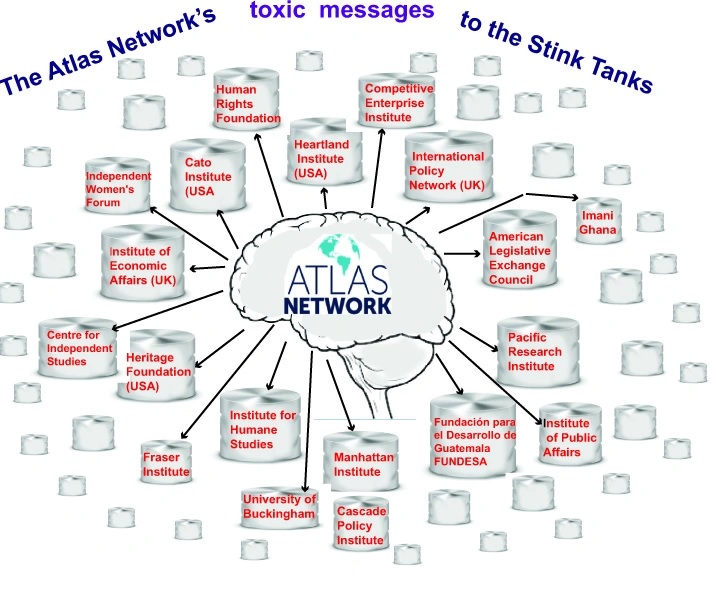
We have a handful of years to achieve a monumental shift from fossil fuel towards renewable energy: Atlas partners aim to ensure this does not take place.

March 3, 2024, by: Lucy Hamilton, https://theaimn.com/new-zealand-is-under-siege-by-the-atlas-network/—
Just as the Atlas Network-connected Advance body intervened in the Voice referendum in Australia and, in recent weeks, a by-election, similar organisations spawned from the American model are distorting New Zealand’s politics from within as well as from without.
One of the key researchers into the Atlas Network, Lee Fang, observed that it has “reshaped political power in country after country.” In America, every Republican president since Ronald Reagan has begun office with a Roadmap provided by the Heritage Foundation, primary Atlas Network partner. The “Mandate” for 2025 puts America on a hard path to fascism should a Republican win in November. Britain’s economy and standing have been savaged by Atlas partners’ impacts on the Tories. In New Zealand, the recently-elected rightwing coalition government is aping the new “Atlas president” of Argentina, aiming to privatise national assets, but is increasingly also imitating Atlas strategies recently seen in Australia, inflaming racial tensions and harming the wellbeing of Māori people.
Dr Jeremy Walker called Australia’s attention to the local Atlas partner organisations’ impact on the Voice to Parliament referendum and is now helping draw together the focus on the New Zealand partners’ very similar distortion of their national debate. There is a deep racism at the heart of this ultra-free market ideology that has licensed the international right to exploit resources and people around the globe untrammelled, largely in American corporate interest, but more broadly for any corporation or allied sector big enough to be a contender. (They do not, by contrast, fight for the renewable energy sector’s interests, as a competitor to their dominant fossil fuel donors; this shapes their climate crisis denial and delay, and colours their loathing of First People’s capacity to interfere with their profits by environment-driven protest. A sense of Western Civilisation as the apex of human existence and deep disdain for non-Western cultures also pervade the network.)
The Atlas model is to connect and foster talent in the neoliberal sphere. Young men (mostly) are funded or trained to replicate the talking points that Ultra High Net Worth Individuals (UHNWI) and lobbyists have built into a global network of over 500 bodies in 100 nations. The fact that neoliberal orthodoxies are more religious ideology that fact-based theories explains why their impact has been so utterly disastrous everywhere they have reshaped societies. The goal is to spawn replicating bodies with benign-sounding names that promote the UHNWI and corporate talking points – but with a veil hiding the self-interest that is obvious when those groups speak for themselves. Some of the bodies feign being thinktanks, which George Monbiot recently renamed junktanks to clarify their disingenuousness. Others are “astroturf” organisations that pretend to be grass roots bodies representing popular opinion. Another model is the beach-head in universities, an independent organisation within those institutions intended to dignify the neoliberal religion and the chosen strategies, including climate denial. All these produce material to fill civic debate and train more acolytes to enter politics, strategy companies and junktanks. Mainstream media elevates their standing by hosting their operatives as experts without explaining that the benign-sounding organisation to which they belong is a foreign-influence operation’s local outlet.
These groups damage local conditions to favour international corporations. They lobby for the removal of the “regulations” that are actually protections for the public – as workers, as consumers, as residents. They push for the privatisation of national treasures so that (often foreign) corporations can exploit the profits at the expense of the public. The greater the damage to the local democracy, the easier it is for them to act unimpeded. The stronger their infiltration of the media, the harder it is for the local electorate to understand the stakes. The politicians and strategists that emerge from the sphere (or are its allies) know that none of this wins votes, so they fill the space with culture war division to distract the voter from paying attention. Race and sexuality are their most obvious targets, as reactionary nostalgia for a mythical past of white picket fences pervades their ideology: a valorisation of “Christianity” and “family” and the “sacredness of marriage” (preached by adulterous politicians) is equally apparent in their propaganda.
The coalition that took power in NZ late in 2023, after a campaign centred on attacking the country’s founding Waitangi Treaty, has considerable Atlas infiltration. There is concern about Atlas fossil fuel and associated tobacco interests perverting policy in parliament, as well as senior ministerial aides who might be compromised. The government has promised to repeal Jacinda Ardern’s ban on offshore gas and fuel exploration, plans to sell water to private interests, not to mention planning to enable the selling off of “sensitive” NZ land and assets to foreign corporations, just as Argentinian Milei is intending.’
One of the government members, the Act Party, began its existence as an Atlas partner thinktank and continues that close connection. It was founded by former parliamentarian Denis Quigley with two members of the Mont Pelerin Society (MPS), the Atlas Network’s inner sanctum. One, Roger Douglas, was responsible for Rogernomics in NZ which has been described as a “right wing coup” that worked to “dismantle the welfare state.” The other, Alan Gibbs, who has been characterised as the godfather of the party, and a major funder, argued Act ought to campaign for government to privatise “all the schools, all the hospitals and all the roads.” This may not be surprising since he made much of his fortune out of the privatisation of NZ’s telecommunications.
The Act Party is currently led by David Seymour who functions as a co-deputy prime minister in the government. He has worked almost his entire adult life within Atlas partner bodies in Canada and boasts a (micro) MBA dispensed by the Network.
In Seymour’s 2021 Waitangi Day speech, he acknowledged his “old friends at the Atlas Network.” In light of that, his recent disdainful and absolute dismissal of the party’s connection to Atlas in an interview was telling: he clearly felt the association was damaging enough to lie outright.
Seymour is also deeply antagonistic to policies dedicated to repairing the disadvantage suffered by Māori people, disingenuously describing provisions that work cooperatively with Māori people as the “dismantling of democracy.” He appears antagonistic to Māori culture.
Another Atlas partner that has been key to distorting debate in NZ is the Taxpayer Union (TPU) which is emblematic of the production of metastasising bodies central to the Atlas strategy. Its co-founder and executive director is another graduate of the Atlas (micro) MBA program. Jordan Williams (currently “capo di tutti capi” of the Atlas global alliance of anti-tax junktanks) laughably depicts Atlas as a benign “club of like-minded think tanks.” He created, however, a body called the Campaign Company which helped radicalise the established farmer power base in NZ politics, planting sponsored material in the media. Williams claimed to grant the farmers “world-class campaign tools and digital strategies.” He also co-founded the Free Speech Union (FSU), which is unsurprisingly fighting regulation of the damaging impact of internet disinformation as well as fostering culture war battles.
A further spin-off of the bodies illustrates the increasing ugliness of the populist strategies. A former Act Party MP has founded the New Zealand Centre for Political Research which is fomenting civic division against Māori interests, including placing hate-mongering advertisements in the media.
The Act Party (alongside the populist New Zealand First party) is at the heart of the coalition government’s intention to destroy NZ’s admirable efforts to promote Māori interests for the betterment of the commonwealth, including the co-governance innovation. Efforts to undo disadvantage and programs that have promoted the distinctive NZ democratic experiment are set to be dismantled. A “massive unravelling” of Māori rights is at stake.
It is not only Māori people who will suffer. The NZ coalition government is also attempting a kind of “shock therapy” that did so much to tip first Chile and then other “developing” nations into brutal pain in pursuit of market “freedom.” The MPS was at the heart of Pinochet’s neoliberal brutality, resulting from Nixon’s injunction to make the Chilean economy scream.[1] New Zealand now faces cuts to a range of services, welfare and disability payments, even while the new PM, one of NZ’s wealthiest ever holders of the role, charged the taxpayer NZD 52,000 to live in his own property. It’s important to remember that this kind of entitlement is the sort that the neoliberals like, alongside subsidies to industry and corporations.
Lord Hannan (one of Boris Johnson’s elevations to the peerage, and a junktank creature) recently spoke in NZ, welcoming “all the coalition partners around this table” to hear his oration. There he celebrated the small percentage of GDP that NZ’s government spends on its people, cheering on the TPU’s power. He also disdained the “tribalism” that has dictated recognition of First Peoples’ suffering. There is grand (but unsurprising) irony in a graduate of three of Britain’s preeminent educational institutions dictating that humanity’s essential equality is all that can be considered when devising policy, particularly in settler-colonial nations.
Amusingly the weightier debunking of the Atlas connections has come from: Chris Trotter, formerly centre left, now a council member of Williams’ FSU; Eric Crampton, chief economist of the New Zealand Initiative, NZ’s leading Atlas partner and Sean Plunkett whose “anti-woke” vanity media platform, Platform, is plutocrat funded and regularly platforms the NZI talking heads.
While Atlas’s system largely functions to connect and train operatives, as well as acting as an extension of American foreign policy, this modest-seeming program must not be ignored. We have a handful of years to achieve a monumental shift from fossil fuel towards renewable energy: Atlas partners aim to ensure this does not take place.
And Atlas partners will push us at each other’s throats while we procrastinate.
[1] That MPS intervention resulted in massive unemployment, extraordinary inequality, and fire-sale prices of national assets to cronies. Much of Chile’s later success is as likely to be attributable to the trade requirements of (statist) China whose demand for copper has done so much to enrich Chile.
Grazing sheep among solar panels could produce higher quality wool, study finds

Sophie Vorrath, Nov 1, 2024,
https://reneweconomy.com.au/grazing-sheep-among-solar-panels-could-produce-higher-quality-wool-study-finds/
The co-location of solar farming with sheep grazing does not have a negative affect on wool production and could even improve the quality of the wool produced, a new study has found.
The study is based on the results of a second round of wool testing at the Wellington solar farm, south east of Dubbo in New South Wales, which has shared its site with 1,700 merino sheep for the past three years.
Legend has it that the decision to graze sheep at the solar farm came about when an employee of Lightsource bp, the owner of the Wellington project, complained to a local, sixth-generation wool farmer about the hassle and cost of mowing the solar farm six times a year.
According to Tony Inder, who heads up the Allendale Merino Stud, the effect on his sheep has been a lot better than he thought it would be – he says the wool quality they are producing has “increased significantly.”
But Lightsource bp – which is now wholly owned by the oil and gas giant BP, after completing the acquisition of the remaining 50.03% interest – has used the opportunity to gather some formal data.
The study, conducted by EMM Consulting with support from Elders Rural Services, compares two groups of merino sheep – one group grazed in a regular paddock and the other at the Wellington solar farm.
The latest findings show grazing sheep among solar panels does no harm to wool production, even in the case of pre-existing high-quality standards. And it says that some parameters even indicate an improvement in wool quality, although conclusive benefits require further long-term measurement.
Lightsource bp says that while the study at the Wellington solar farm is ongoing, it is another indication that solar farms can exist side-by-side with sheep farming, for the benefit of both enterprises.
“These results are very encouraging and highlight the potential for solar farms to complement agricultural practices,” says Emilien Simonot, Lightsource bp’s head of agrivoltaics.
“By integrating sheep farming with solar energy production, we can achieve dual benefits of sustainable energy together with agricultural output.” . By co-locating grazing with renewable energy, land can remain in agricultural use, offering farmers additional revenue while contributing to cleaner energy for the planet.
“Finding ways for agriculture and clean energy to work together is crucial for a more sustainable future,” says Brendan Clarke, interim head o environmental planning Australia and NZ at Lightsource bp.
“The promising results from this study indicate that we are on the right path, and working closely with farmers to grow our knowledge in this area is paramount.”
As for the sheep, Inder says they “just do really well” when grazing among the Wellington solar farm panels.
“I like to say that panel sheep are happy sheep.”
Sophie is editor of One Step Off The Grid and deputy editor of its sister site, Renew Economy. She is the co-host of the Solar Insiders Podcast. Sophie has been writing about clean energy for more than a decade.
Inside the radioactive island with mutant sharks that was used to test nuclear bombs

The water….remains undrinkable and sealife and plants cannot be eaten due to the radioactive water and soil.
The Defence Department concluded in the ’70s that the soil was so contained with cesium-137 and strontium-90 – both taking about three decades to decay, called a half-life – that the best course of action was to just let it rot.
Plutonium-239, however, takes a little longer; 24,000 years..…………………
Josh Milton, Oct 26, 2024,
https://metro.co.uk/2024/10/26/inside-radioactive-island-mutant-sharks-caused-nuclear-bombs-21376332/
Mutant sharks. White sand laced with plutonium. Water tainted with strontium. Hub cap-sized hermit crabs eating coconuts containing caesium. A dome ‘coffin’ crammed with radioactive material in plastic bags.
The Marshall Islands, a ring of coral reefs in the middle of the Pacific Ocean, looks like the perfect place to throw on a floppy sun hat and read a book below swaying palm trees.
But in the 1940s and ’50s, the US used two of the far-flung atolls, Bikini and Enewetak, to test out 67 nuclear bombs.
One was 1,000 times more powerful than the Hiroshima bomb, according to Hibakusha Worldwide, which tracks nuclear incidents.
This was part of Operation Crossroad, an atomic testing programme that came out of the anxiety of the Cold War.
With 52,000 Marshallese people calling the islands home at the time, the 20 islands are the remnants of ancient volcanoes halfway between Hawaii and Australia.
Yet entire islands were vaporized and craters gouged into its shallow lagoons, forcing hundreds of people out of their homes, never to return.
Bikini Atoll now has such a reputation for groovy wildlife it inspired the setting of Spongebob Squarepants.
While the islands are unlikely home to talking sponges, the radiation that lingers in its waters is impacting the wildlife.
Nurse sharks with just one dorsal fin swim around the Bikini Atoll and car-sized coral grows along the seafloor.
‘Popular belief is that radiation causes mutations, and you know what, it’s true,’ Steve Palumbi, a professor of marine sciences also at Stanford, told The Sun.
Even low levels of radiation can cause genetic mutations. Caesium, strontium and other radioactive isotopes break apart DNA, compressing thousands of years of evolution into a few decades in what one paper once described as ‘unnatural selection‘.
Marine life is on the rebound in Bikini. ‘The fact there is life there and the life there is trying to come back from the most violent thing we’ve ever done to it is pretty hopeful,’ said Steve Palumbi, a professor in marine sciences at Stanford University.
The water, though, remains undrinkable and sealife and plants cannot be eaten due to the radioactive water and soil.
People living on nearby islands, now part of the Republic of the Marshall Islands, during and after the testing show a higher risk of developing cancer – not one of the top two causes of death – and birth defects.
The list of woes for the Marshallese does not end there, with rising sea levels fuelled by climate change slowly swallowing up the habitable atolls.
The largest nuclear detonation was the hydrogen bomb Castle Bravo, fired on March 1, 1954, in Bikini. As the mushroom-shaped clast cast a shadow over the island, the radioactive fallout and debris spewed well beyond the shorelines.
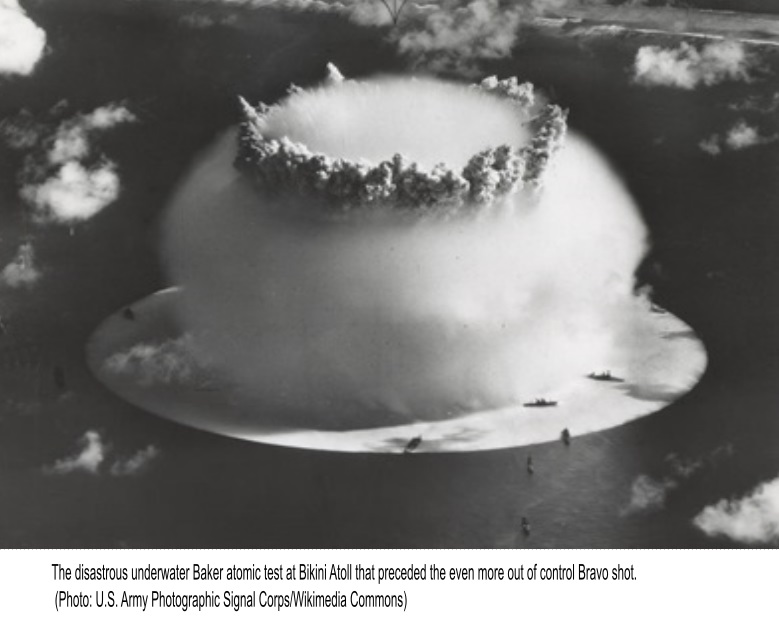
‘Traces of radioactive material were later found in parts of Japan, India, Australia, Europe, and the US,’ says the Atomic Heritage Foundation.
‘This was the worst radiological disaster in US history and caused worldwide backlash against atmospheric nuclear testing.’
Bikini, the colonial spelling of Pikinni, became so radioactive there’s little hope it’ll ever be habitable.
After the Limited Test Ban Treaty of 1963 put an end to atmospheric nuclear testing, this left American officials – and the islands’ displaced citizens – with one option: wait.
The Defence Department concluded in the ’70s that the soil was so contained with cesium-137 and strontium-90 – both taking about three decades to decay, called a half-life – that the best course of action was to just let it rot.
Plutonium-239, however, takes a little longer; 24,000 years. The US dumped 437 plastic bags filled with lumps of plutonium that had spewed after a bomb misfired into a 33-foot crater left behind in 1958 by a nuke on Runit Island.
That, and about 35 Olympic-sized swimming pools’ worth of radioactive soil and nuclear waste.
The crater was plugged up by a 350-foot-wide slab of concrete called the Runit Dome, which locals call ‘The Tomb’, in the ’70s. The dome almost looks like something from a science fiction movie, surrounded by a tropical paradise.
And the dome is leaking. ‘The dome is a significant visible scar on the landscape,’ Ken Buesseler, a marine radioactivity expert at the Woods Hole Oceanographic Institution (WHOI), told Oceans magazine in 2020.
But it’s a relatively small source of radioactivity.’
Overall, more than half of the 167 original inhabitants of Bikini Atoll have died. Some started showing cancers related to radiation exposure in the 1960s, while people living downwind of the explosions suffered burns and low blood counts.
Several generations later, about 5,400 Bikinians are still living in exile. Some live on a lone Pacific island called Kili, roughly 400 miles from Bikini, and others from Honolulu to the ‘Wheat Capital’ of Oklahoma, Enid.
Bikini Atoll largely remains uninhabited, with a tiny caretaker team taking care of the island infrastructure and divers pop in from time to time.
Bikinians continue to fight, however. Lobbying the US Congress for money to redevelop and clean up the place they once called home.
Scientists are hopeful. Remediation efforts include sprinkling affected areas with potassium fertilizer which reduces how much cesium-137 seeps into locally grown crops. How radioactive the soil is has also been decreasing.
The Marshall Islands Program advises that, once resettlement finally begins, a radiation monitoring programme be set up.
‘In this way, the Kili-Bikini-Ejit Local Government and the people of Bikini can be assured that radiological conditions on the islands remain at or below applicable safety standards, and the United States Government can avoid mistakes of the past,’ the programme says.
1 This Month
23-25 October – on Zoom – World BEYOND War’s annual global conferenc


Shut down the radiation-damaged Heysham nuclear reactors now
To see nuclear-related stories in greater depth and intensity – go to https://nuclearinformation.wordpress.com

Say No to NASA’s Reckless Nuclear Reactor on the Moon
Say No to NASA’s Reckless Nuclear Reactor on the Moon

-
Archives
- October 2026 (247)
- September 2026 (339)
- August 2026 (330)
- July 2026 (355)
- June 2026 (287)
- May 2026 (306)
- April 2026 (356)
- March 2026 (251)
- February 2026 (267)
- January 2026 (308)
- December 2025 (358)
- November 2025 (359)
-
Categories
- 1
- 1 NUCLEAR ISSUES
- business and costs
- climate change
- culture and arts
- ENERGY
- environment
- health
- history
- indigenous issues
- Legal
- marketing of nuclear
- media
- opposition to nuclear
- PERSONAL STORIES
- politics
- politics international
- Religion and ethics
- safety
- secrets,lies and civil liberties
- spinbuster
- technology
- Uranium
- wastes
- weapons and war
- Women
- 2 WORLD
- ACTION
- AFRICA
- Atrocities
- AUSTRALIA
- Christina's notes
- Christina's themes
- culture and arts
- Events
- Fuk 2022
- Fuk 2023
- Fukushima 2017
- Fukushima 2018
- fukushima 2019
- Fukushima 2020
- Fukushima 2021
- general
- global warming
- Humour (God we need it)
- Nuclear
- RARE EARTHS
- Reference
- resources – print
- Resources -audiovicual
- Weekly Newsletter
- World
- World Nuclear
- YouTube
-
RSS
Entries RSS
Comments RSS


