UN chief Antonio Guterres to Pacific islands, warning rich nations about climate impacts
|
UN chief Antonio Guterres hits out at climate change ‘paradox’ ahead of historic Pacific trip https://www.abc.net.au/news/2019-05-13/un-chief-antonio-guterres-talks-climate-historic-pacific-trip/11106622, Pacific Beat 13 May 19, The trip marks the first time a sitting UN secretary-general will meet with Pacific Islands Forum (PIF) leaders in the region. Key points:
“Climate change is running faster than what we are … the last four years have been the hottest registered,” Mr Guterres said yesterday alongside New Zealand’s Prime Minister Jacinta Ardern.
Under the Paris Agreement, many countries agreed to a long-term commitment to keep the rise of global temperatures well below two degrees Celsius above pre-industrial levels in a bid to substantially reduce the effects of climate change. After New Zealand, Mr Guterres will travel to Tuvalu, Vanuatu, and Fiji to meet with leaders who have for years been warning that many of the Pacific’s small island nations face being washed away by rising sea levels due to global warming. Mr Guterres added to those sentiments yesterday warning that Pacific nations are on the frontlines of climate change.
“We need to protect the lives of our people and we need to protect our planet.” However, he praised the efforts of Ms Ardern’s Government who just last week, introduced an ambitious bill that aims to make New Zealand mostly carbon neutral by 2050 while giving some leeway to farmers. ‘With America or Australia — Sydney could go down’In Fiji, Mr Guterres will meet with PIF leaders and senior government officials from the region. Samoa’s Prime Minister Tuilepa Sailele, a leading critic against nations who he believes are ignoring the threats of climate change, told the ABC’s Pacific Beat program that he had a message for Mr Guterres. To impress on him the importance of the smallness of our islands, and the quicker moves that our vulnerable islands would like to see from the bigger countries responsible for all these problems that we are facing today,” he said. Mr Sailele, who has previously blasted countries for ignoring the warnings, added that rising sea levels is not just an issue for the Pacific, but for those very same “bigger countries” as well.
His comments follow a controversial withdrawal from the Paris Agreement’s commitments by United States President Donald Trump in 2017, a move that was praised by former Australian prime minister Tony Abbott who last year said that Canberra should do the same. The secretary-general’s Pacific trip comes ahead of an anticipated Climate Action Summit that he plans to convene in September in New York. |
|
|
The Blue Pacific and the legacies of nuclear testing

The Strategist 1 May 2019| Patrick Kaiku States in the Pacific islands are small in landmass and population. Their limited terrestrial resources and lack of comparative advantage are compounded by their remoteness from global centres of commerce. This obviously has impacts on the costs of doing business and integration into global trade relations. Their invisibility in international relations means that small states must creatively frame their presence in the global community.It’s against this backdrop that the ‘Blue Pacific’, which is touted as an empowering worldview, should be understood. The core principles of the Blue Pacific must be read together with recent developments in the region. In 2017, Pacific Islands Forum leaders endorsed the concept as a ‘driving force’ connecting Pacific peoples ‘with their natural resources, environment, culture and livelihoods’. The Boe Declaration of 2018 formally recognised Pacific islanders’ stewardship over the Pacific Ocean.
While big states such as the US and China are competing for influence in the region, the Boe Declaration makes a case for prioritising the concerns of Pacific island communities. The strategic confrontations of big powers do not feature in the daily lives of Pacific peoples. What’s important to the survival of island states is their environment and the capacity of their resources to meet present needs and the needs of future generations. This logic is seen with the proposed Pacific Resilience Facility, which is a regional pool of resources to manage or mitigate the adverse effects of environmental challenges in the region.
….. a sticky issue in the region is the potential effects of nuclear contamination of the Pacific Ocean. The legacies of nuclear tests in the Pacific islands include highly radioactive waste materials stored on vulnerable atolls.
In the 1950s, the Pacific Ocean was considered an empty space by the Euro-American powers. With the onset of the arms race during the Cold War, some of the colonial powers used the Pacific as a testing ground for their nuclear weapons. More than 300 nuclear tests were conducted in the Pacific Ocean. Atolls in the Marshall Islands, Johnston Island, Christmas Island and French Polynesia were used as nuclear test sites, casting long shadows into the present.
On one low-lying Pacific island atoll, the toxic legacy of the nuclear tests remains. In 2017, Mark Willacy from the Australian Broadcasting Corporation investigated the nuclear-waste storage facility on the remote atoll of Enewetak in the Marshall Islands. It was there that the US conducted its series of tests of nuclear weapons, including the first full-scale hydrogen bomb. Before it abandoned its nuclear testing program in the 1970s, the US buried contaminated material on Runit Island.
An estimated 85,000 cubic metres of radioactive waste is buried on Runit Island, including some of the world’s most toxic materials. It will take more than 24,000 years for the waste to disintegrate. It’s buried in porous coral and sand and capped by a concrete dome. Marshallese and international non-government organisations are concerned that sea-level rise and major typhoons will destroy the dome, resulting in the contamination of not only the Marshall Islands but the wider Pacific Ocean. Since the sea is a free-flowing matrix of currents and borderless movements of water, a Pacific-wide disaster is a plausible scenario…….
The Pacific island states have an illustrious record in employing collective diplomacy to tackle difficult issues. Since the 1980s, the high-water marks of collective diplomacy have been the UN Convention on the Law of the Sea in 1982, the 1985 Rarotonga Treaty and the global moratorium on drift-net fishing. Currently, small states in the Pacific islands are actively engaged in framing the narrative on global cooperation to deal with climate change challenges.
The Blue Pacific is a timely framework, emphasising a Pacific islands worldview, and is an alternative to the zero-sum confrontations of big powers in the region. More importantly, it stresses the importance of cooperation on Pacific terms in dealing with transnational challenges. The various major powers embroiled in their great-power confrontations in the Pacific ought to be educated about the significance of the Blue Pacific and their participation in advancing the goals of that paradigm. After all, the Pacific Ocean connects all the large landmasses on the Pacific Rim. The state of affairs in the islands is a microcosm of the planet’s chances of surviving global environmental challenges.
Patrick Kaiku is a teaching fellow in the political science department at the University of Papua New Guinea. https://www.aspistrategist.org.au/the-blue-pacific-and-the-legacies-of-nuclear-testing/
Climate change encroaching on Marshall Islands – drastic effort to “elevate” some of them
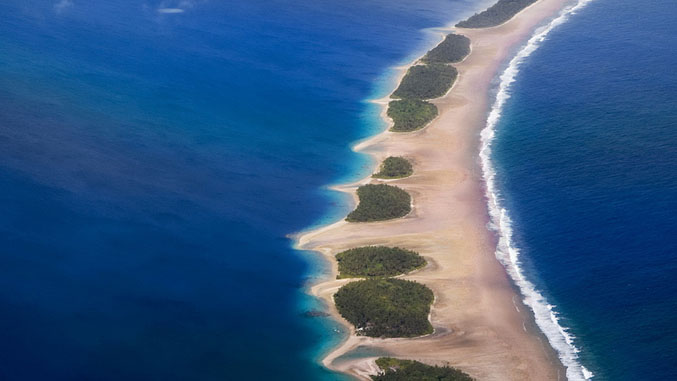 Climate change forces low-lying Marshall Islands to ‘elevate islands’, Climate change has left the low-lying Marshall Islands with little choice but to consider drastic measures. https://www.sbs.com.au/news/climate-change-forces-low-lying-marshall-islands-to-elevate-islands, 24 Feb 19, The far-flung Marshall Islands needs to raise its islands if it is to avoid being drowned by rising sea levels, President Hilda Heine has warned.
Plans are underway for national talks on which of the 1,156 islands, scattered over 29 coral atolls, can be elevated in a dramatic intervention to ensure safety on the islands.
“Raising our islands is a daunting task but one that must be done,” Heine said in an interview with the Marshall Islands Journal published Friday.
“We need the political will, and especially traditional leaders’ commitment, to see this through.
“We must come together as a nation as this is about our survival as a nation, as a people and as a culture.”
A “climate crisis” policy document prepared by the office of the chief secretary painted a bleak outlook for the Pacific Ocean archipelago with a population of 55,000.
It cited an increasing frequency of “inundation events, severe droughts, coral bleaching events, and… looking forward, there is very good reason to believe that conditions and prospects for survival will only worsen.”
Most of the islands are less than two metres (6.5 feet) above sea level and the government believes physically raising the islands was the only way to save the Marshall Islands from extinction.
They have not yet outlined specifics of how this would be achieved expect to have plans formulated by the end of the year. In the meantime, they are keeping a close watch on the ambitious City of Hope project on an artificial island in the Maldives as a viable option.
To lay the foundations of the city – which is expected to accommodate 130,000 people when completed in 2023 – sand is being pumped onto reefs from surrounding atolls and it is being fortified with walls three metres above sea level, which will make it higher than the tallest natural island in the Maldives.
“Whatever approach is selected, it will involve selecting islands to raise, add to, or build upon” Heine said.
“All Marshallese stakeholders, but especially traditional landowners, need to be at the forefront of this discussion if we are ever going to move the conversation forward.”
The Marshall Islands also aims to increase engagement with the three other all-atoll nations – Kiribati, Tuvalu and the Maldives – on climate issues.
“As a group, the atoll nations need to come together to formulate their unique concerns and develop their positions and plans and identify financial needs related to climate impacts,” said Heine, who chairs the Coalition of Atoll Nations Against Climate Change.
Deception and mistrust between Nevada and Department of Energy, over secret plutonium shipment
 The Indy Explains: How a secret plutonium shipment exacerbated mistrust between Nevada and Department of Energy, The Nevada Independent By Daniel Rothberg 18 Feb 19, The secretive Nevada plutonium shipment that has spawned angry rhetoric from Nevada politicians has a history that starts with Russia. In 2000, the United States entered into a pact with Russia to set aside excess weapons-grade plutonium for civilian use in nuclear reactors. Congress then passed a law that it would turn the excess 34 metric tons of plutonium into MOX, or mix-oxide fuel, at a newly built facility in South Carolina.
France’s government snidely changes law to avoid paying compensation to Polynesian victims of atomic bomb testing
 Dismay in Tahiti over changed nuclear compensation law https://www.radionz.co.nz/international/pacific-news/381065/dismay-in-tahiti-over-changed-nuclear-compensation-law French Polynesia’s nuclear test veterans organisations are dismayed to find out that a planned change to the compensation law for test victims was quietly altered last year.
It emerged that in the finance act passed in France in the week before Christmas, a provision of negligible exposure for compensation claimants was included.
This was against the recommendation of a commission set up in 2017 which advised for the reference to negligible risk to be removed as a way to improve the 2010 compensation law.
There had been widespread clamour to change the law because most applications had been thrown out.
The head of the Moruroa e tatou organisation Roland Oldham told the public broadcaster that the situation was simple.
He said the French state refused to compensate the test victims by playing for time.
Father Auguste Uebe-Carlson of the Association 193 also condemned this change, saying the fight was continuing.
The 12-member commission which advised the French legislature was headed by a French Polynesian Senator Lana Tetuanui, who is yet to comment.
France tested 193 nuclear weapons in the South Pacific over a 30-year period, with some of the atmospheric blasts irradiating most islands.
George H.W. Bush’s shameful involvement in the Regime Change in Nuclear-Free Palau
|
George H.W. Bush: Dirty Tricks and Regime Change in Nuclear-Free Palau, LA Progressive 29 Dec 18 Amidst all the presidential pomp, on Dec. 5 George H.W. Bush’s casket was lifted off the black-shrouded bier that had carried Abraham Lincoln after the 16th president’s assassination and driven from the U.S. Capitol to the Washington National Cathedral. But as far as I’m concerned George H.W. Bush went from lying for the state to lying in state. ………..
Much was made about “regime change” in Iraq because of Saddam’s purported WMDs by Pres. Bush 43. But scant attention has been paid to the tragic tale of regime change in a Pacific Island of 15,000 indigenous people who dared oppose U.S. nukes – and to Bush 41’s connection to Palau. George W. Bush may ballyhoo “spreading democracy”, but while Bush Sr. was in the Executive Branch, Palauans were compelled to vote about 15 times in around as many years on self-rule and their nuclear free status. Palauans could vote – but their vote didn’t count unless it favored U.S. policy. Palauans had to keep casting their ballots until Washington attained its desired result: Rescinding the Palau constitution’s antinuclear clauses. It was a unique form of voter suppression.
During this display democracy, Palau was gripped by a reign of terror. On June 30, 1985, Pres. Haruo Remeliik was assassinated, which reopened the then-deadlocked treaty negotiations. Shortly after the liquidation, then-Vice Pres. Bush personally flew to Saipan in the Northern Marianas, located north of Palau and where the Trust Territory administration was HQ-ed, to reopen stalled status parleys, and struck a new deal.
However, antinuclear activists defeated the treaty in a tribunal, where Palau’s High Court ruled a 75% vote favoring a proposed Compact of Free Association was required in order to override the small nation’s antinuclear laws. In 1987, terrorists firebombed and shot Pacific pacifists, and besieged Palau’s congress. A U.S. Congressional General Accounting Office investigation found a $2 million U.S.–derived slush fund financed political violence. In 1988, Palau’s second elected president, pro-U.S. puppet Lazarus Salii, also mysteriously had his head blown off. Although this was officially declared a suicide, the elimination of Salii – who was unable to pass the Compact – untied the Gordian knot that led to the elimination of Palau’s nuclear bans. Other high ranking U.S. officials during the Reagan-Bush era with links to Palau include: Secretary of State George Shultz, who secured Palauan beachheads as a Marine sergeant during WWII. Shultz returned to Palau in 1986 during the Compact re-negotiation process. In the late 1970s, Admiral William Crowe surveyed land in Palau for U.S. bases, and became CINCPAC Commander and Joint Chiefs of Staff Chairman 1985-1989. President Bush Sr. appointed Brent Scowcroft – who’d arranged the Kissinger-ordered surveillance of Micronesian status negotiations – National Security Adviser. Black Ops in ParadiseParis was Washington’s colonial partner in Oceania, and in the 1960s Moruroa atoll, at French-occupied Polynesia, became France’s South Pacific nuclear testing site for atmospheric and underwater N-blasts. On Jan. 12, 1985, Eloi Machoro, a militant leader of the Kanak indigenous people fighting for independence from France was killed by French police snipers. On March 2, 1985, shortly after he’d returned from meeting anti-nuke activists at Auckland, New Zealand, Tahitian activist Charlie Ching was arrested walking to a pro-independence, antinuclear rally in Papeete, Tahiti. On June 30, 1985 the first president of the world’s first national nuclear free zone was gunned down in Palau. Ten days later French General Directorate for External Security secret agents bombed the Rainbow Warrior at nuclear free New Zealand on July 10, 1985, as Greenpeace prepared to protest France’s nuclear testing near Tahiti. The DGSE saboteurs of the Rainbow Warrior were captured and convicted; the implicated chiefs of France’s military and intelligence services resigned. The above appear to be part of a coordinated counterinsurgency program to defeat the nuclear free and independent Pacific movement. French state terrorism was indisputably responsible for bombing Greenpeace’s ship. Is it farfetched to think the assassination of Palau’s president(s) and reign of terror was American state terrorism? Inquiring minds want to know. As former CIA chief, Bush headed what LBJ called “Murder, Inc.,” and, as mobsters say: “The fish stinks from the head down.” The Pentagon had motive: relocating bases from the Philippines (closed after Marcos’ overthrow) to Palau – but the world’s first nuclear free constitution thwarted this aspiration. To find out who commits a crime, see who benefits from it: The IPSECO debt and political violence finally wore Palauans down; in the 1990s their antinuclear framed rules lost at the polls. Palau was, in effect, annexed by Uncle Sam, as was the rest of Micronesia – which, as Bush knew from his WWII days, had vital strategic value. ………. If MSM spent 1% of the time investigating Bush’s ties to the covert actions in Palau as they did extolling his virtues during their funereal coverage, the case of who shot Pres. Remeliik might actually get solved. Instead of ballyhooing and worshipping a golden calf, MSM should mobilize at least some resources to look behind the curtain at the real record of George H.W. Bush and investigate what role, if any, he played in whacking the president of nuclear free Palau and subsequent events in the remote isles of Micronesia. Ed Rampell Ed Rampell covered Palau during Bush’s vice presidency for AP, Reuters, Newsweek, Radio New Zealand, Radio Australia, Gannett Press, Pacific Islands Monthly, etc. He initiated and was the investigative reporter for ABC News’ “20/20” segment, “The Puzzle of Palau,” which aired in July 1987 and proved three young men related to the opposition leader convicted of assassinating President Remeliik were framed political prisoners. Within two weeks of the Barbara Walters-introduced report, they were fully exonerated of the murder by Palau’s Supreme Court. Rampell went on to report for the Australian Broadcasting Corp.’s “Background Briefing” two-part expose that directly resulted in the conviction of Palau’s pro-Washington Minister of State for soliciting the homicide of President Remeliik. The newest books Rampell co-authored are “The Hawaii Movie and Television Book” and “Conversations with W.S. Merwin.” https://www.laprogressive.com/george-bush-dirty-tricks/ |
|
Pacific island countries accuse USA of obstructing talks at UN climate change summit
Vanuatu’s foreign minister says worst offenders on global warming are blocking progress, Guardian, Ben Doherty in Katowice@bendohertycorro, Wed 12 Dec 2018
The United States and other high carbon dioxide-emitting developed countries are deliberately frustrating the UN climate summit in Katowice, Poland, Vanuatu’s foreign minister has said. His warning came as Pacific and Indian ocean states warned they faced annihilation if a global climate “rule book” could not brokered.In a bruising speech before ministers and heads of state, Vanuatu’s foreign minister, Ralph Regenvanu, singled out the US as he excoriated major CO2-emitting developed countries for deliberately hindering negotiations.
“It pains me deeply to have watched the people of the United States and other developed countries across the globe suffering the devastating impacts of climate-induced tragedies, while their professional negotiators are here at COP24 putting red lines through any mention of loss and damage in the Paris guidelines and square brackets around any possibility for truthfully and accurately reporting progress against humanity’s most existential threat,” he said.
Regenvanu said the countries most responsible for climate change were now frustrating efforts to counter it.
The UN’s climate change talks in Poland have been distracted by a semantic debate over whether the conference should “welcome” or “note” the IPCC’s special report warning of dire consequences if global warming rises more than 1.5C above pre-industrial levels, with a bloc of four oil-producing countries – the US, Saudi Arabia, Russia, and Kuwait – insisting the report be only “noted”.
Documents from the conference presidency, seen by the Guardian, indicate the issue of how to acknowledge the report will be returned to later in the week and is likely to further slow progress on negotiating a final outcome. Negotiators said they are growing increasingly pessimistic that talks can be concluded by their deadline on Friday…….
As 193 countries at the climate talks seek to establish a “rule book” on how to implement the commitments made in the Paris agreement three years ago, Regenvanu condemned a two-tier system that exempted high-emissions countries from reductions obligations, saying the world needed “one common rule book, in which rules apply to all”.
The US state department declined to comment on his remarks……https://www.theguardian.com/environment/2018/dec/11/us-accused-of-obstructing-talks-at-un-climate-change-summit
President of French Polynesia admits that leaders lied, over 3 decades, about dangerous radioactivity from French nuclear tests
French Polynesian president acknowledges nuclear test lies https://www.princegeorgecitizen.com/french-polynesian-president-acknowledges-nuclear-test-lies-1.23500250, Thomas Adamson / The Associated Press, NOVEMBER 16, 2018 PARIS —French Polynesian President Edouard Fritch has said the leaders of the French collectivity of islands in the South Pacific lied to the population for three decades over the dangers of nuclear testing.
France gives Tahiti site for nuclear memorial
https://www.radionz.co.nz/international/pacific-news/376007/france-gives-tahiti-site-for-nuclear-memorial 15 November 2018 The French National Assembly has voted to give French Polynesia a building in Papeete for a memorial site of the French nuclear weapons tests. The decision means that the site of the former command complex of the French Navy in Papeete will be made available for this new centre.
“Nuclear Savage: The Islands of Secret Project 4.1”- SANTA FE INDEPENDENT FILM FESTIVAL 2018
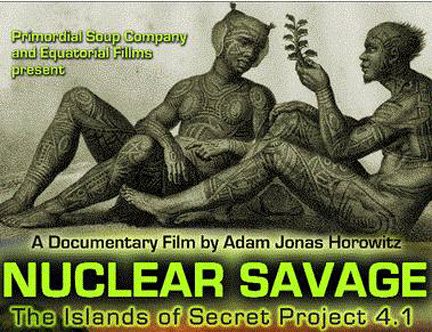 SANTA FE INDEPENDENT FILM FESTIVAL 2018
“Nuclear Savage: The Islands of Secret Project 4.1” and “Atomic Artist” Pasatiempo, Michael Abatemarco
Plan to sue France over ‘crimes against humanity’ in nuclear tests in South Pacific
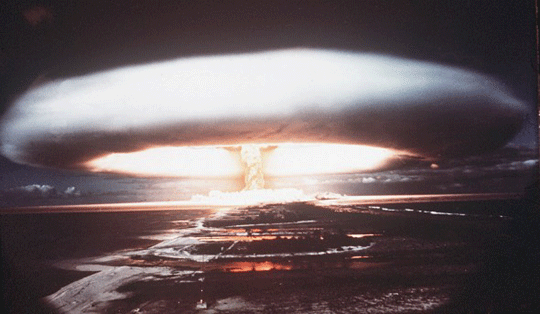 France sued for ‘crimes against humanity’ over nuclear tests in South Pacific https://www.dw.com/en/france-sued-for-crimes-against-humanity-over-nuclear-tests-in-south-pacific/a-45826054
France is being taken to the International Criminal Court for nuclear weapons tests in French Polynesia. France has long denied responsibility for the impacts of the tests and only recently began compensating civilians. France is being taken to the International Criminal Court (ICC) for carrying out nuclear weapons tests in French Polynesia, a Polynesian opposition leader announced on Tuesday.
Oscar Temaru, the archipelago’s former president and current leader of the Tavini Huiraatira Party, announced the move during a United Nations committee dealing with decolonization.
Temaru accused France of “crimes against humanity” and said that he hopes to hold French presidents accountable for the nuclear tests with the ICC complaint.
“We owe it to all the people who died from the consequences of nuclear colonialism,” he told the UN committee.
Maxime Chan from Te Ora Naho, an association for the protection of the environment in French Polynesia, told the UN that there had been 368 instances of radioactive fallout from the tests and that radioactive waste had also been discharged into the ocean — violating international rules.
Three decades of nuclear tests
The French territory, currently home to 290,000 people, is best known for the popular tourist island of Tahiti, but its atolls of Mururoa and Fangataufa were used for decades for nuclear tests.
France carried out 193 nuclear weapons tests on islands in the archipelago between 1960 and 1996 until French President Jacques Chirac halted the program.
Around 150,000 military and civilian personnel were involved in France’s nuclear tests, with thousands of them later developing serious health problems.
France has long denied responsibility for the detrimental health and environmental impacts of the tests, fearing that it would weaken the country’s nuclear program during the Cold War.
In 2010, France passed a law allowing military veterans and civilians to be compensated if their cancer could be attributed to the nuclear tests. Out of approximately 1,000 people who have filed complaints against France, only 20 have been compensated.
French government group to Mururoa to meet nuclear test veterans
French group to visit French Polynesia nuclear sites https://www.radionz.co.nz/international/pacific-news/367417/french-group-to-visit-french-polynesia-nuclear-sites 27 September 2018 A French government commission is about to visit French Polynesia’s nuclear weapons test sites to help modify the French compensation law. The 12-member commission includes three of French Polynesia’s parliamentarians in Paris as well as representatives of ministries such as defence, health and justice.
Samoan Prime Minister Tuilaepa Sailele berates world leaders who fail to take climate issue seriously
World leaders who deny climate change should go to mental hospital – Samoan PM https://www.theguardian.com/environment/2018/aug/31/world-leaders-who-deny-climate-change-should-go-to-mental-hospital-samoan-pm
Tuilaepa Sailele berates leaders who fail to take issue seriously, singling out Australia, India, China and the US, Guardian, Kate Lyons, 31 Aug 18 The prime minister of Samoa has called climate change an “existential threat … for all our Pacific family” and said that any world leader who denied climate change’s existence should be taken to a mental hospital.
In a searing speech delivered on Thursday night during a visit to Sydney, Tuilaepa Sailele berated leaders who fail to take climate change seriously, singling out Australia, as well as India, China and the US, which he said were the “three countries that are responsible for all this disaster”.
“Any leader of those countries who believes that there is no climate change I think he ought to be taken to mental confinement, he is utter[ly] stupid and I say the same thing for any leader here who says there is no climate change.”
Speaking at the Lowy Institute, just days before the beginning of the Pacific Islands Forum in Nauru, the Samoan prime minister seemed to take a swipe at Australia’s commitment to minimising the impact of climate change, which he called the “single greatest threat to the livelihood, security and wellbeing peoples of the Pacific
“While climate change may be considered a slow onset threat by some in our region, its adverse impacts are already felt by our Pacific islands peoples and communities,” said Sailele. “Greater ambition is necessary to limit global warming to 1.5 degrees centigrade and Pacific island countries continue to urge faster action by all countries.”
Sailele said addressing climate change required “political guts” from leaders. “We all know the problem, we all know the causes, we all know the solutions. All that is left would be some political courage, some political guts to get out and tell the people of your country, ‘Do this, this, this, or there is any certainty of disaster.’”
Sailele’s speech comes as leaders of Pacific nations are preparing to meet at the Pacific Islands Forum in Nauru next week, where Australia is expected to face questions about its emissions targets.
Australia’s new prime minister, Scott Morrison, is under pressure from some members of his party to abandon Australia’s commitment to reducing emissions under the Paris agreement.
His immediate predecessor, Malcolm Turnbull, was due to attend the forum, but Morrison has announced he is sending his new foreign minister, Marisa Payne, a move the opposition Labor party condemned as “an insult to our neighbours” as well as “a serious strategic mistake”.
Saliele’s speech also touched on China’s rising influence in the Pacific, saying the region had become “an increasingly contested space”. “The big powers are doggedly pursuing strategies to widen and extend their reach, inculcating a far-reaching sense of insecurity.”
Pacific island nations critical of climate sceptics, call on Australia to act on climate change, and to help them
Key points:
- Mr Sailele says “greater ambition” is needed to stop impact of climate change
- He warns geostrategic competition is creating uncertainty for small Pacific countries
- Australia, New Zealand and the US have been scrambling to reassert influence in the Pacific
Mr Sailele told the Lowy Institute in Sydney that climate change posed an “existential challenge” to low lying islands in the Pacific, and developed countries needed to reduce pollution in order to curb rising temperatures and sea levels.
“We all know the problem, we all know the solutions, and all that is left would be some political courage, some political guts, to tell people of your country there is a certainty of disaster,” Mr Sailele said.
The Prime Minister’s intervention came as some Coalition MPs press the new Prime Minister Scott Morrison to abandon Australia’s promise to cut carbon emissions under the Paris agreement.
New Foreign Minister Marise Payne is also expected to face questions about Australia’s climate change policies at the Pacific Islands Forum leader’s meeting in Nauru next week.
Senator Payne and Pacific leaders are set to sign the “Biketawa Plus” security agreement, which declares that climate change remains the “single greatest threat to the livelihoods, security and wellbeing of the peoples of the Pacific”.
Several other leaders — including Fiji’s Prime Minster Frank Bainimarama and the Marshall Island’s President Hilda Heine — have also called on Australia to do more to cut emissions.
Mr Sailele told the audience that “greater ambition” was needed to stop the destructive impact of climate change.
“While climate change may be considered a slow onset threat by some in the region, its adverse impacts are already being felt by Island communities,” he said……… http://www.abc.net.au/news/2018-08-31/samoan-prime-minister-hits-out-at-climate-change-sceptics/10185142
 |
ReplyForward
|
The possibility of nuclear weapons in South China Sea worries Philippines
The US Department of Defense, in its annual report to the US Congress, warned that Beijing may soon install floating nuclear power stations on its military bases in the disputed waterway. Presidential spokesperson Harry Roque said the Philippine government is concerned over any entry of nuclear weapons on Philippine territory.
“We are concerned about the possibility that any foreign power be it American, Russian, Chinese may bring nuclear warheads into our territory and into Asean, which is declared as a nuclear-free zone,” Roque said in a press briefing Thursday.
Citing the Constitution, Roque stressed that the Philippines is a nuclear-free zone. Section 8, Article 2 of the 1987 Constitution states that “The Philippines, consistent with the national interest, adopts and pursues a policy of freedom from nuclear weapons in its territory.”
The Malacañang spokesman also noted that the whole Association of Southeast Asian Nations is a nuclear-free zone under the Treaty on the Southeast Asia Nuclear Weapon-Free Zone, which was signed.
Roque, however, said that the warning was only “US observation” and that the Philippines is in no position to verify such report.
“The important point to underscore is we have a nuclear-free policy and that should be applied to all countries, including the Americans, because the Americans have been using nuclear-powered [weapons] and have been stationing warships with nuclear capability as well,” he said………. https://www.philstar.com/headlines/2018/08/23/1845175/philippines-concerned-over-possible-nuclear-weapons-south-china-sea#hyf82odPHqmY8vO2.99
1 This Month
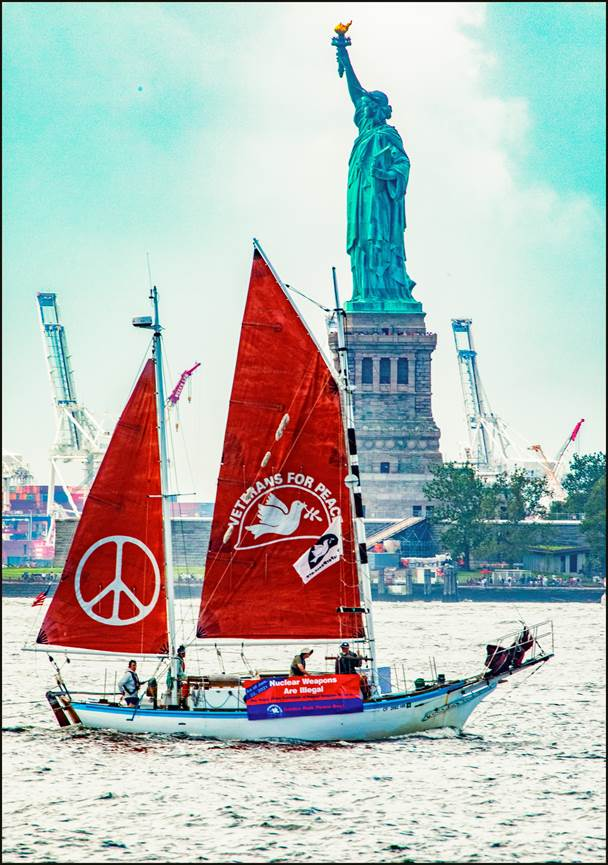
22,000+ miles voyaging for nuclear disarmament
and a radiation-free environment https://vfpgoldenruleproject.org/

of the week- – THE ONENESS of HUMANITY
We the Nuclear Free North


Cuba Is Not a Failed State – It Is a Besieged State
PETITION: “Global Appeal to Endorse Palestinian Right of Return of Refugees”
To see nuclear-related stories in greater depth and intensity – go to https://nuclearinformation.wordpress.com
-
Archives
- July 2026 (27)
- June 2026 (287)
- May 2026 (306)
- April 2026 (356)
- March 2026 (251)
- February 2026 (268)
- January 2026 (308)
- December 2025 (358)
- November 2025 (359)
- October 2025 (376)
- September 2025 (257)
- August 2025 (319)
-
Categories
- 1
- 1 NUCLEAR ISSUES
- business and costs
- climate change
- culture and arts
- ENERGY
- environment
- health
- history
- indigenous issues
- Legal
- marketing of nuclear
- media
- opposition to nuclear
- PERSONAL STORIES
- politics
- politics international
- Religion and ethics
- safety
- secrets,lies and civil liberties
- spinbuster
- technology
- Uranium
- wastes
- weapons and war
- Women
- 2 WORLD
- ACTION
- AFRICA
- Atrocities
- AUSTRALIA
- Christina's notes
- Christina's themes
- culture and arts
- Events
- Fuk 2022
- Fuk 2023
- Fukushima 2017
- Fukushima 2018
- fukushima 2019
- Fukushima 2020
- Fukushima 2021
- general
- global warming
- Humour (God we need it)
- Nuclear
- RARE EARTHS
- Reference
- resources – print
- Resources -audiovicual
- Weekly Newsletter
- World
- World Nuclear
- YouTube
-
RSS
Entries RSS
Comments RSS
 nuclear-news