Stuff, LAURA WALTERS , June 28 2018, When the United States dropped the atomic bomb on Hiroshima in 1945, Taeko Yoshioka Braid watched from the second-floor window of herclassroom, 60 kilometres away.
Braid, who moved to New Zealand in 1956 and now lives in Hastings, travelled to Hiroshima the next day with classmates to look for her family members and take supplies to the victims.
Yoshioka Braid said it was hard to talk about the horrors she saw as a 13-year-old in Hiroshima, including children separated from their parents, and people dying from burns from the blast and the radiated water.
On her second trip to the town at the epicentre, she felt something sticking to her shoes. She eventually realised it was human skin, which had melted off, following the blast.
…….. At a time when the international rules-based order is being challenged, and nuclear weapons remain a global issue, Prime Minister Jacinda Ardern has reinstated the Cabinet portfolio of disarmament and arms control. Ardern announced Winston Peters would take up the ministerial role, during her first foreign policy speech in February. In September last year, New Zealand was one of the first countries to sign the Treaty on the Prohibition of Nuclear Weapons at a ceremony during the United Nations General Assembly.
The treaty is a landmark legally-binding international instrument prohibiting the use of nuclear weapons and related activities.
In July last year, it was adopted by the United Nations Conference to Negotiate a Legally Binding Instrument to Prohibit Nuclear Weapons, Leading Towards their Total Elimination.
Yoshioka Braid’s comments came during the international treaty examination, at a Foreign Affairs, Defence and Trade Select Committee hearing on Thursday. Something that needed to take place before New Zealand ratified the treaty.
“If anyone went there the day the bombed dropped, I’m sure they would all think like me: never again…
“I don’t want those same sorts of things to happen anywhere in the world; anywhere in the world.”
Alternative NZ submission by stuffnewsroom on Scribd….(included on original) ..
It was difficult to describe the experience, she said, adding that the bomb was so strong, some people died instantly, others were alive but too injured to move or talk.
Her daughter, Jacky Yoshioka Braid said New Zealand needed to take a leadership role in the elimination of nuclear weapons.
“We need to stop the fighting, and stop this fantasy around a nuclear war that we possibly could survive – it won’t happen.
“We saw what happened in Hiroshima, we’ve seen the after effects of what happened there and in Nagasaki. They were tiny compared to what could happen today.”
New Zealand created a world-leading anti-nuclear policy in 1984, after seeing what happened in Hiroshima, Nagasaki and the cold war years.
“I think it’s really important that New Zealand takes this leadership role and helps guide these other young people around the world who want to stop the nuclear proliferation,” she said……….. https://www.stuff.co.nz/national/politics/105072027/hiroshima-witness-urges-nz-to-lead-nuclear-weapons-elimination
June 29, 2018
Posted by Christina Macpherson |
New Zealand, PERSONAL STORIES, Reference, weapons and war |
Leave a comment
 Hiroshima witness urges NZ to lead nuclear weapons elimination, Stuff, LAURA WALTERS , June 28 2018
 “………Last month, former Green party candidate, and disarmament campaigner, Thomas Nash said “for technology that hasn’t been used in conflict since 1945, nuclear weapons sure have a knack of getting on to the global agenda”.
But it wasn’t surprising given they posed the greatest existential threat to humanity next to climate change, he said.
Nash also spoke to the select committee on Thursday, urging New Zealand to take a leadership role in eliminating nuclear weapons and global disarmament, in general.
“This treaty has a humanitarian purpose, this is rather distinct from previous international deliberations on nuclear weapons, which have tended to be about big power politics between countries weighing up the grand game and the balance,” he said.
Nash painted a picture of “Cambridge grads, strutting around in operations rooms, thinking about deterrents and game theory, missile silos and sleek nuclear submarines”.
“I think it’s important to think about bringing back this human element of the impact of nuclear weapons, because violence, militarism, relies on a dehumanisation of violence; abstracting it away from us.
“And I think if we’re going to move away from that, we have to acknowledge the human face.”
On behalf of New Zealand Alternative, Nash recommended New Zealand ratify the treaty next month, adding that early ratification would signal New Zealand’s commitment to eliminating nuclear weapons and to making genuine progress on international disarmament work.
Nash was part of the International Campaign to Abolish Nuclear Weapons, which was awarded a Nobel Peace Prize last year after the group of Geneva-based activists was recognised for its role in pushing for a United Nations treaty declaring the weapons illegal.
ABOUT THE TREATY
The Treaty on the Prohibition of Nuclear Weapons is a landmark legally-binding international instrument prohibiting the use of nuclear weapons and related activities.
In July last year, it was adopted by the United Nations Conference to Negotiate a Legally Binding Instrument to Prohibit Nuclear Weapons, Leading Towards their Total Elimination.
In September last year, New Zealand was one of the first countries to sign the treaty, at a ceremony during the United Nations General Assembly.
At the time, then-foreign minister Gerry Brownlee said it represented an important step towards a nuclear-free world, despite no countries that currently hold nuclear weapons signing the treaty.
New Zealand’s signing of the treaty was consistent with the country’s long-standing commitment to international nuclear disarmament efforts.
“It establishes the first global prohibition on nuclear weapons and provides the international legal framework for a world without these weapons,” Brownlee said at the time.
New Zealand joined over 120 other states in supporting the adoption of the treaty at a United Nations conference in July last year.
The treaty would come into force once 50 states have ratified it. At this stage 10 countries have ratified the treaty, according to the International Campaign to Abolish Nuclear Weapons. https://www.stuff.co.nz/national/politics/105072027/hiroshima-witness-urges-nz-to-lead-nuclear-weapons-elimination
June 29, 2018
Posted by Christina Macpherson |
New Zealand, weapons and war |
Leave a comment
 HELL ON HIGH SEAS https://www.thesun.co.uk/news/6626017/us-cold-war-nuclear-tests-bikini-atoll-pacific-ocean-video/ EXCELLENT PHOTOS. Pacific death zone where nuke tests caused thousands of cancer fatalities 60 years after spreading radiation around the world
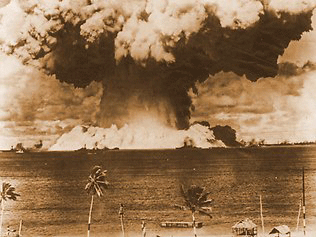
The US detonated dozens of nuclear bombs in the Marshall Islands between 1946 and 1958 including a thermonuclear weapon 1,100 times more powerful than Hiroshima
By Mark Hodge, 26th June 2018
TERRIFYING footage shows a series of nuclear bomb tests unleashing the fires of hell on an idyllic Pacific Ocean paradise.
The video clips, recently released by the US government, give a glimpse into the horror caused by 67 nuke explosions detonated in Bikini Atoll and Enewetak Atoll in the Marshall Islands between 1946 and 1958.
Carried out in the early days of the Cold War, the tests included the 1954 Castle Bravo bomb which remains the most powerful thermonuclear weapon America has ever detonated.
The civilisation-wrecking 15-megatonne explosive, which exploded near Bikini, was 1,100 times bigger than the atomic bomb used to massacre thousands in Hiroshima in 1945.
Bravo – nearly three times its predicted power – exposed thousands in neighbouring islands to the radioactive fallout despite the 167 residents in Bikini Atoll being evacuated before the first test in 1946.
Fallout from the unprecedented explosion – including radioactive particles – spread around the world.
US government scientists declared Bikini safe for resettlement in the early 1970s but residents were removed in 1978 when it became clear that they were ingesting dangerously high levels of radiation from the contaminated fish, plants and water.
To this day, the small community remain exiled from their home.
Dubbed the Pacific Proving Grounds, the Marshall Island sites were used to carry out atmospheric nuclear tests – meaning the bombs were dropped from planes or detonated while underwater.
During the first test on July 1, 1946, military scientists wanted to see the impact of the bombs on naval warships and even filled the boats with animals such as pigs and rats to study the effects of nuclear fallout on livestock, reports Atomic Heritage Foundation.
Among the tests carried out in Enewetak was the world’s first hydrogen bomb, nicknamed Mike, which was detonated on November 1, 1952.
Between, 1977 and 1979, 4,000 American troops were taken to the former island paradise to clean up the contaminated remnants of the 43 nuke tests there.
Hundreds of the soldiers sent now complain of health problems including cancer, brittle bones and birth defects in their children while many of the them are already dead, reports The New York Times.
Speaking with ABC, Michael Gerrard, the director of the Earth Institute at Columbia University, explained that one of the explosions on Enewetak “didn’t work” causing devastating damage to the environment.
He said: “The plutonium was just broken apart by the conventional explosion, leading to about 400 little chunks of plutonium that were spread around the atoll.”
The troops sent to Enewetak collected and dumped 85,000 cubic metres of radioactive material – while wearing only shorts and t-shirts.
According to ABC, the plutonium in the area has a radioactive half-life of more than 24,000 years.
Islanders started to show signs of cancer in the 1960s, while residents further afield showed elevated risk of thyroid tumours and leukaemia, according to Georgetown University professor Timothy J. Jorgenson.
Former residents of Bikini Atoll and their relatives were awarded more than £1.5billion by the Marshall Islands Nuclear Claims Tribunal which was established in 1988.
But despite being permanently displaced from their home, the US stopped paying compensation in 2011 after Congress refused to provide additional funds.
Remarkably, marine life in Bikini has flourished, a Stanford University study last year.
Hundreds of schools of fish including tuna and sharks have thrived while swimming around coral as big as “cars”, reports The Guardian.
Professor Steve Palumbi’s team said Bikini’s marine life looks normal and healthy and do not have mutations like animals found at the Chernobyl nuke site, despite the island being declared a nuclear wasteland.
Palumbi believes that the absence of humans has in fact benefited the local wildlife.
He said: “The fish populations are better than in some other places because they have been left alone, the sharks are more abundant and the coral are big.
“It is a remarkable environment, quite odd.”
He added: “This is the most destructive thing we have ever done to the ocean, dropping 23 atomic bombs on it, yet the ocean is really striving to come back to life.”
The scientists believe that the worst-affected fish died off decades ago and the current marine life are only exposed to low radiation levels because they frequently swim in and out of the atoll
However, a 2012 United Nations reports found that the Bikini remains uninhabitable to humans because of “near-irreversible environmental contamination”.
The fish cannot be eaten, the plants cannot be farmed because of the contaminated soil and consuming water would be dangerous.
In his paper Professor Jorgensen writes: “What happened to the Marshall Islanders next is a sad story of their constant relocation from island to island, trying to avoid the radioactivity that lingered for decades.
“Over the years following the testing, the Marshall Islanders living on the fallout-contaminated islands ended up breathing, absorbing, drinking and eating considerable amounts of radioactivity.”
Between 1945 and 1963, the US and the Soviet Union carried hundreds of atmospheric nuclear tests.
Gases and “radioactive particles” from those detonations have been spread worldwide, according to a study carried out by the Centers for Disease Control and Prevention (CDC).
At least one CDC report claims that radiation deposits from these tests could eventually be responsible for 11,000 cancer deaths in the US alone.
The organs and tissue of anyone who has lived in the US – which carried out atmospheric nuke tests in Nevada – since 1951, shows signs of being exposed to nuclear fallout.
The fallout from 2,000 nuclear explosions in the 20th Century dispersed into weather systems which slightly raised the risk of cancer worldwide, according to the International Physicians for the Prevention of Nuclear War (IPPNW).
A 1991 IPPNW study claimed that particles from all nuclear explosions could be responsible for up to 430,000 cancer deaths globally.
June 27, 2018
Posted by Christina Macpherson |
health, OCEANIA, Reference, weapons and war |
Leave a comment
New Zealand warns its Antarctic veterans about radiation risks from leaky US Navy reactor https://www.stripes.com/news/new-zealand-warns-its-antarctic-veterans-about-radiation-risks-from-leaky-us-navy-reactor-1.533546 By SETH ROBSON | STARS AND STRIPES June 19, 2018
The New Zealand government is warning personnel who worked in Antarctica in the 1960s and ‘70s about radiation from a leaky U.S. Navy reactor.
Alerts were posted online by the New Zealand Defence Force, Antarctica New Zealand and other government entities in January and reported by local media last month.
They advise people to contact the New Zealand Office of Radiation Safety or their doctor if they think they may have been exposed to radiation from the reactor used to power McMurdo Station, Antarctica, from 1962 to 1979.
The U.S. Department of Defense has assessed the risk of radiation exposure for those who worked near the power plant as low.
However, the Department of Veterans Affairs ruled in November that retired Navy veteran James Landy’s “esophageal, stomach, liver, and brain and spine cancers, [were] incurred in active duty service.”
Landy worked at McMurdo as a C-130 flight engineer from 1970 to 1974 and from 1977 to 1981 before dying at age 63 in 2012, said his widow, Pam Landy.
He had pain in his kidneys and went to the doctor and they sent him to an oncologist who said he had cancer from radiation exposure,” she said in a phone interview Monday from her home in Pensacola, Fla.
Veterans who served in Antarctica should have been warned about the radiation risk, Pam Landy said.
“The government knew that thing was there. If they had given people a heads up he could have been diagnosed early and might have a shot at being alive,” she said. “I got a payout from the VA, but it’s a pittance compared to a life.”
The McMurdo reactor had many malfunctions, but personnel might also have been exposed during its decommissioning when soil and rock from the site was trucked through the base to be shipped off the continent, she said.
Peter Breen, 64, was a New Zealand Army mechanic about 2 miles from McMurdo at Scott Base from 1981 to 1982. Rock and soil from the reactor site was taken to a wharf in open trucks, and Breen fears he could have been exposed to contaminated dust blown by the wind or on ice harvested from nearby cliffs.
He’s campaigning for New Zealand Antarctic veterans to be recognized with a medal and offered health checks.
“It is not compensation that guys are after,” he said in a phone interview from his home in Tauranga, New Zealand. “They want a health-check program.”
robson.seth@stripes.com
Twitter: @SethRobson1
June 20, 2018
Posted by Christina Macpherson |
ANTARCTICA, health, New Zealand, weapons and war |
Leave a comment
S Senate panel to hear Guam’s inclusion in radiation exposure compensation program http://www.mvariety.com/cnmi/cnmi-news/local/105237-us-senate-panel-to-hear-guam-s-inclusion-in-radiation-exposure-compensation-program, 15 Jun 2018, Mar-Vic Cagurangan – For Variety HAGÅTÑA — Guam is getting close to achieving its long quest for inclusion in the Radiation Exposure Compensation Act.
- The U.S. Senate Committee on the Judiciary is scheduled to hold a hearing on June 27, 2018 for S.B. 197, also known as the Radiation Exposure Compensation Act Amendments or RECA of 2017, which would allow those who lived in Guam between 1945 and 1962 and who suffered from cancer or other listed radiation-related illness, to apply for compensation that would include free medical care and up to $150,000 from the remaining funds in the RECA Trust Fund.
It has been more than a decade since the National Research Council declared Guam’s eligibility for compensation under the RECA program. In 2005, the council released a report concluding that “Guam did receive measurable fallout from atmospheric testing of nuclear weapons in the Pacific” between 1946 and 1958. The council recommended that people living on island during that period be compensated under RECA “in a way similar to that of persons considered to be downwinders.”
As of 2017, the Justice Department had awarded more than $2 billion in “compassionate compensation” to eligible claimants under RECA, which provides up to $150,000 to victims of radiation. No one from Guam has received a cent from this program. The RECA program expires in 2022, but the justice department will stop receiving applications in 2020 to allow a two-year period to process the compensation.
Robert N. Celestial, president of PARS and longtime advocate for the inclusion of Guam in RECA, will testify before the U.S. Senate Committee.
About 67 nuclear devices were detonated by the Atomic Energy Commission in or around the Marshalls between 1946 and 1962. “The radiation emanating from these explosions severely affected those who lived in the Marshall Islands, resulting in everything from cancers to birth deformities. However, the radioactive fallout didn’t stop there: it extended downwind over 1,000 miles away to Guam,” states the council’s report.
- The 2005 study established that Guam did receive radioactive debris from fallout during the nuclear-weapons testing in the Pacific Ocean. The report, along with other studies, have established a correlation between the nuclear testing and high incidences of cancer in Guam, which is the second leading cause of death locally.
About 67 nuclear devices were detonated by the Atomic Energy Commission in or around the Marshalls between 1946 and 1962. “The radiation emanating from these explosions severely affected those who lived in the Marshall Islands, resulting in everything from cancers to birth deformities. However, the radioactive fallout didn’t stop there: it extended downwind over 1,000 miles away to Guam,” states the council’s report.
Vice Speaker Therese Terlaje said the introduction of the RECA amendment bill is “another step forward achieved by PARS’ fight for justice and assistance for those exposed to radiation on Guam during nuclear weapons testing conducted by the U.S. government in the Marshall Islands.”
Terlaje will also be attending the hearing and following up on lobbying that she participated in last October 2017. She will push for Resolution No. 39-34, passed unanimously by the 34th Guam Legislature in April 2017, which petitioned the U.S. Congress to pass legislation that would compensate those suffering from cancer and health issues due to radiation exposure from nuclear weapons testing in the Pacific.
“Justice is long overdue,” Terlaje said. “Free medical care and compassionate payments of $150,000 will certainly help cancer patients on Guam. Mr. Robert Celestial and the people of Guam have been working for years to educate lawmakers and ensure justice and financial redress for Guam, as has been given to other downwind populations who have endured the environmental and health impacts from radiation. A Senate hearing on whether to include Guam is an historic first. I want members of Congress to recognize that this is a very important issue that warrants justice for Guam’s people and that Guam’s leaders are in full support.”
June 15, 2018
Posted by Christina Macpherson |
OCEANIA, politics, USA |
Leave a comment
According to various experts, New Zealand would indeed likely be the best place to be in the event of a nuclear holocaust. But “best” is a relative term, and this belies just how hellish life could become on one of the world’s last inhabitable countries.
It’s a reminder that whatever happens on June 12 and at future global nuclear negotiations, New Zealand is not a disinterested bystander – and neither are those around the globe who want to treat this country like their own personal bomb shelter. No one gets to opt out of nuclear war.
What happens to NZ if global nuclear war breaks out? News Hub, 4 June 18 Anxiety over nuclear annihilation is lodged in our collective psyche. And fair enough: we’ve blundered our way to the precipice of nuclear warfare so many times by this point that it’s a wonder how we never made it over the edge.
This month, Donald Trump and North Korean dictator Kim Jong Un will, all going well, attempt to alleviate these fears somewhat, in what is arguably the best opportunity in decades to end conflict in the Korean peninsula and drive nuclear tensions down. But even if North Korea successfully de-nuclearises and the US stops its sabre-rattling, the world won’t be safe from the threat of future catastrophe: there remain around 15,000 nuclear weapons in the world today, nearly 14,000 of which are held by Russia and the United States, two countries currently experiencing a renaissance of mutual loathing.
Of course, the question on everybody’s lips is: should global nuclear war break out, what will happen to New Zealand? We after all currently enjoy the status of being the “bolt hole” for the world’s terrified billionaires, and our geographic distance and general disentanglement from the rest of the world’s geopolitical jostling suggests that should the worst happen, we at the very least won’t be in the firing line.
This is a small consolation. According to various experts, New Zealand would indeed likely be the best place to be in the event of a nuclear holocaust. But “best” is a relative term, and this belies just how hellish life could become on one of the world’s last inhabitable countries.
……… some have tried to map out a potential aftermath. In a 2014 paper for Earth’s Future, a team of scientists attempted to model the effects of a limited, regional nuclear war between India and Pakistan that would see each country use 50 warheads, each with a yield of 15 kilotons, about the same as the bomb dropped on Hiroshima.
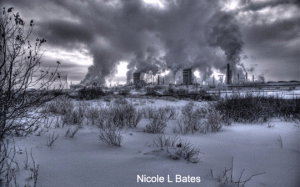 The results weren’t pretty. Even a “limited” war like this would send five megatonnes of smoke into the stratosphere, heating it by up to 100degC and wiping out most of the earth’s ozone layer for as long as a decade. This means the average burn time in the sun would halve for humans, while the resulting surge of UV radiation would wreak havoc on the world’s vegetation and sealife, including, in the latter case, disrupting the entire food chain of the ocean and damaging marine life in its early, developmental stages.
More alarming is the fact that the colossal amount of black carbon sitting up in the stratosphere would cause a global nuclear winter, the coldest average surface temperatures in 1,000 years. That means shorter growing seasons and the destruction of crops by killing frosts, which Brian Toon, one of the authors of the report, has said would reduce yields of corn, wheat and rice by 10-40 percent for years afterwards.
And this is just for a “limited” war.
“After a full scale nuclear war, temperatures would plunge below Ice Age conditions,” Toon explained to a TED audience earlier this year. “No crops would grow. It’s estimated 90 percent of the population of the planet would starve to death.”
Where does New Zealand fit into all this? Based on what several experts have told me, there’s good news and bad news.
The good news is, we would likely be spared the worst consequences of all this. Experts like Toon and Brian Martin, a social scientist at the University of Wollongong who has a PhD in theoretical physics, say that we’d have little to fear from radiation drifting our way. The most harmful isotopes would decay before reaching our shores, and even fallout drifting over from a potential attack on Australia would likely be blown eastward, where it would be rained out.
It’s a similar story when it comes to surface temperature. According to the 2014 study, the scenario it’s based on would produce a drop of around somewhere between 1 and 1.5 degrees – nothing to sneeze at, but substantially less than the 5-7 degrees below normal predicted in the centres of North America and Eurasia.
“In New Zealand, you can still be growing crops,” says Michael Mills, an atmospheric scientist at the National Centre for Atmospheric Research, and another of the study’s authors.
Brian Toon, however, sees a less cheerful forecast in the case of a full-scale nuclear war. “It would cause low light levels and winter conditions in New Zealand for several years, perhaps up to a decade,” he says. “No one has evaluated the impact directly on New Zealand, but I would imagine nothing would grow for several years.”
……… It’s a reminder that whatever happens on June 12 and at future global nuclear negotiations, New Zealand is not a disinterested bystander – and neither are those around the globe who want to treat this country like their own personal bomb shelter. No one gets to opt out of nuclear war. https://www.newshub.co.nz/home/new-zealand/2018/06/what-happens-to-nz-if-global-nuclear-war-breaks-out.html
June 4, 2018
Posted by Christina Macpherson |
New Zealand, weapons and war |
Leave a comment
Philippines mulls nuclear revival, SBS News, 23 May 18 Phillipines holds the only nuclear power plant in Southeast Asia, and some in the power hungry country are looking at reviving the mothballed facility.
…….Opposition to reviving Manila’s nuclear ambitions remains strong, with advocates citing a reliance on imported uranium, high waste and decommissioning costs, as well as safety concerns.Geologist Kelvin Rodolfo has repeatedly warned against the activation of the Bataan plant, saying it sits on an active earthquake fault that runs through a volcano, currently dormant.
He would like to see the International Atomic Energy Agency (IAEA) make that judgment. https://www.sbs.com.au/news/philippines-mulls-nuclear-revival
May 25, 2018
Posted by Christina Macpherson |
Philippines, safety |
Leave a comment

Guardian 25th April 2018 ,Hundreds of thousands of people will be forced from their homes on
low-lying islands in the next few decades by sea-level rises and the contamination of fresh drinking water sources, scientists have warned.
A study by researchers at the US Geological Survey (USGS), the Deltares Institute in the Netherlands and Hawaii University has found that many small islands in the Pacific and Indian Oceans will be uninhabitable for humans by the middle of this century. That is much earlier than previously thought.
Experts say the findings underline the looming climate change driven migration crisis that is predicted to see hundreds of millions of people forced from their homes in the coming years. More than half a
million people around the world live on atoll islands, often extraordinary and beautiful structures based on coral reefs. Their closeness to sea level makes them particularly vulnerable to climate change.
https://www.theguardian.com/environment/2018/apr/25/climate-change-to-drive-migration-from-island-homes-sooner-than-thought
April 27, 2018
Posted by Christina Macpherson |
climate change, OCEANIA |
Leave a comment

https://www.eurekalert.org/pub_releases/2018-04/ugs-ml042318.php, US GEOLOGICAL SURVEY
Sea-level rise and wave-driven flooding will negatively impact freshwater resources on many low-lying atoll islands in such a way that many could be uninhabitable in just a few decades. According to a new study published in Science Advances, scientists found that such flooding not only will impact terrestrial infrastructure and habitats, but, more importantly, it will also make the limited freshwater resources non-potable and, therefore, directly threaten the sustainability of human populations.
Most of the world’s atolls are in the Pacific and Indian oceans. The scientists focused on Roi-Namur Island on Kwajalein Atoll in the Republic of the Marshall Islands for their site study from November 2013 to May 2015. The Republic of the Marshall Islands has more than 1,100 low-lying islands on 29 atolls, is home for numerous island nations and hundreds of thousands of people.
Scientists from the U.S. Geological Survey, Deltares, National Oceanic and Atmospheric Administration, and the University of Hawai?i at Mānoa used a variety of climate-change scenarios to project the impact of sea-level rise and wave-driven flooding on atoll infrastructure and freshwater availability. The approach and findings in this study can serve as a proxy for atolls around the world, most of which have a similar morphology and structure, including, on average, even lower land elevations.
“The tipping point when potable groundwater on the majority of atoll islands will be unavailable is projected to be reached no later than the middle of the 21st century,” said Curt Storlazzi, USGS geologist and lead author of the new report.
Sea levels are rising, with the highest rates in the tropics, where thousands of low-lying coral atoll islands are located. Previous studies on the resilience of these islands to sea-level rise projected they will experience minimal inundation impacts until at least the end of the 21st century. However, those previous studies did not take into account the additional hazard of wave-driven overwash (storm waters and waves that wash up and over the low-lying island) nor its impact on freshwater availability.
“Such information is key to assess multiple hazards and prioritize efforts to reduce risk and increase the resiliency of atoll islands’ communities around the globe,” said Storlazzi.
These findings have relevance not only to populated atoll islands in the Marshall Islands, but also to those in the Caroline Islands, Cook Islands, Gilbert Islands, Line Islands, Society Islands, Spratly Islands, Maldives, Seychelles, and Northwestern Hawaiian Islands.
Thus, the study scientists project that, based on current global greenhouse gas emission rates, the interactions between sea-level rise and wave dynamics over coral reefs will lead to an annual wave-driven overwash of most atoll islands by the mid-21st century. Such annual flooding would result in the islands becoming uninhabitable due to frequent damage to infrastructure and the inability of their freshwater resources to recover between overwash events.
The primary source of freshwater for populated atoll islands is rain that soaks into the ground and remains there as a layer of fresh groundwater that floats on top of denser saltwater. As atoll islands come to be overwashed annually, on average, in the next few decades (assuming current greenhouse gas emission rates), flooding impacts to infrastructure and the loss of freshwater resources would make human habitation difficult in most locations beginning between the 2030s to 2060s, requiring the relocation of island inhabitants or significant financial investments in new infrastructure.
“The overwash events generally result in salty ocean water seeping into the ground and contaminating the freshwater aquifer. Rainfall later in the year is not enough to flush out the saltwater and refresh the island’s water supply before the next year’s storms arrive repeating the overwash events,” explained Stephen Gingerich, USGS hydrologist and co-author of the new report.
The full report, “Most Atolls will be uninhabitable by the mid-21st century due to sea-level rise exacerbating wave-driven flooding,” in Science Advances is available online.
April 27, 2018
Posted by Christina Macpherson |
climate change, OCEANIA |
Leave a comment
No more drilling. Af, CARLY CASSELLA, 13 APR 2018 Prime Minister Jacinda Ardern is doing everything in her power to wean New Zealand off fossil fuels.
This week, the New Zealand government announced it will no longer grant any new offshore oil exploration permits. The 22 permits that have already been issued are set to expire in 2030.
The new Prime Minister, who took office last year, says this is all part of her aggressive, long-term plan to move towards a carbon-neutral future.
“When it comes to climate change, our plan is clear,” said Ardern, according to The New York Times.
“We are committed to the goal of becoming a net zero emissions economy by 2050.”
Ardern added that her ultimate goal is to switch the country’s electricity system to 100 percent renewable energy by 2035.
….. Ardern’s government has promised that “no current” jobs will be lost as a result of the change, which still honors “all agreements with current permit holders.” https://www.scienceaf.com/new-zealand-prime-minister-jacinda-ardern-offshore-drilling#.WuFOjDvAQh0.twitter
April 27, 2018
Posted by Christina Macpherson |
climate change, New Zealand |
Leave a comment
 FT 12th April 2018 , New Zealand has become one of the world’s first countries to ban future offshore oil and gas exploration in a move heralded by environmental campaigners as a symbolic blow to “Big Oil”.
“There will be no further offshore oil and gas exploration permits granted,” said Jacinda Ardern, New
Zealand’s prime minister, on Thursday. “We must take this step as part of
our package of measures to tackle climate change,” she said.
The South Pacific nation’s ban is an important policy move at a time when nations are
exploring how to comply with their requirements under the Paris climate
change agreement.France, Belize and Costa Rica have already announced bans
on either fossil fuel exploration or production, although these are largely
symbolic as none are ma jor oil producers.
However, the policy shift announced by Prime Minister Ms Ardern marks a change in direction for
New Zealand, which under the previous conservative government prioritised
fossil fuel exploration to help the economy grow.
https://www.ft.com/content/d91e9864-3ded-11e8-b7e0-52972418fec4
April 14, 2018
Posted by Christina Macpherson |
climate change, New Zealand, politics |
Leave a comment
 Anti-Nuclear Movement Founder Backs Cancer Crisis Clean-Up at US Base in Azores, 1 March 2018 , WASHINGTON (Sputnik) – The cancer epidemic sweeping Terceira Island in the Azores, home to the US Air Base at Lajes, is a health crisis that requires an immediate environmental cleanup, Dr. Helen Caldicott, founder of a Nobel Peace Prize anti-nuclear movement told Sputnik.
“The situation is a severe public health problem and all necessary facilities should be immediately devoted to helping these poor people,” Caldicott, founder of Physicians for Social Responsibility, the organization that was the co-winner of the 1985 Nobel Peace Prize, said.
Many inhabitants of Portugal’s Terceira Island on which Lajes is located are suffering from deadly diseases, especially cancer, at rates far higher than the rest of the Azores islands in the eastern Atlantic, the Russia-based Ruptly video agency reported.
Caldicott said the report was consistent with a pattern of environmental recklessness and irresponsibility at other US military facilities round the world.
“The US military has an exceptional reputation for leaving behind their toxic wastes wherever they are located, be it US territory or foreign soil… The situation confronting the residents of Terceira Island is typical of so many severely contaminated areas associated with Pentagon activities,” she said.
According to two reports that the local newspaper Diario Insular obtained via a confidential source, the US military is aware of 30 areas of concern and 17 major fuel spills, with six of them having the maximum level of severity on the island.
The reports also said Terceira had about 38 areas with high concentrations of hydrocarbons and heavy metals, including lead and zinc both in water and soil.
Caldicott said the existence of such concentrations of hazardous substances constituted a very clear and dangerous threat to public health.
“The chemicals named in this article as well as the existence of deadly alpha radioactive emitters are obviously contributing to this terrible cancer epidemic among the local population,” she said.
Caldicott also expressed skepticism that the US Air Force could be persuaded or pressured into carrying out a full-scale environmental clean-up on Terceira Island.
“There are some complex chemical methods now available to help ‘clean’ up these toxic carcinogenic hydrocarbon compounds, but as the waste inventories seem very extensive, I doubt that the Air Force will bother itself to perform such a task. It never has before to my knowledge,” she said.
The radioactive waste would need to be carefully assessed and charted before anything could be done, Caldicott concluded.
https://sputniknews.com/analysis/201802241061956949-us-base-azores-cancer/.
March 3, 2018
Posted by Christina Macpherson |
climate change, health, OCEANIA |
Leave a comment
Radiation warning! UWI researchers explore risks of medical treatments that involve radiation http://www.jamaicaobserver.com/news/radiation-warning-uwi-researchers-explore-risks-of-medical-treatments-that-involve-radiation_125898?profile=1373 BY FALON FOLKES, Staff reporter folkesf@jamaicaobserver.com, February 25, 2018
RESEARCHERS at The University of the West Indies (UWI) are working assiduously to gather information to educate Jamaicans about the risks of treatments that involve too much exposure to radiation.
The medical use of radiation is known for being the largest, man-made contribution to the overall annual radiation dose of humans receive.
An overview of the researchers’ study mentioned that, according to the World Health Organisation, more than 3.6 billion diagnostic examinations, 37 million nuclear medicine procedures and 7.5 million radiotherapy treatments are executed annually.
Head of the materials and Medical Physics Research Group, Professor Mitko Voutchkov, explained to the Jamaica Observer that radiation damages the (deoxyribonucleic acid) of the healthy tissue cells in one’s body.
“Cancer is the tissue cells that don’t have biological function. Interestingly, they grow quickly and the cancer spreads all over the body. So this is the radiation effect-radiation damage the cells,” he said.
In addition to this, radiation can also cause hair loss, redness of the skin, radiation burns, fatigue, and even osteoporosis, which is a medical condition in which a person’s bones become brittle and fragile.
“The risk comes from the medical diagnostics, especially if you go very frequently to CT (computed tomography) scan. If you do one or two per year it’s fine, but sometimes it [one’s illness] will require much more,” Professor Voutchkov explained.
“MRI (magnetic resonance imaging) is not so much damaging. If they can have an MRI instead of CT scan, let them choose that,” he added.
With the rapid advancements in technology, modern medical radiation equipment are emitting higher radiation doses. The researchers are concerned about people’s risk of overexposure to this man-made radiation.
The research group’s priority is creating a radiation safety culture in medical radiation imaging and radiotherapy. A part of this mandate requires them to carry out “regular quality control and calibration of medical radiation equipment”.
A survey was done on radiological safety practices in diagnostic centres in Jamaica, to assess their compliance with the Nuclear Safety and Radiation Protection Act. Additionally, a control study was conducted in a New York hospital to compare the radiation safety and management practices to that of Jamaica.
The recommendation arising from these studies is that, a management system is needed to keep records of the dose measurements, storage of dosimeters (a device that keeps track of a person’s exposure to radiation), and their safe use.
It is Professor Voutchkov’s notion that Jamaica’s patients need to be educated on the effects that radiation can have on them when they do treatments at diagnostic centres.
“I travel abroad and I see everywhere that they have videos, they have brochures, so the patients, they get prepared, so they accept the risk. Here, we have nothing,” he said.
With adequate information, he told the Sunday Observer, patients can decide whether or not to consult their general practitioner about alternative treatments, where possible.
As for the diagnostic centres, the professor recommends that equipment be checked for radiation levels to which patients are exposed. He asserted that new diagnostic techniques are developed to lower radiation dose, because radiation use during medical diagnostics should be limited.
February 27, 2018
Posted by Christina Macpherson |
OCEANIA, radiation |
Leave a comment
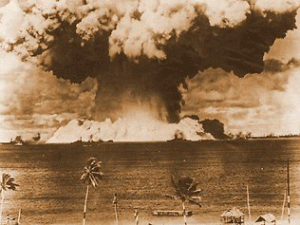 French overseas minister open to nuclear study https://www.onepng.com/2018/01/french-overseas-minister-open-to.html, 1/26/2018 The French overseas minister says she is not opposed to calls for a study into the possible genetic consequences of the French nuclear weapons tests in French Polynesia.
Annick Girardin has told journalists in Tahiti that there will be an answer to the recently raised calls for such a study.Last week, a child psychiatrist, who had worked in French Polynesia for years, suggested that an independent investigation be carried out after noticing a high incidence of disturbed and deformed children among the off-spring of people exposed to radiation from the atmospheric tests.
Girardin has acknowledged the concerns, saying it has to be established how to deal with the question and to see if it is possible to work on it with other countries.
The minister has restated that the former president Francois Hollande recognised two years ago in Papeete the French legacy and assumed responsibility.
She has also launched a project in Papeete to build an institute of archives and documents related to the tests.
She has also frozen the sale of land in the city previously used by the navy for its command for it to be able to be used for a memorial site.The head of the nuclear test veteran’s organisation Roland Oldham is dismissive, saying this will only see the light of day once people are dead.
He has continued to urge Paris to compensate the nuclear test victims suffering from poor health.
Until 2009, France claimed its weapons tests were clean but then passed a law accepting compensation demands.
Hundreds of applications have been filed since but almost all have been thrown out.
January 29, 2018
Posted by Christina Macpherson |
children, France, OCEANIA, weapons and war |
Leave a comment
Guano, Nuclear Testing, Chemical Weapons Another guano claim converted for U.S. military use is Johnston Atoll (Kamala), located about 800 miles southwest of Honolulu.
One phase of expansion on Johnston Island involved construction of a launch pad for high-altitude missile tests for Operation Dominic in the 1960s. Two of the tests were aborted, with radioactive contamination falling on the runway. Forty years later, in 2002, the Air Force “finished burying thousands of cubic meters of plutonium-contaminated waste in a 25-acre landfill on the atoll.”
The question, then, is not when will islands be submerged, but when will sea-level rise make life on low-lying islands impossible.
The answer to that question is close at hand for a number of Pacific islands.
Perhaps the biggest legal stride in New Zealand is Prime Minister Jacinda Ardern’s recent announcement of plans for a special refugee visa for Pacific Islanders, starting with 100 places annually. “We are anchored in the Pacific,” Ardern told reporters. “Surrounding us are a number of nations, not least ourselves, who will be dramatically impacted by the effects of climate change. I see it as a personal and national responsibility to do our part.”

American Polynesia, Rising Seas and Relocation, By Laray Polk, Global Research, January 06, 2018 The Asia-Pacific Journal: Japan Focus 22 December 2017 In the next 30 to 50 years, rising sea levels caused by global warming will subsume low-lying islands in the Pacific Ocean. Inhabitants will have to relocate, but there are few choices. Among nations (with the exception of Fiji and New Zealand) there is little preparation for the inevitable migration of Pacific Islanders. Which nations should commit to the processes of equitable relocation?
The following article will address this question through historical context and colonial occupation; current legal debates surrounding climate change and maritime migration; and the potential rights of “deterritorialized” states, such as retention of exclusive economic zones. Historical context includes an examination of U.S. insular territories in the Pacific and the continued exercise of presidential authority over island possessions.
There are strong arguments to be made that the United States has ethical obligations to assist Pacific Islanders as sea levels continue to rise, with assistance taking many forms. The U.S. is obligated namely because it is the second largest emitter of greenhouse gases, and the largest carbon emitter historically; it has extensively tested atomic and hydrogen bombs and biochemical agents in the Pacific Ocean (Marshall Islands, Christmas Island, Johnston Atoll); has commercially profited from the Pacific ecosystem since the early days of whaling; and in addition to American Samoa, Guam, and the Commonwealth of the Northern Mariana Islands, possesses eight insular territories referred to as “United States Minor Outlying Islands.”1
The U.S. Minor Outlying Islands are Baker Island, Howland Island, Jarvis Island, Johnston Atoll, Kingman Reef, Midway Islands, Palmyra Atoll, and Wake Island. (A ninth minor outlying island, Navassa Island, is located in the Caribbean Ocean, near Haiti.) Around these insular territories is an exclusive economic zone (EEZ) of 200 nautical miles. The National Oceanic and Atmospheric Administration defines the EEZ as “the zone where the U.S. and other coastal nations have jurisdiction over natural resources,” such as fisheries, energy, and other mineral resources.
When the zones of the eight minor outlying islands are combined with those of American Samoa, Guam, Hawaii and the Northern Mariana Islands, it forms a U.S. EEZ in the Pacific Ocean of 2.2 million square miles.2 The United States, seen in this light, is not a distant observer to the Pacific Islanders’ plight but an invested neighbor with shared history; a history defined in large part by commercial exploitation and continuing military entanglements……….
Guano to Nuclear Testing
The early annexation of guano islands by commercial interests explains why access to Christmas Island (Kiritimati) for testing nuclear weapons, first by the U.K., then the U.S., was easily facilitated. How economic rivalry in the 19th century turned to military alliance in the 20th century involves a more complex telling……….
Guano, Nuclear Testing, Chemical Weapons
Another guano claim converted for U.S. military use is Johnston Atoll (Kamala), located about 800 miles southwest of Honolulu. The atoll, claimed by the Pacific Guano Company in 1857, consists of four islands on a coral reef platform, all of which have been artificially expanded by blasting, dredging, and reconstruction programs. According to NOAA, the U.S. Navy began preparing the atoll for military operations in 1939 by enlarging the main island (also named Johnston). Construction lasted until 1942, followed by a second phase in 1963. That year, Johnston and Sand Islands were further enlarged and two artificial islands created, called Akau and Hikina. Johnston, by far the largest of the four, is 16 times its original size and resembles an aircraft carrier.18
One phase of expansion on Johnston Island involved construction of a launch pad for high-altitude missile tests for Operation Dominic in the 1960s. Two of the tests were aborted, with radioactive contamination falling on the runway. Forty years later, in 2002, the Air Force “finished burying thousands of cubic meters of plutonium-contaminated waste in a 25-acre landfill on the atoll.”19
Other uses of the atoll include open-air biochemical testing; chemical weapons storage; and destruction of nerve agents VX and Sarin, sulfur mustard gas, and Agent Orange. Stockpiles of chemical weaponry were transported from Okinawa, Germany, and the Solomon Islands and incinerated on site using the Johnston Atoll Chemical Agent Disposal System (JACADS).20………..
Rate of Rising Seas
Pacific island nations and territories are at different stages of addressing the pressing issues of sea-level rise. Discussions involving retention of EEZs—and the rights and financial security maritime zones confer—represent the long game, and enters into a conceptual realm of “What is nationhood, if a nation no longer exists?” Legitimate answers to questions of this magnitude would require changes in international law, a notoriously slow process. As scientific data on climate change feedbacks demonstrate, island nations and territories need answers now.
The Intergovernmental Panel on Climate Change predicts the oceans will rise by between 11 and 38 inches by the end of the century, with the potential to submerge low-lying islands. A report from 2016, written by former NASA scientist James Hansen and 16 co-authors, predicts that without serious mitigation of greenhouse gas emissions, global sea level is likely to increase “several meters over a timescale of 50 to 150 years.”34 If less than one meter of sea-level rise has the potential to cause an island to disappear by 2100, then Hansen’s numbers portend something more urgent. The question, then, is not when will islands be submerged, but when will sea-level rise make life on low-lying islands impossible.
The answer to that question is close at hand for a number of Pacific islands. Sea-level rise increases both the frequency and magnitude of flooding caused by high tides and storms; saltwater intrusion destroys freshwater sources and the prospect of productive agriculture. Writer and filmmaker Jack Niedenthal, who lives in the Marshall Islands, says that on the island of Kili, “there have been huge changes since about 2011.” That was the first year the island was heavily flooded, and he says it’s happened every year since. Kili, which averages an elevation of 6 feet, is home to many displaced families originally from Bikini Atoll.35
The population there, he says, is trying to raise awareness of climate change with the rest of the world, but it’s challenging. “I find it stunning that there are still so many climate change deniers out there. In the Marshall Islands, we are building numerous seawalls, some very large, others are just building them with old tires and broken down cars.”……..
Freedom and Fear in the High Seas
At a climate change symposium in 2015, Fiji’s Foreign Affairs secretary Esala Nayasi explained the dilemma of Islanders succinctly: “These are people who are on the verge of losing their land that they call home, losing their critical basic necessities and infrastructure, culture, identity and traditional knowledge. This is no longer a news story, it is happening now.”
Nayasi’s sense of urgency is reflected in policy. Among nations, the Republic of Fiji is in the vanguard of relocation efforts……. Because Fiji is a combination of high and low islands, it’s geographically advantaged (though not immune to climate disruption). For other nations such as Tuvalu, comprised of nine coral atolls with a mean elevation of 2 meters, all choices look the same.
Options for relocation are limited in other ways, such as the exclusion of “climate change refugees” from the 1951 Refugee Convention. Under the convention, there are five grounds to qualify for refugee status and fleeing the catastrophic conditions caused by climate change is not one of them. It hasn’t stopped legal challenge in several recent cases in New Zealand. Asylum-seeker Ioane Teitiota from Kiribati lost his case, and was deported in 2015. Sigeo Alesana from Tuvalu had his asylum application declined, but he won his immigration case based partially on the “vulnerability of the couple’s children to illnesses as a result of poor water quality.” According to Radio New Zealand, it’s the first time climate change has been successfully used in an immigration case.40
Perhaps the biggest legal stride in New Zealand is Prime Minister Jacinda Ardern’s recent announcement of plans for a special refugee visa for Pacific Islanders, starting with 100 places annually. “We are anchored in the Pacific,” Ardern told reporters. “Surrounding us are a number of nations, not least ourselves, who will be dramatically impacted by the effects of climate change. I see it as a personal and national responsibility to do our part.”41……….
The U.S. government, with the exception of the Pentagon, is in official denial concerning a major cause of climate disruption: the unabated burning of fossil fuels.44 The current administration has no interest in reducing CO2 emissions or admitting the country’s hand in environmental catastrophe. What will be of interest to U.S. policymakers when the low-lying islands and atolls in the Pacific Ocean begin to disappear is likely to center on the retention of EEZs and other maritime entitlements associated with U.S. insular possessions. If there is to be any U.S. involvement in “adaptation” in this part of the world, preserving these zones is high on the list; Pacific island nations and territories should be included in those efforts. Subsequent to resource depletion, war, nuclear testing and contamination, engagement with the Pacific Ocean ultimately means taking care of the people who live there. https://www.globalresearch.ca/american-polynesia-rising-seas-and-relocation/5624927
January 20, 2018
Posted by Christina Macpherson |
climate change, OCEANIA, wastes |
Leave a comment








 nuclear-news