A rude concrete sign indicates a deadly truth about nuclear radiation and cancer
|
Nuclear tomb leaking radioactive waste into oceans has ‘rude message’ beneath crumbling shell https://www.thesun.co.uk/tech/9986929/nuclear-tomb-radioactive-waste-message-shell/
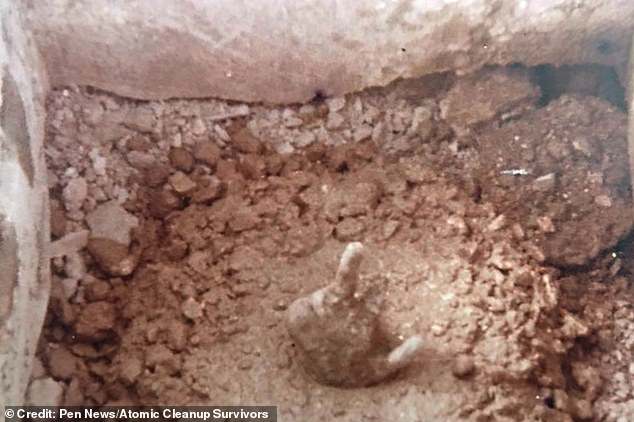
Harry Pettit, Senior Digital Technology and Science Reporter 23 Sep 2019, A CONCRETE tomb that’s haemorrhaging radioactive waste into the world’s oceans has a very rude hidden message beneath its shell. 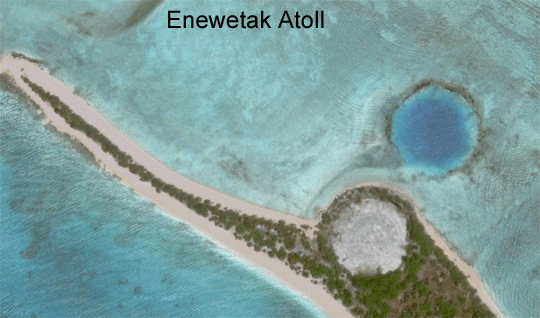 The men who built the dome in the 1970s sculpted a hand flipping the middle finger, which they buried inside the structure before it was sealed and left to crumble on a remote Pacific island. The Enewetak atoll in the South Pacific was used by the US government to test 30 megatons of atomic weapons – equivalent to 2,000 Hiroshima bombs – between 1948 and 1958. After 43 nuclear detonations, thousands of people were sent to clean the islands, shifting 3million cubic feet of contaminated soil and debris into a blast crater. He said: “The dome is a monumental size, so we wanted to put something inside there, but this was during the Cold War so the idea of an official time capsule wasn’t going to work. “So… a rubber glove? Well, we had plenty of those so that worked.” But if Mr Griego and his comrades left their mark on the island, it also left its mark on them. Our members were dying,” he said. “Dying of cancer. Given the damage wrought by the dome, the middle-finger message turned out to be more apt than anyone realised at the time. “The Runit salute turned out to be the right message in several ways,” said Paul, 62.
“One message is what’s happened to the men that were actually tasked to build this dome? What happens now to the Marshallese, the islanders? “What happens now to the Pacific Ocean, to the rest of the world? The dome is leaking and it has been leaking from the beginning.” The US government does not recognise those who worked to clean Enewetak as atomic veterans, so they cannot receive radiation exposure compensation from the Department of Veterans Affairs. |
|
Health research on descendants of Pacific nuclear veterans.
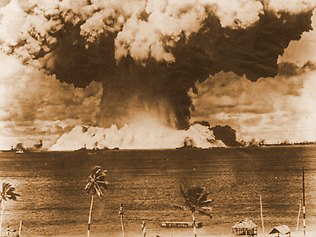 Pacific nuclear veterans’ descendants sought for study. https://www.odt.co.nz/news/national/pacific-nuclear-veterans-descendants-sought-study A search is underway for descendants of service personnel who witnessed a nuclear test at Mururoa Atoll to take part in a nationwide study.A Mururoa Nuclear Veterans Group wants all veterans who were deployed to Mururoa Atoll in 1973, and their families, to be part of a study as it’s believed their children may have been affected by their parents’ exposure to radiation.
The then Labour government sent a frigate to Mururoa Atoll, including then Cabinet Minister Fraser Colman, to protest against French nuclear testing there.
Mururoa Nuclear Veterans Group wants all people on the frigate, and their families to be part of a study as it’s believed their children may have been affected by their parents’ exposure to radiation. The group, which was established in 2013 to press the government to help families with nuclear related illnesses, had 135 members who served at the protest. Of those, 56 had children or grandchildren with unexplained medical conditions.
University of Otago associate professor David McBride, has been tasked with conducting the first medical testing of veterans’ children and grandchildren.
To establish whether genetic transfer of illnesses are related to exposure to nuclear radiation and create a registry “would be difficult but not impossible,” Mr McBride said.
Mururoa Nuclear Veterans Group vice-president, Tony Cox, was concerned veteran’s offspring could be more susceptible to conditions like leukaemia and auto-immune diseases.
“If we don’t do it now, when we die no one else is going to care. Their sickness and problems we consider is directly attributable to our service,” Mr Cox said.
“Be it Operation Grapple, Christmas Island, Mururoa, anywhere else … widows and children especially we are looking for.” The University of Otago will carry out the study from October or November this year, but a registry needs to be created for the study to work.
Mr Cox encouraged anyone with a nuclear testing background to come forward to take part in the study or identify themselves in order to be included in the registry.
Radiation Levels Higher in Marshall Islands Than in Chernobyl
Radiation Levels Higher in Marshall Islands Than in Chernobyl https://www.warhistoryonline.com/war-articles/veteran.html
This is where the United States tested atomic weapons in the 1940s and 1950s. Though it has been over sixty years since testing ended there, the islands are still more radioactive than Chernobyl and Fukushima, sites of two of the worst nuclear reactor disasters.
In a recent study, researchers tested the soil of these sites for plutonium-239 and plutonium-240. In some places, the islands had levels that were ten times higher than soil in the Chernobyl exclusion zone.
While the study was limited, the results indicate that a more thorough test is warranted. The surprising thing to the researchers was that they could not find any guidance from governments or from international organizations which indicated what a permissible level of plutonium would be.
The US tested radioactive weapons in the Marshall Islands even after dropping atomic bombs on Hiroshima and Nagasaki during World War II. At the time, the islands were a district of the Trus Territory of the Pacific Islands. The US ran this district on behalf of the United Nations.
The first tests were carried out on Bikini Atoll in 1946 and involved two bombs names Able and Baker. Over the next twelve years, the US tested 67 weapons on the Bikini and Enewetak atolls.
Those tests included one in 1951 code-named Ivy Mike – the first hydrogen bomb test. The largest hydrogen bomb test occurred in 1954 with the Castle Bravo test. Castle Bomb was over 1,000 times more powerful than Little Boy. Little Boy was the bomb that completely destroyed Hiroshima.
The radioactive damage from the tests was not contained to Bikini and Enewetak, though. Fallout from the test contaminated the Rongelap and Utirik atolls which are also part of the Marshall Islands. People on those islands became sick from the radiation levels.
In 2016, a study of background gamma radiation on the three northern atolls in the Marshall Islands, Bikini, Enewetak, and Rongelap, found elevated levels of the radiation. The study found that Bikini even had a higher level than had previously been reported.
That team returned to do more testing. They recently released the results of those studies in the PNAS journal. The studies focused on the Bikini, Enewetak, Rongelap, and Utirik Atolls in the northern part of the islands.
The studies found levels of gamma radiation that were significantly higher than the levels of a southern Marshall Island that the researchers used as a control.
Especially bad were the levels on Bikini and Naen islands. Those levels were found to be higher than the maximum exposure limit that the US and the Republic of the Marshall Islands had agreed to in the 1990s.
Along with Runi and Enjebi islands in the Enewetak Atoll, the islands were found to have radioactive plutonium levels in the soil that were higher than what has been found at Chernobyland Fukushima.
Ivana Nikolic-Hughes, director of the K1 Project at the Center for Nuclear Studies, stated that the researchers were surprised at the levels of external gamma radiation on Naen Island.
This island is on the outer edge of the Rongelap Atoll and was populated at the time of the Bravo test. The people were moved from the island, moved back and then moved away again, Nikolic-Hughes called it a “dreadful history” of treatment for the Rongelapese people.
A second study by the group used professional divers to collect 130 samples from the Castle Bravo Crater on the Bikini Atoll. Here, isotopes such as plutonium-239 and 240, americium-241 and bismuth-207 were much higher than they were on other Marshall Islands.
The researchers were interested in testing the crater because they feel it is a first step in determining how the testing of nuclear weapons has affected the ocean.
The third study tested over 200 fruits from the islands. They found many of the fruits contained higher levels of cesium-137 which would be deemed unsafe by several countries and international organizations.
The researchers hope the data gathered can be used to educate the residents of the Marshall Islands about the dangers there and inform them of whether it is safe to live on these islands or gather food from them.
Marshall Islands to survey leaking nuclear dome,
|
Marshall Islands to survey leaking nuclear dome, https://www.rnz.co.nz/international/pacific-news/395978/marshall-islands-to-survey-leaking-nuclear-dome , 5 Aug 19, The Marshall Islands government will survey a leaking nuclear-filled dome after growing international concern over the structure. The country’s Nuclear Commission said work is due to start by the end of the year studying the impact of the structure on Enewetak Atoll.It comes after the Pacific Islands Forum Secretary General, Dame Meg Taylor, called for an audit of the dome to determine if it was leaking.
Her UN counterpart, Antonio Guterres, has also raised concerns about the potential radioactive fallout. Nuclear Commission chairperson Rhea Moss-Christian says the survey will take around three years. “We just need to understand better what’s happening, what the status is. We already know that there’s the ground water beneath the dome is mixing with the lagoon water. All we know, based on DOE (US Department of Energy) studies is that the lagoon has more contamination than what is inside the dome.” Ms Moss-Christian said an ongoing US program monitoring the presence of nuclear waste in groundwater continued to be held up by a lack of funding being released by the Department of Interior. “We’ve been relying for years on the data provided by the US through the Department of Energy studies. And we haven’t had a clear enough picture for many years.” |
|
Bikini Atoll, site of nuclear bomb testing, still 10 times more radioactive than Chernobyl
After 61 Years, U.S. Testing Site For Nuclear Weapons Still 10 Times More Radioactive Than Chernobyl https://www.forbes.com/sites/davidbressan/2019/07/25/after-60-years-u-s-testing-site-for-nuclear-weapons-still-10-times-more-radioactive-than-chernobyl/#396a418e26be David Bressan
Between 1946 and 1958 the atolls of the Marshall Islands in the Pacific Ocean were testing ground for the United States nuclear arsenal. The first bomb, called Able, was detonated July 25, 1946, on Bikini Atoll. The first-ever American hydrogen bomb, with the code name Ivy Mike, was tested on Enewetak in 1951. The 1954 Castle Bravo hydrogen bomb was 1,000 times more powerful than Little Boy, the uranium bomb that destroyed the Japanese city of Hiroshima. In 12 years the U.S. tested 67 nuclear weapons on the Bikini and Enewetak Atolls. The craters formed by the explosions are visible from space; however, less obvious is the radioactive contamination of the entire area.
A survey conducted in 2015 found concentrations of radioactive plutonium-239 and -240 in the soil of Bikini and Enewetak almost ten times higher than levels in the Chernobyl exclusion zone, where thirty-three years ago the reactor experienced a catastrophic core meltdown, exploded and parts of the nuclear fuel were released. Levels of gamma radiation were also higher than previously reported on Bikini and significantly elevated on sites tested on Enewetak and Rongelap Atolls.. Radioactive fallout from the Castle Bravo test on March 1, 1954, also contaminated the nearby Rongelap and Utirik Atolls, prompting the evacuation of the local population. Still today some sites surpass the maximum exposure for radiation considered safe by experts. Apart the 67 tests, also a leaking nuclear waste repository is contributing to the radioactive pollution of the area.
On Runit Island, one of forty islands forming the Enewetak Atoll, sits “The Dome” – a 100 meters wide crater filled with 85,000 cubic meters of radioactive debris and waste and covered with half a meter of concrete. The dome sits on permeable rocks and in 2013 leaks of radioactive water were noted at the base of the structure. As sea levels are rising the entire site will be flooded, potentially causing widespread radioactive contamination, including plutonium-239.
New revelations on the very high radiation in the Marshall Islands
Nuclear isotopes on Marshall Islands up to 1000 times higher than Chernobyl or Fukushima https://www.news.com.au/technology/environment/nuclear-isotopes-on-marshall-islands-1000-times-higher-than-chernobyl-or-fukushima/news-story/eaacb5841fec37b39d8a907353dceb50, 17 July 19,Between Australia and Hawaii are islands where locals were banished due to nuclear testing. New research reveals the extent of the problem. Rohan Smith@ro_smith
Never mind Chernobyl and Fukushima.
New research shows a tiny island halfway between Australia and Hawaii has concentrations of nuclear material up to 1000 times higher than at two well-known meltdown locations in Ukraine and Japan.
Research carried out by Columbia University and published this week shows deadly plutonium levels are far higher than previously thought on the Marshall Islands. The group of 29 atolls was subject to 67 US nuclear tests between 1946 and 1958, with locals forced to flee as the country dropped bomb after bomb in paradise.
The United States entombed nuclear waste under a dome on the island of Runit that some believe is leaking into the Pacific Ocean. However the real impact of the contamination is only now being realised.
Researchers wrote that two atolls, Bikini and Enewetak, “were used as ground zero” and took the brunt of the impact.
On Enewetak, the first-ever hydrogen bomb was tested. But Bikini was the site of the world’s largest-ever hydrogen bomb test — known as Castle Bravo.
The tests, researchers say, “caused unprecedented environmental contamination and, for the indigenous peoples of the islands, long-term adverse health effects”.
Researchers tested levels of radioactive isotopes in soil and food sources and found “a real concern” on Runit where the huge dome was designed to contain radiation but is not working.
“The presence of radioactive isotopes on the Runit Island is a real concern, and residents should be warned against any use of the island,” researchers said.
“Moreover, wash-off of existing isotopes off the islands into the ocean from weathering and continued sea level rise continues to threaten, further contaminating the lagoon and the ocean at large.”
On Bikini, researchers found concentrations of particular radioactive material “were up to 15-1000 times higher than in samples from areas affected by the Chernobyl and Fukushima disasters”.
Though residents were banished from the Marshall Islands during the height of the Cold War, many have returned. The Los Angeles Times reports more than 600 people call Enewetak, Runit and Enjebi home.
Jan Beyea, a retired radiation physicist, told the newspaper: “Implicitly, I think these results might caution efforts to return because of the readings found.”
News.com.au previously reported rising sea levels were degrading the concrete dome at Runit, and the US Department of Energy concluded the “burial site” was leaking highly toxic waste.
Locals refer to it as “the poison” and have already been complaining of birth defects and high cancer rates.
After Castle Bravo, islanders more than 160km away mistook fallout for snow. It “caused skin burns, hair loss, nausea and eventually cancer” in many who were exposed, the Times reports.
The warnings from researchers clash with advice from the US Government, which signed a memorandum of understanding with the Republic of the Marshall Islands agreeing it was safe for those who wished to return home.
In the Marshall Islands, the most common cause of death is diabetes, which is related to a thyroid disorder. The second most common cause of death is cancer.
The population of the Marshall Islands is around 70,000 people, with local Marshallese people allowed to live and work in the US without a visa as part of the reparations for the nuclear testing that took place.
Over a third have already moved to the US. It is said when you leave the Marshall Islands, you buy a one-way ticket.
— Additional reporting by Phoebe Loomes
New bill introduced in U.S. Congress will benefit Guam victims of radiation exposure
New bill introduced in Congress will benefit Guam victims of radiation exposure https://pacificnewscenter.com/bill-introduced-in-congress-to-benefit-guam-victims-of-radiation-exposure/
Alarmingly high radiation in soil, ocean sediments and fruits from Marshall Islands

Radiation Levels at the Marshall Islands Remain Disturbingly High https://gizmodo.com/radiation-levels-at-the- marshall-islands-remain-disturb-1836382678?IR=T, George Dvorsky– 15 July 19
An analysis of soil samples, ocean sediment, and fruits from the Marshall Islands—the site of nearly 70 nuclear weapons tests during the 1940s and 1950s—has revealed alarmingly high levels of radiation, with some regions at levels exceeding areas affected by the Fukushima and Chernobyl disasters.
From 1946 to 1958, the United States conducted 67 nuclear tests in the Marshall Islands, a series of atolls located north of the equator between Hawaii and Australia. Twenty-three of these tests were conducted at Bikini Atoll and 44 near Enewetak Atoll, but fallout spread throughout the entire Marshall Islands, exposing the indigenous people there to dangerous levels of radiation.
Much of the Marshall Islands remains uninhabitable as a consequence of these nuclear tests, and it’s not immediately clear when Marshallese residents will be able to return to their ancestral homes. Three new studies published today in Proceedings of the National Academy of Sciences suggests their long-awaited return won’t happen anytime soon. A research team led by Emlyn Hughes and Malvin Ruderman from the Center for Nuclear Studies at Columbia University has detected unsafe levels of radiation in the soil, ocean sediment, and fruits in these contaminated areas.
Three years ago, the same team discovered alarming levels of gamma radiationin the Marshall Islands, and at levels that exceeded scientists’ expectations. The three new PNAS studies add to this prior work, which is being done to determine which, if any, of the Marshall Islands are safe for resettlement, and the specific risks that would be faced by returning indigenous peoples.
For the first study, the researchers measured background gamma radiation in soil samples taken from four atolls in 2017 and 2018: Bikini, Enewetak, Rongelap, and Utirik. Gamma radiation on Bikini and Naen islands were well beyond the maximum exposure limit as stipulated in agreements between the United States and the Republic of the Marshall Islands. On Bikini, the levels were as high as 648 millirems per year, and on Naen they were as high as 460 millirems per year. Safe exposure to radiation is 100 millirems per year, according to the U.S.-Republic of the Marshall Islands agreement.
These levels are “significantly higher” than “areas affected by the Chernobyl and Fukushima accidents,” wrote the study authors. The “radiation levels on Bikini Island, which served as the primary island for habitation on the atoll, before and in the aftermath of the testing, are too high for relocation to Bikini,” according to the new research. Some of the outer islands “may not [be] suitable for habitation on their own, but… islanders may visit in search of food, especially in times of harvest.”
For the second paper, the researchers explored the Castle Bravo crater—the site of the most powerful nuclear test ever conducted by the United States, which happened on March 1, 1954. This 15-megaton explosion vaporized the land beneath it, forming a crater 1.5 kilometers (0.9 miles) wide and 75 meters (246 feet) deep on Bikini Atoll. The ensuing fallout was comprised of pulverized coral, water, and radioactive particles. Traces of the radioactive debris were detected as far as Japan, India, Australia, Europe, and even the United States.
The Castle Bravo explosion also produced radioactive material that settled into the ocean sediment. From the research vessel Indies Surveyor, the researchers collected nearly 130 core samples from the Castle Bravo crater from 2017 to 2018. Analysis showed that, six decades later, the radiation levels are still “orders of magnitude” above normal levels within the top inch of sediment across the entire crater. The researchers conclude thusly:
In summary, there is still residual contamination of radionuclides throughout the Bravo bomb crater, from center to rim. We find that the radionuclide distribution is fairly uniform across the crater with some tapering off toward the crater rim….Although the lagoon is gradually filling in over time, contamination levels from residual long-lived radioactive isotopes, such as plutonium and americium, will likely last for centuries. The nuclear weapon tests caused a dramatic change in sediment composition. Additional studies to determine what the impact on life is in the lagoon craters, especially at the deeper depths, would be valuable.
The third paper is an analysis of fruits found in the Marshall Islands, namely coconuts and pandanus fruits. Cesium-137 features a half-life of around 30 years, and it’s easily absorbed by plants, presenting a potential health hazard. Sadly, 11 islands were found to have coconuts and pandanus fruits with radioactivity exceeding limits established by several countries and international organizations, including International Physicians for the Prevention of Nuclear War (IPPNW). Once again, some of the levels exceeded values found near Fukushima and Chernobyl.
“Based upon our results, we conclude that to ensure safe relocation to Bikini and Rongelap Atolls, further environmental remediation… appears to be necessary to avoid potentially harmful exposure to radiation,” wrote the authors in the study.
All-in-all, some very discouraging results, as much of the Marshall Islands remain unsafe for resettlement. It’s not immediately clear when these islands will be free of radiation, or if people will ever return to Bikini Atoll. Sadly, climate change is making a bad situation worse, as rising sea levels could render many of the safe Marshall Islands uninhabitable.
Tahitians remember atomic bomb tests and withdraw from France’s propaganda memorial project

Marchers in Tahiti ‘mourn’ French nuclear weapons test legacy https://asiapacificreport.nz/2019/07/05/marches-in-tahiti-mourn-french-nuclear-weapons-test-legacy/, By PMC Editor -July 5, 2019 , By RNZ Pacific
An estimated 2000 people have joined a march in French Polynesia this week to mark the 53rd anniversary of France’s first atomic weapons test in the Pacific.
The first test was on July 2, 1966, after nuclear testing was moved from Algeria to the Tuamotus.
Organisers of the Association 193 described it as a “sad date that plunged the Polynesia people into mourning forever”. The test on Moruroa atoll was the first of 193 which were carried out over three decades until 1996.
The march was to the Place Pouvanaa a Oopa honouring a Tahitian leader.
The march and rally were called by test veterans’ groups and the Maohi Protestant church to also highlight the test victims’ difficulties in getting compensation for ill health.
After changes to the French compensation law, the nuclear-free organisation Moruroa e Tatou wants it to be scrapped as it now compensates no-one. The Association 193 said it was withdrawing from the project of the French state and the French Polynesian government to build a memorial site in Papeete, saying it will only serve as propaganda.
Apart from reparations for the victims, the organisation wants studies to be carried out into the genetic impact of radiation exposure.
No justice for Marshall islands, with rising seas and nuclear trash
Nuclear waste, rising seas and Trump: Marshall Islands struggles to stay above water, Yahoo News, Marshall Islands President Heine speaks with Reuters in Geneva By Tom Miles, 21 June 19, GENEVA (Reuters) – The Marshall Islands is literally struggling to stay above water but its President Hilda Heine told Reuters she had saved her breath rather than try to persuade U.S. President Donald Trump to hear its climate change message.
Heine met Trump at the White House last month, along with the presidents of Palau and the Federated States of Micronesia, both of which are also under threat from rising sea levels.
But they did not talk about climate change.
“We made a conscious decision to discuss those things that we think we could accomplish, rather than spend time talking about something that we know is not going to happen,” she said.
“We know that we’re not going to be able to change his mind in 30 minutes about climate change.”
The Marshall Islands, comprising 31 tropical atolls between Australia and Hawaii, risks being underwater in 10-20 years.
“If that’s not scary enough, I don’t know what is. For us, it’s of course an existential issue,” said Heine, who was in Geneva to open a diplomatic mission, address the International Labour Organization and press her country’s case for a seat on the U.N. Human Rights Council.
The scene of massive U.S. nuclear tests in the 1950s, it is also at risk of disaster from radioactive debris the U.S. military left behind.
Her government has put a line item in its budget to cope with environmental costs, with about 5% of spending set aside to fund sea walls to save at least its two most populated areas.
On climate change, Heine said she had a simple message for the world: “Get real. Climate change is here. It’s not anything to just talk about and think, that is going to happen. It’s happening.”
The official statement from the White House meeting cited “the region’s most pressing issues, including responding to natural disasters”, but not climate change or rising sea levels.
The main topic was renewal of U.S. financial grants and the rollover of a Cold War-era defence and security agreement.
The Marshall Islands was occupied by Allied forces in 1944 and placed under U.S. administration in 1947. Between 1946 and 1958, the United States detonated 23 atomic and hydrogen bombs on Bikini and Enewetak atolls, debris from which was left buried under a shallow concrete dome on Enewetak.
“We’re told it’s seeping into the lagoon,” Heine said, adding that the government wanted help to assess the damage and impact on marine life and potential costs of making it safe.
Asked if it was potentially a nuclear disaster on top of a climate emergency, she said: “It could be.”
NUCLEAR JUSTICE
The Marshall Islands gained independence in 1986 and later tried in vain to sue nuclear powers in a David-and-Goliath case at the International Court of Justice.
It now has a “nuclear justice strategy” to cope with displacement and higher cancer rates, but cannot back a treaty banning nuclear weapons because of one provision that would force it to take care of its own clean-up, Heine said.
“The United States would be … off the hook.”…… https://news.yahoo.com/nuclear-waste-rising-seas-trump-120225579.html
U.S. Rep. Tulsi Gabbard from Hawaii wants the U.S, government to provide unclassified report on Runit nuclear waste dome
|
Gabbard Seeks Report On Pacific Nuclear Waste Dome, Runit Dome in the Marshall Islands is reportedly leaking nuclear waste. https://www.civilbeat.org/beat/gabbard-seeks-report-on-pacific-nuclear-waste-dome/ By U.S. Rep. Tulsi Gabbard from Hawaii wants the federal government to provide more information on a dome holding radioactive nuclear waste leftover from U.S. nuclear testing in the Marshall Islands.Gabbard proposed an amendment that has been added to the 2020 National Defense Authorization Act, according to a press release from her office. It would “require the Department of Energy, the Environmental Protection Agency, and the Department of Defense to provide an unclassified public report on the current state of the Runit Dome nuclear waste facility,” the press release said. The dome was created to hold 111,000 cubic yards of nuclear waste and was supposed to be a temporary structure, the Guardian reported in 2015. Leaders of the Republic of the Marshall Islands have expressed concerns about leaks. If Gabbard’s amendment becomes law, the report would describe the condition of the dome and its potential environmental and public health impacts. “The U.S. government is responsible for this storage site and must ensure the protection of the people and our environment from the toxic waste stored there,” Gabbard said in the press release. |
|
Marshall Islands giant clams – a delicacy – except for the plutonium
 Giant clams are a delicacy of the Marshall Islands but illnesses fuel fears of nuclear contamination, ABC
Key points:
- The Marshallese bore the brunt of US nuclear bomb tests between 1946–58
- Tests released large amounts of radioactivity that the US was supposed to clean up
- Local leaders say that people remain fearful of eating contaminated local produce
“You see a nice-looking edible clam in the lagoon — it’s just like giving a kid a lovely lollipop,” nuclear commissioner Alson Kelen told the ABC, maintaining that eating clams will always be part of Marshall Islands life.
From 1946–1958, the US detonated 67 nuclear bombs in the Marshall Islands — some of the largest atomic weapons tests in history — and the area near the test site was evacuated, with locals receiving settlement payouts.
In the aftermath, with widespread radiation sickness being reported across the Marshall Islands, radioactive soil, debris, and wreckage was dumped into a nuclear crater on Enewetak Atoll.
The crater was capped with cement in 1980 and is officially called the Runit Dome — but locals have nicknamed it The Tomb.
The Enewatak people eventually began returning to the islands in the early 1980s following highly controversial talks between the United States and leaders of the Marshall Islands.
Amid reports of ongoing aftereffects and illness, a 2012 United Nations report found that the effects of the nuclear tests were long-lasting, which was followed by a 2013 US Department of Energy report which found radioactive materials were leeching out of the Dome, threatening the already tenuous existence of Enewetak locals. ………..https://www.abc.net.au/news/2019-06-08/illness-on-enewetak-atoll-reignites-nuclear-contamination-fears/11181940
Radioactive shellfish – giant clams in Marshall Islands near USA nuclear dump
High radiation levels found in giant clams near U.S. nuclear dump in Marshall Islands, By SUSANNE RUST and CAROLYN COLE,
Researchers have found high levels of radiation in giant clams near the Central Pacific site where the United States entombed waste from nuclear testing almost four decades ago, raising concerns the contamination is spreading from the dump site’s tainted groundwater into the ocean and the food chain.
The findings from the Marshall Islands suggest that radiation is either leaking from the waste site — which U.S. officials reject — or that authorities did not adequately clean up radiation left behind from past weapons testing, as some in the Marshall Islands claim.
The radioactive shellfish were found near Runit Dome — a concrete-capped waste site known by locals as “The Tomb” — according to a presentation made by a U.S. Department of Energy scientist this month in Majuro, the island nation’s capital. The clams are a popular delicacy in the Marshall Islands and in other nations, including China, which has aggressively harvested them from vast swaths of the Pacific.
According to Terry Hamilton, a veteran nuclear physicist at the Energy Department’s Lawrence Livermore National Laboratory, Runit Dome is vulnerable to leakage by storm surge and sea level rise, and its groundwater, which is leaking into the lagoon and ocean, is severely contaminated.
But the radiation in the shellfish and surrounding lagoon is not coming from the 40-year-old dome, said Hamilton in a slide he presented May 15 to an audience assembled in a hotel conference room in Majuro.
He said isotopic analyses indicated the lagoon contamination was from residue from the initial nuclear weapons testing.
The Los Angeles Times was not at Hamilton’s presentation, and the Energy Department did not make him available to comment. But the following day, residents and officials informed The Times about the findings, which were later confirmed with others.
Between 1946 and 1958, the United States tested 67 nuclear devices in the Marshall Islands, including 44 in Enewetak Atoll, one of the nation’s 29 coral atolls. Although the Marshall Islands were home to only 6% of the total number of tests conducted by the United States, it bore the brunt of more than half the total energy yield of all U.S. nuclear weapons testing.
Much of the fallout from those events is now entombed within Runit Dome. According to a photograph taken of Hamilton’s presentation slides, the 377-foot-wide crater in Enewetak Atoll contains groundwater samples with radiation levels 1,000 to 6,000 times higher than those found in the open ocean.
Some Marshallese who attended the presentation are skeptical about the agency’s conclusion that the dome is not leaking into the lagoon.
“What they’re saying is, here is the dome. And here, in the lagoon area, there is radiation. … But as far as leaking from the dome, we don’t think that’s the case?” said James Matayoshi, mayor of Rongelap Atoll, one of the atolls contaminated by fallout from the nuclear testing program. “That doesn’t make any sense.”
Extending the incredulity further, Matayoshi and others noted that Hamilton presented a short animation of the dome, showing it rise and fall with the tide — suggesting seawater
is freely flowing in and out of the containment zone.
Between 1977 and 1980, the United States enlisted roughly 4,000 U.S. soldiers and subcontractors to clean the site. Many said they were inadequately protected. They excavated soils from Enewetak and elsewhere and turned the soil into a concrete slurry, which they poured into an unlined crater on Runit Island, left behind by the Cactus bomb. They sealed it with a clean concrete top 18 inches thick, creating what is now called the Tomb.
In 1980, the people of Enewetak were told by the U.S. government it was safe to return home.
But there have been lingering worries about the atoll’s safety. The U.S. government told the Marshallese the dome was a temporary fix. It’s now been nearly 40 years. This latest news didn’t alleviate any of those concerns, said Holly Barker, a professor of anthropology at the University of Washington in Seattle. Barker is a member of the Marshall Islands’ three-person National Nuclear Commission — a government-mandated committee charged with seeking justice for nuclear-related injuries and damage.
The basic takeaway from the presentation, said Barker, is the lagoon is so contaminated, any leakage from the dome is negligible.
Which raises the question, “in what way was Runit a cleanup?” Barker said………
Lucinda Anitok, 35, from Sedro-Woolley, Wash., is a descendant of Runit landowners. She said the U.S. testing program in Enewetak had devastated her family. Her grandmother, who was raised on Enewetak, had thyroid cancer. Her mother, who was born there, had cervical cancer. And her sister had leukemia.
“What happened there was wrong,” she said. “It ruined, and is still harming, many people’s lives.”…….https://www.latimes.com/science/environment/la-me-marshall-islands-dome-is-leaking-radiation-20190528-story.htm
Temporary dome over radioactive trash on Runit Island – now leaking waste to the Pacific
|
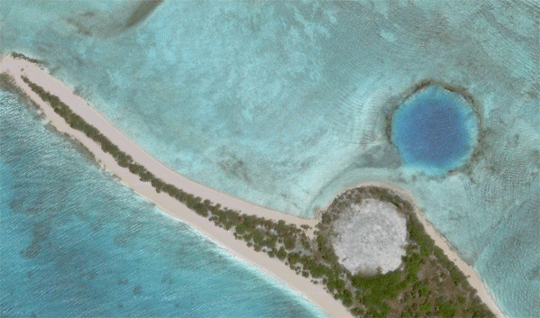
Fears Grow That ‘Nuclear Coffin’ Is Leaking Waste Into The Pacific https://www.forbes.com/sites/trevornace/2019/05/27/fears-grow-that-nuclear-coffin-is-leaking-waste-into-the-pacific/#653322537073, Trevor Nace The tropical blue skies over the southern Pacific Ocean were enveloped by towering mushroom clouds lingering over the Marshall Islands in 1954 as the United States continued its testing of nuclear weapons. The United States conducted 67 nuclear weapon tests from 1946 to 1958 on the pristine Marshall Islands. The most powerful test was the “Bravo” hydrogen bomb in 1954, which was about 1,000 times more powerful than the bomb dropped on Hiroshima, Japan. The extensive nuclear bomb testing blanketed the islands in radioactive ash, covering it in the fine, white, powder-like substance. Children, unaware of what the radioactive ash was, played in the “snow” and ate it according to the Atomic Heritage Foundation. Today, there are growing concerns that the temporary containment of the nuclear waste resulting from those tests is leaking into the Pacific Ocean and could be cracked wide open from the next storm that rolls by. Specifically, the site is believed to be leaking one of the most toxic substances in the world, the radioactive isotope plutonium-239, a byproduct of nuclear bombs that decays with a half-life of 24,100 years. In 1977 the United States worked to clean up the radioactive waste left strewn across the Marshall Islands. In total, an estimated 73,000 cubic meters of radioactive soil was collected across the Marshall Islands. The US used a crater from an especially large nuclear bomb test on Runit Island to stash away the radioactive soil. The 328-foot crater from a May 1958 test was designated the dumping ground. As this was considered a temporary solution, the crater bottom was not lined with impervious material, which would have prevented radioactive waste from entering the below aquifers and Pacific Ocean. After the material was piled into the crater, an 18-inch thick concrete dome was positioned on top of it as a temporary containment. Plans for permanent radioactive waste storage were never finalized and thus the temporary solution has sat as-is for nearly 40 years. Shortly afterward, in 1983 the Marshall Islands agreed on their severity from the United States and with it, the islands released the United States of any responsibility for past nuclear testing. Rising sea level, soil shifting, and storms have all caused new concern over the integrity of the “nuclear coffin” and its ability to contain radioactive waste. The dome is reportedly cracking and the local government fears the next big storm may split the concrete dome apart. In addition, groundwater models suggest that seawater is almost certainly accessing the crater. However, it is unclear how much nuclear waste is seeping from the unlined crater bottom into the Pacific Ocean and groundwater aquifers. Despite recent awareness around the issue, the Marshallese government does not have the money or expertise to properly clean up and isolate the nuclear waste. Thus, the Marshallese are left helpless as their tropical islands continue to leak deadly radioactive waste across its coral reefs. Trevor Nace is a PhD geologist, founder of Science Trends, Forbes contributor, and explorer. Follow his journey @trevornace. |
|
USA’s radioactive dump in the Marshall Islands is leaking
|
Under the dome: Fears Pacific nuclear ‘coffin’ is leaking, https://phys.org/news/2019-05-dome-pacific-nuclear-coffin-leaking.html As nuclear explosions go, the US “Cactus” bomb test in May 1958 was relatively small—but it has left a lasting legacy for the Marshall Islands in a dome-shaped radioactive dump.
The dome—described by a UN chief Antonio Guterres as “a kind of coffin”—was built two decades after the blast in the Pacific ocean region. The US military filled the bomb crater on Runit island with radioactive waste, capped it with concrete, and told displaced residents of the Pacific’s remote Enewetak atoll they could safely return home. But Runit’s 45-centimetre (18-inch) thick concrete dome has now developed cracks. And because the 115-metre wide crater was never lined, there are fears radioactive contaminants are leaching through the island’s porous coral rock into the ocean. The concerns have intensified amid climate change. Rising seas, encroaching on the low-lying nation, are threatening to undermine the dome’s structural integrity. Jack Ading, who represents the area in the Marshalls’ parliament, calls the dome a “monstrosity”. “It is stuffed with radioactive contaminants that include plutonium-239, one of the most toxic substances known to man,” he told AFP. “The coffin is leaking its poison into the surrounding environment. And to make matters even worse, we’re told not to worry about this leakage because the radioactivity outside of the dome is at least as bad as the radioactivity inside of it.” Staggering’ challenges The dome has become a symbol of the mess left by the US nuclear test programme in the Marshall islands when 67 bombs were detonated between 1947-58 at Enewetak and Bikini atolls. Numerous islanders were forcibly evacuated from ancestral lands and resettled, including Enewetak’s residents. Thousands more islanders were exposed to radioactive fallout and suffered health problems. The people of Enewetak were allowed home in 1980, and about 800 islanders now live in the southern part of the atoll, 20 kilometres (12 miles) from Runit. After the US military withdrew, the Marshall Islands government officially accepted a “full and final” settlement to cover the impact of the nuclear tests. But there have long been complaints that the compensation paid by Washington was inadequate, and the United Nations has described “a legacy of distrust” towards the United States. UN Secretary General Guterres raised the issue earlier this month after meeting Marshall Islands President Hilda Heine in Fiji, when they discussed the nuclear legacy and the prospect of radioactive leakage from Runit dome. “The Pacific was victimised in the past as we all know… the consequences of these have been quite dramatic, in relation to health, in relation to the poisoning of waters in some areas,” he said. Marshalls Foreign Minister John Silk said he appreciated Guterres bringing the Runit dome to world attention with this comments.. “We are pleased that the Secretary General made these statements, since so often it seems that these ongoing legacy issues that continue to impact our people are forgotten by the international community,” he said. Uncertain future Rhea Moss-Christian, who chairs the Marshall Islands National Nuclear Commission, said the country “needs the support of the international community to address the staggering health and environmental challenges across the Pacific.” The consequences of the dome failing are unclear. A 2013 inspection commissioned by the US government suggested radioactive fallout in the Enewetak lagoon sediment was already so high a catastrophic failure would not necessarily result in locals receiving increased dosages of radiation. Silk, noting that the US government had committed to ongoing monitoring of the dome, said an independent assessment of the structure’s status “would be helpful”. But Ading said the situation was “a constant source of anxiety for the people of Enewetak”. “We pray that the Runit dome does not eventually become our coffin,” he said. |
|
1 This Month



Shut down the radiation-damaged Heysham nuclear reactors now
To see nuclear-related stories in greater depth and intensity – go to https://nuclearinformation.wordpress.com

Say No to NASA’s Reckless Nuclear Reactor on the Moon
Say No to NASA’s Reckless Nuclear Reactor on the Moon
-
Archives
- October 2026 (256)
- September 2026 (339)
- August 2026 (330)
- July 2026 (355)
- June 2026 (287)
- May 2026 (306)
- April 2026 (356)
- March 2026 (251)
- February 2026 (267)
- January 2026 (308)
- December 2025 (358)
- November 2025 (359)
-
Categories
- 1
- 1 NUCLEAR ISSUES
- business and costs
- climate change
- culture and arts
- ENERGY
- environment
- health
- history
- indigenous issues
- Legal
- marketing of nuclear
- media
- opposition to nuclear
- PERSONAL STORIES
- politics
- politics international
- Religion and ethics
- safety
- secrets,lies and civil liberties
- spinbuster
- technology
- Uranium
- wastes
- weapons and war
- Women
- 2 WORLD
- ACTION
- AFRICA
- Atrocities
- AUSTRALIA
- Christina's notes
- Christina's themes
- culture and arts
- Events
- Fuk 2022
- Fuk 2023
- Fukushima 2017
- Fukushima 2018
- fukushima 2019
- Fukushima 2020
- Fukushima 2021
- general
- global warming
- Humour (God we need it)
- Nuclear
- RARE EARTHS
- Reference
- resources – print
- Resources -audiovicual
- Weekly Newsletter
- World
- World Nuclear
- YouTube
-
RSS
Entries RSS
Comments RSS

