California can now move to safe, clean renewable energy
The End of the San Onofre Nuclear Plant — An Advance for Safe, Clean, Renewable Energy Technologies http://karlgrossman.blogspot.com.au/2013/06/the-end-of-san-onofre-nuclear-plant.html
 Southern California Edison’s announcement this week that it will close its troubled twin-reactor San Onofre nuclear power plant—along with other recent setbacks for atomic energy in the United States—marks a downward spiral for nuclear power.
Environmentalists win 50 year battle to close San Onofre nuclear plant
opponents of the plant acknowledged that questions remain regarding what will happen to radioactive waste generated by the site and to the region’s energy needs.
Environmentalists Celebrate Nuclear Plant Closing, abc news, By GILLIAN FLACCUS and AMY TAXIN Associated Press axin reported from Tustin. AP Writer Elliot Spagat contributed to this report from SAN CLEMENTE, Calif. June 8, 2013 (AP)
Using a cane and wearing a hat reading “Peace No Nukes,” 85-year-old Lyn Harris Hicks shuffled to the front gates of the San Onofre nuclear power plant on Friday to celebrate a utility company’s decision to close the seaside facility for good.
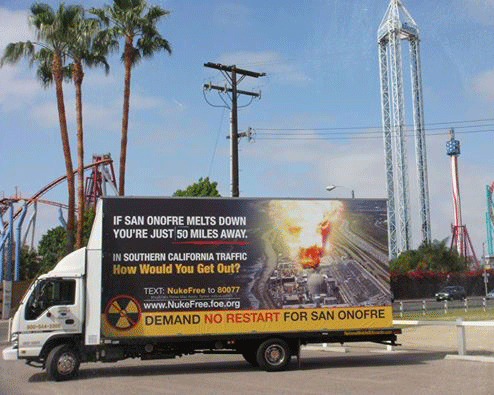
A long-time resident of San Clemente in Southern California, Harris Hicks said she has been fighting the plant — which has been idle since last year — since the 1960s over safety concerns. Continue reading
Higherdeath rate for those living near Browns Ferry Nuclear Plant
The full report may be downloaded at www.matrr.org or www.bredl.org

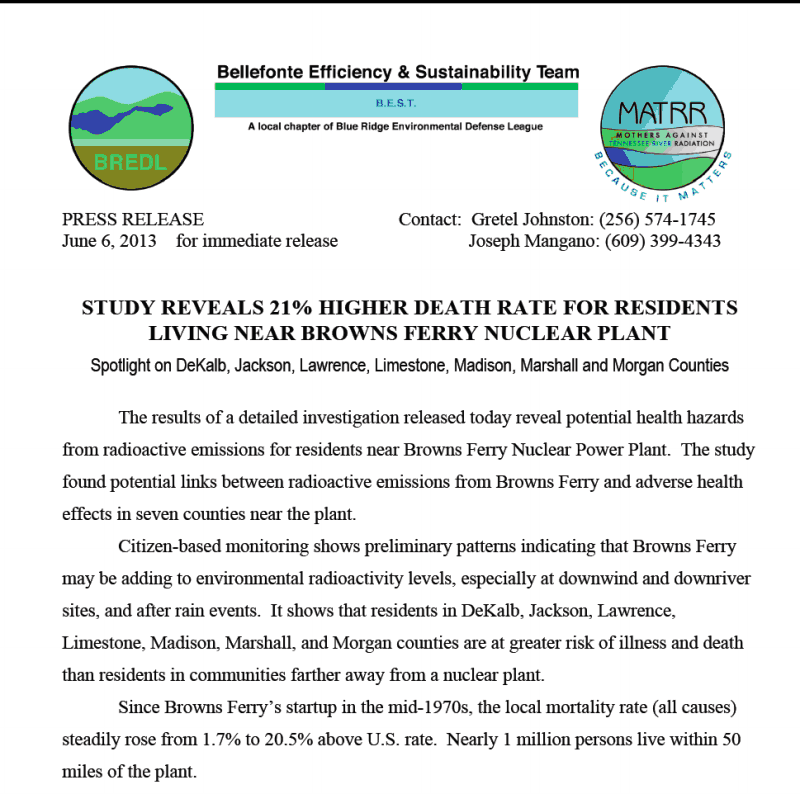
Major findings of the report• Continue reading
Nuclear waste rolling in to Texas dump site

 Texas Site Begins Taking Federal Nuclear Waste http://abcnews.go.com/US/wireStory/texas-site-begins-taking-federal-nuclear-waste-19343196#.UbJENOdwo6I By BETSY BLANEY Associated Press ANDREWS, Texas June 7, 2013 (AP) Republican mega-donor Harold Simmons’ remote hazardous waste dump in West Texas began accepting low-level radioactive material Thursday from a federal lab in New Mexico — the latest step in Simmons’ vision of site that accept all types of waste. Continue reading
Uranium mining continues to radioactively poison land and water in USA
Uranium Mine Pits Continue to Leak Radiation Today
Radiation and heavy metals from uranium mines continue to pollute the land, air and water today and very little action is being taken to stop it.
America’s “Secret Fukushima”: Uranium Mining is Poisoning the Bread Basket of the World By Margaret Flowers and Kevin Zeese Global Research, June 07, 2013 Truthout Early in the morning of July 16, 1979, a 20-foot section of the earthen dam blocking the waste pool for the Church Rock Uranium Mill caved in and released 95 million gallons of highly acidic fluid containing 1,100 tons of radioactive material. The fluid and waste flowed into the nearby Puerco River, traveling 80 miles downstream, leaving toxic puddles and backing up local sewers along the way.

Although this release of radiation, thought to be the largest in US history, occurred less than four months after the Three Mile Island partial nuclear meltdown that sent radioactive gases and iodine into the air, the Church Rock spill received little media attention. In contrast, the Three Mile Island accident made the headlines. And when the residents of Church Rock asked their governor to declare their community a disaster area so they could get recovery assistance, he refused. Continue reading
Safety upgrades required will cost U.S. nuclear plant operators $billions
 U.S. plants covered under the directive are older, boiling-water reactors mainly similar in design to the Fukushima facility…..
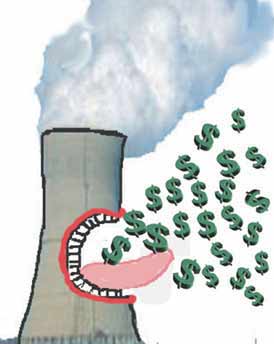
Plant operators may have to spend nearly $3.6 billion over the next three to five years on modifications to the nation’s 102 nuclear facilities in response to the Fukushima accident, according to a Platts survey released on Thursday.
U.S. orders new safety upgrades at nuclear plants By CNN Staff June 7, 2013 –– Washington — U.S. regulators are directing 31 nuclear reactors similar in design to the Fukushima Daiichi plant in Japan, where an earthquake and tsunami caused a meltdown two years ago, to take additional steps to help contain radiation and other damage from any accident that is not quickly halted.
The Nuclear Regulatory Commission directive on Thursday requires enhancements to systems for venting accumulated pressure from containment structures during an emergency. Vents must also be able to safely handle rising temperatures, hydrogen concentrations and radiation levels.
The changes also aim to ensure that plant personnel can continue to operate vents safely if a reactor core melts down, the agency said. Continue reading
Nuclear economics; a fourth American nuclear plant bites the dust
California nuclear plant to shut: a case of unforgiving nuclear economics, Christian Science Monitor, Peter Spotts, 7 June 13 Southern California Edison is shutting the remaining two reactors at San Onofre, citing high repair costs and an NRC ruling that the utility says would delay reactor restarts.
The San Onofre Nuclear Generating Station (SONGS), a nuclear power plant set into the seaside bluffs in northern San Diego County, is closing after the high cost of repairs and a Nuclear Regulatory Commission board ruling prompted its owner, Southern California Edison, to pull the plug on the 45-year-old facility.The announcement Friday that San Onofre’s two functioning reactors were being shut down brings to four the number of reactors that nuclear utilities have slated for closure since last November. Meanwhile, nuclear utilities have three new reactors on the drawing boards.
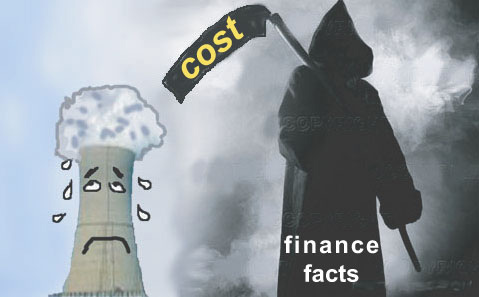
At least for now, “we’re losing them faster than we’re building them,” quips David Lochbaum, a nuclear engineer by training who focuses on nuclear-energy issues at the Union of Concerned Scientists in Washington…..
n early May, the utility Dominion shuttered its single-reactor Kewaunee nuclear plant in Carleton, Wis., a casualty of cheaper sources of electricity and an inability to build additional reactors to take advantage of what the company called economies of scale.
“Nuclear economics is tenuous at best,” Mr. Lochbaum says. “If you do everything right, you can make money at this. But if you stumble, there’s a big price to pay, and not just from a Fukushima-type tragedy.”
Financial setbacks can take their toll as well, he says, whether a setback comes from lost business or from hardware failures or human error that sets the stage for costly repairs……..
What looked to the utility to be a sensible $780 million investment in 2009 and ’10 to extend the lifetime of the two reactors turned into an economic albatross, Continue reading
Heavy illness price paid by indigenous people in uranium mining
A few decades after uranium mining began in the Navajo Nation, increased numbers of cancer cases, lung cancer in particular, began to show up in the miners. A 2008 literature review in New Mexico found that the “Risk of lung cancer among male Navajo uranium miners was 28 times higher than in Navajo men who never mined, and two-thirds of all new lung cancer cases in Navajo men between 1969 and 1993 was attributable to a single exposure — underground uranium mining. Through 1990, death rates among Navajo uranium miners were 3.3 times greater than the U.S. average for lung cancer and 2.5 times greater for pneumoconioses and silicosis.”
 America’s “Secret Fukushima”: Uranium Mining is Poisoning the Bread Basket of the World By Margaret Flowers and Kevin Zeese Global Research, June 07, 2013 Truthout
“……..Thousands of open uranium mines excavated beginning in the 1950s continues to release radiation today. There have been inadequate measurements but the limited measures done show ongoing leaks larger than Fukushima. How did we get here?
It is estimated that 60 to 80 percent of uranium in the US is located on tribal land, particularly in the lands of the Navajo and Great Sioux Nations. After WWII, the United States Atomic Energy Commission (AEC) was created so that the US could obtain uranium for weapons production domestically. The AEC guaranteed that it would purchase all uranium that was mined. A uranium boom ensued. Private corporations jumped in and, in areas of South Dakota, individuals started mining for uranium on their private lands unaware of the dangers.
Private corporations set up thousands of underground and open pit uranium mines on tribal lands and hired local native Indians at low wages. Other than jobs, the uranium mines brought little benefit to these nations because the lands were given to non-Indian companies such as Kerr-McGee, Atlantic Richfield, Exxon and Mobil. Native Indians had little control over what took place. Continue reading
New Mexico’s huge solar energy farm goes ahead
New Mexico’s Largest Solar Farm To Proceed, http://www.energymatters.com.au/index.php?main_page=news_article&article_id=3781 7 June 13, New Mexico’s largest solar energy plant, the 50-megawatt Macho Springs Solar Project, will go ahead after a 25-year power purchase agreement (PPA) was signed by the New Mexico Public Regulator and El Paso Electric Power.
Under the arrangement, El Paso Electric – which services almost 390,000 customers in West Texas and the Rio Grande valley – will purchase the entire output from the solar farm for the duration of the PPA.
Construction of the plant is set to begin in July and will be completed in 2014. Sited on about 500 acres of state land in Luna County, New Mexico, Macho Springs is expected to generate enough power to provide electricity for around 18,000 homes.
The project will avoid 40,000 metric tons of carbon dioxide emissions, the equivalent of taking 7,500 cars off the road, and save up to 340,000 tons of water each year.
The Macho Springs project will create 300 new jobs during its year-long construction phase and three full-time maintenance and operation positions. State Land Commissioner Ray Powell said in a statement that the lease payments from the solar plant could generate as much as $40 million for state land trust beneficiaries over the 40-year term of the lease.
The Macho Springs Solar plant is another addition to First Solar Inc’s stable of utility-scale solar power plants, including California’s massive 550-megawattTopaz and Desert Sunlight solar farms.
“We are very pleased to support El Paso Electric’s efforts to provide clean, reliable, renewable power to its customers, and contribute economic benefits and green jobs created by utility-scale solar development to Luna County,” said Michael Hatfield, First Solar Director of Project Development.
USA’s B61 bomb – useless and a waste of money
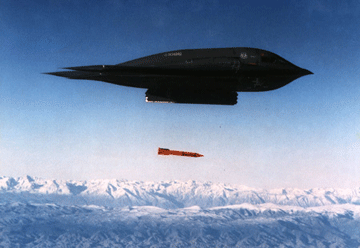 The nuclear bomb we don’t need, L A Times, By Steve Andersen June 6, 2013 The American B61 is a massively expensive investment that provides no real military capability and no real deterrence in today’s Europe………s President Obama prepares to unveil a nuclear weapons policy initiative for his second term, no one is suggesting that the United States should slash defense spending to Russian levels. Defense cuts of that size would be inconsistent with the national interests of America and its allies. But policymakers on both sides of the Atlantic ought to be more inclined than they have been to trim defense programs tailored for a Cold War that has been over for two decades, in particular during an era of sequestration in Washington and austerity in Europe.
Enter the American B61 nuclear bomb …… Throughout the Cold War, thousands of tactical nuclear weapons — short-range nuclear artillery shells, missiles and bombs — were deployed by the United States to deter the Soviets from exploiting their advantages in Europe to mount a lightning attack.
It worked. After the Soviet Union collapsed, President George H. W. Bush ordered the return of almost all U.S. tactical nuclear weapons, leaving only a few hundred air-delivered gravity bombs — the B61 — in European bunkers.
Over the last 20 years, the military rationale for continuing these deployments has evaporated. …..When allocating limited defense resources against real defense priorities, including Afghanistan, Libya, Mali, Syria, nuclear proliferation, terrorism — today’s “guns versus guns” measurements — the B61 simply doesn’t pass muster…… If Americans understood that their government plans to spend about the same amount of money this year, $537 million, on the B61 bomb as it will spend on Alzheimer’s research, while financing nearly three-quarters of NATO’s military spending, the B61 would deservedly become a dead man walking.
So who will make this case? Four American statesmen — George Shultz, William Perry, Henry Kissinger and Sam Nunn — who in a landmark 2007 Op-Ed article called for “eliminating short-range nuclear weapons designed to be forward deployed” — laid the foundation. Since then, a number of European senior statesmen — including defense and foreign secretaries across the political spectrum — have echoed their call.
Obama should connect the dots as part of an initiative to implement the ambitious agenda for nuclear threat reduction he laid out in Prague four years ago, which was endorsed by NATO. Or even better, maybe it will be a European leader who has the iron to seize the initiative and call attention to the obvious: In today’s Europe, tactical nuclear weapons make no sense. http://www.latimes.com/news/opinion/commentary/la-oe-andreasen-nuclear-bomb-20130606,0,4306971.story
All of Tennessee Valley Authority.s nuclear power plants have notices of safety violations
All of TVA’s nuclear power plants operating under notices of safety violations http://enformable.com/2013/06/all-of-tvas-nuclear-power-plants-operating-under-notices-of-safety-violations/ Lucas W Hixson The Tennessee Valley Authority (TVA) is a federally owned corporation in the United States, which is already facing the threat of being sold as it carries some $25 billion in debt -just under the $30 million debt limit set by Congress, is facing increased oversight after having been found to having improperly assessed safety violations at two nuclear power plants. TVA owns and operates the Browns Ferry, Sequoyah, and Watts Barr nuclear power plants, all of which are operating under notices of safety violations. In 2011, the Browns Ferry nuclear power plant was issued a red finding due to the failure of a safety valve and TVA’s failure to recognize the problem.
This week, the Nuclear Regulatory Commission put the Sequoyah nuclear power plant and Watts Bar nuclear power plant on increased oversight after determining that TVA violated nuclear safety standards in how the utility analyzed and prepared its flood assessment risk at the two nuclear power plants, both of which are located on the Tennessee River.
In late April of this year, the NRC staff held a conference with TVA officials to discuss the risk significance of the issues with the flood protection area. After reviewing information presented by TVA and previous NRC inspections, the NRC staff concluded that the licensee had not met safety standards in multiple areas at both nuclear power plants. The NRC concluded that TVA did not adequately establish flooding protection for scenarios involving the failure of upstream dams and also had not taken necessary measures to prevent water from flooding the intake pumping station. Additionally, TVA was cited for an additional violation for not promptly notifying the NRC after discovering that the potential failure of upstream dams could result in an unanalyzed condition affecting plant safety.
In response to the violations, the Nuclear Regulatory Commission also increased its oversight at the nuclear power plants, an expense that TVA will have to pay for, putting all three nuclear facilities operated by TVA under increased oversight due to safety violations. The NRC did not choose to impose further civil penalties and fines on TVA beyond the expense of the additional inspections and oversight.
Nuclear Regulatory Commission orders upgrades for 31 nuclear reactors
Upgraded vent systems ordered for 31 nuclear reactors, including two at Peach Bottom Nuclear Regulatory Commission says move is a safety measure By Jamie Smith Hopkins, The Baltimore Sun, June 6, 2013 The Nuclear Regulatory Commission said Thursday that it has ordered a venting upgrade for nearly a third of the reactors in the country, including ones at the Peach Bottom Atomic Power Station just north of Harford County.
Peach Bottom, in Delta, Pa., has two of the 31 reactors that must now have venting systems that can better handle accidents. The commission’s order is part of its review effort following the 2011 nuclear meltdown in Fukushima, Japan, after an earthquake and tsunami.
Scott Burnell, a spokesman for the Nuclear Regulatory Commission, said officials want venting systems in place that can operate “under a wider set of conditions and keep doing the job they’re designed for” — releasing pressure and hydrogen so containment buildings can hold on to radioactive material….. http://www.baltimoresun.com/business/bs-bz-nuclear-reactor-safety-20130606,0,3084896.story#ixzz2VZ6s598g
Energy firm pulls out of its $billion nuclear power plans
$1 Billion Nuclear Power Plans Abandoned In Iowa Clean Technica, June 6, 2013 Jake Richardson Plans for Iowa’s second nuclear power plant have been dropped by Mid American Energy. No design has been approved for the type of nuclear plant the company had intended, so they have let the idea go. It was reported that ratepayers will be refunded the $8.8 million they paid for a completed feasibility study. Sites not far from Council Bluffs and Davenport were being considered for the plant….
. Friends of the Earth interpreted the decision more broadly saying it is an indication that massive public subsidies for new nuclear power might not be as popular an idea any longer. A poll of Iowans conducted in 2012 found 77% were against a funding arrangement that would have required residents to have to pay the energy company up front for construction of the nuclear plant. Proposed legislation could have made such an arrangement possible, but it was opposed by a number of non-profit advocacy organizations, so it didn’t go through. t http://cleantechnica.com/2013/06/06/1-billion-dollar-nuclear-plant-dropped-in-iowa/#pAxzd7cFlUlp1crh.99
USA’s nuclear waste policy is a mess
Feds Fail on Nuclear Waste, Mational Review Online, Jack Spencer, June 6,The federal government assumed responsibility for nuclear-waste management more than 30 years ago. The Nuclear Waste Policy Act of 1982 created an ostensibly simple system: Nuclear utilities would pay the U.S. Treasury a fee, collected from their customers, to cover the costs, and the government would see to it that the waste was taken care of. The act and its amendments over the years specified every detail of the disposal process. They stipulated how the waste would be disposed of, where, and who would be responsible.
Surprise! Despite the politicians’ and bureaucrats’ best efforts to centrally plan a long-term solution, the system doesn’t work. Although the government successfully collects money from the consumers of nuclear-generated electricity — nearly $30 billion since 1982 — it has collected zero nuclear waste. And as the waste — nearly 70,000 tons and counting — continues to build up at nuclear plants around the country, the government continues to dither. It literally has no plan to collect and dispose of the waste.
To address this, earlier this spring four senators released a draft of another “solution”: the Nuclear Waste Administration Act of 2013. Unfortunately, the NWAA does nothing to fix the failed system. Instead, it accepts the notion that the feds, not waste producers themselves, should be responsible for nuclear-waste management, and it continues the policy of having waste producers pay a flat fee for these services…….
USA marketing nuclear technology to Vietnam
 Obama’s Nuclear Vietnam National Review Online By Henry Sokolski June 4, 2013 In Washington, learning comes hard. Officials may know when to back off when they’ve crossed wires with Congress, but in most cases, and in less time than you’d think, they’re back at it again.
Take the State Department’s rush three years ago to seal a civilian nuclear deal with Vietnam. Secretary of State Hillary Clinton announced that the U.S. had initialed a draft agreement in July of 2010. It featured nuclear-nonproliferation provisions far looser than what Congress wanted. When the Hill found out, it threw a fit, the White House withdrew the deal, and State promised to lead a government-wide review of U.S. nonproliferation policies.
That was 33 months ago. Last September, State completed the review and forwarded its recommendations to the White House. The president has yet to focus on them. Instead he’s gotten excited about promoting U.S. nuclear-reactor exports to — you guessed it — Vietnam.
Last month he sent a U.S. nuclear-export delegation to Hanoi. It included the White House director for nuclear-energy policy, the under secretary of commerce, the assistant secretary of energy for nuclear energy, and 18 nuclear-industry representatives. Their mission: to persuade Vietnam to buy Westinghouse reactors. Continue reading
1 This Month
23-25 October – on Zoom – World BEYOND War’s annual global conferenc


Shut down the radiation-damaged Heysham nuclear reactors now
To see nuclear-related stories in greater depth and intensity – go to https://nuclearinformation.wordpress.com

Say No to NASA’s Reckless Nuclear Reactor on the Moon
Say No to NASA’s Reckless Nuclear Reactor on the Moon

-
Archives
- October 2026 (199)
- September 2026 (339)
- August 2026 (330)
- July 2026 (355)
- June 2026 (287)
- May 2026 (306)
- April 2026 (356)
- March 2026 (251)
- February 2026 (267)
- January 2026 (308)
- December 2025 (358)
- November 2025 (359)
-
Categories
- 1
- 1 NUCLEAR ISSUES
- business and costs
- climate change
- culture and arts
- ENERGY
- environment
- health
- history
- indigenous issues
- Legal
- marketing of nuclear
- media
- opposition to nuclear
- PERSONAL STORIES
- politics
- politics international
- Religion and ethics
- safety
- secrets,lies and civil liberties
- spinbuster
- technology
- Uranium
- wastes
- weapons and war
- Women
- 2 WORLD
- ACTION
- AFRICA
- Atrocities
- AUSTRALIA
- Christina's notes
- Christina's themes
- culture and arts
- Events
- Fuk 2022
- Fuk 2023
- Fukushima 2017
- Fukushima 2018
- fukushima 2019
- Fukushima 2020
- Fukushima 2021
- general
- global warming
- Humour (God we need it)
- Nuclear
- RARE EARTHS
- Reference
- resources – print
- Resources -audiovicual
- Weekly Newsletter
- World
- World Nuclear
- YouTube
-
RSS
Entries RSS
Comments RSS

