No to Small Modular Nuclear Reactors (SMRs). Yes to wind energy, for Warren Buffett
 The best-known investor in the utility arena is raising its stake in wind in Iowa $1.9
 billion….
MidAmerican is cancelling its pursuit of new small modular nuclear power options…..
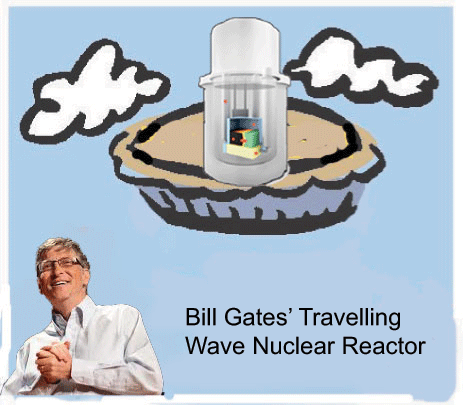
Buffett & co choose wind energy investment over nuclear REeweconomy, By Mike Jacobs 14 June 2013 The Equation Investors working with utilities are making clear and clean choices for meeting our energy needs. Two big announcements show wind and energy efficiency are financeable and attractive, and new small nuclear reactors are not. Recently MidAmerican Energy chose to add more wind energy to its supply, dump a “modular” nuclear plant proposal, and decline to follow the trend toward burning natural gas.
Meanwhile, today Seattle City Light announced a purchase of energy from a commercial energy efficiency developer, demonstrating a power-purchase approach to fund investments in energy conservation that won’t disrupt a utility company’s financial health.
With Warren Buffet behind the wind decision, (MidAmerican is a subsidiary of Buffet’s Berkshire Hathaway), and a new financial model possibly cracking the nut on building owner and utility ambivalence about deep energy retrofits for commercial buildings, these are important developments.
To summarise what just happened: Continue reading
Hollywood stars call for zero nuclear weapons
 Hollywood to Obama: Eliminate Nuclear Weapons http://thediplomat.com/the-editor/2013/06/14/hollywood-to-obama-eliminate-nuclear-weapons/ By Zachary Keck June 14, 2013 Some of Hollywood’s biggest stars have joined with the anti-nuclear group, Global Zero, in a new You Tube video to demand more action on the elimination of nuclear weapons.
Among the stars making a cameo in the video are Whoopi Goldberg, Morgan Freeman, Naomi Watts, Alex Baldwin, Michael Douglas, Martin Sheen, Danny DeVito, Robert DeNiro, Matt Damon, Zoe Kravitz, and Christoph Waltz.
The video begins with a clip of President Barack Obama’s famous 2009 speech from Prague when he stated, “clearly and with conviction America’s commitment to seek the peace and security of a world without nuclear weapons.”
The stars then take turns explaining the importance of eliminating nuclear weapons—including denouncing the notion that the spread of nuclear weapons cannot be stopped. While admitting the enormity of the task, the stars contend in the video that if the world decides it can’t stop the spread of nuclear weapons then it is in some ways admitting that nuclear war is inevitable.
In the second half of the video, the stars introduce themselves and one-by-one say that they demand zero, a reference to Global Zero’s goal of a world without nuclear weapons. See the video at http://www.youtube.com/watch?v=-HbjizKEqG4
Cutbacks as TVA struggles to revive Bellefonte Nuclear Power Station, Alabama
 TVA cuts 530 jobs, spending on Ala. nuclear plant Knox News, RAY HENRY – Associated Press (AP) June 12, 2013 The Tennessee Valley Authority will cut 530 jobs and trim millions of dollars in spending on its effort to revive a mothballed nuclear plant in Alabama, utility officials said Wednesday in a decision that calls into question the project’s future.
A total of 35 TVA employees and 495 contractors will lose their positions at the Bellefonte Nuclear Power Station northeast of Scottsboro, Ala. The budget will fall from $182 million to $66 million, a reduction of roughly 64 percent. Some of the affected TVA employees may be reassigned to other roles within the utility.
The decision comes as the price of natural gas has plummeted, making it difficult for the electric industry to justify the massive costs of new nuclear plants. Utilities in California, Florida, New Jersey and Wisconsin have either shut down plants or will halt operations in the future because they are too costly to repair or upgrade. While the industry proposed building a new wave of reactors just a few years back, only a handful are likely to be completed in the Southeast because of the same economics.
Finishing the first reactor at Bellefonte by 2020 was expected to cost roughly $4.9 billion……. Already, the TVA is under pressure to control its costs. An effort to finish another of its mothballed reactors at the Watts Bar Nuclear Plant in Spring City, Tenn., was originally expected to cost $2.5 billion. Finishing the project may require as much as $2 billion more, according to utility estimates…… http://www.knoxnews.com/news/2013/jun/12/tva-cuts-400-jobs-spending-on-ala-nuclear-plant/
Serious safety flaw – Monticello nuclear power plant not prepared for major flood
Feds fault Monticello nuclear power plant’s flood planning by: DAVID SHAFFER , Star Tribune June 11, 2013 Inspectors said Monticello plant wasn’t prepared for a major flood, but also said Xcel’s response means site is not now a “safety concern.” Xcel Energy’s Monticello nuclear power plant on the bank of the Mississippi River has long been unprepared for worst-case flooding, federal regulators said Tuesday in a finding they classified as having “substantial safety significance.”
U.S. Nuclear Regulatory Commission (NRC) inspectors said Xcel’s flood-fighting efforts, including dikes, could not have been completed in the 12 days required, and some work would take twice that time.
Xcel, which owns and operates the plant 40 miles northwest of the Twin Cities, said it has addressed the problem by putting dike-building materials on site. As a result, NRC inspectors said, the issue is “not a current safety concern.”
But the finding, which is preliminary, is the Monticello plant’s most serious safety shortcoming since the NRC adopted a color-coded, four-step ranking system for inspection results. This problem was ranked “yellow,’’ one level short of the “red,’’ or most serious, level. (The two lowest levels are “green” and “white.” )
Xcel has 10 days to challenge it, and the plant faces enhanced inspections if the finding stands.
Three other U.S. nuclear power plants belonging to other utilities also have been cited recently for unsatisfactory flood-fighting plans after a round of inspections prompted by the 2011 tsunami and disaster at the Fukushima Daiichi nuclear power plant in Japan, an NRC official said…… http://www.startribune.com/business/211107961.html
Nuclear Regulatory Commission will take safety allegations seriously
 Nuclear Energy Activist Toolkit #8: Allegations, Union of Concerned Scientists Dave Lochbaum, director, Nuclear Safety Project June 11, 2013 The NRC’s Allegations Program handles accusations that NRC’s requirements are being violated. The NRC receives allegations from workers at NRC-licensed facilities as well as from other sources. For example, workers sometimes seek to protect their identities (and their jobs) by voicing their concerns to media and groups like UCS. The NRC’s 250-word definition of allegation contains three footnotes containing 206 words of “clarification.” Ignoring that legal mumbo-jumbo, the NRC’s Allegations Program looks into reports that the agency’s requirements may have been violated.
The NRC can process allegations submitted anonymously, but would prefer to know the sources of allegations. The NRC seeks to ensure it correctly understands the allegations before dispatching inspectors to examine the issues. And sometimes the NRC re-contacts sources for additional information during the course of its investigations. The NRC also sends a letter summarizing the scope of its investigation and its findings to sources it knows.
With very few exceptions (such as when an allegation is made in a newspaper article or posted on a website), the NRC treats all sources confidentially even within the agency. For example, while the NRC’s allegations staff know the identity of a source, the NRC’s inspectors who investigate the allegations would not know this information…… Continue reading
Demolishing San Onofre nuclear plant – 50 years and $billions in costs
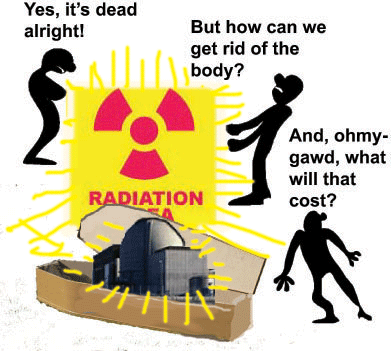 A long cooling-off period for San Onofre nuclear plant http://articles.latimes.com/2013/jun/08/local/la-me-san-onofre-nuclear-20130609 Tearing down San Onofre’s two nuclear reactors will be a technically complex job completed over decades. It’s likely Southern California Edison will first mothball the plant.|By Ralph Vartabedian, Los Angeles Times
Southern California Edison built San Onofre’s two nuclear reactors in about nine years, but tearing them down will be a technically complex, multibillion-dollar job completed over decades. It is likely that Edison first will mothball the plant, which under federal rules could keep its imposing imprint on the Orange-San Diego County coastline for another half-century.
When the plant does come down, it will be a massive job.
Tons of highly radioactive fuel now stored in pools will have to cool before the rods can be moved to concrete pads outdoors. Giant pipes that extend more than a mile into the ocean will have to come out. Pieces of the reactors will have to be cut with special saws and torches that reach 20 feet into the vessels’ cooling water. Continue reading
Future of American nuclear industry hangs on Vogtle new nuclear plant construction
Nuclear power could become a bypassed technology — like moon landings, Polaroid photos and cassette tapes……..
with construction now roughly one-third complete, it is clear that much is not going as planned, and that the schedule — which is closely linked to cost because of growing interest expense on the incomplete asset — has slipped by at least 14 months and possibly more…

The reason that utilities choose nuclear plants, is that they can collect profits on their investments. In Georgia they can do so even before the plant is finished.
Nuclear Power’s Future May Hinge on Georgia Project NYT, By MATTHEW L. WALD June 11, 2013WAYNESBORO, Ga. — The two nuclear reactors rising out of the red Georgia clay here, twin behemoths of concrete and steel, make up one of the largest construction projects in the United States and represent a giant bet that their cost – in the range of $14 billion – will be cheaper than alternatives like natural gas. But something else is at stake with the reactors called Vogtle 3 and 4: the future of the American nuclear industry itself. Continue reading
Concern over radiation risks in CT scans for children
 more research is urgently needed to determine when CT in pediatrics can lead to improved health outcomes and whether other imaging methods (or no imaging) could be as effective. For now, it is important for both the referring physician and the radiologist to consider whether the risks of CT exceed the diagnostic value it provides over other tests, based on current evidence,”
Study Examines Cancer Risk from Pediatric Radiation Exposure from CT Scans http://www.sciencedaily.com/releases/2013/06/130610192536.htm June 10, 2013 — According to a study of seven U.S. healthcare systems, the use of computed tomography (CT) scans of the head, abdomen/pelvis, chest or spine, in children younger than age 14 more than doubled from 1996 to 2005, and this associated radiation is projected to potentially increase the risk of radiation-induced cancer in these children in the future, according to a study published Online First byJAMA Pediatrics. The use of CT in pediatrics has increased over the last two decades. The ionizing radiation doses delivered by the tests are higher than convention radiography and are in ranges that have been linked to an increased risk of cancer. Children are more sensitive to radiation-induced carcinogenesis and have many years of life left for cancer to develop, the authors write in the study background.
“The increased use of CT in pediatrics, combined with the wide variability in radiation doses, has resulted in many children receiving a high-dose examination,” the study notes.
Diana L. Miglioretti, Ph.D., of the Group Health Research Institute and University of California, Davis, and colleagues quantified trends in the use of CT in pediatrics plus the associated radiation exposure and estimated potential cancer risk using data from seven U.S. health care systems. Continue reading
San Onofre nuclear closure an added blow to nuclear industry’s investment hopes
 “It’s difficult to get Wall Street to loan money against so much uncertainty,” “The four closures this year make Wall Street more apprehensive, not less apprehensive.”
Other facilities are nearing the end of their projected lifespans and may need costly renovations while cheap natural gas has siphoned off market share. Potentially expensive regulations to bolster safety in response to a triple meltdown at Japan’s Fukushima Dai-Ichi plant in 2011 have raised the concerns of investors.
“The decision to shut down San Onofre is another sign that the economics of nuclear are under pressure given the low cost of alternative sources,” Travis Miller, a Chicago-based analyst forMorningstar Inc. (MORN), said in a phone interview. “Just five years ago, nuclear power plants looked like a gold mine.”…..
Dominion Resources Inc. (D) and Duke Energy Corp. (DUK) have announced in recent months that they will retire a unit each. Exelon Corp. (EXC) of Chicago plans to shut its 44-year-old Oyster Creek reactor, the oldest in the U.S. fleet, at the end of 2019.
The economic climate, coupled with an increase in renewable energy sources like solar and wind generation, may not bode well for new units, said David Lochbaum, director of the Nuclear Safety Project for the Union of Concerned Scientists, a Cambridge, Massachusetts-based environmental group.
“It’s difficult to get Wall Street to loan money against so much uncertainty,” he said in a phone interview. “The four closures this year make Wall Street more apprehensive, not less apprehensive.”…….
“The decision to shut down rather than retrofit the San Onofre nuclear plant shows the changing economics of the power market,” Howard Learner, executive director of the Environmental Law and Policy Center, a Chicago-based advocate of cleaner energy, said in a telephone interview. “We suspect other nuclear plant owners may start reaching the same decision.” http://www.bloomberg.com/news/2013-06-10/san-onofre-seen-as-latest-setback-for-u-s-nuclear-power.html
Shared Renewable Energy Bill in California an exciting development
California Shared Renewable Energy Bills Gain Momentum, http://theenergycollective.com/rosana-francescato/236241/california-shared-renewables-bills-gain-momentum by Rosana Francescato June 11, 2013 Momentum is building for shared renewable energy in California. Late last week the two bills we’ve been following there, SB 43 and AB 1014, passed with strong margins in their chambers of origin — marking the first time this legislation has moved beyond committee to pass in either chamber.
The author of SB 43, Senator Lois Wolk, worked late into the night to draft last-minute amendments that would address concerns expressed by both Senator Alex Padilla and several utilities. The concerns were about an issue that’s been hounding the bill since its previous incarnation last year as SB 843: that there be no cost-shifting to utility customers not participating in the bill’s program.
The program allows for 500 MW of renewable energy projects that are ideal for utility customers who can’t put solar on their own roof. When they subscribe to energy produced by these shared renewable projects, customers get a credit on their power bill for that energy.
While this may sound great to customers, especially renters, utilities are sceptical. They want to ensure that the method used to calculate the bill credit be fair to all customers, including those who don’t sign up for shared renewables projects. Whether or not the utilities’ concern is disingenuous (remember the debate about net metering?), the bill’s sponsors have focused on addressing this point to ensure both fairness to all customers and passage of the bill.
And pass it did last week, with a vote in the California Senate of 27 – 9. The bill’s current version includes carve-outs that have been key requests of environmental justice and community power organizations: at least 20% of the program is set aside to be built in environmental justice areas, and at least 20% is set aside to be available to residential customers.
Less dramatic was the passage of AB 1014, which sailed through the Assembly with no debate and a vote of 55 – 17. Authored by Assemblyman Das Williams, this bill creates a voluntary program that allows utility customers to opt for 100% renewable energy, through their utility. As with SB 43, an important component of this bill was avoiding any cost-shifting to non-participants.
The bills have distinct approaches, but according to Tom Price, California Shared Renewables Policy and Market Strategies Director, “both solve the same problem — letting people who can’t buy renewable energy because they don’t have a place to physically install it to instead virtually install it on their power bill.”
As currently written, each bill would generate about 500 MW of new clean energy, 6,500 jobs, $60M in new taxes, and $2B in economic activity — all without a penny of state incentives.
At some point, SB 43 and AB 1014 are expected to be reconciled into one. No one knows yet how or when that will happen. Given that some still view SB 43 as pricing mechanism with cost shifts, there may be a convergence toward AB 1014’s PG&E-approved pricing structure. Wolk and Williams are working together to ensure the bills are supportive of each other.
The bills are now set to go through the policy committee of the opposite chamber, and then that chamber’s appropriations committee, before moving on to the whole floor. They’re likely to reach the policy committees by early July.
For the moment, the bills are on pause. But it won’t be long before it’s once again time for action. Keeping both bills moving forward requires showing as much support as possible. To receive updates and find out how you can get involved, sign up at the California Shared Renewables site.
Legal fights loom, as USA’s nuclear plant dominoes fall
The news in both the California and Kentucky cases also goes to show that the Attorney Age has banished the Atomic Age. The most important line in the SCE news release is the last one: “SCE intends to pursue recovery of damages from Mitsubishi Heavy Industries, the supplier of the replacement steam generators … ” Likewise, USEC filed suit against the Department of Energy on May 30. Nuclear energy, once billed as providing unlimited power, is fulfilling its promise—the power of lawyers. “Don’t radiate: Litigate!” may be coming soon to a button or bumper-sticker near you.
 Nuclear Dominoes Fall in California and Kentucky Neighbors for an Ohio Valley Alternative http://ecowatch.com/2013/nuclear-dominoes-fall-in-california-and-kentucky/ By Geoffrey Sea 7 June 13, [Read Part I, Part II, Part III and Part IV of this series] Southern California Edison (SCE) has abandoned plans to restart its two nuclear reactors at San Onofre. The announcement this morning comes exactly one week aftertermination of operations at the Paducah, Kentucky, uranium enrichment plant, which for decades had provided the fuel for San Onofre. It drops the number of operating nuclear reactors in the U.S. below one hundred for the first time since the early 1980s.
The San Onofre decision ends 18 months of wrangling between the utility and environmental opponents, after serious leaks were detected in a steam generator that had been newly installed. The news release by SCE has a detectable tone of relief that the company will no longer have to defend the indefensible. Similar tones have emanated from the Washington headquarters of the Department of Energy (DOE) around the Paducah decision, sending a message that the era of illegalities involving USEC privatization may be nearing an end. Continue reading
Hundreds of corporate whistleblowers targeted by USA cyber attacks
 Obama ordered hit-list of Targeted Individuals worldwide to cyber-attack EXAMINER, JUNE 8, 2013 BY: DEBORAH DUPRE Barack Obama ordered national security leaders to compile a new targeted individual hit-list, this one consisting of possible “adversaries” overseas and, in emergencies in the U.S., for his regime to cyber-attack with “little or no warning,” a top secret document reveals. The 18-page, classified document, entitled Presidential Policy Directive 20, outlines plans for
Offensive Cyber Effects Operations (OCEO), cyber-attacks that would target US adversaries globally……The directive also includes the potential use of cyber-attacks on Americans and others in the US, though any such operations must be conducted with prior authorization of the White House — unless “it qualifies as an Emergency Cyber Action.”……
A target accustomed to internet communications and business could be be isolated, financially ruined, unable to seek help from family and friends without internet capacity.
Each of hundreds of self-identified Targeted Individuals who have contacted this author since 2005 have complained about being cyber-attacked. Most of their accounts related their targeting to corporate whistle-blowing or actively working to end high-level crime.
No nuclear renaissance- instead, a nuclear terminal illness
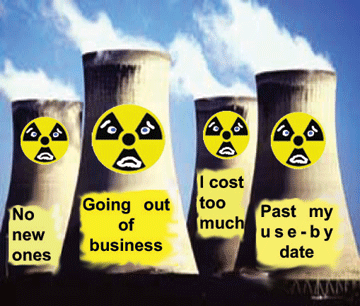 Nuclear plant closures show industry’s struggles, Anchorage Daily News, 8 June 13, LOS ANGELES — The decision to close California’s San Onofre nuclear plant is the latest setback for an industry that seemed poised for
growth not long ago.
In Wisconsin, a utility shuttered its plant last month after it couldn’t find a buyer. In Florida – and now California – utilities decided it was cheaper to close plants rather than spend big money fixing them and risk the uncertainty of safety reviews.
Meanwhile, the low cost of natural gas is discouraging utilizes from spending billions of dollars and lots of time to build nuclear reactors…………In places where utilities sell power into the open market, the low prices don’t offset the financial risk of buildingexpensive and time-consuming nuclear plants……….
Only three nuclear construction projects have moved forward, and they
are all under financial pressure. The Tennessee Valley Authority is finishing a long-mothballed reactor at its Watts Bar plant. Initially budgeted at $2.5 billion, the utility has said finishing the project could cost up to $2 billion
more.
Atlanta-based Southern Co. owns a 46 percent share of two new reactors being constructed at Plant Vogtle in eastern Georgia, a project originally estimated at $14 billion. Southern Co. subsidiary Georgia Power recently asked regulators to raise its share of the construction budget by $737 million to roughly $6.85 billion.
It may cost more. Georgia Power and the companies designing and building the plant are in a legal fight that may cost the utility more money. Separately, an independent monitor hired by Georgia regulators has warned of additional potential costs.
SCANA Corp. announced this week that it expects its costs to rise by around $200 million and the construction schedule to slip while building two reactors at the V.C. Summer Nuclear Station in SouthCarolina.
http://www.adn.com/2013/06/08/2931913/nuclear-plant-closures-shows-industrys.html#storylink=cpy
A crack appears in Tea Party’s opposition to solar emergy
 Even if the Public Service Commission forces Georgia Power to expand its use of solar power in their energy plan, Dooley said the fight is far from over. She plans to continue her efforts by pushing for upcoming legislation that would allow private companies to set up solar farms and feed their energy into Georgia Power’s grid, continuing to put pressure on Georgia Power for cost overruns at its Vogtle nuclear power plant, and possibly even challenging the law that grants monopoly rights to utilities. http://theenergycollective.com/josephromm/234916/tea-party-takes-georgia-power-over-lack-solar-energy
Tea Party Takes on Utility Over Lack of Solar Energy, Energy Collective, Joseph Romm , 9 June 13 The fight to bring cheaper, clean energy to Georgia is uniting some unlikely allies. Renewable energy advocates and leaders of the Atlanta Tea Party are taking on utility giant Southern Co., and its subsidiary Georgia Power, over resisting the call to expand its development of solar energy.
As Debbie Dooley, co-founder of the Atlanta Tea Party explained in an interview with Climate Progress, the group’s interest in the debate is quite simple: “The free market has been one of the founding principles of the Tea Party since it began and a monopoly is not a free market.” Continue reading
Closure of San Onofre nuclear plant hastens the death of nuclear power
 San Onofre is Dead & So is Nuclear Power, Nukefree.org, Harvey Wasserman, 7 June 13 From his California beach house at San Clemente, Richard Nixon once watched three reactors rise at nearby San Onofre. As of June 7, 2013, all three are permanently shut.
It’s a monumental victory for grassroots activism. it marks an epic transition in how we get our energy…… In the early 2000s, Units 2 & 3 needed new steam generators of their own. In the usual grasp for more profits, Edison chose untested, unlicensed new designs.
But they failed. And the whole world was watching. In the wake of Fukushima, two more leaky tsunami-zone reactors surrounded by earthquake faults were massively unwelcome.
So a well-organized non-violent core of local, state and national activists and organizations rose up to stop the madness.
At Vermont Yankee, Indian Point, Seabrook, Davis-Besse and dozens of other reactors around the US and world, parallel opposition is escalating.
Make no mistake—this double victory at San Onofre is a falling domino. Had the public not fought back, those reactors would have been “fixed” at public expense.
Today, they are dead…… we have yet another proof that citizen action makes all the difference in our world…… http://www.nukefree.org/editorsblog/san-onofre-dead-so-nuclear-power
1 This Month
23-25 October – on Zoom – World BEYOND War’s annual global conferenc


Shut down the radiation-damaged Heysham nuclear reactors now
To see nuclear-related stories in greater depth and intensity – go to https://nuclearinformation.wordpress.com

Say No to NASA’s Reckless Nuclear Reactor on the Moon
Say No to NASA’s Reckless Nuclear Reactor on the Moon

-
Archives
- October 2026 (199)
- September 2026 (339)
- August 2026 (330)
- July 2026 (355)
- June 2026 (287)
- May 2026 (306)
- April 2026 (356)
- March 2026 (251)
- February 2026 (267)
- January 2026 (308)
- December 2025 (358)
- November 2025 (359)
-
Categories
- 1
- 1 NUCLEAR ISSUES
- business and costs
- climate change
- culture and arts
- ENERGY
- environment
- health
- history
- indigenous issues
- Legal
- marketing of nuclear
- media
- opposition to nuclear
- PERSONAL STORIES
- politics
- politics international
- Religion and ethics
- safety
- secrets,lies and civil liberties
- spinbuster
- technology
- Uranium
- wastes
- weapons and war
- Women
- 2 WORLD
- ACTION
- AFRICA
- Atrocities
- AUSTRALIA
- Christina's notes
- Christina's themes
- culture and arts
- Events
- Fuk 2022
- Fuk 2023
- Fukushima 2017
- Fukushima 2018
- fukushima 2019
- Fukushima 2020
- Fukushima 2021
- general
- global warming
- Humour (God we need it)
- Nuclear
- RARE EARTHS
- Reference
- resources – print
- Resources -audiovicual
- Weekly Newsletter
- World
- World Nuclear
- YouTube
-
RSS
Entries RSS
Comments RSS

