Hospital workers expose to too much ionising radiation
Hospital workers say error led to higher levels of radiation exposure inforum, 4 July 13 HUDSON, Wis. – Claiming they have been exposed to excess radiation, four Hudson Hospital & Clinics technologists have filed a lawsuit against the architectural firm that designed the hospital and the construction company that built it 10 years ago.
By: Forum News Service, INFORUM HUDSON, Wis. – Claiming they have been exposed to excess radiation, four Hudson Hospital & Clinics technologists have filed a lawsuit against the architectural firm that designed the hospital and the construction company that built it 10 years ago.
The computed tomography, or CT, technicians say quarter-inch plate glass rather than lead-shielded glass was installed in the windows between the scanning and control rooms, thus exposing the workers to more than 20 times the usual radiation…. http://www.inforum.com/event/article/id/405121/group/News/
Plutonium storage activities halted at Los Alamos
All work halted at U.S. plutonium facility — Concern about ‘inadvertent chain reactions’ (VIDEO) http://enenews.com/all-work-halted-at-u-s-plutonium-facility-concern-about-inadvertent-chain-reactions
Title: LANL puts nuke work on hold over safety concerns
Source: Santa Fe New Mexican
Author: Roger Snodgrass
Date: June 28, 2013
Los Alamos National Laboratory Director Charles McMillan has halted a number of activities at PF-4, the lab’s main plutonium facility, pending a thorough verification of safety procedures. All areas of PF-4 involved in processing nuclear materials and production have been placed on hold. […]
Last month, a safety review by the Defense Nuclear Facilities Safety Board identified several problems during an inspection of safeguards against inadvertent chain reactions in the handling and storage of nuclear materials. In one instance, safety board staff identified a prohibited material in a work station. In another situation, workers at the facility identified two containers in a vault that exceeded prescribed limits for the mass and class of materials they contained. During the same period, a worker was found to have been contaminated by a leak from a faulty plug during a pressure test of a glovebox, which is supposed to be a tightly sealed workspace for handling radiological materials. “Multiple infractions” were reported in one particular room from recent months, where operations were already suspended. […]
Watch KRQE’s broadcast here
The exploding costs of the Savannah River MOX plant
The explosive costs of disposing of nuclear weapons WP,By Walter Pincus, July 3 Costs can explode like fireworks when it comes to nuclear weapons disposal.
For example, it could cost more money and take longer to get rid of just 37.5 tons of excess, weapons-grade plutonium than it did for the Manhattan Project to produce the atomic bombs that ended World War II. Four weapons — the Trinity plutonium implosion device tested in the New Mexico desert; the Little Boy uranium bomb dropped on Hiroshima; the Fat Man plutonium bomb that hit Nagasaki, and an unused uranium bomb — were produced within six years in current dollars of some $24.1 billion, according to Stephen I. Schwartz’s book, “Atomic Audit.”
In comparison, it will cost more than $24.2 billion and take until 2036 for the United States to get rid of those 37.5 tons of plutonium, according to a Government Accountability Office estimate. It appears in the Senate Armed Services report on the fiscal 2014 defense authorization bill.
Costs have skyrocketed for the Mixed Oxide Fuel Fabrication Facility at the Savannah River plant in South Carolina. The facility is designed to blend the surplus plutonium with uranium oxide to make mixed oxide (MOX) that can be used as fuel in some U.S. commercial reactors. That would make the plutonium unusable for future nuclear weapons.
When the National Nuclear Security Administration (NNSA) originated this MOX program in 2002, design and construction were to cost $1 billion.
By 2005, the estimate was $3.5 billion. When project construction began in 2007, it was three years behind schedule with a $4.8 billion price tag.
According to NNSA’s fiscal 2014 budget request, construction will hit $7.78 billion.
The annual cost to run the facility has also exploded. NNSA estimated in 2002 that it would cost $100.5 million a year to operate the MOX plant. Annual operating costs are now expected to be $543 million. The planned 2017 completion date has slipped another two years, according to a recent Congressional Research Service report.
Here’s another ticking time bomb. A federal facilities agreement in 2002 with South Carolina called for Washington to pay up to $100 million a year to the state if the plant did not produce 1 ton of MOX fuel annually, starting in 2009. That was to compensate the state for the storage of excess plutonium.
Sen. Lindsay Graham (R-S.C.), a main project booster, has used amendments to delay the fines until 2016, according to a study by the Center for Public Integrity.
The cost prompted the Obama administration to propose slowing construction while it reviews the MOX program, including assessing other ways to get rid of the plutonium……… http://www.washingtonpost.com/world/national-security/the-explosive-cost-of-disposing-of-nuclear-weapons/2013/07/03/64f896e0-e287-11e2-80eb-3145e2994a55_story.html
Uranium mining’s threat to Grand Canyon water
Are We Really Okay With a Uranium Mine Next Door to the Grand Canyon? This move would definitely not fall under the good neighbor policy Take Part, July 3, 2013 Lawrence Karol “……Located just six miles south of Grand Canyon National Park is the site of Canyon Mine, a proposed uranium mine that could negatively impact the area’s cultural values, wildlife, and waters. The Sierra Club has stated that, “Originally approved in 1986, the Canyon Mine has long been the subject of protests by the Havasupai Tribe and others objecting to potential uranium mining impacts on regional groundwater, springs, creeks, and cultural values associated with Red Butte, a Traditional Cultural Property.”
The Obama administration has taken steps to protect one million acres around Grand Canyon from new uranium mining, but Canyon Mine has been permitted to move forward as an existing claim even though the last environmental review of the project is over two decades old.
“Mining has a history of taking precedence over other important issues due in part to the outdated Mining Law of 1872 and the significant political influence of large multinational mining corporations,” says Brune.
“The reviews for Canyon Mine are more than 27 years old, older than a number of the volunteers working on this issue,” he adds. “The mine’s permit was issued with no consideration of significant new information, including the designation of the Red Butte Traditional Cultural Property and the reintroduction of the endangered California condor.”
“Scientific studies published since 1986 demonstrate more strongly the connection between the water in this area and the seeps, springs, and creeks in Grand Canyon. If this mine pollutes the groundwater, it pollutes Grand Canyon,” says Brune………http://www.takepart.com/article/2013/07/03/uranium-mine-next-door-grand-canyon
Solar energy storage in a big way, in Nevada
 Solar towers and storage – about to change the energy game? http://reneweconomy.com.au/2013/solar-towers-and-storage-about-to-change-the-energy-game-91721, By Giles Parkinson on 4 July 2013 The 110MW Crescent Dunes Solar Energy Plant, a concentrated solar power project due to be completed in Nevada early next year, will not just be the largest solar power tower plant with fully integrated energy storage built – it could also challenge the way the world thinks about renewable energy. Or even energy sources in general.
The $1 billion Crescent Dunes project near Tonopah in the Central Nevada Desert, some 300kms north of Las Vegas, was developed by the Santa Monica-based SolarReserve and features the company’s market leading molten salt power tower technology with fully integrated energy storage.
What makes it unique and a potential game changer in the electricity industry is the flexibility and dispatchability of its power, meaning that it can deliver electricity whenever it is needed by customers; and its cost, which already beats diesel, is competitive with new build coal and gas generation.
The Crescent Dunes facility will have 10 hours of molten salt storage, which on average will allow it to deliver 110MW of baseload capacity to Las Vegas between the hours of 12 noon and midnight each day, when the city needs it most to power the lights and air conditioning of its casinos and entertainment palaces. It has signed a 25-year power contract with NV Energy, Nevada’s largest utility, to do that. Continue reading
USA House Republicans want more weapons money, less money for renewable energy
 House Republicans Think $911 Million In 2014 Renewable Energy Funding Should Go To Military Clean Technica July 1, 2013 This past Tuesday, President Obama unveiled his second-term plan for cutting carbon emissions, and delivered a bracing call for the American economy to advance into a clean energy future. This past Wednesday, House Republicans responded by moving a bill out of the Appropriations Committee that would cut investments in renewables by nearly a billion dollars.
The legislation in question is the Energy and Water appropriations bill, which is the fifth of twelve spending bills the House must pass to establish the discretionary budget for 2014. Sequestration — the across-the-board spending cuts that went into effect earlier this year — set a top-line level of $967 billion for that spending. But Republicans are attempting to ease the cuts to the military by slicing even deeper into other programs. That led to a party-line vote in the committee to cut renewable investments in the bill by $911 million from their level in 2013……http://cleantechnica.com/2013/07/01/house-republicans-think-911-million-in-2014-renewable-energy-funding-should-go-to-military/
Radiation exposure to workers at Hanford
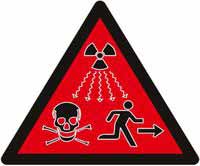 Workers at U.S. nuclear site exposed — Levels “well above threshold for a High Contamination Area” #Hanford http://enenews.com/workers-at-u-s-nuclear-site-exposed-levels-well-above-threshold-for-a-high-contamination-area-hanford
Title: PNNL staffers exposed to radioactive tritium in Richland
Source: The Bellingham Herald
Author: Annette Cary
Date: June 27, 2013
Two Pacific Northwest National Laboratory employees inhaled small amounts of radioactive tritium while doing work in the Hanford 300 Area last month. […]
Tritium inadvertently spread outside the fume hood, including along the routes to radiological trash disposal.
“Contamination levels on the floor immediately adjacent to the fume hood were well above the threshold for a High Contamination Area,” according to the defense board staff report. […]
The event is still under investigation and it’s too soon to say if any changes will be made to laboratory procedures, [PNNL spokesman Greg Koller] said.
See also: TV: “It appears the worst case scenario has happened” at U.S. nuclear site — Most dangerous material on earth “out of control”? — A whopping 800,000 dpm measured outside tank (VIDEO) #Hanford
A handsome dowry for an ugly bride – bribing communities to host nuclear wastes
 On Nuclear Waste Bill, Senators Look to Public for Help By MATTHEW L. WALD. NYT 29 June 13After the Obama administration abandoned plans in 2009 to bury nuclear waste at a repository in Nevada’s Yucca Mountain, a spot chosen by leading senators more than 20 years earlier, a study commission recommended that a new location be picked through “a consent-based process.”
On Thursday, a group of senators introduced a bill, the Nuclear Waste Administration Act, that would establish such a process, based in part on public comments solicited online by the bill’s sponsors — a practice generally reserved for rules proposed by federal agencies. Call it consent-based legislation.
“The Senate did something highly unusual,” said Per F. Peterson, a professor of nuclear engineering at the University of California, Berkeley, and a public policy expert. He said the way the legislation was developed resembled the process used by the study commission, which held hearings around the country. Taking public comment “establishes a strong foundation for the legislation to be successful if passed by the Senate and then by the House,’’ he said…….
Under the new bill, a new federal agency would be empowered to cut a deal with a state and local governments, subject to approval by Congress.

It does not define the elements of such a deal, but the expectation is that the government would offer what amounted to a handsome dowry for an ugly bride: money for roads, universities or other goodies.
In the interim, the bill would allow above-ground storage of nuclear waste in a central location, a temporary resolution to a problem that has arisen asreactors retire and the waste is orphaned.
The bill was introduced by Senators Dianne Feinstein, Democrat of California and chairwoman of the Appropriations Subcommittee on Energy and Water Development; Lamar Alexander of Tennessee, the subcommittee’s ranking Republican; Ron Wyden, Democrat of Oregon and chairman of the Energy and Natural Resources Committee; and Lisa Murkowski of Alaska, the ranking Republican member.
Congress leaves town for the Fourth of July recess on Friday, but the Senate could take up the measure later this year. http://thecaucus.blogs.nytimes.com/2013/06/28/on-nuclear-waste-bill-senators-look-to-public-for-help/?_r=0
Eliminating USA’s useless nuclear weapons – a smart budget move
Smart Savings in the Nuclear Budget | Commentary Roll Call, By Terri Lodge June 28, 2013, As appropriations bills move through Congress, protecting important programs and eliminating wasteful spending is on everyone’s mind. When it comes to smart budget cuts, look no further than nuclear weapons programs.
The B61 nuclear bombs deployed in Europe are a particularly glaring example of a program that drains billions of dollars from the defense budget but does nothing to advance our security.
Nuclear weapons in Europe are an oddity, a footprint of the Cold War. But from a national security perspective, their usefulness disappeared with the Berlin Wall. We can’t afford to spend billions of defense dollars on programs that don’t defend us against today’s threats. Instead of supporting Cold War relics, we should be investing in tools to address 21st-century security challenges.
These challenges are very real and very different from those we faced 20 years ago. Today, we think less about the risk of major nuclear conflict between the United States and Russia. But we think more about the risk of nuclear terrorism. We don’t talk about communist spies infiltrating Congress. But we do talk about climate change, cyberattacks and other unconventional challenges to our security. We don’t do “duck and cover” any more. So why are we investing billions of dollars to keep nuclear bombs in Europe?
Cold War thinking and budget inertia have combined for the worst possible scenario: As the broad defense budget declines, the nuclear budget is about to explode. The United States is on track to spend more than half a trillion dollars on nuclear weapons and related programs over the next 10 years.
Expensive, unnecessary nuclear programs such as the B61 are threatening to squeeze critical defense programs out of the budget. We’re planning to spend more than $10 billion dollars on the B61, while underinvesting in important programs such as nuclear terrorism prevention and next-generation biofuels to reduce our dependence on oil.
Eliminating the B61 and other nuclear programs that don’t advance U.S. security interests will free up funding for other defense priorities. Cutting the B61 for tools our troops can actually use — that’s a tradeoff any smart military strategist would make….. http://www.rollcall.com/news/smart_savings_in_the_nuclear_budget_commentary-225999-1.html
Legal case over US government’s uranium mining ban near Grand Canyon
British Uranium Firm Sues U.S. for $132 Million Over Grand Canyon Mining Ban http://www.grandcanyontrust.org/news/2013/06/british-uranium-firm-sues-u-s-for-132-million-over-grand-canyon-mining-ban/ June 25, 2013 by gctrust WASHINGTON D.C.— On June 21st, British uranium firm VANE Minerals sued the United States in Washington’s U.S. Court of Claims over the Department of the Interior’s January 2012 decision to protect 1 million acres of public lands around Grand Canyon National Park from new uranium mining. VANE’s suit, which claims that uranium mining in Grand Canyon’s watershed “would have no adverse impacts,” seeks up to $132 million from U.S. taxpayers. This is VANE’s second attempt to bring such a suit against the U.S.
USA Senators votes obey their campaign donors
 Senators’ Positions on Climate Change Reflect Their Donors’ Wishes ENN. 28 June 13 Earlier this week, President Obama followed up on the promise he made in his State of the Union Address, to take action on climate change even if Congress wouldn’t. Specifically, he said, “if Congress won’t act soon to protect future generations, I will.
Why would Congress be so recalcitrant on an issue of such vital importance as taking action to minimize (it’s too late to avoid) the impact of a crisis that could threaten the existence of civilization as we know it? A recent analysis performed by MapLight suggests the root of much of the underlying motivation for our elected officials is money. While this isn’t terribly surprising, it is stunningly disappointing to see how lacking in character those men and women we have elected to lead us appear to be — trading the broad interests of future generations for their own very narrow, self-serving interest in raising money to enable them to remain in jobs that, it would appear, they are morally unqualified to serve in.
Looking specifically at campaign contributions given to senators, Maplight found the following campaign contribution levels from industries whose short-term financial interests would benefit from no action being taken on climate change during the period from January 1, 2009—December 31, 2012, as well as from those who would stand to benefit from action being taken. (Source: Open Secrets)
The two tables show the name of the industry or interest and the amount contributed to senators…….
A number of bills have been submitted since 2007, mostly by Democrats attempting to deal with greenhouse gas (GHG) emissions, and these have either died in committee or been filibustered to death if they actually made it onto the floor.
So it should not be a surprise to learn that most of these financial contributions went to Republicans. That is certainly true if we look at oil & gas donors, which gave an average of $60,000 last year to Republican members of the House and Senate versus $10,000 given to Democrats. Total contributions last year, including individuals, PAC and soft money topped $65 million, more than doubling from 2010.
Coal mining interests gave out $17 million, almost all of it to Republicans, except for Joe Manchin of West Virginia, who received $222k, about the same as his Republican counterpart.
Electric utilities made contributions of $23 million to elected officials, alongside a whopping $140 million in overall lobbying (about the same as oil & gas). This was more evenly divided across party lines, with Republicans receiving roughly $14 million and Democrats $9 million.
The president has vowed to use executive authority, primarily through the EPA, to address carbon emissions, largely by limiting the allowable emissions from coal plants, which the Republicans will undoubtedly fight, either through the courts or through additional legislation. As President Obama preemptively pointed out in his speech, opponents always claim that this type of regulation will be bad for business and every time they have been wrong. The critics’ focus tends to be on the very short term changes that need to be made, rather than on the ultimate result of a cleaner, safer society being served by more efficient companies. Too often, as Ramez Naam points out in his excellent book, The Infinite Resource, the role that innovation plays is commonly underestimated.Continue Reading at Triple Pundit
Fear and loathing in USA over nuclear wastes
Stored fuel requires guards and other continuing expenses, which are significant if there is no reactor nearby. Those expenses eventually fall on federal taxpayers because the Energy Department has defaulted on contracts it signed in the 1980s to begin accepting the wastes for burial in 1998. As a result, financial penalties the federal government must pay to the nuclear utilities for failing to dispose of the waste now amount to hundreds of millions of dollars a year.
 Quarrels Continue Over Permanent Repository for Nuclear Waste http://www.nytimes.com/2013/06/28/business/energy-environment/quarrels-continue-over-permanent-repository-for-nuclear-waste.html?_r=0 By MATTHEW L. WALD June 27, 2013 WASHINGTON — As more nuclear reactors across the country are closed, the problem of what to do with their waste is becoming more urgent, government officials and private experts said at a conference here this week.
To address the problem, a bipartisan group of four senators introduced a bill on Thursday that would provide for temporary, centralized storage, even as House leaders remained focused on trying to revive plans for the Yucca Mountain nuclear waste repository that the Obama administration has declared dead.
Nuclear waste is accumulating in steel and concrete storage casks at reactor sites around the country. But the casks — sealed boxes of many tons — cannot be sent to any repository because they are not compatible, said Jeff Williams, director of the Energy Department’s Nuclear Fuel Storage and Transportation Planning Project.
In addition, a growing number of the sites no longer have an operating reactor or the associated fuel-handling equipment, so they have no way to move the highly radioactive fuel to another storage package.
Experts say the amount of orphaned nuclear waste is mounting. Nuclear utilities have announced the retirement of an additional four reactors so far this year, which leaves three more sites without an operating reactor. Before that development, the Energy Department counted nine such sites, with about 2,800 tons of fuel in 248 casks and was hoping to establish a pilot-scale interim storage plant for that fuel. Continue reading
America’s nuclear industry disintegrating
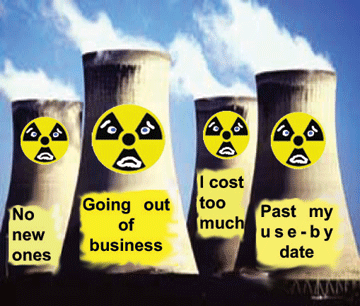 Activists See U.S. Nuclear Industry Starting to Crumble By Matthew Charles Cardinale ATLANTA, Georgia, Jun 27 2013 (IPS) –
“……According to Glenn Carroll, coordinator of Nuclear Watch South, a grassroots organisation that raises awareness about nuclear issues, the four closures bring the total number of nuclear reactors in the United States down to an even hundred, from 104 at the beginning of the year and 114 at the industry’s peak.
— Glenn Carroll
“There haven’t been any new reactors built in over 30 years. A small number of them are under construction, and none of them are going well,” Carroll told IPS. “They’re expensive…and meanwhile, solar and wind are…garnering small wins every day.”
“[The nuclear industry] is crumbling under its own weight,” Carroll said
A gradual deterioration
Just a few years ago, dozens of proposals for possible new nuclear reactors existed. Today, two nuclear projects in Georgia and South Carolina are the only ones still going forward, Carroll noted.
“If there are four reactors being built instead of 44, your economy of scale has just evaporated,” Carroll pointed out, adding that Georgia would be “strapping itself” to rising costs for parts for the plant.
“They’re going to be essentially hand-crafted. No company is going to be set up to create these parts,” she said.
Carroll predicted that other reactors would soon be slated for closure, including those at Vermont Yankee in Vernon, Vermont and at Indian Point in Buchanan, New York. In both cases, state governments have sought to shut down the plants.
Meanwhile, billionaire investor Warren Buffett has completely divested from the nuclear industry. Earlier this month, one company owned by Buffett, MidAmerican Energy, has abandoned a proposal to open a new nuclear facility in Iowa.http://www.ipsnews.net/2013/06/activists-see-u-s-nuclear-industry-starting-to-crumble/
Exelon tries (unsuccessfully) to blame wind energy for nuclear power’s commercial failures
 Exelon Still Blaming Wind PTC For Nuclear Challenges, Exelon Still Wrong About It Think Progress, By Adam James, Guest Blogger on Jun 27, 2013 Exelon recently shelved plans to expand nuclear capacity at their LaSalle and Limerick plants, taking a $100 million hit and once again reverting to the tired old strategy of blaming subsidized wind. The specific target of their ire is the Production Tax Credit (PTC). For wind, that is, not the one that they happily collect for nuclear.
Exelon is (again) wrong about the PTC, as anyone who read our last post already knows.
First, let’s look at the big picture. Wind power has been a tremendous boon for North America. Costs have fallen 90 percent since 1992, the domestic content of wind turbines has dramatically risen, and 75,000 people are employed in the industry. This growth is directly tied to the continued extension of the Production Tax Credit. Wind power is cheap and carbon free, making it good for consumers and the climate alike.
However, Exelon has decided that wind power is bad for their business. The argument they’ve been making is that because wind can collect tax credits for producing energy at times when demand for electricity is very low, electricity prices become negative as the generator pays consumers to take electricity. This hurts their other generators, like nuclear plants, who then have to sell at a loss. Buried in the story about Limerick and LaSalle is a very important point though: negative prices didn’t occur once in springtime.
We debunked this tale before, but I’ll recap the highlights here:……http://thinkprogress.org/climate/2013/06/27/2210711/exelon-still-blaming-wind-ptc-for-nuclear-challenges-exelon-still-wrong-about-it/?mobile=nc
New Mexico protests against uranium mining
La Jicarita: Protesters in Santa Fe Say No Uranium Mining http://unoccupyabq.org/2013/06/la-jicarita-protesters-in-santa-fe-say-no-uranium-mining/ 27 June 13 La Jicarita: Albuquerque and Santa Fe activists joined an inter-tribal delegation to protest the planned resumption of uranium mining in New Mexico. With organizing help from (un)occupy Albuquerque, the June 25 action began at the New Mexico Mining Association offices, then moved to the New Mexico Mining and Minerals Division where the contingent confronted division director Fernando Martinez in a polite but insistent impromptu dialogue. Moving on to the offices of the Uranium Producers of America, the protesters found the occupants had moved out (not in search of larger premises, we hope). Ending up at the Santa Fe plaza, the activists took part in a call to free imprisoned AIM activist Leonard Peltier and an Idle No More-led round dance around the town’s monument to the Indian Wars. Click on the links between the pictures below to hear the words of participants in these events.
Read the full article here.
Reporter Eric Schultz also included audio of many of the speakers, well worth a read, and a listen.
1 This Month
23-25 October – on Zoom – World BEYOND War’s annual global conferenc


Shut down the radiation-damaged Heysham nuclear reactors now
To see nuclear-related stories in greater depth and intensity – go to https://nuclearinformation.wordpress.com

Say No to NASA’s Reckless Nuclear Reactor on the Moon
Say No to NASA’s Reckless Nuclear Reactor on the Moon

-
Archives
- October 2026 (199)
- September 2026 (339)
- August 2026 (330)
- July 2026 (355)
- June 2026 (287)
- May 2026 (306)
- April 2026 (356)
- March 2026 (251)
- February 2026 (267)
- January 2026 (308)
- December 2025 (358)
- November 2025 (359)
-
Categories
- 1
- 1 NUCLEAR ISSUES
- business and costs
- climate change
- culture and arts
- ENERGY
- environment
- health
- history
- indigenous issues
- Legal
- marketing of nuclear
- media
- opposition to nuclear
- PERSONAL STORIES
- politics
- politics international
- Religion and ethics
- safety
- secrets,lies and civil liberties
- spinbuster
- technology
- Uranium
- wastes
- weapons and war
- Women
- 2 WORLD
- ACTION
- AFRICA
- Atrocities
- AUSTRALIA
- Christina's notes
- Christina's themes
- culture and arts
- Events
- Fuk 2022
- Fuk 2023
- Fukushima 2017
- Fukushima 2018
- fukushima 2019
- Fukushima 2020
- Fukushima 2021
- general
- global warming
- Humour (God we need it)
- Nuclear
- RARE EARTHS
- Reference
- resources – print
- Resources -audiovicual
- Weekly Newsletter
- World
- World Nuclear
- YouTube
-
RSS
Entries RSS
Comments RSS

