New guidelines allow far greater radiation exposure to the public
 For Future Reactor Meltdowns, EPA Means “Extra Pollution Allowed” by JOHN LaFORGE Cutting Corners, Cutting Costs, Creating Cancer
As the nuclear power industry struggles against collapse from skyrocketing costs, bankrupting repair bills and investor flight (four operating reactors were permanently closed this year, more than in any previous 12 month period), the government seems to have capitulated to political pressure to weaken radiation exposure standards and save nuclear utilities billions.
On April 15, the EPA issued new Protective Action Guides (PAGs) for dealing with large scale radiation releases — like the catastrophic triple reactor meltdowns at Fukushima, Japan that spread cesium and radio-iodine worldwide. The new PAGs are like a government bailout, saving reactor owners the gargantuan costs of comprehensive cleanup. And eerily, the new PAGs seem to presume the inevitability of radiation disasters that the industry — with its fleet of 100 rickety 40-year-old units — can’t currently afford to withstand.
According to Daniel Hirsch, President of Committee to Bridge the Gap, the latest PAGs took effect in April but can be amended — and EPA is taking comments. Hirsch says that the National Council on Radiation Protection’s plans for implementing the new PAGs “would allow the public to be exposed to extraordinarily higher levels of radiation than previously permitted” during reactor accident emergencies.
The new PAGs also allow extremely high contamination of food, he says. “In essence,” Hirsch reports, the PAGs say “nuclear power accidents could be so widespread and produce such immense radiation levels that the government would abandon cleanup obligations” forcing people to absorb and live with far more cancers.
To cut costs, industry has long pushed for weakening radiation exposure rules. In 2002, Roger Clarke president of the International Commission on Radiological Protection (ICRP) warned in the Bulletin of the Atomic Scientists, “Some people think that too much money is being spent to achieve low levels of residual contamination.” The ICRP recommends exposure standards to governments for nuclear industry workers and the public…….http://www.counterpunch.org/2013/07/09/for-future-reactor-meltdowns-epa-means-extra-pollution-allowed/
Permissible radiation doses established by polluters
 For Future Reactor Meltdowns, EPA Means “Extra Pollution Allowed”, Counter Punch, Cutting Corners, Cutting Costs, Creating Cancer, by JOHN LaFORGE, 11 July 13,
“……….There is no exposure to ionizing radiation that’s safe. Even the smallest exposures have cellular-level effects that can lead to immune dysfunction, birth defects, cancer and other diseases. The National Academy of Sciences’ 7th book-length on the biological effects of ionizing radiation, BEIR-VII, declared that any exposure, regardless of how small, may cause the induction of cancer. BEIR-VII also explicitly refuted and  repudiated the pop culture “hormesus” theory, promoted by industry boosters, that a little radiation is good for us and acts like a vaccination.
Today, the nuclear industry — military, industrial and medical — is required to keep radiation exposures only “as low as reasonably achievable.” This tragicomic standard is neither a medical nor scientific concept. It’s not based on health physics or biology. It’s merely the formal admission that radiation producers cannot keep worker or public exposures to a level that is safe — that is zero.
Exposure limits have been established at the convenience of the military and industrial producers of radioactive pollution, not by medical doctors of health physicists. The late Dr. Rosalie Bertell made clear 36 years ago in Robert Del Tredici’s book At Work In the Fields of the Bomb, “The people with the highest vested interest are the ones that are making the nuclear bombs. And it turns out they have complete control over setting the permissible [radiation exposure] levels.” Since then, little has changed in the regulatory world (although scientists have found that far more damage is caused by low dose radiation than was earlier thought possible): the ICRP’s 1990 recommendations to reduce worker and public exposures by three-fifths has yet to be adopted by the United States.
We can thank industrial and political roadblocks for that, yet in spite of them the government’s permissible dose (lazy reporters often write “safe” dose) of radiation has dramatically decreased over the years — as we’ve come to better understand the toxic, carcinogenic and mutagenic properties of low-level exposures. In the 1920s the permissible dose was 75 rem (radiation equivalent man) per year for nuclear industry workers. In 1936, the limit was reduced to 50 rem per year; then 20-25 in 1948; 15 in 1954; and down to 5 rem per year in 1958. The general public is officially allowed to be exposed to one-tenth the workers’ dose, or 0.5 rem per year. The ICRP’s 1990 suggestion was to cut this to 2 and 0.2 respectively.
With cancer rates at pandemic proportions, adding higher radiation exposures to the effects of 80,000 chemicals that contaminate our air, water and food only makes our chance of avoiding the dread disease slimmer. Rather than permitting increased doses of dangerous and sometimes deadly radiation, especially following reactor disasters, the government should be acting to prevent them — like Germany, Italy and Japan — by preparing the phase-out of the country’s accident-prone nukes.
John LaForge is a co-director of Nukewatch, a nuclear watchdog and environmental justice group in Wisconsin.
AUDIO: crisis of dangerous radioactive trash at Pilgrim Nuclear Power Plant

it would make sense to just stop producing this radioactive trash
At Pilgrim — like Fukushima — spent fuel is stored in a pool high above the reactor. Tarantino says the pool contains all the nuclear waste ever produced by Pilgrim’s reactor.
“We have 40 years worth of spent fuel in the reactor building,” Tarantino said. “Fuel has never left the site.”…… Pilgrim is rapidly running of room. In two years there won’t be any space left in the pool and Pilgrim will have to shut down unless a new waste storage site can be built outside of the reactor building….
Workers have already begun constructing a road to transport huge containers — called dry cask storage — out of the reactor building to a special concrete pad nearby. This is this construction that opponents were trying to photograph with their kite camera……
 AUDIO http://www.wbur.org/2013/07/10/pilgrim-nuclear-waste-permit Residents Challenge Pilgrim’s Permit For New Nuclear Waste Site By Bruce Gellerman July 10, 2013 PLYMOUTH, Mass. — Since 1972, the Pilgrim Nuclear Power Plant here has generated prodigious amounts of electricity, tons of radioactive waste and plenty of controversy.
Wednesday night, the debate heats up as the Plymouth zoning board votes on whether to allow Entergy — the plant’s owner — to continue with construction on a new waste storage site. The vote could stall or even stop the nuclear power plant for good.
Security, And Public Scrutiny
A few weeks ago, anti-nuclear activists — with the help from the law firm EcoLaw — flew a kite with a camera over the plant. They wanted to see what Entergy was building on the 1,600-acre site along Cape Cod Bay.
“This is the first time in a long time that citizens have pulled back the blanket of secrecy that has allowed Entergy to operate without much public scrutiny on the local level,” said attorney Meg Sheehan, who was born and raised in Plymouth. Continue reading
Congress wants answers about nuclear waste transport through Las Vegas
 Titus asks for disclosure of nuclear waste routes
http://www.knoxnews.com/news/2013/jul/10/titus-asks-for-disclosure-of-nuclear-waste/ Associated Press July 10, 2013 LAS VEGAS (AP) — A frustrated congressional representative is asking for more disclosure about a plan to route nuclear waste through Las Vegas.
Rep. Dina Titus, D-Nev., sent a letter Tuesday to the head of the federal Department of Energy asking to discuss a plan to ship 403 canisters of bomb-grade nuclear waste through her home state.
The Las Vegas Sun (http://bit.ly/130TXZE ) reports that she berated the department for failing to provide Congress with adequate information about the plan to ship the canisters from the Oak Ridge
National Laboratory in Tennessee to a Nevada National Security Site. Continue reading
Deep burial a cheaper way than MOX to dispose of plutonium
 Nuclear waste: DC has ignored a cheaper way to dispose of plutonium — until now Sentinel.com, Douglas Birch & R. Jeffrey Smith The Center for Public Integrity, 7 July 13,
For the past decade, Washington has known how to dispose of excess U.S. plutonium at a cost estimated to be hundreds of millions of dollars less than what the Energy Department is spending on a South Carolina factory meant to transform plutonium into fuel for nuclear reactors.
Instead of burning the plutonium, the cheaper alternative mixes it with glass or ceramics and some other materials, so it can be buried deep underground. Continue reading
Nuclear industry executives realise that their business is in decline
 Nuclear power faces uncertain future The shifting economics of energy and Japan’s Fukushima disaster may have squashed the industry’s attempted comeback. Jonathon Berr, MSN Money, 7 July 13, About a decade or so ago, many Americans were talking about a “Nuclear Renaissance.” The public’s unease about the industry, which dated at least as far back as the 1979 Three Mile Island accident, had begun to fade and new nuclear power plants were being proposed in the U.S. for the first time in decades…..Now, though, optimism surrounding nuclear energy is slipping away, even as President Obama has vowed that 80% of America’s electricity will come from renewable resources by 2035 to reduce greenhouse gas emissions……. Continue reading
Solar powered plane’s successful flight across America
 Solar-Powered Plane Lands At JFK in a Sweeping Victory For Renewable Energy http://www.policymic.com/articles/53209/solar-powered-plane-lands-at-jfk-in-a-sweeping-victory-for-renewable-energy Maggie O’Neil , 7 July 13, Last night, at approximately 11:09 PM, co-pilots Bertrand Piccard and André Borschberg safely landed at JFK International Airport on a plane operated by nothing but solar energy.
New York was the final destination of a transcontinental journey that began in San Francisco, followed by Phoenix, then Dallas, then St. Louis, and then Washington, D.C. Continue reading
Unsafety at Brown’s Ferry nuclear plant, and a whistleblower’s case
 For Johnson, speaking out has had consequences, as she said she ran up substantial legal bills without expectation of a resolution with TVA. But she became more concerned about the costs of not speaking out.
“I found myself in the position of becoming a whistleblower when TVA management altered root cause reports I authored to subdue their findings,” she said last week. “I hope that bringing this story to public light will force TVA to address the safety significance of altering the findings of teams of engineers and experts for the sake of protecting production and their own bonuses.”
 Browns Ferry: Shrinking the safety margin at Alabama’s largest nuclear plant By Challen Stephens and Brian Lawson, All Alabama 7 July 13
What federal regulators have said in recent years:
• Browns Ferry received a red finding, the federal government’s most serious warning before shutdown.
• Browns Ferry failed to notice a blocked low-pressure cooling line.
• Inspectors discovered wider problems with safety culture at Browns Ferry.
What a search of TVA and Nuclear Regulatory Commission documents also shows:
• The backup low-pressure line also malfunctioned.
• The high-pressure core spray was installed incorrectly.
• The Unit 1 reactor operated for years with overlapping, malfunctioning emergency cooling systems.
What a whistleblower alleges, and paperwork supports:
• TVA ignored or obscured failing safety tests for malfunctioning equipment.
• TVA hurried to install equipment based on managerial bonuses.
What TVA acknowledges in their own paperwork:
• The plant operated for years with a bias toward power production over safety. Continue reading
The dimming prospects for the nuclear industry
 Exelon, which bills itself as the nation’s “largest competitive power generator,” cited “low natural gas prices and economic and market conditions” that make nuclear construction uneconomical “now and in the foreseeable future.”
Was nuclear the right decision for SCE&G?, Post and Courier, dDoug Pardue, 7 July 13 “…….Ratepayer outrage Robert Johnston buys none of SCE&G’s promise of the billions of dollars in long-range savings from nuclear power.
Johnston is not your normal disgruntled ratepayer. He’s chief strategy officer and executive vice president at The InterTech Group Inc., a North Charleston-based manufacturing conglomerate that also invests in utilities.
Johnston turned rate protester in 2010 when SCE&G tried to win approval for a 10 percent rate increase amid the recession. Johnston helped InterTech make its headquarters building mostly solar-powered, and he added a false roof to his Isle of Palms home so he could place enough solar panels to make his house energy independent.
His monthly electric bill is no longer $400. It’s $9.79. “I’ve effectively fired SCE&G,” he said And that’s what he’d like everyone to do. Continue reading
The nuclear missile interceptor that didn’t intercept
Nuclear missile interceptor fails to hit its target during test launch as US bolsters defenses after North Korea’s weapons tests
- $214 million practice run against incoming attacks misses its mark
- Third failure for U.S.’s only defense system against long-range attack
Mail Online, By DAILY MAIL REPORTER, 7 July 2013 A missile designed to destroy nuclear missiles after they have been fired failed to hit its target during a test launch.
The ground-based interceptor missile fired from Vanderberg Air Force Base was supposed to hit a missile launched in the Kwajalein Atoll 4,000 miles away.
It was the third consecutive failure of the Interceptor system, which is managed by Boeing Co, according to defense officials……http://www.dailymail.co.uk/news/article-2357864/Nuclear-missile-interceptor-fails-hit-target-test-launch-US-bolsters-defenses-North-Koreas-weapons-tests.html#ixzz2YU83XB6B
The failure of the South Carolina Mixed Oxide (MOX) nuclear fuel plant
Nuclear waste: DC has ignored a cheaper way to dispose of plutonium — until now Sentinel.com, Douglas Birch & R. Jeffrey Smith The Center for Public Integrity, 7 July 13, “………..Unrealized ambitions
Although the White House has not allocated any additional funding for the South Carolina plant after 2014, the Energy Department claims it remains in contention as a solution to the plutonium disposal problem. But already it’s clear that the original U.S. goal for the program — reducing the world’s supply of nuclear explosive material by 68 tons – will not be realized.
Washington compromised repeatedly with Russia to pursue a program that even for some of its initial supporters has long since ceased to be a top nonproliferation priority. Meanwhile, the price of the MOX fuel factory soared far beyond the Energy department’s estimates, making it one of many, multi-billion dollar, Energy Department programs accused of being poorly run.
“MOX is just a sample of a larger problem,” says Gene Aloise, a senior federal auditor who tracked nonproliferation projects for the Government Accountability Office from 1994 to 2012.
The result is that Washington has spent at least $3.7 billion on a plant to manufacture reactor fuel no U.S. utility is eager to buy, after rejecting alternatives that likely would have been cheaper.
“The government’s plutonium plan is a pluperfect disaster,” Sen. Edward Markey, a newly-elected Massachusetts Democrat, told the Center for Public Integrity in a statement. “And all to produce $2 billion worth of reactor fuel at a cost of tens of billions of taxpayer dollars and damage to our global non-proliferation efforts.” Markey was the ranking member of the House Natural Resources Committee, has long been active on nuclear safety issues, and in 1986 chaired hearings on the Chernobyl disaster.
The factory’s fate might be decided next year, as the administration prefers, after another $320 million is spent on its construction. Or Congress might decide to take swifter and more decisive action in budget legislation this summer……..And after twenty years of negotiations, promises and plans, and billions in spending, the U.S. appears no closer — in its principal plutonium disposal efforts — to the goal of making the world safer from a nuclear disaster.http://www.tucsonsentinel.com/nationworld/report/070513_nuclear_waste/nuclear-waste-dc-has-ignored-cheaper-way-dispose-plutonium-until-now/
California’s enthusiastic moves to renewable energy
California finds clean energy’s magic ingredient: Ambition REneweconomy, By Giles Parkinson on 8 July 2013 “……There is no talk of repealing or diluting the carbon price, and its renewable energy target is 33 per cent by 2020 …….. Some time in the next couple of years the California legislature in Sacramento is likely to move the bar even higher, to 40 or even 45 per cent (by 2025 or 2030).
Edward Randolph, the energy director from the California Public Utilities Commission, which oversees the investor-owned utilities in the state, says constantly raising that level of ambition has proved extremely successful.
“A lot of people argued against the 33 per cent target saying it was too difficult, but the legislature said ‘no, we’re going to set broad and ambitious goals and let the engineers figure out how to do it,” Randolph tells RenewEconomy in an interview in his San Francisco office last week.
“And quite frankly I think that has been the right way of doing it, saying ‘this is what we are going to do, you guys go figure it out’. That’s worked really well and that’s why I’m certain that in the next year or so the legislators will come back and say we ready to move to 40 per cent or 45 per cent. They don’t wait for us to get to the goal. Once they start seeing progress, they move the goals. And I honestly think it works.”
It’s not stopping there. The office of Democrat governor Jerry Brown, who apparently loves solar, has mandated 3,000MW of rooftop solar by 2017, has a program to encourage “self generation” in other technologies (such as fuel cells), and is looking at taking leadership in the electricity storage market, pushing for a mandated 1GW of storage to be installed by 2020. All these targets are over and above the renewable energy target, known here as Renewable Portfolio Standard. Continue reading
Venezuela to the rescue – asylum offer to Edward Snowden
 Edward Snowden offered asylum by Venezuelan president Reuters in Caracas guardian.co.uk, 6 July 2013 Nicolás Maduro says whistleblower has ‘told the truth in spirit of rebellion’, while Nicaragua also weighs asylum offer Venezuelan president Nicolás Maduro said on Friday he had decided to offer asylum to former US intelligence contractor Edward Snowden, who has petitioned several countries to avoid capture by Washington.
“In the name of America’s dignity … I have decided to offer humanitarian asylum to Edward Snowden,” Maduro told a televised military parade marking Venezuela‘s independence day.
The 30-year-old former National Security Agency contractor is believed to be holed up in the transit area of Moscow’s Sheremetyevo international airport.
WikiLeaks said on Friday that Snowden had applied to six more nations for asylum, bringing to about 20 the number of countries he has asked for protection from US espionage charges.
Maduro said Venezuela was ready to offer him sanctuary, and that the details Snowden had revealed of a US spy program had exposed the nefarious schemes of the US “empire”.
“He has told the truth, in the spirit of rebellion, about the US spying on the whole world,” Maduro said.
“Who is the guilty one? A young man … who denounces war plans, or the US government which launches bombs and arms the terrorist Syrian opposition against the people and legitimate president Bashar al-Assad?”
“Who is the terrorist? Who is the global delinquent?”…….
Earlier on Friday, Nicaragua said it had received an asylum request from Snowden and could accept the bid “if circumstances permit”, president Daniel Ortega said.
“We are an open country, respectful of the right of asylum, and it’s clear that if circumstances permit, we would gladly receive Snowden and give him asylum in Nicaragua,” Ortega said during a speech in the Nicaraguan capital, Managua…….http://www.guardian.co.uk/world/2013/jul/06/edward-snowden-venezuela-asylum
Secret promises to USA, by Japan, to burn plutonium
 Mainichi: Japan’s secret promise with U.S. to burn plutonium — “It is abnormal for sure” — “Expected to stir up controversy” http://enenews.com/mainichi-japan-secretly-promised-to-burn-plutonium-it-is-abnormal-for-sure-expected-to-stir-up-controversy
Title: Japan made secret promise with U.S. to restart pluthermal nuclear program
Source: Mainichi
Date: June 25, 2013
A Japanese prime ministerial envoy secretly promised to the United States that Japan would resume its controversial “pluthermal” program, using light-water reactors to burn plutonium, according to documents obtained by the Mainichi.
The secret promise was made by Hiroshi Ogushi, then parliamentary secretary of the Cabinet Office, to Daniel Poneman, deputy secretary of the U.S. Department of Energy, during Ogushi’s visit to the United States on behalf of then Prime Minister Yoshihiko Noda in September last year.
[…] The fact that a Japanese official promised to the U.S. to implement such a controversial project without a prior explanation to the Japanese public is expected to stir up controversy. […]
“It is abnormal for sure,” said one official with the Agency for Natural Resources and Energy. […]
See also: Plutonium-burning reactors to restart in Japan? — Gov’t forcing companies to use MOX fuel — Official: “We have no other choice”
Legal fightback by Native Americans against uranium mining
The proposed legislation can be found at the website of Defenders of the Black Hills,
Uranium Mining and Native Resistance: The Uranium Exploration and Mining Accountability Act http://intercontinentalcry.org/uranium-mining-and-native-resistance-the-uranium-exploration-and-mining-accountability-act/ BY CURTIS KLINE • JUL 2, 2013 NATIVE AMERICANS IN THE NORTHERN GREAT PLAINS HAVE THE HIGHEST CANCER RATES IN THE UNITED STATES, PARTICULARLY LUNG CANCER. IT’S A PROBLEM THAT THE UNITED STATES GOVERNMENT HAS WOEFULLY IGNORED, MUCH THE HORROR OF THE MEN AND WOMEN WHO MUST CARRY THE PAINFUL, LIFE-THREATENING BURDEN.
The cancer rates started increasing drastically a few decades after uranium mining began on their territory.
According to a report by Earthworks, “Mining not only exposes uranium to the atmosphere, where it becomes reactive, but releases other radioactive elements such as thorium and radium and toxic heavy metals including arsenic, selenium, mercury and cadmium. Exposure to these radioactive elements can cause lung cancer, skin cancer, bone cancer, leukemia, kidney damage and birth defects.”
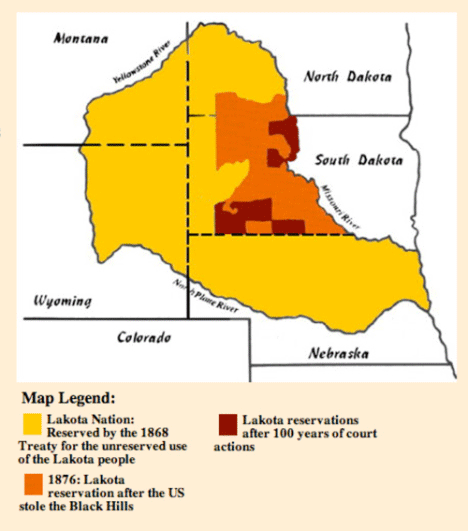
Today, in the northern great plains states of Wyoming, Montana and the Dakotas, the memory of that uranium mining exists in the form of 2,885 abandoned open pit uranium mines. All of the abandoned mines can be found on land that is supposed to be for the absolute use of the Great Sioux Nation under the 1868 Fort Laramie Treaty with the United States.
There are also 1,200 abandoned uranium mines in the Navajo Nation, where cancer rates are also significantly disproportionate. In fact, it is estimated that 60 to 80 percent of all uranium in the United States is located on tribal land, and three fourths of uranium mining worldwide is on Indigenous land.
Defenders of the Black Hills, a group whose mission is to preserve, protect, restore, and respect the area of the 1851 and 1868 Fort Laramie Treaties, is calling the health situation in their own territoryAmerica’s Chernobyl. Continue reading
1 This Month
23-25 October – on Zoom – World BEYOND War’s annual global conferenc


Shut down the radiation-damaged Heysham nuclear reactors now
To see nuclear-related stories in greater depth and intensity – go to https://nuclearinformation.wordpress.com

Say No to NASA’s Reckless Nuclear Reactor on the Moon
Say No to NASA’s Reckless Nuclear Reactor on the Moon

-
Archives
- October 2026 (199)
- September 2026 (339)
- August 2026 (330)
- July 2026 (355)
- June 2026 (287)
- May 2026 (306)
- April 2026 (356)
- March 2026 (251)
- February 2026 (267)
- January 2026 (308)
- December 2025 (358)
- November 2025 (359)
-
Categories
- 1
- 1 NUCLEAR ISSUES
- business and costs
- climate change
- culture and arts
- ENERGY
- environment
- health
- history
- indigenous issues
- Legal
- marketing of nuclear
- media
- opposition to nuclear
- PERSONAL STORIES
- politics
- politics international
- Religion and ethics
- safety
- secrets,lies and civil liberties
- spinbuster
- technology
- Uranium
- wastes
- weapons and war
- Women
- 2 WORLD
- ACTION
- AFRICA
- Atrocities
- AUSTRALIA
- Christina's notes
- Christina's themes
- culture and arts
- Events
- Fuk 2022
- Fuk 2023
- Fukushima 2017
- Fukushima 2018
- fukushima 2019
- Fukushima 2020
- Fukushima 2021
- general
- global warming
- Humour (God we need it)
- Nuclear
- RARE EARTHS
- Reference
- resources – print
- Resources -audiovicual
- Weekly Newsletter
- World
- World Nuclear
- YouTube
-
RSS
Entries RSS
Comments RSS

