Fire in turbine building at Palo Verde Nuclear Plant

 Emergency declared at U.S. nuclear plant due to fire in turbine building — Two ‘reflash events’ occurred — Fire emergency lasted over four hours #PaloVerde http://enenews.com/emergency-declared-at-u-s-nuclear-plant-due-to-fire-in-turbine-building-two-reflash-events-occurred-fire-emergency-lasted-over-four-hours-paloverde
Associated Press, Sept. 3, 2013: The Palo Verde Nuclear Generating Station declared an unusual event when oil-soaked insulation behind a water pump caught fire, officials said Tuesday. […] An unusual event is the lowest of four emergency levels for nuclear power plants. […] APS spokesman said the cause of the fire is under investigation, but NRC spokesman Victor Dricks said it appeared that insulation that covers very hot metal surfaces had become soaked by bearing lubrication over time. […] The unusual event was the second at Palo Verde in two months […] The last unusual event was on July 2 when Unit 1 reactor temporarily reduced its power production after there was a minor explosion in a cabinet that holds electrical switching gear.
NRC: Event Notification Report for September 4, 2013 – – UNUSUAL EVENT DECLARED DUE TO FIRE IN THE TURBINE BUILDING […] An Event Classification of Unusual Event (HU2.1) was declared at 1926 [MST] for the Palo Verde Nuclear Generating Station. At 1912, smoke was detected by a security officer by the ‘A’ train Main Feed pump. An Auxiliary Nuclear Operator investigated and identified a fire on lagging, with one foot flames behind the main standard ‘A’ train Main Feed pump. The fire team responded to the fire and is currently on scene. Fire was declared out at 1957. […] The ‘A’ Main Feed pump high vibration alarm was received, but the continued operation of the main feed pump is currently not in jeopardy.” While removing lagging, during the recovery process, the licensee had 2 reflash events. The flame was extinguished and the licensee continues to remove the oil soaked lagging for the ‘A’ Main Feed pump. […] Vapor extraction differential pressure was increased to eliminate the oil vapor leak. At 2134 MST, received a report of two reflash events while the Fire Department was removing additional lagging with no sustained flame or fire. All the affected lagging has been removed and the fire emergency was terminated at 2345 MST on 9/2/13. See also: Explosion reported at U.S. nuclear plant, emergency declared
Uranium price is tied to what’s going on in Japan, says UEC
Uranium Energy Cuts Output as Nuclear Fuel Prices Lie Low Bloomberg, By Gerrit De Vynck – Sep 5, 2013Uranium Energy Corp which mines and processes the nuclear fuel in Texas, is cutting production as prices trade at a seven-year low…..Uranium spot prices have fallen 22 percent this year amid delays in the restart of nuclear plants in Japan following the March 2011 earthquake and tsunami. Last month, Cameco Corp. (CCO), the world’s third-largest uranium producer, dropped its projected sales volume from its German trading unit Nukem Energy GmbH to 8 million to 10 million from 9 million to 11 million pounds.
“This uranium price is tied to what’s going on in Japan,” said David Talbot, an analyst for Dundee Securities Corp. in Toronto. Once Japanese regulators approve more plant restarts, it will signal to the world to begin buying uranium again and the price will rebound, he said….. http://www.bloomberg.com/news/2013-09-05/uranium-energy-cuts-output-as-nuclear-fuel-prices-lie-low.html
Build ’em up, pull ’em down – always money for the nuclear industry
Nuclear Trashmen Gain From Record U.S. Reactor Shutdowns Bloomberg By Brian Wingfield – Sep 4, 2013 More than 50 years into the age of nuclear energy, one of the biggest growth opportunities may be junking old reactors. Entergy Corp. (ETR) said Aug. 27 it will close its 41-year-old Vermont Yankee nuclear plant in 2014, making the reactor the fifth unit in the U.S. marked for decommissioning within the past 12 months, a record annual total. Companies that specialize in razing nuclear plants and hauling away radioactive waste are poised to benefit.
Disposal work is “where companies are going to make their fortune,” Margaret Harding, an independent nuclear-industry consultant based in Wilmington, North Carolina, said in an phone interview. Contractors that are usually involved in building reactors, including Bechtel Group Inc. and URS Corp. (URS), “are going to be looking very hard at the decommissioning side of it.”
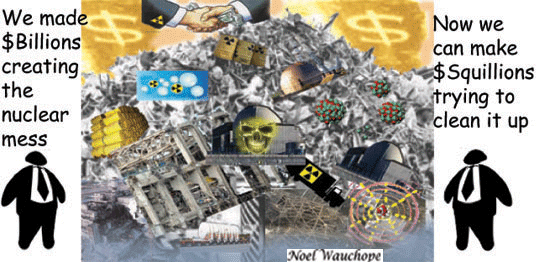
With Dominion Resources Inc. (D), Duke Energy Corp. (DUK)and Edison International (EIX) shuttering reactors this year — and Exelon Corp. (EXC) planning to close its Oyster Creek plant in 2019 — the U.S. nuclear fleet of 104 units is shrinking, even as Southern Co. (SO) and Scana Corp. (SCG) build two units each. The reasons vary: Edison and Duke are permanently removing damaged plants from service. Entergy and Dominion are retiring the units because of factors including a glut of natural gas, a competing fuel……….
The length of time to decommission a reactor creates uncertainty surrounding plant oversight, according to Shaun Burnie, an independent nuclear consultant who previously led environmental group Friends of the Earth’s campaign to close Edison’s San Onofre plant in California.
“Is Entergy going to be around in 50 years time? In 10 years time?” he said in a phone interview.
Ralph Andersen, senior director of radiation safety and environmental protection for the Nuclear Energy Institute, said the industry is entering a new era for the companies that handle reactor decommissioning.
“It really does open the door to the marketplace rethinking ways to handle decommissioning,” he said………. http://www.bloomberg.com/news/2013-09-04/nuclear-trashmen-gain-from-record-u-s-reactor-shutdowns.html
USA’s cover-up of effects of depleted uranium on US soldiers
 The U.S. Army’s own contractor, Doug Rokke, who headed a clean up of depleted uranium (DU) after the first Gulf War stated, “Depleted uranium is a crime against God and humanity.” Mr. Rokke went on to state that when his crew went to the Gulf they were all very healthy people, yet after performing clean up operations, 30 members of his staff died and the majority of the others, to include Mr. Rokke himself, “developed serious health problems.
 The military is aware of depleted uranium’s harmful effects on the human genetic code.
The U.S. Military does not want the rest of the world to find out what we have done
Dangers and Health Effects of Depleted Uranium, Disabled World, Thomas C. Weiss, 4 Sept 13 “…….According to an article by Robert C. Koehler in 2007, the Veterans Administration presented figures of 205,000 soldiers who returned from wars in Iraq and Afghanistan. Of these soldiers, one-third have sought medical care for issues such as:
Perhaps the most compelling evidence of all is the sheer number of veterans of the Iraq and Afghanistan conflicts suffering physical ailments. In an April 12, 2007 article, Robert C. Koehler examined the issue:
- Malignant tumors (1,584)
- Mental disorders (73,157)
- Mystery conditions (67,743)
- Nervous system diseases (61,524)
- Musculoskeletal diseases (87,590)
- Digestive system diseases (63,002)
- Endocrinal and metabolic diseases (36,409)
Many times these conditions are lumped together under the convenient catch all heading of, ‘Gulf War Syndrome.’ It is very likely that at least some of these illnesses are caused by exposure to depleted uranium (DU). The effects of DU contamination may take up to 10 years to manifest and it is likely the number of veterans who will need medical care will be higher than from prior conflicts. Continue reading
The tricky but lucrative business of shutting down dead nuclear raectors
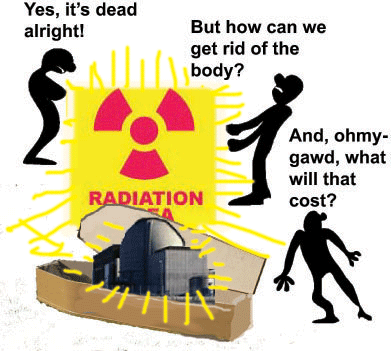 Nuclear Trashmen Gain From Record U.S. Reactor Shutdowns Bloomberg By Brian Wingfield – Sep 4, 2013 1:”……..Tricky Business The physical work involved in tearing down a nuclear plant takes about 10 years, according to John Hickman, a project manager in the U.S. Nuclear Regulatory Commission’s decommissioning branch. The agency gives reactor owners 60 years to complete decommissioning, which it defines as permanently removing a plant from service and reducing radioactivity enough for the property to be used for another purpose.
The NRC is now overseeing 14 commercial reactors that are in some phase of decommissioning, excluding those marked for closure in the last year. The first plant to deliver commercial power in the U.S. was a General Electric Co (GE).-designed unit near Fremont, California, which began service in 1957, according to the agency. It was also the first unit to be decommissioned, in 1963.
Razing a plant is tricky business. Radiation can seep into the concrete, pipes and metal of plant structures, and workers need to be able to break down the units without exposing themselves, or the public, to contamination. Plants often sit idle for decades before being torn down in order to let radioactive material decay. Continue reading
Southern California planning new energy system, with San Onofre closed
Post-nuclear power grid takes shape UT San Diego, By Morgan Lee SEPT. 4, 2013 Responding to the retirement of the San Onofre nuclear plant, energy authorities are closing in on California’s solution for ensuring power supplies to San Diego and the Los Angeles Basin, outlining a plan that will come under scrutiny Monday in Sacramento.
Under a 10-page draft plan, state regulators and Southern California utilities are weighing measures that might revive generators at the San Onofre site to ensure adequate electricity imports……..
Tourists unaware of radiation danger on the Great Plains
America’s Chernobyl: Radioactive Dust Near Mt. Rushmore & Black Hills http://indiancountrytodaymedianetwork.com/2013/09/02/americas-chernobyl-results-uranium-mining-great-plains-151091 ICTMN Staff September 02, 2013
In this video Charmaine White Face, a member of the Oglala band of the Great Sioux Nation, explains uranium mining and its health effects on the people of the Great Plains.
She explains about the 1868 Fort Laramie Treaty and where the abandoned open pit uranium mines are—a total of 3,272 in the states of Montana, Wyoming, North Dakota, South Dakota and Colorado she says.
“The thing about the Darrow Pit Mine is they are only about 40 miles from Mount Rushmore, millions of tourists travel to Mount Rushmore every year not knowing that they are breathing in radioactive dust and the water that they drink in the motels in Rapid City contains uranium,” White Face says.
She also discusses the Riley Pass mine and a warning sign that’s posted warning people to not stay for more than one day within a one-year period. It also says “NO CAMPING.”
White Face goes on to discuss how cancer rates for Native American people in the Northern Great Plains are higher than anyone in the country.
“When we’re standing by that sacred site praying, we’re breathing in a lot of these harmful materials,” she says.
White Face and those working with her asDefenders of the Black Hillshave started calling it America’s Chernobyl because as Dr. K. Kearfott, a nuclear physics professor at the University of Michigan, said: “The radiation levels in parts I visited with my students were higher than those in the evacuated zones around the Fukushima nuclear disaster…”
Reasons to treat chemical weapons differently from nuclear weapons
 Treat Chemical Weapons Differently From Nuclear Weapons. HUFFINGTON POST Scott Sigmund Gartner Professor of International Affairs at Penn State’s School of International Affairs 08/30/2013 The Obama administration has dug itself a hole in Syria by treating chemical weapons like nuclear weapons. While both are weapons of mass destruction, they are critically different on three key dimensions.These dimensions should shape U.S. chemical weapons policy in Syria now and with other countries in the future.
First, although nuclear weapons have not been used since World War II, chemical weapons have been employed in virtually every type of conflict, including interstate wars (Iran-Iraq), civil wars (Yemen), terrorist attacks (Japan), and by individuals (U.S.). Thus, rather than violating a rarely crossed “red line,” Syrian gas reflects an all-too-familiar, fatal pattern, making absolute prohibitions likely to lead to the problematic dilemma currently facing the Obama administration. Continue reading
Protest against dangerous shipment of nuclear wastes from Scotland to South Carolina
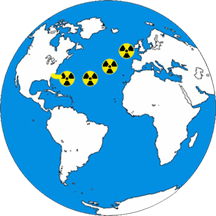 Groups protest plan to ship UK nuclear waste to South Carolina http://chronicle.augusta.com/news/metro/2013-08-29/groups-protest-plan-ship-uk-nuclear-waste-south-carolina?v=1377827799 By Rob Pavey Staff Writer Aug 29, 2013 Environmental groups want to halt a plan to ship spent nuclear fuel from Scotland to Savannah River Site, saying it could make bomb-grade uranium more vulnerable to terrorists. The spent fuel would be moved from the Dounreay research facility in Scotland to SRS, where its highly enriched uranium could be removed at the South Carolina site’s H Canyon facilities, said Tom Clements, southeastern nuclear campaign coordinator for Friends of the Earth.
The material should instead be processed at Sellafield, a former weapons plant in Cumbria, United Kingdon, said Clements and another environmental group – Cumbrians Opposed to a Radioactive Environment. Continue reading
Radiation protection measures for female astronauts seen as DISCRIMINATION !!
 Space radiation concerns holding back female astronauts, they say NBC News, Miriam Kramer, 31 Aug 13, “……….Depending on when you fly a space mission, a female will fly only 45 to 50 percent of the missions that a male can fly,” Peggy Whitson, the former chief of NASA’s Astronaut Corps, said. “That’s a pretty confining limit in terms of opportunity. I know that they are scaling the risk to be the same, but the opportunities end up causing gender discrimination based on just the total number of options available for females to fly. (That’s) my perspective.” [Radiation Threat for Mars-Bound Astronauts (Video)]……..
“I think that the current standards are too confining for exposure limits based on my personal experience and because I think it limits careers more than it is necessary,” Whitson said during an Institute of Medicine Workshop on Ethics Principles and Guidelines for Health Standards for Long Duration and Exploration Class Spaceflights requested by NASA on July 25.
“In my case, if I had a Y chromosome, I would be qualified,” Whitson added. “Because I have two X’s, I’m not.”…. http://www.nbcnews.com/science/space-radiation-concerns-holding-back-female-astronauts-8C11043076
USA tuan contamnated by Fukushima radiation
 Fukushima Radiation Affecting U.S. Tuna http://www.energyrefuge.com/blog/fukushima-radiation-affecting-u-s-tuna/?utm_source=feedburner&utm_medium=feed&utm_campaign=Feed%3A+EnergyrefugecomBlog+%28EnergyRefuge.com+Blog%29
by ANTONIO PASOLINI on AUGUST 28, 2013
Recent reports have exposed what some people had predicted at the time of theFukushima nuclear disaster: that radiation would spread. And it has, through fish that migrates between North America and Japan.
Reuters recently reported that “low levels of radioactive cesium from Japan’s Fukushima Daiichi nuclear accident turned up in fish caught off California in 2011”. The statement was based on a recent report compiled by Stanford University’s Hopkins Marine Station.
Bluefin spawn off the Japanese coast and many migrate across the Pacific. The researchers analyzed tissue samples collected in August 2011, five months after the nuclear spill. All samples contained reactor byproducts cesium-134 and cesium-137 at levels that produced radiation about three percent higher than natural sources.
According to this report, anada and the U.S. are feeling the effects of the radiation in food and water, with babies born with thyroid issues. Government has increased acceptable levels of certain toxic substances in the food imported from Japan.
Most of the radiation leaked in April 2011. Radioactive cesium does not quickly sink to the sea bottom but remains dispersed in the water column, from the surface to the ocean floor. Fish can swim right through it and will ingest it through seawater or by eating contaminated organisms. Bluefin tuna typically have low levels of natural radiation such as potassium 40.
Lawsuit alleges Nuclear Regulatory Commission cover-up
 NRC sued over documents related to Oconee Nuclear Greenville online.com , 30 Aug 13 A n advocacy group for public employees is suing federal nuclear regulators over documents they say are unlawfully withheld — documents they say would prove Duke Energy and the government have been covering up concern over what would happen to Oconee Nuclear Station should the Jocassee Dam ever fail.
The lawsuit has been filed in the U.S. District Court for the District of Columbia by Public Employees for Environmental Responsibility against the U.S. Nuclear Regulatory Commission……..
The suit alleges that the NRC has improperly cited the Freedom of Information Act to withhold internal communications that show just how concerned NRC engineers have been over Oconee’s plans for fending off floodwaters unleashed in the unlikely event of a dam failure.
The suit involves FOI requests for 11 records the group filed.
The group alleges that the NRC refused to release some records, released edited versions of others and did so citing concerns over security that the agency couldn’t prove.
Last fall, two NRC whistle-blowers publicly challenged their agency’s secrecy behind two decades worth of concerns. …… http://www.greenvilleonline.com/article/20130830/NEWS/308300066/NRC-sued-over-documents-related-Oconee-Nuclear
Big salt deposits suggested as dumping place for nuclear wastes

The reasonable thing to do is to stop making nuclear wastes
 Where On Earth Do We Put Spent Nuclear Fuel? Forbes, 29 Aug 13 If Nevada’s Harry Reid is right and Yucca Mountain is flattened, then what will happen to the nation’s 70,000-plus tons of nuclear waste? The Senate Majority Leader is adamant that such spent fuel from the country’s 102 nuclear plants will never find a permanent home in that area that is 90 miles outside of Las Vegas…….
Consider: the U.S. Department of Energy’s Waste Isolation Pilot Program (WIPP), a massive salt formation in southeastern New Mexico that has been accepting waste from nuclear weapons for 14 years. But it is not permitted to take in low-level spent fuel from commercial nuclear reactors.
As Conca explains, WIPP is 16 square miles of a 10,000-square mile, 2,000-foot thick salt layer. Those materials that are placed there are engulfed by the natural geology — the tightest rock on earth. The main obstacle, he adds, is the administrative changes necessary to allow the transport and disposal of spent fuel from the current interim sites to WIPP. Political resistance would also arise.
But massive salt formations are better repositories than the hard rock at Yucca Mountain, he insists, noting that rocks can fracture whereas salt does not. The best salt formations are in New Mexico and Texas.
Conca agrees that taking reprocessed nuclear fuel and using it in a nuclear power plant is less difficult than applying the same material to an atomic weapon. But WIPP changes the equation, he says, noting that, “there is so much uranium in the world that we don’t need to reprocess it. Mining the uranium is so much easier and so much cheaper than reprocessing it.”…..
Legally, Yucca Mountain remains a live topic but politically, it stands little chance of becoming permanent repository, especially because the Senate Majority Leader represents Nevada. But that debate over what to do with spent nuclear fuel has spawned some compelling ideas, some of which have been around for a while.
Reconciling the reprocessing fissures is likely to take decades. But broadening the use of massive salt deposits such as WIPP to include not just weapons-grade material but also radioactive fuel from commercial reactors would be an easier gulf to bridge.
Look at this – World’s largest solar thermal energy plant
Take A Tour Of This Insane Solar Thermal Energy Plant (Excellent photos) GIZMODO ALISSA WALKER 30 AUG 13 Sometime in the next few months, the Ivanpah Solar Electric Generating System will flip the switch on the largest solar plant of its kind in the world: a 377-megawatt, 3500-acre solar thermal energy system. It’s located in California’s Mojave Desert, near the Nevada border, and it’s ridiculously big. ‘

‘I would suggest going to check it out in person during your next Vegas binge weekend, but from the 15 freeway it’s little more than a silvery blur — a rippling, mirage-like, silvery blur that feels like it might sear your retinas if you look at it too long. So it’s a good thing they’ve just posted this incredible virtual tour……. HTTP://WWW.GIZMODO.COM.AU/2013/08/TAKE-A-TOUR-OF-THIS-INSANE-SOLAR-THERMAL-ENERGY-PLANT-IN-THE-CALIFORNIA-DESERT/
The citizens of Vermont show us the benefits of just saying NO to Nuclear
 The profound consequences of the Fukushima Daiichi nuclear-power accident are still unfolding,…….. Fukushima shows us the intolerable costs of nuclear power. The citizens of Vermont show us the benefits of just saying no.
Just say no to nuclear power – from Fukushima to Vermont , the Guardian Amy Goodman, 29 Aug 13 Fukushima showed us the intolerable costs of nuclear power. The citizens of Vermont show us the benefits of shutting it down Welcome to the nuclear renaissance.
Entergy Corp, one of the largest nuclear-power producers in the US, issued a surprise press release Tuesday, saying it plans “to close and decommission its Vermont Yankee Nuclear Power Station in Vernon, Vermont. The station is expected to cease power production after its current fuel cycle and move to safe shutdown in the fourth quarter of 2014.”
Although the press release came from the corporation, it was years of people’s protests and state legislative action that forced its closure. At the same time that activists celebrate this key defeat of nuclear power, officials in Japan admitted that radioactive leaks from theFukushima Daiichi nuclear catastrophe are far worse than previously acknowledged. Continue reading
1 This Month
23-25 October – on Zoom – World BEYOND War’s annual global conferenc


Shut down the radiation-damaged Heysham nuclear reactors now
To see nuclear-related stories in greater depth and intensity – go to https://nuclearinformation.wordpress.com

Say No to NASA’s Reckless Nuclear Reactor on the Moon
Say No to NASA’s Reckless Nuclear Reactor on the Moon

-
Archives
- October 2026 (190)
- September 2026 (339)
- August 2026 (330)
- July 2026 (355)
- June 2026 (287)
- May 2026 (306)
- April 2026 (356)
- March 2026 (251)
- February 2026 (267)
- January 2026 (308)
- December 2025 (358)
- November 2025 (359)
-
Categories
- 1
- 1 NUCLEAR ISSUES
- business and costs
- climate change
- culture and arts
- ENERGY
- environment
- health
- history
- indigenous issues
- Legal
- marketing of nuclear
- media
- opposition to nuclear
- PERSONAL STORIES
- politics
- politics international
- Religion and ethics
- safety
- secrets,lies and civil liberties
- spinbuster
- technology
- Uranium
- wastes
- weapons and war
- Women
- 2 WORLD
- ACTION
- AFRICA
- Atrocities
- AUSTRALIA
- Christina's notes
- Christina's themes
- culture and arts
- Events
- Fuk 2022
- Fuk 2023
- Fukushima 2017
- Fukushima 2018
- fukushima 2019
- Fukushima 2020
- Fukushima 2021
- general
- global warming
- Humour (God we need it)
- Nuclear
- RARE EARTHS
- Reference
- resources – print
- Resources -audiovicual
- Weekly Newsletter
- World
- World Nuclear
- YouTube
-
RSS
Entries RSS
Comments RSS

