Entergy’s dilemma – can’t afford to decommission uneconomic Vermont Nuclear Plant
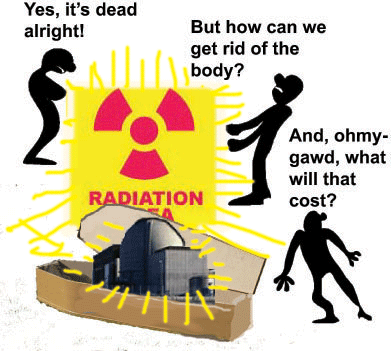 Vermont Nuclear Plant Seeks Decommission But Lacks Funds, Clean Technica 3 April 14, On Friday, the Vermont Public Service Board voted to authorize Entergy Nuclear Operations, Inc., the operators of the Vermont Yankee electricity generating station at 546 Governor Hunt Rd. in Vernon, to close down their nuclear power plant by the end of this year. Because Entergy planned to shut the Vermont nuclear plant down prior to its licensed end-term, the board was required to approve the shutdown……..
Another remaining issue is a 12-year-old National Pollutant Discharge Elimination Systempermit that has been under review by the Vermont Agency of Natural Resources for the past eight years. Continued discharges of warm water into the Connecticut River appear to have adversely affected water quality downstream and altered ecological systems in the watershed.
Entergy has reserved just over $600 million to date for decommissioning the Vermont nuclear plant, according to the Department of Public Service. This amount will not be adequate to meet the costs of full deconstruction, estimated at more than $1 billion according to the company’s 2012 Decommissioning Cost Analysis report.
The company has pledged to put $25 million toward site restoration after decommissioning the plant. However, presumably, the pledge would be moot if Entergy cannot totally decommission the plant.
“That $400 million gap raises issues about where the money will come from to dismantle the plant safely,” MassLive editorializes. http://cleantechnica.com/2014/04/02/vermont-nuclear-plant-seeks-decommission-lacks-funds/
Lax record keeping and security in USA nuclear arsenal
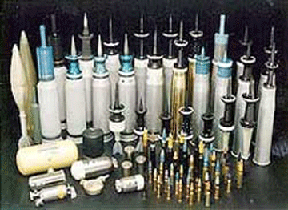 The Guardians Of the U.S. Nuclear Arsenal Don’t Keep Very Good Records http://io9.com/the-guardians-of-the-u-s-nuclear-arsenal-dont-keep-ve-1557024074 3 April 14, The scathing 19-page report, available on the website of Energy Department’s Office of Inspector General, warns that the range of problems “may ultimately increase costs and could negatively impact the reliability and safety” of the U.S. nuclear arsenal.
As the Global Security Newswire notes: In one case, officials incorrectly approved two components to be added to a variant of the W-76 nuclear warhead. The error, they said, cost between $20 million and $25 million, and held up preparation of new parts by an extra 12 months.
The United States never “treated the maintenance of original nuclear weapons [records] as a priority” during or after the Cold War…The auditors argued, though, that “recapturing the department’s original nuclear weapons data in a configurable format can potentially save tens of millions of dollars.”
Even worse—yes, there’s a “worse”—the investigation found that lax security at the Los Alamos National Laboratory “had given system access to approximately 30 nuclear weapons designers regardless of whether they were assigned to a nuclear weapon project.” Translation: Saboteurs could potentially tamper with existing weapons designs.
Intractible dangers for space travel due to ionising radiation
 Mars health risks exceed NASA limits Sky News 3 April 14, Efforts to send humans to Mars would likely expose them to health risks beyond the limits of what NASA currently allows, an independent panel of medical experts said Wednesday.
Therefore, any long-term or deep space missions — which are still decades off — need a special level of ethical scrutiny, said the report by the Institute of Medicine.
‘These types of missions will likely expose crews to levels of known risk that are beyond those allowed by current health standards, as well as to a range of risks that are poorly characterised, uncertain and perhaps unforeseeable,’ said the IOM report.
Currently, astronauts are launched into low-Earth orbit, where they spend three to six months at a time aboard the International Space Station (ISS), but journeys to Mars could take up to 18 months.
NASA has said it aims to send people to the Red Planet by the 2030s and is working on building a heavy duty launcher and spacecraft for this purpose.
Health risks from short-term missions in space can include nausea, weakness and blurred vision, while long-term risks include radiation-induced cancer and the loss of bone mass……..http://www.skynews.com.au/tech/article.aspx?id=963933
Now 21 workers radioactively contaminated at New Mexico nuclear waste site
TESTS SHOW RADIATION CONTAMINATION ON FOUR MORE WORKERS AT NEW MEXICO  SITE http://www.nextgov.com/health/2014/04/tests-show-radiation-contamination-four-more-workers-new-mexico-site/81709/?oref=ng-HPriverThe U.S. Energy Department on Monday said testing had revealed trace levels of contamination in four additional workers at a nuclear waste site in New Mexico.
The announcement brings to 21 the total number of Waste Isolation Pilot Plant, or “WIPP,” personnel who were exposed to small amounts of radiation following a February leak of some radioactive elements from the subterranean nuclear-materials dump, the Associated Pressreports.
The department intended to dispatch a team of eight specialists on Tuesday into the underground portion of the nuclear facility to start establishing outposts that would enable a probe into exactly what led to the leak.
The WIPP facility has not accepted any new atomic waste since the discovery of the radiation leak. This has caused some U.S. nuclear-weapons sites to turn to temporary options for storing their waste.
Nuclear weapons, nuclear safety – the $trillion USA cost
 Money for Food or for Nuclear Bombs?OpEdNews Op Eds 3/31/2014 By Madelyn Hoffman We live in strange times, indeed. In the past few months, the U.S. Congress has failed to extend unemployment benefits for 1.3 million people and has passed legislation that will cut $8.6 billion in food stamps over the next 10 years, affecting 850,000 households in 1/3 of the states. At the same time, the 2015 budget shows a 7% increase in spending on nuclear weapons, from $18.6 billion to $19.4 billion — almost $1 billion. While the overall amount allocated for nuclear weapons is greater than last year, the funds dedicated to nuclear nonproliferation programs — programs to reduce the numbers of available warheads or securing so-called “loose nukes” was cut, making more dollars available to either build new nuclear weapons hardware or spend billions to modernize old ones, such as the B-61 bomb……… costs added together total $1.0095 trillion for 2015! Here are two ways to reduce this. Two nearly identical bills in the U.S. Congress today target nuclear weapons spending to save money. Senator Markey, D-Mass, introduced the “Smarter Approach to Nuclear Expenditures (SANE)” Act and Rep. Blumenauer, D-Ore, introduced the “Reduce Expenditures in Nuclear Infrastructure Now (REIN-IN)” Act. According toEric Tamerlani’s article “Reining in Nuke Spending the Smart Way” in the March 12th Roll Call, these bills will save taxpayers $100 billion on nuclear weapons over 10 years. The bills would reduce the number of new nuclear submarines, cap tactical nuke modernization and scrap the F-35’s nuclear mission. In late April, pro-disarmament activists from around the world will gather at the United Nations to prepare nuclear disarmament proposals to present at the 2015 Nuclear Nonproliferation Treaty (NPT) Review Conference. Sharon Dolev, Director of the Israeli Disarmament Movement, will participate. She will also speak on “Cooling the Hot Spot: A Nuclear Weapons Free Middle East” at NJPA’s April 27th Annual Dinner at the Regency House in Pompton Plains. Her talk will address what a nuclear weapons free Middle East means for Israel, the region, and the world, as well as obstacles within Israel to attaining that important goal. For more information and to make reservations, visit www.njpeaceaction.org. Cooling off tensions in the Middle East and preventing another war will release funds for programs that address community needs. This is not only timely, but essential, for genuine security in our nation and the world. http://www.opednews.com/articles/Money-for-Food-or-for-Nucl-by-Madelyn-Hoffman-Budget_Diplomacy_Food-Stamps_Food-Stamps-140331-42.html |
MOX nuclear plant consumed $billions – now to be closed
 DOE shuts $4 billion ‘plutonium-eater’ reactor Ecologist, Douglas Birch 12th March 2014 A nuclear reactor designed to burn up surplus Cold War plutonium has been closed by the US Department of Energy. Initially it was meant to cost $1bn. So far it has cost $4bn. To complete and operate would cost $25-34bn.
After a year of study meant to examine the viability of the two-decade old program, the department’s leadership made clear in budget documents for fiscal year 2015 that the plant is no longer affordable within budget limits set by Congress.
The mad world of nuclear economics
Initially advertised as a $1 billion program, the plant has already consumed more than $4 billion and was projected to cost up to $10 billion to complete over the next five years. Its total costs – including operation over 15 years – were estimated at nearly $34 billion by a special study conducted for Energy Secretary Ernest Moniz.
The plant, which lay at the center of a diplomatic deal with Russia that was blessed by three U.S. presidents, was supposed to transform at least 34 tons of plutonium withdrawn from retired U.S. nuclear weapons into so-called Mixed Oxide (MOX) fuel to be burned in civilian nuclear power plants. Russia agreed to undertake a similar effort, but the cancellation of the U.S. plan may affect that decision.
The department’s review “has determined that the MOX fuel approach is significantly more expensive than planned and it is not viable within the FY 2015 funding levels”, the White House’s Energy Department budget proposal states……..http://www.theecologist.org/News/news_round_up/2317472/doe_shuts_4_billion_plutoniumeater_reactor.htm
the perils of trying out a new nuclear reactor design
City’s nuclear age lasted only a year Argus Leader. South Dakota Eric Renshaw11:23 p.m. CDT March 29, 2014 In 1959, Northern States Power Co. began construction on what would become the Pathfinder Nuclear Generating Station just south of Interstate 90 between Sioux Falls and Brandon…….. After spending much time and money assembling the plant and trying to get the superheater working the way it should, they finally pushed the plant to run at full output, which lasted about 30 minutes. During that 30 minutes, it was decided that they should never do that again. The flaws in the superheater became evident, and it was deemed too expensive to repair. They’d put enough into it and had learned a lot. It did run at less than peak output from August 1966 to September 1967, though it was never put on the grid.
Pathfinder ceased operation in October 1967 and was converted to a gas- and coal-powered station. The fuel was shipped away in 1970, and the reactor vessel was removed from the plant in 1990 after it had had time to cool down a bit. Its cooling tower collapsed in July 2000, and production stopped in that building………http://www.argusleader.com/story/life/2014/03/30/citys-nuclear-age-lasted-year/7043837/
Three Mile Island nuclear accident: 35 years later the lies continue
Three Mile Island – 35 years on http://www.theecologist.org/News/news_analysis/2334940/three_mile_island_35_years_on.html Linda Pentz Gunter 28th March 2014 Thirty-five years ago today the USA had its worst ever civilian nuclear accident with a reactor meltdown at Three Mile Island. Linda Pentz Gunter reports on the lies and cover ups about the true scale of the radiation release and its impacts on human health. Today marks 35 years since the meltdown at Unit 2 of the Three Mile Island (TMI) nuclear power plant near Harrisburg, Pennsylvania. Despite the long passage of time, myths and misinformation about the disaster still abound. Many questions may remain permanently unanswered.
The consequences of the TMI disaster were made more serious because, early on, emergency planning officials were repeatedly misinformed about the disaster’s progression and kept in the dark about the need for public protective actions.
Ironically, despite today’s popular ‘too much information’ shorthand, TMI is a story of ‘too little information’. What the public believes about TMI is far removed from what really happened. Continue reading
Rushed to hospital – more Hanford nuclear workers get sick
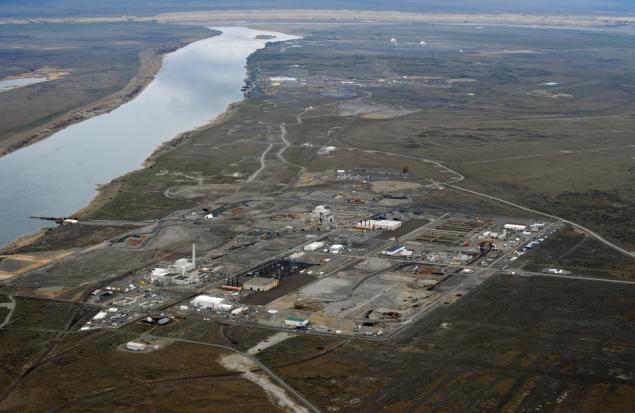 TV: More workers rushed to hospital at U.S. nuclear site — 17 sickened in past week — Former Employee: “It’s pretty scary… to have this many in 8 days is really abnormal” — Company: We’re trying to understand what’s happening (VIDEO) http://enenews.com/tv-more-workers-rushed-to-hospital-at-u-s-nuclear-site-now-17-workers-sickened-in-past-week-former-employee-its-pretty-scary-to-have-this-many-in-8-days-is-really-abnormal-c?utm_source=feedburner&utm_medium=email&utm_campaign=Feed%3A+ENENews+%28Energy+News%29
KING 5 News Seattle, Mar. 26, 2014: Hanford workers sickened by unknown vapors rises to 17— The KING 5 Investigators have found that six Hanford workers were sickened Wednesday from ingesting chemical vapors at the nuclear facility. […] This brings the total to 17 Hanford employees who have needed medical care since last Wednesday due to the inhalation of toxic vapors. […] “Data collection and analysis is underway in the affected (tank) farms to understand what happened and what might be done to reduce the likelihood of future occurrences,” said [Jerry Holloway, External Affairs Manager at U.S. Dept. of Energy’s contractor Washington River Protection Solutions]. […] The incident Wednesday occurred in yet another location at the Hanford site […] Sources tell the reporter 17 people were working on the video inspection when three were suddenly sickened by the release of vapors.
Mike Geffre, retired WRPS employee who spent 26 years at Hanford: “It’s pretty scary. It doesn’t usually happen like this. Usually you see four or five a year. But to have this many in eight days is really abnormal […] Whenever you hear of someone getting tank vapors, you never know what the long term affects are. The affects of exposures like this can show up as health problems years down the road.”
KING 5 News transcript The King 5 investigators learned that workers at the Hanford Nuclear Reservation have been rushed to the hospital. […] I was in Richland doing an interview on this very topic […] during that interview we got word from sources that right at that time that 3 more employees were either going to the hospital here or taken to the onsite medical facility at Hanford because of another such incident […] In those three separate incidents the workers were all at different locations at Hanford, so this isn’t just one problem area where they’re seeing a repeat problem. […] Obviously, workers are concerned, feel there’s a problem here, and they want their employer and the Department of Energy to do something about it.
Strong start to USA renewable energy sources in 2014
|
by Renew Grid on March 26, 2014 For the first two months of this year, renewable energy sources accounted for 91.9% of the 568 MW of new installed U.S. electrical generating capacity, according to a report from the Federal Energy Regulatory Commission (FERC). Coal, oil and nuclear provided none, while natural gas and 1 MW of “other” resources provided the balance.
In February alone, wind and solar made up 80.9% of new domestic capacity, with five new “units” of wind providing 99 MW and 12 units of solar providing 92 MW. In addition, one new unit of natural gas provided 45 MW. Citing the FERC statistics, the SUN DAY Campaign, a renewable energy advocacy group, notes renewable energy sources, including hydropower, now account for 16.14% of total installed U.S. operating generating capacity: hydro – 8.45%, wind – 5.26%, biomass – 1.37%, solar – 0.73% and geothermal steam – 0.33%. This is more than nuclear (9.26%) and oil (4.05%) combined. |
Negligence of USA govt in not testing seafood for Fukushima radiation
School Science Project Reveals High Levels Of Fukushima Nuclear Radiation in Grocery Store Seafood Investment Watch By Michael Snyder March 27th, 2014 “……..Meanwhile, PBS reporter Miles O’Brien has pointed out the extreme negligence of the U.S. government when it comes to testing seafood for Fukushima radiation. The following comes from a recent EcoWatch article…
O’Brien also introduces us to scientists from the Woods Hole Oceanographic Institute who have been testing waters around the reactors—as well as around the Pacific Rim—to confirm the levels of Fukushima fallout, especially of cesium.
These scientists are dedicated and competent. But they are also being forced to do this investigation on their own, raising small amounts of money from independent sources. They were, explains lead scientist Ken Buesseler, turned down for even minimal federal support by five agencies key to our radiation protection. Thus, despite a deep and widespread demand for this information, no federal agency is conducting comprehensive, on-the-ground analyses of how much Fukushima radiation has made its way into our air and oceans.
In fact, very soon after Fukushima began to blow, President Obama assured the world that radiation coming to the U.S. would be minuscule and harmless. He had no scientific proofthat this would be the case. And as O’Brien’s eight-minute piece shows all too clearly, the “see no evil, pay no damages” ethos is at work here. The government is doing no monitoring of radiation levels in fish, and information on contamination of the ocean is almost entirely generated by underfunded researchers like Buesseler.
A video news report in which O’Brien discusses these issues is posted below https://www.youtube.com/watch?v=QIjJlK5EWOw
Fishing for data in the radioactive waters off Fukushima It is the job of the authorities to keep us safe, and the Fukushima nuclear disaster was the worst nuclear disaster in human history.
So why aren’t they doing testing?
Why aren’t they checking to make sure that this radiation is not getting into our food chain? Continue reading
Barack warns of nuclear terrorism, but Homeland Security cuts NYPD bomb detection funding
Homeland Security To Cut NYPD Bomb Detection Funding After Obama Says NYC Nuclear Blast Bigger Concern Than Russia NEW YORK (CBSNewYork/AP), 26 Mar 14, – Less than 24 hours after President Barack Obama said he’s more concerned about the prospect of a nuclear weapon exploding in New York City than Russia’s recent actions, Homeland Security officials announced plans to cut the NYPD’s bomb detection funding by 50 percent….. http://newyork.cbslocal.com/2014/03/26/obama-nuclear-blast-in-nyc-bigger-concern-than-russia/
‘Americans For Prosperity’ sabotaging renewabl energy
 How can renewable-energy supporters compete with Kochs? We Blog, 27 March 14 “……the Senate approved a bill revoking the state’s renewable portfolio standard. The standard has helped generate billions of dollars of investment in Kansas and is overwhelmingly supported by the public, according to a recent survey. But the standard is opposed by the Koch-backed Americans for Prosperity and Kansas Chamber of Commerce, which spent more than a million dollars last election purging moderates from the state Senate.
How can supporters of renewable energy, which includes faith groups, compete with those resources? http://blogs.kansas.com/weblog/2014/03/how-can-renewable-energy-supporters-compete-with-kochs/
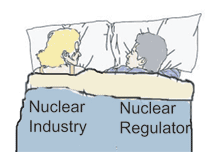
Nuclear power industry oversees and controls nuclear regulators
Nuclear Overseers Are “Fake” Agencies Funded and Controlled by the Nuclear Power Industry http://www.globalresearch.ca/nuclear-overseers-are-fake-agencies-funded-and-controlled-by-the-nuclear-power-industry/24387
By Washington’s Blog
Global Research, The Christian Science Monitor noted recently:
Just as the BP oil spill one year ago heaped scrutiny on the United State’s Minerals Management Service, harshly criticized for lax drilling oversight and cozy ties with the oil industry, the nuclear crisis in Japan is shining a light on that nation’s safety practices.[Russian nuclear accident specialist Iouli Andreev, who as director of the Soviet Spetsatom clean-up agency helped in the efforts 25 years ago to clean up Chernobyl ] has also accused the IAEA of being too close with corporations. “This is only a fake organization because every organization which depends on the nuclear industry – and the IAEA depends on the nuclear industry – cannot perform properly.”
The U.S. Nuclear Regulatory Commission is no better. Continue reading
California will use mainly renewables to replace nuclear energy
 California Mostly Sticks to Renewables to Replace Nuclear Energy http://www.sustainablebusiness.com/index.cfm/go/news.display/id/25596 20 Mar 14, While many feared California would turn to natural gas to replace the electricity from its shuttered San Onofre nuclear plant, the state is holding firm to its commitment to rely increasingly on renewable energy and efficiency.
In its final strategy, the California Public Utilities Commission (CPUC) sticks to “preferred resources” to provide much of the electricity to the Los Angeles/ San Diego area: energy efficiency technologies such as demand response, upgrades to the grid, energy storage and renewable energy. Continue reading
1 This Month
23-25 October – on Zoom – World BEYOND War’s annual global conferenc


Shut down the radiation-damaged Heysham nuclear reactors now
To see nuclear-related stories in greater depth and intensity – go to https://nuclearinformation.wordpress.com

Say No to NASA’s Reckless Nuclear Reactor on the Moon
Say No to NASA’s Reckless Nuclear Reactor on the Moon
-
Archives
- October 2026 (170)
- September 2026 (339)
- August 2026 (330)
- July 2026 (355)
- June 2026 (287)
- May 2026 (306)
- April 2026 (356)
- March 2026 (251)
- February 2026 (267)
- January 2026 (308)
- December 2025 (358)
- November 2025 (359)
-
Categories
- 1
- 1 NUCLEAR ISSUES
- business and costs
- climate change
- culture and arts
- ENERGY
- environment
- health
- history
- indigenous issues
- Legal
- marketing of nuclear
- media
- opposition to nuclear
- PERSONAL STORIES
- politics
- politics international
- Religion and ethics
- safety
- secrets,lies and civil liberties
- spinbuster
- technology
- Uranium
- wastes
- weapons and war
- Women
- 2 WORLD
- ACTION
- AFRICA
- Atrocities
- AUSTRALIA
- Christina's notes
- Christina's themes
- culture and arts
- Events
- Fuk 2022
- Fuk 2023
- Fukushima 2017
- Fukushima 2018
- fukushima 2019
- Fukushima 2020
- Fukushima 2021
- general
- global warming
- Humour (God we need it)
- Nuclear
- RARE EARTHS
- Reference
- resources – print
- Resources -audiovicual
- Weekly Newsletter
- World
- World Nuclear
- YouTube
-
RSS
Entries RSS
Comments RSS

