Obama talked the talk on nuclear disarmament, but not walking the walk
 Nuclear Weapons: Toward Abolition or Armageddon? By Yuki Tanaka
Global Research, May 26, 2014 People still clearly remember that on April 5, 2009 the U.S. President Barack Obama excited an audience in Prague by declaring that his government “will take concrete steps towards a world without nuclear weapons.” As the only nuclear power to have ever used a nuclear weapon, he said, the United States has a moral responsibility to act. Indeed, the U.S. has not only moral responsibility but also legal responsibility for the victims as the nation that committed a crime against humanity by indiscriminately killing tens of thousands of people and causing lifelong radiation sickness to many survivors.
In his speech, Obama also added ‘this goal will not be reached quickly –- perhaps not in my lifetime.’ Clearly, this goal will never be reached if the U.S. continues to spend ever larger sums on nuclear weapons, overshadowing all other nuclear powers, as the Obama Administration has been doing since the speech in Prague.
On April 29 this year, at the Third Meeting of the Preparatory Committee for the 2015 Nuclear Non-Proliferation Treaty Review Conference in New York, Under Secretary Rose Gottemoeller stated in her speech: ‘Indeed, it is the United States’ deep understanding of the consequences of nuclear weapons’ use – including the devastating health effects – that has guided and motivated our efforts to reduce and ultimately eliminate these most hazardous weapons.’
However, despite her claim of “deep understanding [of] the consequences of nuclear weapons’ use,” in the detailed budget for fiscal 2015 released in mid March this year Obama yet again asked for a substantial increase in funding to support nuclear weapons research and production programs under the Department of Energy’s semi-autonomous National Nuclear Security Administration. The proposal includes a seven percent increase in the nuclear warhead budget from $7.7 billion in FY 2014 to $8.3 billion in FY 2015. This budget request sets a new record for DOE nuclear weapons spending, exceeding even the Cold War high point in 1985 under President Reagan’s military buildup. The plan, moreover, is to increase the military budget to an astounding $9.7 billion by FY 2019, 24 percent above FY 2014.
A large proportion of this budget is for “modernizing” nuclear weapons — both warheads and delivery systems. Among the priorities is the B61 Life Extension Program, designed to extend the life of B61 nuclear bombs by an additional 20 to 30 years. The Obama Administration is requesting $634 million, up 20 percent from FY2014, for this program, which has already catapulted from an original estimate of $4 billion to more than $10 billion. Currently 200 of the B61 bombs are located in Europe.
While rebuilding nuclear weapons at exorbitant expense, Obama proposes to slash the budget for dismantling these weapons by 45 percent, from an already paltry $54.2 million to $30 million. No additional funding has been allocated for a nuclear waste clean-up program, and the National Nuclear Security Administration’s $790 million in spending on nuclear nonproliferation programs is to be cut by 21 percent, or $152 million. Amongst these programs is the Global Threat Reduction Initiative, a program that plays a key part in the effort of preventing terrorists from acquiring nuclear and radiological materials that could be used as weapons of mass destruction.
According to the study entitled Projected Costs of Nuclear Forces 2014 -2023 issued in December 2013 by the nonpartisan Congressional Budget Office, it would cost the U.S. government a total of $355 billion over the next decade to maintain and “modernize” the nuclear weapons stockpile, delivery systems and research and production complex. This would be almost 70 percent more than senior officials have predicted over the next decade. According to the report, The Trillion Dollar Nuclear Triad: U.S. Strategic Modernization Over the Next Thirty Years, published in January 2014 by the James Martin Center for Nonproliferation Studies, ‘Over the next thirty years, the United States plans to spend approximately $1 trillion maintaining the current arsenal, buying replacement systems, and upgrading existing nuclear bombs and warheads.’
It is clear from this official data that the U.S. government has no intention at all to “take concrete steps towards a world without nuclear weapons” despite repeated rhetoric on the reduction of nuclear weapons by Obama himself and his senior staff. Indeed this is the ultimate irony that cannot be ignored: the U.S., under the president who won the Nobel Peace Prize is holding piles of nuclear weapons, while demanding that North Korea and Iran give up their nuclear programs, threatening them with military might. It is not surprising, therefore, that other nuclear power nations such as Russia, China, England and France are also adopting similar policies to “modernize” their own nuclear weapons. In 2012 China officially replaced its “non preemptive nuclear strike” policy by one that permits “the use of nuclear weapons for the purpose of defense,” clearly indicating the possibility of conducting a preemptive nuclear strike………..
USA Memorial Day protest against unsafe Pilgrim Nuclear Power Plant

 Group protests Pilgrim nuclear plant safety plan http://www.myfoxboston.com/story/25610835/group-protests-pilgrim-nuclear-plant-safety-plan#ixzz32xg16R3C May 26, 2014 SAGAMORE, Mass. (MyFoxBoston.com) — Protesters gathered near the Sagamore Bridge Monday to highlight safety concerns about the Pilgrim nuclear power plant.
The protesters say the current emergency plan is unacceptable because it doesn’t include a viable evacuation route in the event of an accident.
The protest comes just two months after Gov. Deval Patrick wrote to the Nuclear Regulatory Commission. He said the Plymouth plant should be decommissioned if it can’t follow safety regulations.
Pilgrim has been relicensed through 2032 and its operators say it is safe.
The dismal history of USA’s failed thorium nuclear experiment
 Thorium: the wonder fuel that wasn’t http://thebulletin.org/thorium-wonder-fuel-wasnt7156 Robert Alvarez May 2014, “Thorium-Fueled Automobile Engine Needs Refueling Once a Century,” reads the headline of an October 2013 story in an online trade publication. This fantastic promise is just one part of a modern boomlet in enthusiasm about the energy potential of thorium, a radioactive element that is far more abundant than uranium. Thorium promoters consistently extol its supposed advantages over uranium. News outlets periodically foresee the possibility of “a cheaper, more efficient, and safer form of nuclear power that produces less nuclear waste than today’s uranium-based technology.”
Early thorium optimism. The energy potential of the element thorium was discovered in 1940 at the University of California at Berkeley, during the very early days of the US nuclear weapons program. Although thorium atoms do not split, researchers found that they will absorb neutrons when irradiated. After that a small fraction of the thorium then transmutes into a fissionable material—uranium 233—that does undergo fission and can therefore be used in a reactor or bomb.
By the early 1960’s, the US Atomic Energy Commission (AEC) had established a major thorium fuel research and development program, spurring utilities to build thorium-fueled reactors. Back then, the AEC was projecting that some 1,000 nuclear power reactors would dot the American landscape by the end of the 20th century, with a similar nuclear capacity abroad. As a result, the official reasoning held, world uranium supplies would be rapidly exhausted, and reactors that ran on the more-plentiful thorium would be needed.
With the strong endorsement of a congressionally created body, the Joint Committee on Atomic Energy, the United States began a major effort in the early 1960s to fund a two-track research and development effort for a new generation of reactors that would make any uranium shortage irrelevant by producing more fissile material fuel than they consumed.
The first track was development of plutonium-fueled “breeder” reactors, which held the promise of producing electricity and 30 percent more fuel than they consumed. This effort collapsed in the United States in the early 1980’s because of cost and proliferation concerns and technological problems. (The plutonium “fast” reactor program has been able to stay alive and still receives hefty sums as part of the Energy Department’s nuclear research and development portfolio.)
The second track—now largely forgotten—was based on thorium-fueled reactors. This option was attractive because thorium is far more abundant than uranium and holds the potential for producing an even larger amount of uranium 233 in reactors designed specifically for that purpose. In pursuing this track, the government produced a large amount of uranium 233, mainly at weapons production reactors. Approximately two tons of uranium 233 was produced, at an estimated total cost of $5.5 to $11 billion (2012 dollars), including associated cleanup costs.
The federal government established research and development projects to demonstrate the viability of uranium 233 breeder reactors in Minnesota, Tennessee, and Pennsylvania. By 1977, however, the government abandoned pursuit of the thorium fuel cycle in favor of plutonium-fueled breeders, leading to dissent in the ranks of the AEC. Alvin Weinberg, the long-time director of the Oak Ridge National Laboratory, was, in large part, fired because of his support of thorium over plutonium fuel.
By the late 1980’s, after several failed attempts to use it commercially, the US nuclear power industry also walked away from thorium. The first commercial nuclear plant to use thorium was Indian Point Unit I, a pressurized water reactor near New York City that began operation in 1962. Attempts to recover uranium 233 from its irradiated thorium fuel were described, however, as a “financial disaster.” The last serious attempt to use thorium in a commercial reactor was at the Fort St. Vrain plant in Colorado, which closed in 1989 after 10 years and hundreds of equipment failures, leaks, and fuel failures. There were four failed commercial thorium ventures; prior agreement makes the US government responsible for their wastes.
Where is the missing uranium 233? As it turned out, of course, the Atomic Energy Commission’s prediction of future nuclear capacity was off by an order of magnitude—the US nuclear fleet topped out at about 100, rather than 1,000 reactors—and the predicted uranium shortage never occurred. America’s experience with thorium fuels faded from public memory until 1996. Then, an Energy Department safety investigation found a national repository for uranium 233 in a building constructed in 1943 at the Oak Ridge National Laboratory. The repository was in dreadful condition; investigators reported an environmental release from a large fraction of the 1,100 containers “could be expected to occur within the next five years in that some of the packages are approaching 30 years of age and have not been regularly inspected.” TheEnergy Department later concluded that the building had “deteriorated beyond cost-effective repair. Significant annual costs would be incurred to satisfy current DOE storage standards, and to provide continued protection against potential nuclear criticality accidents or theft of the material.”
The neglect extended beyond the repository and storage containers; the government had also failed to keep proper track of its stores of uranium 233, officially classified as a Category I strategic special nuclear material that requires stringent security measures to prevent “an unauthorized opportunity to initiate or credibly threaten to initiate a nuclear dispersal or detonation.”
A 1996 audit by the Energy Department’s inspector general reported that the Oak Ridge National Laboratory, the Rocky Flats nuclear weapons facility, and the Idaho National Laboratory “had not performed all required physical inventories ... the longer complete physical inventories are delayed, the greater the risk that unauthorized movement of special nuclear materials could occur and go undetected.” The amounts of uranium 233 that the Oak Ridge and Idaho national labs have reported in their inventories has significantly varied. Based on a review of Energy Department data, there appears to be an inventory discrepancy; 96 kilograms or 6 percent of the U-233 produced is not accounted for. The Energy Department has yet to address this discrepancy, which difference is enough to fuel at least a dozen nuclear weapons.
Uranium 233 compares favorably to plutonium in terms of weaponization; a critical mass of that isotope of uranium—about 6 kilograms, in its metal form—is about the same weight as a plutonium critical mass. Unlike plutonium, however, uranium 233 does not need implosion engineering to be used in a bomb. In fact, the US government produced uranium 233 in small quantities for weapons, and weapons designers conducted several nuclear weapons tests between 1955 and 1968 using uranium 233. Interest was renewed in the mid-1960s, but uranium 233 never gained wide use as a weapons material in the US military because of its high cost, associated with the radiation protection required to protect personnel from uranium 232, a highly radioactive contaminant co-produced with uranium 233.
For a terrorist, however, uranium 233 is a tempting theft target; it does not require advanced shaping and implosion technology to be fashioned into a workable nuclear device. The Energy Department recognizes this characteristic and requires any amount of more than two kilograms of uranium 233 to be maintained under its most stringent safeguards, to prevent “onsite assembly of an improvised nuclear device.” As for the claim that radiation levels from uranium 232 make uranium 233 proliferation resistant, Oak Ridge researchers note that “if a diverter was motivated by foreign nationalistic purposes, personnel exposure would be of no concern since exposure … would not result in immediate death.”
The end of an unfortunate era. After its 1996 safety investigation at the Oak Ridge National Laboratory, the Energy Department spent millions to repackage about 450 kilograms of uranium 233 that is mixed with uranium 235 and sitting in the lab’s Building 3019, and to dispose of diluted uranium 233 fuel stored at the Idaho National Lab. The Energy Department’s nuclear weapons program managed to shift responsibility for the stockpile in Building 3019 from Oak Ridge to the Office of Nuclear Energy, which envisioned using the uranium 233 to make medical isotopes. This plan fell apart, and in 2005 Congress ordered the Energy Department to dispose of the uranium 233 stockpile as waste.
Since then, the Energy Department’s Office of Environmental Management has considered uranium 233 disposal to be an unfunded mandate, disconnected from other, higher-priority environmental cleanup compliance agreements. After several fits and starts, including a turnover of four project managers in less than two years, the Energy Department’s disposition project “had encountered a number of design delays, may exceed original cost estimates, and will likely not meet completion milestones,” the department’s inspector general reported in 2010. The cost of the project increased from $384 million to $473 million—or more than $1 million per kilogram for the disposal of uranium 233.
In an effort to reduce costs, the Energy Department developed a plan to ship nearly 75 percent of the fissile materials in Building 3019, as is, to a landfill at the Nevada Nuclear Security Site by the end of 2014. Because such disposal would violate the agency’s formal safeguards and radioactive waste disposal requirements, the Energy Department changed those rules, which it can do without public notification or comment. Never before has the agency or its predecessors taken steps to deliberately dump a large amount of highly concentrated fissile material in a landfill, an action that violates international standards and norms.
In June 2013, Nevada Gov. Brian Sandoval and members of the state’s congressional delegation announced their opposition to the landfill disposition plan. Energy Secretary Ernest Moniz visited with Sandoval but did not back down from the landfill plan. Even though the Oak Ridge material in its current form meets the legal definition for radioactive waste requiring geologic disposal, the Energy Department has taken the position that the sweeping authority granted to it under the Atomic Energy Act allows the department to dispose of the fissile material however it pleases, regardless of the state’s objection.
The United States has spent nearly $10 billion to discourage practices like landfill dumping of fissile materials in the former Soviet Union, only to have the Energy Department try it at home. Heedless of the discrepancy between overseas and domestic disposal policies, the department’s agenda—which focuses on saving money on guards who would be needed to secure the uranium 233—is placing the United States in an impossible position when it comes to criticizing the nuclear materials security of other countries. So ends America’s official experience with thorium, the wonder fuel.
Anti-nuclear protestors plan rally against Pilgrim nuclear power plant i
Pilgrim nuclear plant protesters to gather at Sagamore Bridge http://www.gazettenet.com/businessmoney/12117764-95/pilgrim-nuclear-plant-protesters-to-gather-at-sagamore-bridge Sunday, May 25, 2014 BOURNE — Protesters are planning to gather near the Sagamore Bridge on Memorial Day to highlight concerns about the safety of the Pilgrim nuclear power plant in Plymouth.
The protesters called the current emergency plan in the event of an accident at the power plant unacceptable for those on the Cape.
The protest comes two months after Gov. Deval Patrick wrote the Nuclear Regulatory Commission expressing concerns about the plant. Patrick said he was writing on behalf of 15 southeastern Massachusetts communities.
Patrick said he shares their concerns because of what he called the lack of a “viable evacuation route” off of Cape Cod.
The NRC relicensed Pilgrim through 2032. The plant’s operators say it’s safe and secure.Patrick said the NRC should require the plant be decommissioned if it can’t comply with safety regulations.
America’s nuclear waste sites form many ticking time bombs

it is crazy to keep making this stuff!
 AP: Ticking time bombs of nuclear waste at multiple U.S. sites? Lab checking for smoking drums — CNN: “Imminent threat from radiation” — Gundersen: Serious public health effects if one blows; “Very, very volatile… like nitroglycerin” (VIDEO) http://enenews.com/cnn-imminent-threat-from-radiation-leak-gundersen-interview-public-to-suffer-serious-health-effects-if-nuclear-waste-drums-blow-up-aboveground-a-major-concern-very-very-volat
AP, May 21, 2014: Los Alamos National Laboratory [LANL] on Wednesday told state government it has isolated and is closely monitoring nuclear waste […] packed with a type of cat litter suspected in a radiation leak at [WIPP]. [LANL] said the 55-gallon barrels have been secured in special containers and moved to an isolated area with a fire protection system. They also are being monitored 24 hours a day for any change in temperature, smoking or other abnormalities. […] More than 100 other suspect containers are being stored temporarily at Waste Control Specialists in Andrews, Texas.
AP, May 23, 2014: Has cat litter turned barrels of New Mexico nuclear waste into ticking time bombs? […] COULD THE OTHER BARRELS BE TICKING TIME BOMBS? [LANL] said it has packed them in special containers, placed them under a dome with a fire extinguishing system and is closely monitoring them. Waste Control Specialists has taken similar precautions. As for the more than 350 containers already at the Waste Isolation Pilot Plant, Flynn has ordered the U.S. Department of Energy to expedite plans for sealing off the underground rooms where the waste is stored. Complicating that effort is the laborious investigative process […] they are still working to see if other containers have been breached.
CNN Interview with Arnie Gundersen, May 21, 2014: ‘Imminent’ threat from radiation leak
- At :15 in — Arnie Gundersen, Fairewinds Chief Engineer: Barrels are above ground and still at Los Alamos, which is a major concern because this material gets more and more unstable as it gets warmer, and of course we’re heading into the summer months on the desert. So those barrels that are above ground, if they were to blow like the one that did below ground, we’d have a serious public health effect. […]
At 1:30 in – Gundersen: When the corn [in the kitty litter] absorbed the moisture, the nitrogen inside got very, very volatile. Almost like in these old movies when you see somebody holding nitroglycerin — any shake will cause it to be disturbed. Well that’s what happened to these canisters that have the organic kitty litter. They’ve got to go back through and find all of those and isolate them and then figure out how to change the litter.
USA Congress Bill to take money from nuclear weapons, and to care of veterans
House Bill Would Tap Into Nuclear Weapons Fund to Aid Veterans National Journal, By Douglas P. Guarino 23 May 14 The version of the fiscal 2015 defense authorization bill that the House approved Thursday would cut some controversial nuclear weapons spending in a bid to help veterans. Continue reading
Wind energy a winner in the right wing State of Texas
How Green Energy Won Out Over Fossil Fuels in a Red State In Texas, wind power is set to come online faster than natural gas over the course of the next decade.by Clare Foran National Journal, 22 May 14 Wind is going head to head with natural gas at the heart of the fracking boom—and wind is winning.

Fracking—a drilling technique that involves breaking open shale rock formations to extract oil and natural gas—has taken Texas by storm. The Lone Star State is dotted with drill sites and leads the nation in natural-gas production. But wide open spaces and strong gusts make it an ideal place to turn turbines. And Texas also takes the top spot for states with the most wind power.
Green energy has steadily gained traction in the deep-red state. In 2003, wind made up less than 1 percent of the power supply, according to state grid operator the Electric Reliability Council of Texas. By 2013, that share had risen to roughly 10 percent.
Problems in nuclear reactor decommissioning thrashed out in US Senate hearing
 Senate Hearing on Nuclear Reactor Decommissioning Challenges Energy Collective May 22, 2014 Bemnet Alemayehu, Project Scientist, Nuclear Program, Washington, D.C.
U.S. Senator Barbara Boxer’s Environment & Public Works Committee held a hearing on Wednesday, May 14th, 2014 to assess the challenges of nuclear reactor decommissioning nationwide. Panelists called to testify at Wednesday’s senate hearing included Christopher Recchia, Public Service Department Commissioner of Vermont, Geoffrey Fettus, Senior attorney of NRDC, Donald Mosier, Council Member of the City of Del Mar, Michael Weber, Deputy Executive Director for Compliance Programs of NRC and Marvin Fertel, President & Chief Executive Officer of NEI.
Christopher Recchia’s testimony to the senate opposed a request by operators of the Vermont Yankee nuclear power plant to discontinue off-site emergency planning after the reactor shuts down. He argued that the off-site emergency planning should continue after the reactor shuts down until all of the plant’s spent fuel rods are removed from pools and placed in dry cask storage. ……… Continue reading
The Energy and Policy Institute (EPI) ‘outs’ the fossil fuel groups behind the attacks on renewable energy
New Report Exposes Fossil Fuel Front Groups Behind Attacks on Renewables http://www.desmogblog.com/2014/05/22/new-report-exposes-fossil-fuel-interest-groups-behind-clean-energy- attacks Fossil fuel exploitation in the United States has reached a fevered pitch. Oil production is at a near-record high, and fracking activities have made the U.S.the number one producer of natural gas. All of this comes at a cost. In 2013, the oil industry averaged 20 oil spills per day, destroying countless swaths of the environment and leaving toxic chemicals for nearby residents to deal with. Meanwhile, oil and gas train derailments have totaled at least 11 in the last 11 months.
During this period of dirty energy dominance, investments in renewable energy continued to fall by 14% in 2013. The United States is averaging 20 oil spills per day, 1 dirty energy transport train derailment and explosion per month, and yet we’re still doubling down on fossil fuels.
This all seems fairly shocking, until you peel back the curtain on who is behind the efforts to keep renewable energy solutions out of the picture, which is exactly what a new report has done. The Energy and Policy Institute (EPI) has released a report detailing not only the fossil fuel front groups behind the attacks on clean energy, but also how they are able to use their money and political muscle to prevent a viable market for clean energy, limiting energy choices for consumers.
From the report, Attacks on Renewable Energy Standards and Net Metering Policies By Fossil Fuel Interests & Front Groups 2013-2014:
The fossil fuel lobby aggressively uses lobbying and propaganda to achieve their goals. Self-identified “free market think tanks” are among the most effective advocates for the fossil fuel industry to lobby for policy changes. Dozens of these so-called free market organizations, a majority of which are members of the State Policy Network (SPN), worked to influence state level energy policies and attack the clean energy industry…
Fossil fuel-funded front groups operate in multiple areas to influence the policy-making process in their attempts to eliminate clean energy policies. Continue reading
NextGen Climate, – a progressive, pro-environment counterbalance to the wealthy oil and gas industry
 Green billionaire prepares to attack ‘anti-science’ Republicans By Peter Hamby, CNN National Political Reporter May 22, 2014 Washington An environmental advocacy group backed by hedge fund tycoon Tom Steyer is set to unleash a seven-state, $100 million offensive against Republican “science deniers” this year, a no-holds-barred campaign-style push from the green billionaire that could help decide which party controls the Senate and key statehouses come November.
The Steyer-backed outside group, NextGen Climate, has billed itself as a progressive, pro-environment counterbalance to the wealthy oil and gas industry — as well as the primary foil to the pro-business Koch brothers and their well-funded conservative donor network.
The outfit, launched last year by the San Francisco billionaire, has already pledged to spend heavily this midterm year in Iowa to assist the Democratic Senate nominee Bruce Braley, and in Florida, where Gov. Rick Scott is facing a difficult re-election fight against Democrat Charlie Crist……….
GOP candidates in the NextGen cross hairs — Scott in Florida, Terri Lynn Land in Michigan, Scott Brown in New Hampshire and Cory Gardner in Colorado — hew closely to the “Republican troglodyte brand,” Lehane argued.
“They are anti-immigrant, anti-women, anti-science,” he said. “It’s a tough brand to win elections around.”
The group said that climate can be successfully used as a wedge issue — Lehane framed it as a moral clash between “right and wrong” — to boost turnout among Democratic voting groups that tend not to show up in midterm election years, specifically young voters, Hispanics and African-Americans……….
he primary difference between Steyer and conservative mega-donors, Lehane said, is that Steyer is not personally profiting from his political efforts. “He is giving all the money away,” he said. “He doesn’t have stand to gain some economic benefit by spending money that translates into his own personal economics.”
Lehane added, “We are spending a drop in the big oil bucket as compared to the fossil fuel industry, especially the Koch brothers. All Tom is trying to do is try to balance and level the playing field. We are never going to have as much money as the other side.” http://edition.cnn.com/2014/05/22/politics/steyer-climate-change-campaign/
Several decades of high radiation levels along California coast
Gov’t Report: Elevated radiation on California coast to last “several decades” — Local marine life “will accumulate” Fukushima radioactive material — Plutonium a potential concern — “On-going monitoring clearly warranted” yet ‘surprisingly little’ underway (VIDEO) http://enenews.com/inseveral-decades
California Coastal Commission (State of Calif. Natural Resources Agency), Apr. 30, 2014:
‘Several Decades’ of Fukushima Contamination
“The most recently reported measurements of radioactive cesium in North Pacific seawater indicate that the Fukushima plume is beginning its arrival off the west coast of North America. […] It remains uncertain exactly when, and at what concentration, the radioactive plume will reach the California coast […] Once the radioactive plume does reach California, concentrations of radiocesium are predicted to increase to peak values between 2016 and 2019, declining gradually thereafter over the next several decades.”
Plutonium Concerns?
“Fukushima releases were dominated by gases and volatile fission products […] with little of the […] primary nuclear fuels (plutonium, uranium) […] long-lived nuclear fission products of potential concern include isotopes of strontium and plutonium […] a very small amount of plutonium may have been released to the atmosphere”
Marine life/Seafood
“When the plume of radioactivity currently spreading across the North Pacific reaches the California coast, local marine life will accumulate Fukushima-derived radioactive cesium (and other radionuclides present at much lower levels, such as 90Sr). […] marine organisms are unlikely to accumulate dangerous quantities of radioactivity. However, on-going monitoring of the situation is clearly warranted.” [See also
On-going Monitoring?
“[S]urprisingly little research effort has been devoted to [the potential for dangerous levels of contamination] in California. […] Outside of Japan, ocean monitoring of Fukushima radiation has received much less attention and support from government agencies […] neither the U.S. federal government nor the state of California is currently testing for Fukushima-derived radiation off the California coast.”
Watch a discussion of this report at the last Coastal Commission meeting here
USA’s Plutonium facility at Los Alamos ruled not safe
 Federal Safety Board Cautions DOE on LANL Plutonium Facility L0s Alamos Study Group, 20 May 14
Main plutonium facility might “collapse” in earthquake unless repairs are completed; scope of work needed still unknown
Board says full re-start of LANL plutonium facility premature; nuclear criticality accidents not ruled out
On May 16, the Defense Nuclear Facilities Safety Board (DNFSB, Board), cautioned Congress about the structural integrity of the main plutonium facility at Los Alamos National Laboratory (LANL) in the event of an earthquake similar to those which have rocked the site in recent millenia. The building in question, “PF-4,” was built in 1978 to earlier, less stringent earthquake standards.
The Board was established by Congress in 1988 to advise the Department of Energy (DOE) on the safety of DOE’s nuclear facilities.
Also on the 16th, DNFSB Chairman Peter Winokur wrote National Nuclear Security Administration (NNSA) Administrator Frank Klotz about the Board’s concerns regarding LANL’s planned re-start of higher-hazard plutonium operations in PF-4 without first evaluating the potential of those operations to result in nuclear criticality accidents. Such accidents, were they to occur as a result of human error, mechanical failure or any other cause, would invariably involve very high levels of radiation and have often been fatal to surrounding workers. Such accidents have happened before at LANL and at other nuclear facilities in the U.S. and abroad. (See for example this LANL review.)
Regarding the first issue DNFSB writes in its “Report to Congress on the Status of Significant Safety Issues Concerning the Design and Construction of DOE’s Defense Nuclear Facilities” that:
..the Board remains concerned that PF-4 is vulnerable to seismic collapse. The large plutonium inventory of PF-4, coupled with the facility’s proximity to the public, creates the potential for high off-site radiological consequences. DOE is pursuing actions to address the collapse vulnerability, but maintains that PF-4 is safe to operate in the interim and complies with DOE standards for seismic performance. The Board communicated to DOE in a letter dated July 17, 2013, that it does not agree… -: http://lasg.org/press/2014/press_release_20May2014.html#sthash.cCZ6igPz.VLFKX1CD.dpuf
USA East Coast nuclear power plants set to sink under rising seas
 How Rising Seas Could Sink Nuclear Plants On The East Coast Shane Shifflett Kate Sheppard, HUFFINGTON POST, 19 May 14 In 2011, a tsunami sent waves as high as 49 feet crashing over the seawalls surrounding the Fukushima Daiichi Nuclear Power Plant in Japan, causing meltdowns at three of the plant’s reactors. After that incident, the United States Nuclear Regulatory Commission (NRC) ordered nuclear facilities in the U.S. to review and update their plans for addressing extreme seismic activity and potential flooding from other events, such as sea level rise and storm surges. Those plans aren’t due until March 2015, which means that many plants have yet to even lay out their their potential vulnerabilities, let alone address them.
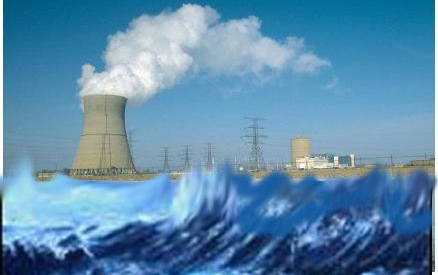
During the 1970s and 1980s, when many nuclear reactors were first built, most operators estimated that seas would rise at a slow, constant rate. That is, if the oceans rose a fraction of an inch one year, they could be expected to rise by the same amount the next year and every year in the future.
But the seas are now rising much faster than they did in the past, largely due to climate change, which accelerates thermal expansion and melts glaciers and ice caps. Sea levels rose an average of 8 inches between 1880 and 2009, or about 0.06 inches per year. But in the last 20 years, sea levels have risen an average of 0.13 inches per year – about twice as fast.
And it’s only getting worse. The National Oceanic and Atmospheric Administration (NOAA) has laid out four different projections for estimated sea level rise by 2100. Even the agency’s best-case scenario assumes that sea levels will rise at least 8.4 inches by the end of this century. NOAA’s worst-case scenario, meanwhile, predicts that the oceans will rise nearly 7 feet in the next 86 years.
But most nuclear power facilities were built well before scientists understood just how high sea levels might rise in the future. And for power plants, the most serious threat is likely to come from surges during storms. Higher sea levels mean that flooding will travel farther inland, creating potential hazards in areas that may have previously been considered safe. During Superstorm Sandy, for example, flooding threatened the water intake systems at the Oyster Creek and Salem nuclear power plants in New Jersey. As a safety precaution, both plants were powered down. But even when a plant is not operating, the spent fuel stored on-site, typically uranium, will continue to emit heat and must be cooled using equipment that relies on the plant’s own power. Flooding can cause a loss of power, and in serious conditions it can damage backup generators. Without a cooling system, reactors can overheat and damage the facility to the point of releasing radioactive material.
Salem and Hope Creek Nuclear Generating Stations Operated by PSEG Nuclear, LLC.……..
Turkey Point Nuclear Generating Station Operated by Florida Power & Light Co……..
America agonises over what to do with nuclear radioactive trash
that they should stop making this toxic stuff
LEGACY OF AMERICA’S NUCLEAR POWER PLANTS — SPENT FUEL AND NO PLACE TO PUT IT BRATTLEBORO REFORMER BY BOB AUDETTE MAY 19, 2014. BRATTLEBORO — After Vermont Yankee nuclear power plant is closed and when the site is finally cleaned up — perhaps before the end of the next decade — there will still be a lingering reminder of what existed there since 1972.
As at other nuclear power plant sites around the country, spent nuclear fuel — or nuclear waste, as it used to be called prior to a successful rebranding campaign waged by the nuclear industry — might remain in Vernon long after all other reminders of Yankee are gone.
In fact, the Nuclear Regulatory Commission released last year a revised waste confidence rule that stated impacts would be small if spent fuel had to be stored at nuclear sites “indefinitely.”
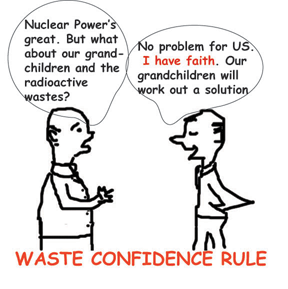
Ernest Moniz, the secretary of the U.S. Department of Energy, was in Vermont last week. During a phone interview with the Reformer, Moniz said his department is focused on developing a way to take care of the nation’s nuclear waste. However, noted Moniz, DOE needs the go-ahead from Congress. Continue reading
Accident at US repository highlights need for tougher nuclear safety monitoring
 Call for better oversight of nuclear-waste storage Accident at US repository highlights need for tougher safety monitoring, say experts.Nature, Declan Butler 13 May 2014 A serious accident in February at the United States’ only deep-storage repository for nuclear waste might never have happened had the government not disbanded a key independent scientific body charged with oversight of the safety of the facility.
The Waste Isolation Pilot Plant (WIPP), carved out of a salt bed 655 metres below the desert near Carlsbad in New Mexico, is run by the Department of Energy (DOE) and stores low- and medium-level military nuclear waste, containing long-lived, man-made elements such as plutonium and americium. But there are politically controversial plans to store far hotter high-level waste at the site. Nuclear-waste experts say that the accident — in which a container is thought to have ruptured or exploded — along with management errors and a lack of oversight at WIPP, highlight the need for an independent risk assessment of any proposed expansion.
The facility was opened in 1999 and is designed to operate for a few decades, after which it will be sealed forever. The accident on 14 February released moderate levels of radioactivity into the repository, as well as small amounts into the environment, and officials say that the plant will not reopen for at least 18 months.
According to a preliminary report released on 24 April by a DOE-appointed Accident Investigation Board, the root cause of the accident lies with the department’s field office and Nuclear Waste Partnership, the contractor that operates the site, both in Carlsbad. They failed to identify radiological risks and make plans to control them, the report’s authors said. They added that maintenance of safety systems was neglected, and that DOE oversight was “ineffective”………
Ed Lyman, a nuclear expert with the Union of Concerned Scientists in Washington DC, says that he strongly supports exploring the storage of down-blended weapons-grade plutonium at WIPP. Such waste generates much less heat than does spent fuel, he adds. But he rejects storing spent fuel at WIPP, as its likely impacts on the surrounding salt “would be inviting trouble”.
The DOE Field Office in Carlsbad and the Nuclear Waste Partnership had not responded to Naturewhen this article went to press.
Several scientists say that whatever the test results or arguments, the storage of high-level waste at WIPP should be ruled out because of the nature of the site. The area is rich in oil, gas and minerals, and oil and gas wells hug the 41-square-kilometre area. Hydraulic fracturing — fracking — of gas is also carried out nearby. This poses the risk that the WIPP repository could be disturbed by future drilling and mining, for example, by the puncture of the high-pressure brine reservoirs beneath WIPP.
There is no way that the authorities would ever approve such a site for storing high-level waste, says Chaturvedi. http://www.nature.com/news/call-for-better-oversight-of-nuclear-waste-storage-1.15211
1 This Month
23-25 October – on Zoom – World BEYOND War’s annual global conferenc


Shut down the radiation-damaged Heysham nuclear reactors now
To see nuclear-related stories in greater depth and intensity – go to https://nuclearinformation.wordpress.com

Say No to NASA’s Reckless Nuclear Reactor on the Moon
Say No to NASA’s Reckless Nuclear Reactor on the Moon
-
Archives
- October 2026 (170)
- September 2026 (339)
- August 2026 (330)
- July 2026 (355)
- June 2026 (287)
- May 2026 (306)
- April 2026 (356)
- March 2026 (251)
- February 2026 (267)
- January 2026 (308)
- December 2025 (358)
- November 2025 (359)
-
Categories
- 1
- 1 NUCLEAR ISSUES
- business and costs
- climate change
- culture and arts
- ENERGY
- environment
- health
- history
- indigenous issues
- Legal
- marketing of nuclear
- media
- opposition to nuclear
- PERSONAL STORIES
- politics
- politics international
- Religion and ethics
- safety
- secrets,lies and civil liberties
- spinbuster
- technology
- Uranium
- wastes
- weapons and war
- Women
- 2 WORLD
- ACTION
- AFRICA
- Atrocities
- AUSTRALIA
- Christina's notes
- Christina's themes
- culture and arts
- Events
- Fuk 2022
- Fuk 2023
- Fukushima 2017
- Fukushima 2018
- fukushima 2019
- Fukushima 2020
- Fukushima 2021
- general
- global warming
- Humour (God we need it)
- Nuclear
- RARE EARTHS
- Reference
- resources – print
- Resources -audiovicual
- Weekly Newsletter
- World
- World Nuclear
- YouTube
-
RSS
Entries RSS
Comments RSS

