How easily nuclear brinkmanship can slide into nuclear war
The U.S. state presumably does not intend to provoke a hot war with Russia and China.. But directing intensive protowar against powerful nuclear-armed states is to risk the possibility of ‘sleep walking’ into the abyss through miscalculation, or through a gradual hightening of conflicts which finally go out of control.
Nuclear Brinksmanship: Obama’s ProtoWar Against Russia and China By Eric Sommer Global Research, May 31, 2014 Counterpunch Russia and China are both under attack by a multi-pronged U.S.-led ‘proto-war’ which could erupt into ‘hot war’ or even nuclear war. ‘Protowar’ or ‘proto-warfare’ is the term I have coined to describe the use of multiple methods intended to weaken, destabilize, and in the limit-case destroy a targeted government without the need to engage in direct military warfare.
Protowar methods include threats against the targeted country; economic sanctions; military encirclement around its borders. cyber-warfare, drone warfare, and use of proxy forces from within or from outside the country for political and/or military action against the local government.
U.S.-led protowars also invariably include propaganda campaigns against the targeted governments. The media campaigns are waged by the five giant media conglomerates which now control 90% of the U.S. media and which are directly linked to the U.S. foreign-policy establishment through various means including corporate memberships in the Committee for Foreign Relations.
You can recognize these media campaigns because they frequently employ the words ‘human rights’ or ‘democracy’ as the pretext for U.S. state protowars against other countries. Sometimes, of course, these words cannot possibly be applied at all, as in the massive support currently given to the murderous military dictatorship in Egypt or the midevilist kingdom of Saudi Arabia. In these cases the U.S. media and government substitute the words ‘U.S. National Interest’ for ‘human rights’ as the pretext for targeting another country.
Proto-warfare often precedes, or leads up to, hot wars, as when a decade of economic sanctions, media demonization, and media-supported lies about ‘weapons of mass destruction’ led up to the Iraq war. Thousands of young American men and women were sent over to kill and be killed, or to be injured or traumatized, to say nothing of the up to a million Iraqis who died as a result of the war. However, Iraq did not possess nuclear or other weapons of mass destruction, so there was no danger of a nuclear conflagration. Matters are much different with respect to Russia and China, both nuclear powers.
The ProtoWar Against Russia and China
U.S.-led proto-warfare against Russia and China has a number of elements. To begin with, it conforms to two popular doctrines in U.S. foreign policy circles. The first doctrine states that the U.S. must never allow another super-power to emerge, and must remain the unchallenged dominant force on Earth. This doctrine is clearly set-out in the original version of the U.S. Defence Department policy document known as ‘the Wolfowitz doctrine:
“Our first objective is to prevent the re-emergence of a new rival, either on the territory of the former Soviet Union or elsewhere, that poses a threat on the order of that posed formerly by the Soviet Union. This is a dominant consideration underlying the new regional defense strategy and requires that we endeavor to prevent any hostile power from dominating a region whose resources would, under consolidated control, be sufficient to generate global power.”
The document containing this statement and similar notions was changed for public consumption after the original provoked an outcry when it was leaked to the press. The second doctrine underpinning proto-warfare against Russia and China is that U.S. dominance of the planet depends on control of the Eurasian land mass, on which Russia and China occupy key positions. This doctrine has been heavily promoted by former US National Security Advisor Zbigniew Brzezinski. “For America,” he has written, ” the chief geopolitical prize is Eurasia… Eurasia is the globes largest continent and is geopolitically axial. A power that dominates Eurasia would control two of the worlds’ three most advanced and economically productive regions… Eurasia is thus the chessboard on which the struggle for global primacy continues to be played.
In pursuit of Eurasian dominance a whole gamut of protowar tools are now being used by the U.S. in its campaigns against Russia and China. Militarily, the U.S.-led Nato military alliance has progressively squeezed Russia’s’ strategic space by enlisting one former Russian aligned state in Eastern Europe after another. Now, with a U.S.-supported coup-imposed government in power in Kiev, there is open talk of Nato also incorporating Ukraine, a country right on Russia’s’ border……………
On the other side of Eurasia, U.S. military encirclement of China has also recently proceeded apace. Military bases and transfers of billions of dollars in military equipment have been positioned around China for years in areas such as South Korea, Taiwan, and Japan.
Now, with the Obama administrations’ so-called ‘pivot to Asia’, a new more ambitious program called ‘Air-Sea battle plan’ involves deployment of large amounts of very hi-tech military systems and equipment in the pacific area all aimed at China.
At the same time, new U.S. military bases are being opened across the Pacific arena, from the Philippines to Australia, with no other conceivable target but China.
In conjunction with this Pacific military build-up, the U.S.state is attempting to use previously minor disputes over ownership of maritime resources to turn a number of smaller Asian nations into proxies to help it destabilize China. These nations include Japan, South Korea, Vietnam, and the Philippines. By offering its support, and in some cases promises of military assistance in any maritime conflict with China, the U.S. has stoked the ambitions and aggressive nationalist tendencies of these smaller nations vis-a-vis China.
Coinciding with the military build-up against China is extensive cyber-penetration of China by the U.S. NSA (National Security Agency), as revealed by whistle-blower Edward Snowden.
This penetration includes wholesale capture of hundreds of thousands or millions of Chinese mobile text messages; the monitoring of mobile phone conversations of Chinese leaders; and serious intrusions into the computer network backbone system of Beijings’ Tsinghua university, which is linked to large numbers of Chinese research centers including labs engaged in sensitive military-related work………
The danger of the U.S.Eurasian protowar erupting into hot war – or even nuclear war – stems from a single factor: Previous U.S.-led protowars which erupted into hot wars were against countries like Serbia, Iraq, or Libya. Those countries did not have nuclear weapons and could not effectively defend themselves against U.S. military and other pressures Russia and China are in a different category – they are nuclear- armed and can defend themselves.
The U.S. state presumably does not intend to provoke a hot war with Russia and China.. But directing intensive protowar against powerful nuclear-armed states is to risk the possibility of ‘sleep walking’ into the abyss through miscalculation, or through a gradual hightening of conflicts which finally go out of control. . In 1914, with the European powers of the day already on edge, it took just the assassination of a minor duke in a peripheral country to trigger World War I. As an old adage has it, “If you play with fire, you may get burned.” http://www.globalresearch.ca/nuclear-brinksmanship-obamas-protowar-against-russia-and-china/5384644
Questioning the economics of Small Modular Nuclear Reactors (SMRs)
Christian Science Monitor, Small-scale nuclear plants can be strung together and might save utilities on capital costs. But critics question the efficiency and operating costs of small-scale nuclear plants. By Ken Silverstein, June 1, 2014 The Obama administration wants to seed the United States with pint-size nuclear reactors, and this week it backed a new developer to do it. The US Department of Energy (DOE) said it would provide $217 million in matching funds over five years to NuScale, which builds small, ready-made reactors that can be strung together.
But NuScale only gets the federal funds if it can match them with money from private investors, who so far have been leery of the technology. In April, Babcock & Wilcox said it would scale back its DOE-backed plans to build modular reactors for the Tennessee Valley Authority because it failed to secure venture capital. Will NuScale do any better?
NuScale says its advantage is that 12 of its modular reactors can be combined to form a 540 megawatt unit. When one of the modules goes down, it could easily be maintained while the rest of the reactors continue to operate, so that whole facilities are not knocked off the grid. Each individual module could be refueled in relatively short order.
The cost of a 540 megawatt unit would be between $2.2 billion and $2.5 billion. That’s marginally less expensive per unit of output than a traditional nuclear plant. And at that price, utilities would not be taking the kind of financial risks they might otherwise have to if they built a $15 billion to $20 billion central nuclear facility.
As a first step, Oregon-based NuScale is opening a manufacturing plant in Charlotte, N.C., where it will hire 70 employees.
“This expansion … is critical to completing NuScale’s design and submitting our design certification application to the Nuclear Regulatory Commission,” writes Mike McGough, chief commercial officer of NuScale, in an e-mail. The company hopes to submit its design certification in the latter half of 2016. And it plans to begin signing commercial contracts by 2023.
That’s a long and arduous process – just as it is for a larger nuclear plant. Typically, investors don’t want to tie up their money for that long. The Department of Energy’s involvement is aimed at trying to create some legal and financial certainties so they can invest with more confidence. While NuScale says that its units are more affordable than larger centrally located nuclear facilities and that they can replace retiring coal plants, its critics say that the technology lacks efficiencies and cannot compete against combined-cycled natural gas facilities.
“I wish them luck but the economics don’t make sense,” says Mike Keller, president of Kansas-based Hybrid Power Technologies, in an interview regarding both NuScale and Babcock & Wilcox. He adds that the smaller units are inefficient, which means that they produce more nuclear waste than their larger nuclear cousins while they would generate power at three times the current cost of a combined cycle natural gas plant.
“Having a big chunk of money [from the government] does not equal commercial success,” adds Mr. Keller. “The US government should do more due diligence.”………http://www.csmonitor.com/Environment/Energy-Voices/2014/0601/Pint-size-nuclear-plants-get-a-boost-from-Obama-administration
Another pesky NRC Chair who puts public safety above nuclear industry profits!
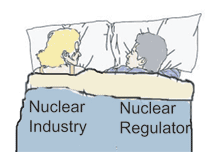 NRC rejects effort to move radwaste from pools; Macfarlane issues strong dissent Michael Mariotte, Green World, 30 May 14, The Nuclear Regulatory Commission has again sided with the nuclear power industry (where have you heard that one before?) and rejected efforts by environmental/clean energy groups and five U.S. Senators to move high-level radioactive waste out of overcrowded, dangerous and poorly-protected fuel pools as soon as it is cool enough to be placed in dry casks.
Not only did the NRC Commissioners take this unconscionable vote, they said this was their last word on the subject and they would refuse to ever again consider the issue.
 But the vote wasn’t unanimous: NRC Chair Allison Macfarlane, who has spent her career studying radioactive waste issues, issued a strong dissent to the decision, essentially arguing that the NRC staff hasn’t done its homework.
Which brings up an interesting subject we’ll talk about more below: what if the four Commissioners who voted for the industry on the waste issue–and nearly always vote for the industry–had been unsuccessful in their efforts in 2012 to oust then-chair Greg Jaczko, who almost certainly would have taken the same position as Macfarlane? We might then be looking at a Commission that could in a few months have had both Jaczko and Macfarlane as members, and perhaps at least one more Commissioner independent of the agency. That would be a very different situation than the industry-dominated and sympathetic Commission that has far too long run the NRC……….
In her dissent, Macfarlane castigated the staff for essentially shoddy research: “In my view, the staff has not adequately explored the issue of spent fuel management in the pool and as a result, I do not have adequate information on which to base a view on the need to require approaches that may lead to some form of expedited transfer of spent fuel from pools to dry casks.”
Macfarlane said she did not necessarily support a program to move the radioactive fuel to dry casks within five years, but primarily because the technical capacity to do so may not exist. And she complained that was the only option presented by the staff to the Commission:…….
In her nine-page dissent, the NRC chair also complained about the NRC staff’s failure unwillingness to fully engage the public in the agency’s radioactive waste discussions, writing, “I do not agree with the staff’s approach in engaging the public near the very end of the
current two-year regulatory review process, without the ability to fully provide input on key regulatory factors or review the draft regulatory analysis that was provided to the Commission. In accelerating this Tier 3 activity to align with the Waste Confidence environmental activities for public transparency, the staff may have ironically impeded the same public from fully vetting this issue in the safety and security arenas.”
Macfarlane concluded citing the precautionary principle:……….http://safeenergy.org/2014/05/29/nrc-rejects-effort-to-move-radwaste-from-pools/
No new contracts for 3 Exelon nuclear reactors: they may now close
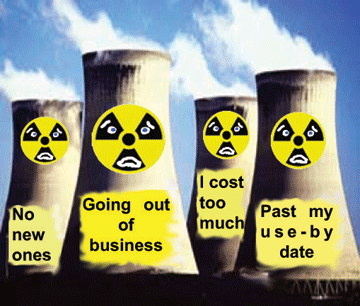 Exelon nuclear plants may retire after failing to secure new contracts, Utility DIVE, By Claire Cameron MAY 27, 2014
Dive Brief:
- Three of Exelon’s nuclear power plants failed to get new contracts at the annual PJM Interconnection capacity auction for 2017-18, putting their future at risk.
- The plants, Byron and Quad Cities in Illinois and Oyster Creek in New Jersey, could now close after they were priced out of the market by cheaper competitors. Traditionally, the company has made between $1-8 per megawatt-hour in revenue from the sale of power from these plants.
- This year’s PJM capacity auction saw power supply prices rise from last year’s three year low of $59.37 per MW to $120 per MW.
Dive Insight:
Exelon relies on the capacity auction to keep funding the expensive nuclear facilities it operates. Without contracts, however, the utility could be forced to turn to federal and state regulators for a bailout.
Exelon has yet to seek such a resolution. Prior to the results of the auction being announced, an Illinois House Resolution charging the Environmental Protection Agency, the Federal Energy Regulatory Commission and grid operators to adopt more nuclear-friendly policies was floored. ……http://www.utilitydive.com/news/exelon-nuclear-plants-may-retire-after-failing-to-secure-new-contracts/267503/
With Allison MacFarlane and Gregory Jaczko. USA’s nuclear power plans could be very different
NRC rejects effort to move radwaste from pools; Macfarlane issues strong dissent Michael Mariotte, Green World, 30 May 14,
“……….Back to the composition of the NRC. If Greg Jaczko, who  voted against licenses for the Vogtle and Summer reactors and since leaving the Commission has recommended phase-out of U.S. reactors, were still chair, Allison Macfarlane would almost certainly have still been President Obama’s next Democratic nominee (the NRC is required to have no more than three of its five members from the same political party). And there are two Democratic seats up this year: Commissioner Magwood is leaving the agency soon to head up Europe’s Nuclear Energy Agency, which exists not to regulate, but promote nuclear power (a position that raises the issue of whether it was a conflict-of-interest for Magwood to have taken this vote, and for that matter any other vote at this point) and Commissioner Apostolakis’ five-year term ends next month. He has not announced publicly whether he wants a second term, but the President is certainly under no obligation to re-appoint him even if he does.
We would have a very different Commission then. But we still could. Now, President Obama is in a position to act to fundamentally change the NRC and support his chosen chair. And, as this vote makes clear, to support his chosen NRC chair Macfarlane, he mustuse this opportunity to appoint such advocates to the NRC. Otherwise, he will be simply hanging her out to dry.
For that reason, NIRS has begun an e-mail campaign to urge the President to appoint such people to the Commission now. You can make your voice heard here. And NIRS and other groups will be making this point as forcefully as possible in other venues in the coming weeks as well. http://safeenergy.org/2014/05/29/nrc-rejects-effort-to-move-radwaste-from-pools/
Barack Obama takes action on climate change
 Obama to unveil historic climate change plan to cut US carbon pollution
• Proposed regulations could cut carbon pollution by up to 25%
• President still faces potential opposition from Republicans
• Q&A: why the carbon proposal could make climate history
Suzanne Goldenberg, US environment correspondent theguardian.com, Friday 30 May 2014 President Barack Obama will unveil a plan on Monday that will cut carbon pollution from power plants and promote cap-and-trade, undertaking the most significant action on climate change in American history.
The proposed regulations Obama will launch at the White House on Monday could cut carbon pollution by as much as 25% from about 1,600 power plants in operation today, according to those claiming familiarity with the plan.
Power plants are the country’s single biggest source of carbon pollution – responsible for up to 40% of the country’s emissions.
The rules, which were drafted by the Environmental Protection Agency and are under review by the White House, are expected to do more than Obama, or any other president, has done so far to reduce the carbon dioxide emissions responsible for climate change.
They will put America on course to meet its international climate goal, and put US diplomats in a better position to leverage climate commitments from big polluters such as China and India, Obama said in a speech to West Point graduates this week.
“I intend to make sure America is out front in a global framework to preserve our planet,” he said. “American influence is always stronger when we lead by example. We can not exempt ourselves from the rules that apply to everyone else.”
It won’t be without a fight. Obama went on in his remarks at West Point to take a shot at Republicans who deny climate change is occurring, and the White House press secretary, Jay Carney, on Thursday accused critics of making “doomsday claims” about the costs of cutting carbon…….
Obama had originally hoped to cut carbon pollution by moving a bill through Congress. Four years after that effort fell apart, campaigners say the EPA rules could deliver significant emissions cuts – near the 17% Obama proposed at the Copenhagen climate summit – and the cap-and-trade programmes that were so reviled by Republicans.
The EPA, using its authority under the Clean Air Act, proposed the first rule phase, covering future power plants, last September.
In this the more politically contentious phase of the plan, it is widely believed the EPA will depart from the “inside the fence-line” convention of earlier environmental regulations for mercury and other pollutants, which focused on emissions-scrubbing on specific power plants.
The EPA administrator, Gina McCarthy, is seeking steep reductions – as much as 25% – but she has hinted repeatedly that she will allow states latitude in how they reach those targets.
The plan would allow electricity companies to reduce pollution by shutting down the oldest and most polluting coal plants. They can install carbon-sucking retrofits. They can expand wind and solar energy, upgrade the electrical grid, encourage customers to update to more efficient heating and cooling systems, or more efficient appliances and lightbulbs.
“They have recognised huge emissions reductions opportunities are often cheaper than trying to do it all inside the plant,” said David Doniger, who heads the climate programme at the NRDC. “If you want to get substantial reductions and you want to get it economically, you have to take into account a system-wide approach.”…….http://www.theguardian.com/environment/2014/may/29/obama-unveil-historic-climate-plan-carbon-pollution
Shortcomings in doctors’ understanding of ionising radiation in medicine
 Residents lack knowledge of radiation safety By Eric Barnes, AuntMinnie.com staff writer May 30, 2014 — Medical residents have limited knowledge of radiation safety, with just over half knowing that fluoroscopy could produce radiation-induced skin burns, for example. Radiology residents were only marginally more informed, according to survey results published inAcademic Radiology.
To their credit, 95% of residents, regardless of specialty, reported a link between ionizing radiation and the future development of cancer, the authors wrote. For radiology residents, 98% said they believe in such a link. Continue reading
Urge Obama to support his NRC chair, appoint strong safety advocates to NRC.
 The Nuclear Regulatory Commission has again sided with the nuclear power industry (where have you heard that one before?) and rejected efforts by environmental/clean energy groups and five U.S. Senators to move high-level radioactive waste out of overcrowded, dangerous and poorly-protected fuel pools as soon as it is cool enough to be placed in dry casks.
Not only did the NRC Commissioners take this unconscionable vote, they said this was their last word on the subject and they would refuse to ever again consider the issue.
But the vote wasn’t unanimous: NRC Chair Allison Macfarlane, who has spent her career studying radioactive waste issues, issued a strong dissent to the decision, essentially arguing that the NRC staff hasn’t done its homework.
What are those nasty smells from Hanford’s nuclear waste tanks?
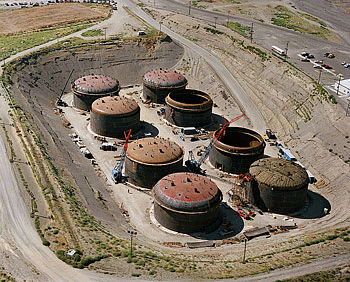 6 Hanford Nuclear Reservation workers report smelling chemical vapors in tank farms http://www.foxnews.com/us/2014/05/29/6-hanford-nuclear-reservation-workers-report-smelling-chemical-vapors-in-tank/ RICHLAND, Wash. – Six workers at the Hanford Nuclear Reservation are receiving medical evaluations after they reported smelling chemical vapors at two underground storage tank farms.
Washington River Protection Solutions, which operates the underground tanks at Hanford, says five of the workers reported symptoms typically related to chemical vapor exposure.
The employees were working in or near Hanford’s AP and SY Tank Farms when the vapors were reported. All workers immediately exited the area and moved upwind.
Hanford officials are taking samples and checking for possible sources of the vapors.
There have been numerous incidents in recent months when Hanford workers have reported smelling chemical vapors while working in the tank farms.
The tanks contain radioactive wastes left over from the production of plutonium for nuclear weapons.
Unpalatable price facts hit Wyoming’s uranium industry
 Wyoming mines affected by low uranium prices Houston Chronicle, May 29, 2014 CASPER, Wyo. (AP) — Some uranium producers in Wyoming say they’re being affected by weak demand that has caused prices for the nuclear fuel to slip to their lowest level in eight years.
Spot prices for yellowcake are down to $28 per pound. That’s as low as they’ve been since 2006 and down from $75 per pound in 2011………
the current situation is that we have oversupply due to excess inventories,” said Rob Chang, an industry analyst at the New York-based investment firm Cantor Fitzgerald.
Wyoming is among the top uranium-producing states. Wyoming’s uranium mines employ a process of dissolving uranium out of underground deposits and then pumping the ore-containing solution to the surface through wells.
Uranium One has stopped drilling new uranium wells and laid off eight employees since last year, said Donna Wichers, Uranium One vice president for the Americas.
“At $28 a pound you can imagine what that is doing to us,” Wichers said……..http://www.houstonchronicle.com/business/energy/article/Wyoming-mines-affected-by-low-uranium-prices-5514120.php
Nuclear Regulatory Commission to end plan to accelerate removal of spent fuel rods
 Nuclear Power Regulator Sticks Its Head Further into the Ground http://blog.ucsusa.org/spent-fuel-decision-nrc-550 Union of Concerned Scientists, David Wright, physicist & co-director, Global Security May 28, 2014 An ostrich is a clichéd symbol of people making bird-brained
decisions that ignore reality. But it’s hard to think of something more apt for the Nuclear Regulatory Commission (NRC) sometimes.
 Take its most recent decision: The commissioners voted 4 to 1 to end consideration of a plan to accelerate the transfer of the growing stocks of nuclear waste at U.S. nuclear plants from spent fuel pools to safer dry casks. (The lone vote for safety was cast by the NRC Chair—Allison Macfarlane.) Moreover, the Commission said it didn’t want to think about it anymore, ordering that “no further generic assessments be pursued related to possible regulatory actions to require the expedited transfer of spent fuel to dry cask storage.”
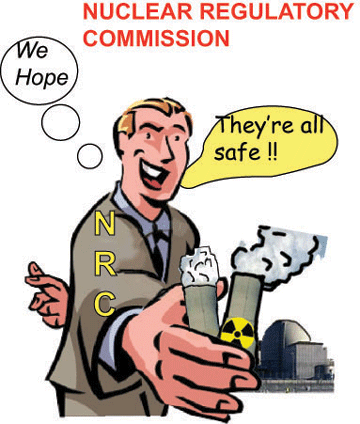
That anti-science position is difficult to fathom. Given the potential consequences of an accident or terrorist attack on a spent fuel pool, you would hope the body responsible for ensuring public safety would want to know all it could, and use that information to reduce nuclear risks.
Risks from Spent Fuel Pools
After all, most spent fuel pools at reactors at U.S. plants contain much more nuclear material than the reactor core itself—in many cases more than 5 times as much. And as I noted in an earlier post, even the NRC believes that poses a huge risk. A recent study by NRC staff considered an accident scenario at the Peach Bottom nuclear plant in Pennsylvania that resulted in a fire of the spent fuel rods and the release of radioactivity that, on average, would lead to more than 17,000 cancer deaths, 9,400 square miles of evacuated territory—an area the size of New Hampshire—and more than 4 million people displaced long-term.
So everyone agrees the consequences of such an accident are potentially huge. And in such a case, transferring spent fuel out of the pools and putting it in dry casks would make an astounding difference.
In particular, the same NRC staff study compared the consequences of an unmitigated spent fuel fire in the Peach Bottom pool today with the consequences assuming all spent fuel that had been in the pool longer than 5 years had been moved to dry casks. It found that after the transfer, the number of cancer deaths would be 10 times smaller and the amount of evacuated territory and number of long-term displaced people would both be 50 times smaller.
The NRC’s “Flawed and Incomplete Analysis”
So, what was behind the Commission’s decision?
 It decided that while the consequences of such an event might be horrific, the probability of it happening was so low that it didn’t need to take additional steps to lessen those consequences. You would think it must have pretty convincing evidence of that fact to make such a decision and decree that it was time to stop looking at it further.
You would be wrong.
People—including staffers at the NRC itself—have identified a lot of problems with the analysis that backs up the NRC’s conclusion (see, eg, here and here). My colleague Ed Lyman calls the analysis “flawed and incomplete.” But you don’t need to get into the details of the study to find a glaring omission that undermines its conclusions: The analysis did not include the possibility of a terrorist attack on a spent fuel pool. Even if a nuclear plant is operating perfectly, such an attack could lead to exactly the kind of “loss of coolant” accident described above. And in a 2006 study, the National Academy of Sciences calls out spent fuel pools as something “knowledgeable terrorists might choose to attack.”
So the crucial piece of logic leading to the NRC’s wrong-headed decision is completely unconvincing—certainly not something you should bet the safety of tens of thousands of Americans on.
Ostriches sticking their heads in the ground appeals to our sense of absurdity—the idea that it thinks it can be safe by refusing to look at whatever risk is at hand. That absurdity becomes tragic when the NRC does the same thing, and people’s lives are at stake. About the author: David Wright is a physicist and the co-director of the Global Security Program. He is a nationally known expert on the technical aspects of missile defense systems, missile proliferation, and space weapons. See David’s full bio.
USA some funds authorised to go from nuclear weapons to veterans care
House Bill Shifts Some Nuclear Weapons Funds To Pay for Veterans Care Defense One, Douglas P. Guarino 27 May 14, The version of the fiscal 2015 defense authorization bill that the House approved last week would cut some controversial nuclear weapons spending in a bid to help veterans.
The legislation — which authorizes but does not appropriate funds for military-related items — includes two related amendments offered by Rep. Dan Kildee, D-Mich. Together they would cut $7.5 million out of the $643 million that the Obama administration requested for controversial efforts to extend the life of B-61 gravity bombs, many of which are stationed in Europe.
The two provisions also would take $7.5 million out of projects to refurbish the Navy’s W-76 nuclear warhead — more than half of the funding boost that the Republican leadership of the House Armed Services Committee had sought to authorize for the program. The bill would allow up to $266.3 million in spending on W-76 refurbishment, still $7.1 million more than the Obama administration requested.
The money — along with $15 million that would be cut from the Navy’s shipbuilding budget — would fund two initiatives:
One would create “a training program to increase and improve financial literacy and training for incoming and out-going military personnel,” according to the legislation. According to a statement Kildee provided to Global Security Newswire, this would help address a problem of “unscrupulous lenders” targeting service members.
The other would require the Pentagon to commission a third-party study meant to “identify deficiencies in the treatment of wounded warriors and offer recommendations to the secretary of Defense and Congress to improve such treatment,” the measure states.
The House approval of Kildee’s amendments comes amid furor on Capitol Hill over revelations about former service members who died while on a Veterans Affairs waiting list for medical appointments in Phoenix.
According to Kildee’s staff, “at a time when our wounded service members are not getting the adequate care they deserve, it is a misplaced priority to spend more money on such nuclear refurbishment programs for outdated weapons systems, especially when the Pentagon has not even asked for it.”
The House also approved, by a 224-199 vote, an amendment offered by Rep. Earl Blumenauer, D-Ore., that would require the Congressional Budget Office to update its report on the projected costs of U.S. nuclear forces on an annual basis. The move follows a report earlier this year by the James Martin Center for Nonproliferation Studies arguing that the current plan for modernizing the arsenal is too costly to implement.
The Republican-led House Rules Committee, however, blocked floor debate on an amendment offered by Rep. Mike Quigley, D-Ill., and John Garamendi, D-Calif., calling for more in-depth analysis on the need to maintain all three components of the so-called nuclear triad.
The provision would have required the nonpartisan Government Accountability Office to study the justification and rationale for maintaining the three components, which include bombs that can be dropped by aircraft, along with ballistic missiles both at sea and on land. The measure would also have instructed theGAO study and to identify any excess costs that could be trimmed……..http://www.defenseone.com/politics/2014/05/house-bill-shifts-some-nuclear-weapons-funds-pay-veterans-care/85261/
Risk of further explosions at Waste Isolation Pilot Plant (WIPP)
 Nuclear-waste facility on high alert over risk of new explosions, Nature,
US repository scrambles to seal off barrels containing cat-litter buffer thought to be responsible for February accident. Declan Butler 27 May 2014 Time bombs may be ticking at the United States’ only deep geological repository for nuclear waste. US authorities concluded last week that at least 368 drums of waste at the site could be susceptible to the chemical reaction suspected to have caused a drum to rupture there in February. That accident caused radioactive material to spill into the repository and leak into the environment above ground.
The Waste Isolation Pilot Plant (WIPP) near Carlsbad, New Mexico, is mined out of a salt bed 655 metres underground, and stores low- and medium-level military nuclear waste, containing long-lived, man-made radioactive elements such as plutonium and americium. The suspect drums contain nitrates and cellulose, which are thought to have reacted to cause the explosion in February, and are located in two of the repository’s eight vast storage rooms — 313 in panel 6, which has already been filled, and 55 in the partly filled panel 7, where the February accident occurred.
To mitigate the threat of further exploding drums, the New Mexico Environment Department (NMED) in Santa Fe issued an order on 20 May giving the US Department of Energy (DOE) and the Nuclear Waste Partnership — the contractor that operates the WIPP site — until 30 May to come up with a plan to “expedite” the sealing of panel 6 and part of panel 7. It is not yet clear when the panels will be sealed, as that will depend on how long it takes to ensure that the sealing is done safely, says Jim Winchester, a spokesman for the NMED………
In addition to the drums at the WIPP, another 57 containing the suspect mix are still in temporary storage at the LANL. On 19 May, the NMED told the DOE and the LANL that they had two days to present a plan to secure the drums. In their response on 21 May, the LANL and the DOE said that the drums were being transferred to a tent fitted with fire-control and high-efficiency particulate air filtration to contain any radioactive particles in the event of an accident. They added that air radiation levels and the temperature of the drums were being monitored, and that the drums were being inspected hourly for signs of rupture.
The WIPP has been closed since the February accident and will reopen only “when it is safe to do so”, according to a 22 May statement from the DOE. The accident is still under investigation, and parts of the underground repository are still contaminated with radioactivity. The DOE added that current assumptions and precautions about the hazards of operating the WIPP are being “evaluated and revised”. http://www.nature.com/news/nuclear-waste-facility-on-high-alert-over-risk-of-new-explosions-1.15290
USA House approves, by one vote, policy to maintain nuclear missile triad
 House Bill Shifts Some Nuclear Weapons Funds To Pay for Veterans Care Defense One, Douglas P. Guarino 27 May 14 “……..The House approved by voice vote an amendment offered by Rep. Steve Daines, R-Mont., — whose home state hosts ground-based missile silos — that would make it “the policy of the United States to operate, sustain and modernize or replace the triad” in its entirety.
The House bill also contains language, to which the White House objects, that would require that every intercontinental ballistic missile silo currently containing a deployed missile be kept operational.
At press time, all of the potential discrepancies with the House bill and the Senate version of the annual defense authorization bill were not yet clear. The Senate Armed Services Committee completed drafting its version of the bill on Thursday, but had not yet released the full text of the legislation.
One apparent difference is that the Senate bill would authorize $365 million for the Cooperative Threat Reduction program — the entire amount that the Obama administration requested. TheCTR program — which secures and dismantles potential weapons of mass destruction throughout the world that are considered to be a threat to the United States — would be cut by $10.5 million under the House bill.
Unlike the House bill, the Senate legislation would also provide $346 million — $145 million more than the administration requested — to continue construction of a controversial facility in South Carolina that would convert excess bomb-grade plutonium into nuclear fuel. The administration is looking to suspend construction of the facility while it explores other, possibly cheaper, methods of disposing of the plutonium.
Some lawmakers are questioning the administration’s cost estimates, however, and have suggested it should be able to make a decision in less than the 18 months it has projected. Senate appropriators at a budget hearing earlier this month gave National Nuclear Security Administration officials two weeks to come up with new ways to make the original mixed-oxide fuel conversion plan cost less.
According to NNSA spokesman Derrick Robinson, administration officials did have a follow-up meeting with Sens. Dianne Feinstein, D-Calif., and Lamar Alexander, R-Tenn. last week. It was “a substantive conversation that discussed a range of options and challenges, which included a discussion of MOXcosts and options,” he said.
Robinson did not provide any revised cost projections. http://www.defenseone.com/politics/2014/05/house-bill-shifts-some-nuclear-weapons-funds-pay-veterans-care/85261/
USA’s “temporary” radioactive waste containers are becoming permanent

it’s time to stop making this toxic radioactive trash
US Nuclear Power Plants Prepare Long-Term Radioactive Waste Storage http://www.theepochtimes.com/n3/697217-us-nuclear-power-plants-prepare-long-term-radioactive-waste-storage/ By Associated Press | May 26, 2014 WATERFORD, Conn.—Nuclear power plants across the United States are building or expanding storage facilities to hold their spent fuel — radioactive waste that by now was supposed to be on its way to a national dump.
The steel and concrete containers used to store the waste on-site were envisioned as only a short-term solution when introduced in the 1980s. Now they are the subject of reviews by industry and government to determine how they might hold up — if needed — for decades or longer.

With nowhere else to put its nuclear waste, the Millstone Power Station overlooking Long Island Sound is sealing it up in massive steel canisters on what used to be a parking lot. The storage pad, first built in 2005, was recently expanded to make room for seven times as many canisters filled with spent fuel.
Dan Steward, the first selectman in Waterford, which hosts Millstone, said he raises the issue every chance he can with Connecticut’s congressional members.
“We do not want to become a nuclear waste site as a community,” Steward said.
The government is pursuing a new plan for nuclear waste storage, hoping to break an impasse left by the collapse of a proposal for Nevada’s Yucca Mountain. The Energy Department says it expects other states will compete for a repository, and the accompanying economic benefits, and it’s already heard from potential hosts in New Mexico, Texas and Mississippi. But the plan faces hurdles including a need for new legislation that has stalled in Congress.
So plants are preparing to keep the high-level nuclear waste in their backyards indefinitely. Most of it remains in pools, which cool the spent fuel for several years once it comes out of the reactors. But with the pools at or nearing capacity, the majority is expected within a decade to be held in dry casks, or canisters, which are used in 34 states. Only three of the 62 commercial nuclear sites in the U.S. have yet to announce plans to build their own.
In the past few years since the Yucca Mountain plan was abandoned, the government and industry have opened studies to address unanswered questions about the long-term performance of dry cask storage. The Nuclear Regulatory Commission in 2011 began offering 40-year license renewals for casks, up from 20-year intervals. The tests are focusing on how to monitor degradation inside the canisters, environmental requirements for storage sites, and how well the canisters hold up with “high burnup,” or longer-burning fuels that are now widely used by American plants.
“Now that we’ve shown that the national policy is shifting, we’re having to relook at these systems to make sure they still meet the regulations for longer and longer periods of time,” said Eric Benner, an NRC official who has served as the inspections branch chief with its spent fuel storage division.
At Millstone, 19 canisters loaded with spent fuel are arrayed on a concrete pad, which was expanded in October to make room for as many as 135 canisters by 2045. The canisters, which are cooled by air circulation, seal the waste with inert gas inside an inner chamber and are themselves loaded into concrete modules. Workers regularly inspect temperature gauges and, during the winter, shovel snow off the vents.
Millstone’s low-level nuclear waste is shipped to a disposal facility in Barnwell, South Carolina.
The spent fuel is piling up at a rate of about 2,200 tons a year at U.S. power-plant sites. The industry and government decline to say how much waste is currently stored at individual plants. The U.S. nuclear industry had 69,720 tons of uranium waste as of May 2013, with 49,620 tons in pools and 20,100 in dry storage, according to the Nuclear Energy Institute industry group.
Spent nuclear fuel is about 95 percent uranium. About 1 percent is other heavy elements such as curium, americium and plutonium-239. Each has an extremely long half-life — some take hundreds of thousands of years to lose all of their radioactive potency.
Watchdog groups say the dry storage poses fewer safety concerns than the reactors themselves, and many have pushed for spent fuel to be transferred more quickly from the pools. Heavy security is in place to deter sabotage by terrorists.
The administration’s strategy calls for an interim storage facility by 2025 and a geologic repository by 2048.
Peter Lyons, an assistant secretary for nuclear energy at the U.S. Energy Department, said it cannot make plans for individual sites until the passage of legislation creating a new framework for waste policy. But he said the groups in southeastern New Mexico, western Texas and Mississippi are only the most public of potential hosts to express interest in taking in high-level waste.
The idea for the interim facility is to take spent fuel left behind from reactors that have already shut down, as is the case at sites in California, Maine, Massachusetts, Michigan, Wisconsin, Connecticut, Colorado and Oregon.
1 This Month
23-25 October – on Zoom – World BEYOND War’s annual global conferenc


Shut down the radiation-damaged Heysham nuclear reactors now
To see nuclear-related stories in greater depth and intensity – go to https://nuclearinformation.wordpress.com

Say No to NASA’s Reckless Nuclear Reactor on the Moon
Say No to NASA’s Reckless Nuclear Reactor on the Moon
-
Archives
- October 2026 (170)
- September 2026 (339)
- August 2026 (330)
- July 2026 (355)
- June 2026 (287)
- May 2026 (306)
- April 2026 (356)
- March 2026 (251)
- February 2026 (267)
- January 2026 (308)
- December 2025 (358)
- November 2025 (359)
-
Categories
- 1
- 1 NUCLEAR ISSUES
- business and costs
- climate change
- culture and arts
- ENERGY
- environment
- health
- history
- indigenous issues
- Legal
- marketing of nuclear
- media
- opposition to nuclear
- PERSONAL STORIES
- politics
- politics international
- Religion and ethics
- safety
- secrets,lies and civil liberties
- spinbuster
- technology
- Uranium
- wastes
- weapons and war
- Women
- 2 WORLD
- ACTION
- AFRICA
- Atrocities
- AUSTRALIA
- Christina's notes
- Christina's themes
- culture and arts
- Events
- Fuk 2022
- Fuk 2023
- Fukushima 2017
- Fukushima 2018
- fukushima 2019
- Fukushima 2020
- Fukushima 2021
- general
- global warming
- Humour (God we need it)
- Nuclear
- RARE EARTHS
- Reference
- resources – print
- Resources -audiovicual
- Weekly Newsletter
- World
- World Nuclear
- YouTube
-
RSS
Entries RSS
Comments RSS

