Safety of USA’s The Waste Isolation Pilot Plant in question

 Radiation leak at nuclear waste dump raises questions New York Post, May 16, 2014 ALBUQUERQUE, N.M. — A radiation leak at the government’s troubled nuclear waste dump has been linked to a waste container shipped from Los Alamos National Laboratory, officials said Friday, raising questions about the safety of other barrels being stored on the lab’s northern New Mexico campus and at a temporary site in West Texas…….. watchdog Don Hancock of the Southwest Research and Information Center in Albuquerque said that until more is known about the breach, “we can’t have assurances.”
In a statement, the U.S. Department of Energy said pictures from the latest entry into the half-mile deep Waste Isolation Pilot Plant (WIPP) near Carlsbad in southeastern New Mexico confirm that a container from Los Alamos has a cracked lid and evidence of heat damage.
Officials last week zeroed in on the containers from Los Alamos, prompting officials to suspend shipments of waste from Los Alamos to the temporary site in West Texas. In a statement, the U.S. Department of Energy said pictures from the latest entry into the half-mile deep Waste Isolation Pilot Plant (WIPP) near Carlsbad in southeastern New Mexico confirm that a container from Los Alamos has a cracked lid and evidence of heat damage.
Officials last week zeroed in on the containers from Los Alamos, prompting officials to suspend shipments of waste from Los Alamos to the temporary site in West Texas.
Los Alamos is under orders to remove thousands of such barrels of toxic waste from outdoor storage on a mesa. The presence of the waste, and its potential dangers, came to light three summers ago as a massive wildfire lapped at the edge of lab property. The lab had been on target to have the last of the containers shipped to the Waste Isolation Pilot Plant by June 30 when the repository was shuttered by the leak Feb. 14 that contaminated 22 workers with low levels of radiation……..
The Waste Isolation Pilot Plant is the federal government’s only permanent repository for low-level nuclear waste from Los Alamos National Laboratories and other federal facilities…….http://nypost.com/2014/05/16/radiation-leak-at-nuclear-waste-dump-raises-questions/
Unacceptable delay in Nuclear Regulatory Commission’s action on safety regulations
Are nuclear regulators dragging feet on safety? Orange County Register, BY TERI SFORZA / STAFF COLUMNIST, 18 May 14, ‘Lessons learned’ from the 2011 Fukushima disaster prompted calls for changes that would limit dangers. The pace of improvements is at issue. Germany decided to shut down all of its nuclear power plants by 2022. Switzerland will follow suit by 2034. Jordan is rethinking plans for nuclear power. The U.S. and France remain committed, and new builds surge ahead by the dozens in China and Russia.
Much has changed worldwide in the wake of the Fukushima disaster, according to a recent analysis by the U.S. Government Accountability Office. But have things changed enough?
Japan was the only nation to fundamentally restructure its nuclear regulatory framework after Fukushima – modeling it largely on the U.S. Nuclear Regulatory Agency, the GAO found.
And critics here say that model bureaucracy, the NRC, has been dragging its feet on critical reforms, endangering the public. That’s a charge the NRC vehemently denies.
‘UNACCEPTABLE DELAY’……..“More than two years ago, the NRC charged its most senior nuclear safety officials with making recommendations to help prevent a similar disaster at facilities in the United States,” said Sen. Barbara Boxer at a hearing on post-Fukushima “lessons learned” earlier this year. “Some of the 12 recommendations that NRC’s Task Force proposed have been acted on. The NRC has issued orders to enhance safety when plants lose electrical power and to increase the reliability of venting systems to prevent explosions.
“Other measures to enhance nuclear safety have not moved forward as quickly as they should have,” Boxer continued. “For example, the NRC has allowed three full years for seismic evaluations of nuclear reactors in the Western United States to be completed. If a seismic evaluation finds that there is a seismic risk, the NRC provides an additional three years for yet more analysis.
“This is an unacceptable delay – earthquakes will not wait until after the paperwork has been completed. When the NRC is made aware of new seismic risks, as it was for the Diablo Canyon nuclear facility near San Luis Obispo, it should require immediate steps to be taken to protect the people who live and work near these facilities.”
The Union of Concerned Scientists – a nonprofit watchdog that keeps an eye on the NRC – takes the criticism a bit further……..Another critic is Gregory Jaczko, former chairman of the NRC, who was at the helm when Fukushima melted down in 2011 and resigned in 2012 after controversy over how he treated workers – and after expressing the desire for swifter adoption of Fukushima’s lessons learned.
In an interview last fall with the industry magazine IEEE Spectrum, Jaczko said that more Fukushima-type accidents are inevitable. “For nuclear power plants to be considered safe, they should not produce accidents like this. By ‘should not,’ I don’t mean that they have a low probability, but simply that they should not be able to produce accidents like this (at all). …..http://www.ocregister.com/articles/nrc-614679-nuclear-plants.html
USA Energy Dept in a fix about legal cases and no answer for nuclear wastes

they should stop making this toxic radioactive trash
 Tiny nuclear waste fee added up to billions LA Times, 17 May 14 A charge for electricity that millions of Americans didn’t even know they pay will suddenly disappear Friday, after the Energy Department this week quietly notified utilities across the country that it was suspending its fees for a future nuclear waste dump.
The Energy Department has been collecting $750 million from electricity bills every year  for such a dump since 1983, putting it into a trust fund that now contains $31 billion.
The court-ordered suspension may be a modest victory for consumers, but it reflects the government’s failure over the last 40 years to get rid of what is now nearly 70,000 metric tons of highly radioactive spent fuel, accumulating at 100 nuclear reactors across the nation……… Continue reading
Wildfires threaten San Onofre nuclear power plant
 Fires sweep southern California and prompt partial evacuation of San Onofre nuclear power plant news.com.au 15 May 14 FIREFIGHTERS are scrambling to control multiple blazes in southern California on the second day of a sweltering heatwave.
 San Diego County officials say there are nine wildfires burning in the region covering more than 36 square kilometres.
At a press conference today, fire and emergency officials said the greatest concern is now in the city of San Marcos north of San Diego, where a new blaze broke out in the late afternoon and some 21,000 evacuation notices have been sent to residents……One fire prompted the partial evacuation of the San Onofre nuclear power plant, theLos Angeles Times is reporting……..
The blazes, which also closed a major north-south highway, come amid record temperatures in the western US state, where the annual wildfire season typically starts much later in the year………http://www.news.com.au/world/fires-sweep-southern-california-and-prompt-partial-evacuation-of-san-onofre-nuclear-power-pant/story-fndir2ev-1226918410622
As weapons companies make money, depleted uranium destroys lives
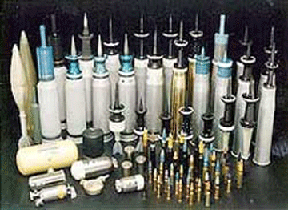 Uranium Weapons Still Making Money, Wreaking Havoc http://www.counterpunch.org/2014/05/15/uranium-weapons-still-making-money-wreaking-havoc/ by JOHN LAFORGE The US Army has awarded General Dynamics a $12 million contract to deconstruct and dispose of 78,000 depleted uranium anti-tank shells. The Pentagon’s May 6 announcement calls for “demilitarization” of the aging shells, as newer depleted uranium rounds are added to the US arsenal.
In the perpetually profitable business of war production, General Dynamics originally produced and sold some of the 120-millimeter anti-tank rounds to the Army. One of the richest weapons builders on earth, General Dynamics has 95,000 employees and sells its wares in 40 countries on six continents.
The International Coalition to Ban Uranium Weapons in Manchester, England, reports the armor-piercing shells to be disassembled are thought to be the large 105-millimeter and 120-millimeter anti-tank rounds. Depleted uranium, or DU, weapons are made of extremely dense uranium-238. More than 700,000 tons of DU has been left as waste in the US alone from the production of nuclear weapons and nuclear reactor fuel rods. The urankum-238 is left when fissionable uranium-235 is separated for H-bombs and reactor fuel. DU is only ‘depleted’ of this U-235. It is still a radioactive and toxic heavy metal. A tax and ecological liability, DU is given away free to weapons builders.
The Pentagon is replacing older DU shells in spite of international appeals for a moratorium on their use. The military is set to buy 2,500 large anti-tank rounds just this year at a cost of $30 million or over $10,000 each from Alliant Tech Systems, formerly of Minneapolis.
In 1991, during its 40-day, 1,000-sorties-per-day bombardment, between 300 and 800 tons of DU was blasted into Iraq by US forces. Another estimated 170 tons were used in the 2003 bombing and annexation. Toxic, radioactive contamination left from the use of these weapons (the DU burns and turns to dusty aerosol on impact) has been linked to the skyrocketing incidence of birth abnormalities in southern Iraq and to the Gulf War Syndrome among tens of thousands of US combat veterans.
After the US/NATO bombardment of Kosovo in 1999, our DU weapons were discovered to be spiked with plutonium and other isotopes. This news created a political uproar in Europe and led to the admission by the US Energy Department that “the entire US stock of depleted uranium was contaminated” with plutonium, americium, neptunium and technetium. United Nations investigators in Kosovo found sites hit with DU to be poisoned with all four isotopes. The Nation magazine reported that about 150,000 tons uranium-238 was dirtied with plutonium-239 and neptunium-237 and that “some apparently found its way to the Persian Gulf and Balkans battlefields.” (Robert Alvarez, “DU at Home,” The Nation, April 9, 2001, p. 24)
European papers shouting “Plutonium!” in headlines saw US and NATO officials rushing to microphones to claim with straight faces that their shells contained “mere traces of plutonium, not enough to cause harm,” and that the highly radioactive materials “were not relevant to soldiers’ health because of their minute quantities.” But plutonium is 200,000 times more radioactive than U-238 and ingesting less than 27 micrograms of plutonium-239 a millionth of an ounce — will cause lung cancer.
(One indication of just how poisonous these weapons are is that in 30 years of resisting nuclear weapons and the war system, the only ‘not guilty of trespass’ verdict I ever won from a jury followed a protest at Alliant Tech over its DU program. The jury agreed with four of us that since poison weapons are banned by the Geneva and Hague Conventions our action was an attempt at crime prevention.)
Long-term disposal plans for the uranium from 78,000 shells were not outlined by the Army. Uranium in the shells is often alloyed with titanium or molybdenum, and if these metals are not recycled, they could become part of our vast stockpile of DU, requiring indefinite storage as intermediate-level radioactive waste. Other parts of the munitions are currently disposed of as low-level rad’ waste in spite of the plutonium content.
Melting shells of the sea butterflies – a sign of global warming endangering oceans
 You Know the Ocean’s in Trouble When Your Shell Starts Melting http://www.enn.com/wildlife/article/47393 Things are getting really dicey for a little ocean creature called a pteropod. Better known as the “sea butterfly,” this delicate little sea snail is serving as an unfortunate bellwether of the deteriorating state of our oceans. Why? Conditions in the Antarctic ocean and along the West Coast of the U.S. have become so unnaturally acidic that the shells of sea butterflies are literally dissolving away.
“We did not expect to see pteropods being affected to this extent in our coastal region for several decades,” said Dr. William Peterson, an oceanographer at National Oceanic and Atmospheric Administration (NOAA)’s Northwest Fisheries Science Center, in a NOAA press release.
Damage that’s “several decades” early is a big alarm bell. We’d better pay close attention before it’s too late.
 What We’re Doing to Our Oceans
The chemistry of the world’s oceans is changing, thanks to the carbon dioxide humans continue to spew into our atmosphere. Oceans absorb between one quarter to one third of that carbon dioxide. Over time, it has turned the ocean from a slightly alkaline state to a bit more acidic.
According to some estimates, the ocean’s pH level 150 years ago was about 8.2. It’s now about 8.1. It may seem to be an infinitesimal shift, but it’s worse than it sounds. The more acidic the ocean gets, the harder it is for marine life like oysters, clams and corals to form calcium carbonite skeletons and shells.
In the case of pteropods, the increased acidity of the ocean is actually eating away at their shells.
“The first thing that happens is the dissolution of their shell,” NOAA’s Dr. Nina Bednarsek told PBS. “Dissolution can be mild, [to] very severe. Once you have it dissolving on the outside, you have to put so much more energy into the shell in order to maintain it. The energy that you would otherwise use for other important physiological maintenance you are putting in the shell maintenance.”
Researchers working off the coast of Oregon, Washington and California in 2011 discovered that over half of the sea butterflies they found onshore were victims of “severe dissolution damage.” Offshore, about 24 percent were damaged.
If we don’t change our ways, by 2050, researchers estimate that coastal waters will be 70 percent more acidic than they were in the pre-industrial era.
Continue reading at ENN affiliate, Care2.
Huge and worrying task of cleaning up Zion Nuclear Plant
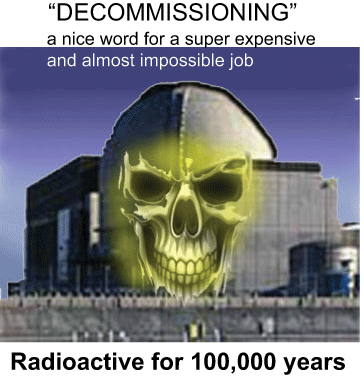 Decommissioning Of Zion Nuclear Plant Raises Safety Concerns ZION, Ill. (CBS) 15 May 14. — It’s the largest closing of a nuclear plant in the United States, and it’s right in our backyard. The most critical and dangerous part of the process at Zion is underway right now with the transfer of used nuclear fuel. CBS 2’s Jim Williams is the only local TV reporter allowed inside to see firsthand what’s going on and to get answers to concerns about safety in this original report. For us, it was a first: an interview right next to a worker holding a radiation detector………….
The plant stopped operating 16 years ago, but what was left behind is so toxic robots were brought in.
“You don’t want men in there using hand tools and torches,” said Sauger.
By train and truck, they’re shipping the less hazardous material to Texas, Tennessee and Utah where it will be buried.
Dan Pryor is the project manager. He described the less hazardous material as “filters, rags, mops; things that might have been in contact with radiated material and might be contaminated.”
But spent nuclear fuel that had been in this cooling pool is being placed in steel cylinders called casks and then encased in concrete. Dave Kraft of the Nuclear Energy Information Service said, “We call this the nuclear bowling alley,” because all 65 casks will end up together above ground next to the old plant.
Kraft fears they could be a prime target for terrorists in a plane.
“If you have a huge fire from a burning airliner for example, It’s going to affect everything around,” said Kraft.
Kraft and Paul Kakuris, of the Dunesland Preservation Society worry the casks could break open, releasing radiation across the Chicago area and poisoning the Lake.
“We are at risk here. This is the water supply for 20 million people,” said Kakuris………Today, the casks are surrounded by high fences and razor wire. Heavily armed security guards are everywhere there. Still, it’s not enough to satisfy the critics.
“You only get one chance to be wrong,” said Kraft.
Another safety concern is how will those steel and concrete casks hold up over time before a permanent storage site is created? The nuclear regulatory commission expects them to be replaced in 100 years. But, environmentalists fear those casks may wind up sitting there next to Lake Michigan for much longer than that. http://chicago.cbslocal.com/2014/05/14/decommissioning-of-zion-nuclear-plant-raises-safety-concerns/
Militarising the Pacific – “island people are better radiation test subjects than mice are”
In a 1956 Atomic Energy Commission meeting, Merril Eisenbud, director of the AEC Health and Safety Laboratory, described the Marshallese thus: “While it is true that these people do not live, I would say, the way Westerners do, civilized people, it is nevertheless also true that these people are more like us than the mice.”.

 The Militarized Pacific: An Anniversary Without End 14 May 2014 By Jon Letman, Truthout | Op-Ed March 1, the 60th anniversary of the Castle Bravo test – a nuclear detonation over a thousand times more powerful than the bomb that destroyed Hiroshima – has come and gone. Predictably, major decadal events, like a 15-megaton explosion over a Micronesian atoll, garner fleeting attention, but it’s all the days between the anniversaries that tell the real story of those who live with the impacts.
For the people of the Marshall Islands, where Enewetak, Bikini and neighboring atolls were irradiated and rendered uninhabitable by 67 nuclear tests between 1946 and 1958, the brief anniversary recognition only underscores what little attention the Marshallese and, in a broader sense, millions of peoples of the Asia-Pacific are given by the US government and public……..
places like the US-backed naval base being built on South Korea’s Jeju island and the enormous military testing and training ranges in the Northern Mariana Islands (larger than much of the western United States) receive almost no attention. Names like Pagan, Rongelap and Kwajalein are scarcely known in the country that uses these islands for its own military testing……..
increased levels and types of cancers in the Marshall Islands, based on National Cancer Institute (NCI) research and firsthand accounts by Marshallese, are the result of nuclear testing. Continue reading
Lawmakers press for stronger safety regulations for spent nuclear fuel rods
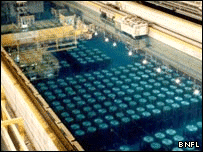 Bills would beef up safety regs for spent nuclear fuel http://thehill.com/regulation/205962-bills-would-beef-up-safety-regs-for-spent-nuclear-fuel By Benjamin Goad – 05/13/14 Lawmakers are pressing to bolster regulations for spent nuclear fuel, contending that pools left to languish for decades at decommissioning plants could prove disastrous in the event of an accident or terrorist attack.
Sens. Barbara Boxer (D-Calif.), Ed Markey (D-Mass.) and Bernie Sanders (I-Vt.) on Tuesday introduced a trio of bills meant to tighten safety and security at plants winding down operations around the country.
“Experts agree that a spent fuel pool accident could have consequences that are every bit as bad as an accident at an operating reactor,” Markey said.
Spent fuel can produce heat and radiation threats long after it is removed from a nuclear reactor’s electricity generating operation. Too dangerous to ship away from the plant altogether for as long as seven years, the spent fuel is left in pools at the plants.
A leak — whether due to accident or attack — could lead to fire and widespread contamination, the lawmakers said, citing various reports. Yet current Nuclear Regulatory Commission (NRC) rules allow for spent fuel to remain in the pools until the reactor completes decommissioning, which can take as long as 60 years, they said.
The Safe and Secure Decommissioning Act of 2014 would bar the NRC from exempting reactor licensees from any safety or security requirements at decommissioning plants until all fuel stored at the site is transferred into safer dry casks.
The lawmakers contend that the NRC has granted every exemption request it has ever received from decommissioning reactors, despite the agency’s own determination that an earthquake could result in a devastating breach. The Dry Cask Storage Act of 2014 is designed to force nuclear reactor operators to adhere to an NRC-approved plan for the transfer of spent fuel to dry cask storage within 7 years of the time the plant’s decommissioning plan is submitted.
Under the lawmakers’ Nuclear Plant Decommissioning Act of 2014, states and local communities would be guaranteed a meaningful role in the preparation of decommissioning plans for retired nuclear plants.
The legislation would require the NRC to publicly approve or reject every proposed decommissioning plan.
“Every state with a nuclear power plant has a strong interest in how that plant is decommissioned,” Sanders said. “This is about making sure that states and local communities can play a meaningful role in a decision.”
Concern about oversight of San Onofre Nuclear Decommissioning
Del Mar Councilman To Testify At Senate Hearing On Nuclear Power Plant Decommissioning http://www.kpbs.org/news/2014/may/12/del-mar-councilman-testifies-senate-hearing-decomm/, May 12, 2014 By Alison St John U.S. Sen. Barbara Boxer, chairwoman of the Committee on Environment and Public Works, will convene a hearing Wednesday morning in Washington D.C., to look at the challenges of decommissioning nuclear reactors nationwide.
One of the five panelists called to testify is Del Mar City Councilman Don Mosier. Mosier, a biologist at the Scripps Research Institute, said he has concerns about continuing to store 4,000 tons of radioactive waste at San Onofre. The plant, 50 miles north of San Diego, was shut down in 2013 after a small radioactive leak was discovered in the steam generators in 2012.
“When the reactors were closed, we hoped that some of the safety concerns about San Onofre would be diminished,” Mosier said, “but I actually think they’re increased because of the lack of planning for storing all this radioactivity.“
Mosier said he has questions about the spent fuel pools and dry cask storage at San Onofre that were not designed for the kind of “high burn-up” fuel that will be stored there. High burn-up fuel (HBF ) is hotter and more radioactive than previously used fuel rods.
Mosier said the Nuclear Regulatory Commission that oversaw San Onofre when it was in operation, does not have the same level of regulatory authority over the decommissioning process.
“I feel in the absence of federal oversight, one of the things I am going to argue for is more state and local control of the decommissioning process,” Mosier said.
A Citizens’ Engagement Committee set up by Edison, the company that operates San Onofre, is not the independent oversight Mosier hopes to see.
Other panel members at Wednesday’s Senate hearing include Michael Weber, NRC deputy director for waste compliance programs, and Geoffrey Fettus of the Natural Resources Defense Council.
Waste Isolation Pilot Plant radioactive leak due to kitty litter?
Nuclear expert says kitty litter contributed to radiation leak at WIPP Current Argus News, By Zack Ponce, 13 May 14 zponce@currentargus.com CARLSBAD >> A change in the type of “kitty litter” that’s mixed with transuranic waste may be to blame for February’s radiation leak at the Waste Isolation Pilot Plant. A scientist who worked at WIPP until 2010 says he believes a change from non-organic kitty litter to organic litter caused a chemical reaction inside a waste drum, releasing the radioactive isotopes.
WIPP announced Monday night that photos taken over the weekend showed evidence of melted plastic and rubber on 55-gallon drums, indicating that the production of heat likely occurred in the underground area where waste is stored, according to a news release.
Jim Conca, who worked with WIPP from 2000 to 2010, said last week he believes a chemical reaction involving the kitty litter caused a small explosion inside a waste drum. New Mexico Environment Department Secretary Ryan Flynn confirmed on Monday that he has heard Department of Energy officials discuss the possibility that kitty litter may have been to blame for the radiation leak. Flynn said it is just one of many theories the DOE is exploring and nothing is certain at this time.
WIPP Recovery Manager Jim Blankenhorn said during last week’s town hall meeting that officials believe the radiation leak was likely caused by nuclear waste that contained nitrate salt which gave off some sort of chemical reaction. Blankenhorn said a switch from a non-organic substance to organic was what triggered the event. According to Conca, the unidentified substance containing elements mirroring nitrate salt is kitty litter.
Under WIPP’s congressional mandate, the nuclear waste disposal facility located 26 miles east of Carlsbad cannot accept any liquid waste, and therefore kitty litter is used as a preventative measure to absorb any remnants of liquid before the drums are sealed and shipped to Southeastern New Mexico, Conca said……… http://www.currentargus.com/carlsbad-news/ci_25750452/doe-examining-possibility-kitty-litter-contributed-radiation-leak
Political opposition to Miami Nuclear Plant
Tallahassee Rep. To Oppose Miami Nuclear Plant Expansionhttp://news.wjct.org/post/tallahassee-rep-oppose-miami-nuclear-plant-expansion By JESSICA PALOMBO May 13, 2014 A Tallahassee lawmaker and a South Florida mayor are planning to ask Florida Gov. Rick Scott to stop the expansion of a Miami nuclear power plant. Scott and his cabinet will hear from Florida Power and Light Tuesday about its plans to add reactors to its Turkey Point plant.
Florida Power and Light’s proposal includes two new nuclear reactors and 89 miles of transmission wires to stretch across nearby towns. The wires are a sticking point for Pinecrest Mayor Cindy Lerner. Lerner is slated to attend the meeting alongside state Rep. Michelle Rehwinkel Vasilinda (D-Tallahassee), who says an expansion of nuclear power has statewide implications.
“What’s really happening is we’re pushing out the desire and need for other innovations and for other renewable energy answers,” she says.
Vasilinda has unsuccessfully sponsored bills repealing power companies’ ability to charge customers for nuclear plants that are never built, as happened recently in Levy County. And she says she’s concerned about the safety of all nuclear reactors as sea levels continue rising.
Right wing attack on Colorado Clean Energy Standard fails in court
 Court Slaps Down Right Wing Attack On Colorado Clean Energy Standard http://thinkprogress.org/climate/2014/05/13/3437403/right-wing-attack-on-colorado-res-slapped-down-by-court/ BY TOM KENWORTHY
 ON MAY 13, 2014 COLORADO’S RENEWABLE ENERGY STANDARD, ONE OF THE MOST AMBITIOUS IN THE U.S., HAS THE DISTINCTION OF BEING APPROVED NOT JUST BY THE STATE LEGISLATURE BUT ALSO BY VOTERS IN A STATEWIDE REFERENDUM.
Now it’s been approved in the courts.
In a decision that could have implications for other renewable energy requirements under attack by the fossil fueled right wing, a U.S. District Court judge has upheld Colorado’s RES. Judge William J. Martinez flatly rejected arguments by the Energy and Environment Legal Institute that Colorado’s RES violated the Commerce Clause of the U.S. Constitution. Martinez granted summary judgment to the three defendants in the case, all commissioners of the state’s Public Utilities Commission.
In a news release responding to the decision, EarthJustice — which represented environmental groups which intervened in the case — said the decision will have implications beyond Colorado because renewable standards in some of the 30 other states that have them are “under legal attack by the fossil fuel industry and its supporters.”
Michael Hiatt, an EarthJustice attorney, said in an interview there have been a number of cases attacking clean energy and climate change efforts that have been rooted in Commerce Clause arguments and that the Colorado decision is important in beating back that line of legal attack. “It confirms that states do have the authority to mandate the use of renewables,” he said.
The Colorado case dates to 2011 when plaintiff Energy and Environment Legal Institute was known as the American Tradition Institute (ATI), a longtime opponent of mainstream climate science and clean energy. ATI had a partner organization called the American Tradition Partnership. According to theInstitute for Southern Studies the groups have ties to fossil fuel interests including the Koch brothers.
According to SourceWatch, ATI or its employees have been involved in campaign finance violations in Montana, in suing the University of Virginia to obtain access to the emails of climatologist Michael Mann, and in an effort to build a nationwide movement against wind power.
Colorado voters approved the state’s first RES in 2004, which required large investor-owned utilities to get 10 percent of their power from renewable sources. The state legislature has twice improved upon that first requirement, and those large utilities must now get 30 percent of their power from renewable sources by the year 2020. Municipal utilities and large rural electric co-ops must meet less stringent standards.
Dramatic rise in cancers, infant mortality near Diablo Canyon power plant
 Study: Nuclear Reactors Are Toxic to Surrounding Areas, Especially With Age 11 March 2014 By Candice Bernd, Truthout | Report A study released tlast week shows that public health in the communities surrounding California’s Diablo Canyon power plant in San Luis Obispo County declined dramatically after the plant was built. The findings also document the presence of Strontium-90 in baby teeth.
Is the baby tooth under your child’s pillow radioactive? It could be if you live relatively close to a nuclear power plant that has been operating normally and in accordance with federal regulations, according to a new study.
The study, released last week by the Santa Barbara-based think tank World Business Academy for its Safe Energy Project, found that public health indicators such as infant mortality rates and cancer incidence in surrounding areas rose dramatically after Pacific Gas and Electric’s (PG&E) two nuclear reactors at the Diablo Canyon power plant began operations in 1984 and 1985.
“This should be a concern for any nuclear reactor and its health risks, whether it’s been operating for a day or 30 or 40 years because these reactors create over 100 cancer-causing chemicals; much of it is stored as waste at the plant, but a portion of it is released into the environment and gets into human bodies through the food chain,” said Joseph Mangano, who authored the study. He is the executive director of the nonprofit Radiation and Public Health Project (RPHP).
The findings also document the presence of the radioactive isotope Strontium-90 in baby teeth, showing that the Strontium-90 levels in 50 baby teeth collected mostly from San Luis Obispo County, but also from Santa Barbara County, which is downwind from the Diablo Canyon plant, was 30.8 percent higher than the levels found in the 88 baby teeth from the rest of the state. Continue reading
USA follows Russia in a massive nuclear weapons drill
 The US Is Conducting A Massive Nuclear Arms Drill Days After A Russian Nuclear Exercise Business Insider Australia, JEREMY BENDER 13 May 14 The B-2 stealth bomber is taking part in Exercise Global Lightning 14.
U.S. Strategic Command will be conducting a massive “deter and detect” nuclear drill from May 12 to May 16, just four days after a similar Russian exercise. The U.S. drill, known as Exercise Global Lightning 14, is set to include ten B-52s and six B-2 bombers in an attempt to demonstrate U.S. military flexibility and responsiveness.
The drill, which is meant to simulate a scenario in which the U.S. would have to protect itself and its allies in the event of a “strategic attack,” is being touted as a chance to incorporate modern technology into U.S. drills…….http://www.businessinsider.com.au/us-conducting-a-massive-nuclear-arms-drill-2014-5
1 This Month
23-25 October – on Zoom – World BEYOND War’s annual global conferenc


Shut down the radiation-damaged Heysham nuclear reactors now
To see nuclear-related stories in greater depth and intensity – go to https://nuclearinformation.wordpress.com

Say No to NASA’s Reckless Nuclear Reactor on the Moon
Say No to NASA’s Reckless Nuclear Reactor on the Moon
-
Archives
- October 2026 (170)
- September 2026 (339)
- August 2026 (330)
- July 2026 (355)
- June 2026 (287)
- May 2026 (306)
- April 2026 (356)
- March 2026 (251)
- February 2026 (267)
- January 2026 (308)
- December 2025 (358)
- November 2025 (359)
-
Categories
- 1
- 1 NUCLEAR ISSUES
- business and costs
- climate change
- culture and arts
- ENERGY
- environment
- health
- history
- indigenous issues
- Legal
- marketing of nuclear
- media
- opposition to nuclear
- PERSONAL STORIES
- politics
- politics international
- Religion and ethics
- safety
- secrets,lies and civil liberties
- spinbuster
- technology
- Uranium
- wastes
- weapons and war
- Women
- 2 WORLD
- ACTION
- AFRICA
- Atrocities
- AUSTRALIA
- Christina's notes
- Christina's themes
- culture and arts
- Events
- Fuk 2022
- Fuk 2023
- Fukushima 2017
- Fukushima 2018
- fukushima 2019
- Fukushima 2020
- Fukushima 2021
- general
- global warming
- Humour (God we need it)
- Nuclear
- RARE EARTHS
- Reference
- resources – print
- Resources -audiovicual
- Weekly Newsletter
- World
- World Nuclear
- YouTube
-
RSS
Entries RSS
Comments RSS

