Court clears anti nuclear nun of sabotage conviction
 Nun’s sabotage conviction for nuclear facility break-in overturned by court http://www.theguardian.com/us-news/2015/may/08/nun-sister-megan-rice-nuclear-facility-tennessee-sabotage-overturned Second ruling, for injuring government property, upheld after Sister Megan Rice and two fellow activists broke into Tennessee uranium storage facility in 2012 An appeals court has overturned the sabotage convictions of an 85-year-old nun and two fellow peace activists who broke into a facility storing much of this country’s bomb-grade uranium and painted slogans and splashed blood on the walls.
In a 2-1 opinion issued on Friday, a panel of the sixth US circuit court of appeals overturned the most serious conviction against Sister Megan Rice, 66-year-old Michael Walli and 59-year-old Greg Boertje-Obed. The court upheld a conviction for injuring government property.
On 28 July 2012, the activists cut through several fences at the Y-12 national security complex in Oak Ridge to reach the uranium storage bunker. Once there, they hung banners, prayed and hammered on the outside wall of the bunker to symbolize a Bible passage that refers to the end of war: “They will beat their swords into ploughshares.”
At issue was whether the nonviolent protest injured national security. The majority opinion of the appeals court found that it did not. “If a defendant blew up a building used to manufacture components for nuclear weapons … the government surely could demonstrate an adverse effect on the nation’s ability to attack or defend … But vague platitudes about a facility’s ‘crucial role in the national defense’ are not enough to convict a defendant of sabotage,” the opinion says.
Rice is serving a sentence of just under three years. Walli and Boertje-Obed are each serving sentences of just over five years.
Defendant’s attorney Bill Quigley said he hopes they will be re-sentenced to time served and released from prison.
The US attorney’s office for the eastern district of Tennessee did not immediately comment on the ruling Friday.
FUKUSHIMA BREAKING NEWS; on V DAY SISTER MEGAN RICE, GREG AND MICHAEL. convictions over turned
USA’s wasteful and useless nuclear missiles
The inescapable fact is that the Minuteman III today is a missile without a mission whose continued operational deployment represents neither sound military doctrine nor responsible fiscal policy
Missiles Without a Mission, Irascible Musings, 8 May 15 Retired General James Cartwright, who led U.S. Strategic Command, responsible for America’s strategic nuclear forces, from 2004 until 2007, recently articulated in an interview that in order to safeguard American Minuteman III intercontinental ballistic missiles (ICBMs) from the threat of cyber-attack, the United States should “de-alert” them, taking them “off-line” so that rather than being prepared to be launched at a moment’s notice, it would take 24 to 72 hours to get the missiles ready for operation……………
The Minuteman missile was once a critical component of a so-called nuclear Triad composed of land-based ICBMs, nuclear-armed bombers, and submarine-launched ballistic missiles. The value of the Minuteman III to the Triad today centers on the fact that any potential enemy would have to employ hundreds, if not thousands, of nuclear weapons to neutralize it – in short, the Minuteman III exists to serve as a nuclear sump in a world where the risk of massive nuclear attack is slim to none. It is this sort of mind-numbing reality that has led to professional atrophy within the ranks of the US Air Force personnel who man the Minuteman III launch control centers, resulting in flagging morale, lax accountability and cheating scandals.
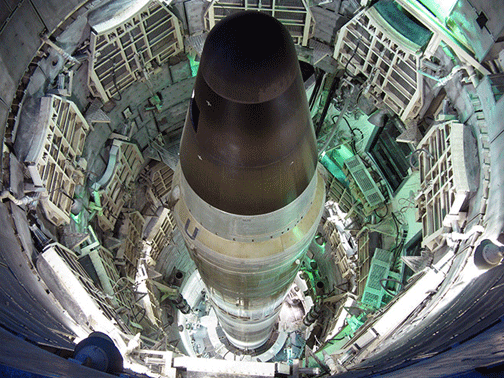
Nuclear deterrence today is not what it was thirty years ago. Continue reading
USA spending $60 Mln on Multilateral Nuclear Environmental Program in Russia (MNEPR)
 US to Spend $60 Mln on Russian Nuclear Security Despite Sanctions http://sputniknews.com/us/20150508/1021898724.html The United States Department of Energy might spend over $60 million on nuclear security activities in Russia.
The DOE National Nuclear Security Administration (NNSA) “has budgeted the funds to be spent this year through an international organization called the Multilateral Nuclear Environmental Program in Russia (MNEPR),” news website read, citing administration sources. NNSA spokesperson Derrick Robinson did not reject this information and said that US-Russian dialogue on nuclear security issues plays a great role in diminishing the level of nuclear terrorism threat.
He added that the United States has worked with Russia for a long time in order to stop the spread of weapons of mass destruction.
The United States and the European Union, as well as some other Western nations, have accused Moscow of escalating the crisis in Ukraine, and imposed economic sanctions on Russia to exert a change in Kremlin policy. Moscow r
Former DOE and NRC employee tried to sell nuclear secrets
Former US government employee tried to steal nuclear weapons secrets http://www.smh.com.au/world/former-us-government-employee-tried-to-steal-nuclear-weapons-secrets-20150508-ggxrwc.html May 9, 2015 Lisa Lambe The US Justice Department has charged a former government employee for allegedly trying to steal nuclear secrets through email attacks and sell them to China. .
According to an indictment , Charles Eccleston allegedly attempted the “spear-phishing” attack in January targeting dozens of email accounts, which he believed would unleash a virus to collect sensitive information on nuclear weapons.
Eccleston, a former employee at the Department of Energy and the Nuclear Regulatory Commission, has lived in the Philippines since 2011 after being fired in 2010.
He was caught in a sting by the Federal Bureau of Investigation after he approached a foreign embassy about providing classified US information.
Undercover FBI employees then posed as foreigners and promised to pay for the spear-fishing attack, according to the Justice Department.
The indictment did not identify the country Eccleston allegedly approached, but The Washington Post has reported that it was China.
A Justice Department spokesman declined to identify the country.
Eccleston drew on his past career to draw up email lists and compose the text of an innocuous-seeming invitation to a conference that he sent to 80 Energy Department employees, according to the indictment.
Spear-fishing involves convincing an email recipient to click on a link in a message that then releases a virus and Eccleston believed the code he included in the invitation would both damage computers and extract information. But the link had been provided by an undercover agent, who ensured it would not infect recipients’ machines, according to the indictment.
Eccleston, 62, was detained on March 27 and deported to the United States. The first hearing on the indictment is scheduled for May 20.He was charged with four felony offences, including crimes involving unauthorised access of computers and wire fraud. For the wire fraud charge, Eccleston faces a maximum sentence of 20 years.
Another shutdown at Oyster Creek Nuclear Plant
he NRC ’s performance indicator for unplanned scrams for each 7,000 hours of operation changes from green to white if a nuclear plant has more than three unplanned shutdowns. Oyster Creek crossed the green/white threshold on July 11, 2014, when the plant had a fourth unplanned shutdown, the NRC has said.
The new “modern” nuclear arms race between USA and Russia
 Russia and the US are racing to modernize their nuclear forces http://www.businessinsider.com.au/russia-and-the-us-are-racing-modernize-their-nuclear-forces-2015-5 JEREMY BENDER The Kremlin has embarked on a process to update all of its nuclear warheads and launch systems.
The modernization effort will affect all of Russia’s strategic and nonstrategic nuclear weapons — a total of 4,500 warheads, the Bulletin of Atomic Scientists reports. The modernization process includes the replacement of Soviet-era intercontinental ballistic missiles (ICBMs) with new rocket launch systems.
Also included in the modernization push is the development and launch of an upgraded Borei-class ballistic missile submarine. Within the coming decade, Moscow plans to replace two older ballistic missile submarine classes with the newly updated Borei. The new variant will feature improved electronics, among other modifications.
Russia is not alone in wanting to upgrade its nuclear forces. The US also wants to modernize its nuclear weapons and launch platforms with the express aim of making its arsenal more efficient without having to acquire new warheads.
“[W]hile we haven’t deployed major new strategic systems in some time, we’ve been modernising the ones we’ve got more or less continuously — new rocket motors and guidance systems for the Minuteman missiles, lots of rebuilt parts for the B-52s, etc., etc.,” Matthew Bunn, a nuclear proliferation expert at Harvard, told Politifact.
In total, the US modernization plans are estimated to cost a total of $US348 billion over the coming decade,accordingto estimates from the Congressional Budget Office.
However, the total bill could rise to as much as $US1 trillion over the following three decades thanks to upkeep costs, a report from the James Martin Center for Nonproliferation Studiesestimates.
This process of modernization is triggering what John Mecklin, the editor of The Bulletin of Atomic Scientists, calls a “different kind of arms race.”
“It’s one in which technological advance is the race,” Mecklin told the BBC. “Nuclear countries are trying to make sure that the other nuclear countries don’t get some sort of technological edge.”
This modernization drive has no resulted in matching efforts within the US and Russia. Just as Russia is modernising its arsenal of ICBMs and ballistic missile submarines, the US is also replacing its nuclear triad with new missiles, submarines, and a next-generation bomber.
Moves to solve Ukrainian crisis undermined by USA’s Senate Armed Services Committee

 How the Senate Armed Services Committee is Undermining Minsk II, Helen Caldicott M.D. by Ricky Onsman on May 6, 2015 By James Carden, The Nation, April 30, 2015
On April 28 three European foreign ministers—Serbia’s Ivica Dačić, Germany’s Frank-Walter Steinmeier and Switzerland’s Didier Burkhalter—met in their capacities as members of the OSCE’s Ministerial Troika to discuss the latest developments in eastern Ukraine. According to the OSCE, the foreign ministers “reiterated that [the Ukraine] crisis can be resolved only through peaceful means and that the political process in that regard should be advanced without delay” and “called on all sides to fully and unconditionally respect the cease-fire.”
Meanwhile, on April 26, Financial Times reported that Kiev is coming under increased pressure from Western European capitals to do its part to implement the Minsk cease-fire agreement. According to FT, German diplomats expressed frustration that Kiev is “dragging its feet” in implementing the agreement. For his part, French President Françl;ois Holland has warned Ukrainian President Petro Poroshenko that “the only line of conduct is the full implementation of the Minsk accord.”
Yet it seems these calls for a peaceful solution to the crisis are not only falling on deaf ears, but are also purposefully being undermined, in Washington.
To wit: the same day the aforementioned troika met in Belgrade, the 28th, the Senate Armed Services Committee held a hearing on “United States Security Policy in Europe,” though perhaps, given the tenor of the hearing, it should have been held under the rubric “The Russians are Coming!”
Armed Services Committee Chairman, Senator John McCain (R-AZ), got right to the point, running down a list of Russia’s sins—real and imagined. He derided the Obama administration’s “so-called reset” policy and warned of Mr. Putin’s “neo-imperial objectives.” McCain accused Russia of violating the Minsk II cease-fire agreement and hectored NATO allies to follow the example of Poland and Estonia and increase its defense expenditures. Unbelievably, McCain closed his remarks by telling the gallery, which included a visiting delegation of Ukrainian parliamentarians, that “none of us wants to return to the Cold War.”
Depressingly, there seemed to be little daylight between McCain and the committee’s ranking member, Senator Jack Reed (D-RI). Both he and McCain have called on President Obama to “provide defense lethal assistance” to Ukraine. Only Senators Angus King (I-ME) and Joe Manchin (D-WV) expressed any skepticism towards the idea of sending lethal aid to Ukraine. The situation that pertains in the Washington of 2015, is in stark contrast to the previous Cold War. Today, it would seem, Democrats and Republicans are engaged in a contest of who can ‘out-hawk’ the other on Russia………..
it is hard, given the tenor of the policy discussion on Capitol Hill over the past week, to escape the conclusion that President Obama is under intense pressure—not only from both political parties, but also, disturbingly, from the NATO supreme allied commander—to wade ever deeper into the Ukrainian morass.
Originally published at http://www.thenation.com/article/205921/how-senate-armed-services-committee-undermining-minsk-ii http://www.helencaldicott.com/how-the-senate-armed-services-committee-is-undermining-minsk-ii/
US Senate passes Bill to give Congress a stake in nuclear deal with Iran
S enate Passes Bill to Review Iran Nuclear Deal Maya Rhodan @m_rhodan TIME, 7 May 15 Bill to give Congress oversight of the nuclear plan passes Senate
Republicans and some Democrats in Congress have been pushing for oversight of the pending deal given that current proposals include relief from some of the sanctions placed on Iran by Congress. The bill that passed Thursday requires that Congress be able to review and possibly reject any deal the U.S. and world powers make with Iran regarding nuclear weapons. If Congress approves of the deal — or fails to disapprove within a certain timeframe — the President’s deal can move forward……
While the debate continues, however, some lawmakers have signaled their support for the President’s negotiations with Iran. In a letter first reported on by the Washington Post, 150 Democrats urged Obama to “stay on course” and commended the work of world powers so far in the process.
“The stakes are too great and the alternatives are too dire,” the letter reads. “If the United States were to abandon negotiations or cause their collapse, not only would we fail to peacefully prevent the nuclear-armed Iran, we would make that outcome more likely.”
The Washington Post reports that the letter could mean the President has enough Congressional support to override a veto should lawmakers vote to reject the deal once it is released in June. http://time.com/3850806/congress-iran-nuclear-deal/
Up to 592 Trillion Bq of Plutonium equivalent involved in disaster at US nuclear dump
 Gov’t Analysis: Up to 592 Trillion Bq of Plutonium equivalent involved in disaster at US nuclear dump – Over 5,000 times amount in waste drum blamed for WIPP release — Official: “We thought for sure” there were multiple ruptured drums — “It actually was measured” in city many miles away (VIDEO) http://enenews.com/govt-analysis-592-trillion-becquerels-involved-release-nuclear-dump-5000-times-waste-drum-being-blamed-wipp-disaster-official-thought-sure-multiple-ruptures-actually-measured-city-many-miles-aw?utm_source=feedburner&utm_medium=email&utm_campaign=Feed%3A+ENENews+%28Energy+News%29
DOE Town Hall in Los Alamos on WIPP Leak Findings (mp3), Apr 23, 2015 (emphasis added):
- Question (at 1:43:15 in): So you’ve come up with an amount that you think was in the drum, and you’ve been able to forensically track that. The underground is pretty contaminated at this point, the walls are contaminated, the filters are contaminated — andit actually was measured in Carlsbad 30 miles away. So that’s a significant quantity of plutonium or other isotopes. How is that quantity matching with what is in the drum?
- Ted Wyka, US Dept. of Energy Chief Nuclear Safety Advisor and chairman of DOE’s Accident Investigation Board: You’re right, any release is obviously too much. We do have hundreds of surveys… We think we have a pretty good source term calculation to the extent that we need to identify it as one drum…
- Question: I don’t feel like that answers my question, which is of course is your job, right?… There’s so much plutonium, americium, or whatever those secret ingredients were, and now it’s spread all over in a layer and it’s leaked into the air — what is that quanity?…
- Wyka (at 1:49:15 in): Does that mean there’s no other sympathetic secondary releases from other drums? I can’t tell you that.
U.S. DOE Accident Investigation Board (AIB) Report Phase 2, Radiological Release at WIPP(pdf), Apr 2015: The inventory in drum 68660 [was] 2.84 PE-Ci [plutonium equivalent curies]… Source terms initially released in Panel 7 Room 7 [is estimated at] 2 to 10 PE-Ci.
Savannah River National Laboratory WIPP Source Term Attribution Analysis (pdf), Aug 2014:
> ESTIMATES OF TOTAL INVENTORY OF ACTIVITY INVOLVED
- Source Term (ST) = MAR [Material at Risk] x DR [Damage Ratio] x ARF [Airborne Release Fraction] x RF [Respirable Fraction]
- Assume a 2 Ci release from Room 7 based on assessment from previous slide
- Bounding Case 1… MAR = ST / (DR x ARF x RF) = 2 Ci / 0.5 x 0.0005 x 0.5 = 16,000 Ci[592,000,000,000,000 becquerels]
- Bounding Case 2… MAR = ST / (DR x ARF x RF) = 2 Ci / 0.5 x 0.01 x 1.0 = 400 Ci
Note the AIB reports the total inventory of activity in drum 68660 was 2.84 Ci. SRNL’s estimate of total inventory of activity involved was 400-16,000 Ci (141-5,634 times drum 68660 inventory).
This may explain Wyka’s statement at the Carlsbad town hall, “We went in thinking there’s another drum…We thought for sure we’d see something. Most of the analysis team thought so.”
Growing community opposition to nuclear waste repository near Kincardine

 More communities expected to join fight to stop nuclear waste repository near Kincardine http://www.theobserver.ca/2015/05/07/more-communities-expected-to-join-fight-to-stop-nuclear-waste-repository-near-kincardine A federal review panel’s ‘praising’ endorsement of Ontario’s largest electricity generator and its proposed nuclear waste repository speaks volumes about the state of the regulatory world, says Sarnia Mayor Mike Bradley.
“We expected (the proposal) to be approved with conditions,” he said Thursday. “What we didn’t expect was the glib and glossy language throughout the report praising OPG (Ontario Power Generation).
“One of the diseases that happens in the regulatory world is that the regulator often becomes a captain for the proponents and we see that with rail and other issues.”
In its decision released late Wednesday, the joint review panel found the proposed repository was “not likely to cause significant adverse environmental effects” if mitigation measures are implemented.
The deep geological repository is expected to house low-to-intermediate-level radioactive waste near Kincardine. It will be located only a kilometre away from Sarnia’s drinking water source.
Hundreds of Canadian and U.S. communities and environmentalists have been sounding the alarms over the plan, speaking at public hearings and contacting their elected representatives.
“I can’t argue the science,” said Bradley, who is a vocal opponent of the plan. “I’m not a scientist, but what we can argue is that there were no other locations looked at.”
He anticipates more support will come on board with the issue headed to the political sphere.

Environment Minister Leona Aglukkaq and the federal cabinet will decide whether to approve the project within the next 120 days.
“Since (2012), we’ve had over 140 cities from both sides of the border, including Chicago, join the opposition and now I expect this is grow in these coming months,” Bradley said.
A spokesperson with the lobby group Stop the Great Lakes Nuclear Dump described the issue as an “intergenerational, non-partisan issue that affects millions of Canadians and Americans.”
“It is a decision that will affect the Great Lakes for the next 100,000 years,” Beverly Fernandez told The London Free Press. “The last place to bury and abandon radioactive nuclear waste is beside the largest supply of fresh water on the planet.”
But OPG official Jerry Keto told the newspaper Fernandez should “give some relevance and credit to the science behind this.”
“We’re very pleased with the results,” he said of the panel recommendation. “We’re very happy that we have the endorsement.” – With files from The London Free Press barbara.simpson@sunmedia.ca
C.A.N Coalition Against Nukes “TRITIUM TRUTHS” Campaign

“GOT A NUKE FACTORY IN YOUR BACKYARD?” ** (NO SAFE DOSE!!)
** TRITIUM LEAKS FOUND AT MANY NUKE SITES (Associated Press Investigative Report: http://www.ap.org/company/awards/part-ii-aging-nukes)
“BRACEVILLE, Ill. (AP) — Radioactive tritium has leaked from three-quarters of U.S. commercial nuclear power sites, often into groundwater from corroded, buried piping, an Associated Press investigation shows.
“The number and severity of the leaks has been escalating, even as federal regulators extend the licenses of more and more reactors across the nation.
“Tritium, which is a radioactive form of hydrogen, has leaked from at least 48 of 65 sites, according to U.S. Nuclear Regulatory Commission records reviewed as part of the AP’s yearlong examination of safety issues at aging nuclear power plants. Leaks from at least 37 of those facilities contained concentrations exceeding the federal drinking water standard — sometimes at hundreds of times the limit.
“While most leaks have been found within plant boundaries, some have migrated offsite. But none is known to have reached public water supplies.
“At three sites — two in Illinois and one in Minnesota — leaks have contaminated drinking wells of nearby homes, the records show, but not at levels violating the drinking water standard. At a fourth site, in New Jersey, tritium has leaked into an aquifer and a discharge canal feeding picturesque Barnegat Bay off the Atlantic Ocean. …” read full report here: http://www.ap.org/company/awards/part-ii-aging-nukes
(attached photo montage by Laura Lynch)
Source: http://coalitionagainstnukes.org/c-a-n-coalition-against-nukes-tritium-truths-campaign/
The nuclear decommissioning problem – a financial disaster looming
 the coming closures could drag on for decades and place unexpected burdens on investors, consumers or taxpayers.
The question is who will pay — for Humboldt Bay, and for dozens of other reactors that are in the process of closing or might soon.
 Nuclear operators like PG&E are supposed to lay up enough money to cover the costs, similar to how corporations fund pensions. Turns out, most haven’t.
PG&E’s Humboldt Bay trust fund, for instance, is currently $308 million short, according to a company filing to the U.S. Nuclear Regulatory Commission. PG&E customers will shoulder the cost in the form of higher electricity bills.
“Somebody’s got to pay for it — the money doesn’t come from magic,” said Allison M. Macfarlane, a former NRC chairman. Brittany McKannay, a PG&E spokeswoman, said the company is committed to operating and decommissioning its nuclear plants safely.
The U.S. nuclear industry is feeling its age. Once touted as a source of electricity that would be “too cheap to meter,” plants need expensive upgrades to protect them from terrorism and natural disasters.
At the same time, they face growing competition from renewables and natural gas. Five new reactors are under construction, but current economics give little incentive to build more. Looming is an unprecedented wave of closures.
Yet 82 of the 117 U.S. nuclear power plants, including seven in the process of shutting down, don’t have enough cash on hand to close safely, according to NRC records. And closing tends to cost more than operators expect. Based on NRC filings, the actual combined cost may be somewhere in the neighborhood of $100 billion — $43 billion more than the current balance of the trust funds.
So the coming closures could drag on for decades and place unexpected burdens on investors, consumers or taxpayers.
“The public has a right to demand that all nuclear power plant operators are secure in their funding,” Sen. Edward J. Markey, a Massachusetts Democrat on the Environment and Public Works Committee, said in a statement in response to questions from Bloomberg.
Among the underfunded plants are FirstEnergy Corp.’s Three Mile Island in Pennsylvania, site of the 1979 partial meltdown, and Entergy Corp.’s Indian Point, about 35 miles north of New York City……..http://www.japantimes.co.jp/news/2015/05/05/world/u-s-nuclear-dilemma-reactors-aging-decommissioning-cash-billions-short-permanent-waste-site-eludes/#.VUldaI6qpHw
Neuropathy in Navajo children almost certainly caused by uranium mining pollution
fragile communities continue to live amid the poisoned wells and contaminated earth, and the uranium riddled sagebrush flats are home for the next generation of Navajo children.
Abandoned Uranium Mines Plague Navajo Nation, Earth Island Journal BY SONIA LUOKKALA – MAY 5, 2015 Mining companies left behind a legacy of poisoned wells and contaminated earth
We are in Diné Bikéyah, land of the Navajo. “………The incidence of Navajo neuropathy is five times
higher on the western side of the Navajo reservation than on the eastern side. Some researchers believe this discrepancy is linked to the land: On the western side, the mines were mostly tunnels, whereas in the west they were primarily open pits. After the uranium companies left, the unfilled pits started to fill with water. Some, as deep as 130 feet, eventually formed into small lakes. Unsuspecting Navajos and their livestock use the contaminated water for drinking.
A 1990 study of Navajo neuropathy ruled out water contamination as a possible cause of the disease………As the Los Angeles Times also reported, in 1986, Thomas Payne an environmental health officer for Indian Health Services, along with a National Park Service ranger, took water samples at 48 sites surrounding Cameron, AZ, a town in Navajo Nation. These samples revealed uranium levels in wells as high as 139 picocuries per liter. In abandoned pits, the levels were as high as 4,024 pinocuries. The EPA limit for safe drinking water is 20 picocuries per liter. ….. Continue reading
in sum – cheaper, more easily available energy storage helps at the scale of the power grid, and also at the level of our homes, to further advantage cleaner, renewable energy. So if the economics of storage are finally starting to line up – and its business side to ramp up – that can only be good news for the planet.
 Tesla’s battery announcement shows the coming revolution in energy storage, Sydney Morning Herald May 2, 2015 Chris Mooney “……Tesla announced that it is offering a home battery product, which people can use to store energy from their solar panels or to back-up their homes against blackouts, and also larger scale versions that could perform similar roles for companies or even parts of the grid.
For homeowners, the Tesla Powerwall will have a power capacity of either 10 kilowatt hours or 7 kilowatt hours, at a cost of either $US3500 or $US3000………
Tesla isn’t the only company in the battery game, and whatever happens with Tesla, this market is expected to grow. A study by GTM Research and the Energy Storage Association earlier this year found that while storage remains relatively niche – the market was sized at just $US128 million in 2014 – it also grew 40 per cent last year, and three times as many installations are expected this year.
By 2019, GTM Research forecasts, the overall market will have reached a size of $US1.5 billion.
“The trend is more and more players being interested in the storage market,” says GTM Research’s Ravi Manghani. Tesla, he says, has two unique advantages – it is building a massive battery-making “gigafactory” which should drive down prices, and it is partnered with solar installer Solar City (Musk is Solar City’s chairman), which “gives Tesla access to a bigger pool of customers, both residential and commercial, who are looking to deploy storage with or without solar.”
The major upshot of more and cheaper batteries and much more widespread energy storage could, in the long term, be a true energy revolution – as well as a much greener planet. Here are just a few ways that storage can dramatically change – and green – the way we get power: Continue reading
Exelon has 60 years in which to remove Oyster Creek’s 650 metric tons of spent fuel
Oyster Creek: After 2019, what then?, asbury park press, Randy Bergmann, @appopinion10 May 3, 2015 For people who had lived in the shadow of the Oyster Creek nuclear power plant in Lacey for decades, the news in 2009 that it was to close 10 years earlier than allowed under its license extension was warmly welcomed. Finally, the health and safety threats posed by the plant would be coming to an end.
Well, not really — at least no time soon.
That “good news” has been tempered by the fact plant owner Exelon, which agreed to mothball the reactor in exchange for the state not requiring it to install cooling towers, has up to 60 years to remove the from its elevated spent fuel pool, totally dismantle the plant and clean up the site.
A Nuclear Regulatory Commission rule change in 2011 extended the period in which closed nuclear reactors were allowed to decommission from 30 years to 60 years. Although Exelon has yet to establish a timetable for when that will be done, the company’s president and CEO, Christopher Crane, has said it will be no sooner than 10 years, as stipulated in its agreement with the state, and up to 60 years.
In some ways, the risks posed by a closed plant that has yet to be decommissioned can be as great as one that continues to operate and is closely monitored by the NRC.
What are the odds of a disaster occurring at Oyster Creek? They’re remote. But given the nightmarish consequences of such a disaster occurring at a site around which 4.5 million people reside within a 50-mile radius, they’re not remote enough for citizens and the state to sit back and allow the Nuclear Regulatory Commission, which has a well-deserved reputation as an industry lapdog, to dictate the process every step of the way……..
What is the likelihood of another major nuclear disaster occurring in the future?Researchers Spencer Wheatley and Didier Sornette at ETH Zurich in Switzerland and Benjamin Sovacool at Aarhus University in Denmark last month calculated that there is a 50-50 chance a Chernobyl-like event or worse will occur in the next 27 years, a 50-50 chance another Fukushima event will take place within 50 years and a 50-50 chance a Three Mile Island-type event will take place within 10 years.
Long odds, for sure. But citizens and the state must do everything they can to ensure every step that can increase the margin of safety is taken.
Here are the top six reasons citizens, state and local officials and New Jersey’s federal representatives must pay close attention to the decommissioning of Oyster Creek:
1. The soonest the plant will be decommissioned under the agreement Exelon reached with the state to close the plant early is 2029. If Exelon chooses to close at the end of 60 years, Oyster Creek, the oldest commercial reactor in the nation, would be 110 years old…..
2. Oyster Creek is one of just three nuclear plants with the identical design of Fukushima I, which was the first of three units to melt down. ….
3. Keeping spent fuel in elevated spent fuel pools, as is the case with older plants like Oyster Creek and Fukushima, is believed by some critics to pose greater risks than spent fuel kept in dry casks.
Spent fuel contained in spent fuel pools is the leading cause for concern of those worried about the safety risks of plants that are closed but not fully decommissioned
4. No public participation or input by the state is required under NRC regulations in the development of a decommissioning plan….
5. It isn’t clear whether there will be sufficient funds to provide a safe dismantling of the plant when it is ultimately decommissioned…..
6. If an accident were to occur, the experience from superstorm Sandy demonstrated that the evacuation plan would not work…..
Five steps N.J. can take to improve safety margins………http://www.app.com/story/opinion/columnists/2015/05/01/oyster-creek-nuclear-reactor-decommissioning/26735703/
1 This Month
23-25 October – on Zoom – World BEYOND War’s annual global conference

To see nuclear-related stories in greater depth and intensity – go to https://nuclearinformation.wordpress.com
-
Archives
- October 2026 (149)
- September 2026 (339)
- August 2026 (330)
- July 2026 (355)
- June 2026 (287)
- May 2026 (306)
- April 2026 (356)
- March 2026 (251)
- February 2026 (267)
- January 2026 (308)
- December 2025 (358)
- November 2025 (359)
-
Categories
- 1
- 1 NUCLEAR ISSUES
- business and costs
- climate change
- culture and arts
- ENERGY
- environment
- health
- history
- indigenous issues
- Legal
- marketing of nuclear
- media
- opposition to nuclear
- PERSONAL STORIES
- politics
- politics international
- Religion and ethics
- safety
- secrets,lies and civil liberties
- spinbuster
- technology
- Uranium
- wastes
- weapons and war
- Women
- 2 WORLD
- ACTION
- AFRICA
- Atrocities
- AUSTRALIA
- Christina's notes
- Christina's themes
- culture and arts
- Events
- Fuk 2022
- Fuk 2023
- Fukushima 2017
- Fukushima 2018
- fukushima 2019
- Fukushima 2020
- Fukushima 2021
- general
- global warming
- Humour (God we need it)
- Nuclear
- RARE EARTHS
- Reference
- resources – print
- Resources -audiovicual
- Weekly Newsletter
- World
- World Nuclear
- YouTube
-
RSS
Entries RSS
Comments RSS

