Obama has given in to corporate lobby on the Trans Pacific Partnership
Scarier still is the part of the TPP that will give corporations the right to sue governments for lost profits. The proceedings will be conducted before secret corporate tribunals.
Foreshadowing nasty corporate suits are what is happening now in Australia, Egypt, and Germany.
Philip Morris, an American tobacco company, is suing Australia for prohibiting the sale of cigarettes to underaged smokers in that country.
 Why Obama Is Making the Mistake of Pushing the TPP (Trans-Pacific Partnership)
Michael E. Drake Democratic Perspectives on the corporate take- over of America, 15 May 15
He has convinced himself that American labor cannot compete with labor forces in the rest of the world, particularly in Asia. He said, “That ship has already sailed.” Obama has given up. He has given in to corporate interests who want things both ways for the sake of short term profit. Corporations, who recognize no international boundaries, insist on producing goods for the lowest possible cost in labor. That means, first of all, outsourcing and building factories in other countries. Secondly, they insist on this country importing those goods for sale here in the United States with no tariffs.
What has this way of doing business cost us already? Start with 60,000 factories in this country since the year 2000. Also disappearing is the millions of manufacturing jobs that went along with these factories. Then comes the gigantic trade deficit that we as a country has been running for decades. Lately, the trade deficit (the difference between what we sell to other countries and what other countries sell us) has been running around 50 billion dollars a month. Our wealth is flying out the door at an incredible rate, and we, suckers that we are, are left holding the bag. Congressman Alan Grayson of Florida has helped produce a short film which explains it all. I urge you to take a look at it…….
Now, in addition to the economic loss that has already occurred, our president is asking us to give away even more. He wants us to do it on a fast track in Congress, which means no real debate, no amendments, no changes whatsoever to an agreement negotiated by corporate executives and corporate lobbyists. Continue reading
Renewable energy racing ahead – nuclear power declining
It’ s harder to find real new about nuclear power, than it is for renewable energy. Renewable energy is the future, and this website should, theoretically, be following the excitinfg developments in both large and small-scale wind and solar developments.
However – it IS “nuclear-news” – so from now on, I’m concentrating on the more strictly “nuclear” issues, and just pointing to headlines and brief notes for that other topic – however tantalising its news:
 RENEWABLE ENERGY:
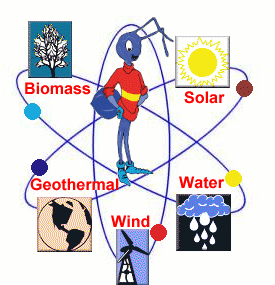
California’s Renewable Energy Plan Will Save $51 Billion a Year by Andrew Burger on Friday, May 15th, 2015 California’s new renewable energy target, proposed by Gov. Jerry Brown during his inaugural address in January, is not only achievable: It would result in as much as $51 billion in annual savings for the state’s residents, according to an analysis by Strategen Consulting that “quantifies the economic and societal impacts” of the governor’s proposed goals.
Ahead of schedule when it comes to meeting a current goal of sourcing 33 percent of electricity from renewable sources by 2020, Gov. Brown proposes raising the state’sRenewables Portfolio Standard (RPS) target up a big notch – to 50 percent by 2030…….http://www.triplepundit.com/2015/05/ca-govs-renewable-energy-plan-will-save-51b-year/
UK Renewable Energy Investment And Generation Surges In 2014, Clean Technica May 15th, 2015 by Joshua S Hill A new report shows that renewable energy investment in the United Kingdom hit a record high in 2014, with electricity generated from renewables increasing by 20% as well.
In fact, in 2014, not only did renewable energy investment hit a record of £10.7 billion, but renewable jobs increased by 9% as well…..http://cleantechnica.com/2015/05/15/uk-renewable-energy-investment-generation-surges-2014/
Renewable energy storage will end capacity payments Capacity payments and fossil energy can be made redundant by electric cars, writes Teodora Serafimova. The European Commission recognises the important role energy storage technologies will have to play in the future energy system, both in its Energy Security Strategy of May 2014 as well as in its more recent Energy Union strategy. Bellona has long been convinced of the necessity of energy storage in the face of a rapidly growing share of renewables in the energy mix. With such storage technology quickly materialising, notably from the electric car industry, it’s time to take stock of the changes this will bring.
Energy storage does not only hold the potential for us to make better use of renewable power, but in doing so it also allows us make less use of fossil power. Being less dependent on fossil power erodes the case for subsidies like capacity payments keeping this industry alive.
Energy storage technologies, such as compressed air storage and batteries, can store low-cost renewable energy when the system experiences oversupply, then release this energy to the grid when it is more needed, such as at night in the case of solar or when the output of wind power falls below demand.
In short, energy storage gives renewable energy the flexibility it currently lacks. ……http://www.euractiv.com/sections/transport/renewable-energy-storage-will-end-capacity-payments-314609
High radio frequency (RF) exposure – a health hazard requiring Radiation Warnings on Cell Phones
California City Will Vote on Requiring Radiation Warnings on Cell Phones http://time.com/3855722/radiation-warnings-cell-phones/ Victor Luckerson @VLuck May 12, 2015 Some scientists have called for further study about the impact of the radiation
The city council in Berkeley, Calif. will vote Tuesday on whether cell phones should come with a warning notice explaining the dangers of high radio frequency (RF) exposure. If the law is passed, retailers in the city would have to warn customers that carrying a phone in a pocket or bra while it is on and connected to a wireless network could expose the user to excessive RF radiation.
Cell phones emit radio frequency energy that can be absorbed by human tissue. There isn’t any conclusive evidence that this type of radiation causes cancer, but some scientists have called for further study into the issue. Cell phone makers such as Apple recommend keeping your cell phone at least 5 to 10 mm away from your body to avoid excessive RF exposure, but these warnings are often buried in phone manuals or deep in settings menus.
Lawmakers have attempted to institute similar ordinances in places such as Maine, Hawaii and New Mexico, but Berkeley would be the first place to actually pass such a law. In Berkeley, 82% of adults would like to know the recommended distance a phone should be kept from their bodies, according to a survey funded by the California Brain Tumor Association.
Sister Megan Rice Michael Walli, and Greg Boertje-Obed still in prison with no sentence at all
TNP attorneys file motion for immediate release https://transformnowplowshares.wordpress.com/2015/05/15/tnp-attorneys-file-motion-for-immediate-release/ BY TNPLOWSHARES ⋅ MAY 15, 2015
Everyone seemed to have the same question following the news that the Sixth Circuit Court of Appeals had thrown out the sabotage charge against Michael Walli, Megan Rice and Greg Boertje-Obed and vacated the sentences on both the sabotage and the depredation charges. The court noted if the three had been sentenced only on the depredation charge, according to the sentencing guidelines, they would likely have received shorter sentences and would have already served their full time. So the question of the day: When are they getting out?
A fair question—they now are being held in federal prison with no sentence at all.
Within days of the Sixth Circuit’s ruling, Judge Amul Thapar, who handled the original case, convened a conference call with the lawyers from both sides. He apparently told them he had not yet been assigned the case, but he wanted to set a schedule in case he was. The result was a July 8 date set for resentencing. (The Court’s decision to throw out the sabotage charge and vacate the sentences could be appealed by the prosecutor, a decision we are told would be made not in Knoxville, but in Washington; the feds have two weeks to file a notice of appeal, then as much as 90 days to actually file the appeal, after which the defense gets time to respond, and the feds get more time for a final response—you can see how this would drag out with Greg, Megan and Michael still in prison.
But the case resides still in the Sixth Circuit (Thapar, who is a federal judge in Lexington, KY, originally drew the case because the Knoxville court had a vacancy on the bench; the judge who had been assigned the case had retired; Thapar drew the reassignment. That empty seat in Knoxville has since been filled, so it is not absolutely certain that the case would be remanded to Thapar for re-sentencing.) So, long story short, attorneys for MGM filed a motion with the Sixth Circuit on Thursday, May 15, asking for immediate release.
The Sixth Circuit wasted no time. Within hours, it issued an order requiring the government to respond to the motion for immediate release by noon on Monday, May 18.
That is where things stand at this moment.
Here is a copy of the Defense Motion for Immediate Release:Def Motion for Immediate Release 5-14-15
Costs rise with more delays at Georgia Nuclear Plant
 Regulators: More Delays Possible for Georgia Nuclear Plant ATLANTA —abc news, May 13, 2015, By RAY HENRY Associated Press Regulators say there’s a “high probability” a nuclear plant under construction in Georgia will be delayed even longer than the three years already announced by its owners, according to an analysis obtained by The Associated Press.
Southern Co. subsidiary Georgia Power and its co-owners are building two more nuclear reactors at Plant Vogtle in eastern Georgia. A project using the same reactor design, Westinghouse Electric Co.’s AP1000, is underway at the Summer nuclear station in South Carolina, which has seen similar delays……..
Time is money in the nuclear power industry. The longer building a power plant takes, the more utility companies must pay in construction and borrowing costs. Ultimately, electric customers will pay for the plant’s costs unless regulators intervene. A single day of delay will cost Georgia Power roughly $2 million, according to estimates from regulators…….http://abcnews.go.com/US/wireStory/regulators-delays-georgia-nuclear-plant-31020059#.VVPN4Dd00rg.twitter
USA’s House of representatives passes bill for Congress to review Iran nuclear deal
House passes bill for Congress to review Iran nuclear deal Seattle Times, May 14, 2015 By DEB RIECHMANNT The Associated Press WASHINGTON (AP) — Congress on Thursday sent President Barack Obama a bill to give lawmakers the power to review and potentially reject a nuclear deal with Iran.
The House overwhelmingly passed the measure, 400-25, a reflection of lawmakers’ insistence on having a say in what could be a significant international accord to get Iran to curb its nuclear program in exchange for relief from economic sanctions.Getting a deal would enhance Obama’s foreign policy record, and while the GOP-led Congress doesn’t want to see a nuclear-armed Iran, they are skeptical about Iranian compliance and have demanded time to review the fine points of any agreement the White House reaches with Tehran.
Presidential spokesman Josh Earnest said again Thursday that Obama would sign the bill into law.Negotiators from the U.S. and five other nations are rushing to reach a deal with Tehran by the end of June. As the House voted, Obama met at the Camp David presidential retreat in Maryland with Arab leaders in hopes of convincing them that U.S. overtures to Iran would not come at the expense of commitments to their security in the region.
The Iran nuclear legislation would bar Obama from waiving congressional sanctions for at least 30 days while lawmakers examine any final deal. The bill would stipulate that if senators disapprove of the deal, Obama would lose his current power to waive certain economic penalties Congress has imposed on Iran.The bill, which was passed last week by the Senate on a 98-1 vote, would require Congress to pass a resolution of disapproval to reject the deal, an action that Obama almost certainly would veto. Congress then would have to muster votes from two-thirds of each chamber to override the veto.
Even if Congress rejects his final nuclear deal with Tehran, however, Obama could use his executive pen to offer a hefty portion of sanctions relief on his own. He could take unilateral actions that — when coupled with European and U.N. sanctions relief — would allow a deal to be implemented………..http://www.seattletimes.com/nation-world/house-passes-bill-for-congress-to-review-iran-nuclear-deal/
USA’s nuclear salesmen happy with Barack Obama’s trade deal with China
 Barack Obama’s nuclear deal with China, quiet submarines and the South China Sea, SMH, May 11, 2015 Steven Mufson “……….The deal would allow Beijing to buy more US-designed reactors and pursue a facility or the technology to reprocess plutonium from spent fuel. China would also be able to buy reactor coolant technology that experts say could be adapted to make its submarines quieter and more difficult to detect.
The formal notice initially did not draw any headlines. Its unheralded release on April 21 reflected the administration’s anxiety that it might alarm members of Congress and non-proliferation experts who fear China’s growing naval power – and the possibility of nuclear technology falling into the hands of third parties with nefarious intentions.
Now, however, Congress is turning its attention to the agreement. The Senate Foreign Relations Committee is set to hear from five Obama officials in a closed-door meeting on Monday to weigh the commercial, political and security implications of extending the accord. The private session will permit discussion of a classified addendum from the Director of National Intelligence analysing China’s nuclear export control system and what Mr Obama’s notification called its “interactions with other countries of proliferation concern”.
The White House’s willingness to push ahead with the nuclear accord with Beijing illustrates the evolving relationship between the world’s two largest powers, which, while eyeing each other with mutual suspicion and competitiveness, also view each other as vital economic and strategic global partners. The Nuclear Energy Institute, an industry trade group, argues that the new agreement will clear the way for US companies to sell dozens of nuclear reactors to China, the biggest nuclear power market in the world………..http://www.smh.com.au/world/barack-obamas-nuclear-deal-with-china-quiet-submarines-and-the-south-china-sea-20150511-ggyl25.html
Weapons proliferation and other risks in USA’s marketing of nuclear technology to China
US nuclear deal with China raises proliferation concerns, Guardian Steven Mufson 12 May 15
Critics of Obama agreement are worried about Beijing’s growing naval power “……..The deal would allow Beijing to buy more US-designed reactors and pursue a facility or the technology to reprocess plutonium from spent fuel. China would also be able to buy reactor coolant technology that experts say could be adapted to make its submarines quieter and harder to detect.
The formal notice’s unheralded release on 21 April reflected the administration’s anxiety that it might alarm members of Congress and nonproliferation experts who fear China’s growing naval power – and the possibility of nuclear technology falling into the hands of third parties with nefarious intentions.
Now, however, Congress is turning its attention to the agreement. The Senate foreign relations committee was set to hear from five Obama officials in a closed-door meeting on Monday to weigh the commercial, political and security implications of extending the accord. The private session permitted discussion of a classified addendum from the director of national intelligence analysing China’s nuclear export control system and what Obama’s notification called its “interactions with other countries of proliferation concern”.
The White House’s willingness to push ahead with the nuclear accord with Beijing illustrates the evolving relationship between the world’s two largest powers, which, while eyeing each other with mutual suspicion and competitiveness, also view each other as vital economic and strategic global partners. The Nuclear Energy Institute, an industry trade group, argues that the agreement will clear the way for US companies to sell dozens of nuclear reactors to China, the biggest nuclear power market in the world……..
The US has bilateral 123 agreements with 22 countries, plus Taiwan, for the peaceful use of nuclear power. Some countries that do not have such agreements, including Saudi Arabia, Jordan and Malaysia, have expressed interest in clearing obstacles to building nuclear reactors…………..
In December 2006, Westinghouse Electric — majority-owned by Toshiba — signed an agreement to sell its AP1000 reactors to China. Four are under construction, six more are planned, and the company hopes to sell 30 others, according to an April report from the Congressional Research Service.
When it comes to nuclear weapons proliferation, China is in a different category from other 123 agreement nations. It first tested a nuclear weapon in 1964 and now has an arsenal of about 250 nuclear warheads. So US concerns have focused more on whether China has transferred technology to other countries.
“Concerns persist about Chinese willingness as well as ability to detect and prevent illicit transfers,” the CRS report said. “Missile proliferation from Chinese entities is a continuing concern.” The US wants China to refrain from selling missiles capable of carrying nuclear weapons, a payload of 499kg, as far as 305km. A State Department compliance report in 2014 said that Chinese entities continued to supply missile programmes in “countries of concern”.
China has a pilot plant engaged in reprocessing in Jiu Quan, a remote desert town in Gansu province. Satellite photos show that it is next to a former military reprocessing plant, according to Frank von Hippel, a Princeton University physics professor who specialises in nuclear arms control. There is not even any fencing between the sites, he says. “That’s been one of the hang-ups of the (reprocessing) deal” that China has been trying to negotiate with France for several years, von Hippel said.
Sokolski said the agreement proposed by Obama lacks a requirement for explicit, case-by-case US permission for a reprocessing project using American technology or material from US reactors. It gives consent in advance. And he fears that over the 30-year life of the new 123 agreement, China might want to compete with Russian and US arsenals and make more bombs, for which plutonium is the optimal material…………http://www.theguardian.com/us-news/2015/may/12/us-china-nuclear-deal-proliferation-concerns
Elizabeth Warren makes a compelling case against the Trans-Pacific Partnership
 Sovereignty For International Investors (Trans-Pacific Partnership
  (TPP)) http://tm.durusau.net/ May 11th, 2015 Elizabeth Warren makes a compelling case against the Trans-Pacific Partnership in The Trans-Pacific Partnership clause everyone should oppose, where she says:
…
ISDS [Investor-State Dispute Settlement] would allow foreign companies to challenge U.S. laws — and potentially to pick up huge payouts from taxpayers — without ever stepping foot in a U.S. court. Here’s how it would work. Imagine that the United States bans a toxic chemical that is often added to gasoline because of its health and environmental consequences. If a foreign company that makes the toxic chemical opposes the law, it would normally have to challenge it in a U.S. court. But with ISDS, the company could skip the U.S. courts and go before an international panel of arbitrators. If the company won, the ruling couldn’t be challenged in U.S. courts, and the arbitration panel could require American taxpayers to cough up millions — and even billions — of dollars in damages.If that seems shocking, buckle your seat belt. ISDS could lead to gigantic fines, but it wouldn’t employ independent judges.Instead, highly paid corporate lawyers would go back and forth between representing corporations one day and sitting in judgment the next. Maybe that makes sense in an arbitration between two corporations, but not in cases between corporations and governments. If you’re a lawyer looking to maintain or attract high-paying corporate clients, how likely are you to rule against those corporations when it’s your turn in the judge’s seat?
…
The use of ISDS is on the rise around the globe. From 1959 to 2002, there were fewer than 100 ISDS claims worldwide. But in 2012 alone, there were 58 cases. Recent cases include a French company that sued Egypt because Egypt raised its minimum wage, a Swedish company that sued Germany because Germany decided to phase out nuclear power after Japan’s Fukushima disaster, and a Dutch company that sued the Czech Republic because the Czechs didn’t bail out a bank that the company partially owned. U.S. corporations have also gotten in on the action: Philip Morris is trying to use ISDS to stop Uruguay from implementing new tobacco regulations intended to cut smoking rates.
…
I understand Senator Warren’s focus on the United States, but it diverts her from a darker issue raised by the TPP.
The TPP gives international investors sovereignty equivalent to national governments. Continue reading
Alarm in New York following explosion at Indian Point Power Plant
New York Nuclear Scare After Explosion at Indian Point Power Plant New Yorkers contemplated the pros and cons of nuclear energy again Sunday after an explosion at Indian Point nuclear power plant in Westchester. By: Hana Levi Julian, Jewish Press May 10th, 2015 “….The Indian Point nuclear power plant that provides 25 percent of the electric juice for the Big Apple and Westchester County went into “emergency response” late Saturday afternoon.
Billows of black smoke rose into the sky over the Indian Point nuclear power plant near Buchanan, New York.
A transformer failed, causing an explosion that ripped through the non-nuclear side of the plant.
The blaze was just 200 yards away from the building in which the reactor was located.
Firefighters who rushed to the scene were able to extinguish the flames, Entergy spokesperson Jerry Nappi told CNN, adding that one of the plant’s two reactor units automatically shut down.
No one was injured in the fire and there was “no threat to the public safety at any time. All Indian Point emergency systems worked as designed,” the facility said in a tweet.
But the fire had to be extinguished twice, because the flames re-ignited. Even so, the fire was out within half an hour.
Governor Andrew Cuomo received a briefing on site and told reporters, “These situations we take very seriously. This is a nuclear powered plant; it’s nothing to be trifled with.”http://www.jewishpress.com/news/breaking-news/new-york-nuclear-scare-after-explosion-at-indian-point-power-plant/2015/05/10/
Hudson River oil slick caused by nuclear plant fire
Governor says nuclear plant fire produced Hudson River oil slick; 1 reactor remains shut BUCHANAN, N.Y. (AP) 11 May 15— Part of a nuclear power plant remained offline Sunday after a transformer fire created another problem: thousands of gallons of oil leaking into the Hudson River.
At an afternoon briefing, New York Gov. Andrew Cuomo said emergency crews were out on the water near Buchanan trying to contain and clean up the transformer fluid that leaked from Indian Point 3.
“There’s no doubt that oil was discharged into the Hudson River,” Cuomo said. “Exactly how much, we don’t know.”
The transformer at the plant about 30 miles north of midtown Manhattan failed on Saturday evening, causing a fire that forced the automatic shutdown.
Oil in the transformer seeped into a holding tank that did not have the capacity to contain all the fluid, which then entered river waters through a discharge drain……..
A spokesman for the Nuclear Regulatory Commission said several thousand gallons of oil may have overflowed the transformer moat.
The reactor itself was deemed safe and stable throughout, said a spokesman for owner Entergy Corp. The plant’s adjacent Unit 2 reactor was not affected and remained in operation………
The environmental watchdog group Riverkeeper issued a statement Sunday saying the latest Indian Point accident proves that the plant should be closed for good.http://www.usnews.com/news/us/articles/2015/05/10/transformer-fire-shuts-down-part-of-indian-point-power-plant
100 per cent renewable energy plan for Apple
Apple wants to run on 100 per cent renewable energy, improve supply chain’s greenness, Manufacturers Monthly 12 May, 2015 Apple has announced plans to run its entire business in China through renewable energy, and to make its supply chain more environmentally friendly.
In a statement released yesterday, CEO Tim Cook said greening manufacturing operations would take years, but would be worth the effort.
“We are excited to work with leaders in our supply chain who want to be on the cutting edge of China’s green transformation,” said Cook…….
According to Apple, 87 per cent of its US operations worldwide are powered through renewable energy, and wants this to reach 100 per cent.
According to the company, 100 per cent of its US operations and all of its data centers are run by renewable power.
It launched its first solar project in Sichuan Province three weeks ago.
Entergy’s Arkansas nuclear plant requires highest level of inspection oversight from NRC
Nuclear One earns worst rating Entergy’s Russellville plant in line for intense inspections, Arkansas Online, 10 May 15 By David Smith Arkansas Nuclear One has the worst performance rating out of all 100 nuclear power plants in the country, the federal Nuclear Regulatory Commission says.
The power plant is the only one in the country in the “column four” category of the commission’s rating of overall plant performance. The column four designation means the plant gets the highest level of inspection oversight from the commission.
Column one power plants require the fewest inspections. Plants in column five aren’t permitted to operate, the commission said.
It is rare for a plant to be in column four, said Victor Dricks, a spokesman for the commission.
“Sometimes there are one or even two plants in column four,” Dricks said. “It generally takes several years of very concerted effort on the part of a nuclear power plant operator to address issues and then be returned to column one.”
No nuclear plant has ever been placed in column five, Dricks said.
Representatives from the NRC and Entergy Arkansas will discuss the plant’s “significant decline in performance” at a meeting Tuesday in Russellville. The plant’s two nuclear reactors account for about 61 percent of the electricity that Entergy Arkansas generates in a year.
The public meeting at Lakepoint Conference Center, 61 Lake Point Lane near the nuclear plant, begins at 6 p.m.
Arkansas Nuclear One has received two findings of “substantial safety significance” that pushed its performance rating down into column four.
The first was filed in June last year in connection with the March 2013 handling of a 1 million-pound turbine stator, which fell 30 feet while it was being moved by a contractor, killing of one worker and injuring eight others. The accident occurred in a non-nuclear part of the plant.
The second finding, filed in January, is related to the 2013 accident. It involved Entergy’s failure to design, construct and maintain the seals that protect safety-related equipment in the emergency diesel fuel storage building from flooding.
When the stator fell, it damaged a water main, Dricks said. “The fire pump started and discharged thousands of gallons of water into the turbine building,” Dricks said. “There are floor seals that should prevent the water from flowing down into an auxiliary building. But the seals were defective, so water flowed into areas where it shouldn’t have been.”
Commission inspectors later discovered there were more than 100 unsealed conduits that allowed the water into the auxiliary building, Dricks said.
“They also found some degraded hatches,” Dricks said.
The cumulative effect of these two violations moved the plant into column four, the commission said……..http://www.arkansasonline.com/news/2015/may/10/nuclear-one-earns-worst-rating-20150510/?f=business
US follows Hong-Kong and Taiwan to restrict food imports from Japan over radionuclide contamination concern
US restricts food import from Japan over radionuclide contamination concern
The United States has recently tightened restriction of food import from Japan. According to Import Alert 99-33 issued by US FDA, a list of Japanese food will be banned unless they pass physical examination, which includes milk, butter, milk-based infant formula, and other milk products; vegetables and vegetable products; rice and whole grain; fish; meat and poultry; venus clam; sea urchin; yuzu fruit; Kiwi fruit. FAD indicates that revision to this import alert is due to radionuclide contamination.
FDA says it will continue consultation with Japanese government to ensure products from the affected prefectures do not pose a health risk to US consumers. FDA will continue monitoring the public health risks due to radionuclide contamination, and when appropriate will remove the Import Alert and resume routine coverage of entries.
http://en.people.cn/n/2015/0509/c98649-8889831.html
My comments
What is interesting, and what should be also interesting to the American people is that it is China which publishes this article about the US import Alert 99-33 issued by US FDA last April 2015 whereas up to now I have not seen it published/posted by any US media nor website.
What is also interesting, is it took the Japanese contaminated food repeatedly found in Taiwan and Hong-Kong in last March and April , and well published in the chinese media and websites, for finally the US FDA to wake up after 4 years of lethargy to take some action.
If things are getting too hot with exports from Tohoku and Kanto contaminated regions to the US, Japan will change the origin adress of their products as being from Kansai, Chubu, Chugoku, Shikoku and Kyushu regions…With adequate paperwork, good credible certificates of origin, it will not pass under contamination control, and business will continue as usual.
Or they will mix a highly contaminated product from one area with a lesser contaminated product from another area, so as to lower the contamination level to become acceptable to the level of acceptable threshold of the US, as they are already doing inside Japan with rice.
Regarding imports the US FDA mostly relies on the certificates of origin, not questioning the veracity of the data provided on those certificates, and very seldom monitor the contamination level of all incoming food stocks, only once in a blue moon at random.
Corruption is the big problem in USA government and corporations
 America’s Main Problem: Corruption The Daily Sheeple, – Government corruption has become rampant: Washington’s Blog May 8th, 2015
- Senior SEC employees spent up to 8 hours a day surfing porn sites instead of cracking down on financial crimes
- Nuclear Regulatory Commission workers watch porn instead of cracking down on unsafe conditions at nuclear plants
- An EPA employee who downloaded 7,000 porn files, then spent 2-6 hours each workday watching porn. He’s been doing it for years … but the EPA never fired him. Another EPA employee harassed 16 women co-workers … and then was promoted to a higher-paying job with more responsibility, where he harassed more women
1 This Month
15 October. Joint Appeal for Nuclear Abolition Day -presentation to the UN on October 15 will be live on UNWebTV
Endorse the Nuclear Abolition Day Appeal
23-25 October – on Zoom – World BEYOND War’s annual global conference

To see nuclear-related stories in greater depth and intensity – go to https://nuclearinformation.wordpress.com
-
Archives
- October 2026 (149)
- September 2026 (339)
- August 2026 (330)
- July 2026 (355)
- June 2026 (287)
- May 2026 (306)
- April 2026 (356)
- March 2026 (251)
- February 2026 (267)
- January 2026 (308)
- December 2025 (358)
- November 2025 (359)
-
Categories
- 1
- 1 NUCLEAR ISSUES
- business and costs
- climate change
- culture and arts
- ENERGY
- environment
- health
- history
- indigenous issues
- Legal
- marketing of nuclear
- media
- opposition to nuclear
- PERSONAL STORIES
- politics
- politics international
- Religion and ethics
- safety
- secrets,lies and civil liberties
- spinbuster
- technology
- Uranium
- wastes
- weapons and war
- Women
- 2 WORLD
- ACTION
- AFRICA
- Atrocities
- AUSTRALIA
- Christina's notes
- Christina's themes
- culture and arts
- Events
- Fuk 2022
- Fuk 2023
- Fukushima 2017
- Fukushima 2018
- fukushima 2019
- Fukushima 2020
- Fukushima 2021
- general
- global warming
- Humour (God we need it)
- Nuclear
- RARE EARTHS
- Reference
- resources – print
- Resources -audiovicual
- Weekly Newsletter
- World
- World Nuclear
- YouTube
-
RSS
Entries RSS
Comments RSS

