Renewable energy – 60% of new USA electricity capacity
 US Large-Scale Renewables Account For More Than 60% Of New Capacity http://cleantechnica.com/2015/10/28/us-renewables-account-60-new-capacity/
by Joshua S Hill
New figures reveal that US utility-scale renewable energy projects accounted for more than 60% of new energy capacity installed throughout the first three quarters of 2015. In new figures released by the US Federal Energy Regulatory Commission (FERC) in its monthly Energy Infrastructure Update (PDF), it was revealed that renewable energy sources — including biomass, geothermal, hydropower, solar, and wind — accounted for 60.20% of the total 7,276 MW of new electrical generation installed in the US during the first 9 months of 2015.
Wind alone made up 40.76% of all new capacity so far this year, with 2,966 MW of new generating capacity spread out over 26 new projects.
Second, among renewable energy technologies, was utility-scale solar, with 1,137 MW over 142 projects. Biomass was third, with 205 MW spread over 16 projects; geothermal steam fourth, with a 45 MW project; and hydropower fifth, with 27 MW across 18 projects.
“With Congress and numerous states now questioning the ability of renewable energy sources to meet targets called for in the Administration’s new Clean Power Plan (CPP), the explosive growth of wind, solar, biomass, hydropower, and geothermal in recent years confirms that it can be done,” noted Ken Bossong, Executive Director of the SUN DAY Campaign. “In fact, the latest FERC data suggest that the CPP’s goals are unduly modest and renewables will handily surpass them.”
Wind dominated even in the month of September alone, with 3 projects (or units, as FERC labels them) totalling 448 MW.
The three projects that came online during September were the 211 MW Rattlesnake Den Wind project, located in Glasscock County, in Texas; the 211 MW Logans Gap Wind project, located in Comanche County, Texas; and the smaller 25.6 MW Saddleback Ridge Wind Phase 2 Expansion Project, located in Franklin County, Maine.
USA environmental groups demand changes to Trans Pacific Partnership
They demanded that the enforcement mechanisms be strong and meaningful and that the rights of foreign investors to challenge domestic environmental laws be struck out.
Several green groups outline demands for Pacific trade pact, The Hill,
By Timothy Cama and Vicki Needham – 10/29/15 More than a dozen environmental and conservation groups on Thursday laid out eight pages of demands that they say lawmakers must use to judge the strength of the Trans-Pacific Partnership (TPP) trade agreement.
The groups, led by the Sierra Club, are sending a letter to members of Congress well in advance of an expected vote on the sweeping Asia-Pacific deal that was completed nearly a month ago with 11 other nations, according to the document first obtained by The Hill. The groups are urging a “no” vote on the 12-nation deal if the TPP doesn’t address their concerns.

The letter is a last-ditch effort from environmentalists, who feel that significant parts of what they demanded in TPP were not incorporated into the deal, despite the Obama administration’s efforts to highlight protections for wildlife and conservation.
The White House has said it would release the TPP text within 30 days of TPP’s conclusion, a deadline that is fast approaching.
But a vote on the TPP isn’t expected until at least early next year. Once the text is released there will be a 60-day period before President Obama can sign the deal, which covers 40 percent of global growth. …..
The greens’ demands are meant to allay their concerns about the agreement, chiefly that it would give foreign corporations too much power to challenge U.S. environmental protections and that international trade of fossil fuels would be greatly increased.
Negotiators included a chapter in the agreement to protect the environment, but as the detailed text of the pact has not been released publicly and only outlines have, greens said they cannot fully judge if their concerns have been met.
“The environment chapter should be judged by whether its provisions are strong enough to have a meaningful impact on the ground in TPP countries and whether the obligations will be enforced,” the groups wrote in their Thursday letter.
“We are also concerned that any potential benefits of the environment chapter will be overwhelmed by the negative impacts of other provisions in the pact,” they said, referring to their concerns about the agreement’s provisions on foreign investment, plant and animal food safety and coherence to regulations, among other pieces.
Green groups’ initial reaction to the agreement has been very negative, aligning with how environmentalists generally view free-trade agreements.
“The Trans-Pacific Partnership would empower big polluters to challenge climate and environmental safeguards in private trade courts and would expand trade in dangerous fossil fuels that would increase fracking and imperil our climate,” Sierra Club Executive Director Michael Brune said in a statement when the initial details were released in October.
“The TPP’s environment chapter might look nice on the surface but will be hollow on the inside, and history gives us no reason to believe that TPP rules on conservation challenges such as the illegal timber or wildlife trade will ever be enforced,” he said…..
They demanded that the enforcement mechanisms be strong and meaningful and that the rights of foreign investors to challenge domestic environmental laws be struck out.
Additionally, the groups want the agreement to avoid invalidating current United States rules on subjects like restricting exports of fossil fuels, product labeling or environmental protections. http://thehill.com/policy/finance/258539-greens-outline-demands-for-pacific-trade-pact
Campaign is launched against dangerous nuclear waste transport

 Stop Fukushima Freeways Campaign Kicks Off http://yubanet.com/usa/Stop-Fukushima-Freeways-Campaign-Kicks-Off.php#.Vi_lUdIrLGg
New Map shows DC AREA would be a Corridor for Extremely Dangerous Radioactive Nuclear Waste Shipments By: Nuclear Information & Resource Service (NIRS) Washington, DC October 27, 2015 – Over 250 intensely radioactive nuclear waste shipments would cross through the Washington DC metropolitan area and thousands more would travel across the roads, rails and waterways of the nation, if plans for the country’s first, and scientifically indefensible, nuclear waste repository in Nevada move forward. Today, Nuclear Information and Resource Service released maps of the likely routes radioactive shipments would use, joining dozens of environmental and clean energy groups across the country. The groups want residents to weigh in with Congress and decision makers about the dangers.
According to the map, highly radioactive waste fuel from nuclear power reactors in Virginia and Maryland would pass through the DC area on railroad tracks next to Metro Rail trains, including passing though Union Station. Each shipment contains several times more radioactive material than the Hiroshima bomb blast released, with 20 to 50 tons of irradiated fuel assemblies in each canister. Department of Energy studies completed in the 1990s confirmed that accidents in transporting the waste to Yucca Mountain would be a certainty, due to the large number of shipments that would be required. The shipments would also be vulnerable to attack or sabotage along the hundreds or thousands of miles that each cask would travel.
“The DC area is not ready for mass transportation of nuclear waste—we can barely handle severe weather conditions” said Diane D’Arrigo of Nuclear Information and Resource Service (NIRS). “First responders are not trained or equipped for high level radioactive waste accidents and a shipping campaign of this magnitude is unprecedented. We have all witnessed horrible oil train derailments and explosions in recent months. An accident involving tons of nuclear waste in Washington, DC could force thousands of people to evacuate their homes, schools, and businesses and radioactively-contaminate dozens of square miles,” D’Arrigo reported.
Some in Congress want to force a nuclear waste dump to open in Nevada, over President Obama’s and the state’s objections as well as that of the Western Shoshone Nation. The president has defunded the proposed Yucca Mountain repository since 2010, effectively abandoning the controversial project, while Nevada is certain that the site is not suitable for storing nuclear waste and opposes the project. Nevada controls land and water rights the federal government would need to complete the project. To overcome that obstacle, Congress would need to enact a law overriding the state’s rights. Doing so would then open the door for the nuclear waste shipments to begin.
“Congress should stop wasting time and money on Yucca Mountain which should have been disqualified long ago for its technical inability to isolate nuclear waste,” said Tim Judson, NIRS Executive Director. “It is unconscionable to risk the lives of DC area residents transporting nuclear waste through our neighborhoods and railways just to dump it at Yucca Mountain, where we know it will leak anyway. We need real isolation of nuclear waste, and we are never going to get there until Congress officially cancels Yucca Mountain and moves on. Until then, the waste can be stored more securely where it is now, without putting it on our roads, rails and waterways, traveling through our communities,” concluded Judson.
NIRS is calling on Mayor Bowser and Governors McAuliffe and Hogan to oppose Yucca Mountain and prevent transportation of nuclear waste until there is a scientifically proven, environmentally sound, and socially responsible long-term management plan. The nuclear waste problem can never truly be resolved until nuclear power plants are permanently shut down and stop generating radioactive material. New reactors would only exacerbate the problem: more dump sites would need to be created, and the transportation of lethal atomic waste would have to continue indefinitely.
Large-scale nuclear waste transport would also occur if, as some in Congress advocate, a “centralized interim storage” site for high-level radioactive waste were created. In that case, the waste would either have to move twice (once to the interim site, and then to a permanent site), thus doubling the risks or the “interim” site would become a de facto permanent waste dump–without going through the necessary scientific characterization.
Anxiety over transport of dangerous radioactive trash
both Nevada residents and a host of anti-nuclear groups in states along the likely routes have opposed the plan, saying a mistake is inevitable in the transport of so much fuel, estimated by the Tennessee Environmental Council at 20 tons to 50 tons of irradiated fuel in each canister.
 Radioactive waste could be transported through Chattanooga, anti-nuclear group says http://www.timesfreepress.com/news/local/story/2015/oct/27/radioactive-waste-could-be-transported-through-chattanooga-anti-nuclear-group-says/332775/ {incl maps) The Tennessee Environmental Council, an anti-nuclear watchdog group, says that Chattanooga is a likely waystation for the transport of nuclear waste on its way to Nevada.
A map released by the group shows that radioactive waste from 30 nuclear reactors would pass through Tennessee by rail, each shipment containing more radioactive material than the Hiroshima bomb blast.
Chattanooga would likely see shipments from the Sequoyah nuclear plant pass through on its way south and west, while fuel from the Watts Bar plant would likely be transported north. Other shipments coming from Georgia and beyond could be transported through Chattanooga on its way to Nashville.
Nashville would see far more traffic, the group said, with waste from 21 reactors in 6 states passing through the city’s Radnor Yard. Under a plan that has been in the works for many years, but that has faced stiff opposition from many groups, nuclear fuel that is piling up at plants across the nation would be transported to a more secure facility in Nevada, dubbed Yucca Mountain. The facility, which is buried deep underground, would offer a safer storage option for the dangerous waste, which remains radioactive for thousands of years, officials say.
But both Nevada residents and a host of anti-nuclear groups in states along the likely routes have opposed the plan, saying a mistake is inevitable in the transport of so much fuel, estimated by the Tennessee Environmental Council at 20 tons to 50 tons of irradiated fuel in each canister.
The likely routes to be used to transport the fuel would be “vulnerable to attack or sabotage along the hundreds or thousands of miles that each cask would travel,” the group warned in a news release.
But some on Congress worry that the danger is just as great, if not greater, when nuclear fuel is sitting in storage piles at dozens of sites across the U.S., each of which must be secured separately. Though U.S. President Barrack Obama has defunded the Yucca Mountain site, some lawmakers have proposed overriding objections by Nevada and others in order to store the fuel underground in a central repository. The Tennessee Environmental Council also questioned whether first responders along the routes to Nevada have been trained to handle a “rad waste” accident, which could pose similar or worse hazards than recent derailments of oil trains, or trains carrying dangerous chemicals. To generate support in their efforts to stop nuclear power, the group has coined the routes “Fukushima Freeways,” a reference to a nuclear plant in Japan that exploded after a Tsunami knocked out its power supply.
According to a data sheet supplied by Nevada officials, Tennessee would ship an estimated 2,663 of the large casks by rail, and Georgia would ship another 1,672, with Alabama shipping a further 1,514 casks.
New TVA Nuclear Station has old, possibly unsafe, design
 Concern Over Old Design of New TVA Nuclear Plant Public News Service – TN | October 2015 | Download audio SPRING CITY, Tenn. – A Tennessee nuclear reactor more than 40 years in the making now has its operating license from the U.S. Nuclear Regulatory Commission (NRC), and will soon begin producing electricity for Tennessee Valley Authority (TVA) customers. But environmental advocates say the Watts Bar 2 Reactor 50 miles northeast of Chattanooga is without modern safety features that would protect residents and the environment in the event of a natural disaster. Sara Barczak, high-risk energy choices program director with the Southern Alliance for Clean Energy, says while the NRC will continue extensive safety reviews, the license is cause for concern.
All too many failures in nuclear power pipelines
Nuclear Pipe Nightmares, UCS Dave Lochbaum, director, Nuclear Safety Project October 27, 2015 Disaster by Design
If you had a dollar for every foot of pipe—or even just a quarter for every three inches of pipe—used in the nation’s nuclear power plants, you would probably not be reading this post. That chore would be delegated to one or more of your many minions.
Pipes at nuclear power plants carry cooling water to the reactor vessel and spent fuel pool, transport steam to the main turbine, provide hydrogen gas to cool the main generators, supply fuel and lubricating oil to the emergency diesel generators, maintain the fire sprinklers ready to extinguish fires, and numerous other vital functions. Given so many pipes, a success rate of 99.99%—remarkably similar to a failure rate of one broken pipe out of ten thousand pipes—would result in lots of piping failures.
The Electric Power Research Institute’s report revealed lots of piping failures at U.S. nuclear power plants between 1961 and 1997 (Fig. 1). The non-leaking failures are identified by inspections indicating that safety margins had been compromised, forcing the pipes to be replaced before they leak. The leaking failures are identified by puddles on the floor or other obvious signs, again forcing pipes to be replaced.
[excellent charts on original]
The Electric Power Research Institute’s report identified numerous reasons why pipes break (Fig. 2). MIC under corrosion stands for microbiologically induced corrosion—tiny little bugs that eat metal. Pipes can be designed wrong, installed wrong, or weakened via an array of methods during use.
[article goes on to describe pipe failures at:]
Dresden Nuclear Plant
Fission Stories #65 described the January 25, 1994, …..
Browns Ferry Nuclear Plant
On August 14, 1984…..
Surry Nuclear Plant
On December 9, 1986,….
Mihama Nuclear Plant
A 22-inch diameter pipe in the condensate/feedwater system ruptured on August 9, 2004, at the Mihama nuclear plant in Japan …..
Oyster Creek and Dresden Nuclear Plants
LaSalle Nuclear Plant
On May 27, 1985…..
Oyster Creek Nuclear Plant
Fission Stories #29 described how 133,000 gallons drained from the condensate storage tank at the Oyster Creek nuclear plant in New Jersey in September 1996…..
Davis Besse Nuclear Plant
Fission Stories #131 described the March 2002 discovery by workers at the Davis-Besse nuclear plant in Ohio that a crack in a pipe allowing a control rod inside the reactor vessel to be connected to and manipulated by its electric motor outside the vessel had been leaking cooling water from the reactor for as long as six years……
Byron Nuclear Plant
On October 19, 2007, workers brushing away rust on the outer surface of a cooling water pipe at the Byron nuclear plant in Illinois poked a hole in it……
Big Rock Point Nuclear Plant
The NRC described a broken pipe at the Big Rock Point nuclear plant in their annual report to the U.S. Congress on abnormal occurrences in 1998…….
Safety by Intent
The table above from the Electric Power Research Institute indicates that 1,816 failures were identified by testing and inspection at U.S. nuclear power plants between 1961 and 1997 while 2,247 failures were found after pipes had leaked.
This data reinforce a theme too often appearing in nuclear safety posts to our All Things Nuclear blog—testing and inspection efforts are less effective than they need to be. Afederal regulation requires that plant owners have extensive testing and inspection programs that find and fix safety problems in a timely and effective manner. If compliance with this regulation were fact rather than fiction, the data should show more piping failures are found via tests and inspections than by puddles on the floor.
The NRC must figure out why testing and inspection efforts are violating federal safety regulations by failing to find and fix piping failures in a timely and effective manner. http://allthingsnuclear.org/nuclear-pipe-nightmares/
Radioactive trash burning underground near major USA city
 “Nuclear fire” erupts at radioactive facility near major US city — Footage shows underground explosions, massive smoke plumes — AP: “Unknown amount of radioactive waste burned” — EPA sends emergency radiological team — Residents: “We were flat out lied to… Why didn’t they evacuate the town?” (VIDEO) http://enenews.com/nuclear-fire-erupts-radioactive-dump-100-miles-major-city-footage-shows-underground-explosions-massive-smoke-plumes-ap-unknown-amount-radioactive-waste-burned-epa-sends-radiological-emergency?utm_source=feedburner&utm_medium=email&utm_campaign=Feed%3A+ENENews+%28Energy+News%29
CBS Las Vegas, Oct 22, 2015 (emphasis added): Government officials are still looking into what may have caused a low-level radiological storage facility [~100 miles outside Las Vegas] to go up in flames… “We didn’t even hear about it when it happened, according to Cindy Craig, a resident. “We weren’t even get told about it until the next day.”
Las Vegas Review-Journal, Oct 21, 2015: Carol Johnston, owner of KC’s Outpost [in Beatty, Nevada]… said she was serving customers on a patio Sunday when she “heard a big boom” then looked up and saw a big puff of smoke. “Why didn’t they evacuate the town then?” she asked in a telephone interview Wednesday.
CBS Las Vegas, Oct 22, 2015: In the 40-second cellphone video… you can see the explosion in the shooting from the ground causing massive plumes of smoke. The explosion caused the facility to go up in flames. State officials said the fire started inone of 22 covered trenches used to store low-level radioactive material…
AP, Oct 19, 2015: EPA said the unknown amount of low-level radioactive waste that burned had been deposited… before 1992… [USGS previously] found high concentrations of radionuclides underground, the Nuclear Resource and Information Service said.
Las Vegas Review-Journal, Oct 22, 2015: Fire Marshal Chief Peter Mulvihill said [it] “burned very hot“… Items buried in the low-level nuclear waste dump include… nuclear reactor crud…
AP, Oct 21, 2015: Mulvihill said the fire burned unabated after starting Sunday during intense thunderstorms and flash flooding… Now, first-responders have backed off while investigators locate archived paperwork to determine what was buried in the burned trench… [I]ncident managers initially feared about 2,000 people in the sprawling rural area would need to be evacuated if radiation had been detected. Mulvihill told reporters that all but two employees left the… facility adjacent to the radioactive waste dump…
Las Vegas Review-Journal, Oct 20, 2015: “We don’t know exactly what caught fire. We’re not exactly sure what was burning in that pit,” Fire Marshal Chief Peter Mulvihill said… “there was some energetic burning” that blew a hole in the cover soil that caps trench No. 14, where low-level radioactive materials were buried.
AP, Oct 19, 2015: [EPA] is sending a radiological emergency team to look for contamination… EPA spokesman Rusty Harris-Bishop says no dangerousgamma radiation has been detected… The fire eruptedSunday during heavy rain…
KSNV, Oct 20, 2015: [R]esidents are still concerned because of what was burning, and because they say they were “flat out lied to“… As the fire burned, the US 95 was closed for a 140 mile stretch for nearly 24 hours. People waiting in their cars say they were told a much different reason for the traffic jam. “They told us it was debris in the road,” one resident told News 3. “We found out it was a nuclear waste fire.”
KSNV, Oct 20, 2015: This small town voiced big concerns at Tuesday night’s town hall after a fire at a low-level radioactive waste dump… “We don’t find out about it in the city of Beatty until we watch the news the next morning. What if that was extremely hazardous?” [a resident] said. “I’m very, very upset about it.”… many questions remain including what exactly was burning?… “We have absolutely no idea… what it is” [Sheriff Sharon Wehrly] said…
Las Vegas Sun, Oct 23, 2015: Sunday’s nuclear fire… reportedly did not emit above-average doses of radiation.
Las Vegas Sun, Oct 22, 2015: Media buzzed with reports of a low-level nuclear fire… [T]he plume of smoke — determined by the… government to not be hazardous to public health — billowed… residents, though, were unaware of the details of the emergency situation.
Las Vegas Review-Journal, Oct 19, 2015: Mulvihill said investigators would be taking a close and methodical look at the site “once it is safe to go down there.”… [The fire] was allowed to burn itself out over the course of about 12 hours… US Ecology officials said they created “an exclusion zone around the facility” at the request of state regulators… As part of their investigation, state officials said they will be looking at the [dump’s] overall stability…
KTNV, Oct 22, 2015: You can see a column of white smoke… Then multiple underground explosions in trench 14 send more smoke spewing out. The ground erupts… We don’t know what these explosions kicked up into the air but we do know state leaders were well aware of the risks buried at the U.S. Ecology site… Minutes from legislative hearings detail concerns about “unknown contamination levels.” The state expressed concern because it was not sure of the contamination levels or when a fissure might occur.
KTNV transcript, Oct 22, 2015 (at 2:20 in): “We’ve just learned… there are 2 new areas of land that are sinking from recent flooding at the site, and a crater where the fire broke out.”
Watch broadcasts: KTNV | NBC Las Vegas
NRC allows nuclear companies to use decommissioning funds for waste storage, violating rules
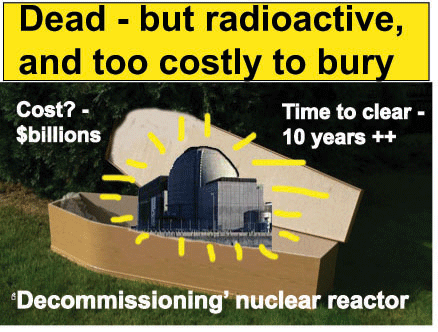
 Nuclear plants dip into dismantling funds to pay for waste By Dave Gram, The Associated Press DAILY NEWS, 10/25/15, MONTPELIER, VT. WITH A FEDERAL PROMISE TO TAKE HIGHLY RADIOACTIVE SPENT FUEL FROM NUCLEAR PLANTS STILL UNFULFILLED, CLOSED REACTORS ARE DIPPING INTO FUNDS SET ASIDE FOR THEIR EVENTUAL DISMANTLING TO BUILD WASTE STORAGE ON-SITE, RAISING QUESTIONS ABOUT WHETHER THERE WILL BE ENOUGH MONEY WHEN THE TIME COMES.
It violates Nuclear Regulatory Commission rules for the plants to take money from their decommissioning trust funds to pay for building the concrete pads and rows of concrete and steel casks where waste is stored after it is cooled in special storage pools. But the NRC is granting exemptions from those rules every time it is asked.
“All of the plants that have permanently shut down in recent years have sought, and been approved for, the use of decommissioning funds for spent fuel storage costs,” NRC spokesman Neil Sheehan wrote in an email in response to questions from The Associated Press this past week.
These include the Kewaunee plant in Wisconsin, San Onofre 1 and 2 in California, Crystal River 3 in Florida, and Vermont Yankee in Vernon, in Vermont’s southeast corner, which closed at the end of last year. The Zion 1 and 2 reactors in Illinois, which shut down in the late 1990s, had gotten a similar OK to use decommissioning money for spent fuel storage, Sheehan said.
Ratepayers chipped in during nuclear plants’ lives to set aside the money it would take eventually to tear down reactors, remove their radioactive components and restore the sites. It was not envisioned they also would have to pay for indefinite storage of spent fuel on the roughly 100 nuclear plant sites around the country.
And long-term, on-site storage of nuclear waste is a bad idea, said Arnold Gundersen, a former nuclear industry executive turned consultant who frequently criticizes the industry.
“You build power plants near water because you have to cool them, and you build nuclear waste storage sites away from water” because of the threat of radioactive materials reaching it, Gundersen said
“It would be much better to get the stuff underground where terrorists couldn’t fly a plane into it,” he said.
Nuclear industry spokespeople, government officials and industry critics agree the retirement fund raids have been triggered by the failure to date of the U.S. Department of Energy to open a permanent disposal site for spent nuclear fuel. For years, the government had been planning a disposal site at Nevada’s Yucca Mountain, but that plan has been scuttled by a lack of funding from Congress.
That has left reactors redesigning the racks in their spent fuel pools to accommodate more of the waste and expanding into “dry cask” storage, both of which Vermont Yankee did in the years before its owner, Entergy Corp., closed the plant at the end of last year because it was becoming less competitive against electricity generated with cheap natural gas.
The spent fuel bottleneck leaves closed and soon-to-close nuclear plants with the prospect that for the indefinite future, they will look like the site of the former Maine Yankee plant. That plant was permanently shut down in 1997, nearly two decades ago. Today, the reactor is gone, but the site in the coastal town of Wiscasset still features 60 steel canisters encased in concrete that contain the 550 metric tons of spent fuel the plant generated in its 25-year life. The site is guarded 24 hours a day, 7 days a week………..http://www.dailynews.com/business/20151025/nuclear-plants-dip-into-dismantling-funds-to-pay-for-waste
Federal authorities cancel shipment of high level radioactive trash to Idaho
Feds cancel research shipment of spent nuclear fuel to Idaho, Salt Lake Tribune, By KEITH RIDLER The Associated Press, 25 Oct 15, Boise, Idaho • Federal authorities have canceled the first of two proposed research shipments of spent nuclear fuel to eastern Idaho but still hope to deliver the second.
The U.S. Department of Energy said Friday that 25 fuel rods weighing about 100 pounds will not be sent to the Idaho National Laboratory.
The move comes after federal and state officials couldn’t come to terms on a waiver to a 1995 agreement that ties such shipments to nuclear waste cleanup at the 890-square-mile site. The federal agency is currently in violation of the agreement because of its failure to convert 900,000 gallons of liquid waste into solid form due to malfunctions at a $571 million plant……..
The Department of Energy wants to better understand “high burnup” spent fuel that is accumulating at nuclear power plants in the U.S. High burnup fuel remains in nuclear reactor cores longer to produce more energy but comes out more radioactive and hotter. It’s cooled in pools before being encased in steel and concrete.

The first proposed shipment to Idaho initially set for August would have come from the Byron Nuclear Power Station in Illinois.
The second shipment, also of 25 spent nuclear fuel rods weighing about 100 pounds, is scheduled for January 2016, from the North Anna Nuclear Power Station in Virginia.
The Department of Energy “will continue to work with the state of Idaho in an effort to identify a path forward for the proposed second shipment,” the agency said……..http://www.sltrib.com/home/3097310-155/feds-cancel-research-shipment-of-spent
Residents of St Louis County get cancer from long-term exposure to low level radiation
 The threat of low-level radiation http://www.cbsnews.com/news/is-radiation-to-blame-for-st-louis-county-cancer-cases/ VINITA NAIR CBS NEWS October 21, 2015, NORTH ST. LOUIS COUNTY, Mo.— A study released Wednesday by the World Health Organization said long-term exposure to radiation — even low levels — can dramatically increase the risk of dying from cancer.
Carl Chappell lost his 44-year-old son Steven to appendix cancer three months ago. CBS News talked with him and six of his neighbors, all of whom either had cancer or lost a parent or child to it.
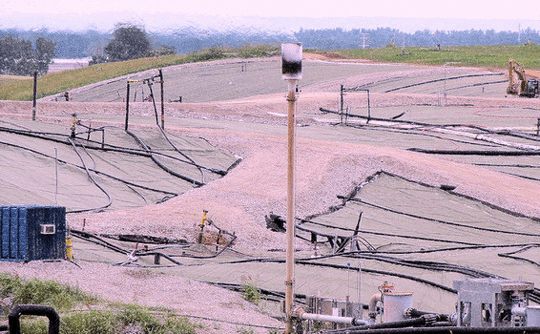
They all grew up in North St. Louis County, where radioactive material left over from America’s nuclear weapons program was stored — thousands of dirty barrels — near a creek than ran alongside their playgrounds and backyards.
Using social media, the neighbors said they’ve documented more than 2,700 cases of cancer, auto-immune diseases and tumors in their area. Below: Landfill West Lake, St Louis
“They’re not statistics and they’re not numbers,” Mary Oscko, who has stage 4 lung cancer, told CBS News. “They were my neighbors.”
Currently, the Army Corps of Engineers lists 24 other sites in 10 states with low-level radioactive contamination that they are in the process of cleaning up. There are three other contaminated sites still under consideration for clean up. A former chemical processing plant in Queens, New York is one of them. Radiation barriers were installed as a “band-aid” solution in 2013.
Michael Feldmann with the Army Corps of Engineers says the cleanup moves slowly for a reason.
“In general, there are things that we need to move at the pace we are performing in order to protect the health and environment of the area,” Feldmann said.
Dr. Fasial Kahn is the director of public health in St. Louis County.
“Some disasters unfold slowly over time, and their true nature and extent and severity only becomes clear in terms of human cost once you start counting people around you,” Kahn said.
In North St. Louis County, neighbors have a list to keep track of who’s gotten sick — including 21 people who lived on the same street.
The residents told CBS News they believe they had long-term exposure to the low level contamination, a type of prolonged exposure that has never been studied.
Los Alamos National Laboratory has radioactive materials stolen
 Radioactive material keeps getting stolen from nuclear lab, feds say http://www.foxnews.com/us/2015/10/23/radioactive-material-keeps-getting-stolen-from-nuclear-lab-feds-say/ Federal officials say workers have stolen radioactive materials from Los Alamos National Laboratory in New Mexico multiple times this year.
The Albuquerque Journal reported Friday that the items were taken from an area that stores contaminated materials before they’re shipped elsewhere. A federal court filing says there have been 76 thefts by Los Alamos personnel in 2015.
An affidavit says lab officials contacted federal investigators on Sept. 30 to say a subcontractor’s employee had stolen items.
The day before, police responded to a call about a man throwing materials into bushes near the lab. Officers found several radioactive items, including a band saw that tested 500 times above the allowable limit for contamination.
A Los Alamos spokesman referred questions to the FBI, which didn’t respond to a request for comment.
Decadesof bungling over radioactive landfill in St Louis County
 How a six-figure deal from the 1960s blocked clean-up of radiotoxic site, Examiner, Byron DeLear , 13 Oct 15 One hundred and twenty-six thousand dollars. That’s how much money was offered by Contemporary Metals Corporation in 1962 to acquire all the contents of the world’s first nuclear waste dump. It may seem unbelievable and incredibly reckless by today’s standards for the U.S government to even consider off-loading thousands of tons of highly dangerous radioactive material to a small private entity, but at that time the dangers were neither fully known nor appreciated. A subsequent owner illegally dumped a large quantity of this radioactive material at the West Lake Landfill.
Today, an underground fire threatens to ignite these dangerous substances inundated with uranium, thorium, and radium — a radiotoxic concoction found to be unique to nuclear weapons-related waste. Recently, experts brought by Missouri Attorney General Chris Koster estimate the fire could reach the radioactive waste in as little as 3-6 months. These same experts cite evidence of the radioactive contaminants leaching off-site into trees and groundwater. Emergency evacuation plans warning of a potential “catastrophic event” have also been released by St. Louis County — naturally, as can be expected, folks are growing restless.
Yesterday, four local school districts have sent letters to parents letting them know of the potential emergency and that the circumstances are being closely monitored. “We remain frustrated by the situation at the Landfill,” said Mike Fulton, superintendant of the Pattonville School District. “This impacts not only our community, but the entire St. Louis region.”
With the underground fire burning for nearly six years, four decades of inaction by a rotating cavalcade of shape-shifting private interests, numerous state and federal agencies, officials, and politicians, one might wonder:
What’s makes the West Lake Landfill case so special? — so absolutely unique a situation to have foisted upon this region a decades-long, ongoing saga of bungled management, finger-pointing, and negligence? Why hasn’t the site been cleaned-up? Continue reading
Exxon’s campaign to spread doubt on the science of climate change
Exxon Sowed Doubt About Climate Science for Decades by Stressing Uncertainty
 Collaborating with the Bush-Cheney White House, Exxon turned ordinary scientific uncertainties into weapons of mass confusion. Inside Climate News, David Hasemyer and John H. Cushman Jr. 23 Oct 15 As he wrapped up nine years as the federal government’s chief scientist for global warming research, Michael MacCracken lashed out at ExxonMobil for opposing the advance of climate science.
His own great-grandfather, he told the Exxon board, had been John D. Rockefeller’s legal counsel a century earlier. “What I rather imagine he would say is that you are on the wrong side of history, and you need to find a way to change your position,” he wrote.
Addressed to chairman Lee Raymond on the letterhead of the United States Global Change Research Program, his September 2002 letter was not just forceful, but unusually personal.
No wonder: in the opening days of the oil-friendly Bush-Cheney administration, Exxon’s chief lobbyist had written the new head of the White House environmental council demanding that MacCracken be fired for “political and scientific bias.”
Exxon was also attacking other officials in the U.S. government and at the UN’s Intergovernmental Panel on Climate Change (IPCC), MacCracken wrote, interfering with their work behind the scenes and distorting it in public.
Exxon wanted scientists who disputed the mainstream science on climate change to oversee Washington’s work with the IPCC, the authoritative body that defines the scientific consensus on global warming, documents written by an Exxon lobbyist and one of its scientists show. The company persuaded the White House to block the reappointment of the IPCC chairman, a World Bank scientist. Exxon’s top climate researcher, Brian Flannery, was pushing the White House for a wholesale revision of federal climate science. The company wanted a new strategy to focus on the uncertainties.
“To call ExxonMobil’s position out of the mainstream is thus a gross understatement,” MacCracken wrote. “To be in opposition to the key scientific findings is rather appalling for such an established and scientific organization.”
MacCracken had a long history of collaboration with Exxon researchers. He knew that during the 1970s and 1980s, well before the general public understood the risks of global warming, the company’s researchers had worked at the cutting edge of climate change science. He had edited and even co-authored some of their reports. So he found it galling that Exxon was now leading a concerted effort to sow confusion about fossil fuels, carbon dioxide and the greenhouse effect.
Exxon had turned a colleague into its enemy.
It was a vivid example of Exxon’s undermining of mainstream science and embrace of denial and misinformation, which became most pronounced after President George W. Bush took office. The campaign climaxed when Bush pulled out of the Kyoto Protocol in 2001. Taking the U.S. out of the international climate change treaty was Exxon’s key goal, and the reason for its persistent emphasis on the uncertainty of climate science.
This in-depth series by InsideClimate News has explored Exxon’s early engagement with climate research more than 35 years ago – and its subsequent use of scientific uncertainty as a shield against forceful action on global warming. The series is based on Exxon documents, interviews, and other evidence from an eight-month investigation………. http://insideclimatenews.org/news/22102015/Exxon-Sowed-Doubt-about-Climate-Science-for-Decades-by-Stressing-Uncertainty
Apple developing huge solar investment in China
 Apple steps up solar power investment in China http://www.smh.com.au/business/energy/apple-steps-up-solar-power-investment-in-china-20151022-gkfttm.html October 22, 2015 Alex Nussbaum “The time for action is now:” Apple chief Tim Cook. The move will make Apple’s operations in China carbon-neutral, the company says.
Apple will build an additional 200 megawatts of solar power in China and push suppliers to make similar commitments, as the maker of the iPad and Apple Watch seeks to offset its global-warming emissions in the world’s most polluting country.
The solar investment comes atop two previously announced solar farms in southern China that have now been completed, producing a combined 40 megawatts of power, Apple said in a statement overnight. The company will also partner with suppliers, including iPhone maker Foxconn Technology Group, on an additional 2 gigawatts of solar, wind and hydropower projects.
“Climate change is one of the great challenges of our time, and the time for action is now,” Apple chief executive Tim Cook said. “We believe passionately in leaving the world better than we found it and hope that many other suppliers, partners and other companies join us in this important effort.”
The promises are part of Apple’s efforts to cut greenhouse-gas emissions and come ahead of a United Nations summit in Paris later this year where world leaders will try to reach a global deal on reining in climate-change pollution. China, the world’s biggest source of greenhouse gases, has promised to almost double the amount of energy it gets from renewable and nuclear power by 2030.
Apple said in April that it would partner with US-based SunPower Corp. to build the two generating stations in Sichuan province. The new solar farms produce more power than Apple’s operations consume in China, making the company “carbon neutral,” it claims. The 200 megawatts of new investments will involve construction in northern, eastern and southern China and “will begin to offset the energy used in Apple’s supply chain.”
Foxconn will construct 400 megawatts of solar by 2018 as part of the initiative with suppliers, starting in Henan province. Foxconn has committed to generate as much renewable energy as its Zhengzhou factory uses in final production of the iPhone, Apple said.
Bloomberg
Anxieties, disputes, over St Loius underground fire burning near radioactive trash dump
“I can say with some confidence that a flood, fire, earthquake, tornado, what have you, is going to move this radioactive material and other contaminants at the landfill in a way we cannot control.”
Officials squabble as underground fire burns near radioactive waste dump in St. Louis area , LA Times, 21 Oct 15Matt Pearce Contact Reporter A fire is smoldering beneath a landfill in a densely populated suburb of St. Louis — and it has been there for five years.
Underground landfill fires, or “smoldering events” as some officials call them, aren’t rare. What makes the fire at the landfill in Bridgeton, Mo., so unusual is that it’s less than a quarter of a mile from a large deposit of nuclear waste — with no barrier in its way.
The radioactive legacy of St. Louis’ role in the World War II atomic weapons program has unleashed Cold War-style nuclear paranoia in the area, as some residents debate what kind of gas masks to buy or whether to move away. Corporate, federal and state officials don’t agree on what kind of threat West Lake Landfill poses to residents, or even if it poses a threat at all. Various scientists and officials have presented clashing stories to the public about whether the underground fire is moving and what might happen if it reaches the nuclear waste.
1 This Month
15 October. Joint Appeal for Nuclear Abolition Day -presentation to the UN on October 15 will be live on UNWebTV
Endorse the Nuclear Abolition Day Appeal
23-25 October – on Zoom – World BEYOND War’s annual global conference

To see nuclear-related stories in greater depth and intensity – go to https://nuclearinformation.wordpress.com
-
Archives
- October 2026 (139)
- September 2026 (339)
- August 2026 (330)
- July 2026 (355)
- June 2026 (287)
- May 2026 (306)
- April 2026 (356)
- March 2026 (251)
- February 2026 (267)
- January 2026 (308)
- December 2025 (358)
- November 2025 (359)
-
Categories
- 1
- 1 NUCLEAR ISSUES
- business and costs
- climate change
- culture and arts
- ENERGY
- environment
- health
- history
- indigenous issues
- Legal
- marketing of nuclear
- media
- opposition to nuclear
- PERSONAL STORIES
- politics
- politics international
- Religion and ethics
- safety
- secrets,lies and civil liberties
- spinbuster
- technology
- Uranium
- wastes
- weapons and war
- Women
- 2 WORLD
- ACTION
- AFRICA
- Atrocities
- AUSTRALIA
- Christina's notes
- Christina's themes
- culture and arts
- Events
- Fuk 2022
- Fuk 2023
- Fukushima 2017
- Fukushima 2018
- fukushima 2019
- Fukushima 2020
- Fukushima 2021
- general
- global warming
- Humour (God we need it)
- Nuclear
- RARE EARTHS
- Reference
- resources – print
- Resources -audiovicual
- Weekly Newsletter
- World
- World Nuclear
- YouTube
-
RSS
Entries RSS
Comments RSS

