Expanding nuclear power will reduce and retard climate protection.
 “[E]xpanding nuclear power is uneconomic, is unnecessary, is not undergoing the claimed renaissance
 in the global marketplace … and, most importantly, will reduce and retard climate protection.
Nuclear Power: Dead in the Water it Poisoned, CounterPunch, by JOHN LAFORGE NOVEMBER 5, 2015 On Feb. 11, 1985, the cover page of Forbes thundered, “The failure of the U.S. nuclear power program ranks as the largest managerial disaster in business history, a disaster on a monumental scale.…”
Fourteen months later, reactor No. 4 at Chernobyl exploded and burned for 40 days, spreading radioactive fallout across the entire Northern Hemisphere, depositing cesium-137 in Minnesota’s milk[1]and Japan’s topsoil.[2]
So how is it that Congressional representatives, TV network pundits, FOX ditto heads and even CNN program directors still promote nuclear power?
Part of the answer comes from American University researcher Judy Pasternak and her students. According to Pasternak’s 2010 study, the nuclear industry spent $645 million over 10 years lobbying Capitol Hill, and another $63 million in campaign contributions over the same period.[3] Between 1999 and 2008, these millions manufactured the canard that nuclear power is “carbon free,” “clean” and can “help fend off climate change.” Prior to this spending blitz, the US nuclear power program was, because of the shock of accidents at Three Mile Island in 1979 and Chernobyl in 1986, “pretty well dead in the water” — in the words of economist and author Jeremy Rifkin.[4]
The lobbyists and check writers worked hard spinning the yarn that the richest and most pollution-intensive industrialists on earth were concerned about climate change and wanted to cut carbon emissions — but they didn’t convince everybody.
Independent scientists, free of corporate blinders and the market imperative of short term profit, scoff at “green nuke” propaganda. Continue reading
USA’s Environment Protection Agency helping nuclear industry out of its financial crisis
 Nuclear Power: Dead in the Water it Poisoned, CounterPunch, by JOHN LAFORGE NOVEMBER 5, 2015 “……..As the nuclear industry struggles against financial collapse, government regulators seem to have capitulated to political pressure to weaken radiation exposure standards after accidents and thereby save the industry hundreds of billions of dollars.
On April 15, the EPA issued new Protective Action Guides (PAGs) for dealing with large-scale radiation releases — like Fukushima. The proposed PAGs represent a preemptive government bailout, because they would save reactor owners the nine-figure costs of currently required decontamination following large radiation releases. Eerily, the new PAGs seem to presume the premeditated inevitability of catastrophic releases that the industry can’t afford to withstand. The likelihood of such events was cold-bloodedly conceded by NRC Commissioner James Asselstine who testified to Congress in 1986: “[W]e can expect to see a core meltdown accident within the next 20 years, and it … could result in off-site releases of radiation … as large as or larger than the releases … at Chernobyl.”[48]
Now that Fukushima has tripled down on Commissioner Asselstine’s radiation roulette wager, real players in big electricity are running for the exits. Unlike Congressional hogs feeding at utility lobbying buffets, or commercial television executives who devour utility advertising checks, Wall Street isn’t buying bank-busting liabilities like Fukushima which will cost Japan a minimum of $350 billion and which is relentlessly salting the entire Pacific Ocean with long-lived radioactive materials.
Big investors must smirk at sloganeering about “safe reactor designs” spouted in documentary hoaxes like “Pandora’s Promise.” They read headlines from Japan and recall the stinging deception purveyed by Lewis Straus of the Atomic Energy Commission who said electricity from reactors would be “too cheap to meter.” And they can’t forgetForbes’ 1985 denunciation of nuclear power as industry’s “largest managerial disaster.”
Only add to Forbes’ prescient epitaph that nuclear is also history’s broadest and most and persistent health and environmental catastrophe.
Notes……. http://www.counterpunch.org/2015/11/05/nuclear-power-dead-in-the-water-it-poisoned/
“Nuclear can’t compete today”
Asked about Duke Power Florida’s August decision to cancel new reactor plans, Peter Bradford, a former NRC  commissioner, told theTampa Bay Times that a nuclear construction boom “was just this artificial gold rush. And yes, it does show the renaissance is dead.”
Nuclear Power: Dead in the Water it Poisoned, CounterPunch, by JOHN LAFORGE NOVEMBER 5, 2015 “……..Well before Fukushima’s triple meltdowns staggered nuclear’s future, Congress and the industry were struggling to ignore its abandonment by important players around the world and public condemnations made by former supporters, and since March 2011 major figures the world over are saying “No nukes.”
Speaking in New York City Nov. 27, World Bank President Dr. Jim Yong Kim said, “The World Bank Group does not engage in providing support for nuclear power. … [O]ur focus is on finding ways of working in hydroelectric power, in geo-thermal, in solar, in wind. … and we don’t do nuclear energy.” A week earlier, Kim said governments weren’t doing enough to confront climate change, revealing that the WBG well knows that nuclear power is no answer.[33]
World Bank directors may have adopted the recommendation of the US Commission on the Prevention of Weapons of Mass Destruction Proliferation and Terrorism, which concluded in 2009 that governments can and should help stop nuclear weapons proliferation by “… discouraging … the use of financial incentives in the promotion of civil nuclear power.”[34]
More pointedly, Gregory Jaczko, who was Chairman of the NRC when Japan’s Fukushima-Daiichi catastrophe started in 2011, warned in 2012 that “All 104 nuclear power reactors now in operation in the US have a safety problem that cannot be fixed and they should be replaced with newer technology…”[35] When he left the NRC, theTimes editorialized that “the country is losing a strong advocate for public safety who was always willing to challenge the nuclear industry and its political backers in Congress.” Continue reading
Security escort rear-ends semi carrying nuclear weapon in US
 http://www.9news.com.au/world/2015/11/04/17/18/security-escort-rear-ends-semi-carrying-nuclear-weapon US security forces apparently transporting a nuclear weapon suffered an embarrassing slip-up when an armoured escort rear-ended the main vehicle as the convoy sped through a truck stop.
To make matters worse, the high-speed prang occurred just as the bystander filming was being told off by federal police for capturing the incident.
Uploaded to YouTube overnight, the video shows the intimidating convoy of at least ten vehicles and the semi, as well as several helicopters, barrelling through an unnamed town on what looks to be a US interstate highway. Continue reading
Plumes of disinformation from nuclear lobby hide the truth on radiation
 The National Council on Radiation Protection (NCPR) says, “…the Council assumes that, for radiation-protection purposes, the risk of stochastic [random] effects is proportional to dose without threshold…”[17] (Emphasis added) In other words, “… every increment of radiation exposure produces an incremental increase in the risk of cancer.”[18]
Nuclear Power: Dead in the Water it Poisoned, CounterPunch, by JOHN LAFORGE NOVEMBER 5, 2015 “……….Another part of reactor greenwashing is the powerful influence of mis- and disinformation following the Great East Japan Earthquake, the resulting tsunami, and the catastrophic Fukushima radiation gusher that began March 11, 2011.
In reporting on the contamination of soil, tap water, rain water, groundwater, breast milk, vegetables, fish, baby food, animal feed, beef, and incinerator ash, radiation was and is almost always said to pose little or no “immediate” danger. This minimization is designed to and quite successfully does ease public concern and push Fukushima’s ongoing radio-contamination from public consciousness.
Contaminated spinach and milk “do not pose an immediate health threat,” NPR’s Giles Snyder reported April 19, 2011. The Agence France-Presse reported October 6, 2011, “An exposure of 100 millisieverts per year is considered the lowest level at which any increase in cancer risk is evident.” However, as the US Nuclear Regulatory Commission says, “…any increase in dose, no matter how small, results in an incremental increase in risk.”[11]
An April 11, 2011 Forbes report flatly misstated the US EPA’s published public warning about radiation. Noting that a Phoenix, Arizona, drinking water sample contained 3.2 pico-curies per liter of radioactive iodine-131 from Fukushima, and that the EPA’s maximum contaminant level is 3.0, the writer concluded, “EPA does not consider these levels to pose a health threat.” In fact, the EPA officially warns that “there is no level below which we can say an exposure poses no risk.”
This pattern of misstatement and official falsehood went to the very top of the food chain. Japan’s Chief Cabinet Secretary Yukio Edano famously declared March 11, 2011, “Let me repeat that there is no radiation leak, nor will there be a leak.”[12] He later asked the public not to overreact to reports of radioactively contaminated food, saying, according to the BBC, “Even if you eat contaminated vegetables several times, it will not harm your health at all.”
President Obama followed suit. Continue reading
“Worst accidental radioactive pollution of Pacific Ocean” hasn’t moved US to test seafood
Nuclear Power: Dead in the Water it Poisoned, CounterPunch, by JOHN LAFORGE NOVEMBER 5, 2015 “………..Radiation exposure and contamination should concern everyone because by all accounts the volume of  radioactive materials discharged to the Pacific Ocean by Fukushima is the single greatest radioactive contamination of the sea ever observed. [27] An estimated 27 “peta-becquerels” (27 million billion becquerels) of cesium-137 had already leaked or been deliberately dumped into the Pacific by October 2011. A becquerel represents one atomic disintegration/second.
Last July, Tokyo Electric Power Co., which owns the Fukushima wreckage, acknowledged that an additional 300 tons-a-day of highly contaminated water is leaking into the Pacific from the six-reactor station — and has been since the beginning of the disaster almost three years ago. The American Medical Association — following the revelation of massive ongoing leaks — called on the US government to “monitor and fully report the radioactivity levels of edible species sold in the United States.”[28]
Yet at present, US seafood is not regularly tested for cesium contamination, in spite of the large numbers of fish and other foods that have been found contaminated by Fukushima isotopes — including blue fin[29] and albacore tuna[30] caught off the US West Coast, grapefruit from Florida, and prunes, almonds, pistachios and oranges from California.[31]
In this context, a coalition of public health and environmental groups petitioned the FDA in early summer demanding a drastic reduction in the amount of radioactive cesium allowed in food. The petition by members of the Fukushima Fallout Awareness Network (FFAN) declared that the arbitrarily high 1,200 becquerels-per-kilogram (Bq/kg) US limit is “ridiculous.” The standard is between 120 times to 24 times weaker than Japan’s.
The petition demands that US foods have no more than 5 Bq/kg of cesium-137 and -134, and that all food be tested and labeled with its cesium content. The FFAN reports that the devastated Fukushima reactors continue to leak more than 10 million becquerels of cesium-134 and cesium-137 per hour into the environment, “with no sign of stopping.” The network said it was “alarmed” at the lack of testing currently in place to meet the threat of radioactive contamination in food. Because cesium-134 has a hazardous life of about 10-20 years, and cesium-137 has a hazardous life of about 300-600 years, the FFAN said, the threat of food contamination “is a long-term issue that deserves immediate attention………”http://www.counterpunch.org/2015/11/05/nuclear-power-dead-in-the-water-it-poisoned/
USA’s budgetary tug of war between nuclear weapons and radioactive trash clean-up
The clean-up work, which includes a mixture of radioactive and chemical wastes, “is the largest environmental remediation ever undertaken by mankind and the most technically challenging”
One reason for the Energy Department’s struggles is a budgetary tug of war within the agency. One part of the department maintains the US’s atomic arsenal, and another is in charge of cleaning up the contamination from nuclear work. Funds for both come from the same pot, and in a shift from the 1990s, an increasing portion is going towards ensuring the readiness of the weapons arsenal

 Toxic remnants of US nuclear program http://www.theaustralian.com.au/business/wall-street-journal/toxic-remnants-of-us-nuclear-program/story-fnay3ubk-1227591352430m JOHN R. EMSHWILLER, GARY FIELDS THE WALL STREET JOURNAL NOVEMBER 03, 2015
About 70km southeast of San Francisco, in an 320ha mini-city built to create atomic bombs, there’s a contaminated building slated for eventual demolition.
Mark Costella, a facilities manager at the Energy Department’s Lawrence Livermore National Laboratory, would prefer to tear down the structure, but doesn’t have the tens of millions of dollars needed.
Instead, he is spending $US500,000 ($700,000) to fix the roof.
These are the kinds of contradictions at the heart of the complicated, expensive and struggling effort to clean up the US’s 70-year-old nuclear weapons program.
The Energy Department’s clean-up operation is wrestling with reduced budgets, tens of billions of dollars in ballooning cost estimates and 2700 structures on its to-do list. Officials said more than 350 additional unneeded facilities controlled by other programs in the Energy Department are probably eligible for transfer to the clean-up operation. But that office said its funds were limited and it was not accepting any more projects, no matter their significance.
That means some of the nation’s toughest threats are now on the backburner, possibly for decades, while relatively low-priority work moves forward.
Dirty and decaying structures where weapons work and other nuclear activities were carried out — some the size of several football fields and old enough to qualify for Social Security — are clustered in federal sites from South Carolina to California. Some are within easy walking distance of people’s homes. Continue reading
What’s happening? USA’s weapons program and nuclear waste clean-up funds come from the same kitty!
Q&A: What’s Next for America’s Nuclear-Waste Clean-Up, http://blogs.wsj.com/washwire/2015/11/02/qa-whats-next-for-americas-nuclear-waste-clean-up/ WSJ, By GARY FIELDS and JOHN R. EMSHWILLER
The Senate and House are expected as early as this week to take up the defense authorization bill President Barack Obama vetoed last month and try to push a version of it through again. Buried in the bill is a proposal that could dramatically re-order nuclear-weapons clean-up activities, a decades-long effort that is costing taxpayers hundreds of billions of dollars
The proposal is five paragraphs, barely noticeable in the 1,000-plus-page document. But, if implemented, its effects could be felt in communities around the country. Here’s a Q&A:
What is the problem?
Creating America’s nuclear arsenal left thousands of structures around the U.S. tainted with radioactive and chemical contamination. Over the past quarter century, the Energy Department clean-up office has disposed of about 2,800 of them with a like number still to do. However, for various reasons some of the dirtiest and most dangerous buildings aren’t yet on that clean-up list and might not be added for decades.
How many structures are in this sort of limbo?
An Energy Department inspector general’s report this year put the number at over 350. Among them is Alpha 5 in Tennessee. Larger than ten football fields, it produced uranium for the Hiroshima bomb but is now a decaying structure of radioactive and chemical contamination where “the speed of degradation is far outpacing” maintenance funding, said an Energy Department report.
Why aren’t these places getting addressed?
The issue, as with many things, is money. The Energy Department’s money for the weapons program and the clean-up effort come from the same the same kitty. A quarter century ago, with the end of the Cold War, more money for the first time started flowing into clean-up than weapons. In recent years that situation has reversed. Plus, much of the money available to the clean-up operation is committed at various sites and there isn’t enough money to take to address some of these other buildings–even if they are more in need of attention than some of the structures being dealt with.
What are Congress and the administration doing?
The energy secretary has appointed a working group to review clean-up priorities. The provision in the vetoed defense bill would require buildings such as Alpha 5 to be added to the clean-up operation within three years—a timetable the Obama administration says isn’t possible.
Entergy closes unprofitable Fitzpatrick nuclear power plant
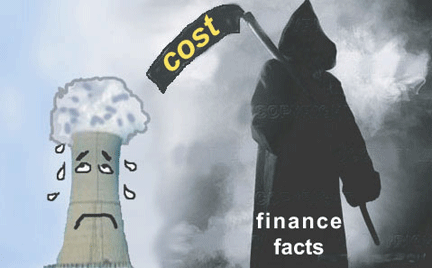 Lack of profitability forces Entergy to close Fitzpatrick nuclear power plant, Enformable, 2 Nov 15 Entergy officials have confirmed that late 2016 or early 2017 the Fitzpatrick nuclear power plant will be shut down instead of refueled and brought back online.
The plant was scheduled for refueling in September 2016 but has been losing Entergy money and can no longer be kept afloat. Wall Street analyst Julien Dumoulin-Smith of UBS Securities, recently predicted FitzPatrick would lose about $40 million in 2016 and as much as $85 million by 2018. Entergy recently told investors that the Fitzpatrick plant had lost so much money, that it was worth nearly a billion dollars less than what it was valued at……http://enformable.com/2015/11/lack-of-profitability-forces-entergy-to-close-fitzpatrick-nuclear-power-plant/
St Louis County becoming another USA radioactive Sacrifice Zone?
St. Louis Sacrifice Zone: Gov’t’s Secret ‘Catastrophic Event Plan’: Tons Radioactive Waste, 1000s Gallons Tainted Water-Spill, Fires, Before It’s News, October 29, 2015 Thousands of gallons of tainted water spilled Tuesday at the Bridgeton landfill near St. Louis, the second incident in days, as an underground fire could reach radioactive waste dump site in three to six months and seven churches have been set ablaze, increasing the development of another American sacrifice zone. Hundreds recently packed Bridgeton church, demanding to know why St. Louis County silently put an emergency plan for a potential “catastrophic event” at Bridgeton Landfill and adjacent West Lake landfill a year ago. Families are moving, becoming environmental refugees in their own country.
“We are not financially able to uproot our lives, but we’re forced to,” said Tonii Morris, who lives up the street from the Bridgeton landfill. “Staying here is not an option.”
Saturday, a fire broke out near an existing smoldering underground fire that is heading toward an old nuclear waste dump. A sewer pipe connecting Bridgeton Landfill to Metropolitan St. Louis Sewer District treatment facilities overflowed, releasing thousands of gallons of sewage Tuesday. These come as churches in the same area are being burned. At least 20 families are no longer waiting for answers or repairs. They are refugees, among the first to be moving, or have moved.
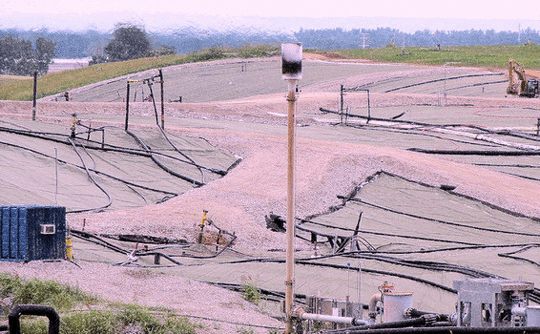
“Tonnage of radiological waste at the Bridgeton-Westlake landfill exceeds Fukushima over 20 fold, and Chernobyl by 163 times. How diluted the Bridgeton nuclear waste is appears unknown,” says Mining Awareness Plus in a comprehensive report, Is the Missouri Landfill Fire a US Chernobyl or Fukushima in the Making?
Saturday afternoon, firefighters rushed to the landfill to extinguish a brush fire. The fire was caused by a faulty switch on an Ameren utility pole inside the landfill’s perimeter fence, Pattonville Fire Protection District’s Battalion Chief Ken Aydelott said. He said a switch overheated, causing hot metal to drop below and ignite the fire. The last small fire at the landfill was in February 2014.
At least 20 families plan to move soon due to the troubled landfills and conflicting reports, according to a questionnaire on a West Lake Facebook page that has grown by 10,000 members in the last month to over 17,000.
Despite officials saying the new leak of tainted water is contained, mothers from North Saint Louis County, outraged about their local landfill on the brink of a nuclear emergency, putting their families at risk, have taken to the streets in protest……..http://beforeitsnews.com/alternative/2015/10/st-louis-sacrifice-zone-catostrophic-event-plan-coverup-tons-of-radioaactive-waste-1000s-gallons-tainted-water-spill-fires-3235920.html?utm_campaign=&utm_source=https%3A%2F%2Ft.co%2F4wD1rKreTN&utm_content=beforeit39snews-floatingtoolbar&utm_medium=twitter&utm_term=http%3A%2F%2Fb4in.info%2Fgoil
USA’s radioactive waste pile-up is ‘constipating’ the nuclear industry
 Beyond Yucca Mountain: The present impasse and uncertain future of nuclear waste storage, SNL By Andrew Coffman Smith, October 28, 2015
“If we don’t clean up the legacy of the past, there won’t be a nuclear future,”declared Mike Simpson, Idaho Congressman and chairman of the House Subcommittee on Energy and Water Development, during an Oct. 27 panel discussion on the issue….Thirty-three years after Congress passed the Nuclear Waste Policy Act and several years after the defunding of the proposed Yucca Mountain nuclear waste storage project, America has yet to find a permanent home for its nuclear waste, and a panel of experts said the future of nuclear storage lay with consenting communities.
Simpson said not having a solution for the long term storage of nuclear waste in the U.S. is “constipating” the nuclear energy sector…..
While the House continues to include funding for Yucca Mountain in budget proposals every year, the Senate has instead followed the recommendations of a Blue Ribbon Commission set up in 2010 by President Barack Obama and examined alternatives to Yucca Mountain using a community consent-based approach, said Simpson…..
Simpson said the current refurbishing of New Mexico’s Waste Isolation Pilot Plant, or WIPP, has led to a buildup of nuclear waste across the country at the expense of states because the facility cannot receive any more waste until the construction is completed. Simpson said that he expects that a surface facility will be built at WIPP to store the waste until the underground storage facilities at WIPP reopens to store nuclear waste in its deep geological repository.
Simpson also said the challenges faced in getting WIPP’s “relatively small” facility operating gives him great pause as to what will happen when the decision is made to operate the larger waste treatment plant in Hanford, Washington.
“We have to convince the American people that you can clean up this stuff that we have been doing for the last 50 years and the biggest challenge we face and the most eminent threat we face is probably at Hanford,” Simpson said.
Simpson said a third storage site that is in trouble is the Savannah River mixed oxide fuel facility, or MOX, in South Carolina that the U.S. Department of Energy is seeking to shut down. The DOE is seeking to have MOX’s uranium down blended and stored at WIPP or another location. Simpson said the problem with MOX is that the U.S. has an agreement with Russia that requires the existence of MOX and the support of both Russia and New Mexico is needed to transport the nuclear waste at MOX to WIPP…..
One of the things that we heard really pretty consistently across the country was a lack of confidence that the federal government was able or intended to live up to the commitments that it’s already made,” said Brailsford. “Once the waste is somewhere, that ‘somewhere’ has lost a lot of its bargaining power so how are you even going to hold the federal government’s feet to the fire to live up to what it has committed to?”
Nuclear Regulatory Commission (NRC) concerned about cyber security – is making new rules
US readies new rules for nuclear reactors, The Hill By Cory Bennett – 10/30/15 The government is moving forward with new cybersecurity requirements for nuclear power plants. The rules will require greater reporting of cyber incidents in the hopes of better understanding the digital threats facing nuclear reactors…….
In an effort to get ahead of this threat, the 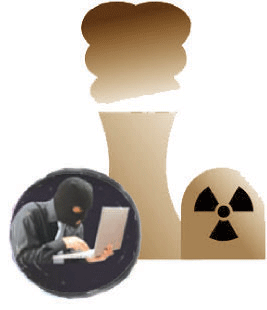 , an independent regulatory agency, on Friday released a new set of reporting requirements. The increased information will aid in the NRC’s “analysis of the reliability and effectiveness” of cybersecurity programs for nuclear power reactors, according to a Federal Register notice.
Heightened awareness of this threat is increasingly important as governments start to target nuclear plants in their burgeoning offensive cyber programs. It’s widely believed the U.S. and Israel were behind a 2010 cyberattack that crippled nearly one-fifth of Iran’s nuclear centrifuges.More recently, South Korea accused North Korea of hacking into one of its nuclear plants. The intrusion exposed sensitive data, but didn’t endanger the plant’s reactors.
A recent report also warned that the nuclear industry is in a “culture of denial” over these hacking risks.
Chatham House, an international affairs think tank, spent 18 months interviewing top nuclear officials and investigating nuclear power plants around the world. The results were not comforting.
“Cybersecurity is still new to many in the nuclear industry,” Caroline Baylon, the report’s author,told the Financial Times earlier this month. “They are really good at safety and, after 9/11, they’ve got really good at physical security. But they have barely grappled with cyber.” Many plants still have control systems linked to the Internet, for example, exposing nuclear reactors to potential digital hijackings.
Overall, the report found 50 cyber incidents at nuclear plants, some of which nearly led to meltdowns. For instance, the safety system at an Alabama nuclear plant was overwhelmed with network traffic, almost triggering a catastrophe……http://thehill.com/policy/cybersecurity/258663-white-house-updates-nuclear-plants-cyber-requirements
Legal case continues, with USS Reagan sailors ill from Fukushima radiation
Fukushima – a Hushed Up Catastrophe, CounterPunch, by ROBERT HUNZIKER , OCTOBER 30, 2015 “……. the pro-nuke school of thought should contemplate: Two hundred U.S. sailors of the USS Reagan have a pending lawsuit against TEPCO, et al claiming that young sailors are already experiencing leukemia, ulcers, gall bladder removals, brain cancer, brain tumors, testicular cancer, dysfunctional uterine bleeding, thyroid illness, stomach ailments and other complaints unusual in such young adults.
The sailors participated in “Operation Tomodachi,” providing humanitarian relief after the March 11th, 2011 Fukushima disaster based upon assurances that radiation levels were okay.
According to plaintiff’s attorneys, more sailors are in the process of coming on board as a tempest of nuclear radiation aftereffects spreads thru the ranks.
Then, it’s little wonder that Einstein prophetically stated: “The unleashed power of the atom has changed everything save our modes of thinking, and we thus drift toward unparalleled catastrophes.”
Unparalleled catastrophes, indeed! http://www.counterpunch.org/2015/10/30/fukushima-a-hushed-up-catastrophe/
Fire erupts within feet of USA radioactive trash dump
CBS: Fire erupts at another U.S. nuclear site near major city — Witness: Flames within feet of radioactive waste — TV: “You can see the smoke for miles… A big-time scare” — EPA emergency response specialists deployed (PHOTO & VIDEOS) http://enenews.com/fire-another-nuclear-site-major-city-witness-flames-feet-radioactive-waste-tv-smoke-could-be-miles-epa-emergency-response-specialists-deployed-photo-videos?utm_source=feedburner&utm_medium=email&utm_campaign=Feed%3A+ENENews+%28Energy+News%29KTVI, Oct 24, 2015 (emphasis added): Brush fire at West Lake Landfill sparks concern —Smoke could be seen for miles as fire crews responded to a brush fire at the West Lake Landfill in Bridgeton Saturday… The fire was started by a faulty switch… inside the landfill’s perimeter. The switch overheated, causing hot metal to drop below and ignite a fire… Arearesidents and elected officials gathered near the scene of the fire Saturday to see if it would move into a restricted area where an underground fire is burning. Residents were concerned that the fire would reach area whereradioactive waste is buried…
KTVI Transcript, Oct 24, 2015: You can see the smoke for miles… A big-time scare for residents out there tonight… Dawn Chapman, resident: “This fire came within feet of it,within feet of radioactive waste“…
CBS News, Oct 27, 2015: No one knows for sure what will happen if the fire comes into contact with it… some low-level radiation has moved into neighborhoods… But it’s not just the underground fire that is a concern – this weekend a grass fire erupted within some 75 yards of the radioactive waste. This region also sits near an earthquake fault line.
AP, Oct 26, 2015: On Saturday, a fire blamed on a faulty utility pole ignited brush on the West Lake Landfill’s grounds… [EPA official Mark] Hague said testing showed no immediateevidence residents were in peril.
St Louis Public Radio, Oct 27, 2015: Stoking many fears was [a] brush fire at the Bridgeton Landfill… which was first called in to the fire department by a resident. Some took that as asign that the landfill’s owner, Republic Services, does not have an adequate handle on the site… [EPA] sent a letter reprimanding Republic Services for the incident.
St. Louis American, Oct 25, 2015: Saturday’s fire supposedly resulted from a malfunctioning electrical switch… EPA emergency response specialists were deployed to the site of the fire, according to the EPA’s statement. “Personnel will be in the field today taking samples from the surrounding area to confirm there is not a release of contaminants,” it stated… “Pattonville Fire District conducted air monitoring during the event.” The Missouri Department of Natural Resources (MDNR)… reviewed data from its monitors located near the landfills, “and the readings stayed consistent with background,” according to the EPA.
CBS St Louis, Oct 25, 2015: Missouri Attorney General Chris Koster [said] “the fire at the Bridgeton Landfill is ever changing”… Koster says Saturday’s fire is a reminder flames can surface in unexpected places without warning.
See report from earlier this month here: AP: Catastrophic event could release radioactive fallout over major U.S. metropolitan area — Gov’t issues emergency plan as fire burns near nuclear site — Senator: “What we have… could end up as Chernobyl” (VIDEO)
See last week’s reports from Las Vegas-area here: EPA data shows radiation spike in major US city soon after explosions at nuclear waste facility — AP: Drums of buried waste were blasted over site’s fence; Large crater reported (VIDEO)
After explosions at nuclear waste facility, major USA cities record radiation spike
EPA data shows radiation spike in major US city soon after explosions at nuclear waste facility nearby — AP: Drums of buried waste were blasted over site’s fence; Large crater reported — Emergency Official: US gov’t brought in “resources I’ve never even seen before, it was amazing” (VIDEO) http://enenews.com/epa-data-shows-radiation-spike-major-city-after-explosions-nuclear-waste-facility-ap-drums-buried-waste-blasted-sites-fence-large-crater-reported-emergency-official-govt-brought-resources-ive-ne?utm_source=feedburner&utm_medium=email&utm_campaign=Feed%3A+ENENews+%28Energy+News%29
New York Times (AP), Oct 25, 2015 (emphasis added): Radioactive Dump That Burned in Nevada Had Past Troubles… State officials said this week they didn’t immediately know what blew up… A state fire inspector, Martin Azevedo, surveyed the site on Wednesday. His report, obtained Friday by The Associated Press, described moisture in the pit and “heavily corroded” 55-gallon drums in and around the 20-foot-by-30-foot crater. Debris from the blast spread 190 feet. Two drums were found outside the fence line… Nevada state emergency management chief Caleb Cage said operating records for the damaged trench…weren’t immediately available… [Former Nevada Governor Robert List] expressed doubt that anyone will ever know what’s really underground at the site. “Good luck with that,” he said. “What we found when we did our investigation was they had very, very skimpy records about what was there.”
Vance Payne, Director of Emergency Management for Nye County, Oct 20, 2015 Board of County Commissioners meeting (at 1:18:45 in): Our federal partners from DOE [US Dept. of Energy] put to bearresources I’ve never even seen before, it was amazing. The effort was nothing short of herculean. There was overflights of aircraft with special monitoring equipment that was put in the air just as fast as they were able — when the weather cleared a little bit — and they did it on the ground. The CST team, the Civil Support Team, came down from Reno and they came down in a hurry — it was amazing how fast they moved their teams. They did ground testing, they did mid-level aerial testing, and they did high-level area testing over the towns of Amargosa and Beatty — as well as the entire transportation line north to south on Highway 95 and 373. So I can tell you that No. 1, it was amazing. I can tell you that a lot of effort was put into making sure that our county and communities were as safe as we could probably make them. This morning we’re getting additional reports coming in, and they’ll continue to come in on the testing over the next few weeks. No radioactive materials were detected anywhere on the ground or in the air.
KTNV Las Vegas, Oct 19, 2015 (at 0:45 in): Preliminary air quality tests say the air is fine — but Nye County officials aren’t trusting just that — more extensive surveys are being done, and those results could take days.
Watch: KTNV | County Commission
1 This Month
15 October. Joint Appeal for Nuclear Abolition Day -presentation to the UN on October 15 will be live on UNWebTV
Endorse the Nuclear Abolition Day Appeal
23-25 October – on Zoom – World BEYOND War’s annual global conference

To see nuclear-related stories in greater depth and intensity – go to https://nuclearinformation.wordpress.com
-
Archives
- October 2026 (139)
- September 2026 (339)
- August 2026 (330)
- July 2026 (355)
- June 2026 (287)
- May 2026 (306)
- April 2026 (356)
- March 2026 (251)
- February 2026 (267)
- January 2026 (308)
- December 2025 (358)
- November 2025 (359)
-
Categories
- 1
- 1 NUCLEAR ISSUES
- business and costs
- climate change
- culture and arts
- ENERGY
- environment
- health
- history
- indigenous issues
- Legal
- marketing of nuclear
- media
- opposition to nuclear
- PERSONAL STORIES
- politics
- politics international
- Religion and ethics
- safety
- secrets,lies and civil liberties
- spinbuster
- technology
- Uranium
- wastes
- weapons and war
- Women
- 2 WORLD
- ACTION
- AFRICA
- Atrocities
- AUSTRALIA
- Christina's notes
- Christina's themes
- culture and arts
- Events
- Fuk 2022
- Fuk 2023
- Fukushima 2017
- Fukushima 2018
- fukushima 2019
- Fukushima 2020
- Fukushima 2021
- general
- global warming
- Humour (God we need it)
- Nuclear
- RARE EARTHS
- Reference
- resources – print
- Resources -audiovicual
- Weekly Newsletter
- World
- World Nuclear
- YouTube
-
RSS
Entries RSS
Comments RSS

