Media blackout on US sailors made ill by Fukushima radiation
 Total blackout of Fukushima truth by U.S. media; sailors suffer and die while denial continues October 21, 2015, by: J. D. Heyes (NaturalNews) Nearly four years after a major tsunami created the massive tidal wave that destroyed much of Japan’s Fukushima nuclear power complex in the northern part of the country, spewing radioactive waste into the air and surrounding Pacific Ocean, the truth about the after-effects of that disaster continue to reside in the shadows.
For example, one of the most under-reported stories of all pertaining to the disaster — and one that should be of particular interest to Americans — is the fate of a number of crewmembers aboard the USS Ronald Reagan, the U.S. Navy carrier sent to assist Japanese military and civilian authorities in the immediate aftermath of the quake…….
It was Morales’ endocrinologist who asked her the question that made her start to wonder about Fukushima and about the “official line” regarding radiation exposure. He asked if she had been aboard the Reagan during Tomodachi, and she said she had.
The endocrinologist then said he had also removed six thyroid glands from other sailors aboard the Reagan, and it was then that Morales put together her own poor health and her participation in the operation.
Retired Navy Lt. Steve Simmons knows. He, too, has been suffering from illness since serving aboard the Reagan during Tomodachi.
Dozens more sickened
“There are individuals out there who are in very similar situations to myself… progressive muscle weakness that starts in their legs and starts to ascend. There are individuals out there who have developed different forms of cancer, leukemia, children of service members born with birth defects because of their service over there,” he said in a recent interview.
You can see the full interview here.
Others have also come forward. In December 2013, Fox News reported that, at the time, a total of 49 Reagan sailors had developed cancers, thyroid issues and other problems related to radiation exposure:
In a lawsuit filed against Tokyo Electric Power Company (TEPCO), the plaintiffs claim the power company delayed telling the U.S. Navy the tsunami had caused a nuclear meltdown, sending huge amounts of contaminated water into the sea and, ultimately, into the ship’s water system.
That full report is here.
The Daily Kos, citing a report from Al Jazeera, put the number of sailors sickened at 51.
Sources:…….
http://www.naturalnews.com/051651_Fukushima_Navy_sailors_media_blackout.html#ixzz3pcQ4Fsio
Touting the nuclear industry to South Carolina’s students, calling it ‘renewable’!
Engineers seek to educate about role of nuclear energy, Technican, North Carolina, October 22, 2015 Alex Kanora, Correspondent
Participating in the National Nuclear Science Week for the fifth time, NC State’s nuclear engineers are spending this week educating fellow students about the everyday presence of nuclear science, from electricity to textiles.
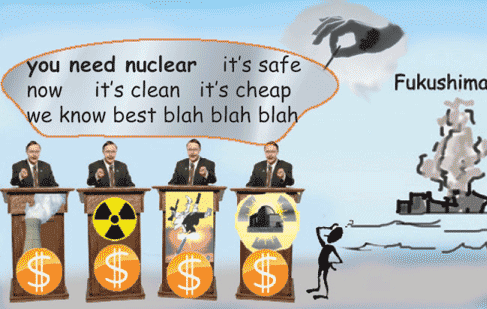
The primary goal of National Nuclear Science Week is to demystify what it means to study nuclear engineering and celebrate its role in society, according to Lisa Marshall, director of Outreach, Retention and Engagement for the department of nuclear engineering. ……..
Tuesday evening at Talley Student Union, nuclear engineering students showed “Pandora’s Promise,” a documentary that explains misconceptions and why skeptics were turned into believers in nuclear power. …..“Many people think of nuclear science as a weapons technology, which in turn keeps people from believing that nuclear energy is a great source of renewable energy,” Marshall said. …… http://www.technicianonline.com/news/article_b2d156e8-7873-11e5-8076-5ff13e669dad.html
50 years later, USA will clean up site of nuclear bomb’s crash in Spain


 Palomares nuclear crash: US agrees Spanish coast clean-up http://www.bbc.com/news/world-europe-34569614 19 October 2015 Almost 50 years after four nuclear bombs fell on the Spanish coast after two US military planes collided, American officials have signed a deal to clean up contaminated land.
None of the bombs detonated in January 1966, but three fell around Palomares and a fourth was found on the sea bed.
Highly toxic plutonium was spread over a 200-hectare (490-acre) area.
On a visit to Madrid, Secretary of State John Kerry agreed to finalise a deal on disposing of contaminated soil.
Under the agreement in principle, signed by Mr Kerry and Spanish Foreign Minister Jose Manuel Garcia-Margallo, the US will remove the soil at Palomares to a site in the US.
Spanish media said the soil would be transported to a site in Nevada. The deal comes a few months before the 50th anniversary of the crash, one of the most serious nuclear incidents of the Cold War.
An earlier consignment of contaminated soil was shipped to a site in South Carolina shortly after the accident and buried in deep trenches.
But further analysis of soil in the area has been carried out in recent years, and the health of residents in the Palomares area is still being monitored.
- On 17 January 1966, a US B-52 bomber carrying four 1.5 megaton bombs collided with a refuelling tanker some 31,000 feet above Palomares on Spain’s Mediterranean coast
- The tanker crew and three people on board the bomber were killed
- One bomb equipped with a parachute landed intact
- Two bombs hit the ground at high speed, scattering plutonium
- A fourth bomb landed five miles off shore and was later recovered by USS Petrel
“I looked up and saw this huge ball of fire, falling through the sky” – Spain waits for US to finish nuclear clean-up
Amnerica’s newest nuclear power station too 42 years to finish
It Took 42 Years to Finish This U.S. Nuclear Power Plant, Bloomberg Naureen Malik HarryRWeber 22 Oct 15
-
Watts Bar Unit 2 given 40-year operating license by regulator
-
First U.S. atomic reactor authorized in almost two decades
-
Forty-two years and counting. That’s how long it’s taken to get America’s latest nuclear reactor up and running.
The stop-start saga behind Unit 2 at the Watts Bar complex near Knoxville, Tennessee, moved a step closer to its conclusion Thursday when the Nuclear Regulatory Commission granted the plant a 40-year operating license.
The length of time it took to get to this stage bears witness to the headwinds that have buffeted the atomic industry over the decades. Work on the reactor was suspended in 1985 when the owner decided it wasn’t needed, especially in an era of low fossil-fuel prices. More recently, costly safety upgrades in the wake of the Fukushima disaster and competition from a flood of cheap natural gas have taken a toll.
The go-ahead from the NRC clears the last remaining hurdle before the Tennessee Valley Authority can bring Unit 2 into service, at an estimated cost of about $6 billion. It’ll be the first new nuclear plant in the U.S. since TVA, the largest publicly owned U.S. power company, started running Unit 1 at Watts Bar in 1996. …….http://www.bloomberg.com/news/articles/2015-10-22/it-took-42-years-to-finish-this-nuclear-power-plant-in-the-u-s-
Radiation and cancer: to USA’s NRC it’s PR not science, that counts
Instead of treating cancer as a scientific issue, the nuclear industry treats it as a PR challenge. Frequent attempts are made to trivialize the dangers of radiation. Often this involves the Radiation- Is-Everywhere tactic complete with ludicrous examples (“It’s just like eating a banana,” or “It’s just like flying to Denver”). They like to show how little radiation is in an average X-ray but they are careful not to mention that radioactive exposure is cumulative: every dose adds.
The dirty little secret of the nuclear industry is that all NPP regularly discharge radiation into the environment. Nuclear power plants cannot operate without these discharges, and the NRC sets standards for what is allowable.
The push by the nuclear industry to block cancer research demonstrates their true colors.
 NRC Blocks Cancer Study Near San Onofre and other Nuclear Power Plants http://voiceofoc.org/2015/10/nrc-blocks-cancer-study-near-san-onofre-and-other-nuclear-power-plants/
By Roger Johnson October 14, 2015 Do the regular radioactive emissions from nuclear power plants (NPP) increase the risk of cancer? No one knows for sure whether living near a NPP can cause cancer, but on Sept. 8 the Nuclear Regulatory Commission (NRC) terminated a study designed to find out. It would have been carried out by the prestigious National Academy of Sciences which spent 5 years planning the study.
One of the six locations chosen for study was our own San Onofre. The medical records of everyone living within 31 miles of San Onofre (a circle from Huntington Beach around to Solana Beach) would have been part of the study. The research proposal is entitled Analysis of Cancer Risks in Populations near Nuclear Facilities.
The NRC logo is “Protecting People and the Environment” but many wonder if it should read “Protecting the Nuclear 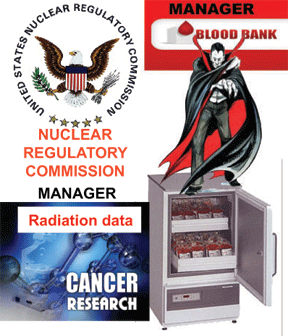 Industry and Its Profits.”
The NRC said it could not afford the $8 million, but no one swallows this since the NRC has an annual budget of over $1 billion (90 percent of which comes from the industry it is supposed to be regulating).
The NRC also said that it already knows the answer: low-level radiation coming from NPP is harmless. It continues to cite a now thoroughly discredited study by the National Cancer Institute (NCI) which examined this issue a quarter of a century ago and failed to find cancer streaks. The nuclear industry prefers this study because it likes the results.
We now know that the NCI study failed because it studied only cancer deaths, not incidence, and it studied only where people died, not where they lived or worked. It also averaged people living very near a NPP with those who lived far away. Also worrisome are recent studies in Europe which discovered that children who live near a NPP double their risk of cancer. The NAS is well-aware of this and designed part of the study to focus on children.
Instead of treating cancer as a scientific issue, the nuclear industry treats it as a PR challenge. Continue reading
Precious Groundwater in Drought Areas Threatened by Uranium Mining
Why Are We Allowing Uranium Miners to Pollute Groundwater in Drought Zones?
 Uranium mining threatens aquifers that could provide the drought-stricken West with emergency water supplies. BRIAN PALMER OCT 16, 2015 Mining uranium, the fuel for nuclear reactors, is a dirty business. Following World War II, mining companies extracted millions of tons of uranium from Navajo tribal lands in the West, contaminating homes and water supplies in the process. It went on for decades, and Navajo miners developed lung cancer at very high rates.
Today, even as the United States nuclear power industry struggles to survive, uranium mining continues. The techniques are more modern, but conservationists say the threat could be just as insidious: polluting water supplies in drought-ridden parts of the country where drinking water is already alarmingly scarce.
New rules proposed by the federal government last year could help reduce the threat—although industry is fighting to weaken them, along with its Republican allies in Congress. And critics say the proposed regulations might not be strong enough anyhow. Ironically, this might all be happening to extract a resource we barely need anymore—at the risk of one that we most certainly do……..
The industry must now work with what geologists call “roll-fronts.” These are relatively thin uranium deposits that formed deep underground over the course of thousands of years. Typically just 10 to 30 feet in height—too small to be harvested by human miners—the roll-fronts can only be extracted by chemical means.
The process used today is called in situ recovery, or ISR, mining. (Opponents use the more chemically descriptive phrase “in situ leaching,” or ISL.) The mining company drills four or five holes, called injection wells, and then pumps down a mix of an oxidizing agent (often hydrogen peroxide or simple oxygen) and water. Pressure from the constant influx of fluid forces the solution to percolate through the uranium-rich layer of Earth toward another hole, called the production well, which carries it up to the surface. At this point, the company reverses the chemical reaction that dissolved the uranium, using a separate chemical to precipitate the metal out of the water. The water, now stripped of most of the uranium, heads back into the well to continue the cycle…….

In reality, ISR mining isn’t so tidy, and the few peer-reviewed studies available suggest that leaching uranium out of rocks contaminates the surrounding groundwater for decades. As Western states deal with increasing levels of drought, that’s a problem…….
Remediation is water- and time-intensive, but does it work? The answer is pretty disturbing: No one knows. There have been only a handful of major studies on the efficacy of the uranium-mining remediation process. Continue reading
A year later, uncertainty over management of Vermont Yankee’s radioactive trash
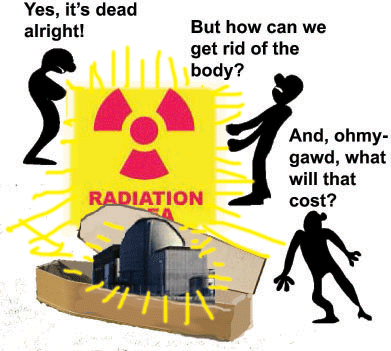 Nearly A Year After Shutdown, Vermont Yankee Continues To Spark Debate http://digital.vpr.net/post/nearly-year-after-shutdown-vermont-yankee-continues-spark-debate#stream/0By JANE LINDHOLM & SAM GALE ROSEN • OCT 12, 2015 Almost a year after its shutdown, the Vermont Yankee nuclear power plant is still sparking debate over safety, spending and the disposal of nuclear waste.
Vermont Edition spoke to Susan Smallheer, a reporter with theRutland Herald, about what’s been happening since the Vermont Yankee nuclear power plant shut down last December, as well as the back and forth between Entergy Corporation and the state of Vermont as mediated by the Nuclear Regulatory Commission.
On what’s currently happening at the plant
Entergy is putting a majority of buildings in what is called “safe and dark” mode, and demolishing minor buildings. Ultimately, they are preparing to transfer fuel from the spent pool into a facility that will begin construction in 2016.
“That will hold the spent nuclear from Vermont Yankee until the year 2052, when Entergy is expecting the Department of Energy to take away the fuel,” says Smallheer.
Uncertainties arise when discussing where this spent fuel will be held next. Vermont and Vermont Yankee have a contract with a Texas facility, owned privately by Waste Control Specialists, which holds a federal permit until 2045. According to filings that Entergy has made with the NRC, Vermont Yankee does not expect to begin deconstruction until 2068.
“Vermont Yankee has to be demolished, decommissioned and decontaminated before the waste can be shipped to Texas,” says Smallheer.
On how decommissioning funds are being spent
A point of contention for the state and Entergy is how Entergy Vermont Yankee is spending money from the decommissioning trust fund, which had reached approximately $660 million as of the shutdown.
“Now it’s down to about $600 million,” says Smallheer. “Yankee has made quite a few withdrawals with this so-called 30-day notification to the NRC, which is how the state of Vermont learns about it.”
The state claims that Entergy is not providing enough information on how these funds are being spent. “Vermont has a very vested interest in not only getting the plant decommissioned as quickly as possible, because Entergy said they’ll start decommissioning as long as there’s adequate funds in the decommissioning trust fund, but because whatever’s leftover goes back to Vermont ratepayers who started the fund,” says Smallheer.
“[The state] needs to know how [Entergy] is spending it, and if they can say it’s being spent wisely,” says Smallheer.
New York nuclear stations can’t afford costly shutdowns – so prolong decommissioning
 New York nuclear plants phase out, challengingly http://www.capitalnewyork.com/article/albany/2015/10/8579839/new-york-nuclear-plants-phase-out-challengingly One doesn’t have look hard in New York and throughout the region to see that the nuclear power industry has hit a rough patch.
The James FitzPatrick nuclear plant in Oswego County may be closing. The Ginna plant is on life support. Gov. Andrew Cuomo says he wants to close Indian Point.
Those closings and potential closings, combined with closure of Vermont Yankee in December and the announcement this month that Pilgrim in Massachusetts would be shuttered, herald what nuclear experts say is a denouement to the story of nuclear power in the United States.
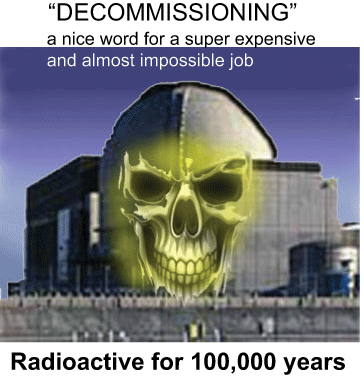
“I would call it an organic phaseout,” said Mycle Schneider, a nuclear consultant based in Paris, during a conference at the New York Society for Ethical Culture on Thursday. “Nuclear’s position is threatened by a number of factors.”
Among those threats, he and others said, are the increasing costs of safely providing nuclear power, stagnant demand, a decrease in electricity use, and “ferocious competitors,” including natural gas and renewable power.
The question for state and federal regulators becomes how to safely and efficiently retire the nation’s nuclear fleet, a task infinitely more complex than getting rid of a typical power plant. Continue reading
Closure of Pilgrim nuclear station opens a new era of costly, dangerous, radioactive trash clean-up
Decommissioning Pilgrim could take decades, millions Boston Globe By Nestor Ramos and David Abel GLOBE STAFF OCTOBER 13, 2015 Shutting off the power at a nuclear plant takes only a few minutes. But decommissioning one — safely removing and storing dangerous radioactive material and closing down the plant for good — can take decades.
In announcing Tuesday that it planned to close the Pilgrim Nuclear Power Station, owner Entergy Corp. revealed few details about how it plans to decommission its aging plant in Plymouth, rated among the least safe in the country. But recent history at nuclear plants in New England and beyond suggests that the process could be long, contentious and cost hundreds of millions of dollars.
Entergy has 60 years to close the plant, according to Nuclear Regulatory Commission guidelines, and that clock may not even start running until 2019, the year by which the company plans to cease operations at Pilgrim. That means it could be 2079 before radioactivity is reduced to safe levels — the ultimate goal of decommissioning.
Company officials say Pilgrim shouldn’t take that long. “We don’t intend to wait until 60 years,” said Bill Mohl, president of Entergy Wholesale Commodities, which oversees most of its nuclear plants.
Still, decommissioning any nuclear power plant takes time. Giant industrial edifices such as the reactor, where the fuel generates heat that is converted to steam, would be difficult to dismantle even if they were not brittle and dangerously radioactive. Radioactive nuclear fuel must remain in storage pools for years after the plant has ceased to generate power.
And even after the fuel is stowed in giant canisters called dry casks, deciding where to store the nuclear waste is still tied up by debate in Washington, and remains years away.
“It’s going to take years in any event,” said Geoffrey Fettus, a senior attorney at the Natural Resources Defense Council. “It’s very complicated, very expensive industrial cleanup.” Continue reading
USA’s “Small Modular Nuclear Reactor” lobby pinning its hopes on Australia?
 16 October 2015, Elsewhere in the world, proponents of small nuclear reactors are pitted against the large reactors, but here in Australia, as Noel Wauchope reports, proponents of small reactors see them as enabling conventional nuclear and uranium mining to flourish. QUIETLY, AND pretty much under the media radar, a dispute is going on in the global nuclear industry between the advocates of “Generation III” — big nuclear reactors, and “Generation IV” — small nuclear reactors…….
the nuclear lobby’s spiel to Australia is something different, and very original. No dispute — because the argument is that small reactors would further the large reactor industry.
First articulated by Oscar Archer on ABC RN, March 2015, the idea is that Australia, in setting up small nuclear reactors, would enable the conventional nuclear industry and uranium mining to flourish:….. As Archer says, Australia would indeed be the pioneer for the new technology.
And that’s what the USA “new nuclear” lobby desperately needs. They need this, because they’re finding it impossible to go ahead in America. Why? Well it’s those pesky safety regulations imposed by the Nuclear Regulatory Commission.
What the “Small Nuclear” lobby needs is a “nuclear friendly” country – one with less stringent safety
regulations – to set up their nuclear reactors on a test site. Hence the enthusiasm of those lobbyists for the South Australia Nuclear Fuel Chain Royal Commission, as shown, for example, in a recent Royal Commission hearing speech by Thomas Marcille of Holtec International nuclear company.
……… the Nuclear Regulatory Commission(NRC) has proved to be real nuisance since it tightened regulations for the licensing process after the Fukushima nuclear disaster. The new nuclear marketers have had to go overseas, first to China, then perhaps to Australia?…. https://independentaustralia.net/environment/environment-display/why-australia-is-important-to-the-small-nuclear-lobby,8263
USA’s nuclear industry staggers to its tomb, as Pilgrim Station shuts down
Entergy’s decision to shut Pilgrim is welcomed by safe energy activists everywhere as part of the rapid collapse of the atomic power mis-adventure.
But across the U.S. some two dozen Fukushima clones still operate. The entire industry is a decayed, money-losing tombstone for the failed lies about “too cheap to meter.”
So it’s great another shut-down has been announced. But four more years of yet another decayed, increasingly dangerous and hugely unprofitable reactor being kept open is not acceptable.
The no nukes movement will not take it lying down. Stay tuned.
Another U.S Nuke Bites the Dust http://ecowatch.com/2015/10/14/nuclear-power-bites-dust/ Harvey Wasserman | October 14, 2015 The chain reactor operator Entergy has announced it will close the Pilgrim nuke south of Boston. The shut-down will bring U.S. reactor fleet to 98, though numerous other reactors are likely to face abandonment in the coming months.

But Entergy says it may not take Pilgrim down until June 1, 2019—nearly four years away.
Entergy is also poised to shut the FitzPatrick reactor in New York. It promises an announcement by the end of this month. Entergy also owns Indian Point 2 and Indian Point 3 some 40 miles north of Manhattan. Unit 2’s operating license has long since lapsed. Unit 3’s will expire in December.
Meanwhile California’s two reactors at Diablo Canyon are surrounded with earthquake faults. They are in violation of state and federal water quality laws and are being propped up by a corrupt Public Utilities Commission under fierce grassroots attack. With a huge renewable boom sweeping the state, Diablo’s days are numbered—and hopefully will shut before the next quake shakes them to rubble.
Meanwhile, like nearly all old American nukes, both Pilgrim and FitzPatrick are losing tons of money. Entergy admits to loss projections of $40 million/year or more at Pilgrim, with parallel numbers expected at FitzPatrick. The company blames falling gas and oil prices for the shortfalls.
Owners of King CONG (Coal, Oil, Nukes and Gas) facilities hate renewables. But in fact the boom in wind, solar, increased efficiency and other Solartopian advances are at the real core of nuke power’s escalating economic melt-down. Continue reading
Dramatic fall in price of solar electricity
 Solar Energy Sees Eye-Popping Price Drops Solar electricity’s price tag has plummeted 70 percent, says a new report, as SolarCity rolls out a low-cost, super-efficient panel. By Christina Nunez, National Geographic OCT 02 2015 “…….The figure, cited in a report this week from Lawrence Berkeley National Laboratory, coincides with SolarCity’s debut Friday of what it calls the world’s most efficient rooftop solar panel. The largest residential solar installer in the U.S. says its module can produce 38 percent more power than a standard one, yet costs less to produce.
Not bad for an industry that had no large-scale U.S. presence just a decade ago. Photovoltaic panels currently contribute only about 1 percent of all electricity, but lower costs are helping fuel the expansion of large, utility-size projects.
As historic UN climate talks near, solar’s latest strides are key in the worldwide race to slash carbon emissions by paring back dependence on fossil fuels. (See surprising countries where wind and solar are booming.)……….
The falling price of power from large-scale solar projects reflects the lower cost of building them. The report notes that cost fell by more than 50 percent between 2009 and 2014. At the same time, solar farms have seen a “notable improvement” in how much power they put out, thanks to smarter siting and better technology.
SolarCity is aiming to apply its own gains in efficiency and cost to the residential market when it begins production at its 1-gigawatt facility in Buffalo, New York, in early 2017. Its new rooftop panel, which earned a rating of 22.04 percent efficiency in a third-party certification test, surpasses an earlier record set by SunPower, which has a high-efficiency model rated at 21.5 percent.
Another trend Bolinger called “encouraging”: Solar’s reach is expanding. Most development has been centered in the Southwest, but Bolinger says big solar power contracts are cropping up in Alabama, Arkansas, Florida, and Georgia—states that “haven’t seen much solar development in the past to speak of.” http://news.nationalgeographic.com/energy/2015/10/151002-solar-energy-sees-eye-popping-price-drops/
Threat of out of control fire to radioactive trash site
 I wonder if, in bushfire prone Australia, the South Australia Nuclear Fuel Chain Commission’s fudgy old pro nukers have considered increasing fire risks and the vulnerability of nuclear facilities?
‘Catastrophic’: Underground fire creeps towards nuclear waste site, news.com.au, OCTOBER 12,  2015 BENEATH the surface of a US landfill lurk two things that should never meet: a slow-burning fire and a cache of Cold War-era nuclear waste, separated by no more than 365 metres.
Government officials in Missouri have quietly adopted an emergency plan in case the smouldering embers ever reach the waste, a potentially “catastrophic event” that could send up a plume of radioactive smoke over a densely populated area near the city’s main airport.
Although the fire at Bridgeton Landfill, near St. Louis has been burning since at least 2010, the plan for a worst-case scenario was developed only a year ago and never publicised until last week, when St. Louis radio station KMOX first obtained a copy……..
Directly next to Bridgeton Landfill is West Lake Landfill, also owned by Republic Services. The West Lake facility was contaminated with radioactive waste from uranium processing by a St. Louis company known as Mallinckrodt Chemical. The waste was illegally dumped in 1973 and includes material that dates back to the Manhattan Project, which created the first atomic bomb in the 1940s.
The Environmental Protection Agency is still deciding how to clean up the waste. The landfill was designated a Superfund site in 1990.
The proximity of the two environmental hazards is what worries residents and environmentalists. At the closest point, they are 1,000 to 1,200 feet apart.
If the underground fire reaches the waste, “there is a potential for radioactive fallout to be released in the smoke plume and spread throughout the region,” according to the disaster plan.
The plan calls for evacuations and development of emergency shelters, both in St. Louis County and neighbouring St. Charles County. Private and volunteer groups, and perhaps the federal government, would be called upon to help, depending on the severity of the emergency…………
Last month, Koster said he was troubled by new reports about the site. One found radiological contamination in trees outside the landfill’s perimeter. Another showed evidence that the fire has moved past two rows of interceptor wells and closer to the nuclear waste.
Koster said the reports were evidence that Republic Services “does not have this site under control.”……..http://www.news.com.au/technology/environment/catastrophic-underground-fire-creeps-towards-nuclear-waste-site/story-e6frflp0-1227565910467
‘New Nuclear” lobby wants to weaken USA’s safety regulations
 What a con!
Even if they did get rid of the safety regulations, ‘new nuclear’ wouldn’t be ready in time to affect climate change.
And that’s even if ‘new nuclear’ could affect climate change. Which it can’t.. The Nuke lobby conveniently forgets the entire chain from mining to waste burial – all of which is highly greenhouse gas emitting.
The ‘new nuke’ lobby pretends they’ve solved the radioactive trash problem, which they haven’t.
The sad part is – all that money going to a dead end technology – when it could be furthering good design, energy efficiency, and renewable energy development.
Allison Macfarlane sounds like a person of integrity. I bet that the new nuke, and the old nuke lobbies were glad to have her off the head of the NRC.

Advanced Nuclear Industry to Regulators: Give Us a Chance, MIT Technology Review, Richard Martin, October 13, 2015 Entrepreneurs argue that reactor technology innovation is limited by regulatory barriers. The U.S. Nuclear Regulatory Commission has licensed one new nuclear plant in the last 35 years. Yet there are now nearly 50 companies in the U.S. and Canada researching and developing advanced nuclear power technologies, according to Third Way, a Washington, D.C.-based research organization focused on energy, climate change, and national security. These companies are backed by more than $1.3 billion in private capital from individual investors like Bill Gates and from major venture capital funds .
Several of those companies were on the MIT campus in Cambridge, Massachusetts, last week for the Solve Conference , participating in a workshop called “Building a Scalable, Safe New Nuclear Reactor Design.” Among the companies represented were Transatomic Power, TerraPower, Moltex Energy, Tri-Alpha Energy, and Terrestrial Energy.
Several of those companies were on the MIT campus in Cambridge, Massachusetts, last week for the Solve Conference , participating in a workshop called “Building a Scalable, Safe New Nuclear Reactor Design.” Among the companies represented were Transatomic Power, TerraPower, Moltex Energy, Tri-Alpha Energy, and Terrestrial Energy.
Many of these new entrants view the NRC’s prolonged and expensive licensing process as a barrier to innovation. It can take a decade or more, and hundreds of millions of dollars, just to get a license for a prototype reactor from the NRC.
 This, says Allison MacFarlane, who was NRC chairman from 2012 to 2015 and is now the director of the Center for International Science and Technology Policy at George Washington University, is the way it should be. The long time lines, safety concerns, and high capital cost of building nuclear plants all require a regulatory process that is thorough, painstaking, and costly. “Nuclear is a different beast,” MacFarlane said at Solve……
The undermanned NRC has indeed embarked on a reform program, but unfortunately it’s not the sort of reform the advanced reactor community is seeking…..a February NRC presentation on Project Aim 2020, the agency’s internal strategic plan, foresees that the number of new reactors seeking licenses will be “down significantly” by 2020. …
MacFarlane is unmoved. “The problem is not the NRC,” she said at the conference. “It’s the economics” of nuclear power.
She has a point. As long as the price of power from natural gas plants hovers at all-time lows, it will be hard for any form of new nuclear reactors to be built….. http://www.technologyreview.com/news/542411/advanced-nuclear-industry-to-regulators-give-us-a-chance/
The fight to preserve pure water in Nebraska from uranium mining contamination
Water first! Lakota women and ranchers lead charge to close toxic uranium mine , Ecologist, Suree Towfighnia / Waging NonViolence 13th October 2015 The impending renewal of the license for a uranium mine in Nebraska has ignited a years long resistance among those – most of them women – for whom good health and safe, clean water in the Ogallala aquifer is as important as life itself, writes Suree Towfighnia. But for others, jobs and money come first. Now the Nuclear Regulatory Commission must reach its decision.
With a population of around 1,000 people, the rural town of Crawford, Nebraska was an unlikely setting for a federal hearing.
But it became the site of one in late August thanks to the dogged determination of a group of Lakota and environmental activists, as well as geologists, hydrologists and lawyers – all of whom have been fighting the permit renewal of a uranium mine located in town.
The region is ripe with stories from the brutal Indian wars, when Lakota and neighboring tribes fought over western expansion.
Today, this intersection of frontier America and Native resistance is a battleground in the war between environmental advocates and energy corporations, only this time allies from all sides are joining forces in the effort to protect their water.
The Crow Butte Resources, or CBR, uranium mine is comprised of thousands of wells at the base of Crow Butte, a sacred site located within Lakota treaty territories.
For the past couple of decades CBR has mined uranium using the in situ leach process, which injects water under high pressure into aquifers, extracts uranium ore, and then processes it into yellow cake.
Each year 700,000 pounds of uranium is produced here and shipped to Canada, where it is sold on the open market. CBR has applied for a permit renewal and expansions to three neighboring sites.
Pure water must be protected at all costs Continue reading
1 This Month
15 October. Joint Appeal for Nuclear Abolition Day -presentation to the UN on October 15 will be live on UNWebTV
Endorse the Nuclear Abolition Day Appeal
23-25 October – on Zoom – World BEYOND War’s annual global conference

To see nuclear-related stories in greater depth and intensity – go to https://nuclearinformation.wordpress.com
-
Archives
- October 2026 (139)
- September 2026 (339)
- August 2026 (330)
- July 2026 (355)
- June 2026 (287)
- May 2026 (306)
- April 2026 (356)
- March 2026 (251)
- February 2026 (267)
- January 2026 (308)
- December 2025 (358)
- November 2025 (359)
-
Categories
- 1
- 1 NUCLEAR ISSUES
- business and costs
- climate change
- culture and arts
- ENERGY
- environment
- health
- history
- indigenous issues
- Legal
- marketing of nuclear
- media
- opposition to nuclear
- PERSONAL STORIES
- politics
- politics international
- Religion and ethics
- safety
- secrets,lies and civil liberties
- spinbuster
- technology
- Uranium
- wastes
- weapons and war
- Women
- 2 WORLD
- ACTION
- AFRICA
- Atrocities
- AUSTRALIA
- Christina's notes
- Christina's themes
- culture and arts
- Events
- Fuk 2022
- Fuk 2023
- Fukushima 2017
- Fukushima 2018
- fukushima 2019
- Fukushima 2020
- Fukushima 2021
- general
- global warming
- Humour (God we need it)
- Nuclear
- RARE EARTHS
- Reference
- resources – print
- Resources -audiovicual
- Weekly Newsletter
- World
- World Nuclear
- YouTube
-
RSS
Entries RSS
Comments RSS

