Endless delays – that’s the system for Hanford nuclear waste clean-up
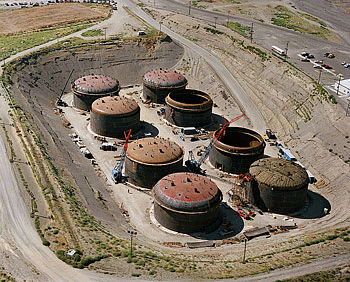 Will Hanford’s Big Clean-Up Ever Begin? Fifteen years past its originally scheduled start-up date, the nuclear facility’s glassification plant is way over budget and no one seems able to nail down a deadline. At fault, say critics, are mismanagement, frequent turnover in the top brass, and a culture that doesn’t take kindly to criticism. Seattle News Weekly, By John Stang , Dec 15 2015 “……….The story of Tamosaitis’ unheralded warnings is not the exception in the ongoing struggle to contain Hanford’s waste. Rather, this episode is just the latest in a litany of setbacks that has put the project over budget and off schedule again and again.
Officially, the reasons are that this is a first-of-its-kind project with difficult-to-perfect new technology.
In reality, the glassification project—like most of Hanford—resembles a giant Dilbert comic book. The culture is the culprit. There are immense corporate and social pressures to look good now and hope someone else is in charge when things go wrong later. These pressures include high turnover in upper management, bonuses to corporations, individual career advancement, and retaliation against those who rock the boat at inconvenient times. Continue reading
Kentucky history illustrates the real disaster of nuclear energy
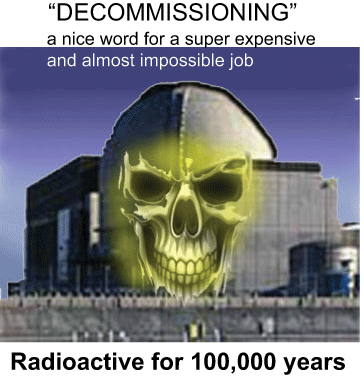 And then there are the power plants themselves after they have completed their 30-40-year life. Do you build a lead mausoleum around it and then another one around it? You certainly can’t dismantle it and take it off to nowhere.
Be wary, Kentucky legislators, when thinking about entering the nuclear field.
KY should stay far from nuclear power http://www.courier-journal.com/story/opinion/2015/12/17/commentary-nuclear-power-waste/77473024/ David Ross Stevens Kentucky history tells us that the commonwealth should stay as far away as possible from nuclear power. Yet the recently past Energy Secretary Len Peters was proposing to the Kentucky legislature that it consider allowing uranium-powered electricity plants. Now there is a new Energy and Environment Cabinet secretary in Charles Snavely, who represented the coal company that was justfined $500,000 to $6 million for water pollution violations. (But that’s another story.) Will Snavely include nuclear energy with a mix of energy in Kentucky’s future?
As coal continues to decline mainly because of natural gas prices and as solar/wind power flex their muscles, nuclear energy always seems to hover on the horizon like an enticing siren.
Here is why Kentucky and every other state should avoid nukes like the plague. Most of the negatives happen in the uranium enrichment cycle before making electricity and in the storage (or non-storage) of radioactive wastes after electrical generation. Both have been disasters for the state: at the uranium enrichment plant at Paducah and at the radioactive waste deposit site at Maxey Flats near Morehead. Continue reading
The importance of understanding USA’s nuclear triad
What the nuclear triad is, why it matters By Kingston Reif December 16, 2015 Kingston Reif is the director for Disarmament and Threat Reduction Policy at the Arms Control Association. @KingstonAReif.(CNN)National security issues dominated Tuesday night’s Republican presidential candidate debate. And while the recent terrorist attacks in Paris and San Bernardino — and the conflict with ISIS — took center stage, the candidates also sparred on the under-the-radar issue of nuclear weapons policy. The question is whether any of the candidates fully understand quite how critical this subject is to America’s security.
As former Defense Secretary William Perry recently warned, the United States and Russia are on the verge of a new nuclear arms race, and Washington is currently planning to spend roughly $1 trillion dollars on nuclear weapons over the next 30 years without any real national debate.
How did the candidates do on the issue Tuesday?
Debate panelist Hugh Hewitt asked Donald Trump and Sen. Marco Rubio how they would approach the stewardship of America’s aging nuclear arsenal. Trump clearly had not done his homework on the subject, ending a rambling answer with “nuclear is just the power, the devastation is very important to me.”
Rubio, meanwhile, said that all three legs of America’s nuclear triad — submarines, land-based missiles, and bombers –“are critical” and in need of modernization. Ironically, he recommended the same course of action that President Barack Obama is pursuing: namely, a multi-hundred-billion-dollar plan to rebuild all three legs of the triad and their associated warheads and supporting infrastructure.
While many Republicans believe that the Obama administration has allowed America’s nuclear weapons to atrophy, the reality is that the administration has requested huge increases for nuclear weapons programs at the Defense and Energy Departments to sustain and modernize the arsenal.
For example, the administration’s fiscal year 2016 request for nuclear weapons programs at the Energy Department is roughly $3.5 billion more than the Bush administration’s final budget request. In fact, the GOP-led Congress has provided less funding for this program than requested by President Obama.
The reality is that the key issue is not so much that the Obama administration has spent too little on nuclear weapons, but that its current plans are unrealistic and would sustain an arsenal that U.S. military leaders have concluded is larger than necessary to deter a nuclear attack against America and its allies.
According to a Congressional Budget Office report in January, the direct costs of the administration’s plans for nuclear forces will total about $350 billion between fiscal 2015 and fiscal 2024. And this is just the tip of the spending iceberg, as most of these modernization programs are still in the research and development phase. Over the next 30 years, the bill could add up to $1 trillion, according to three separate independent estimates.
Meanwhile, U.S. military leaders continue to warn that the United States faces a cash crunch in the near future when it comes to sustaining and modernizing nuclear forces………
Ultimately, though, no matter what one’s perspective is on the role of nuclear weapons in U.S. national strategy — and whether the current plan to rebuild a bloated U.S. arsenal is necessary or affordable — the GOP candidates for president should at least be able to explain to the American people how the they propose to pay for the current modernization plans. And they should also be prepared to tell taxpayers why they should pay for more nuclear weapons than is required for deterrence, and how they would seek to reduce the danger to the United States posed by Russia’s nuclear arsenal. http://edition.cnn.com/2015/12/16/opinions/reif-nuclear-weapons-policy/
Nuclear Regulatory Commission: obfuscation when it comes to Freedom of Information
 NRC management of FOIA requests puzzling experts, Enformable, Lucas W Hixson 16 Dec 15 Many people know of my interest in the release of information through the Freedom of Information Act by the Nuclear Regulatory Commission.
In October 2014, I participated in a meeting with Dave Lochbaum of Union of Concerned Scientists, Lawrence Criscione (who works for the Nuclear Regulatory Commission, but was participating in the meeting as a private citizen), Tim Judson of Nuclear Information Research Service, Jim Riccio of Greenpeace, Paul Gunter of Beyond Nuclear and the NRC Staff. During that meeting each of the participants presented their concerns with how the NRC was interpreting certain FOIA rules. My particular concerns that I presented at that meeting pertained to documents released relating to the Fukushima Daiichi nuclear disaster.
After that meeting, a group of participants (Lochbaum (Chairman), Judson, Riccio, Gunter, and Hixson) determined to form an official committee to interface with the Nuclear Regulatory Commission on FOIA-related activities. That is how in December of 2014 the Freedom of Information Team (FIT) came into being……..
Tateiwa was in Tokyo in the early days of the Fukushima Daiichi nuclear disaster, translating TEPCO press releases from Japanese to English, meeting with the EU delegation and the NRC. He was also present at a very important meeting on March 27th in Tokyo between NISA, INPO, and the NRC. He participated in the IAEA Preliminary Fact-Finding visit to the Fukushima Daiichi plant in April 2011 and May 2011. In June 2011 he was at the private residence of U.S. Ambassador Roos trying to reinforce ties, and in August he was aiding the INPO-led support team at Fukushima Daiichi. By September 2011, Tateiwa was transferred to the TEPCO office in Washington D.C.
I felt that there was much that the public could learn and benefit from a better understanding of what Tateiwa knew and when and what he relayed to the NRC and when, so I asked Mr. Lochbaum to FOIA for all communication and materials transmitted between Mr. Tateiwa and any member of the NRC.
Dave Lochbaum submitted a FOIA request on Wednesday, August 5th, 2015 at 10:36:17 A.M. for “All materials transmitted between Mr. Kenji Tateiwa and the NRC from March 1, 2011, to date. Also, all written communications (e.g., emails, memos, letters, reports) between Mr. Kenji Tateiwa and the NRC from March 1, 2011, to date. By letter dated April 23, 2015 (ML15113B323), the ACRS Chairman conveyed appreciation to TEPCO, Mr. Tateiwa’s employer, for his appearance before the ACRS on April 10, 2015. The ACRS chairman stated that Mr. Tateiwa had “unique insights” and had great “familiarity with the Fukushima Daiichi issues.” UCS is aware that Mr. Tateiwa has had extensive experience with the Fukushima response and cleanup and seeks more of his “unique insights.””
No response was ever received from the NRC…….
Clearly, previous FOIA requests by other organizations and individuals encompassed emails and should’ve included Tateiwa’s records, but when Dave searched the NRC ADAMS database, he could only find ten records – six of them being FOIA responses.
Dave requested that the NRC not limit the scope of the FOIA request and to make all documents requested available. This morning he also sent an email to Hubert Bell, Inspector General of the NRC, asking him to look into potential NRC staff wrongdoing by not releasing some, if not all, of these records in response to prior FOIA requests.
Mr. Lochbaum’s concerns are that either the NRC program office is lying now about the inventory of unreleased records to/from Mr. Tateiwa in their possession, or that the NRC violated federal FOIA law by failing to release some or all of these records in response to numerous prior FOIA requests.
You can bet that we will be watching these events develop closely.http://enformable.com/2015/12/nrc-management-of-foia-requests-puzzling-experts/
Kansas’ nuclear workers with cancer from exposure to radiation
A 2008 government investigation uncovered processes that produced radioactive dust that workers would have inadvertently breathed in and eaten – and buildings given a soap-and-water cleanup and repurposed after Spencer sold off its nuclear operations.
National Institute for Occupational Safety and Health – a division of the Centers for Disease Control and Prevention – did conclude that because of deficiencies found in the way materials were handled, it was likely that workers outside the nuclear operation were also exposed to dangerous levels of radioactive materials
 Kansas cancer survivors fight for compensation for radiation exposure decades ago
Cancer survivors seeking compensation complain of delays, red tape
THE WICHITA EAGLE, BY DION LEFLER dlefler@wichitaeagle.com GALENA , 17 Dec 15
Robert and Sharon Houser are part of a “Special Exposure Cohort.”
It’s an honor they’d just as soon have done without.
What it means is that it may be marginally easier for them to get compensation from the government for the cancers they’ve suffered, which could be related to radiation exposure from when they worked at the Spencer Chemical Co.’s Jayhawk Works just north of Galena.
They were there when the company made a brief foray into processing uranium for the fledgling nuclear power industry in the 1950s and 1960s. Continue reading
Strong wind power takes over New York’s electricity as nuclear station shut down
 Wind Rescues New York Power After Nuclear Plant Shutdown Naureen Malik , Bloomberg, December 16, 2015 A nuclear reactor that supplies Manhattan unexpectedly went offline Monday night, though you wouldn’t know it to look at power prices.
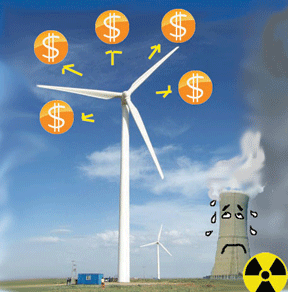
The Indian Point 3 plant, 27 miles (43 kilometers) north of New York City, automatically shut down at 7 p.m. because of an electrical disturbance, owner Entergy Corp. said in an e-mailed statement late Monday. The last time that happened,spot power more than doubled. Tuesday, wind turbines in the state came to the rescue, running close to capacity and compensating for the loss of the reactor.
While renewables make up a small portion of U.S. generating capacity, wind and solar have subdued prices and at times curtailed the need for plants that rely on coal and natural gas. Meanwhile, Entergy is facing political and economic pressure as Governor Andrew Cuomo seeks to shut the plant while power prices in December head for the lowest monthly average on record.
Spot wholesale power for New York City fell $27.34, or 56 percent, to $21.33 per megawatt-hour in the hour ended at 1 p.m. compared with the same period Monday, according to grid data compiled by Bloomberg……..http://www.bloomberg.com/news/articles/2015-12-15/wind-rescues-new-york-power-prices-after-nuclear-plant-shutdown
New York Governor Cuomo orders investigation of Indian Point Nuclear Station
 Cuomo calls for investigation of Indian Point nuclear plant http://news10.com/2015/12/16/cuomo-calls-for-investigation-of-indian-point-nuclear-plantcuomo-calls-for-investigation-of-indian-point-nuclear-plant/By Ali Stewart December 16, 2015 ALBANY, N.Y. (AP) – Gov. Andrew Cuomo has directed state utility regulators to begin a full investigation of the operations and safety protocols at the Indian Point nuclear power plant on the Hudson River about 30 miles north of Manhattan.
Plant owner Entergy says federal regulators with nuclear expertise say the plant is safe.
Monday evening, one reactor was automatically shut down. The company says the disturbance on the non-nuclear side of the plant is related to a high voltage transmission line. There was no release of radioactivity and no threat to the public.
The other reactor was shut down for three days earlier this month due to a tripped circuit breaker. The two reactors together supply about one-quarter of the power used in New York City and Westchester County.
Huge in crease in medical insurance claims by nuclear workers
Medical Care, Compensation Increase for Texas Nuclear Plant Workers http://www.insurancejournal.com/news/southcentral/2015/12/15/391907.htm December 15, 2015 The past few years have seen an increase in the number of workers at a nuclear weapons plant in the Texas Panhandle who have been compensated and given medical care for conditions caused by exposure to plant hazards.
Those hazards include chemicals in the maintenance warehouse, toxins on a production line and beryllium, a cancer-causing metal used in the production of nuclear warheads, according to the Fort Worth Star-Telegram.

The paper reviewed federal totals for health care and compensation awarded for workplace-related illnesses at the Pantex plant near Pampa.
About 20 percent of the worker claims for compensation were approved at the nation’s top facility for nuclear weapon assembly, disassembly and maintenance. Now, about half are being approved for workers across the 16,000-acre site, including auditors, firefighters, laboratory workers, janitors and security guards.
About $171 million in compensation and medical bills has been paid more than 1,300 workers and families since the Energy Employees Occupational Illness Compensation Program began in 2000.
The number of claimants was beyond estimates by those who devised the program, said Sarah Ray, a former Pantex critical safety systems training specialist, who has filed thousands of claims on behalf of Pantex workers and their families since the program started.
“Overall, there just has not been a real grasp of the true situations faced by nuclear weapons workers,” said Ray, who believes that thousands more are unaware they’re sick because they have not developed symptoms. Rachel P. Leiton, director of the Labor Department’s program, says the agency has over the years implemented shortcuts to ease access to the program for families.
“We try to the best we can to compensate them based on our statutory authority that we’re given,” she said.
Workers at Pantex undergo required annual physicals in which they submit blood samples sent for analysis to National Jewish Health, a Denver-based medical research facility that specializes in respiratory and allergic disorders.
Nuclear power an expensive distraction from REAL solutions to climate change – Gregory Jaczko
Given the lead-time of about ten to fifteen years for nuclear power plant design, approval and construction, a massive program of new construction would need to begin within the next few years to start to replace the soon-to-be-retiring units.
 The latest poster child for nuclear climate change salvation is a fleet of advanced reactors, which — on paper — do provide enticing improvements to the current generation of reactors. At best, however, this technology is several decades from becoming commercially viable, too far into the future to be relevant.
The reality with nuclear power is that it has proven time and again to take longer and cost more to develop than predicted. There is nothing in the new designs nor the performance of the industry today that suggests this trend will end.
 Nuclear Power and Climate Change http://www.huffingtonpost.com/gregory-jaczko/nuclear-power-and-climate_b_8806792.html?ir=Australia 15/12/2015 Gregory Jaczko Fmr. US Nuclear Regulatory Commission Chairman and Commissioner As world leaders convene in Paris in an attempt to prevent a rise in global temperatures, the nuclear industry has — not surprisingly — seized this moment to once again promise the perfect solution to the climate challenge. Having witnessed this industry up close for the last decade and a half, I am concerned that the uniquely perfect promise of safe, clean, predictable, and affordable nuclear power will divert our focus from solutions that will actually work to control greenhouse gas emissions. Continue reading
Official data now reveals hugh extent of Fukushima radiation to USA West Coast
OFFICIAL DATA: FUKUSHIMA BOMBARDED WEST COAST WITH 790X NORMAL RADIATION http://www.thedailysheeple.com/official-data-fukushima-bombarded-west-coast-with-790x-normal-radiation_122015 DECEMBER 14, 2015 | JOSHUA KRAUSE | THE DAILY SHEEPLE |Ever since the meltdown of the Fukushima Daiichi power plant in 2011, our government has been pretty quiet about the environmental and health implications of that disaster. When the plant first melted down, much of our population was justifiably alarmed. After all, many of us remembered the Chernobyl incident and how the radiation it produced spread all across Europe, and in smaller amounts, the world.
But the government assured us that everything would be fine, and at most we would see a negligible amount of radioactive particles in the United States. Everyone who said otherwise was and still is, called a quack or a conspiracy theorist.
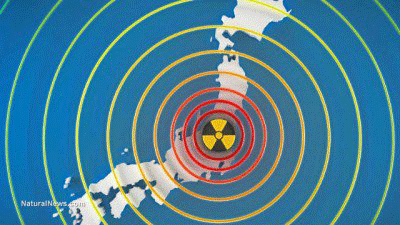
However, official government data that was collected in 2011 has just seen the light of day, and it suggests that our initial concerns were probably correct. The information was collected by officials with Los Angeles County when concerns were raised by residents. After state and federal agencies failed to test the area for radiation in a timely manner, the county hired their own people to run the test. Natural News reported on the results.
Samples were taken between April 29 and May 2, 2011, approximately seven weeks after the radioactive releases from Fukushima. The county found that gross alpha radiation levels at a location in Los Angeles were 300 femtocuries per cubic meter (fCi/m3), and levels at a Hacienda Heights location were 200 fCi/m3.
For context, the Lawrence Livermore National Laboratory reports the average (annual median) level of gross alpha activity for the state of California as just 0.38 fCi/m3 – that is, 790 times lower.
The levels detected in Los Angeles County were a full 100 times higher than the level that requires an investigation at a U.S. nuclear laboratory, according to the Environmental Monitoring Plan at Brookhaven National Laboratory: “If the gross alpha activity in the [air] filters is greater than 3 fCi/m3, then collect more samples in the vicinity, and project manager will review all detections above the limits … All values greater than the above-stated gross alpha/beta concentration shall trigger an investigation.”
Finally, the Los Angeles County levels were almost 15 times higher than the federal regulatory limit for alpha radiation, which is 21 fCi/m3, according to a 2010 document from Idaho National Laboratory.
Moreover, the alpha radiation emitting particles that were deposited on the West Coast are incredibly dangerous for humans. While Gamma and Beta Radiation have far more power and penetration, Alpha rays produce a tremendous amount of damage in the human body when ingested. Because they don’t penetrate materials like Gamma rays do, all of their energy is deposited into the cells that reside near the particle.
More importantly, it doesn’t take very many of these particles to ruin your long-term health. For instance, if you were exposed to a temporary large dose of radiation, your body could probably recover from it, perhaps without even developing cancer. But when the particle itself is embedded in your tissue for weeks, months, and in some cases for years, as it destroys and mutates surrounding cells over and over again, you can expect a significantly shorter lifespan. Even if the amount radiation is small, it’s also continuous, and its source is difficult to remove
So while the government was telling us that everything was hunky dory in the weeks after the Fukushima meltdown, major West Coast cities like Los Angeles were being drenched in alarming levels of this radioactive waste.
Who knows how much of that fell onto the countless farms in the Central Valley, which feed much of the United States? And since they failed to inform us about the danger we were in then, who knows how much danger we are in now? Our government hates to admit when its wrong (or they won’t admit that they lied to us), so if we are still in danger, somehow I doubt they will have anything to say to us now.
Delivered by The Daily Sheeple
We encourage you to share and republish our reports, analyses, breaking news and videos (Click for details).
Contributed by Joshua Krause of The Daily Sheeple.
Joshua Krause is a reporter, writer and researcher at The Daily Sheeple. He was born and raised in the Bay Area and is a freelance writer and author. You can follow Joshua’s reports at Facebook or on his personal Twitter. Joshua’s website is Strange Danger .
Once again the world at the nuclear brink
 The New Nuclear Arms Race Former Clinton Defense Secretary offers dire warning. The Nation 16 Dec 15 By Katrina vanden Heuvel
Two decades later, Perry has written a new book, “My Journey at the Nuclear Brink,” in which he offers a dire warning: “Far from continuing the nuclear disarmament that has been underway for the last two decades, we are starting a new nuclear arms race.”
This is not hyperbole. The United States and Russia are acting with increasing belligerence toward each other while actively pursuing monstrous weapons. As Joe Cirincione described in the Huffington Post, the Pentagon plans to spend $1 trillion over 30 years on “an entire new generation of nuclear bombs, bombers, missiles and submarines,” including a dozen submarines carrying more than 1,000 warheads, capable of decimating any country anywhere. In the meantime, President Obama has ordered 200 new nuclear bombs deployed in Europe.
Read the full text of Katrina’s column here. http://www.thenation.com/article/the-new-nuclear-arms-race/
America’s nuclear workers: 33,480 died from radiation- caused illnesses
At least 33,480 US nuclear workers died of exposure: Report http://www.presstv.ir/Detail/2015/12/13/441510/US-nuclear-arsenal-dead-Cold-War A yearlong investigation reveals that America’s great push to win World War II and the Cold War has left “a legacy of death on American soil,” with at least 33,480 US nuclear workers dying of radiation exposure over the course of the last seven decades.
The death count, disclosed for the first time, is more than four times the number of American fatalities in the wars in Iraq and Afghanistan, according to a report from McClatchy called “irritated.”
The investigation has exposed the “enormous human cost” of the US nuclear weapons complex using more than 70 million records in a database obtained from the US Department of Labor under the Freedom of Information Act.
The count includes all workers who died after they or their survivors were compensated under a special fund established in 2001 to help those who were exposed to deadly materials while building the US nuclear stockpile, the report said.
A total of 107,394 workers, involved in the construction of America’s nuclear arsenal, have been diagnosed with cancers and other diseases over the last seven decades, records from an interactive database showed.
In addition to utilizing the federal data, McClatchy’s investigation is also based on over 100 interviews with nuclear workers, government officials, experts and activists.
The report noted that US government officials greatly underestimated how sick the nuclear workforce would become. At first, the government estimated that the compensation program would cost $120 million a year to cover 3,000 people. However, 14 years later, the government has spent $12 billion of taxpayer money to compensate more than 53,000 nuclear workers.
Despite the enormous costs, federal records show that only fewer than half of those who sought compensation have had their claims approved by the US Department of Labor.
Decades after the first victims of the radiation exposure have been identified; McClatchy’s investigation revealed that current safety standards have not reduced the exposure rates and day-to-day accidents in America’s nuclear facilities.
The government, meanwhile, seeks to save money by cutting current workers’ health plans, retirement benefits and sick leave. More than 186,000 nuclear employees have been exposed since the compensation program was created in 2001.
McClatchy conducted the project in partnership with the Investigative Fund of the Nation Institute, a nonprofit media center in New York City.
The report comes as the US prepares to upgrade its aging nuclear arsenal to the tune of $1 trillion over the next 30 years.
Idaho nuclear workers: 360 killed by by exposure to radiation

 Federal government acknowledges nuclear radiation likely killed 396 in Idaho, George Zapo, Inquisitr, 13 Dec 15 The federal government acknowledged that nuclear radiation work performed at an Idaho site likely caused or contributed to the deaths of 396 workers. Hundreds of Idaho National Laboratory (INL) employees have filed health insurance claims, declaring the nuclear radiation work they performed at the United States’ leading center for nuclear energy research and development caused them to become ill, and in many cases die prematurely.
Jim Delmore worked at INL since 1966. He is one of the top experts in the nation on mass spectrometry, an analytical chemistry technique. He’s retired now, but he continues to work at the INL as a senior fellow.
Jim said has suffered through several bouts of five different cancers — all in remission now. Based on what he knew from a 1972 incident, he made a claim in 2013 under the Energy Employees Occupational Illness Compensation Program Act.
On November 13, 1972, Jim Delmore came to the laboratory he ran at the Idaho National Laboratory, and found the facility roped off from entry because of a plutonium contamination. It turns out, a chemist brought a sample of plutonium nitrate into the Mass Spectrometry Laboratory at the Idaho Chemical Processing Plant the day before that was 10,000 times larger than needed, Delmore said.
The plutonium nitrate spread throughout the lab. Internal tests showed the dose to the lungs of the 13 lab staff was small. However, it also showed that several of the workers had been previously contaminated and had not been adequately monitored.
Delmore received $150,000 in compensation. In addition, other INL workers, who were able to prove their work with nuclear radiation likely contributed to, or caused their illness, received part of $53 million in health care costs paid under the program.
Another $188 million was paid to the survivors of 471 former INL workers who’ve died, according to the Department of Labor.
The federal government acknowledged for the first time this year nuclear radiation work done by workers at Idaho National Laboratory probably caused or contributed to the deaths of 396 workers.
Though the U.S. federal government compensated the families of nearly 480 INL workers who died, official say that only 396 workers proved to the government’s satisfaction that nuclear radiation exposure at INL was 50 percent or more responsible for their deaths. So far, 15,809 of the nuclear worker deaths nationwide fit that test.
Idaho National Laboratory employees have been finding it difficult to prove eligibility. In fact, nearly two of every three claims are denied. When an INL worker has a disease that qualifies, they also have to prove they had been exposed to high levels of nuclear radiation or hazards.
Fortunately, because Jim Delmore brought the 1972 nuclear radiation incident and the lack of internal monitoring to the attention of the National Institute for Occupational Safety and Health (NIOSH) in his 2013 claim, many former employees may be eligible for compensation without having to prove anything — except that they have a qualifying disease.
Jim Delmore simply responded about the eligibility of his co-workers…….. http://www.inquisitr.com/2630254/government-acknowledges-nuclear-radiation-likely-killed-396/
Kansas nuclear workers: sickness and death toll from radiation-induced illness
nearly 300 former Kansas City Plant workers who have received more than $55 million in compensation for illnesses linked to their work, according to an analysis of government data obtained by McClatchy Newspapers through the Freedom of Information Act.
In more than half of the cases, the money went to survivors after the workers died.
Most of those who applied to the federal fund got nothing, including the families of at least 554 deceased Kansas City Plant workers whose claims the government denied.
Kansas City’s nuclear legacy trails weapon makers and their families
Scores of workers have died after making nuclear weapons at the Bannister Road plant
A government review finds more radioactive materials used at the plant than was known before
The federal government has paid $55 million to sickened workers, but a vast majority are still frustrated that they have not been compensated The Kansas Cty Star, BY LINDSAY WISE lwise@mcclatchydc.com AND SCOTT CANON scanon@kcstar.com 13 Dec 15 Marlon Smith , worked as a roofer at the Bannister Federal Complex in south Kansas City for just five months in 2005.
That’s all the time it took for him to suffer irreparable damage to his lungs by inhaling particles of beryllium, a hazardous metal used in nuclear weapons production.
Today the 58-year-old has chronic beryllium disease, a serious respiratory condition that can be fatal.
Smith says the subcontractor he worked for never warned him about the dangers of beryllium exposure, even after he asked why other workers in a tent a few yards away from him were fully suited in protective gear.
“I said, ‘Where is my suit?’ ” he recalls. “They said, ‘You don’t need one. You need just a dust mask.’ ”
News that beryllium and other toxins sickened workers at the site broke years ago. But a recent investigation by the federal government revealed that some employees at the Kansas City Plant might have been exposed to more radiation than previously known. Already, the government has paid workers from the plant, or their survivors, tens of millions in compensation for illnesses and deaths. That figure is still growing……..the latest investigation by the National Institute for Occupational Safety and Health and an advisory board appointed by the president has turned up proof that operations at the site in the 1950s, ’60s and ’70s involved more radioactive materials — and potentially higher radiation doses to workers — than previously disclosed in the public record.
More than 1,440 workers who fell ill after working at the Kansas City Plant have applied for compensation and medical coverage from the federal government. The money comes from a fund created in 2001 to recognize the sacrifices made by nuclear workers who helped America fight the Cold War.
Smith received a check this year for $150,000 from the federal government, a sum he considers a paltry price for his life and livelihood.
“How can you put a price on somebody’s life?” he asked.
The roofer is in a group of nearly 300 former Kansas City Plant workers who have received more than $55 million in compensation for illnesses linked to their work, according to an analysis of government data obtained by McClatchy Newspapers through the Freedom of Information Act.
In more than half of the cases, the money went to survivors after the workers died.
Most of those who applied to the federal fund got nothing, including the families of at least 554 deceased Kansas City Plant workers whose claims the government denied.
The approval rate for cases involving former workers at the plant is particularly low at just 23 percent — less than half the national average, McClatchy’s analysis found.
Workers and their relatives say they’re confounded by the paperwork and bureaucracy of the claims process.
Otha Gilliam has a stack of documents for his late parents’ compensation cases at least a foot thick in his home in south Kansas City.
The struggle to follow through with the claims leaves him overwhelmed……..
As the government now acknowledges, work with natural uranium took place at the plant in the early 1950s. Natural uranium emits about twice as much radioactivity per gram as depleted uranium. Workers also machined magnesium alloys containing thorium, a radioactive element, in the 1960s and ’70s. And they used tritium, a radioactive isotope of hydrogen, to prepare calibration sources and produce luminescent switch plates. Radioactive nickel-63 was plated on disks that also were used to calibrate radiation detectors.
The natural uranium and mag-thorium alloy machining could result in the biggest bumps to workers’ estimated radiation doses, said Stuart Hinnefeld, director of NIOSH’s Division of Compensation Analysis and Support……..http://www.kansascity.com/news/government-politics/article49473260.html
Texas nuclear workers sick and dying from exposure to radiation
widespread examples of payouts that occur only after a worker dies. She handled the claim of one widow who just this year received a payout on a claim that her husband filed in 2005. The husband died of cancer in 2011.
“Many claimants have commented that they think the claims are drug out so that the claimants die,” Ray said. “It truly is less costly to pay a survivor than it is to pay compensation and provide long-term healthcare for a living worker.”
Half of all claims are settled on behalf of survivors, including workers’ spouses, children, parents, grandchildren and grandparents
The perils of Pantex: Hundreds of workers sickened at Texas nuclear weapons plant, Star telegram, 13 Dec 15
Panhandle nuclear weapons assembly plant a hazardous workplace
Workers used to joke that they made soap at the facility
More than 1,300 workers and families have been awarded compensation since 2000 BY YAMIL BERARD yberard@star-telegram.com
AMARILLO “…..Years ago, it was popular for plant workers to tell spouses and other loved ones that they made soap at the nuclear weapons assembly facility on a 16,000-acre parcel. But Pantex now conjures up a different image, as hundreds have suddenly fallen ill or died at the plant, a vital component in the nation’s nuclear weapons program since the 1950s.
The federal government has made concessions to a growing number of workers, like Ruzich, whose Pantex jobs made them sick. Many hundreds have been provided with medical coverage and lump sum payments, under the energy employees’ compensation program, according to records provided to the Star-Telegram by the Labor Department.
Bob Ruzich, now 64, said he never thought the chemicals in the maintenance warehouse and the toxins on the production line would give him throat and tongue cancer.
“I didn’t think much about it, but I do now believe that’s what caused my cancer,’’ said Ruzich, who worked dismantling warheads and in the maintenance department since 1982.
Several years ago, less than 1 in 5 claims were decided in favor of workers and their families, according to records provided to the Star-Telegram. Now, more than half are typically handed compensation and medical care because of a prevalence of scientific evidence that their illness was caused by an exposure to plant hazards, records say.
All told, $171 million in compensation and medical bills has been disbursed to more than 1,300 workers and families since the energy employees’ compensation program began in 2000, the program’s numbers say.
“The number of claimaints or sick workers was beyond the expectations of those who originally created the program,” said Sarah Ray, a former Pantex critical safety systems training specialist, who has filed thousands of claims on behalf of Pantex workers and their families since the program started.
“Overall, there just has not been a real grasp of the true situations faced by nuclear weapons workers,” said Ray, who believes that thousands more aren’t aware that they are sick because they have not developed symptoms…….
Since 2000, David Pompa has documented each sick case in a running log that includes more than several hundred employees. Over the years, Pompa has gone with the sick to see doctors, to meet with supervisors and staff members and to special hearings with government claims examiners, employees said……
Ray, the former Pantex training specialist, said she now hears of more families burying their dead.
“Workers at Pantex are walking time bombs,’’ Ray said. “They have this false bravado — especially the guys. Then all of a sudden, they are really, really sick and they learn they are deathly ill from some lung problem. Then they’ve got something else and they die, just because they’re not paying attention to the minor signs.”……
Ray, who has filed thousands of claims on behalf of Pantex workers and their families, said it can take years for claimants to receive money or get healthcare assistance. Ray has a bachelor’s degree in business administration and a master’s in instructional technology.
She’s seen widespread examples of payouts that occur only after a worker dies. She handled the claim of one widow who just this year received a payout on a claim that her husband filed in 2005. The husband died of cancer in 2011.
“Many claimants have commented that they think the claims are drug out so that the claimants die,” Ray said. “It truly is less costly to pay a survivor than it is to pay compensation and provide long-term healthcare for a living worker.”
Half of all claims are settled on behalf of survivors, including workers’ spouses, children, parents, grandchildren and grandparents, Leiton indicated……..http://www.star-telegram.com/news/state/texas/article49500030.html
1 This Month
15 October. Joint Appeal for Nuclear Abolition Day -presentation to the UN on October 15 will be live on UNWebTV
Endorse the Nuclear Abolition Day Appeal
23-25 October – on Zoom – World BEYOND War’s annual global conference

To see nuclear-related stories in greater depth and intensity – go to https://nuclearinformation.wordpress.com
-
Archives
- October 2026 (139)
- September 2026 (339)
- August 2026 (330)
- July 2026 (355)
- June 2026 (287)
- May 2026 (306)
- April 2026 (356)
- March 2026 (251)
- February 2026 (267)
- January 2026 (308)
- December 2025 (358)
- November 2025 (359)
-
Categories
- 1
- 1 NUCLEAR ISSUES
- business and costs
- climate change
- culture and arts
- ENERGY
- environment
- health
- history
- indigenous issues
- Legal
- marketing of nuclear
- media
- opposition to nuclear
- PERSONAL STORIES
- politics
- politics international
- Religion and ethics
- safety
- secrets,lies and civil liberties
- spinbuster
- technology
- Uranium
- wastes
- weapons and war
- Women
- 2 WORLD
- ACTION
- AFRICA
- Atrocities
- AUSTRALIA
- Christina's notes
- Christina's themes
- culture and arts
- Events
- Fuk 2022
- Fuk 2023
- Fukushima 2017
- Fukushima 2018
- fukushima 2019
- Fukushima 2020
- Fukushima 2021
- general
- global warming
- Humour (God we need it)
- Nuclear
- RARE EARTHS
- Reference
- resources – print
- Resources -audiovicual
- Weekly Newsletter
- World
- World Nuclear
- YouTube
-
RSS
Entries RSS
Comments RSS

