Christmas joy for the weapons makers, especially in USA
 US foreign arms deals up by nearly $13 billion December 27, 2015 Nicholas Fandos The United States controls just over 50 per cent of the world’s weapons markets, Read more: http://www.theage.com.au/world/us-foreign-arms-deals-up-by-nearly-13-billion-20151226-glv3sx.html#ixzz3vU4qe9zF Nicholas Fandos, 27 Dedc 15 . Washington: Foreign arms sales by the United States jumped by almost $US10 billion ($13 billion) in 2014, about 35 per cent, even as the global weapons market remained flat and competition among suppliers increased, a new congressional study has found.
American weapons receipts rose to $US36.2 billion in 2014 from $US26.7 billion the year before, bolstered by multibillion-dollar agreements with Qatar, Saudi Arabia and South Korea. Those deals and others ensured that the United States remained the single largest provider of arms around the world last year, controlling just over 50 per cent of the market.
Russia followed the US as the top weapons supplier, completing $US10.2 billion in sales, compared with $US10.3 billion in 2013. Sweden was third, with roughly $US5.5 billion in sales, followed by France with $US4.4 billion and China with $US2.2 billion.
South Korea, a key US ally, was the world’s top weapons buyer in 2014, completing $US7.8 billion in contracts. It has faced continued tensions with neighbouring North Korea in recent years over the North’s nuclear weapons program and other provocations. The bulk of South Korea’s purchases were made with the United States, worth more than $US7 billion, and included transport helicopters and related support, as well as advanced unmanned aerial surveillance vehicles.
Brazil, another developing nation building its military force, was third with $US6.5 billion worth of purchase agreements, primarily for Swedish aircraft.
The report to Congress found that total global arms sales rose slightly in 2014 to $US71.8 billion, from $US70.1 billion in 2013. Despite that increase, the report concluded that “the international arms market is not likely growing over all” because of “the weakened state of the global economy”.
It was the second successive year that global sales remained steady, suggesting that the market has begun to level off after several years of extreme fluctuation.
Read more:
Is America oblivious to the fact of sick and dying nuclear workers?
U.S. shrugs on nuclear worker safety http://www.kentucky.com/opinion/editorials/article50563650.html
Contractors cut health benefits in push to reduce costs
Their story is sad.
This is outrageous: Workers in U.S. nuclear facilities are still being exposed to radiation on the job and will suffer the consequences to their health and longevity.
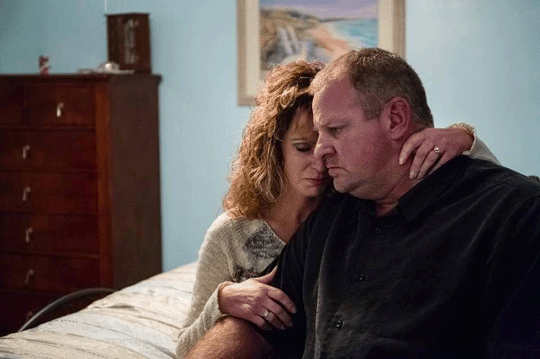
More than 186,000 workers have been exposed to radiation since 2001, when the federal government finally established a fund to compensate sick nuclear workers and their survivors.
The government has already paid $11 million to 118 workers who began working at nuclear weapons facilities after 2001, according to an exhaustive examination of federal data by the McClatchy Washington bureau.
Stronger safety standards and greater awareness are failing to protect today’s workers, even as the U.S. embarks on a $1 trillion, 30-year modernization of its nuclear arsenal.
(The goal is to reduce the number while sharpening the accuracy of our bombs. Whether the U.S. should pay so much to risk another nuclear arms race is a serious question for another day.)
The cost of compensating sick nuclear workers is also high, even though awards are relatively modest and workers and their families often must battle bureaucracy for years to qualify, according to McClatchy’s reporting.
Taxpayers have spent $12 billion so far to compensate nuclear workers whose sickness or deaths were linked to their occupations.
It’s significant that the government underestimated how sick its nuclear workforce would become. Original predictions were that the compensation program would serve 3,000 people. Instead, 53,000 sick workers have been compensated, while 107,394 have been diagnosed with cancer and other work-related diseases, and workers still are getting sick.
Some of the sick are Kentuckians who worked in Paducah, where uranium was enriched for weapons and military reactors and where environmental contamination is also a costly Cold War legacy. (Owned by the U.S. Department of Energy, the nation’s last remaining gaseous diffusion plant now produces nuclear fuel and is leased to a private corporation.)
As was the case in Paducah, nuclear workers still say that the risks are worth it because they have few or no alternatives that pay as well.
People in this line of work also say good health care benefits are a must but the government is pressuring contractors who run nuclear weapons facilities to reduce costs by cutting employee pay and benefits, including health care and sick leave.
As McClatchy reported from the Texas Panhandle, 1,100 union employees at the Pantex plant, where B61 gravity bombs are being modernized, went out on strike earlier this year to protest benefits cuts.
A partnership led by Bechtel and Lockheed Martin known as Consolidated Nuclear Security won the contract to run the Pantex plant and the Y-12 complex in Oak Ridge, Tenn. by promising to save the government $3.27 billion over 10 years
Bechtel and Lockheed Martin brought to the assignment a less than stellar record: a combined 11 complaints of retaliation against whistle blowers who raised safety concerns; and $70 million in violations, including falsifying test records and insufficient radiation controls, reports McClatchy.
The two companies’ employees and their survivors have received $200 million in compensation from taxpayers for job-related illnesses.
Pretending that nuclear workers no longer face serious health risks or that the government and its contractors are doing all they can to protect them is a brutal false economy. This country should do better.
USA’s historic nuclear targets, simply called “Population”
“this document may be history, but unfortunately the weapons are not yet history.”
1950s U.S. Nuclear Target List Offers Chilling Insight, NYT By SCOTT SHANEDEC. 22, 2015WASHINGTON — Target category No. 275 from the nuclear target list for 1959 may be the most chilling. It is called simply “Population.”

For the first time, the National Archives and Records Administration has released a detailed list of the United States’ potential targets for atomic bombers in the event of war with the Soviet Union, showing the number and the variety of targets on its territory, as well as in Eastern Europe and China.
It lists many targets for “systematic destruction” in major cities, including 179 in Moscow (like “Agricultural Equipment” and “Transformers, Heavy”), 145 in Leningrad and 91 in East Berlin. The targets are referred to as DGZs or “designated ground zeros.” While many are industrial facilities, government buildings and the like, one for each city is simply designated “Population.”
“It’s disturbing, for sure, to see the population centers targeted,” said William Burr, a senior analyst at the National Security Archive, a research group at George Washington University that obtained the target list in response to a request first made in 2006. Mr. Burr, who specializes in nuclear history, said he believed it was the most detailed target list the Air Force had ever made public.
The targets are identified only generically, with code numbers that correspond to specific locations. The exact addresses and names of facilities from that period are in a still-classified “Bombing Encyclopedia,” which Mr. Burr said he was trying to get declassified.
The 800-page document, marked “Top Secret” and in a fuzzy gray typescript, comes to light as the issue of air power and the possible targeting of civilians is again in the news. The United States has avoided bombing the Islamic State’s headquarters in Raqqa, Syria, for instance, because of the presence of civilian prisoners in the same complex.
But some presidential candidates have criticized President Obama for not ordering more strikes, including Senator Ted Cruz, Republican of Texas, who has called for “carpet bombing” the Islamic State in Syria and Iraq. When challenged, Mr. Cruz said that “the object isn’t to level a city.”
“The object is to kill the ISIS terrorists,” he added, using an acronym for the Islamic State.
The newly declassified target list is titled “Atomic Weapons Requirements Study for 1959.” It is essentially a huge spreadsheet, produced by the Strategic Air Command in 1956 and projecting what could and should be hit in a potential war three years later…….
Stephen I. Schwartz, an independent consultant on nuclear weapons policy and the co-author and editor of a 1998 book on American nuclear weapons, “Atomic Audit,” called the target list “grim and frankly appalling.” But he said he was pleased that the document had been published at a time when fewer and fewer Americans, including policy makers, have much knowledge of nuclear weapons.
“We’ve known the general contours of nuclear war planning for a few decades,” he said. “But it’s great that the details are coming out. These are extraordinary weapons, capable of incredible destruction. And this document may be history, but unfortunately the weapons are not yet history.” http://www.nytimes.com/2015/12/23/us/politics/1950s-us-nuclear-target-list-offers-chilling-insight.html?_r=0
Yet more radiation “hot spots” found in St Louis suburb, along with high cancer rates
 7 more nuclear waste “hot spots” found in St. Louis suburb http://www.cbsnews.com/news/seven-more-nuclear-waste-hot-spots-found-in-north-st-louis-county-missouri-suburb/ By VINITA NAIR CBS NEWS December 22, 2015, NORTH ST. LOUIS COUNTY, Mo. — Three-hundred residents of North St. Louis County crowded into a local gym, anxious about what they would hear. Soil near the local creek was contaminated by improperly stored nuclear weapons waste in the 1960’s and 70’s, and people have been getting sick.
The Army Corps of Engineers was there to deliver the latest test results.
Seven additional parcels have been identified,” one official announced.
The seven new “hot spots,” areas of low level nuclear contamination, were discovered as crews tested the creek this summer. The new sites include four commercial properties and three homes. Add in the five sites already slated for clean up, and that’s 12 places in the area with contamination.
- “Hot spot” near nuclear waste has St. Louis residents on edge
- “They found a tumor the size of a golf ball,” said Angela Powers. Last fall, she lost her 9-year-old grandchild Jordan to a brain tumor that is rare in children.
“If it came from this, wow, we want some answers. It’s making me angry. She was my only grandchild.”
It was a variety of rare illnesses that caught the attention of Jenelle Wright and her neighbors.
Four years ago, the group created a Facebook page that has since logged 2,700 cancers and autoimmune conditions around town. They begged federal health authorities to investigate.
“We’ve had to go through many battles, I don’t even know if I can count all of them…literally calling an agency 30 times and not having them return your phone call.”
- This month, they finally got results. The Centers for Disease Control sent a health assessment team to document the residents stories, which could confirm a link between radiation and the illnesses.
Mary Oscko has stage four lung cancer and blames it on the contamination.
“If I shake the table enough, you can’t eat your meal off of it. If I make enough noise, you’ll want to listen to me. And we are now starting to make enough noise. We’re standing up and saying “Hi, I’m Mary. I’m dying of cancer.'”
Residents are hoping the health study might result in compensation for their medical bills and their homes. But the assessment could take two years, and some folks like Oscko are worried they won’t be around to see it concluded.
Savannah River Nuclear Station’s scandal of sick and dying workers
Ailing nuclear workers: Relying on Jesus and morphine, Charlotte Observer, 13 Dec 15
‘Smitty’ dies at 62 from cancer after working as a reactor operator
No compensation for him, or for thousands of other workers
Frustration with government from workers across the country
BY ROB HOTAKAINEN, SAMANTHA EHLINGER AND MIKE FITZGERALDMcClatchy Washington Bureau AUGUSTA, GA. 19 Dec 15

On an oven-hot Sunday in late August, Smitty wore white dress shorts and a cool lilac shirt that contrasted nicely with his salt-and-pepper hair, dozing in the front pew of the Southside Baptist Church.
Holding a black zippered Bible on his lap, he had his left leg stretched out all the way, resting it on two pillows on the seat of a wheelchair positioned just in front of him. He did it that way to protect a raw wound from a blood clot that ran from his knee to his hip. Doctors told him it was one of the biggest clots they’d ever seen.
[Irradiated: Read the full four-part report]
After working 17 years at the Savannah River nuclear weapons plant, just across the Georgia state line in South Carolina, Smitty found out on Sept. 11, 2008, 10 years after he retired, that he had multiple myeloma, a cancer.
Just like 54,005 other workers who have tried to get help from the federal government after getting sick at a nuclear weapons plant, Smitty never got a penny.
At 62, he relied instead on Jesus and morphine.
That meant up to two 30 milligram tablets of morphine sulfate every four to six hours, as needed, and prayers all day long, including the reading of at least one chapter in the Bible each day…….
Until the end, Smitty said he could not understand how the feds could say there was insufficient evidence to approve his claim for compensation. He said it was particularly perplexing because federal officials first led him to believe that his claim would be accepted, then suddenly ruled against him.
“I thought I was approved and shared it with my wife, and within no time at all, it was disapproved,” Smitty said……..
Survivors such as Priscilla Maez Clovis of Albuquerque, N.M., say the people who run the Energy Employees Occupational Illness Compensation Program are doing what they’ve always done: “Delay, deny, until you die.”
Over the past year, McClatchy journalists found that, on average, it takes 21.6 months for a claimant to get approved, while 20,496 workers spent five or more years navigating the bureaucracy. The government’s data shows that one production worker at a defunct facility in Portsmouth, Ohio, had to wait 14 years for compensation. The unidentified employee had bladder and brain cancers.
Across the nation, stories of frustration abound:………
The Investigative Fund of The Nation Institute, a nonprofit media center based in New York City, helped support this project. http://www.charlotteobserver.com/news/nation-world/article49568870.html
USA Dept of Energy starting to begin to plan for nuclear waste disposal
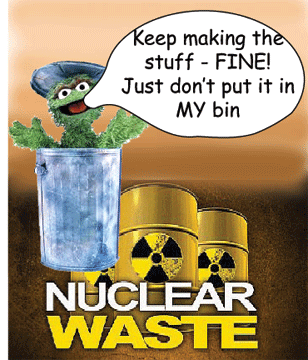 DOE launches nuclear waste disposal initiative http://thehill.com/policy/energy-environment/263959-doe-launches-nuclear-waste-disposal-initiative By Timothy Cama – 12/21/15 The Department of Energy is formally launching its initiative aimed at establishing a disposal site for spent nuclear fuel.
The department said Monday that it is accepting input on the disposal plan, which centers on finding at least one place to store spent fuel, with the consent of the local community.
It’s a key step toward rolling out what the Obama administration thinks is the best way forward for nuclear waste disposal.
It stands in stark contrast to the proposed Yucca Mountain nuclear waste repository in Nevada, which was designated by Congress to be the country’s main waste site, but which the Obama administration canceled amid strong local and state opposition to it.
“The launch of our consent-based siting initiative represents an important step toward addressing this nuclear waste management challenge, so that we can continue to benefit from nuclear technologies,” Lynn Orr, the Energy Department’s deputy secretary for science and energy, wrote in a Monday blog post.
While it will take years before the first pilot storage site is established, the administration’s action nonetheless is a small step toward solving the problem of nuclear waste sitting at dozens of current and former nuclear power plants and defense-related sites around the country.
The administration’s plan is largely informed by a wide-ranging 2013 report from a blue-ribbon commission, which concluded that a “consent-based” waste site is the ideal strategy and alternative to Yucca.
Los Alamos National Security loses contract to manage nuclear weapons lab after 2017
Contract to manage federal nuclear weapons lab up for grabs after 2017 http://www.nwherald.com/2015/12/21/contract-to-manage-federal-nuclear-weapons-lab-up-for-grabs-after-2017/apybmgs/ By The Associated Press LOS ALAMOS, N.M. – The $2 billion contract to manage one of the federal government’s premier nuclear weapons laboratories will be up for grabs after 2017. The National Nuclear Security Administration has decided not to grant an extension of Los Alamos National Security’s contract to run the Los Alamos National Laboratory.
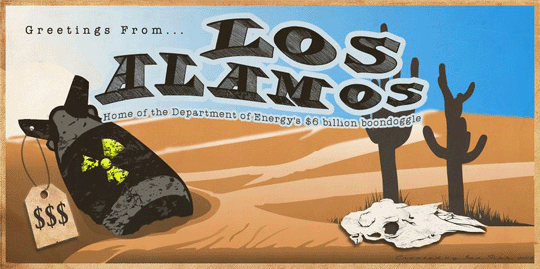
Members of New Mexico’s congressional delegation say the reasons cited by the agency include a serious safety incident involving a worker, and the handling of enriched uranium at a Nevada facility in 2014.
The lab also has shared blame for errors that led to the indefinite closure of the federal government’s only underground nuclear waste repository in 2014.
The current contract expires in September 2017.
Lab Director Charlie McMillan told employees the lab’s latest review was better than the previous two but not good enough to ensure an automatic contract extension.
Transfer of Vermont Yankee’s dangerous nuclear used fuel trash to dry storage
Vermont Yankee to start moving spent nuclear fuel into dry storage in 2017 http://www.masslive.com/news/index.ssf/2015/12/vermont_yankee_to_start_moving.html By Mary Serreze | Special to The Republican On December 20, 2015 Entergy plans to start moving Vermont Yankee’s spent nuclear fuel into dry cask storage in 2017, two years earlier than originally anticipated, reports the online Vermont Digger.
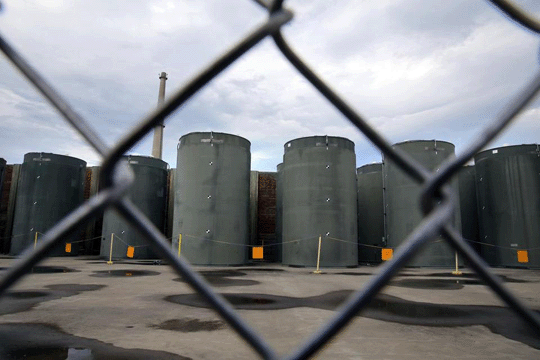
The Louisiana-based Entergy announced the decision Wednesday, but the idea was first introduced in an October filing with the Vermont Public Service Board, as part of the company’s bid for approval to build a second concrete pad for spent fuel storage at the Vernon, Vermont site, located on the banks of the Connecticut River.
The 620-megawatt Vernon plant, which began operations in 1972, stopped producing power Dec. 29, but most of its spent fuel remains in wet storage in a pool inside the plant’s reactor building.
While dry storage is considered safer than wet storage, concerns have been raised about the transfer process, in which fuel is pulled from the pool, placed in casks, loaded onto a large, tracked vehicle nicknamed “Cletus” and moved slowly to the spent fuel pad, Vermont Digger reports.
Entergy remains under a 2020 deadline to move the fuel into dry cask storage. Under the federally-sanctioned SAFSTOR process, full decommissioning could take up to 60 years. Under SAFSTOR, Vermont Yankee would be “mothballed” until its decommissioning fund reaches the level necessary to clean up the entire site.
State and regional officials, as well as critics of the plant, have raised concerns about the overall decommissioning project’s financing, as well as the presence of non-radiological and radiological waste at the site. The dry cask storage plan will be funded with a $145 million line of credit, which Entergy plans to repay by suing the U.S. Department of Energy for breach of its contract to remove spent nuclear fuel from the Vermont Yankee site.
The Nuclear Regulatory Commission has approved the use of the plant’s decommissioning trust fund to pay for long-term fuel storage, although the state has challenged that decision in federal appeals court.
Mary Serreze can be reached at mserreze@gmail.com
Excavation planned – removal of NUMEC nuclear waste dump in Parks Township
 NUMEC nuclear waste dump in Parks Township will be excavated http://triblive.com/neighborhoods/yourallekiskivalley/yourallekiskivalleymore/9678472-74/nuclear-corps-materials#axzz3v71kOvgB
According to the U.S. Nuclear Regulatory Commission, Special Nuclear Material is only “mildly radioactive” but can include fissile material — uranium-233, uranium-235 and plutonium-239 — that, in concentrated form, can be the primary ingredients of nuclear explosives.
By Mary Ann Thomas, Dec. 22, 2015 After finding more complex radioactive contamination than expected in 2011 at the nuclear waste dump in Parks Township, the Army Corps of Engineers announced Tuesday it will stay the course for a $350 million project to dig up and remove 36,000 tons of waste.The Corps shut down the cleanup four years ago after unearthing more highly radioactive nuclear materials that required special handling, escalating cleanup costs.
The defunct Nuclear Materials and Equipment Corp. and successors, the Atlantic Richfield Co. and Babcock & Wilcox disposed of uranium, plutonium and other hazardous materials at the 44-acre, Armstrong county, site from 1960 until the early 1970s. With plants in Parks and Apollo, those companies produced fuel for Navy nuclear reactors, nuclear power plants and other government entities.
The Corps will release its request for proposals from contractors and likely name a new cleanup company in 2017. The contractor will develop new plans and start digging again in 2018. The waste will then be shipped out of state.
The project is expected to finish between 2026 and 2028 : http://triblive.com/neighborhoods/yourallekiskivalley/yourallekiskivalleymore/9678472-74/nuclear-corps-materials#ixzz3v728qWVp
Threat to Russia of USA’s tactical nuclear weapons in Europe
U.S. tactical nuclear weapons in Europe threaten Russia – Putin http://rbth.com/international/2015/12/20/us-tactical-nuclear-weapons-in-europe-threaten-russia-putin_552869
“U.S. tactical nuclear weapons have always been there [on the planes] after WWII, after America became a nuclear power. They are simply modernizing them now,” the president said in an interview in a documentary, “World Order,” of the Rossiya-1 (VGTRK) television channel.
“Indeed, this is a dangerous thing now. Why? Because our tactical nuclear weapons are not strategic for the United States, they cannot reach their territory, while U.S. tactical nuclear weapons in Europe can reach our territory. In this sense, they are strategic for us and they are posing a bigger threat to us than our strategic nuclear weapons,” the president said.
Turning contaminated Hanford Nuclear Reservation into a tourist site!
Most polluted US nuclear weapons building site plans for influx of tourists, Guardian 20 Dec 15
Hanford Nuclear Reservation, country’s newest national park and home to the world’s first full-sized nuclear reactor, prepares for expanded crowds. Thousands of people are expected next year to tour the Hanford Nuclear Reservation, home of the world’s first full-sized nuclear reactor and the most polluted US nuclear weapons production site.
Hanford, near Richland, about 200 miles east of Seattle in south-central Washington state, is the newest national park.
Visitors will not, however, be allowed anywhere near the country’s largest collection of toxic radioactive waste.
“Everything is clean and perfectly safe,” said Colleen French, the US Department of Energy’s program manager for Hanford. “Any radioactive materials are miles away.”
The Manhattan Project national historical park, signed into existence in November, also includes sites at Oak Ridge, Tennessee and Los Alamos, New Mexico. The Manhattan Project is the name for the US effort to build an atomic bomb during the second world war.
At Hanford, the main attractions will be B Reactor and the ghost towns of Hanford and White Bluffs, which were evacuated by the government to make room for the Manhattan Project………
Nine reactors were built at Hanford and operated during the Cold War. That work created more than 56m gallons of radioactive waste that the government still spends more than $1bn a year to maintain and clean up…….. http://www.theguardian.com/us-news/2015/dec/20/hanford-nuclear-reservation-manhattan-project-washington-national-park
The nuclear charlatans’ last refuge – their myth about climate change
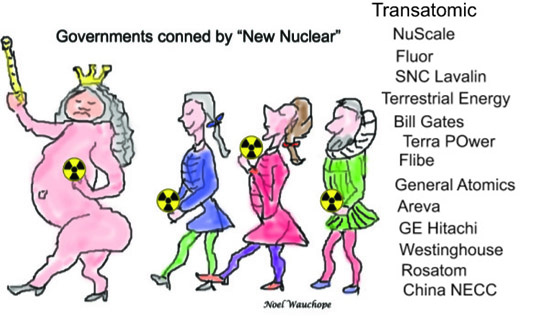
Praise the Lord and pass the ammunition: Nuclear power and climate progress in the 21st century http://thebulletin.org/commentary/praise-lord-and-pass-ammunition-nuclear-power-and-climate-progress-21st-century 17 DECEMBER 2015 Peter A. Bradford adjunct professor, Vermont Law School and former Nuclear Regulatory Commission member
In the 15th year of the era formerly known as “the nuclear renaissance,” not a single molecule of carbon dioxide emission has been avoided by a renaissance reactor built in the United States or in Europe. Unless the 40-year-old Watts Bar 2 reactor scheduled to operate in Tennessee early in 2016 is called “renaissance,” this situation will not change for several more years.
Climate change, so urgent and so seemingly intractable, has become the last refuge of nuclear charlatans throughout the Western world. From well-meaning ideologues and editorial writers claiming that the unknowable is theirs to state with certainty, to paid advocates more skilled in pleasing and persuading government officials than furthering consumer and environmental well-being, prophetic arguments have swollen from a stream to a river and now merge with the Seine in Paris, threatening to submerge the world under a layer of nonsense rising as inexorably as the seas themselves.
We are told that:
- Energy efficiency and renewables cannot save us because they are too costly, too small and too variable, despite their falling costs, rapidly rising deployment, and particular success in the world’s fourth largest economy in Germany.
- The power markets that that have functioned reliably and efficiently for 20 years and that repeatedly reject nuclear as too expensive are “flawed” because they don’t reward nuclear for its benefits as to fuel diversity and reliability, and—in a valid criticism not fixable by uniquely nuclear subsidies—do not reflect the lack of carbon pricing in most of the United States.
- Nuclear power’s problems of cost, delay, and inflexibility will soon be solved by new designs, if only misguided regulators and environmentalists will get out of the way, never mind that regulators and environmentalists have had no hand in the cancellation of some 25 renaissance reactors.
James Hansen, perhaps the most visible of the climate scientists who advocate heavy reliance on breeder or other innovative reactor designs without paying any attention to their track record of long and costly failure, has become ever more reminiscent of Groucho Marx leaping from a paramour’s bed to confront a disbelieving husband with: “Who are you going to believe, me or your eyes?”
Our eyes tell us that the breeder reactor technology has been abandoned in the United States, in France, in Germany, and in Britain. In Japan, the Monju breeder has operated one year out of the last 20. (See von Hippel et al, “Fast Breeder Reactor Programs: History and Status”). Of course success in technology often builds from many failures, but there are no signs of success on this horizon, and delay—as Hansen among others often tells us—allows ever more CO2 to concentrate in the skies to accelerate warming for decades regardless of the technologies deployed 20 years from now.
The op-ed that Hansen and three other scientists signed from Paris says that by building 115 reactors per year from now until 2050, we could eliminate fossil fuels from the electric sector. What these four nuclear horsemen don’t mention is that, using the cost of Britain’s proposed Hinkley station as a proxy (even though breeders and their attendant reprocessing facilities would surely cost more), this commitment would cost some $2 trillion per year, or $70 trillion altogether.
Making assumptions about renewables and efficiency plus electrical storage capacity that are more plausible than Hansen’s assumptions about an immediate reversal in the fortunes of breeder reactors, equivalent carbon reductions can be achieved at much lower cost and in less time, leaving money over for continuing research and development, even nuclear R&D.
Another group of scientists (including one of Hansen’s cosigners), also writing from Paris, said, “Our nation’s gross domestic product (GDP) has grown since 2007 without increases in energy consumption due in large part to major advances in fuel economy in vehicles and energy efficiency in buildings. Solar power comprised 32 percent of all new electric generating capacity in the U.S. last year—a twelvefold increase in the amount of solar photovoltaic installations since just five years ago. Wind power now generates about five percent of our nation’s electricity, and in some regions already costs less than natural gas and coal-fired generation. Texas alone nearly doubled its wind energy generation between 2009 and 2014. Propelled by remarkable gains such as these, states and cities across our nation are setting ambitious targets for reducing carbon emissions.”
Our real challenge is to develop market rules and regulatory processes that allow low-carbon technologies to reap the rewards of their relative cleanliness while competing vigorously with each other to meet the needs of developing and developed nations. The economists who succeed in this urgent task are a much better bet than scientists who claim the gift of prophesy.
The Hansen letter contains these remarkably unself-aware sentences:
“To solve the climate problem, policy must be based on facts and not on prejudice.”
“The climate issue is too important for us to delude ourselves with wishful thinking.”
“The future of our planet and our descendants depends on basing decisions on facts, and letting go of long held biases when it comes to nuclear power.”
Amen, brother.
The nuclear snake oil salesmen now pitching Small Reactors as “green”

The Sierra Club says it has all the makings of a snake-oil sale. The organization would prefer the Obama administration abandon the extremely costly pursuit of advanced nuclear power in favor of greater investment in renewable energy such as solar and wind power.
Small-scale nuclear plants being pitched as new green, Albuquerque Journal, December 20th, 2015“……….State leaders aren’t necessarily rushing to embrace the vision in a place where all but one nuclear plant have been mothballed and where old-guard nuclear safety advocates warn that so-called advanced nuclear technologies are an attempt to put shiny earrings on the same old pig.
But the investors and nuclear scientists opening startup labs in the office parks of California’s technology hubs and within the research centers of universities see a more influential ally in the White House.
‘All of the above’ strategy Nuclear power is at the nub of the Obama administration’s “all of the above” strategy for reinventing the energy industry in an era of climate change, and its faith in the fraught power source has captured the imagination of some notable and deep-pocketed West Coast thinkers.
Investors, including Microsoft founder Bill Gates and PayPal co-founder Peter Thiel, have poured about $2 billion into a few dozen small outfits, many of which are concentrated in the West. …….
Nuclear déjà vu That may all be possible someday, say the nuclear experts at the Union of Concerned Scientists, but that day is probably several decades and many tens of billions of dollars away. The sudden excitement around nuclear makes them nervous. They say they have seen this before. Continue reading
South Carolina nuclear workers made sick, and dying, by radiation
Editorial: Nuclear workers show America’s darker side http://www.islandpacket.com/opinion/editorials/article50722150.html ISLANDPACKET newsroom@islandpacket.com The numbers are sobering. The problem is immense.
In a special report presented over the past week, our fellow McClatchy journalists put faces on the heavy and often hidden cost of America’s atomic weaponry.
A total of 107,394 workers have been diagnosed with cancers and other diseases after building the nation’s nuclear stockpile over the last seven decades. At least 33,480 former nuclear workers are dead after helping the U.S. win World War II and the Cold War before getting sick enough to qualify for government compensation.
Taxpayers have spent $12 billion so far treating and compensating more than 53,000 sick nuclear workers.
But fewer than half the workers who sought help had their claims approved. More than 54,000 workers have been denied government help. Some say the government’s tactic is to “Delay, deny, until you die.”
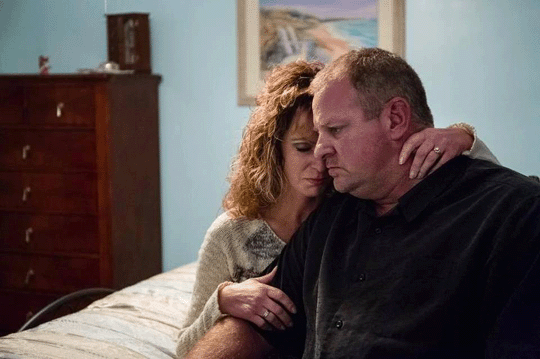
South Carolina, home to the Savannah River Site outside Aiken, has certainly paid a toll to the silent killer.The site that turned 65 this year was established by President Truman to produce the basic materials used in the fabrication of nuclear weapons.
Nearly 40 million gallons of highly radioactive nuclear waste remains at SRS — 90 miles up the Savannah River from where much of Beaufort County’s drinking water is withdrawn. The waste is stored in aging tanks.
And the federal government’s poor record for helping its workers is matched or exceeded by its miserable record of dealing with the nuclear waste that will threaten workers and communities ad infinitum.
Earlier, McClatchy reported that the United States already has generated more than 80,000 tons of spent nuclear fuel and high-level nuclear waste, and the toxic materials are stored at some 80 sites in 35 states…….
What we see is a nation in denial. We see a nation willing to consider workers in its hodgepodge of nuclear sites to be collateral damage. We see a nation that has grossly underestimated the cost to the workers.
And we see a nation that for pure politics will endanger entire communities and states by failing to confront its sick legacy of the atomic age.
We see a nation that should do much better by its own people.http://www.islandpacket.com/opinion/editorials/article50722150.html
McClatchy reportreveals the staggering death toll from radiation, among nuclear workers

 More US fatalities from radiation exposure than in the wars in Afghanistan and Iraq, McClatchy report reveals, Fukushima Watch, December 15th, 2015, by Greg White The reverberations of nuclear power are most often reported on during the occasional nuclear meltdown, like the 1986 Chernobyl disaster and the 2011 Fukushima disaster. But, the consequences of nuclear power are far more persistent and prevalent than the mainstream media has often led the public to believe, even in the US. According to a yearlong investigation, a staggering 33,480 US nuclear workers have died from radiation exposure in the last seven decades.(1,2)The death count was published and disclosed for the first time by American publishing company McClatchy. The report revealed that the number of US workers who died from nuclear radiation exposure was four times greater than the number of American casualties in the wars in Afghanistan and Iraq. The count involves all workers who died after they or their survivors were compensated by a special fund established in 2001, which aided workers who helped build the US nuclear stockpile.
Approximately 107,394 workers were diagnosed with cancer or other maladies after building the country’s nuclear stockpile over the last seven decades. The researchers extrapolated information using a database obtained from the US Department of Labor under the Freedom of Information Act. In addition, the investigation involved over 100 interviews with nuclear workers, scholars, government authorities and environmental activists.
US GOVERNMENT VASTLY UNDERESTIMATES HEALTH RISKS OF NUCLEAR PRODUCTION The report underlined the fact that the federal government underestimated how sick the US nuclear workforce would become. At the beginning, the government expected a compensation program that would serve 3,000 people at an annual cost of $120 million. Fourteen years later, however, the government has spent $12 billion of taxpayer money to reimburse more than 53,000 nuclear workers.(1)
“I think that, when this program was created in 2001, there had been some awareness in Congress leading up to, and it was created through the efforts of the Clinton administration to compensate workers who had become ill,” explained Lindsay Wise, a reporter involved in the investigation.(3)
“It started to become apparent that many of these workers had been exposed to dangerous subjects, radioactivity and other toxins, without realizing it or without knowing the full extent of the health hazards that they were facing.”(3)
“And so once that started to come to light through some research of some reporters, The Washington Post and other places, there was pressure in Congress to pass a fund to compensate the workers.”(3)
Although the costs vastly exceeded government expectations, federal records reveal fewer than half of the nuclear workers who sought compensation have had their claims approved by the US Department of Labor.(3)…… http://www.fukushimawatch.com/2015-12-15-more-us-fatalities-from-radiation-exposure-than-in-the-wars-in-afghanistan-and-iraq-mcclatchy-report-reveals.html
1 This Month
15 October. Joint Appeal for Nuclear Abolition Day -presentation to the UN on October 15 will be live on UNWebTV
Endorse the Nuclear Abolition Day Appeal
23-25 October – on Zoom – World BEYOND War’s annual global conference

To see nuclear-related stories in greater depth and intensity – go to https://nuclearinformation.wordpress.com
-
Archives
- October 2026 (139)
- September 2026 (339)
- August 2026 (330)
- July 2026 (355)
- June 2026 (287)
- May 2026 (306)
- April 2026 (356)
- March 2026 (251)
- February 2026 (267)
- January 2026 (308)
- December 2025 (358)
- November 2025 (359)
-
Categories
- 1
- 1 NUCLEAR ISSUES
- business and costs
- climate change
- culture and arts
- ENERGY
- environment
- health
- history
- indigenous issues
- Legal
- marketing of nuclear
- media
- opposition to nuclear
- PERSONAL STORIES
- politics
- politics international
- Religion and ethics
- safety
- secrets,lies and civil liberties
- spinbuster
- technology
- Uranium
- wastes
- weapons and war
- Women
- 2 WORLD
- ACTION
- AFRICA
- Atrocities
- AUSTRALIA
- Christina's notes
- Christina's themes
- culture and arts
- Events
- Fuk 2022
- Fuk 2023
- Fukushima 2017
- Fukushima 2018
- fukushima 2019
- Fukushima 2020
- Fukushima 2021
- general
- global warming
- Humour (God we need it)
- Nuclear
- RARE EARTHS
- Reference
- resources – print
- Resources -audiovicual
- Weekly Newsletter
- World
- World Nuclear
- YouTube
-
RSS
Entries RSS
Comments RSS


