USA changes law to make it harder for nuclear radiation victims to get compensation
the directive signals an initial step toward trying to dismantle or rein in a $12 billion compensation program that has made payments to more than 53,000 sickened workers or their survivors since 2001.
 Nuclear workers fear new policy will make it harder to win compensation
Department of Labor says nuclear facilities are much safer since 1995
Workers and advocates worry it will be more difficult to prove cases
A fight is underway to get policy repealed in order to protect sick employees
BY LINDSAY WISE, ROB HOTAKAINEN AND FRANK MATT McClatchy Washington Bureau, 22 Jan 16 WASHINGTON
Abelardo Garza was working near tanks full of toxic sludge at Hanford nuclear reservation in Washington state last Aug. 14 when one of his co-workers noticed a strange smell.
Within minutes, Garza’s nose started bleeding. The next morning, he awoke gasping for breath.
It was the fourth time in five years that Garza would end up in the hospital after suspected exposure to chemical vapors at Hanford, a 586-square-mile site where workers once made plutonium for the bomb dropped on Nagasaki, Japan.
Now Garza, 65, worries that a new federal directive the government says was intended to speed up compensation claims by sick and dying nuclear workers could harm his chances of qualifying for benefits if his health worsens in the future.
The directive, which became effective in December 2014, orders claims examiners to conclude that workers at Department of Energy nuclear facilities have not have any significant exposure to toxins since 1995 “in the absence of compelling data to the contrary.”
To Garza, the wording of the government’s directive feels like a dismissal. Continue reading
Trans Pacific Partnership lets corporations override environmental laws
the TPP would give foreign corporations like TransCanada broad power to demand compensation for policies that do not conform to their “expectations.”
In other words, any time our government takes an “unexpected” step to protect our air, our water, our economy, or the health of our families from dangerous projects like Keystone XL, corporations could use that as a reason to ask a tribunal to order the government to pay.
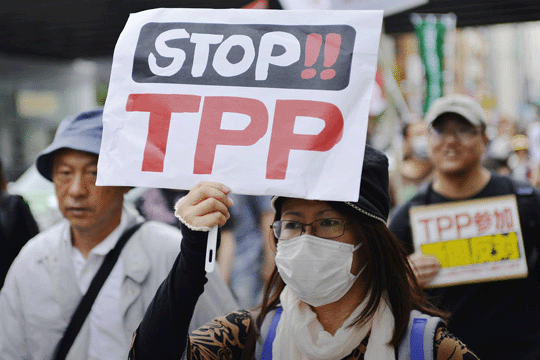
TPP provisions would undermine environmental efforts http://www.msnbc.com/msnbc/opinion-tpp-provisions-would-undermine-environmental-efforts?utm_content=buffer4500f&utm_medium=social&utm_source=twitter.com&utm_campaign=buffer 01/21/16 03 By Michael Brune For years the Sierra Club has warned that international trade deals could be used by corporations to undermine U.S. environmental protections. Now the Canadian oil company TransCanada is attempting to do exactly that in response to President Obama’s rejection of its Keystone XL tar sands pipeline.
This dispute won’t be settled in a normal court of law, though. Instead, it will be argued in a trade tribunal with no accountability to any domestic legal system — a private legal system that is outside U.S. law. No judge will hear the case. Instead, three private lawyers will issue a binding ruling that cannot be appealed. Many of these tribunal lawyers actually rotate between rendering judgments and representing corporations in their cases against governments. Therefore, it’s no great surprise when corporations come out on top and ordinary people either foot the bill or lose environmental and health protections.
This is unfair and unjust, pure and simple. We should be doing all we can to defend the environmental and health safeguards that keep us safe — not make them even more vulnerable to corporate attacks. Why would we want to lower our environmental standards to a lowest-common denominator dictated by the expectations of corporations who have proven they’d put profits before people?
Furthermore, at a time when virtually the entire world just agreed at the Paris climate talks that we must keep dirty fuels in the ground to avoid climate disaster, giant fossil fuel corporations see toxic trade agreements like the TPP as a way to trump the health and environmental protections that can keep dirty fuels in check and promote clean energy.
Luckily, opposition to the TPP is steadily growing, just as it did for the Keystone XL pipeline. Environmental groups, labor unions, public health advocates, and an array of diverse constituencies are voicing their opposition, whether because of investor-state dispute settlement provisions or one of the sweeping deal’s other controversial provisions. Many members of Congress from both parties are already saying no to the TPP.
We’ve seen what can happen when we come together to say no to a bad idea. We defeated the Keystone XL pipeline, and we can defeat the Trans-Pacific Partnership. We need a new model of trade that puts the health and safety of people before the profits of big corporations that are already polluting our air and water.
Michael Brune is the executive director of the Sierra Club, the nation’s largest grassroots environmental organization. Brune is the author of “Coming Clean — Breaking America’s Addiction to Oil and Coal.”
Washington State Bill Calls Nuclear “CLEAN”!
 Bill includes nuclear in Washington plan for clean power, Tri City Herald, 22 Jan 16
Sen. Sharon Brown wants nuclear to be included to maximum extent possible
Sen. John McCoy says no reason to call out nuclear above all other power sources
Bill passed out of committee 5-1

BY ANNETTE CARY acary@tricityherald.com A bill that would promote nuclear power in Washington state as a clean power source was passed out of a Senate committee this week, but with some opposition.
Sen. Sharon Brown, R-Kennewick, the lead sponsor of the bill, proposed the legislation to maximize the use of nuclear power in the state’s carbon reduction strategy. She is particularly interested in the possibilities for small modular reactors.
The legislation would require any state plan submitted to the U.S. Environmental Protection Agency related to its Clean Power Plan or any rule adopted by the state under the federal plan provide for the use of nuclear generation to the maximum extent allowed. Small modular reactors are specifically mentioned.
The reactors are proposed to be manufactured in factory and then shipped in modules to where they would be used, with more modules added as needed.
EPA set carbon pollution limits for the nation’s existing power plants in August in a rule called the Clean Power Plan. It set plans for individual states to reduce carbon pollution from existing plants and requires them to submit plans to ensure they meet carbon emission goals……..
Washington state law does not include any provisions against nuclear power, said Sen. John McCoy, D-Tulalip.
“Nuclear is part of the power mix,” he said. “The issue is, ‘Do we move nuclear to the top of the list and only support nuclear?’ The answer is no.”
It requires too much water and requires that uranium be mined, he said. He also pointed out that the nation has no repository for storing used nuclear fuel, he said. But it should still be considered part of the overall mix of energy for the state.
He voted against passing the bill out of committee, with Brown and four other senators in favor……..
However, a representative of the Oregon and Washington chapters of Physicians for Social Responsibility, Charles Johnson, said operation of a NuScale small modular reactor would require a vote of the people.
In 1981, state residents passed an initiative requiring voter approval before bonds are issued for energy production projects with a capacity of 250 megawatts or more. NuScale is proposing 50 megawatt reactors that could be linked together in groups of up to 12 to generate 600 megawatts.
“It is premature for us to decide to add this to the Clean Power Plan,” Johnson said. http://www.tri-cityherald.com/news/local/hanford/article56194035.html
Dangerous situation in Los Angeles gas crater
 LA gas well has ‘destabilized’, large crater develops in area — Officials: “Could be catastrophic” — TV: Risk of massive fire, possible explosion — Expert: “If wellhead fails, the thing is just going to be full blast… a horrible, horrible problem” — Company refuses to provide photos or media access (VIDEO) http://enenews.com/la-gas-destabilized-officials-could-be-catastrophic-tv-experts-highly-flammable-gas-creating-risk-massive-fire-explosion-professor-wellhead-fails-going-be-full-blast-itll-be-horrible-horrible-pr?utm_source=feedburner&utm_medium=email&utm_campaign=Feed%3A+ENENews+%28Energy+News%29
Los Angeles Times, Jan 15, 2016 (emphasis added): Efforts to plug Porter Ranch-area gas leakworsened blowout risk, regulators say — Southern California Gas Co… is trying to avoid a blowout, which state regulators said is now a significant concern after a seventh attempt to plug the well created more precarious conditions at the site. If a blowout occurs, highly flammable gas would vent directly up through the well… rather than dissipating as it does now… State officials said a blowout would increase the amount of leaked gas… That natural gas also creates the risk of a massive fire… The risk of fire already is so high that cellphones and watches are banned from the site… [The gas company’s attempts to stop the leak] expanded a crater around the wellhead, state and gas company officials said. The crater is now 25 feet deep, 80 feet long and 30 feet wide, those officials said… [The gas company] declined repeated requests from The Times… The gascompany would not provide current photos of the site or allow media access… In one internal state report obtained by The Times, an agencyofficial described [one] kill effort as a “blowout to surface.” “A large column of gas, aerated mud, and rock formed a geyseraround the wellhead,” the state observer wrote.
Scott McGurk, senior oil and gas field regulator assigned to daily watch at Aliso Canyon, Jan 15, 2016: The site and wellhead were made more unstable by the gas company’s attempts to stop the leak by pumping a slurry directly into the well… The wellhead sits exposed within the cavernous space, held in place with cables attached after it wobbled during the plugging attempt… During one of [the plugging] attempts Nov. 13, a hole in the ground opened 20 feet north of the well… Gas that had seeped through diffuse rock fissures on the western side of the narrow ridge began streaming instead from the new vent… the vent allowed a “serious amount of gas” to escape.
Gene Nelson, a physical sciences professor at Cuesta College, Jan 15, 2016: “If the wellhead fails, the thing is just going to be full blast… It will be a horrible, horrible problem. The leak rates would go way up.”
Don Drysdale, California Department of Conservation spokesman, Jan 15, 2016: Thepossibility of fire [is] “a concern” even without a blowout.
Los Angeles Times, Jan 16, 2016: [There’s] new evidence the [Puclic Utility Commission] is concerned that the compromised well site in Aliso Canyon is vulnerable to either a blowout… an explosion, or both… PUC includes a warning that damage to the well system, which was subjected to two months of aggressive high-pressure pumping to try to plug the leak, might now permit air to mix with methane in a way that “could be catastrophic.”… [T]he utility began a series of increasingly aggressive attempts to plug the well with heavy mud… those efforts instead scoured a 25-foot-deep crater around the well, blew out a large vent from which gas could escape more freely, and threatened the stability of the wellhead itself… The Department of Conservation says those facilities present “a direct and ongoing threat to public health, safety, and the environment”…
NPR, Jan 15, 2016: Adding to concerns over the disaster, efforts to stop the leak appear to have destabilized the well, the Los Angeles Times reports, raising the risk of a blowout… SoCalGas’ efforts to cap the well have actually increased the risk of a blowout. Seven attempts to plug the leak have made the area less stable… even without a blowout, the leak could catch on fire.
FOX LA transcript, Jan 16, 2016: “Trying to avoid a blowout, state regulators say it’s now a big concern after SoCalGas has tried to plug a leaking well near Porter Ranch seven times. If a blowout happens, experts say highly flammable gas would go up the well, creating a risk of a massive fire — possibly even an explosion.”
Watch FOX LA’s broadcast here (wait for 2nd video to play autonatically)
Legal action over Los Alamos failure to complete radioactive trash cleanup
 Nuclear Watch to sue over LANL cleanup problems By Mark Oswald / Journal Staff Writer January 21st, 2016 Albuquerque Journal SANTA FE – Nuclear Watch New Mexico on Wednesday put the federal Department of Energy and the private contractor that manages Los Alamos National Laboratory on official notice that it will file suit over the lab’s failure to meet cleanup goals established in a legally binding 2005 consent order.
The notice mailed Wednesday notes the lab missed a December final deadline for completion of Los Alamos clean-up work and hasn’t asked for an extension of the now-expired schedule that was set a decade ago.
That makes DOE and Los Alamos National Security LLC (LANS), the lab’s private manager, liable for civil penalties and subject to injunction, says the notice by attorney Jonathan Block of the New Mexico Environmental Law Center.
“We are putting the weaponeers on notice that they have to clean up their radioactive and toxic mess first before making another one for a nuclear weapons stockpile that is already bloated far beyond what we need,” said Jay Coghlan, executive director of Nuke Watch, a nonprofit watchdog group. He was referring to DOE’s recent preliminary approvals for changes at Los Alamos, including new underground facilities, to accommodate re-starting production of plutonium “pits,” the triggers for nuclear weapons……..
The Environment Department has plans to revise the 2005 cleanup consent order with DOE and LANS, a private consortium that includes Bechtel and the University of California.
The order was a result of the Environment Department’s 2002 finding that decades worth of radioactive and hazardous waste at Los Alamos posed an “imminent” threat to health and the environment. The state issued an order requiring LANL to investigate its 40-square-mile property for waste. DOE and the lab argued their own cleanup schedule was better and sued.
The 2005 consent deal ending the dispute laid out milestones toward “fence-to-fence” cleanup by 2015, enforceable by financial penalties. But getting enough funding for the work – federal dollars have been mostly in the range of $185 million to $200 million annually – became increasingly difficult, and it was clear in recent years that the lab would come nowhere near meeting deadlines set in the 2005 document. In November, state Environment Secretary Ryan Flynn said he believes it will cost much more than DOE’s own $1.2 billion estimate to finish the job.
Nuke Watch’s Coghlan said Wednesday that cleanup at Los Alamos “continues to be delayed, delayed, delayed,” despite plans to spend a trillion dollars over 30 years to rebuild the U.S. nuclear weapons force……..
Nuke Watch also has been pushing for a formal public hearing process – which Nuke Watch contends is required and allows interested parties to submit materials and question witnesses – as a revised consent order on cleanup is developed. Flynn has said that would cause delays and promised opportunities for public comment instead in other settings, such as meetings of a citizens advisory board.
Flynn also has insisted that before a new consent order is negotiated, DOE must come to final agreement with the state over plans for $73.5 million that the federal agency agreed to pay for a radioactive leak that has shut down the nation’s nuclear waste repository near Carlsbad. Two years ago, a waste drum from LANL, improperly packed, breached at the Waste Isolation Pilot Plant and contaminated the storage facility. http://www.abqjournal.com/709455/news/nuke-watch-files-suit-over-missed-clean-up-deadlines-at-los-alamos.html
Report on errors in nuclear missile incident is classified ‘secret’
 US airmen damage nuclear missile as ‘troubleshooting’ mission goes wrong, Guardian, 23 Jan 16
The air force stripped the three airmen of their nuclear certification following the incident in 2014 and quietly launched an accident investigation. Errors by three airmen troubleshooting a nuclear missile in its launch silo in 2014 triggered a “mishap” that damaged the missile, prompting the Air Force to strip the airmen of their nuclear certification and quietly launch an accident investigation.
In a statement, the Air Force declined to provide details of the incident or a copy of the report produced last November by the Accident Investigation Board, saying the information was classified and too sensitive to be made public.
Under the Air Force’s own regulations, Accident Investigation Board reports are supposed to be made public. The Air Force did release a brief summary to the Associated Press after it repeatedly sought answers for more than a year. The summary said the full report was classified by General Robin Rand, who took over as commander of Air Force Global Strike Command in July 2015……..
The accident follows a period of turmoil inside the nuclear missile corps amid an emerging national debate about the costs and benefits of investing hundreds of billions of dollars to modernize the entire strategic nuclear force at a time when war craft is changing………..
The investigation report summary said the actual cause of the accident, established by “clear and convincing evidence,” is classified. ……http://www.theguardian.com/world/2016/jan/23/us-airmen-damage-nuclear-missile-as-troubleshooting-mission-goes-wrong
How the tax payer funds the nuclear industry – to keep it alive
The many ways of counting subsidies
Among the goodies routinely given away, according to the Concerned Scientists, are:
- Subsidies at inception, reducing capital costs and operating costs.
- Accounting rules allowing companies to write down capital costs after cost overruns, cancellations and plant abandonments, reducing capital-recovery requirements,
- Recovery of ‘stranded costs’ (costs to a utility’s assets because of new regulations or a deregulated market) passed on to rate payers.
 Yes, you read that last item correctly. Even when the energy industry receives its wish to be rid of regulation, it is entitled to extra money because of the resulting rigors of market pressures.
The ongoing environmental disaster at Fukushima is a grim enough reminder of the dangers of nuclear power. But nuclear does not make sense economically, either. Continue reading
Best to store nuclear wastes locally in deep bores, not export it
The deep borehole project is particularly interesting because almost anywhere you look in America, there are deep rocks perfect for this method. Every state can have its own borehole repository, much to some of these state’s annoyance, since most political leaders would rather foist their waste off on someone else and claim victory for their constituents.
But Congress doesn’t exactly like the deep borehole idea because they would not be able to gang up on one state and force it down their throat. Each state would have its own deep nuclear disposal boreholes and wouldn’t be able to promise their citizens that the nuclear waste would ever leave their state
DOE Tries To Change The Rules On Nuclear Waste Disposal http://www.forbes.com/sites/jamesconca/2016/01/21/doe-tries-to-change-the-rules-on-nuclear-waste-disposal/#2715e4857a0b28df073f561e James Conca , “……..DOE is funding a study to drill a borehole more than 3 miles deep into the Earth’s crust below North Dakota to test a disposal method for radioactive waste called Deep Borehole Disposal. In this scenario, waste would be placed in the lower mile of the borehole in crystalline rock that would isolate the waste from the surface and shallow environments.
The borehole would then be filled up with some special layers, including asphalt, bentonite, concrete and crushed rock that will isolate the waste for geologic time. The borehole would need a diameter of at least 17 inches at the bottom for placing containers, and would be lined with steel casing. Future boreholes will be wider as the technology evolves, which is has been doing lately.
These developments follow directly the recommendations of President Obama’s Blue Ribbon Commission on America’s Nuclear Future, and followed up in thePresident’s Memorandum on disposal of Defense High-Level Waste and the2013 Administration’s Strategy for the Management and Disposal of Used Nuclear Fuel and High-Level Radioactive Waste. Conca and Wright (2012)provide background on nuclear waste and interpretation of the three BRC recommendations pertaining to nuclear waste disposal that has led to these changes.
But the basic strategy of this new disposal initiative is: Continue reading
Nuclear industry survived only because of ‘liability cap’
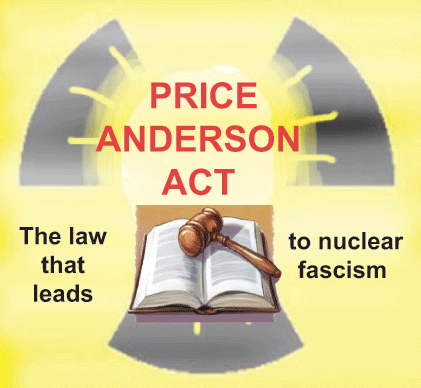
After 60 years of nuclear power, the industry survives only on stupendous subsidies, Ecologist, Pete Dolack 4th January 2016 Without ‘liability caps’ the industry would have been dead long ago
The British government, for instance, currently foots more than three-quarters of the bill for radioactive waste management and decommissioning, and for nuclear legacy sites. A report prepared for Parliament estimates that total public liability to date just for this program is around £50 billion, with tens of billions more to come.
Liability caps for accidents are also routine. In the US the Price-Anderson Act, in force since 1957, caps the total liability of nuclear operators in the event of a serious accident or attack to $10.5 billion. If the total is higher, as it surely would be, taxpayers would be on the hook for the rest.
As a further sweetener, the Bush II / Cheney administration, in 2005, signed into law new nuclear subsidies and tax breaks worth $13 billion. The Obama administration, attempting its own nuclear push, has offered an additional $36 billion in federal loan guarantees to underwrite new reactor construction, again putting the risk on taxpayers, not investors.
The Vermont Law School paper aptly sums up this picture with this conclusion: [page 69]
“If the owners and operators of nuclear reactors had to face the full liability of a nuclear accident and meet the alternatives in competition that is unfettered by subsidies, no one would have built a nuclear reactor in the past, no one would build a reactor today, and anyone who owned one would exit the nuclear business as quickly as they could.”
If we had a rational economic system, they surely would.http://www.theecologist.org/News/news_analysis/2986749/after_60_years_of_nuclear_power_the_industry_survives_only_on_stupendous_subsidies.html
Former nuclear power executive sentenced for fraud
Former Executive of Nuclear Power Company Sentenced Jennifer R. Ransom to Serve 30 Months in Prison, Clearwater Tribune, 8 jan 16 BOISE – Jennifer R. Ransom, 41, of Meridian, Idaho, was sentenced Jan. 7 in United States District Court to 30 months in prison followed by three years of supervised release—the first six months of which is home confinement–for the crime of securities fraud, U.S. Attorney Wendy J. Olson announced. Senior United States District Judge Edward J. Lodge also ordered Ransom to forfeit $580,780 and pay $116,138 in restitution to victim-investors. Ransom pleaded guilty to one count of securities fraud on April 21, 2015.
According to the plea agreement, Ransom was the Senior Vice President of Administration of Alternate Energy Holdings, Inc. (“AEHI”). AEHI was a development stage company headquartered in Eagle, Idaho, that planned to construct and operate a nuclear power plant in Payette County, Idaho.
According to the plea agreement, Ransom joined AEHI in late 2007. Prior to joining AEHI, Ransom took and passed the Series 63 examination, one of the tests required to become a licensed Securities Agent, and knew it was wrongful and unlawful to engage in conduct that was designed to defraud or deceive investors by artificially controlling or fraudulently affecting the price of securities. Notwithstanding, she agreed with her co-defendant, Donald L. Gillispie, the former President and CEO of AEHI, and other “nominees” to a scheme to defraud or deceive AEHI investors……..
n May of 2015, Ms. Ransom’s co-defendant, Donald Gillispie, failed to appear for two scheduled arraignment hearings. He remains a fugitive and is being pursued by the United States Marshals Service.
The case was investigated by the Internal Revenue Service, Criminal Investigation Division, and the Federal Bureau of Investigation.
Today’s announcement is part of efforts underway by President Obama’s Financial Fraud Enforcement Task Force (FFETF), which was created in November 2009 to wage an aggressive, coordinated and proactive effort to investigate and prosecute financial crimes http://www.clearwatertribune.com/news/online_only_news/former-executive-of-nuclear-power-company-sentenced/article_658d5ea2-b65a-11e5-81af-1b4cc23d91cb.html
Pro nuclear Bill moves to Wisconsin Senate
Nuclear options, ISTHMUS, 21 Jan 16 January 21, 2016 (Wisconsin) “…….Under current law, state regulators are barred from approving new nuclear power plants unless there is a federal facility to store nuclear waste and the new plant is not a financial burden for ratepayers. No such federal facility exists. A proposal from Rep. Kevin Petersen (R-Waupaca) removing those provisions made it through committee with bipartisan support last month and passed in the Assembly on Jan. 12.
Now, it moves on to the Senate. A spokeswoman for Senate Majority Leader Scott Fitzgerald did not respond to an Isthmus request for comment on the status of the bill. Gov. Scott Walker has said he supports lifting the moratorium………
Alliant Energy spokesman Scott Reigstad says the company is focusing on transitioning its energy generation mix away from large, coal-fired plants and ramping up natural gas generation, which produces 50% to 60% less carbon. Alliant also owns wind farms and hydroelectric dams and has seen growth in customer-owned renewables, like solar panels.
Madison Gas and Electric recently launched a renewable energy initiative, Energy 2030, which aims to supply 30% of its retail energy sales from renewable sources by 2030. The plan makes no mention of nuclear power, says Dana Brueck, MGE spokeswoman.
Environmental groups agree on the need to cut carbon emissions. But many say renewable energy sources like wind and solar offer a cheaper option for generating power.
“If we want to reduce customers’ bills, energy efficiency is the answer,” says Mitch Brey, organizer for renewable energy advocacy group RePower Madison. He says that instead of exploring nuclear options, the Legislature should focus on reducing the state’s dependency on coal. Wisconsin is one of the biggest coal consumers in the nation — more than 60% of the net electricity generation came from burning the fossil fuel in 2013, according to the U.S. Department of Energy.
Renewable energy is also safer than nuclear power, say environmentalists, who fear the prospect of nuclear catastrophes like those that occurred at Chernobyl, Three Mile Island and Fukushima.
“There’s a saying that when you have a solar spill, it’s called a sunny day,” says Elizabeth Ward, a program coordinator with the Sierra Club-John Muir Chapter.
Ward says nuclear power plants are unlikely to help Wisconsin meet the EPA’s Clean Power Plan goals by the 2030 deadline. Facilities are costly and time-consuming to construct, and utility companies have no plans to build in the near future.
“There’s no way we could see a proposal, approval and construction of a nuclear power plant by that time,” she says.
Ward also warns of a possible “unintended consequence” of the legislation. She believes if the moratorium is lifted, it would “strongly signal” to the U.S. Department of Energy that Wisconsin is open to storing nuclear waste. President Barack Obama halted plans to store spent nuclear fuel at Yucca Mountain in Nevada, but the DOE has also identified Wisconsin’s Wolf River Batholith as a possible site for a repository.
“That does not bode well,” Ward says……….
Anniversary of a nuclear disaster in Spain
 The day America dropped 4 nuclear bombs on Spain, [excellent photos] Daily Mail, 19 Jan 18 … but the disaster, 50 years ago, has been forgotten by all but its surviving victims
- On January 16 1966, a U.S. B-52 Stratofortress took off from Seymour Johnson Air Force base in North Carolina
- Bombers were continually flown on 24-hour missions across the Atlantic, to provide the States’ nuclear capability
- It was a routine mission for the crew but then disaster struck over Palomares, Andalucia, as the aircraft refuelled
- Four hydrogen bombs plummeted to earth at horrific speeds, which would have killed millions had they exploded
By GUY WALTERS FOR THE DAILY MAIL18 January 2016 “……the B-52 had overshot and the boom had missed the fuel nozzle in the top of the plane. Instead, the boom had smashed into the bomber with such force that its left wing was ripped off.
Fire quickly spread up the fuel-filled boom and ignited all 30,000 gallons of the tanker’s kerosene, causing it to plummet to the ground. Meanwhile, the bomber started to break up, and the crew did their best to get out of the plane using parachutes.
As for the hydrogen bombs, there was nothing that could be done. In less than two minutes, they would be crashing into the Earth at an enormous speed — potentially destroying much of the regions of Andalucia and Murcia.
Hundreds of thousands of people could be about to die, and the nuclear fallout would have the capacity to kill millions more all over Europe — not just from radiation poisoning but from cancers for decades to come……..
The nuclear payloads of the four American B28 hydrogen bombs mercifully did not detonate when they landed, even though the conventional explosives in two of the bombs did explode, showering some 500 acres around the fishing village of Palomares with three kilograms of highly radioactive plutonium-239. Continue reading
“Modernisation” making nuclear war more likely: time to renew disarmament process
Modernizing’ the Opportunities for Nuclear War Huffington Post, Lawrence Wittner Professor of History emeritus, SUNY Albany, 18 Jan 16, A fight now underway over newly-designed U.S. nuclear weapons highlights how far the Obama administration has strayed from its commitment to build a nuclear-free world.
 ……The fight, as a recent New York Times article indicates, concerns a variety
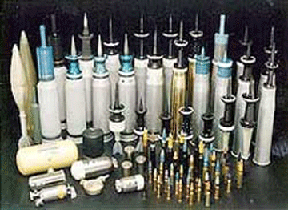
 of nuclear weapons that the U.S. military is currently in the process of developing or, as the administration likes to say, “modernizing.” Last year, the Pentagon flight-tested a mock version of the most advanced among them, the B61 Model 12. This redesigned nuclear weapon is the country’s first precision-guided atomic bomb, with a computer brain and maneuverable fins that enable it to more accurately target sites for destruction. It also has a “dial-a-yield” feature that allows its handlers to adjust the level of its explosive power……
The Federation of Atomic Scientists pointed out that the high accuracy of the weapon and its lower settings for destructiveness might tempt military commanders to call for its use in a future conflict…….
Another weapon undergoing U.S. government “modernization” is the cruise missile. Designed for launching by U.S. bombers, the weapon–charged William Perry, a former secretary of defense–raised the possibilities of a “limited nuclear war.” Furthermore, because cruise missiles can be produced in nuclear and non-nuclear versions, an enemy under attack, uncertain which was being used, might choose to retaliate with nuclear weapons.
Overall, the Obama administration’s nuclear “modernization” program–including not only redesigned nuclear weapons, but new nuclear bombers, submarines, land-based missiles, weapons labs, and production plants–is estimated to cost as much as $1 trillion over the next thirty years. Andrew C. Weber, a former assistant secretary of defense and former director of the interagency body that oversees America’s nuclear arsenal, has criticized it as “unaffordable and unneeded.” After all, the U.S. government already has an estimated 7,200 nuclear weapons.
The nuclear weapons modernization program is particularly startling when set against President Obama’s April 2009 pledge to build a nuclear weapons-free world. Although this public commitment played a large part in his receipt of the Nobel Peace Prize that year, in succeeding years the administration’s action on this front declined precipitously.
It did manage to secure a strategic arms reduction treaty (New START) with Russia in 2010 and issue a pledge that same year that the U.S. government would “not develop new nuclear warheads.” But, despite promises to bring the 1996 Comprehensive Test Ban Treaty to the Senate for ratification and to secure further nuclear arms agreements with Russia, nuclear disarmament efforts ground to a halt. Instead, plans for “nuclear modernization” began. The president’s 2016 State of the Union address contained not a word about nuclear disarmament, much less a nuclear weapons-free world.
What happened?
Two formidable obstacles derailed the administration’s nuclear disarmament policy. At home, powerful forces moved decisively to perpetuate the U.S. nuclear weapons program: military contractors, the weapons labs, top military officers, and, especially, the Republican Party. Republican support for disarmament treaties was crucial, for a two-thirds vote of the U.S. Senate was required to ratify them. Thus, when the Republicans abandoned the nuclear arms control and disarmament approach of past GOP presidents and ferociously attacked the Obama administration for “weakness” or worse, the administration beat an ignominious retreat. To attract the backing of Republicans for the New START Treaty, it promised an upgraded U.S. nuclear weapons program.
Russia’s lack of interest in further nuclear disarmament agreements with the United States provided another key obstacle. With 93 percent of the world’s nuclear weapons in the arsenals of these two nations, a significant reduction in nuclear weapons hinged on Russia’s support for it. But, angered by the sharp decline of its power in world affairs, including NATO’s advance to its borders, the Russian governmentengaged in its own nuclear buildup and spurned U.S. disarmament proposals.
Despite these roadblocks, the Obama administration could renew the nuclear disarmament process. Developing better relations with Russia, for example by scrapping NATO’s provocative expansion plan, could smooth the path toward a Russian-American nuclear disarmament agreement. And this, in turn, would soften the objections of the lesser nuclear powers to reducing their own nuclear arsenals. If Republican opposition threatened ratification of a disarmament treaty, it could be bypassed through an informal U.S.-Russian agreement for parallel weapons reductions. Moreover, even without a bilateral agreement, the U.S. government could simply scrap large portions of its nuclear arsenal, as well as plans for modernization. Does a country really need thousands of nuclear weapons to deter a nuclear attack? Britain possesses only 215. And the vast majority of the world’s nations don’t possess any.
Given the terrible dangers and costs posed by nuclear weapons, isn’t it time to get back on the disarmament track? http://www.huffingtonpost.com/lawrence-wittner/modernizing-the-opportuni_b_9005600.html?ir=Australia
Nuclear waste deals that fell flat, between Toshiba, USA and Mongolia
 The elephant in the room for Toshiba is nuclear http://www.japantimes.co.jp/news/2016/01/16/national/media-national/elephant-room-toshiba-nuclear/
BY PHILIP BRASOR THE JAPAN TIMES, JAN 16, 2016
Japanese press outlets often cover scoops from competing outlets, but it’s rare to build on a competitor’s story with original reporting, especially when the scoop is a few years old. In December, the weekly magazine Aera, which is affiliated with the Asahi Shimbun, ran an article about a secret meeting that took place between representatives of Japan, Mongolia and the United States almost five years ago. This meeting was first reported by Haruyuki Aikawa in the May 9, 2011, issue of the Mainichi Shimbun.
What interested Aera reporter Atsushi Yamada about the article was Aikawa’s assertion that Toshiba Corp. was on hand for the negotiations. In 2006, Toshiba had bought a majority share in the American company Westinghouse, a manufacturer, like Toshiba, that started out in the home electronics field and eventually expanded into nuclear power plant construction. Japan said it would buy uranium mined in the central Asian country and in return Mongolia would tap Japan’s nuclear energy expertise in building power plants and, more significantly, nuclear fuel reprocessing facilities that would incorporate the acceptance of high-level nuclear waste from Japan and other countries.
Though the Mainichi story received little attention in Japan or the U.S., it was translated and disseminated in Mongolia, thus leading, only three months after the 2011 nuclear meltdown in Fukushima, to citizen protests against the deal, which opponents said would turn their country into a “toilet” for the world’s nuclear waste. Later, the Mongolian government said it might be difficult for it to accept this waste.
Yamada read subsequent emails between Toshiba’s president at the time, Norio Sasaki, and an official of the U.S. Dept. of Energy, which said that negotiations with Mongolia should continue and that any further arrangements be made in a confidential manner. Toshiba’s public relations department confirmed the existence of the emails to Yamada but denied that Toshiba had asked the Mongolian government to receive outside nuclear waste. The negotiations, it said, had more to do with “building on the system of nuclear nonproliferation.”
Aikawa told Yamada that while ostensibly the negotiations were between the three governments, the plans for the deal were drawn up by the U.S. and Toshiba with the aim of selling nuclear power plants to emerging economies under a scheme called Comprehensive Fuel Service. According to this scheme, vendors assure potential customers that they will handle any future nuclear waste produced by power plants the customers buy, which is why Mongolia’s acceptance of such waste is so important. Due to local resistance, neither the U.S. nor Japan has anywhere to dump spent fuel, even their own.
The reason Yamada became so interested in this topic years after the fact is that in the meantime, Toshiba has been caught up in financial scandals that have brought the company to its knees, and he wanted to explore the connection between Toshiba’s nuclear energy business and its fiscal woes.
The connection itself is not a secret. Toshiba spent almost ¥600 billion to buy its share of Westinghouse, which at the time of the purchase was only worth about ¥250 billion. The extra “goodwill” money (norendai) was in anticipation of future revenues that would accrue as Toshiba expanded its nuclear energy business both in Japan and throughout the world with Westinghouse as its “trump card.” But then Fukushima happened, putting a serious damper on demand for plant construction.
The revenues Toshiba envisioned didn’t materialize, and the norendai became a huge liability it tried to hide through bookkeeping. Sasaki, his predecessor and his successor are all now being sued by Toshiba’s management for ordering improper accounting practices after Nikkei Business reported that Toshiba was violating Tokyo Stock Exchange regulations regarding the disclosure of a subsidiary’s losses.
However, at the end of December, the Financial Services Agency, in its investigation of the accounting scandal, did not find Toshiba to be at fault, but rather punished the auditing firm of Ernst & Young ShinNihon for “failure to detect” Toshiba’s improper accounting practices. In a follow-up article in the Jan. 11 issue of Aera, the reporter wondered if this arrangement didn’t smack of “conspiracy,” and an FSA representative told the magazine that the agency “suspected” as much but “could not find any evidence.” For the next three months, ShinNihon is suspended from signing any new business contracts and must pay a “surcharge” of ¥2.1 billion. Though that may sound severe, industry people told Aera that usually in such cases penalized companies are suspended from conducting business altogether.
So why didn’t the FSA accuse Toshiba of accounting fraud, especially given that it’s not uncommon for auditors to revise their findings so as not to inconvenience powerful clients? As Yamada points out, the agency didn’t even mention Westinghouse in its findings.
Perhaps the government still needs Toshiba, since Prime Minister Shinzo Abe has pegged Japanese growth at least partly to the export of nuclear technology. In November, the Asahi Shimbun interviewed the CEO of Westinghouse, who said his company had plans to build dozens of new reactors all over the world, “including Japan.” Abe is selling nuclear technology to Vietnam, Turkey and other countries, and in October he finalized a trade deal with Mongolia.
Ryoko Imaoka, an associate professor at Osaka University and longtime expert on Mongolia, has explained that the U.S., desperate to find a friendly country to accept nuclear waste, was pushing Japan to make a deal with Mongolia. Japan publicly downplays the nuclear part of the trade agreement and Japanese media have obliged, though Mitsubishi Corp. is already developing three new mines there. She says the country’s currently dormant uranium pits remain extremely radioactive and it’s not clear where any nuclear waste would be buried, but in any event there are Mongolians who are ready to sue to shut the whole thing down.

Nuclear Waste Isolation Pilot Plant (WIPP)- what needs to be done?
Analyses of the accidents by the DOE have documented a lack of a ‘safety culture’ at WIPP.
The current regulatory period of 10,000 years is short relative to the 24,100-year half-life of plutonium-239, let alone that of uranium-235, which has a half-life of 700 million years.
Policy: Reassess New Mexico’s nuclear-waste repository, Nature Cameron L. Tracy, Megan K. Dustin & Rodney C. Ewing 13 January 2016
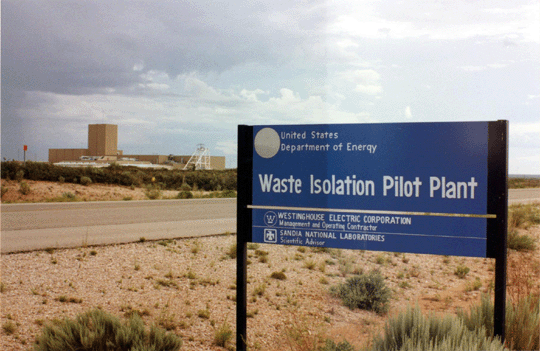
Proposals to bury plutonium from nuclear weapons must address chemical interactions and intrusion risks. More than 600 metres below ground near Carlsbad, New Mexico, is the world’s only operating deep geological repository currently accepting transuranic nuclear waste: that contaminated by elements heavier than uranium. The Waste Isolation Pilot Plant (WIPP), run by the US Department of Energy (DOE), is used to dispose of laboratory equipment, clothing and residues from the nation’s nuclear-defence programme. In the past 15 years, around 91,000 cubic metres (equivalent to covering a soccer field to a depth of about 13 metres) of such transuranic waste, mostly of relatively low radiation levels, has been placed there.
The main contaminants are long-lived isotopes of plutonium (mainly plutonium-239, with a half-life of 24,100 years, and plutonium-240, with a half-life of 6,560 years) and shorter-lived isotopes of americium and curium. In rooms carved out of a 250-million-year-old salt bed, the waste is stored in hundreds of thousands of plastic-lined steel drums. The repository is now at about half of its planned capacity and is to be sealed in 2033.
The DOE is responsible for performing safety assessments to ensure that WIPP will not exceed limits on exposure to radioactivity, as set by the US Environmental Protection Agency (EPA), for 10,000 years.
But new demands are emerging. An arms-control agreement with Russia made in 2000 obliges the United States to dispose of 34 tonnes of plutonium from dismantled nuclear weapons1. Following the terms of the agreement, the United States planned to convert the material into a fuel — mixed (uranium and plutonium) oxide, or MOX — to burn in commercial nuclear-power plants. But faced with soaring construction costs for a MOX fabrication facility at the Savannah River Site in South Carolina, the DOE has commissioned evaluations of alternatives2.
The most recent report3, published in August 2015, recommends burying the weapons’ plutonium at WIPP. Judging the repository’s performance to have been “successfully demonstrated”, the DOE’s Red Team expert panel proposes that the 34 tonnes of weapons plutonium can be added to WIPP once it has been diluted to low concentrations comparable to that of the transuranic waste at WIPP.
In fact, WIPP’s safety record is mixed. Continue reading
1 This Month
15 October. Joint Appeal for Nuclear Abolition Day -presentation to the UN on October 15 will be live on UNWebTV
Endorse the Nuclear Abolition Day Appeal
23-25 October – on Zoom – World BEYOND War’s annual global conference

To see nuclear-related stories in greater depth and intensity – go to https://nuclearinformation.wordpress.com
-
Archives
- October 2026 (139)
- September 2026 (339)
- August 2026 (330)
- July 2026 (355)
- June 2026 (287)
- May 2026 (306)
- April 2026 (356)
- March 2026 (251)
- February 2026 (267)
- January 2026 (308)
- December 2025 (358)
- November 2025 (359)
-
Categories
- 1
- 1 NUCLEAR ISSUES
- business and costs
- climate change
- culture and arts
- ENERGY
- environment
- health
- history
- indigenous issues
- Legal
- marketing of nuclear
- media
- opposition to nuclear
- PERSONAL STORIES
- politics
- politics international
- Religion and ethics
- safety
- secrets,lies and civil liberties
- spinbuster
- technology
- Uranium
- wastes
- weapons and war
- Women
- 2 WORLD
- ACTION
- AFRICA
- Atrocities
- AUSTRALIA
- Christina's notes
- Christina's themes
- culture and arts
- Events
- Fuk 2022
- Fuk 2023
- Fukushima 2017
- Fukushima 2018
- fukushima 2019
- Fukushima 2020
- Fukushima 2021
- general
- global warming
- Humour (God we need it)
- Nuclear
- RARE EARTHS
- Reference
- resources – print
- Resources -audiovicual
- Weekly Newsletter
- World
- World Nuclear
- YouTube
-
RSS
Entries RSS
Comments RSS


