America’s nationwide problem of nuclear wastes, and Edison’s experimental Holtec solution
 O.C. Watchdog: Could there be an ‘early’ nuclear cleanup at San Onofre? Orange County Register, By TERI SFORZA / March 23, 2016 “…….NATIONWIDE PROBLEM Some 72,000 metric tons of highly radioactive waste has piled up at 75 commercial reactor sites in America over the past half-century, according to a recent review by the U.S. Government Accountability Office.
That’s not how it was supposed to be.
To encourage the development of nuclear power, the federal government passed the Nuclear Waste Policy Act of 1982, promising to accept and dispose of spent fuel and high-level waste by Jan. 31, 1998.
Utilities operating nuclear power plants made payments into a Nuclear Waste Fund to pay for disposal.
About $750 million a year was collected from ratepayers, and the disposal program’s funding grew to $41 billion over three decades. But the federal government never accepted any commercial nuclear waste for permanent disposal.
The nuclear industry sued, and a federal judge found that the U.S. Department of Energy couldn’t continue charging for a service it not only wasn’t providing, but wouldn’t provide for many decades. In 2014, utilities stopped collecting the charge – about 20 cents a month on the average electric bill. After the government spent $10 billion on a now-abandoned plan to create a permanent disposal site at Nevada’s Yucca Mountain, about $30 billion remains in the fund, earning about $1 billion in interest a year.
Local governments, including San Clemente, Laguna Beach, Oceanside, Encinitas and San Diego County, are pressing Washington to fulfill its obligations.
“We all want it gone,” said San Clemente City Councilman Tim Brown last month.
BREAKTHROUGH?
Edison agrees.
“We are very much in alignment with our nearby communities, which are making efforts to get the nuclear fuel moved off-site to another location,” said Maureen Brown, Edison spokeswoman. “Before it can be moved off-site, though, it has to be in a dry storage canister for transport. We are continuing with preparations to expand dry storage and get all the fuel out of the spent fuel pools.”
That’s supposed to be done by 2019. Edison has chosen Holtec International’s Hi-Storm Umax underground system for dry storage. The fuel is expected to remain in an “underground monolith” on-site through 2049, when Edison assumes the federal government will take custody of all spent nuclear fuel.)
The Department of Energy will begin public meetings on the new push for interim storage sites on Tuesday in Chicago.A second hearing is scheduled in Atlanta on April 11 and a third in Sacramento on April 26.
“(W)e in the communities surrounding SONGS have a keen interest in removing the spent fuel from the site,” Victor wrote in a recent memo to the Community Engagement Panel. “As the option of Yucca Mountain has stalled, spent fuel has been backing up at sites around the country with no place for permanent disposal. The idea of consolidated interim storage (CIS) could be a solution.
San Onofre’s storage system will be part of a real-time experiment, as Edison partners with the Electric Power Research Institute to develop inspection techniques to monitor casks as they age.
No entity has previously done what Edison is planning – burying this kind of spent fuel in dry casks for decades. Critics have raised concerns about the ability of the casks to withstand the heat of the fuel over time.
Some don’t think temporary storage is the answer.
“If such a site were ever built, it would be a disaster for the hosting community,” said activist Ace Hoffman of Carlsbad. “DOE calls it ‘consent-based,’ but how can future generations that will have to deal with the mess give their consent? And why on earth would they?
“DOE calls it ‘interim,’ but what exactly that means has never been defined, except to mean ‘until a permanent repository opens up somewhere.’ Who’s going to fall for that line?” http://www.ocregister.com/articles/fuel-709466-nuclear-san.html
Scepticism on San Onofre nuclear station cleanup plan
 O.C. Watchdog: Could there be an ‘early’ nuclear cleanup at San Onofre? Orange County Register, By TERI SFORZA / March 23, 2016 Federal efforts to speed up the removal of spent radioactive fuel from power plants like the mothballed San Onofre Nuclear Generating Station are gaining momentum and inspiring guarded optimism among local officials.
Critics, however, remain deeply skeptical.
In January, the U.S. Department of Energy launched a new push to create temporary nuclear waste storage sites in regions eager for the business, currently in West Texas and New Mexico.
Several such sites could be up and running while the prickly question of finding a location for a permanent repository – the root of the present paralysis in nuclear waste disposal – is hashed out.
“That could mean moving the fuel from San Onofre a decade earlier than is envisioned now, maybe more,” said David Victor, who chairs the San Onofre Community Engagement Panel. The volunteer group of academic, industry, environmental and local government representatives advises the plant’s owner, Southern California Edison.
“I am cautiously optimistic,” he said. Victor, director of the Laboratory on International Law and Regulation at UC San Diego, met with officials in Washington this month to convey populous Southern California’s eagerness to solve the nuclear waste storage problem. An update on those efforts, as well as the latest on plans to dismantle the shuttered twin reactors, will be presented at 6 p.m. today at the San Onofre Community Engagement Panel’s quarterly meeting in Oceanside.
Decommissioning the plant south of San Clemente is expected to cost $4.1 billion and be mostly completed by 2030. But spent nuclear fuel is expected to remain on the beachside bluff much longer………… http://www.ocregister.com/articles/fuel-709466-nuclear-san.html
US households turning to solar panels. Impact on power industries

 Impact of solar panels keeps growing The U.S. power industry is feeling the pressure, with about 1 million households turning to the sun. PORTLAND PRESS HERALD, BY JONATHAN N. CRAWFORD BLOOMBERG.22 Mar 16 Rooftop solar is casting a $2 billion shadow over power generators across the eastern United States.
With more than a million U.S. houses set to have solar panels by the end of next month, grid managers serving the eastern U.S. plan to cut the amount of electricity they buy from conventional plants by about 1,400 megawatts, starting in 2019, according to industry consultant ICF International Inc. That’s enough juice to power about 780,000 households.
The result could be as much as $2 billion in lost revenue for generators that are already reeling from lower demand, tight environmental regulation and depressed prices. Power producers including NRG Energy Inc. warn that the growing reliance on solar may curtail investment in conventional power plants, threatening the reliability of the U.S. electricity system. That’s already happened in Germany, they say, citing plans by EON and RWE to scrap existing or planned plants……..
Under “Energiewende,” a German transition plan designed to lessen fossil fuel use, about 30 percent of the country’s power is now generated by renewables, sending power prices to their lowest levels in more than a decade. That spurred EON’s Uniper unit to seek closure of two gas-fired units in Bavaria, and Essen-based RWE to scrap plans to start up its coal-fired Westfalen-D plant, valued at $1.1 billion…….
This year, for the first time, operators of regional power grids such as PJM Interconnection, which serves more than 61 million customers ranging from Washington to Chicago, and ISO New England Inc., have included solar growth in their estimates for 2019, spurring more national debate on how the nation’s electrical system will be financed and managed moving forward. http://www.pressherald.com/2016/03/19/impact-of-solar-panels-just-keeps-growing/
St Louis County residents count the health toll from radioactive wastes
As they painstakingly mapped out the cases, Wright, Schanzenbach, and other members of the group were struck by the statistical improbability of what they were seeing. They found higher than average levels of leukemia, rare brain tumors, breast, and colon cancers — all known to be associated with nuclear radiation exposure according the Centers for Disease Control and the US Environmental Protection Agency. “We realized that we were seeing the effects of long-term exposure among people who grew up in North St. Louis County from the 1960s to the 1980s when the contamination was at its worst,” says Wright…….
Over the past four years, more than 100 current and former North St. Louis County residents have filed lawsuits against Mallinckrodt and the other companies involved in the manufacture and disposal of the nuclear waste, alleging these businesses’ reckless and negligent actions caused their cancers and other illnesses.
According to the latest data collected by the survey, as of 2015 there were 1,993 self-reported cancer cases, of which 45, including Patricia Barry’s, were cases of appendix cancer — a disease so rare that it’s usually seen in 1 of about 500,000 people a year in the United States.
In total, there were more than 2,725 reported cases of multi-generational illnesses, including rare cancers, thyroid problems, infertility, autoimmune diseases, and genetic mutations in children. (below, archival photo of waste barrels, st Louis)

 Nuclear Waste Creates Casualties of War in Missouri TruthOut , 18 March 2016 By Lori Freshwater, Earth Island Journal | News Analysis “…….Google search revealed shocking information. It seemed there was an unusually high number of rare cancers and diseases afflicting current and former residents of several neighborhoods that Coldwater Creek ran through, including St. Ann. The most likely cause, the news reports and websites she scanned indicated, was the creek, which had been contaminated by radioactive waste from the World War II era. Continue reading
South Carolina does not want to be the world’s nuclear waste dump
 “We strongly object to foreign-origin plutonium coming into South Carolina
over the next seven years we will continue to see dangerous shipments of nuclear waste routed through Charleston harbor
More Nuclear Dumping In South Carolina, FITSNEWS, 22 Mar 16 “……This week, nuclear shipments to the Palmetto State are back in the news – specifically the latest round of foreign plutonium slated to arrive in South Carolina from Japan.
That’s right: South Carolina is no longer the nation’s dumping ground … we are taking toxic waste from all over the world.
 Foreign waste has been shipped to SRS for years – but the latest scheduled arrival in Charleston Harbor this month has finally sparked some criticism from nuclear watchdogs. “We strongly object to foreign-origin plutonium coming into South Carolina when DOE’s program to manage surplus weapons plutonium is in shambles,” said Tom Clements, director of Savannah River Site Watch. “As DOE’s plutonium fuel project has totally failed, it’s time for DOE to live up to its commitment to remove plutonium from South Carolina and not bring in more with no viable disposition path out of the state.”…..
The Japanese shipment – an estimated 331 kilograms of highly fissionable material – is reportedly being transported by British warships to Charleston harbor later this month. Its arrival and subsequent transfer to SRS is a matter of intense speculation and secrecy.
Why are we taking Japan’s plutonium? So terrorists don’t steal it, according to the feds …
In fact we reached out to the S.C. State Ports Authority (SCSPA) seeking information about the shipment, but the agency’s leadership told us it had “no idea” about the details.
S.C. governor Nikki Haley has merely stated that she wants the twelve metric tons of plutonium on-site at SRS to be processed prior to new waste arriving. She’s threatened lawsuits to that effect, too……….
over the next seven years we will continue to see dangerous shipments of nuclear waste routed through Charleston harbor en route to SRS with absolutely nothing resembling a long-term disposal agreement in place.
DOE recently indicated its intention to send six metric tons of stored plutonium from SRS to a facility in New Mexico, but this transfer is nothing but further confirmation of the abandonment of the MOX program – which was subsidizing an estimated 2,100 South Carolina jobs………..http://www.fitsnews.com/2016/03/22/more-nuclear-dumping-in-sc/
NEW NUCLEAR AIR-LAUNCHED CRUISE MISSILE A REDUNDANT CAPABILITY
 CRUISE CONTROL: WHY THE U.S. SHOULD NOT BUY A NEW NUCLEAR AIR-LAUNCHED CRUISE MISSILE KINGSTON REIF MARCH 21, 2016 The Obama administration’s fantastical plan to modernize the Cold War-era nuclear triad of land-based missiles, submarine-launched missiles, and long-range bombers is prompting an increasingly loud and much-needed debate in Washington and beyond about whether the effort is necessary and sustainable.
One of the most controversial pieces of this “all of the above” sustainment approach, which is projected to exceed $350 billion over the next decade, is the Air Force’s proposal to build a new fleet of roughly 1,000 nuclear-capable air-launched cruise missiles (ALCMs).
The Defense Department and supporters of replacing the nuclear ALCM in Congress and the think tank communityargue that building a new missile is necessary to maintain an effective U.S. nuclear deterrent because the current missile is losing its ability to penetrate increasingly sophisticated air and missile defenses. These proponents alsoclaim that retaining an ALCM option for the bomber leg of the triad provides the president with unique options to control escalation and respond proportionally to a limited nuclear attack. In other words, the new missiles would augment the ability of the U.S. military to fight a nuclear war.
In the halls of the Pentagon, where planners have spent decades justifying nuclear force levels that would make a hoarder seem frugal by comparison, these arguments have taken on an almost religious quality. Yet strip away the magical thinking that permeates so much of U.S. nuclear strategy and the case for a new ALCM is weak: it is redundant, recklessly expensive, and potentially destabilizing………
A redundant capability
While supporters of the LRSO cite anticipated improvements in the air defenses of potential adversaries as a reason to develop the new nuclear cruise missile, it is doubtful that any target the missile could hit could not also be destroyed by other U.S. nuclear weapons or conventional cruise missiles……..
U.S. nuclear capabilities would remain highly credible and flexible even without a nuclear ALCM. The arsenal includes other weapons that can produce more “limited” effects, most notably the B61 gravity bomb. More importantly, the notion the use of nuclear weapons can be fine-tuned to carefully control escalation to a full-scale nuclear exchange is very dangerous thinking. It is highly unlikely that an adversary on the receiving end of a U.S. nuclear strike would (or could) distinguish between a large warhead and a small warhead. The fog of war is thick. The fog of nuclear war would be even thicker.
Large or small, nuclear weapons are extremely blunt instruments, both in terms of their destructive power and the taboo associated with the fact they have not been used in 70 years. As Michael Krepon has elegantly put it, the case for the LRSO “demands a fealty to nuclear warfighting concepts that most Americans will be hard-pressed to understand. The nuclear deterrence business is most persuasive to taxpayers in the abstract; particulars require the suspension of disbelief.”
Other arguments in favor of the LRSO are also unconvincing. ……..
Furthermore, as highlighted by William Perry, President Bill Clinton’s defense secretary, and Andrew Weber, President Barack Obama’s assistant secretary of defense for nuclear, “cruise missiles are a uniquely destabilizing type of weapon” due to the fact that “they can be launched without warning and come in both nuclear and conventional variants.”
The possible risk of miscalculation and unintended escalation posed by the LRSO requires far more scrutiny than the blithe assertions from the administration that the missile will be stabilizing.
Indefensible Costs
The case for the LRSO is further undermined when one considers the high budgetary costs and significant opportunity costs. The United States is planning to rebuild all three legs of the nuclear triad and their associated warheads at a cost and on a schedule that many military leaders say is unsustainable…….
The bloated U.S. nuclear arsenal of approximately 4,700 weapons is largely irrelevant to the most pressing national security challenges the United States faces. Retaining an unnecessarily large arsenal and enhancing U.S. nuclear warfighting capabilities will not help Washington address the challenges posed by great powers such as Russia and China. If anything, doing so will exacerbate relations with these countries.
The choice is clear: chart a more realistic path for the nuclear arsenal that doesn’t severely constrain the force-sizing options of future presidents and reduces the risk of doing serious damage to conventional capabilities and other national security programs. As an early step in this course correction, the Pentagon should cancel its new cruise missile program and prioritize continued investments in the other legs of the nuclear triad and more relevant and usable non-nuclear capabilities, including longer-range conventional cruise missiles.
Doing so would be far more beneficial to U.S. security than spending billions to buy a redundant new nuclear missile unneeded for either deterrence or assurance.
Kingston Reif is the Director for Disarmament and Threat Reduction Policy at the Arms Control Association. You can follow him on Twitter at @KingstonAReif. http://warontherocks.com/2016/03/cruise-control-why-the-u-s-should-not-buy-a-new-nuclear-air-launched-cruise-missile/
LARGE-SCALE SOLAR POWER STORAGE CAN BECOME A REALITY
CAN LARGE-SCALE SOLAR POWER STORAGE BECOME A REALITY?, Stanford Engineering, An unexpected finding by a team of engineers could lead to a revolutionary change in how we produce, store and consume energy. By Glen Martin, 16 Feb 16, “……..Now a team led by William Chueh, an assistant professor of materials science and engineering, and Nicholas Melosh, an associate professor in the same department, has made a discovery that could make large-scale solar power storage a reality.
The breakthrough is based on the fact that ordinary metal oxides, such as rust, can be fashioned into solar cells capable of splitting water into hydrogen and oxygen.
So far it has been impractical to use water-splitting as a way to store the sun’s energy. One reason is cost-efficiency. Silicon-based solar cells, such as those used in rooftop solar arrays, are good at converting visible and ultraviolet light into electricity. But silicon cells waste the infrared light, which bears heat, beating down on them.”Standard cells utilize a relatively small portion of the spectrum, and the rest is lost as heat,” Chueh said.Until the recent Stanford experiments, it was believed that metal oxides also became less efficient as they became hotter. And since they were less efficient than silicon to start with, that made them less interesting as a water-splitting technology.The Stanford experiments change that misconception…………Discovering that heating up metal oxides produces more energy means that relatively simple engineering could be applied to heat these solar cells to enhance their efficiency.”You don’t have to add energy from an outside source,” said graduate student and team member Andrey Poletayev. “You can do it for free by concentrating solar radiation, either through a magnifying lens or parabolic mirrors.”Chueh believes that this discovery will refocus attention on developing metal oxides as cost-effective alternatives to silicon solar cells. Quite apart from their potential use in a day-to-night energy storage scenario, he envisions that pure hydrogen gas produced by water-splitting could be used to power vehicles or other machines directly and without pollution.”We can store these gases, we can transport them through pipelines, and when we burn them we don’t release any extra carbon,” said Chueh. “It’s a carbon-neutral energy cycle.”This research was supported by Stanford’s Global Climate and Energy Project and by the National Science Foundation. https://engineering.stanford.edu/news/can-large-scale-solar-power-storage-become-reality
Problems of decommissioning nuclear reactors
Commentary on report: The Nationwide Failures of Decommissioning Regulation: Decommissioning Trust Funds or Slush Funds?
Fairewinds Energy Education DOWNLOAD THE REPORT
MiningAwareness, 24 Mar 16 After so many years rats can set up and spread contamination. However, where will they be decommissioned to? While the rats are a problem, letting the reactors sit up does actually allow some of it to become less radioactive. Some period of letting it sit up also allows time for a real solution, if there is any outside of a 24/7 monitored bunker.
A few years would allow construction of such a facility. Certainly Vermont is happy to send its large nuclear parts to sit outside and be buried at the Clive facility in Utah or West Texas.
Who wouldn’t be happy to get shot of this lethal waste? Eventually it’s going to come back up from its burial ground and land on the eastern states too. To be fair I haven’t read this document. However, I think that Vermont’s “waste pact” is with west Texas, WCS (Waste Control Specialists).
Although Vermont may not be suitable for radioactive waste due to rain, west Texas is unsuitable due to heat and alternating rain and dry spells, in conjunction with burial in concrete lined clay. Plus it’s hard to see the fairness in this, except there is a good chance that the rain out following the inevitable explosion at WCS will be over Vermont. Burial of waste is unacceptable everywhere. And, that’s what they do at WCS and Clive.
It’s easy to see people in the eastern US think that what happens out west has nothing to do with them, but weapons testing proved otherwise. Interestingly, if German nuclear waste is buried in South Carolina, rather than further west, Germany may be more impacted by the inevitable explosion than the US. Certainly Europe may be. But, like Europe’s unwanted people, the movement of the waste will be gradually westward.
New design nuclear reactors not happening for a long time (if at all)
“Our target is — can we really move the process forward and have a commercial option by 2030?” Mr. Kuczynski said. To do that, he and others say, the pace of the design process, and of the Nuclear Regulatory Commission’s review process, needs to be sped up.
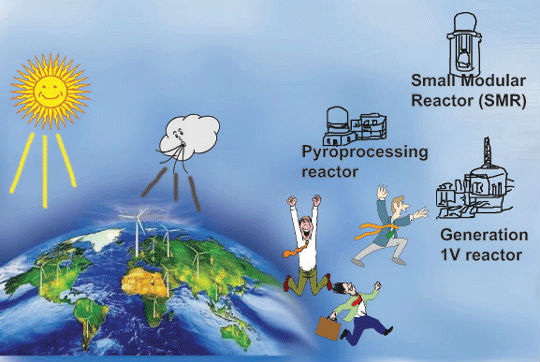
“It’s a 25-year process, no matter what,” said Michael McGough, the chief commercial officer of NuScale Power, which is the furthest along among companies working on less conventional reactors. NuScale’s design, called asmall modular reactor, uses water as a coolant, but the units are far smaller than current reactors and have advanced safety features. They could be built largely in a factory, saving money, and up to 12 of them could be installed at one site.
Mr. McGough knows all about long timetables; NuScale’s design has been under development since 2000……
Many in the industry hope that extending the licenses of existing reactors will forestall at least some closings. Nuclear plants were originally licensed for 40 years, but almost all have sought and received 20-year extensions.
The regulatory commission has begun researching what would be required to extend a plant’s life to 80 years. “We’re asking very basic questions, like how long can a reactor vessel remain acceptable since it’s being bombarded by neutrons,” said Scott Burnell, a spokesman………
Given the relatively poor economics of nuclear power, however, even if a plant could be licensed to operate up to 80 years, the question remains whether it would be financially worthwhile for it to do so, especially if expensive work is required. Skeptics cite two American plants that have been closed for economic reasons since 2012, after their licenses were extended to 60 years.
Similar economic uncertainties surround the latest generation of reactors, the Westinghouse AP1000……..
“What eventually happens with the four AP1000s will be very important,” said Matthew McKinzie, a senior scientist with the Natural Resources Defense Council. “If the economics of extending the lifetime of a plant to 80 years are poor, then what does that say about the economics of a new plant?”
Critics of nuclear power say that novel designs like molten salt reactors raise new issues, especially regarding safety, that will require much time to evaluate.
“A regulator can’t accept paper studies saying that a reactor is supersafe,” said Edwin Lyman of the Union of Concerned Scientists. “They need documentation, experimental data.”
“The industry and Department of Energy have this fantasy that you can have some general design-neutral licensing process,” he added………..http://www.nytimes.com/2016/03/22/science/nuclear-energy-power-plants-advanced-reactors.html?_r=0
New York looks to fees to save uneconomic nuclear power stations
NY eyes fee to save some nuclear plants Democrat and Chronicle March 20, 2016 ALBANY – New York’s energy regulators have a problem. ……… two of the state’s three upstate nuclear plants — the R.E. Ginna Nuclear Power Plant in Wayne County and the James A. FitzPatrick Nuclear Power Plant in Oswego County — are facing financial trouble and could close as soon as mid-2017. The third, Nine Mile Point, is also in Oswego County.
A fourth plant — the Indian Point Energy Center in Buchanan, Westchester County —is facing opposition from Gov. Andrew Cuomo as owner Entergy Corp. seeks new federal licenses.
The solution? Money……..

“Nuclear is one thing. Nuclear a stone’s throw from 20 million people when you have no evacuation plan is problematic,” Cuomo told reporters Wednesday in Rochester.
In December, Cuomo directed the Public Service Commission to install the state’s carbon-cutting goals into state regulations. As part of that, Cuomo — who appoints the commission’s members — directed the board to come up with a plan to help save the “upstate nuclear facilities,” but not Indian Point.
The commission outlined its plan in late January. And, as expected, the proposal excluded Indian Point: Only plants with valid federal licenses through 2029 would be eligible. And Indian Point’s licenses are technically expired, though it is awaiting federal approval.
The remaining three nuclear plants — Ginna, FitzPatrick and Nine Mile Point — would be eligible……
Campaign opposing licenses for nuclear expansion in Texas
 Environmentalists try to block nuclear growth in Texas, Victoria Advocate By Sara Sneath March 19, 2016 WADSWORTH – One of the largest nuclear power facilities in North America is set to double in size.
The Nuclear Regulatory Commission recently gave the South Texas Project the green light to build two new reactors at its plant between Bay City and Palacios. The company is holding off on building the reactors because of low natural gas prices and a lack of demand for new energy in Texas.
But state environmental groups want the company’s licenses yanked. They say the licenses violate the Atomic Energy Act, which prohibits foreign control or domination of a U.S. nuclear project.
Robert Eye, an attorney representing Public Citizen, the Sustainable Energy and Economic Development Coalition and the South Texas Association for Responsible Energy, said Toshiba has been fully funding the pre-licensing proceedings for the new reactors since 2011.
“In our view, the entity who funds it then has the ability to control it,” he said. “And, in that regard, that’s an important legal issue because they may use this license at some point, or they may try to use this license at some point. And, in our view, it’s not a valid license.” https://www.victoriaadvocate.com/news/2016/mar/19/environmentalists-try-to-block-nuclear-growth-in-t/
High costs loom for Xcel Energy’s nuclear reactors
 Xcel Energy faces more big investments to keep its nuclear units running Xcel faces $487 million in upgrades at its Prairie Island facility by 2020 By David Shaffer Star Tribune MARCH 19, 2016
The high cost of upgrading 40-year-old nuclear reactors is confronting Xcel Energy again.
Investments in the Prairie Island nuclear power plant in Red Wing, Minn., are projected to cost more than expected — $487 million by 2
20, with more spending needed in the next decade.
It’s not a replay of cost overruns at Xcel’s other reactor in Monticello, Minn. That 2013 surprise, which state regulators blamed on imprudent management, led Xcel to write off $125 million last year………
in a fresh surprise, Xcel also has offered to study shutting down Prairie Island years before the reactors’ operating licenses expire in 2033-34. Xcel isn’t pushing early retirement, which would accelerate the costly job of decommissioning. It’s an option being presented to the Minnesota Public Utilities Commission, which regulates Xcel’s rates and investments.
Two nuclear plants, including one in Wisconsin, have shut down for economic reasons since 2013. Four other nuclear plants in other states face similar challenges and are slated to close by 2019.
Even if Xcel retires its Prairie Island units in the 2020s, the Minneapolis-based utility said significant investment is needed just to keep them operating for a few years. One of the plant’s two generators is the original unit, and is to be replaced in 2018 if not sooner. Four cooling towers also need refurbishment or replacement, as do dozens of decades-old pumps, motors and controls, the utility said…….. the near-term investment in the Prairie Island plant isn’t the end of the story. Xcel said another $600 million to $900 million in additional work likely will be needed at Prairie Island in the 2020s………http://www.startribune.com/xcel-energy-faces-more-big-investments-to-keep-its-nuclear-units-running/372610701/
Armed UK vessels secretly take weapons grade plutonium from Japan to USA
The Pacific Egret and its escort ship Pacific Heron are reportedly lightly armed UK flagged vessels and arrived in Kobe port from Barrow-in-Furness, England on March 4th. The Egret docked in Tokai for pre-transport logistics last week. Both ships after departing Tokai port will sail together most likely through the South Pacific to the east coast of the United States.
NPT and Nuclear Security Risks’ Exposed by Secret Plutonium Shipment: NGOs, March 18, 2016 Tokyo- (PanOrient News) A coalition of five non-governmental organizations warned today that a shipment of weapons-grade plutonium scheduled to
depart the port of the Japanese Tokai nuclear station in Ibaraki prefecture this coming weekend highlights the failure, but also the proliferation risks, of the current Japanese nuclear policy.
A cargo of 331kg of plutonium will be loaded on to the Pacific Egret, an armed British nuclear transport ship, prior to departure under armed escort to the United States. It will be the largest shipment of separated plutonium since 1.8 tons of plutonium was delivered to Japan by controversial Akatsuki-maru in 1992. The two month voyage to the Joint Base Charleston-Weapons Station will then see the plutonium dumped at the Department of Energy Savannah River Site (SRS) in South Carolina. The U.S. National Nuclear Security Administration, which is responsible for the shipment, has identified that storage in Japan poses a security risk justifying its removal.
The organizations, Citizen Nuclear Information Center (Japan); Green Action (Japan); Savannah River Site Watch (U.S.); CORE (England), and Greenpeace, said in a statement they condemn the shipment as a dangerous distraction from the major problem in Japan which is its overall nuclear energy policy, where over 9 tons of plutonium remains stockpiled and there are plans to produce many tons more during the coming decade. The representatives of the five organizations have worked together over the past quarter century against Japan`s plutonium and nuclear fuel cycle program.
For the U.S. and Japanese government, the Tokai shipment will be mistakenly hailed as demonstrating their commitment to reducing the threat from fissile materials, the statement noted. Both Prime Minister Abe and President Obama plan to announce the ‘success’ of the removal from Japan, at the fourth Nuclear Security Summit from March 31st -April 1st in Washington, D.C., while Japan will be desperate to avoid any discussion of the proliferation and security threat posed by its plutonium fuel cycle program.
“If 331 kg of plutonium warrants removal from Japan on the grounds of its vulnerability and in the interests of securing nuclear weapons material, then there is no credible justification for Japan’s current program and future plans to increase its plutonium stockpiling. Hailing a shipment of hundreds of kilograms of plutonium as a triumph for nuclear security, while ignoring over 9 tons of the weapons material stockpiled in Japan and in a region of rising tensions, is not just a failure of nuclear non proliferation and security policy but a dangerous delusion,” said Shaun Burnie, senior nuclear specialist at Greenpeace Germany, who is currently in Japan. ……..
Toshiba investigated Over Westinghouse Accounting
 Toshiba Said to Face U.S. Probe Over Westinghouse Accounting, 17 Mar Tom Schoenberg and Matt Robinson, 2016, Bloomberg Toshiba Corp. is under investigation by the U.S. government over allegations that it hid $1.3 billion in losses at its nuclear power operations, according to two people familiar with the matter. Shares plunged in Tokyo.
The Justice Department and the Securities and Exchange Commission are looking into whether fraud was committed, said the two, who asked not to be named because the investigations aren’t public. The probes, they said, follow one by Japan’s securities regulator, which found that Toshiba falsified financial statements and documents involving its issuance of corporate bonds.
U.S. authorities are scrutinizing allegations made in an internal review published last year by the Tokyo-based company, the two people said. The report, a 334-page version of which was published in English on Toshiba’s website in December, said management was complicit in padding profits for almost seven years. It led to the resignations of top officials, including Hisao Tanaka, Toshiba’ president and chief executive officer.
Until now, the investigation into Toshiba’s accounting practices had been limited to its home country, where regulators fined the company $62.1 million — the largest penalty ever imposed — and fined its former auditor, Ernst & Young ShinNihon, $17.4 million and barred it from accepting new business for three months. Toshiba President Masashi Muromachi, who took over as the scandal unfolded last year, promised to take steps to overhaul operations and prevent future wrongdoing.
The stock fell 8 percent to 192 yen in Tokyo, the biggest drop since Feb. 5. The shares had climbed as as much as 4.9 percent before the probe was reported.
“The markets are very sensitive to any news of impropriety,” said Yukihiko Shimada, a Tokyo-based analyst at SMBC Nikko Securities Inc. “Toshiba has previously assured investors that everything was right at Westinghouse. Their track record isn’t great.”
The recent expansion by U.S. authorities, which are known to open cases even when another jurisdiction is already investigating, means Toshiba could face further enforcement action in America. The U.S. can exert jurisdiction in part because the allegations involve its Westinghouse Electric Co. unit, which is based in Cranberry Township, Pennsylvania. The report also names Ernst & Young, which audited the Westinghouse accounts……..
In Japan, Toshiba’s accounting scandal is the largest since 2011, when Olympus Corp. admitted to using takeovers to hide $1.7 billion in losses. Toshiba, a 140-year-old industrial group that makes everything from nuclear reactors to microchips and home appliances, dropped to a 35-year low in Tokyo in February after widening its annual loss forecast to a record $6 billion as it restructures in the wake of the scandal.
Toshiba said it initially uncovered irregularities related to “percentage of completion” estimates used on infrastructure projects including nuclear, hydroelectric, wind-power equipment, air-traffic control and railway systems. Percentage of completion accounting is a subjective method that relies almost completely on management estimates on the profitability of long-term contracts………
Westinghouse was purchased by Toshiba for $5.4 billion in 2006. Toshiba explained to investors in November that Westinghouse’s nuclear plant construction business was harmed by the Fukushima nuclear disaster.
Toshiba’s internal report describes how the company failed to account for more than $100 million in Westinghouse losses on its 2013 books involving the construction of a nuclear power plant in Florida. Toshiba officials traveled to the U.S. to meet with Westinghouse executives to discuss findings showing increasing costs of the Florida project…….http://www.chicagotribune.com/news/sns-wp-blm-toshiba-0c20a5c8-ec23-11e5-a9ce-681055c7a05f-20160317-story.html
Cocaine use among staff at Nuclear Missile Base
Air Force Investigating Cocaine Use at Nuclear Missile Base http://gawker.com/air-force-investigating-cocaine-use-at-nuclear-missile-1765720042 Sam Biddle 18 Mar 16, Cocaine and nuclear weapons: A good mix? That’s what an official probe into coke abuse by “about a dozen airmen” at the F.E. Warren Air Force Base in Wyoming will investigate, the AP reports.
The coked-up airmen in question are, reassuringly, not the people who have their fingers on the literal button required to begin a nuclear war. But they are, scarily, the people tasked with defending the 150 Minuteman III ICBMs (each with an explosive yield roughly eight times greater than the bomb that leveled Hiroshima, easily capable of destroying an entire large modern city) from the rest of the world. As the AP notes, they’re crucial to the operation and safety of America’s vast nuclear stockpile:
Security forces at nuclear missile bases are entrusted to patrol the missile fields and respond to any security emergencies. They are highly trained and given enormous responsibility. Just last month, Deputy Defense Secretary Robert Work visited F.E. Warren and observed a demonstration by security forces of the techniques and equipment they would use to recapture a missile silo that had been taken over by intruders.
In other words, not the kind of people you want doing key bumps in the bathroom. This is the second time in two years that F.E. Warren has been under investigation: In 2014, missile officers responsible for actually launching those ICBMs were caught cheating on their proficiency tests and also doing a lot of illegal drugs.
This sounds like it would be a very fun job were it not for the possibility of fucking up and beginning a nuclear holocaust.
-
Archives
- October 2026 (129)
- September 2026 (339)
- August 2026 (330)
- July 2026 (355)
- June 2026 (287)
- May 2026 (306)
- April 2026 (356)
- March 2026 (251)
- February 2026 (267)
- January 2026 (308)
- December 2025 (358)
- November 2025 (359)
-
Categories
- 1
- 1 NUCLEAR ISSUES
- business and costs
- climate change
- culture and arts
- ENERGY
- environment
- health
- history
- indigenous issues
- Legal
- marketing of nuclear
- media
- opposition to nuclear
- PERSONAL STORIES
- politics
- politics international
- Religion and ethics
- safety
- secrets,lies and civil liberties
- spinbuster
- technology
- Uranium
- wastes
- weapons and war
- Women
- 2 WORLD
- ACTION
- AFRICA
- Atrocities
- AUSTRALIA
- Christina's notes
- Christina's themes
- culture and arts
- Events
- Fuk 2022
- Fuk 2023
- Fukushima 2017
- Fukushima 2018
- fukushima 2019
- Fukushima 2020
- Fukushima 2021
- general
- global warming
- Humour (God we need it)
- Nuclear
- RARE EARTHS
- Reference
- resources – print
- Resources -audiovicual
- Weekly Newsletter
- World
- World Nuclear
- YouTube
-
RSS
Entries RSS
Comments RSS

