Residential solar power a money saver

 Saving Money With Solar Power http://mentalitch.com/saving-money-with-solar-power/The boundless financial benefits of solar power Having a solar energy system in your home puts you at a great advantage without being completely reliant on the electric grid and helping the environment. This is a great move to going green and living green. Another reason is that you may want to avoid paying astronomical electricity bills in the future by traditional energy companies. Hiring a solar power installation company will help you develop a solar energy, for whatever reasons that have driven you to need for such move.So why go green with having a solar power system for your home? There are a lot of good reasons to have solar energy for your property.
1) Increase in home/property value Installing a solar energy system in your home will definitely appreciate the value of your property. It will even add to the curb appeal of your home. Having a solar power system of your home will move you ahead of other property sellers in the marketplace and will be a long term benefit to the home. A licensed solar energy company will be able to help you determine how much the value of your home will be affected by the installation of a solar energy system.
2) Reduction of electricity bill costs Having a solar energy system installed in your home will help you reduce the monthly bill that you have to pay for the electric company. Before installing a solar energy system its important to get the right one that meets your needs. Professionals will first have to determine your current electricity consumption and right size the system. You may want to forgo paying the bills to the electric company completely, or at least greatly reduce electricity bills by paying the company a fraction what your previous average monthly bill. In some cases, after installing a solar energy system, your electrical bill may be completely wiped out. Some electrical companies will ‘bank’ excess power from your system so your bill even in winter or less sunny times will not increase.
Having “green energy” installed in your home comes with advantages. You may be able to get credits which will help cover the installation costs. There are many programs from the government and other organizations that reward you with incentives for having such a great source of clean, alternative energy in your home.
4) Freedom from price fluctuations by many energy companies Traditional energy companies are facing increasing demands for their power that may cause them to raise rates. With a solar power system as an alternative source of energy to your home, you can offset potential increases in your electric bill and not get caught up in the rising energy prices. Installing a solar power system in your home will give you a great advantage over those that don’t have one. Aside from contributing something good to our environment, having an alternative source of energy in your home can provide a lot of benefits. It can save you a lot of money and also increase the resale value of your property – and if you plan it right you may be able to do it with a lower cost thanks to government incentives.
Wind and solar lead in new energy generation
Wind adds the most electric generation capacity in 2015, followed by natural gas and solar
Wind, natural gas, and solar made up almost all new electric generation capacity in 2015, accounting for 41%, 30%, and 26% of total additions, respectively, according to preliminary data. The data also show a record amount of distributed solar photovoltaic (PV) capacity was added on rooftops throughout the country in 2015. The trend of wind, natural gas, and solar additions making up most new capacity is likely to continue in 2016.
http://www.eia.gov/todayinenergy/detail.cfm?id=25492
The Surprise New Boom Market for Residential Solar 03/23/2016. As the price of solar powered electricity keeps falling and rooftop panels pop up in an increasing number of neighborhoods, an interesting thing is shaping up in the market. Residential solar is no longer for just well-to-do homeowners. Indeed, the growth market in solar is median- and low-income neighborhoods in California and other locales, according to multiple recent reports.
http://www.huffingtonpost.com/greenbiz-group/residential-solars-new-bo_b_9526460.html
Rockefeller to ditch oil, gas, holdings on ethical and economic grounds: criticises Exxon Mobil
Rockefeller Dumps Oil, Exxon Mobil Charity linked to the founder of Exxon Mobil’s precursor says it will ditch its oil and gas holdings. http://www.usnews.com/news/articles/2016-03-24/in-a-changing-climate-rockefeller-fund-dumps-oil-exxon-mobil-holdings Alan NeuhauserMarch 24, 2016,Citing “morally reprehensible conduct on the part of Exxon Mobil,” the Rockefeller Family Foundation – whose namesake, John D. Rockefeller, founded Exxon’s precursor, Standard Oil – will dump its holdings in America’s largest oil conglomerate, plus coal and tar sands companies, the charity announced Wednesday.
The nonprofit pointed to both economics and ethics: Amid a huge surplus of oil and sluggish global demand, oil prices are in the middle of a 19-month slump, spurring hundreds of thousands of layoffsfrom the energy sector worldwide. Climate change, meanwhile, has created a moral imperative to decrease the planet’s reliance on fossil fuels like oil, the fund said.
“While the global community works to eliminate the use of fossil fuels, it makes little sense—financially or ethically—to continue holding investments in these companies,” the charity said in a statement. “We must keep most of the already discovered reserves in the ground if there is any hope for human and natural ecosystems to survive and thrive in the decades ahead.”
Exxon was the only company the charity singled-out by name. Last year, award-winning investigations by InsideClimate News and the Los Angeles Times reported that Exxon had known about global warming as early as 1977 and accounted for it in its financials, even as it emphasized to lawmakers and the public that the science was in doubt.
The New York Attorney General’s Office is investigating whether Exxon lied to investors, and the hashtag #ExxonKnew has become a mainstay on social media.
“The company worked since the 1980s to confuse the public about climate change’s march, while simultaneously spending millions to fortify its own infrastructure against climate change’s destructive consequences and track new exploration opportunities as the Arctic’s ice receded,” the fund said of Exxon. “As a matter of good governance, we cannot be associated with a company exhibiting such apparent contempt for the public interest.”
[ALSO: Exxon Mobil Under Investigation for Climate Change Denial]
There are also financial imperatives, especially in the firm’s decision to turn away from coal and the tar sands: While coal-fired electricity is the nation’s greatest source of greenhouse gas emissions, the sector has also been stricken by a rash of bankruptcies as power producers have switched from coal to cheap and cleaner-burning natural gas. Last week, Peabody Energy, the world’s largest coal producer, indicated it was on the brink of going under.
Likewise, extracting crude from the tar-sands – largely concentrated in western Canada – emits far more heat-trapping carbon than conventional oil and gas drilling. But the process is also far more expensive, and with both low oil prices and the Obama administration’s rejection of the Keystone XL pipeline’s northern stretch last year, companies have pulled out from the sector.
The Family Foundation’s announcement comes a year and a half after another Rockefeller charity, theRockefeller Brothers Fund, revealed it would eliminate $860 million it held in oil, coal and other fossil fuels.
“History moves on, as it must,” the Family Foundation said.
Deep sleep for high level nuclear wastes
Deep sleep Warren Cornwall*, Science 10 Jul 2015: Vol. 349, Issue 6244, pp. 132-135
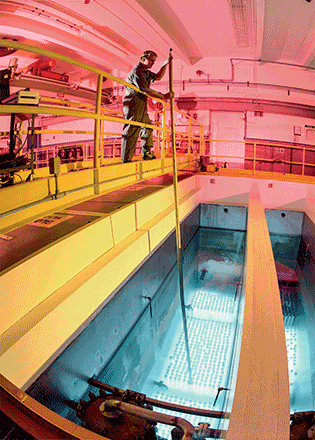 DOI: 10.1126/science.349.6244.132 One of the world’s biggest radioactive headaches sits in an aging cinderblock building in the desert near Hanford, Washington, at the bottom of a pool of water that glows with an eerie blue light. The nearly 2000 half-meter-long steel cylinders are filled with highly radioactive cesium and strontium, leftover from making plutonium for nuclear weapons. The waste has been described as the most lethal single source of radiation in the United States, after the core of an active nuclear reactor. It could cause a catastrophe if the pool were breached by an unexpectedly severe earthquake, according to the U.S. Department of Energy (DOE), the waste’s owner.
Now, a deceptively simple-sounding solution is emerging: Stick the cylinders in a very deep hole. The approach, known as deep borehole disposal, involves punching a 43-centimeter-wide hole 5 kilometers into hard rock in Earth’s crust. Engineers would then fill the deepest 2 kilometers with waste canisters, plug up the rest with concrete and clay, and leave the waste to quietly decay.
The idea has been around for decades, but not long ago scientists had all but abandoned it. Over the past 5 years, however, as improved drilling technologies converged with the political and technical woes bedeviling other nuclear waste solutions, boreholes have regained their allure. DOE has gone from spending almost nothing on borehole research to planning a full-scale field test, costing at least $80 million. And earlier this year U.S. Energy Secretary Ernest Moniz gave boreholes a dash of publicity during a major speech, mentioning them as a promising way to deal with the cesium and strontium waste at DOE’s Hanford Site nuclear complex.
Boreholes have “been plan B and just missed the boat for years,” says nuclear engineer Michael Driscoll, a retired professor from the Massachusetts Institute of Technology (MIT) in Cambridge and one of the concept’s leading advocates. “Maybe now is the time.”
Many nuclear waste veterans, however, are skeptical. The technical challenges are daunting, they argue, and boreholes won’t end political opposition to building new nuclear waste facilities. “The borehole thing to me is a red herring,” says attorney Geoff Fettus of the Natural Resources Defense Council (NRDC) in Washington, D.C., which supports underground disposal in a shallower mine, but has sued DOE over now abandoned plans to bury the waste inside Nevada’s Yucca Mountain……..
This past March, a White House policy shift opened the door further. Moniz announced that the Obama administration would abandon previous plans to put all high-level waste in one spot and instead would seek separate sites for disposing of commercial nuclear waste—about 85% of the total—and military waste. Moniz called some of the defense waste, including Hanford’s radioactive cylinders, “ideal candidates for deep borehole disposal.”………
Yet borehole disposal is not as straightforward as it might seem. The Nuclear Waste Technical Review Board, an independent panel that advises DOE, notes a litany of potential problems: No one has drilled holes this big 5 kilometers into solid rock. If a hole isn’t smooth and straight, a liner could be hard to install, and waste containers could get stuck. It’s tricky to see flaws like fractures in rock 5 kilometers down. Once waste is buried, it would be hard to get it back (an option federal regulations now require). And methods for plugging the holes haven’t been sufficiently tested. “These are all pretty daunting technical challenges,” says the board’s chair, geologist Rod Ewing, of Stanford University in Palo Alto, California.
Even if those technical problems are surmounted, boreholes might solve only a fraction of the nation’s waste problem. That’s because much of the high-level waste simply wouldn’t fit down a hole without extensive repackaging. “Due to the physical dimensions of much of the used nuclear fuel, it is not presently considered to be as good of a candidate [for borehole disposal] as the smaller waste forms,” said William Boyle, director of DOE’s Office of Used Nuclear Fuel Disposition Research and Development, in a statement to Science. Spent fuel rods from commercial power reactors, for instance, are often bundled into casks that are about 2 meters across.
Then there’s the same problem that dogged Yucca Mountain: the politics of finding a place to drill the holes. “Let’s just assume [boreholes] could work better than anybody ever imagined,” says Fettus, the NRDC attorney. “You still wouldn’t solve the nut that everyone has been unable to solve”: persuading state and local governments to take on waste from across the nation………
Other nations with nuclear waste, including China, are watching. But, for now, the United States is the only country getting ready to drill. “Nobody else has stepped forward,” says Geoff Freeze, a nuclear engineer at Sandia who is overseeing the U.S. experiment. “It kind of fell to us.” http://science.sciencemag.org/content/349/6244/132.full
Problem of Hanford’s highly radioactive pool of CESIUM-137 AND STRONTIUM-90
Deep sleep Warren Cornwall*, Science 10 Jul 2015: Vol. 349, Issue 6244, pp. 132-135 DOI: 10.1126/science.349.6244.132 “………..CESIUM-137 AND STRONTIUM-90 are the hot potatoes of the nuclear waste world, packing a powerful radioactive punch in a relatively short half-life of 30 years. At Hanford, there’s barely enough to fill the back of a pickup truck. Yet it contains more than 100 million curies of radiation, roughly one-tenth the radiation in the core of a large nuclear reactor. And it produces enough heat to power more than 200 homes.
To prevent the tubes from causing trouble, they sit under about 4 meters of water in what resembles a giant swimming pool, emanating a blue glow known as Cherenkov radiation as high-energy particles slam into the water. The 1974 building housing the pool is past its 30-year life span, according to DOE’s inspector general. Bombarded by radiation, the pool’s concrete walls are significantly weakened in places. Some of the tubes have failed and been stuck inside larger containers. In a review of DOE facilities conducted after the 2011 disaster at Japan’s Fukushima Daiichi Nuclear Power Station, the department’s Office of Environmental Management concluded that the Hanford pool had the highest risk of catastrophic failure of any DOE facility, for example in a massive earthquake, according to a report from the department’s inspector general. DOE says it plans to move the pool waste into dry casks for safer storage, but it hasn’t said when.
It’s an urgent situation and a huge safety risk,” says Tom Carpenter, executive director of the watchdog group Hanford Challenge in Seattle, Washington, which has been critical of DOE’s efforts to secure the waste.
Borehole advocates point out that the Hanford tubes are less than 7 centimeters in diameter, narrow enough to fit down a hole without extensive repackaging. All could fit into a single shaft. Other military waste could also go down a borehole, advocates add. One candidate is plutonium that DOE has extracted from dismantled nuclear weapons. Most of it is currently stored as softball-sized metal spheres at a DOE facility in Texas. In contrast to Hanford’s cesium and strontium, the plutonium is fairly cool, but extremely long-lived, with a half-life of 24,000 years. DOE is considering other options for the plutonium, including turning it into fuel for nuclear reactors or combining it with other nuclear waste and burying it. But boreholes could be an effective way to put it far out of the reach of anyone trying to lay their hands on bombmaking material……….http://science.sciencemag.org/content/349/6244/132.full
Solar power’s mighty future
We’ve Barely Begun to Tap the Sun’s Mighty Power http://www.motherjones.com/blue- marble/2016/03/solar-power-nrel-study By Tim McDonnell Mar. 24, 2016 It seems like every few weeks there’s some new measurement of how successful solar power is in the United States. In early March, industry analysts found that solar is poised for its biggest year ever, with total installations growing 119 percent by the end of 2016. This week, federal government analysts reported that in 2015, solar ranked number three (behind wind and natural gas) in megawatts of new electricity-producing capacity brought online. That rank is even more impressive when you consider that each individual solar installation is fewer megawatts than a wind turbine, and far fewer than a natural gas plant; that means solar panels are popping up like crazy across the country.
The report is the deepest dive on solar’s potential since NREL conducted a similar analysis in 2008. The new report’s estimate is much larger than the older report’s, mostly because of vast new troves of satellite imagery data of the country’s rooftops and computer models that are better able to calculate how much power each panel can produce. The analysis leaves behind policy and cost considerations. Instead, the only question is: How much power could we really get if we slathered every roof in America with solar panels? The answer: About 39 percent of the country’s electricity consumption, at current levels.
It’s important to note that the report looks only at rooftop panels, as opposed to utility-scale solar farms. Utility-scale solar provides about twice as much power as rooftop panels, so the full potential of solar is likely even higher than what NREL describes in this report. Even 39 percent, though, would be a revolutionary change from where we are now; despite solar’s rapid growth in the last several years, it still accounts for less than 1 percent of electricity consumption. Coal, which is still the nation’s number-one energy source, commands about 32 percent of the market. So the future that NREL is envisioning here would basically flip our energy makeup on its head.
The most potential exists in sunny states, obviously, but also in states that have relatively low electricity needs. [good map on original] Again, NREL stresses that the estimates here “provide an upper bound on potential deployment rather than a prediction of actual deployment.” It’s very unlikely that this exact scenario will come to pass. The most recent study by Stanford energy economist Mark Jacobson, who researches ways the US could get 100 percent of its power from renewable sources, sees rooftop solar contributing about 7 percent of total electricity by 2050. And that’s with, as Vox‘s David Roberts put it, “enormous, heroic assumptions about social and political change.”
But hey…we’re dreamers of the golden dream, right?
Wake up World! Belgium terrorist attack shows vulnerability of nuclear facilities
“Every country, no matter how safe it thinks it is, needs to protect nuclear weapons and the materials you could use to make them against the full spectrum of plausible threats,”
“And wherever there are potential nuclear bomb materials, they need to have armed guards.”
A Nuclear Wake-Up Call in Belgium, Huffpost, 25 Mar 16, By R. Jeffrey Smith “…….The risk of radiation bombs raised few concerns before it became clear that al Qaeda was seeking nuclear materials. And over the past 15 years, those worries have taken a back seat to an even larger anxiety: that materials usable in a Hiroshima- or Nagasaki-sized nuclear bomb might fall into the wrong hands.
As a result, the Obama administration has focused its attention until now on locking down or eliminating the big sparkplugs: plutonium and highly enriched uranium.
But the smaller “dirty bombs” and their lighter security have been a real source of worry among specialists, some of whom say that a detonation somewhere in the world is inevitable.

“I’m surprised it has not happened yet,” said Laura Holgate, the National Security Council’s senior director for weapons of mass destruction terrorism, at a Washington symposium three years ago. The mechanics of such a device are simple and widely known.
An internal Energy Department report in 2013 counted 70,000 medical, industrial and research devices with potentially dangerous radiological materials, and observed that they are “poorly secured at facilities in nearly every country.”……..
“Every country, no matter how safe it thinks it is, needs to protect nuclear weapons and the materials you could use to make them against the full spectrum of plausible threats,” said Matt Bunn, a nuclear security expert and former White House official who is now at Harvard University. “And wherever there are potential nuclear bomb materials, they need to have armed guards.”
Government studies have shown that attackers can reach sensitive areas at many nuclear sites quickly, and that “it’s really hard to design systems” against a concerted assault, Bunn said.
That’s why Britain, Canada, France, Germany and the United States have long posted armed guards at sensitive sites. But many other countries still don’t. The Netherlands, which supplies a large portion of the world’s radioisotopes, is one; Italy, Argentina, Brazil, Slovakia and Spain similarly lack regulations requiring armed guards at their nuclear sites, according to the nonprofit advocacy group Nuclear Threat Initiative.
Many other measures can be taken to limit the risks of radiological materials. These include expert training of security personnel, helping less-developed countries find and use non-threatening industrial or medical alternatives, and creating rigorous systems to track material locations.
A major problem, however, is that the U.S. budget for this work has declined steadily in recent years, largely to make room for increased spending on modernizing nuclear weapons. The administration in February proposed a $7.6 million cut for next year and $270 million less than previously planned over the next four years. A U.S. target for securing radiological materials in 4,400 facilities has slipped by more than a decade, according to the Arms Control Association……..http://www.huffingtonpost.com/the-center-for-public-integrity/a-nuclear-wake-up-call-in_b_9532550.html
“Deadly force” – a new rule for nuclear facility safety
 Tenn. House OKs deadly force by security officers at ‘nuclear power reactor’ facilities http://www.knoxnews.com/news/politics/house-oks-deadly-force-by-security-officers-at-nuclear-power-reactor-facilities-2e94b9d4-2e46-5bc3-e-373013301.html By News Sentinel Staff, 25 Mar 16, NASHVILLE — The House gave final legislative approval Monday night to a bill expanding the use of deadly force by security officers at nuclear power reactor facilities.
Tennessee law currently allows the use of deadly force by security personnel at “category I nuclear facilities” — facilities possessing “strategic special nuclear material” defined and licensed by the Nuclear Regulatory Commission, “when reasonably necessary to prevent or impede an act of radiological sabotage,” under specific circumstances.
The bill expands the law to include any “nuclear power reactor facility.”
The House voted 94-0 Monday on the bill, following the Senate’s 32-0 vote on Feb. 29. The bill now goes to the governor.
Shared solar – a cheaper, better way to go for electricity
Shared solar can help low-income customers get in on the solar development.
Rooftop solar can be expensive, even with incentives or leasing programs, leaving low-income ratepayers out. Shared solar can let them in on the benefits of solar. A couple of recent reports show how.

Love solar power but got no rooftop? “Shared solar” is coming for you. Vox [excellent pictures] by David Roberts on March 24, 2016 To date, solar power has mostly been available to utilities (as big power plants) or individual home and business owners (as rooftop panels).
Left out has been … well, everyone else, those of us who are not utility executives and do not have the money, wherewithal, or suitable rooftops to install solar ourselves. That’s a lot of people who love solar power but have no way to get directly involved in it.
Here’s how shared solar fits into the larger energy picture, how it works, its benefits and drawbacks, and its future potential……There are two kinds of community-scale solar. The first is utility-owned, with power sold to utility customers — a traditional arrangement between a utility and a power plant developer, just on a smaller scale. Lots of smaller utilities, municipals, and co-ops are getting into this.
The other is shared solar, in which customers a) share ownership of a community-scale PV array, b) “subscribe” to the power output of such an array, or c) both.
Existing community-scale solar is split roughly half and half between those two types.
How many shared solar projects are there? From a new report by Deloitte:
In 2010, only two shared solar projects existed [in the US]. Today 77 utilities administer 111 projects across 26 states, accounting for a combined capacity of about 106 megawatts (MW).
That’s a tiny base — less than 1 percent of installed solar PV capacity, according to GTM — but growth is accelerating.
According to RMI, if you include both types, community-scale solar could grow to 30 GW capacity by 2020.
Typically, customers “subscribe” to a shared solar project. Some subscribe to a certain amount of capacity (say, the output of one panel), measured in kW. Some subscribe to a certain amount of power, measured in kWh. The credit for the power appears on a customer’s utility bill.
Who runs these things? “Shared solar arrays,” writes NREL, “can be hosted and administered by a variety of entities, including utilities, solar developers, residential or commercial landlords, community and nonprofit organizations, or a combination thereof.”
Exactly who can build and run a shared solar project depends on whether it is located in a regulated or deregulated energy market (more on that in a second) and what type of utility service area it’s in.
Shared solar is overwhelmingly driven, at least at the moment, by customer demand. So it makes sense that the utilities most responsive to their customers — co-ops, where customers are also owners — are leading the way on shared solar projects.
Deloitte offers this information-packed breakdown of shared solar by utility type:………
Benefits of shared solar
Shared solar has many of the benefits of distributed “behind-the-meter” solar and many of the benefits of larger solar power plants, with few of the drawbacks of either.
Like utility-scale solar, it enjoys economies of scale and simple, established financing models; unlike utility-scale solar, it can squeeze into almost any surface or piece of land, near existing transmission or distribution lines.
Like distributed, behind-the-meter solar it is low risk, can be sited near existing load, increases the resilience of the distribution grid, and satisfies the powerful consumer craving for solar power; at the same time, it is cheaper, simpler (fewer contracts per kW of capacity), and more inclusive than behind-the-meter solar.
Utilities, especially investor-owned utilities, aren’t in love with it (to them it’s just a more expensive version of a solar plant), but if they get their act together, they can use small, strategically sited shared solar projects to ease grid congestion or avoid expensive new grid investments………..
Shared solar can bring solar to low-income customers
One benefit is worth calling out in particular: Shared solar can help low-income customers get in on the solar craze.
Rooftop solar can be expensive, even with incentives or leasing programs, leaving low-income ratepayers out. Shared solar can let them in on the benefits of solar. A couple of recent reports show how.
One is the “Low-Income Solar Policy Guide,” from a coalition of groups including GRID Alternatives, Vote Solar, and the Center for Social Inclusion. The other is from the Interstate Renewable Energy Council (IREC): “Shared Renewable Energy for Low- to Moderate-Income Consumers: Policy Guidelines and Model Provisions.”
Both get into the technical weeds on program design and financing……… http://www.vox.com/2016/3/24/11297054/shared-solar
Solar WINDOWS (not panels)
AMAZING IOT #8: SOLAR WINDOWS (NOT PANELS!) ST Smarter Together, 16 Mar 16 A handful of startups are heading toward a new window of opportunity: solar powered windows. If you think about all of the windows in the world – Manhattan alone has 10.7 million windows – creating a window that allows businesses to save on energy costs would be breaking into an almost unimaginably huge market.
Solar powered windows sound conceptually like an oxymoron: Solar panels absorb and reflect light while windows let light through. Various startups have proposed different solutions to this issue which, at its heart, is a serious one. The company Solaria, uses thin strips of photovoltaics on already existing glass, making windows appear pin-striped. Another startup called Oxford Photvoltaics uses perovskite – an oxide used for superconductors – in order to capture solar energy. ………. competitor Richard Lunt and his team at Michigan State University created solar panel windows with a new method called Transparent Luminescent Solar Concentrator (TSLC). This method has the photovoltaic strips on the edge of the glass, allowing the window to be more transparent than the other two……..http://smartertogether.telenorconnexion.com/2016/03/amazing-iot-8-solar-windows-not-panels/
Spent nuclear fuel staying put near closed San Onofre nuclear power station
 Where is the San Onofre nuclear waste going? Spent fuel staying put for now, San Diego Union Tribune By Rob Nikolewski March 25, 2016 Some 3.6 million pounds of nuclear waste is stored at the now-shuttered San Onofre Nuclear Generating Station (SONGS) but when the waste will be transferred and where it will end up are still very open questions.
“I think everyone can agree we want to get the spent fuel off the San Onofre site sooner rather than later,” said Garry Brown, executive director and CEO of the nonprofit clean water organization Orange County Coastkeeper, Thursday night at the quarterly meeting of the Community Engagement Panel.
After the California Coastal Commission approved a site permit last October, a plan was approved to bury the waste in concrete casks within 125 feet of a seawall and the beach on a low-lying plain at the plant operated by Southern California Edison.
“We need to de-energize the plant as soon as we can,” Tom Palmisano, chief nuclear officer at Southern California Edison, told the 18-member panel during a Powerpoint presentation in Oceanside.
The prospect of casks on site has generated plenty of opposition. “We may never be able to move these,” said Gary Headrick, co-founder of San Clemente Green. “These storage containers are not reliable.”….
Among the problems is the near-paralysis on the part of the federal government to permanently deal with nuclear waste……..http://www.sandiegouniontribune.com/news/2016/mar/25/songs-nuclear-waste/
Vulnerability of San Onofre’s nuclear wastes

 Concerns over nuclear waste stored at San Onofre http://www.cbs8.com/story/31565017/concerns-over-nuclear-waste-stored-at-san-onofrePosted: Mar 26, 2016 SAN DIEGO (CBS 8) – North County residents voice their concerns over the plan to store nuclear waste at the former San Onofre power plant Thursday.
The troubled plant closed four years ago, but the spent fuel could be there for much longer.The process of decommissioning it is expected to be complete by the year 2030.
Some say it’s a plan that has sparked concern over the public safety.
“This nuclear waste at this site is as vulnerable a target as you can possibly have for the terrorist to attack us here,” Mike Aguirre, San Diego Attorney said.
Representatives from Southern California Edison countered that the stored fuel would not be a vulnerable target.
“We have a well-trained security force, reviewed and approved by the NRC to meet, what they consider the credible threats that we need to meet,” Thomas Palmisano said.
The Department of Energy has made a push to create temporary storage sites in west Texas and New Mexico. If the plan gets the green light, it could expedite the removal of nuclear waste from San Onofre.
USA’s nuclear industry in death spiral?
 Has U.S. Nuclear Power’s Death Spiral Begun? With carbon markets and subsidies in doubt, nuclear is no longer affordable IEEE Spectrum, By Peter Fairley 25 Mar 2016 U.S. nuclear power plant operators are fighting a war on two fronts: Crashing prices for natural gas and accelerating market penetration of renewable energy have both contributed to dramatic drops in wholesale power price levels—in some states, they’ve fallen by more than two-thirds over the past decade. This has left nuclear power, whose operating costs are pretty much fixed, with few options other than surrender.
That marks quite a reversal, says Gregory Jaczko, former chairman of the U.S. Nuclear Regulatory Commission. “It’s been a widely held belief that nuclear is incredibly cheap to operate. That was the case 10 years ago, when nuclear plants were cash cows. That’s not the case today, especially as the plants age,” he says.
Fission is already giving ground. Two plants, in Wisconsin and Vermont, shut down in 2013 and 2014, respectively. More shutdowns are anticipated in Massachusetts, New Jersey, and New York, and at least half a dozen more plants are teetering on the brink of insolvency.
Nuclear operators had been expecting President Obama’s Clean Power Plan, which would have established national carbon regulations and increased the cost of fossil-fuel-generated electricity, to offer them a reprieve. But their hope was short-lived: The U.S. Supreme Court decided in February to stay implementation of the plan.

Operators’ next best hope is that state governments will be motivated to step in and save them. ……
By June, state regulators plan to detail special payments for New York’s nuclear plants. For companies that open their books and show that their plants are losing money, New York is vowing to make them whole.
“It’s probably the stickiest energy policy question there is in the electric sector,” says Julien Dumoulin-Smith, a senior power markets analyst with New York City–based UBS Investment Research.
New York is not alone. Several states, including Illinois and Ohio, are seeking to give nuclear power plants an extra boost. Exelon lists the dual-reactor Quad Cities site in Illinois among its uncompetitive plants. Dumoulin-Smith says local power prices are being “pummeled” by wind power, noting that Quad Cities sits just across the border from Iowa, which leads the United States in wind power penetration.
Quad Cities, along with Exelon’s nine other reactors in Illinois, caught a break from regional grid operator PJM, which last year began offering more supplements to power plants that commit to staying in its energy market for several years, thus backstopping its power supply. Those Illinois plants raked in more than US $1.5 billion from PJM’s capacity market last September, ensuring that Quad Cities will remain in operation through mid-2018.
But experts say that tougher times could lie ahead, as the extension of tax breaks for wind and solar power voted through the U.S. Congress in December fuels further growth in renewable generation. New York’s program appears to anticipate this, positing that assistance to nuclear reactors is more of a temporary lifeline than a long-term guarantee. State aid is, according to a white paper from the N.Y. Public Service Commission, a means of supporting “a smooth emission-free transition from nuclear to nonnuclear resources” in the event that energy prices “are not able to support the continued financial viability of the [fission] plants.” This article appears in the March 2016 print issue as “U.S. Fission Fizzles.” http://spectrum.ieee.org/energy/nuclear/has-us-nuclear-powers-death-spiral-begun
Home solar energy is booming in USA
The Surprise New Boom Market for Residential Solar Huffington Post, By Barbara Grady 24 Mar 16 As the price of solar powered electricity keeps falling and rooftop panels pop up in an increasing number of neighborhoods, an interesting thing is shaping up in the market.
Residential solar is no longer for just well-to-do homeowners. Indeed, the growth market in solar is median- and low-income neighborhoods in California and other locales, according to multiple recent reports.

In 2015, a full 65 percent of residential solar getting installed in California was in zip codes with median household incomes of $70,000 or less, while just 6 percent of installations in the state were happening in neighborhoods with median household incomes above $100,000, according to a report from Kevala Analytics.
A surge in solar adoption — as well as a shift in where that adoption is taking place — is driven by economics that make solar the money saving option for electricity rate payers and by policies that offer flexible ways for people to benefit from solar.
In California, Massachusetts, New York, Colorado, the District of Columbia, Maryland and some other places, policies that extend the reach of solar to renters and residents without rooftops are widening the market for individual and community installations alike. Financing mechanisms prevalent in some markets but not in others have also made it possible for people to opt for solar without requiring they have money for big upfront costs.
Federal policies adopted in the last couple of years, such as Property Assessed Clean Energy loan funds, and National Community Solar programs have helped. …..http://www.huffingtonpost.com/greenbiz-group/residential-solars-new-bo_b_9526460.html
Large number of baby deaths close to nuclear contaminated site
Cemetery full of dead babies missing brains next to US nuclear site — Funeral Director: Almost all infants we have died the same way… “that’s pretty much all I see on death certificates” — Few miles from “most contaminated place in hemisphere” — “One of largest documented anencephaly clusters in US history” (VIDEO) http://enenews.com/one-largest-documented-clusters-history-video?utm_source=feedburner&utm_medium=email&utm_campaign=Feed%3A+ENENews+%28Energy+News%29 March 23rd, 2016
Waiting for answers: a community copes with babies’ deaths
Seattle Times, updated Jan 28, 2016 (emphasis added): How the state is missing chances to find deadly birth defect’s cause… at least 40 other mothers have lost babies to [anencephaly, which result in missing large parts of the brain] in Yakima, Benton and Franklin counties since 2010… one of the largest documented clusters of anencephaly in U.S. history… “Something’s going on and someone needs to tell us,” said [mother Sally] Garcia… Dr. Lisa Galbraith was one of the doctors… In Prosser, the obstetrician oversaw care of Garcia’s pregnancy and others affected by the disorder… “I had a total of four or five babies with anencephaly over the course of two years,” recalled Galbraith… the rate of anencephaly was much higher [than US averages]… Washington health officials… have collected no blood samples, performed no genetic tests and conducted no examination of water, soil… and have no plans to do so… In Texas, just three babies withanencephaly sparked enough outrage to overhaul the state’s birth-defects reporting system.
Seattle Times video transcript – Carlen Majnarich, funeral director: “It’s tragic… It just seems like that’s pretty much all I see on the death certificate is the same diagnosis. And nobody seems to know why. We average close to 100 families a year here in Prosser [a few miles from Hanford]. Almost all the infants that we have have died of anencephaly. It’s just what do you say?”… Sally Garcia (mother who lost her baby to anencephaly): “All these on this side [of the cemetery] are all babies… all babies, starting from right there.”
The Legal Examiner, Dec 31, 2015: [T]he strange eruption of anencephaly cases, which occurs in Washington at a rate almost 5 times as high as the national average, has highlighted a number of government policies that may actually conceal these sort of birth defect “clusters,” rather than help investigate them.
KVEW-TV, Mar 4, 2016: As of November 2015 cases of anencephaly have continued to increase with the current rate at 9.5 per 10,000 live births.
Sara Barron, MS, BSN – American Journal of Nursing, Mar 2016: In the spring of 2012 two babies without brains were born within weeks of each other at the rural hospital in Washington State where I was working… I was stunned when the delivering physician said another patient was expecting the same outcome. After speaking with colleagues at neighboring hospitals, I learned that two other babies with anencephaly had recently been born in the area. In over 30 years of nursing, I had seen only two cases of anencephaly prior to these. I called the Washington State Department of Health and reported a birth defect cluster… RISK FACTORS…Radiation exposure. Popular media and blogs have often linked the Washington State NTD cluster to the Hanford Nuclear Reservation in Benton County, Washington. Althoughleaks from nuclear power plants have been associated with a higher rate of anencephalyand other NTDs, Washington State Department of Health investigators point out that the three counties with the highest prevalence of NTDs were both upwind and upriver of the Hanford site, making the nuclear plant an unlikely cause of the 2012 cluster.
- Bulletin of the Atomic Scientists: “The Hanford Site… is widely considered to be the most contaminated place in the Western Hemisphere”
- KOIN: “The biggest, most toxic nuclear waste site in the Western hemisphere”
- Time: “The largest nuclear clean-up site in the western hemisphere”
- AFP: “The Western hemisphere’s most contaminated nuclear site“”
More infant deaths near Hanford: Cemetery blocks filled w/ babies downwind of US nuclear site — Mother: My newborns died in hours… tumors all over, brain disintegrated after massive stroke — “Body parts, cadavers, fetuses… nuke industry took in the dead of night”
-
Archives
- October 2026 (129)
- September 2026 (339)
- August 2026 (330)
- July 2026 (355)
- June 2026 (287)
- May 2026 (306)
- April 2026 (356)
- March 2026 (251)
- February 2026 (267)
- January 2026 (308)
- December 2025 (358)
- November 2025 (359)
-
Categories
- 1
- 1 NUCLEAR ISSUES
- business and costs
- climate change
- culture and arts
- ENERGY
- environment
- health
- history
- indigenous issues
- Legal
- marketing of nuclear
- media
- opposition to nuclear
- PERSONAL STORIES
- politics
- politics international
- Religion and ethics
- safety
- secrets,lies and civil liberties
- spinbuster
- technology
- Uranium
- wastes
- weapons and war
- Women
- 2 WORLD
- ACTION
- AFRICA
- Atrocities
- AUSTRALIA
- Christina's notes
- Christina's themes
- culture and arts
- Events
- Fuk 2022
- Fuk 2023
- Fukushima 2017
- Fukushima 2018
- fukushima 2019
- Fukushima 2020
- Fukushima 2021
- general
- global warming
- Humour (God we need it)
- Nuclear
- RARE EARTHS
- Reference
- resources – print
- Resources -audiovicual
- Weekly Newsletter
- World
- World Nuclear
- YouTube
-
RSS
Entries RSS
Comments RSS

