Transatlantic flights with nuclear waste cargo – an unacceptable danger
“Nuclear waste should be dealt with as close to where it is produced as possible rather than risking transporting it in ships or planes. This waste will remain dangerous for tens of thousands of years. The consequences of an accident during transit would be horrific.”
the proposed shipment sent an “open invitation to terrorists keen to get their hands on this prime terrorist material”.

Campaigners condemn UK Government for playing transatlantic nuclear ping-pong,
Herald Scotland, MICHAEL SETTLE, 31 Mar 16 CAMPAIGNERS have denounced the UK Government’s decision to play “transatlantic nuclear ping-pong” by agreeing a deal to transport 700 kilograms of weapons-grade uranium fuel from Dounreay in Caithness to the US.
The SNP’s Paul Monaghan, the local MP, said he too was deeply concerned by the development and is to demand assurances from David Cameron about the safety of the transportation, which he believes will involve up to nine flights from Wick airport using huge American c-130 Galaxy aircraft.
“Wick airport is not built for that kind of aircraft. I’m very concerned about the prospect of the planes flying over the town,” declared the backbencher.
Mr Monaghan stressed that the highly-enriched uranium fuel, which he said had originated from the former soviet state of Georgia, could only be used for nuclear weapons.
Claiming the Prime Minister had “obfuscated” in his replies when asked previously about the planned shipment of nuclear fuel from Dounreay to the US, the Nationalist MP said the safety of local people was his “paramount concern” and that the UK Government, through its lack of clarity, was “abrogating its responsibility to the people of Scotland”.
Mr Cameron is due formally to announce the deal when he attends an international nuclear security summit in Washington DC tomorrow. It will involve the largest ever shipment of radioactive material from the UK to America, which in turn will send a different form of the nuclear element to Euratom, the European atomic agency, for conversion in France into medical isotopes to be used in European hospitals for the diagnosis and treatment of cancer.
A UK Government source said: “It’s a win-win; we get rid of waste and we get back something that will help us to fight cancer.”
But Richard Dixon, director of Friends of the Earth Scotland, said: “Only the nuclear industry could think it was a good idea to risk playing ping pong with large quantities of one of the most dangerous materials on the planet across the Atlantic.
He added: “Nuclear waste should be dealt with as close to where it is produced as possible rather than risking transporting it in ships or planes. This waste will remain dangerous for tens of thousands of years. The consequences of an accident during transit would be horrific.”
John Finnie, justice spokesman for the Scottish Greens, dismissed the UK Government’s attempt to present the proposal to send dangerous nuclear waste across the Atlantic as helping in the fight against cancer as “at best misleading and at worst cynical”.
He added: “Moving such a large amount of toxic waste shows callous disregard for the safety of people in the Highlands. There must be better ways to fight cancer than sending dangerous uranium on an 11,000 kilometre round trip.”
Whitehall has, for security reasons, not confirmed the details of the transportation or the timescale.
Last year, the Sunday Herald broke the story about a “secret plan” to ship nuclear material from Dounreay to America.
The report said the plan was for nearly five kilograms of enriched uranium to be transported by sea from Caithness to the US Government’s nuclear complex at Savannah River in South Carolina.
The material was said to have come from a research institute in Mtskheta, some six miles from the Georgian capital, Tbilisi, in a secretive US operation codenamed Auburn Endeavour in April 1998. Washington was said to have been worried at the time that it could have fallen into the hands of Chechen gangs or Iran.
However, the proposed UK Government plan is to ship not five kilograms but 700kg or more than 110 stones of the nuclear material.
At the time of “secret plan” report one anti-nuclear campaigner warned the proposed shipment sent an “open invitation to terrorists keen to get their hands on this prime terrorist material”……..http://www.heraldscotland.com/news/14395623.Campaigners_condemn_UK_Government_for_playing_transatlantic_nuclear_ping_pong/
USA and China – joint statement: both will sign Paris climate deal
 US and China to sign Paris climate deal http://www.heraldsun.com.au/news/breaking-news/us-and-china-to-sign-paris-climate-deal/news-story/94b6ac23151ca2d99645372ed0bf9269
The United States and China have confirmed that they will sign the Paris climate change agreement in New York on April 22, a move that officials hope will help the accord enter into force this year.
The world’s two biggest greenhouse gas emitters issued a joint presidential statement on Thursday in which they called on other countries to sign the accord next month “with a view to bringing the Paris Agreement into force as early as possible”.
Leaders from nearly 200 countries forged the landmark agreement to transform the world’s fossil fuel-driven economy on December 12 after four years of fraught negotiations.
But the Paris climate agreement needs at least 55 countries, representing at least 55 per cent of global emissions, to formally accede to it before it can enter into force.
Stern has stepped down from his role as the chief US climate negotiator, and will be replaced by his former deputy, Jonathan Pershing, on April 1.
United Nations Secretary-General Ban Ki-moon said earlier this month that he expected 120 or more countries would sign the accord at the April 22 ceremony at its New York headquarters.
US and UK to do cyber attack tests on a nuclear power plant
 UK and US to simulate cyber-attack on nuclear plants to test resilience UK and US to simulate cyber-attack on nuclear plants to test resilienceCountries plan to cooperate by exploring the resilience of nuclear infrastructure to a terrorist attack, Guardian, Heather Stewart, 31 Mar 16 Britain and the US will stage a war-game later this year, simulating a cyber attack on a nuclear power plant, to test the readiness of the government and utility firms.As David Cameron prepares to fly to Washington to attend a nuclear security summit, convened by Barack Obama, government sources said the two countries plan to cooperate on exploring the resilience of nuclear infrastructure to a terrorist attack……. Separately, Cameron is also set to announce an exchange deal with the US, which will see the UK ship 700kg (110st) of nuclear waste, most of it currently stored at Dounreay, in Scotland, to be processed in America.
Cameron will also commit to spend £10bn this year to fund the world of agencies including the IAEA, on improving the security of civil nuclear infrastructure worldwide. Over lunch on Friday, the world leaders will discuss “scenario-planning” for protecting their nuclear facilities, and preventing volatile nuclear materials falling into the wrong hands…….http://www.theguardian.com/uk-news/2016/mar/31/uk-us-simulate-cyber-attack-nuclear-plants-test-resilience
|


Nine Mile Point Nuclear Station desperate for money: call for taxpayer funding
 Nine Mile Point nuclear plant faces financial peril, exec says, syracuse.com, By Tim Knauss | tknauss@syracuse.com 31 Mar 16 SCRIBA, N.Y. — Nine Mile Point Nuclear Station is “losing a lot of money” and could someday face an early closure like its Oswego County neighbor, the FitzPatrick plant, unless state officials develop price supports for Upstate nuclear plants, a top company official said Wednesday.
The pending shutdown of FitzPatrick has dominated headlines, but the larger Nine Mile Point station next door suffers similar financial hardships, said Joseph Dominguez, executive vice president of plant owner Exelon Corp.
Dominguez said the 1,900-megawatt Nine Mile Point facility no longer makes enough money to cover operating expenses. He declined to say how steep its losses are………
state officials scramble to implement new subsidies that would reward Upstate nuclear plants for generating carbon-free power and provide them with millions in additional revenue.

Gov. Andrew Cuomo in December ordered state regulars to establish so-called “zero emission” subsidies for Upstate nuclear plants for a 15-year period. Cuomo has committed to cutting carbon emissions 40 percent by 2030. If nuclear reactors shut down and are replaced by natural gas-fired plants, carbon emissions would increase.
But Cuomo’s plan is opposed by some advocates of renewable energy, who say forcing utility ratepayers to pay more for nuclear power is a waste of resources that should be devoted to cleaner technologies like wind and solar power.
Details of the nuclear price supports have not been worked out. But the staff of the Public Service Commission estimated last month that current wholesale electric prices are about $15 per megawatt-hour lower that what Upstate nuclear plants need to survive. If utility ratepayers have to make up that difference, the cost could be $300 million a year or more, even with FitzPatrick closed……..
Most recently, state Sen. Patty Ritchie proposed $100 million in the state budget to keep FitzPatrick operating until permanent nuclear price supports are in place.
FitzPatrick’s owner, Entergy Corp., has rejected such efforts and stays on course to close the plant.
Dominguez, of Exelon, said FitzPatrick is just one of four Upstate reactors at risk of shutting down -“ including the two at Nine Mile Point and Exelon’s other Upstate facility, the Ginna nuclear plant in Wayne County.
“We appreciate the focus that the legislators are putting on FitzPatrick, but it’s really an issue that’s broader than FitzPatrick,” he said. “It’s four units up there. A limited one-time budget fix for one plant frankly isn’t going to do it. You’re just going to end up with another plant that’s going to be in jeopardy within months, or at most years.”…….http://www.syracuse.com/news/index.ssf/2016/03/nine_mile_point_nuclear_plant_faces_financial_peril_exelon_exec_says.html
Radiation in seafood. Is that why California bans commercial crab fishing?
 California bans commercial crab fishing due to excessive radiation in seafood, March 27, 2016 by: David Gutierrez, staff writer NaturalNews In November of last year, California state officials placed an indefinite hold on the commercial crab season, in order to protect public health. The reason given by the state was dangerously high levels of algal toxins in the bodies of the crabs.
But according to New York radio station 95.1 FM (SuperStation 95), insiders from the California Fish and Game Commission have revealed that the real reason for the ban was dangerously high levels of radioactivity resulting from the 2011 Fukushima nuclear disaster.
Radioactive crab are so dangerous to eat that state officials felt the need to protect the public, Superstation 95 reports. But officials were unwilling to publicly admit the true reason for the ban, which contradicts official claims that the Fukushima disaster poses no threat to the U.S. West coast………..
“If people started connecting the dots proving radiation in seafood was making them sick, it would utterly destroy California’s seafood industry in days,” SuperStation 95 quotes the sources as saying………
The crab are not the first West Coast seafood to be reported radioactive. A recent study found that 100 percent of Pacific bluefin tuna tested off the coast of California contained radioactive materials from the Fukushima disaster.
Among the radioactive isotopes already detected off the U.S. west coast is strontium-90, which mimics calcium in the human body and therefore accumulates in the bones. There it can cause cancers of the bone and blood.
Sources for this article include:
SFChronicle.com http://www.naturalnews.com/053440_California_crab_season_radioactive_ocean.html#ixzz44MERWbgz.
Obama’s role in nuclear security summit – but who will take over from him?
 Obama’s Last Chance to Bolster Nuclear Security, VOA March 29th, 2016 By Barbara SlavinTerrorist attacks in Belgium and Pakistan lend a greater sense of urgency to President Barack Obama’s final nuclear security summit, set to open on Thursday in Washington.
Leaders of more than 50 nations will discuss further steps to reduce and safeguard stockpiles of nuclear materials that would pose an even more serious threat to civilians than suicidal fanatics armed with guns and conventional explosives.
The concern is less about terrorists obtaining an actual nuclear weapon than stealing components for a so-called dirty bomb that could contaminate urban centers. Another frightening possibility is that terrorists could infiltrate and sabotage a nuclear power plant in an attempt to cause a catastrophic meltdown.
Belgian authorities found troubling evidence that the Islamic State network responsible for last week’s attacks on Brussels airport and the metro had been conducting surveillance of the home of a senior official at a local nuclear power plant. Two employees at another nuclear facility went to Syria as foreign fighters in 2012. One died in Syria, but the other returned to Belgium and was released from jail last year.
Long before the Syrian conflict and the advent of ISIS, the Obama administration made nonproliferation and nuclear security major priorities.
Since Obama started holding nuclear summits in 2010, 14 countries plus Taiwan have given up highly enriched uranium (HEU) once used in civilian reactors. An additional 2,697 kilograms of nuclear material has been moved or blended down to less potent forms and radiation detection equipment has been installed at 250 airports, seaports and land border crossings, according to Robert Manning of the Atlantic Council.
But there are still about 1,800 tons of nuclear material in military and civilian sites around the world, enough for thousands of weapons. The stockpile includes 61 tons of HEU at 100 civilian nuclear facilities in 25 countries. That’s enough for nearly 2,000 bombs.
China, whose president Xi Jinping will be attending the summit, has made a significant contribution to nuclear security by agreeing to take back HEU it provided as fuel for research reactors in several countries including Syria and Ghana. These reactors, developed in the 1950s and 60s, typically produce medical isotopes for use in treating cancer and other diseases, and were provided to many developing nations without much thought about their potential proliferation risk……..
A key question is how to institutionalize nonproliferation after Obama leaves office. There are real concerns about American nuclear policy under Obama’s successor, particularly if the winner of the November elections is the current frontrunner for the Republican presidential nomination, Donald Trump.
The bombastic real estate mogul, who revealed in an early debate that he did not know what the nuclear triad is (it is the three means of delivering a nuclear weapon from land, sea or air) envisions a drastic retrenchment of U.S. foreign policy commitments that could spur more countries to develop nuclear weapons.
Reversing more than 70 years of U.S. strategic thinking, Trump told The New York Times recently that the United States might be “better off” if Japan developed nuclear arms to deter a nuclear North Korea and if Tokyo did not have to continue to rely on the U.S. nuclear umbrella against both North Korea and China……..http://blogs.voanews.com/us-opinion/2016/03/29/obamas-last-chance-to-bolster-nuclear-security/
Solar towers- a more effective system for lower light conditions
 New solar towers, cubes offer 20X more power, researchers say Solar towers are ideal for lower light conditions, Computerworld, By Lucas Mearian Mar 23, 2016 5 Researchers at MIT have discovered a method of optimizing solar energy collection by arranging photovoltaic (PV) panels on a tower or in a cube shape.
The new forms of solar energy collection offer anywhere from double to 20 times as much output compared with today’s common flat-panels using the same area.
The technology would be most advantageous in northern climates — further away from the equator — where the less intensive solar exposure can be optimized.
MIT’s research, the findings for which are based on both computer modeling and outdoor testing of real modules, were published in the journal Energy and Environmental Science…….http://www.computerworld.com/article/3047660/sustainable-it/new-solar-towers-cubes-offer-20x-more-power-researchers-say.html
Community solar power now getting the backing of energy utilities
 Even Utilities Are Starting To Get Behind Community Solar http://oilprice.com/Alternative-Energy/Solar-Energy/Even-Utilities-Are-Starting-To-Get-Behind-Community-Solar.html By Nick Cunningham, 28 March 2016 Solar energy is rapidly becoming one of the top choices for new electricity capacity as costs continue to decline and generous public policies accelerate tremendous growth for the sector.
Last year was a record year for the solar industry and the momentum is set to continue. In 2016, the EIA expects the U.S. electricity market to see 26 gigawatts of new capacity installed. Utility-scale solar is expected to capture 9.5 GW of that total, or more than one-third. If that comes to pass, it would be triple the rate of installations of utility-scale solar compared to 2015, and would also equate to more than the combined total of installations from 2013 to 2015.
That could be a conservative estimate. The Solar Energy Industries Association, a trade group, expects the solar industry to add 16 GW of new solar capacity, with about three-quarters of that coming from the utility-scale segment.
A much smaller segment of the solar industry could begin to take off, however. With the bulk of solar installations made up of large-scale utility-size projects, plus some commercial and residential projects proliferating at a healthy rate, the tiny but rapidly growing “community solar” sector could begin to capture a lot more attention.
The growth of solar has been held back by the large upfront costs. That problem is already being overcome with the leasing model, which requires no upfront investment.
But another problem with solar is that not everyone can participate – some people live in apartment buildings, or do not own their own home, or do not have a suitable rooftop to host PV panels. According to Greentech Media, around 77 percent of U.S. households are ineligible for solar panel installations for one reason or another.
“Community solar” solves this problem by allowing people to buy or lease a slice of a shared solar project that is somewhere off site, maybe in a nearby town or on a tract of open land. One could live in an apartment building and still buy into a community solar project, receiving credits on their utility bill.
The community solar model is becoming more common, opening up a vast new market for the solar industry. Community solar grew five-fold last year. New customers can still access a leasing model that has no upfront costs, and with community solar they do not even need to have their own rooftop to do so.
Better yet, community solar projects are increasingly competitive, offering ratepayers a clean source of power without added cost. There is a lot of room for improvement as well. As of now, the issues and design specifications can vary from project to project, but as the sector grows, developers will find ways to standardize projects, reduce development times, and scale-up a small-scale model.
No longer able to ignore the coming explosion in the solar market, utilities have been fighting to tweak public policy to block the threat of solar. But some utilities, in a recognition of reality, are trying to get in on the community solar game so as not to be left behind.
Deloitte cites the case of a Minnesota utility that allows ratepayers to buy in to a community solar project at a discounted rate if they also purchase a new electric water heater. The idea is that the household will heat their water with the extra electricity it produces at midday, avoiding the need to use electricity in the later afternoon and early evening when demand is at a peak. The customer benefits, and the utility benefits by shaving off peak demand.
State policies have also helped. In particular, Colorado and Minnesota have passed laws that require their utilities to setup community solar programs for their ratepayers. Two dozen more have voluntary programs.
Solar is popular too. Deloitte surveyed 1,500 households to find out what they thought were the most pressing energy-related issues, and 64 percent of them said “increasing the use of solar power” was a top three issue for them. As more customers discover community solar, they will increasingly demand their utility offer community solar programs to allow them access.
To be sure, community solar is still small. There are just 111 projects across the U.S., though that is sharply up from only two in 2010, according to Deloitte. Most projects are smaller than 1 megawatt, and the largest is only 20 megawatts. Most projects serve between 40 and 600 customers, according to a report from The Rocky Mountain Institute.
Nevertheless, the solar industry is growing rapidly, and community solar could be the fastest growing segment. The Rocky Mountain Institute argues that 15 GW of community solar could come online by the end of the decade.
For years, utilities have seen solar power as a threat, but that could be changing. As Deloitte puts it, the “evolution of community solar is a classic case of business model innovation turning a challenge into an opportunity. Foreseeing the inevitable growth of distributed energy resources, utilities are deploying these programs to get ahead of the game and to capture the benefits that distributed resources provide to the grid.”
New York Governor Andrew Cuomo blasted security conditions at Indian Point Nuclear plant
 New York’s governor just slammed the state of a nuclear power plant 40 miles from Manhattan, Business Insider MICHELLE MARK 30 MAR 16 New York Governor Andrew Cuomo blasted the troubling conditions at the Indian Point Nuclear plant Tuesday evening, announcing in a statement that hundreds of faulty bolts were found within one of the plant’s reactors.
The plant poses no immediate danger to public health and safety, but the bolts are the latest incident in a series that “raise deep concerns” about the plant’s operations and further the state’s argument that the plant should not be re-licensed, Cuomo said.
The plant is located in Buchanan, New York, approximately 40 miles from New York City.
The two working reactors at the plant opened in the 1970s, and have worried many of the 2,100 residents who live around the facility for years. The licenses for both reactors have expired, but the Nuclear Regulatory Commission determined that the amount of complaints lodged against the plant warrant its continuing operations until all the grievances are addressed, according to the Guardian.
The Indian Point facility has a long history of issues. Just a few:……http://www.businessinsider.com.au/the-ny-governor-just-slammed-the-state-of-a-nuclear-power-plant-2016-3?r=US&IR=T
US govt no longer worried about Japan’s plutonium stockpiling as weapons proliferation risk?
U.S. official changes stance on Japan’s nuclear policy http://the-japan-news.com/news/article/0002840098 By Seima Oki / Yomiuri Shimbun Correspondent , 29 Mar 16, WASHINGTON — U.S. Assistant Secretary of State Thomas Countryman said in a press conference by telephone on Monday that Japan’s nuclear fuel cycle project, which reuses spent nuclear fuel from nuclear power plants to extract plutonium, does not raise concerns about nuclear nonproliferation, effectively changing his earlier position on the matter.
At a hearing of the U.S. Senate’s Foreign Relations Committee on March 17, the assistant secretary in charge of international security and nuclear nonproliferation had voiced his concerns about Japan’s nuclear policy and said that it would be desirable for Japan to halt its nuclear fuel reprocessing project.
In the press conference, Countryman said that Japan was a pioneer in the civilian use of nuclear energy and that no other country was closer or more important as a partner to the United States than Japan.
Japan’s stockpiling of plutonium has been criticized by China at U.N. meetings and on other occasions. To this, Countryman said that Japan has been proceeding in a transparent manner, which was understandable to the rest of the world.
He also expressed his stance that the U.S. government will cooperate with Japan as an ally to wipe out anxiety in the international community.Speech
Troubled history of New York’s Indian Point nuclear power station
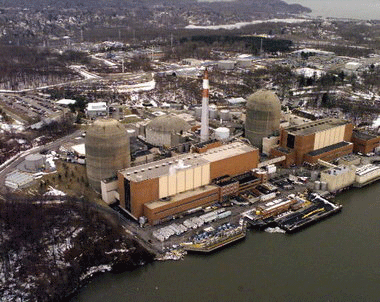 Indian Point nuclear plant reeks of troubled history As New York’s governor and other critics wage an ongoing campaign to shut the facility down citing leaks and old age, nearby residents explain complicated tale, Guardian, Sam Thielman, 29 Mar 16 Outside the Westchester Diner in Peekskill, New York, about 40 miles from New York’s Central Park, a reactor dome crests the trees behind an overpass like a giant’s bald head.
It’s one of two at Indian Point Energy Center, at the bank of the Hudson river in neighboring Buchanan, among the oldest nuclear power plants still in operation, and a monument to the energy industry’s resistance to years of work by concerned scientists, locals and state officials to close down a facility that only last month dumped a plume of radioactive waste into their groundwater.
Indian Point’s two working reactors opened in the early 1970s and have had a lot of people worried for a long time. Five years ago the New York Times wondered if it was “America’s Fukushima” – the Japanese site of the world’s worst radiation crisis since Chernobyl. In February the New York governor, Andrew Cuomo, called its operation “unacceptable” – he wants the plant closed.
It’s easy to see the source of his concern. The population density around Indian Point is of more than 2,100 people per square mile, by far the greatest for any of the US’s 61 nuclear power plants. Many of those people live and work in the plant’s shadow with growing unease.
In May 2015, an electrical transformer in the reactor called Unit 3 exploded, causing water to flood a room near the explosion where electrical distribution panels are housed and pouring 3,000 gallons of oil into the Hudson. The Union of Concerned Scientists classified the incident as a “near miss” in its annual review.Last year near misses occurred at eight nuclear facilities in the US. “Had the flooding not been discovered and stopped in time, the panels could have been submerged, plunging Unit 3 into a dangerous station blackout, in which all alternating current (AC) electricity is lost,” the report’s authors wrote. “A station blackout led to the meltdown of three nuclear reactor cores at Fukushima Dai-ichi in 2011.”
In February, radiation levels at three monitoring wells around the plant spiked, in one spot by 65,000%. Patricia Kakridas, a spokeswoman for Entergy, said the source was likely “water which exited a temporary filtration system that was set up and dismantled in late January 2016” in preparation for refueling; the company said radioactive material won’t leach into drinking water.
And in March, when the plant was being refueled, a breaker tripped and cut power in one of the reactors; when the diesel generators kicked in, they died while trying to restart the first electrical system. Fortunately a second backup worked.
Because the plant is cooled in large part by water from the Hudson – up to 2.5bn gallons a day – it kills about 1 billion fish and other aquatic organisms a year.
Incidents such as these are among the reasons Cuomo wants it closed, and Indian Point is now in a vulnerable position. The operating license for Indian Point 3 expired in December. The license for Indian Point 2 expired in 2013 (Indian Point 1 was decommissioned in 1974). Yet both remain active as the company pursues a license renewal and in the meantime Spectra, a pipeline company, is planning to add a gas pipeline that runs underneath the property to the two that have been there since the plant was built………
The fuel remains onsite at Indian Point, as it does at most nuclear power plants, and must be carefully maintained, for example it must be cooled for at least a decade before it can be sealed in concrete “dry casks”. Sheehan (and others) point out that moving it out of the state along Interstate 95 is impractical given the population density along the busy transport corridor. The plant has produced about 1,500 tons of waste and continues to produce more.
At this point, the license renewal process for Indian Point is scheduled through at least September of 2016 but the legacy of Indian Point, whether it closes or no, has a half-life of far, far longer.http://www.theguardian.com/us-news/2016/mar/28/indian-point-nuclear-plant-new-york-troubled-history
The coming wave of shutdowns of old nuclear reactors in America
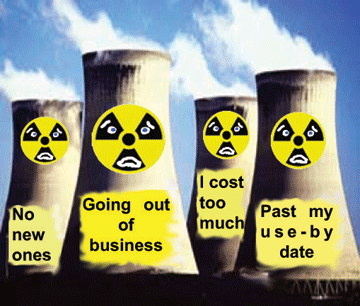 One-Third Of US Nuclear Reactors Are Near Mandatory Retirement The Daily Caller, ANDREW FOLLETT, 29 Mar 16 A 39-year-old nuclear plant in Ohio, which was only designed to operate for 40 years, was shut down Sunday for life-extending maintenance.
The Ohio reactor isn’t unique either. The average age for American nuclear reactors is 35, nearly obsolete by modern design standards and near the end of 40-year operating licenses. Sixteen American nuclear reactors are more than 42 years old, according to government data compiled and mapped last week by The Daily Caller News Foundation…….
Unexpected shutdown of Washington nuclear power station
Nuclear Power Plant in Washington Unexpectedly Shut Down, abc news, By THE ASSOCIATED PRESS RICHLAND, Wash. — Mar 29, 2016 Washington state’s only nuclear power plant has been shut down after operators received an indication that a system used to cool equipment wasn’t working. Officials said there was no release of radiation and no danger to the public.
The Columbia Generating Station near Richland was shut down about 1:30 p.m. on Monday, Energy Northwest spokesman John Dobken said.
Officials hope to restart the plant sometime this week, Dobken told The Associated Press early Tuesday.
The Tri-City Herald reported that the plant was shut down after operators were alerted to problems with the system that uses water to cool heat exchangers and pumps, including those that control the power level of the reactor.
Energy Northwest says it seems that a water system valve may not have been in the right position, but adds that an investigation is ongoing…….http://abcnews.go.com/US/wireStory/nuclear-power-plant-richland-unexpectedly-shut-37995902
Renewable energy shines in American energy investment
If a Power Plant Is Built in U.S., It’s Likely to be Renewable [good graphs] http://www.
climatecentral.org/news/if-a-power-plant-is-built-in-us-chances-are-its-renewable-20175
March 25th, 2016 If a new electric power plant is built in the U.S. these days, chances are it’s renewable — either wind or solar.
That’s the gist of a report the U.S. Department of Energy released this week showing that, together, wind and solar accounted for nearly two-thirds of all new electric power plants built in 2015. It’s a trend expected to continue through 2016, even with low natural gas prices likely to keep utilities building plenty of gas-fired power plants, too.
“Right now, it’s primarily a wind and solar market,” U.S. Energy Information Administration analyst Chris Namovicz said, adding that renewables have been thriving on an extension of wind and solar tax credits, though wind is becoming competitive with fossil fuels even without the help of a tax credit.
As global investments in renewable energy far outpace investments in fossil fuels for electric power, the expansion of wind, solar and other renewable energy sources is critical for the globe to uphold the Paris climate agreement, which aims to keep global warming to 2°C (3.6°F) above pre-industrial levels.
Burning coal to produce electricity is the world’s leading driver of climate change. In the U.S., low natural gas prices and climate policies are allowing lower-carbon energy sources to eclipse coal as the leading sources of electricity.
Together, wind and solar accounted for 67 percent of all new electric power generation capacity built in the U.S. in 2015. That adds up to more than 13 gigawatts of carbon-free electric power generation capacity, enough to provide power to more than 9 million homes.
Natural gas accounted for 30 percent of new electric power generation capacity built last year.
Most renewable-powered plants built in the U.S. last year were built in two states — Texas and California — according to EIA data. Texas is the reigning champ of the wind industry, accounting for 42 percent — more than 3 gigawatts — of all the new wind power capacity built in the U.S. in 2015. Oklahoma, Kansas, Iowa, and North Dakota rounded out the top five wind farm-building states in 2015.
Wind is in the process of rebounding from the industry nearly going bust in 2013, a year when the industry bottomed out because of great uncertainty about the future of a wind power production tax credit. Last year, Congress extendedthe tax credit through 2019.
Today, more than 50,000 wind turbines twirl across the U.S. — enough to power 19 million homes.
As for solar, California built more than any other state in 2015 — more than 2 gigawatts. The state was responsible for building 42 percent of all new solar power constructed last year.
About half of all that solar energy built in California last year came from large utility-scale solar farms. The rest was built in the form of rooftop solar or small solar power systems.
North Carolina, Nevada, Arizona, and Utah rounded out the top five states building new solar plants in 2015.
USA minimising effect of Fukushima nuclear radiation: Clinton’s secret food pact.

 Radiating Americans: Fukushima rain, Clinton’s secret food pact, Examiner, Deborah Dupre
Human Rights Examiner , 27 Mar 16, Government agreed to downplay Fukushima radiation Fukushima is far from stabilized according to energy advisor veteran with 39 years of nuclear power engineering experience, Arnie Gundersen who told Solar IMG Saturday that Americans, not just in the northwest, are unaware of being rained on with Fukushima nuclear hot particles and eating Fukushima contaminated food because the US government has deliberately minimized the catastrophe, partially due to a pact Secretary of State Hillary Clinton signed with Japan. Gundersen, with a team of other scientists, intends to prove government statements about Fukushima are false.
“The United States came up with a decision to downplay Fukushima,” said Gundersen who is awakening the public with information such as hot particles in rain will continue falling in the U.S., not just in the Pacific Northwest, for another year, and mentioning high-level fallout in Oklahoma a few days ago.
Gundersen told SolarIMG that high-level people he knows in the State Department said Hillary Clinton signed a pact with her counterpart in Japan agreeing for the United States to continue buying food from Japan, despite that food not being properly tested for radioactive materials.
“So we are not sampling the food coming into the United States,” he said, repeating, “The US government has come up with a decision at the highest levels of the State Department, as well as other departments who made a decision to downplay Fukushima.”
In April, the month after the powerful tsunami and earthquake crippled Japan including its nuclear power plant, “Hillary Clinton signed a pact with Japan that she agreed there is no problem with Japanese food supply and we will continue to buy them so we are not sampling food coming in from Japan” according to Gundersen.
Due to this high degree of secrecy enshrouding the Fukushima nuclear catastrophe, that Gundersen said is ongoing, he has called on Americans with Geiger counters to send samples to him for an independent research team’s study.
Gundersen says the new study will prove that what the U.S. government is telling Americans is false………
One reason millions will die from Fkushima is what some experts in July called scandalous collusion to cover-up the horrendous facts about the nuclear holocaust occurring.
Fukushima stabilized? Many children to suffer thyroid cancer in three to five years
“The reactors are better than since the accident,” said Gundersen, but “they all have holes on them, so they are not holding water.” “Until a couple of weeks ago, they had to constantly add water. Now there’s a system in place that’s cleaning the water enough that they can pump it back into the reactor.”
Gundersen stated that the reactors are still creating “an enormous amount of waste” and that “the filters are hotter than a pistol.” “I still believe water is leaking into the ocean and I know water’s leaking into the ground table,” he said.
Gundersen said it is a concern that there are indications that there is still iodine on site plus, ‘enormous amounts of iodine have been in the water.” “There’s an awful lot of kids that are going to have thyroid problems in the next three to five years as the result of this.”
Kicking the nuclear can, Worst to come: Unit 4, Contaminated food and water, Children and cancer……….http://www.examiner.com/article/radiating-americans-fukushima-rain-clinton-s-secret-food-pact
-
Archives
- October 2026 (129)
- September 2026 (339)
- August 2026 (330)
- July 2026 (355)
- June 2026 (287)
- May 2026 (306)
- April 2026 (356)
- March 2026 (251)
- February 2026 (267)
- January 2026 (308)
- December 2025 (358)
- November 2025 (359)
-
Categories
- 1
- 1 NUCLEAR ISSUES
- business and costs
- climate change
- culture and arts
- ENERGY
- environment
- health
- history
- indigenous issues
- Legal
- marketing of nuclear
- media
- opposition to nuclear
- PERSONAL STORIES
- politics
- politics international
- Religion and ethics
- safety
- secrets,lies and civil liberties
- spinbuster
- technology
- Uranium
- wastes
- weapons and war
- Women
- 2 WORLD
- ACTION
- AFRICA
- Atrocities
- AUSTRALIA
- Christina's notes
- Christina's themes
- culture and arts
- Events
- Fuk 2022
- Fuk 2023
- Fukushima 2017
- Fukushima 2018
- fukushima 2019
- Fukushima 2020
- Fukushima 2021
- general
- global warming
- Humour (God we need it)
- Nuclear
- RARE EARTHS
- Reference
- resources – print
- Resources -audiovicual
- Weekly Newsletter
- World
- World Nuclear
- YouTube
-
RSS
Entries RSS
Comments RSS

