USA facing up to the dilemma of mounting nuclear waste
“Don’t fall for an idea that this is unsafe to keep it where it is and now we have to move it. I would say it is unsafe, but it’s not going to be safer somewhere else.”
 Meanwhile some attendees questioned whether a true consent-based siting process is possible and argued that no fully-informed communities would consent to hosting nuclear waste.
“It will be very hard to find communities that will be willing,” said Wasserman-Nieto. “We really needto stop the creation of this waste.
“I begged and pleaded with the Blue Ribbon commission, do not target Native American tribes again for these dumps,” . “This is an environmental injustice, this is radioactive racism.”
Energy Department Seeks Public Process for Nuclear Waste Storage, TruthOut, Friday, 08 April 2016 By Kari Lydersen, Midwest Energy News | Report Half a century ago when the town of Zion, Illinois agreed to site a nuclear power plant on its Lake Michigan shoreline, civic leaders felt they were helping to secure a clean and dependable energy source through the turn of the century.
They never intended to become a nuclear waste dump.
But since the Zion plant closed in 1998, waste has been stored on-site as it is at working and defunct reactors across the country. And since neither a permanent geologic repository nor proposed interim storage sites for nuclear waste have been created, the waste may remain in Zion for quite some time……..
city leaders decided it was worth it, in part because, “There was an understanding that when the operating license of the plant expired, these 400 acres would be returned to pristine condition,” Hill said. “That was the deal — it was an unwritten deal but that was the deal the people of Zion understood. There was never an understanding that once the plant closed the people of Zion would play host to a radioactive dump.”
The Chicago hearing is part of a new Department of Energy effort aimed at avoiding situations like the debacle surrounding efforts to build a permanent repository at Yucca Mountain and other controversies regarding the storage of nuclear waste. The process will include public comments in the Federal Register, public meetings around the country, webinars and small group meetings, with a summary of the findings to be published in late 2016.
The process builds on a Blue Ribbon Commission launched in 2010 to study the waste issue…….
A Voluminous Problem
There are about 70,000 metric tons of spent fuel from power generation stored at operating and defunct commercial reactors and a small number of sites managed by the Department of Energy nationwide. Waste is usually stored in pools for about five years, and then moved to dry casks.
Illinois has the most reactors and waste sites of any state, with the decommissioning Zion reactor and six operating plants. About 2,200 metric tons of waste are being produced each year, and currently operating reactors will over their lifetime bring the total inventory to about 140,000 metric tons of spent fuel, according to the government.
In remarks delivered by video to the Chicago event, Energy Secretary Ernest Moniz stressed that no specific sites for permanent or interim storage are currently being considered; rather the department is seeking input on how to construct a consent-based process to choose sites so waste can be removed from individual reactors…….
Some proposed creating a new entity or agency to carry out the process, since there is a “long history with DOE.”
Some compared the issue to genetically modified foods, worrying that “what people don’t know can hurt them,” as one group put it. They expressed concerns about trains, trucks and barges carrying nuclear waste through communities to storage sites. Some questioned whether new storage sites are necessary, and proposed turning reactor sites where waste is currently stored into interim sites.
“If it’s a safety issue, then why has it been safe to keep the nuclear waste there for as long as we have?” asked Gail Snyder, board president of the anti-nuclear group Nuclear Energy Information Service. “Don’t fall for an idea that this is unsafe to keep it where it is and now we have to move it. I would say it is unsafe, but it’s not going to be safer somewhere else.”
Speaking on a panel before the group discussions, environmental activist Kim Wasserman-Nieto stressed the need for a meaningful consent-based process, not a token one with a predetermined outcome……
John Kotek, DOE acting assistant secretary for the Office of Nuclear Energy, said that the department plans to make grants to local governments, states, communities and tribal nations to participate in the consent-based siting process. He said the department has requested $25 million from Congress for such grants.
Meanwhile some attendees questioned whether a true consent-based siting process is possible and argued that no fully-informed communities would consent to hosting nuclear waste.
“It will be very hard to find communities that will be willing,” said Wasserman-Nieto. “We really need to stop the creation of this waste to avoid having these conversations every couple years.”
During the public comment period, Kevin Kamps, radioactive waste watchdog of the anti-nuclear organization Beyond Nuclear, argued that Native American leaders have been offered financial incentives in an effort to coerce them to accept radioactive waste.
“I begged and pleaded with the Blue Ribbon commission, do not target Native American tribes again for these dumps,” said Kamps. “This is an environmental injustice, this is radioactive racism.” http://www.truth-out.org/news/item/35562-energy-department-seeks-public-process-for-nuclear-waste-storage
Renewable energy and new technologies undercutting price of nuclear power
Unable To Compete On Price, Nuclear Power On The Decline In The U.S. npr, 8 Apr 16 Renewable energy and new technologies that are making low-carbon power more reliable are growing rapidly in the U.S. Renewables are so cheap in some parts of the country that they’re undercutting the price of older sources of electricity such as nuclear power.
The impact has been significant on the nuclear industry, and a growing number of unprofitable reactors are shutting down……….
right from the start, people in the nuclear industry struggled with a big problem: cost. Making nuclear power cheap was the Holy Grail.
It never panned out. Nuclear plants keep coming in over-budget. And after the Fukushima disaster in Japan in 2011 — when three nuclear reactors melted down after an earthquake and tsunami hit — companies were forced to spend millions of dollars more on safety equipment to keep older plants operating.
“It would be very difficult for any company to make a decision to try to build a new nuclear plant,” says Mike Twomey, a spokesman for Entergy Nuclear,which runs nuclear power plants.Entergy has already taken one unprofitable reactor offline in Vermont and plans to close two more plants that are losing money in upstate New York and Massachusetts.
In all, 19 nuclear reactors are undergoing decommissioning, of which five have been shut down in the past decade, according to the U.S. Nuclear Regulatory Commission.
The main reason behind the wave of closures is a new generation of cheap, gas-fired power plants that has pushed the wholesale price of electricity into the basement.
But Mycle Schneider, a nuclear industry analyst, says nuclear also faces growing price pressure from wind and solar. Renewable energy is so cheap in some parts of the U.S. that it’s even undercutting coal and natural gas.
“We are seeing really a radical shift in the competitive markets which leave nuclear power pretty much out in the rain,” Schneider says……..
even within the nuclear industry itself, a growing number of experts agree that the U.S. has reached a pivot point, where new nuclear power plants are just too expensive.
“We think that the costs of new nuclear right now are not competitive with other zero-carbon technologies, renewables and storage that we see in the marketplace,” says Joe Dominguez, executive vice president for governmental and regulatory affairs and public policy at Exelon, a nuclear power company that has announced plans to close one of its existing reactors in New Jersey.
Three other plants that are losing money in Illinois and upstate New York are also being reviewed for possible closure, Dominguez says.
“Right now we just don’t have any plans on the board to build any new reactors,” he says.
Companies like Exelon and Entergy hope state governments will agree to subsidize their existing reactors…….http://www.npr.org/2016/04/07/473379564/unable-to-compete-on-price-nuclear-power-on-the-decline-in-the-u-s
USA Secretary of State defends nuclear pact with Tehran


 Kerry on Iran nuclear deal: If they’re cheating, we’ll know it Secretary of state defends pact with Tehran ahead of expected grilling by angry Republicans in Congress, Times of Israel, BY RICHARD LARDNER April 5, 2016,WASHINGTON (AP) — US Secretary of State John Kerry on Tuesday defended the landmark nuclear deal the United States made with Iran ahead of a congressional hearing where Senate Republicans are expected to hammer the Obama administration for considering the easing of financial restrictions against Tehran.
Kerry acknowledged the harsh criticism of the arrangement, which is designed to prevent Iran from becoming a nuclear power, telling MSNBC there’s a furious debate even in Iran over whether Tehran should choose missiles over dialogue.
“I think what you’re seeing there is tension” between moderates and hard-liners over Iran’s future course, Kerry said.
Kerry’s remarks came just hours ahead of a scheduled hearing by the GOP-led Senate Foreign Relations Committee on the implementation of the nuclear accord. Thomas Shannon, the undersecretary of state for political affairs, will testify.
The committee’s hearing comes amid reports that the administration may relax the prohibition that prevents US dollars from being used in transactions with Iran. Angry lawmakers, who contend the US was taken advantage of in the deal, have countered that Tehran would be getting more than it deserves from the international nuclear pact reached last year.
While no final decision has been made, officials told The Associated Press the Treasury Department has prepared a general license permitting offshore financial institutions to access dollars for foreign currency trades in support of legitimate business with Iran, a practice that is currently illegal.
Several restrictions would apply, but the change could prove significant for Iran’s sanctions-battered economy. It also would be highly contentious in the United States, where Republican and several Democratic lawmakers say the administration promised to maintain a strict ban on dollars along with other non-nuclear penalties on Iran after last July’s seven-nation nuclear agreement.
The nuclear pact provided Iran with billions of dollars in sanctions relief for curtailing programs that could lead to nuclear weapons. But the Iranians say they haven’t benefited to the extent envisioned under the deal because of other US measures linked to human rights, terrorism and missile development concerns.
Kerry told MSNBC that Iran “needs to make some clear decisions about the role that it intends to play in the region and the world.”
Kerry added, “if they’re cheating, we will know it.”……..http://www.timesofisrael.com/kerry-on-iran-nuclear-deal-if-theyre-cheating-well-know-it/
In a fully accountable marketplace, wind power is the leader
The best renewal would be the creation of a level playing field where all energy sources bear their own costs and all subsidies are removed.
In a fully accountable marketplace, challenger fuels like wind will do very well because they cost less when all costs are counted. The incumbent fuels fear that accountability—for good reason.
Market forces choose wind power http://thehill.com/blogs/congress-blog/energy-environment/274890-market-forces-choose-wind-power By Former Rep. Bob Inglis (R-S.C) 1 April 16 As a staunch believer in free markets, I don’t pick winners and losers- I let the market do that for me. And right now, the free market is telling me wind power is a big part of America’s energy future.
 There will always be people who hold on to old technology even while the evidence mounts around them that the new is better. Time and time again, history proves that those who refuse to be forward-looking get left behind. Whether it’s buggy whip manufacturers scoffing at the Model T Ford or someone hunting for a pay phone, some people just can’t adapt to the times.Here’s what happened for wind power in 2015. It was the year’s largest source of newly installed electric capacity, beating solar and natural gas by significant margins. Wind made up 35 percent of all new electricity that came online last year.
We see this progress in state after state: Iowa generated 31 percent of electricity with wind in 2015, while 12 states created at least 10 percent.
Or how about this: America continues to be the best in the world for wind energy production. We should be proud that the United States is number one on the list, beating China, Germany and every other country. Continue reading
Farmers turn to solar power for an economic “crop”
 Farmers Quit Corn; Grow Solar Power, Triple Pundit, by Leon Kaye on Friday, Apr 1st, 2016 One of the arguments used against solar power deployment is the amount of space needed for all of those solar panels. Although one study has shown that 0.6 percent of all land in the U.S. would be needed to completely electrify the country, the fight still goes on, even as solar and wind power technologies continue to increase in efficiency while decreasing in costs.
The fight is also occurring in counties across the U.S., as landowners and farmers seek new ways to generate revenue. Most of rural America has missed out on the economic revival that has conjoined technology and urbanization in many cities, so these counties are also seeking new ways to generate tax revenues. Farmers, of course, have also taken a hit due to the ongoing slump in global commodities.
The controversy over farmers having the right to sign contract with solar and wind power companies is now taking center stage in North Carolina.
The combination of the state’s Renewable Energy Portfolio Standard (REPS), which requires utilities operating in the state to generate some electricity from renewables, along with its booming tech culture, has turned the Tar Heel State into a solar powerhouse. In fact, the Solar Energy Industries Association (SEIA) says North Carolina ranks third in the nation amongst U.S. states in total solar capacity. Last year, the installation of over 1,100 megawatts of solar power placed North Carolina in second nationally in new solar generation.
And much of this power is generated in rural counties across the state, from the northern border with Virginia to along the South Carolina state line. According to Solar Strata, one company that is riding North Carolina’s solar boom, these new solar farms are appearing on farmland where crops such as tobacco, peanuts, cotton and corn can no longer earn enough money for farmers to keep their land. Other sites are appearing on fallow land that has not been farmed in years. Companies such as Solar Strata pay rent to these farmers, with contracts that often last as long as 20 years. As quoted by one farmer who was interviewed by Joe Ryan of Bloomberg, “It gives me a way to keep the farm . . . and pass it to my grandchildren.”…….http://www.triplepundit.com/2016/04/harvesting-solar-offers-farmers-stable-incomes/
Saving the family farm – through farming the wind
In many cases, lease payments from turbines are the difference between keeping a farm and selling off the land.
Jason Wilson of Calhan, CO, told me, “The wind farm allowed us to be able to keep our family farm. We had come to a point where it no longer made financial sense to keep the property even with its vast sentimental value. The wind farm balanced the financial viability with the sentimental value, allowing the family farm to be passed on to the next generation.”
wind farms bring other opportunities for employment. Wind turbine technician is the fastest growing occupation in the country and presents another employment avenue for people who enjoy rural lifestyles.
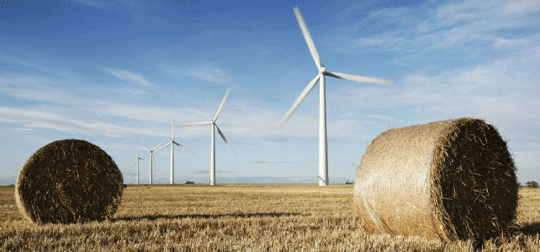
How does wind help the family farm stay in the family?, http://www.aweablog.org/how-does-wind-help-the-family-farm-stay-in-the-family/ Greg Alvarez, 22 Mar 16, During my tour through Colorado wind power last week, I often heard how wind helps keep the fabric of rural communities intact, allowing them to thrive.
Land lease payments make it possible for family famers and ranchers to keep their businesses running, expanded tax revenue provides resources to buy new emergency services equipment, and wind farms bring well-paying jobs to the community, meaning young people don’t have to leave home to find a good career.
Millions in financial resources for rural communities
New data released today allows us to quantify these sorts of anecdotes: landowners with wind turbines on their property now receive a total of $222 million in lease payments every year. Overall, landowners in six states currently receive over $10 million each year in lease payments, and 26 states have landowners that receive over $1 million.
This revenue acts as a drought resistant cash crop for family farmers and ranchers, providing a stable source of income they can count on when productivity declines because of drought or other causes. It also helps protect them from commodity price fluctuations, a frequent source of frustration in the agricultural world.
Real world impacts
In many cases, lease payments from turbines are the difference between keeping a farm and selling off the land.
Jason Wilson of Calhan, CO, told me, “The wind farm allowed us to be able to keep our family farm. We had come to a point where it no longer made financial sense to keep the property even with its vast sentimental value. The wind farm balanced the financial viability with the sentimental value, allowing the family farm to be passed on to the next generation.”
The Wilson farm sits on the plains at the base of Pike’s Peak. It’s a beautiful, serene place started by Jason’s great-grandfather in the 1940’s. Jason will be taking over the operation in the coming years, and his family explained they had no doubt this transition is only possible because of the lease payments they receive in exchange for hosting wind turbines.
Tax revenue helps communities thrive
Land lease payments aren’t the only source of revenue from wind farms; they also help expand the tax base. In many states, wind increases property tax funds by millions of dollars. For example, in Colorado increased property tax revenue from wind could near $19 million a year by 2030.
When our team visited a wind farm in the northeastern part of the state, in a town called Peetz, we heard that the local fire department had been using hand-me-down trucks in poor condition from other counties. Some locals joked that the old fire trucks couldn’t make it up a hill. However, after a wind farm was built, the resulting tax base expansion enabled the town to purchase brand new trucks.
Since around 70 percent of American wind farms are located in rural communities where median household incomes are lower than overall U.S. median incomes, lease payments and added tax revenue are doubly important. Overall, wind farm investment in such areas has exceeded $101 billion.
Wind farms mean local jobs
A final component in this economic picture concerns the jobs wind farms bring to a community.
In many rural areas, jobs are limited to agricultural professions. Young people that may want to pursue a different livelihood are often forced to move away because of a lack of options, even if they don’t want to leave their families and hometowns.
However, wind farms bring other opportunities for employment. Wind turbine technician is the fastest growing occupation in the country and presents another employment avenue for people who enjoy rural lifestyles.
Our team met with a wind farm operations and maintenance crew in Peetz, CO, and many of its members fell exactly into this category. Working as a wind turbine technician provided them with well-paying jobs while also allowing them to stay in the town they grew up in and loved, in close proximity to their extended families. The crew told us this option simply wasn’t available before the wind farm was built.
There are a multitude of different ways wind power brings resources and opportunities to local communities. Even better, the dollar amounts and job numbers will only increase as we continue to grow this American energy source, which will help rural towns thrive along the way.
Indigenous people push for decontamination of Los Alamos National Laboratory atomic research area
Tribe on front lines of fight over nuclear lab contamination Seattle Times, April 4, 2016 By SUSAN MONTOYA BRYAN The Associated Press ALBUQUERQUE, N.M. (AP) — The tribal community of San Ildefonso Pueblo sits in the shadow of Los Alamos National Laboratory, one of the nation’s premier laboratories and the birthplace of the atomic bomb.
The tribe is on the front lines of a battle to rein in contamination left behind by decades of bomb-making and nuclear research.
Pueblo Gov. James Mountain says he’s encouraged that New Mexico regulators, under a revamped cleanup proposal, have identified as a priority a plume of chromium contamination at the tribe’s border with the lab.
San Ildefonso Pueblo, in northern New Mexico’s high desert, has a tribal enrollment of about 750. Its members are known for their artistry, creating jewelry, paintings, traditional black-on-black pottery and other works.
Groundwater sampling shows increasing chromium concentrations at the edges of the plume, indicating it’s migrating through an area considered sacred by the tribe and closer to the Rio Grande, which provides drinking water to communities throughout the region. The plume has stretched about 1 mile into the upper part of the regional aquifer, and is about a half-mile wide and 100 feet thick.
It’s about a half-mile from the closest drinking water well.
“Without a doubt, it definitely raises concerns,” Mountain said.
The contamination was first detected more than a decade ago, and officials traced it to potassium dichromate used to prevent corrosion inside cooling towers at Los Alamos lab’s power plant. As part of regular maintenance from 1956 to 1972, the chemicals were discharged into canyons below…….
The U.S. Energy Department’s Office of Environmental Management is asking for $189 million for work at the lab next fiscal year. That would pay for handling radioactive waste stored at the lab, as well as completing the chromium investigation.
“The essence is groundwater is precious in New Mexico so we take threats to groundwater very seriously,” he said. “We certainly think there’s an elevated risk associated with any contamination to groundwater.”
The area also is home to flaked stone tools, ceramic shards and even a wagon road that dates back to the homestead period of the 1800s.
“It’s a very important area to the pueblo,” Mountain said. “And it’s not just on the parameters of physical inhabitation. There’s an effect on the pueblo’s health and welfare, on our mental well-being, our spiritual well-being.” http://www.seattletimes.com/nation-world/tribe-on-front-lines-of-fight-over-nuclear-lab-contamination/
Very serious consequences if Iran nuclear deal scrapped
U.S. warns of dire consequences if By Nicole Gaouette April 5, 2016 Washington (CNN)The Obama administration warned of dire consequences Tuesday should the next occupant of the Oval Office scrap the Iran nuclear deal.
Lawmakers want Entergy to pay its fair share of tax
Westchester OKs Indian Point tax deal http://www.lohud.com/story/news/local/westchester/2016/04/05/westchester-oks-indian-point-tax-deal/82635322/ Mark Lungariello, mlungariel@lohud.com
Entergy agrees to pay almost $4 million for 2015, but some lawmakers wanted a more equitable deal running through 2024.
The owners of Indian Point Energy Center will pay Westchester County more per year in a new tax deal approved Monday, although some lawmakers questioned if the company is really paying its fair share under the agreement.
The county Board of Legislators approved in a 12-4 vote a new payment in lieu of taxes, or PILOT, for the two active nuclear reactors and an adjacent building at Indian Point in Buchanan. The land is property-tax exempt and the plant’s owner, Entergy, instead pays a set fee negotiated with the municipality.
The new deal runs through 2024, with Entergy’s payment increasing annually by the lesser amount of the New York state tax cap or 2 percent. Under the deal, the company agreed to pay almost $4 million to Westchester backdated for 2015 after paying $3.1 million in the final year of its last PILOT.
Legislator Catherine Parker, a Rye Democrat, voted against the PILOT after a public hearing during which no members of the public spoke.
“We want to make sure that we have an equitable situation for the taxpayer and for the entity,” she said.
Legislature Chairman Michael Kaplowitz, a Somers Democrat who also voted against the measure, had sought to renegotiate the terms so that the PILOT was tied more directly to the county’s annual tax increase or decrease.
The expired PILOT, he said, was agreed to during an uncertain time for nuclear facilities. Under that agreement, Indian Point’s owner paid $3.4 million in 2003 but that payment decreased to a low of $2.6 million in 2007 before bouncing back up.
Entergy bought Unit 2 from Con Edison and Unit 3 from NYPA. Unit 1 is no longer in use. The company has separate PILOTs already approved by the town of Cortlandt, the village of Buchanan and the Hendrick Hudson school district.
Plutonium shipped from Japan to go to Waste Isolation Pilot Plant (WIPP), New Mexico
 Plutonium from Japan to be disposed of underground in New Mexico, Japan
  Times, KYODO APR 2, 2016 U.S.-bound plutonium that has recently been shipped out of Japan will be disposed of at a nuclear waste repository in New Mexico after being processed at the Savannah River Site facility in South Carolina, according to an official of the National Nuclear Security Administration.
“The plutonium will be diluted into a less sensitive form at the SRS and then transported to the Waste Isolation Pilot Plant (WIPP) for permanent disposal deep underground,” said Ross Matzkin-Bridger, who is in charge of the operation at the NNSA, a nuclear wing of the Department of Energy.
“The dilution process involves mixing the plutonium with inert materials that reduce the concentration of plutonium and make it practically impossible to ever purify again,” he said in a recent phone interview.
The official made the remarks ahead of the latest Nuclear Security Summit, sponsored by President Barack Obama, which began Thursday in Washington.
On Friday, Prime Minister Shinzo Abe said Japan will give up more highly enriched uranium (HEU) as part of what Obama hailed as an unprecedented bid to tighten control over unused nuclear material…..
Japan received the plutonium and HEU fuels from the U.S, Britain and France from the late 1960s to early 1970s for research purposes in the name of “Atoms for Peace.” The nuclear fuel delivery, however, has generated controversy in South Carolina since it was reported that it was en route to the U.S. government-run SRS facility in the state.
South Carolina is “at risk of becoming a permanent dumping ground for nuclear materials,” Gov. Nikki Haley said in a recent letter to Energy Secretary Ernest Moniz, calling for the shipment to be stopped or rerouted…….
In the statement, the Japanese government made a new pledge to remove and transfer HEU fuels from the Kyoto University Critical Assembly (KUCA), another Japanese research institute, to the United States for down-blending and “permanent threat reduction.”…….
the materials recently transferred from Japan are only the tip of the iceberg. Currently, Japanese utilities possess over 47 metric tons of separated plutonium, which is equivalent to about 6,000 nuclear bombs http://www.japantimes.co.jp/news/2016/04/02/national/politics-diplomacy/plutonium-japan-disposed-underground-new-mexico/#.VwGXrZx97Gj
America’s mayors speak out in support of Obama’s Clean Power Plan
 Cities Speak Up to Save Obama’s Clean Power Plan, City Lab, A large coalition of U.S. mayors and local governments is coming to the EPA’s defense in the legal battle to cut carbon emissions from power plants. JULIAN SPECTOR @JulianSpector Mar 31, 2016
President Barack Obama’s flagship plan to fight climate change is getting a boost from city leaders across the country.
The National League of Cities, the U.S. Conference of Mayors, and a coalition of 54 local governments are filing arguments in federal court Friday morning in support of the Clean Power Plan, imploring the D.C. Circuit Court of Appeals to allow the Environmental Protection Agency to regulate greenhouse gases emitted from existing power plants.
The amicus brief, provided in advance to CityLab, argues that the EPA has a duty to protect the public from harmful pollution in ways laid out by the Clean Power Plan. Cities, meanwhile, are uniquely vulnerable to climate change and are already paying for its effects, they say.
These comments come days after the EPAoutlined its own arguments in defense of the plan, which is being challenged by 27 states and an assortment of coal and power industry groups. The rule would force changes in the power sector with a goal of cutting its emissions by 32 percent from 2005 levels by 2030. At stake is the scope of the EPA’s regulatory powers, but also the ability of the U.S. government to meet its commitments to fighting climate change, as agreed to in the Paris negotiations last December………
“President Obama’s Clean Power Plan is essential to reduce our nation’s greenhouse gas emissions,” Los Angeles Mayor Eric Garcetti writes to CityLab. “The Supreme Court must choose between helping cities fight climate change or standing squarely in their way.” http://www.citylab.com/politics/2016/03/epa-clean-power-plan-cities-supreme-court/476127/
Warns of persistent threat of nuclear terrorism
US President Barack Obama holds nuclear summit, focusing on Islamic State and North Korea APRIL 2, 2016 Anna Caldwell in Washington DC news.com.au News Corp Australia Network US President Barack Obama has warned of a persistent threat of terrorists getting their hands on nuclear materials despite progress in reducing such risks, and called on world leaders to do more to safeguard nuclear facilities.
Obama cited concerns about groups such as al-Qaeda and Islamic State trying to obtain nuclear materials, saying this was no time for the international community to be complacent.
Obama was hosting more than 50 world leaders for his fourth and final summit focused on efforts to lock down vulnerable atomic materials to prevent nuclear terrorism……
US President Barack Obama has warned of a persistent threat of terrorists getting their hands on nuclear materials despite progress in reducing such risks, and called on world leaders to do more to safeguard nuclear facilities.
“There is no doubt that if these madmen ever got their hands on a nuclear bomb or nuclear material, they would certainly use it to kill as many people as possible,” he told a global nuclear security summit in Washington DC.
Obama cited concerns about groups such as al-Qaeda and Islamic State trying to obtain nuclear materials, saying this was no time for the international community to be complacent.
Obama was hosting more than 50 world leaders for his fourth and final summit focused on efforts to lock down vulnerable atomic materials to prevent nuclear terrorism…….http://www.news.com.au/world/us-president-barack-obama-tells-world-leaders-to-stand-against-north-koreas-nuclear-strength/news-story/80c17b166c9c1974b042b04d9af7eda8
EPA will clean up thorium pollution adjacent to West Lake Landfill.
EPA says it will remove radioactive dirt on private property adjacent to landfill, St Louis Post Dispatch, By Jacob Barker St. Louis Post-Dispatch 2 Apr 16
The Environmental Protection Agency plans to clean up spots of dirt on private property just outside the radioactively contaminated West Lake Landfill.
Testing from the Missouri Department of Natural Resources identified radioactive contamination on property beyond the landfill’s perimeter, according to a report released Friday. The agency said the findings were “consistent” with prior EPA studies.
Levels of thorium were above Environmental Protection Agency limits for unrestricted use in two locations on the edge of property now used as a service and repair facility for AAA Trailer Services.
The contamination is to the west of the northernmost part of the West Lake Landfill known as “Area 2,” which is not adjacent to thesmoldering Bridgeton Landfill……..
EPA limits thorium levels to 7.9 pico Curies per gram for unrestricted use (a pico Curie represents 2.2 atomic disintegrations per minute). ……. Thorium mostly emits radiation that can’t pierce the skin, so radiation exposure is mostly through ingestion or inhalation.
West Lake was contaminated with byproducts from uranium processing for the nation’s early nuclear weapons program. Thorium was the only uranium decay product found at levels above EPA guidelines in the DNR tests. The DNR report recommended further investigation around the areas where the contamination was detected. http://www.stltoday.com/news/local/metro/epa-says-it-will-remove-radioactive-dirt-on-private-property/article_3732051c-ea91-5ba2-9120-88fe8e0cc5b8.html
China, USA, strike deals on climate and nuclear security
Despite disputes, U.S., China strike climate, nuclear deals David Jackson, USA TODAY April 1, 2016 WASHINGTON — Despite ongoing disputes over cyber espionage, intellectual property, and the South China Sea, the United States and China struck deals Thursday on nuclear security and climate change.
The two nations agreed to sign the new global climate change agreement on April 22, the day it becomes operational; the agreement reached in Paris late last year calls on countries to develop plans to reduce greenhouse gas emissions.
“We’re committing to formally join it as soon as possible this year, and we urge other countries to do the same,” President Obama said before meeting with Chinese President Xi Jinping on the sidelines of the bi-annual nuclear security summit.
As for that topic, the United States and China issued a joint statement pledging more cooperation on efforts to improve the storage and security of nuclear material in an effort to prevent nuclear terrorism………http://www.usatoday.com/story/news/2016/03/31/obama-xi-jinping-china-climate-change/82483840/
Rural Indians’ lawsuit against coal power plant is dismissed by USA judge
U.S. judge nixes lawsuit against World Bank over power plant in India BY SEBASTIEN MALO http://www.reuters.com/article/us-india-lawsuit-worldbank-idUSKCN0WW2H2 NEW YORK (Thomson Reuters Foundation) 30 Mar 16 – A U.S. federal judge has dismissed a lawsuit filed by Indian fishermen and farmers who sued the World Bank over a loan for a power plant they claimed ravaged the environment.
The World Bank’s International Finance Corporation (IFC) is shielded by immunity and cannot be sued in the United States, the U.S. District Court judge ruled.
The IFC loaned $450 million to help build the coal-fueled Mundra power plant in India’s coastal region of Gujarat, which became fully operational in 2013.
The Indian company that carried out the project, Coastal Gujarat Power Limited, a subsidiary of Tata Power, said it would create jobs, benefit 16 million domestic consumers and provide competitively priced electricity to industry and agriculture.
But fishermen, farmers and others living near the plant said it took a huge toll on the environment.
Saltwater leaking from the plant made groundwater undrinkable and unfit for irrigation, hot water from the cooling system harmed the fish catch and air quality suffered, they said in the U.S. lawsuit filed last year in the District of Columbia.
Their way of life could be “fundamentally threatened or destroyed,” the complaint said, accusing the IFC of irresponsible and negligent conduct in financing and supervising its loan.
But U.S. District Court Judge John Bates in a ruling last week said under the International Organizations Immunities Act, the IFC is immune to prosecution in the United States.
The Indians plan to appeal, the U.S. nonprofit EarthRights International, which filed the lawsuit, told the Thomson Reuters Foundation.
“This is a fight for our lives and livelihood,” Gajendrasinh Jadeja, head of Navinal Panchayat, a village that is a party in the case, said in an email.
“We believe we will prevail,” Jadeja said.
An IFC spokeswoman said the organization would not comment on active legal matters.
A plan being implemented by Coastal Gujarat Power, however, includes what she called “mitigation measures,” she said, but she did not elaborate.
The World Bank and IFC have come under criticism by groups that contend their focus on big projects can disrupt the environment and displace people.
The IFC, with 184 member countries, is the “largest global development institution focused exclusively on the private sector in developing countries,” according to its website.
(Reporting by Sebastien Malo, Editing by Ellen Wulfhorst. Please credit the Thomson Reuters Foundation, the charitable arm of Thomson Reuters, that covers humanitarian news, women’s rights, trafficking, land rights and climate change. Visit news.trust.org)
-
Archives
- October 2026 (129)
- September 2026 (339)
- August 2026 (330)
- July 2026 (355)
- June 2026 (287)
- May 2026 (306)
- April 2026 (356)
- March 2026 (251)
- February 2026 (267)
- January 2026 (308)
- December 2025 (358)
- November 2025 (359)
-
Categories
- 1
- 1 NUCLEAR ISSUES
- business and costs
- climate change
- culture and arts
- ENERGY
- environment
- health
- history
- indigenous issues
- Legal
- marketing of nuclear
- media
- opposition to nuclear
- PERSONAL STORIES
- politics
- politics international
- Religion and ethics
- safety
- secrets,lies and civil liberties
- spinbuster
- technology
- Uranium
- wastes
- weapons and war
- Women
- 2 WORLD
- ACTION
- AFRICA
- Atrocities
- AUSTRALIA
- Christina's notes
- Christina's themes
- culture and arts
- Events
- Fuk 2022
- Fuk 2023
- Fukushima 2017
- Fukushima 2018
- fukushima 2019
- Fukushima 2020
- Fukushima 2021
- general
- global warming
- Humour (God we need it)
- Nuclear
- RARE EARTHS
- Reference
- resources – print
- Resources -audiovicual
- Weekly Newsletter
- World
- World Nuclear
- YouTube
-
RSS
Entries RSS
Comments RSS

