Who are the pro nuclear donors funding Center for Strategic and International Studies (CSIS)?
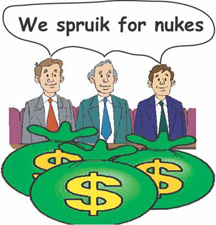 US Think Tank Urging Japan Keep Nuclear Funded By Japanese Govt & Nuclear Industry , Simply Info, April 12th, 2016 | “……The CSIS received over $500,000 from the Japanese government. …Japan is a top donor to CSIS. Only the UAE and US are included in that top donor category along with Japan.
Contributions over $200,000
Lockheed Martin Corporation
Northrop Grumman Corporation
Contributions over $100,000
Bechtel Corporation
General Dynamics Corporation
Mitsubishi Corporation
Nippon Keidanren
Raytheon
Contributions over $65,000
Marubeni Corporation
Rolls-Royce plc
Contributions over $35,000
Fluor Corporation
GE Foundation
Hitachi, Ltd.
ITOCHU Corporation
Mitsubishi Heavy Industries, Ltd.
Mitsui & Co., Ltd.
Contributions under $34,999
Chubu Electric Power Co., Inc.
E. I. du Pont de Nemours and Company
Électricité de France S.A.
Exelon Corporation
General Atomics
General Electric Company
Honeywell International, Inc.
Mitsubishi Hitachi Power Systems, Ltd.
Toshiba Corporation
URENCO USA http://www.fukuleaks.org/web/?p=15416
Plymouth needs an unbiased Nuclear Committee to advise on decommissioning Pilgrim Nuclear Power Station
 Rash of resignations from the Nuclear Matters Committee Forget the nuclear power plant, the town’s Nuclear Matters Committee is decommissioning itself. Wicked Local Plymouth By Frank Mand
fmand@wickedlocal.com Apr. 14, 2016
PLYMOUTH – Forget the nuclear power plant, the town’s Nuclear Matters Committee is decommissioning itself.
Long-time member and chair Jeff Berger resigned last year, or at least thought he had. According to the town clerk it’s not official. Committee member Rich Grassie followed shortly thereafter, to devote his energy to another project.Chairman Rich Rothstein offered his letter of resignation earlier this year, and then committee member Heather Lightner did the same.
The full committee is supposed to have nine-members so today – including Berger who is technically still on the committee – they barely have enough members to reach a quorum (five) and hold a meeting.
So does the Nuclear Matters Committee still matter?
Brian Sullivan, a senior fellow at the American Leadership and Policy Foundation who writes a column on safety issues, including nuclear power topics, for the Old Colony Memorial, says it couldn’t have happened at a worse time.
“We in Plymouth are at a critical juncture when it comes to the decommissioning of the Pilgrim Nuclear Power Station,” Sullivan told the Old Colony last month. “Unfortunately, we are suffering a brain-drain at the same time.”
Sullivan suggests the resignations might be due to the committee’s lack of independence.
“We know from his recent commentary,” Sullivan said, “that former NMC Chairman Jeff Berger is pleased to now be able to speak out without having to be concerned about political reservations.”
It may not be that simple though………
Lightner, one of the newest members and the last to resign is also the most skeptical of those who recently resigned about the committee’s continued relevance.
“Although the Nuclear Matters Committee has a wealth of knowledge related to nuclear power and nuclear engineering, the committee is seriously lacking a diverse membership,” Lightner told the Old Colony. “If the NMC is to continue and bring value to the town, it must include more members who can speak to environmental issues, economic factors and development, and health and safety as part of the decommissioning conversation and decision-making process.”
Lightner would also like to see the selectmen, who appoint all committee members, limit the number of members who are associated with the nuclear industry or Entergy in particular and institute term limits to encourage new ideas and a balanced decommissioning discussion.
“Otherwise, the NMC should be dissolved,” Lightner said. “Perhaps the best plan is to appoint a brand new, more diverse group focused specifically on decommissioning, which could then advise the Entergy Working Group and Board of Selectmen.”
But even the town seems to be moving away from the committee…….http://plymouth.wickedlocal.com/article/20160414/NEWS/160418679/?Start=2
The Pilgrim nuclear power plant not to close until 2019
Closing date set for Pilgrim nuclear power plant will close May 31, 2019, plant operator Entergy announced. Boston Globe By David Abel and John R. Ellement GLOBE STAFF APRIL 14, 2016 The company that owns the Pilgrim Nuclear Power Station said Thursday that it intends to refuel next year and continue operating the power plant in Plymouth for three more years.
Officials at Entergy Corp. said the plant will close on May 31, 2019. The company had been weighing whether to shutter the plant next year — as critics had hoped it would — before it would be required to start an expensive refueling process.
The decision means Pilgrim’s 609 employees will continue to work there until the plant closes, but activists say it also means Entergy will continue operating what the Nuclear Regulatory Commission has deemed one of the nation’s least-safe reactors…….
Local activists who have long opposed the plant’s continued operations said they worry that Entergy is more concerned about its finances than public safety.
“The bottom line is that this decision is about Entergy’s pocketbook — not about public safety,” said Mary Lampert, director of Pilgrim Watch, a longtime critic of the plant. “This is an old plant, and Entergy is unwilling to spend the money to fix the problems, and the NRC is allowing them to do that. That means we’re in a heightened period of risk.”
Last October, Pilgrim said it would close no later than June 2019, after supplying power to more than a half-million homes and businesses for four decades. The announcement came a month after the NRC designated Pilgrim one of the nation’s three least-safe reactors.
Company officials have said they decided to close the plant because of the plummeting price of a competing fuel, natural gas, and the reluctance of federal and regional officials to provide financial incentives for nuclear power plants…….https://www.bostonglobe.com/metro/2016/04/14/pilgrim-nuclear-power-plant-close-may/FRXGHcfMrk3nSngdYueMML/story.html
EDF in America going for wind power, abandoning nuclear
 EDF shows that wind makes better sense than nuclear,Ecologist Chris Goodall April 2016 EDF in the UK may be propelled by its disastrous nuclear ambitions, writes Chris Goodall. But across the Atlantic it’s another story: the company is the US’s biggest wind developer, and selling its power, profitably, for under 40% of the price it has been promised for Hinkley C, including federal tax credits…….
Within the same company, they do things very differently on the other side of the Atlantic; there EDF focuses wholeheartedly on wind and has no nuclear under development.
It has just proudly announced that it has become the largest wind developer in North America with a portfolio in 2015 of over 1 gigawatt of newly constructed wind farms.
If it continues at the current rate, it will be generating more electricity from wind by 2025 than would be provided by Hinkley Point C. The numbers are as follows. Hinkley will generate about 25 terawatt hours a year. EDF’s 2015 annual portfolio of new wind projects will provide about 3 terawatt hours a year at average US utilisation factors.
If it continues to develop new wind projects at the rate of 1 gigawatt a year, it will be generating well over 30 terawatt hours a year from wind by the end of 2025. 2025 is when EDF says Hinkley will be finished.
What about the capital cost of wind versus nuclear? The latest US estimates suggest a figure of about $1,700 per kilowatt of capacity. That means EDF’s projects completed in 2015 cost about $1.8bn. Over ten years, that rate of installation will mean a total cost of around $18bn or about £13bn. Wind is therefore at least 30% cheaper to construct.
And it is much cheaper to operate. The most important project it completed in 2015, the 250 MW farm at Roosevelt in New Mexico, has sold its electricity for the next 20 years to a utility for $23.39 a megawatt hour, less than 20% of the price agreed for Hinkley of £92.50/MWh.
Note that the Roosevelt price is somewhat subsidised by Federal tax credits but even without this benefit the cost of wind would be less than 40% of the price of UK nuclear. Wind saves consumers money when compared to the nuclear alternative.
It’s simple really: renewables are a better and more secure investment
EDF finances many of its US wind projects on the back of power purchase agreements with major companies such as Microsoft, Procter and Gamble and Google. They commit to buy the electricity produced at a fixed price, not the inflation adjusted figure that the UK will pay for Hinkley. The EDF press release said:
“Corporate America is increasingly turning to renewable energy to power its business operations, based both on consumer preferences and because renewable energy simply makes economic sense.”
We never hear this line from EDF in the UK.
EDF cannot guarantee the wind will blow or the sun shine. Unlike in Britain, its US business is also investing heavily in energy storage. The US company has announced 100MW of battery systems in the US because “Energy storage is an attractive, cost-effective addition to intermittent energy generation projects.” However there’s no mention of batteries on EDF’s UK web site.
For sensible reasons large international companies often pursue varied market strategies in different countries. EDF in the US has decided to back wind while the UK has gone for nuclear.
But even a quick look shows that the energy and financial returns to the US strategy seem far clearer and better for the company, and its customers, than the tactics of the UK business. http://www.theecologist.org/blogs_and_comments/commentators/2987489/edf_shows_that_wind_makes_better_sense_than_nuclear.html
American nuclear engineer arrested for allegedly secretly helping China’s nuclear program
 US Engineer Helped China’s Nuclear Program for 2 Decades, Authorities Say http://abcnews.go.com/US/us-engineer-helped-chinas-nuclear-program-decades-authorities/story?id=38403235 By MIKE LEVINE Apr 14, 2016 The FBI has arrested an American nuclear engineer in Delaware for allegedly spending the past two decades illegally helping China build nuclear material with expertise he gleaned from others inside the United States.
According to a federal indictment unsealed today in Tennessee, Allen Ho — a naturalized U.S. citizen with residency in both Delaware and China — worked with others inside the United States to help Chinese agencies develop and produce “special” material relating to nuclear reactors.
Under the direction of a Chinese government agency, Ho allegedly identified and recruited experts from the U.S. civil nuclear industry who could provide the technical assistance he sought — often paying them for their help or arranging for them to travel to China, prosecutors say.
“China has the budget to spend,” Ho allegedly told one of the experts he tried to recruit in 2009. “China will be able to design their Nuclear Instrumentation System independently and manufactur[e] them independently after the project is complete.”
Specifically, Ho and others looked to obtain what the Justice Department calls “integral assistance” and “sensitive nuclear technology” relating to a “Small Modular Reactor Program” and an “Advanced Fuel Assembly Program” in China, and the group allegedly also sought help with nuclear reactor-related computer codes.
“Prosecuting those who seek to evade U.S. law by attaining sensitive nuclear technology for foreign nations is a top priority for [us],” the head of the Justice Department’s National SecurityDivision, John Carlin, said in a statement.
While operating his own technology firm based in Delaware, Ho has also been a senior adviser with China’s largest nuclear power company, which specializes in the development and manufacture of nuclear reactors, according to prosecutors.
Charged with conspiracy to unlawfully engage and participate in the production and development of special nuclear material outside the United States, Ho could face life in prison if convicted.
“The arrest and indictment in this case send an important message to the U.S. nuclear community that foreign entities want the information you possess,” FBI Executive Assistant Director Michael Steinbach said. “The federal government has regulations in place to oversee civil nuclear cooperation, and if those authorities are circumvented, this can result in significant damage to our national security.”
Wind power – the big buy-up by big companies
Why companies like Google and Walmart are buying so much wind power, WP, By Brady Dennis April 12 The U.S. wind energy industry had a memorable 2015, from installing thousands of new turbines across the country to supporting a growing number of jobs.
But perhaps one of the most noteworthy brights spots of the past year, according to an annual report released Tuesday by the American Wind Energy Association (AWEA), was the growing demand for wind energy from major corporations. High-tech firms such as Google Energy, Facebook and Amazon Web Services, as well as more traditional companies such as Procter & Gamble, General Motors, Walmart and Dow Chemical, have signed contracts to purchase increasing amounts of wind energy in coming years.
Corporations and other non-utility customers — including some municipalities and universities — accounted for more than half of the wind power capacity sold through so-called power purchase agreements in 2015, according to the AWEA. The group said that corporate and other non-utility buyers have signed contracts for more than 4,500 megawatts of wind power capacity, or enough to power the equivalent of about 1.2 million American homes.
Why does that matter?
[These states are setting wind energy records – and suing over Obama’s climate plans]
- Wind energy is seeing a global, not just a domestic boom. While the United States generated more electricity from wind than in any previous year during 2015, China outpaced every other nation in the amount of new wind energy capacity. China, the United States, Germany, Brazil and India combined to produce more than 80 percent of all new wind capacity installations in 2015, according to the AWEA………https://www.washingtonpost.com/news/energy-environment/wp/2016/04/12/why-companies-like-google-and-walmart-are-buying-so-much-wind-power/
Conspiracy charges against Chinese state-owned nuclear firm an US citizen
Chinese state-owned firm, US citizen charged in nuclear case: US http://www.smh.com.au/world/chinese-stateowned-firm-us-citizen-charged-in-nuclear-case-us-20160414-go6w6t.html
April 15, 2016 Washington: A Chinese state-owned nuclear power company and a US citizen were indicted on Thursday on charges of conspiracy to produce special nuclear material outside the United States without the required US authorisation, the Justice Department said.
The China General Nuclear Power Company and Allen Ho, a naturalised US citizen and a nuclear engineer, were charged in a two-count indictment in the Eastern District of Tennessee, the department said in a statement.
Under the radar. Japan’s nuclear development pushed along by USA think tank


 US Think Tank Urging Japan Keep Nuclear Funded By Japanese Govt & Nuclear Industry, Simply Info April 12th, 2016 | A report by The Intercept this week provided a missing piece of the puzzle from 2012 and Japan’s attempted nuclear exit. Back in 2012 then PM Noda established a policy for Japan to phase out nuclear power by 2030. This of course brought protest from Japan’s nuclear industry but more curiously brought protest by various parties claiming to represent the US. One of these was a series of eyebrow raising public statements by John Hamre who showed up in Japan weeks after the new policy was announced.
Hamre is the president of a Washington DC think tank, the Center for Strategic and International Studies (CSIS). While in Japan he made a series of claims about Japan’s need for nuclear power, the US stance on the issue and readily debunked claims about renewable energy. Hamre does not hold any authority to speak on behalf of the US but gave the impression he was sharing US official views on the issue. News reports described him as “a former deputy US defense secretary”. What was not known in 2012 was who bankrolled Hamre’s Japanese speaking tour or his opinions on the issue.
The Intercept’s new report on foreign government funding of TPP promotion within the US provides that missing piece. Hamre’s Center for Strategic and International Studies is heavily funded by the Japanese government and a long list of US and Japanese nuclear industry companies. The Intercept cites a 2014 investigative report by the New York Times that looked into foreign influence on DC think tanks and how that goes on to skew US policy, laws and spending. The New York Times investigation pressured the CSIS to publish their corporate and government donors list for the first time in 2014. The New York Times also explains that these lobbying activities on behalf of foreign governments masquerading as impartial scholarship are likely illegal in the US. The Foreign Agents Registration Act requires such arrangement to be disclosed to the US government………..http://www.fukuleaks.org/web/?p=15416
Florida drinking water wells threatened by nuclear plant leak
Nuclear Plant Leak Threatens Drinking Water Wells in Florida, NYT By LIZETTE ALVAREZ MARCH 22, 2016 MIAMI — When Florida’s largest power company added two nuclear reactors to an existing plant that sat between two national parks — Biscayne Bay and the Everglades — the decision raised the concerns of environmentalists and some government officials about the possible effects on water quality and marine life.
Now more than four decades later, Florida Power & Light’s reactors atTurkey Point, built to satisfy the power needs of a booming Miami, are facing their greatest crisis. A recent study commissioned by the countyconcluded that Turkey Point’s old cooling canal system was leaking polluted water into Biscayne Bay.
This has raised alarm among county officials and environmentalists that the plant, which sits on the coastline, is polluting the bay’s surface waters and its fragile ecosystem. In the past two years, bay waters near the plant have had a large saltwater plume that is slowly moving toward wells several miles away that supply drinking water to millions of residents in Miami and the Florida Keys.
Samples of the water at various depths and sites around the power plant showed elevated levels of salt, ammonia, phosphorous and tritium……
last month, a Florida administrative judge, Bram Canter, chastised the state and Florida Power & Light, finding that the cooling canal system is “the major contributing cause” for the growth of the large underground saltwater plume and for its westerly move toward the drinking water well fields. He ordered the state and the company to clean up the cooling canals, which it had started to do under an October consent decree with the county.
The Biscayne Aquifer, the judge noted in his ruling, is an “important natural resource.” It is the main source of drinking water in the county and is vital to irrigation and the marsh wetland communities, he added. Judge Canter made his ruling after a Florida rock mining company sued the company over the saltwater plume. http://www.nytimes.com/2016/03/23/us/nuclear-plant-leak-threatens-drinking-water-wells-in-florida.html?ref=energy-environment&_r=1
Wind power in America in a big way, and transmission grid development

US Wind Energy Juggernaut: You Ain’t Seen Nothing Yet (CT Exclusive Interview), Clean Technica, April 4th, 2016 by Tina Casey The American Wind Energy Association will release its much anticipated annual report on April 12, and the group’s CEO Tom Kiernan provided CleanTechnica with some advance insights during a one-on-one phone chat last week. Hint: it’s gonna be big.
Kiernan also discussed two recent major milestone developments in the US wind industry, one being the construction of the nation’s first ever offshore wind farm — which will finally open the floodgates to developing the immense Atlantic Coast wind resources — and the other involving the Energy Department in what will be the biggest ever renewable energy project in the US.
The 2015 American Wind Energy Association Report
AWEA has already teased some info for its 2015 annual wind energy report to the press, underscoring the sector’s reduction in carbon dioxide, sulfur dioxide, and nitrogen emissions:
Electricity generated by wind in 2015 displaced an estimated 176,000 metric tons of SO2 and 106,000 metric tons of NOx, representing $7.3 billion in avoided health costs last year alone.
AWEA provides third-party statistics that suggest wind sector growth has contributed to a total US power sector emissions drop down to 1995 levels, while average electricity rates dropped — yes, dropped — 5.5 percent below 2009.
The group also states that “wind energy is the most cost-effective energy source to comply with the Clean Power Plan” put forth by President Obama last summer, and in the interview Kiernan emphasized that wind also provides the US with a pathway for honoring its Paris COP21 global climate pledge.
Among other tidbits, AWEA’s 2015 statistics reveal that the US is now #1 in global wind energy production.
During his conversation with CleanTechnica, Kiernan provided this additional teaser for the 2015 report:
There will be some exciting news about jobs growth…for example wind technicians [maintenance, service and repair positions] is now the fastest-growing profession in the country…
The group has also has some big news about private sector, non-utility wind investments and it has scheduled another preview announcement about the report for April 7, so stay tuned for that.
Offshore Wind Ready For Its Closeup
CleanTechnica’s conversation with Kiernan began with a discussion of the soon-to-be-completed Block Island wind farm off the coast of Rhode Island. Offshore wind energy development faces some technological challenges compared to onshore, so getting “steel in the water” is a major development for the industry:………
Biggest Ever Clean Power Project In The US
The other big development is the Energy Department’s announcement that it will get behind the proposed 700-mile megawatt Clean Line Plains & Eastern transmission line, designed primarily to transport electricity from Oklahoma and Texas wind farms through Arkansas to Tennessee and points east.
At 4,000 megawatts, Plains & Eastern counts as the biggest renewable energy project so far in US history. By way of comparison, the Hoover Dam hydropower plant clocks in at 2,000 megawatts of capacity.
The other striking thing about the project is the Energy Department approval (check out theTennessee Valley Authority for an idea of the scale and impact of major federally sanctioned energy initiatives).
As described by Kiernan, federal involvement provides wind with the same procedural advantages that other conventional forms of energy have long enjoyed:
It’s important for building momentum for [wind] transmission projects throughout the country…conventional power has long term, proven regulatory processes that are speedier. This is the first one for clean energy…it’s a very important step for the industry. This is a transformational project.
US Wind Energy Rising………http://cleantechnica.com/2016/04/04/us-wind-energy-takes-off-with-transmission-offshore-farm/
Religious groups urge US lawmakers to approve funding for Green Climate Fund (GCF)
Faith groups call for more international climate funding The Hill, By Devin Henry – 04/11/16 More than 120 religious groups are encouraging lawmakers to approve President Obama’s proposed $750 million contribution to an international climate change fund.
In a letter to members of Congress, the groups say the  is an important way to “build resilience and stability in the face of the unavoidable impacts of climate change,” an issue they say their faith backgrounds call them to focus on.
The GCF is an international pool of money designed to help poor and developing countries cope with climate change. Obama has requested Congress provide $750 million for the fund in 2017. …….http://thehill.com/policy/energy-environment/275864-faith-groups-call-for-more-international-climate-funding
Waste Isolation Pilot Plant (WIPP) still not open, and USA’s toxic nuclear waste mounts
 Changing nuclear landscape alters WIPP’s role Local News Santa Fe Apr 10, 2016. By Rebecca Moss The New Mexican “………Don Hancock of the Southwest Research and Information Center, a nuclear safety watchdog group, said more environmental assessments under the National Environmental Policy Act need to be conducted to assess WIPP’s capacity or ability to handle additional plutonium.
“There is more of that waste in existence than there is room at WIPP,” Hancock said. “Insofar as they want to bring in foreign plutonium, they have to get the law changed.”
He said Japan’s civilian plutonium would be in direct violation of the Land Withdrawal Act’s stipulation that the waste stored at WIPP come from U.S. defense activities.
The Land Withdrawal Act states: “The Secretary shall not transport high-level radioactive waste or spent nuclear fuel to WIPP or emplace or dispose of such waste or fuel at WIPP.”
“Geological repositories kind of win by default. If the decision is to put it in the ground, then it could be done someplace else,” Hancock said.
“We the public were always told, ‘Oh no, none of this prohibited materials — ignitable, reactive, potential explodable materials — will ever come to WIPP. We are not allowed to ship those ignitable, reactive [materials]. We have lots of safeguards so that will never happen,’ ” Hancock said, adding, that has been proven wrong.
U.S. Sen. Tom Udall, D-N.M., said in a statement that the future of MOX and what that will mean for New Mexico are questions that should be rigorously considered by Congress. He said it is likely “this debate will continue into the next administration.”
“My understanding is that the amount of defense waste in South Carolina likely would require an expansion at WIPP and a change in its total radiation limits, which are set by law,” he said. “And that is not a small issue to address.”
Before the diluted plutonium in South Carolina can be transported to WIPP, he said, an environmental assessment, public comment and an agreement from the state of New Mexico should occur.
Many “ifs” exist regarding the safety of the waste and the remaining capacity at WIPP, he said. If the waste is transported, he said, New Mexico should be compensated and workers trained to deal with a radiological emergency.
“We shouldn’t talk about new missions for WIPP until it’s open,” he said. “And until we know that it will be able to safely complete its current mission.”
Expanded nuclear waste role for USA’s Waste Isolation Pilot Plant
 Changing nuclear landscape alters WIPP’s role Local News Santa Fe Apr 10, 2016. By Rebecca Moss The New Mexican When the salt bed trenches of the Waste Isolation Pilot Plant were mined on the outskirts of Carlsbad in the mid-1980s, Congress dictated specific guidelines for what could be held within its chambers. Only low-level transuranic waste — rags, tools and even soil that had been contaminated with potent radiation through the creation and testing of nuclear weapons in the U.S. — could fill the 6.2 million-cubic-foot cavern more than 2,000 feet below ground.
Even within these limited parameters, finally approved by the Environmental Protection Agency in 1998, it took WIPP 20 years to open. When the first waste-bearing truck drove from Los Alamos to Carlsbad the following year, two women sat on the pavement and a man parked his car in the middle of the road, hoping to prevent its passage. Others waved American flags in support.
But in the 17 years since the facility opened, the nation’s nuclear landscape has changed. WIPP remains the world’s only underground geological repository for nuclear waste, and a confluence of budget constraints, geopolitical issues, the threat of terrorists obtaining nuclear materials and other concerns have led many to consider whether WIPP’s mission should be expanded to include not only higher levels of waste from the U.S. but also waste from around the world. Plans are already in motion to accept plutonium from Japan.
The U.S. now has 61.5 metric tons of plutonium that require a path to disposal — a path that increasingly points to WIPP, despite vulnerabilities exposed by an underground truck fire at the plant in 2014 and an unrelated radiation leak that followed days later, shutting down the plant for the past two years. Officials say it might reopen by the year’s end.
In late March, the National Nuclear Security Administration announced that more than 6 tons of plutonium would be diluted with a blend of chemical compounds called oxides — a process known as down-blending — at the Savannah River Site in South Carolina and would then be shipped to New Mexico. A portion of that plutonium — just under 1 metric ton, or 2,000 pounds — from “foreign sources” could be included in the shipment, the agency said.
The Department of Energy then announced a $6 billion contract spanning a 10-year period for the Savannah River Site to prepare and package the waste. And on April 1, President Barack Obama and Japanese Prime Minister Shinzō Abe announced that “critical” highly enriched uranium and separated plutonium had been removed from the Fast Critical Assembly nuclear reactor research facility in Japan and shipped to the U.S.
Despite objections from the state of South Carolina, the plutonium from Japan was sent to the Savannah River Site. NNSA spokeswoman Francie Israeli confirmed to The New Mexican last week that the plutonium ultimately will be placed at WIPP.
WIPP originally was intended to be the nation’s first deep-underground nuclear repository — not the only such facility in the U.S. or in the world. A high-level waste storage site planned for Yucca Mountain in Nevada was abandoned in 2011 following extensive public and political outcry in the state. No other sites have been designated as nuclear repositories since.
Meanwhile, the Obama administration set a goal in 2009 “to secure all vulnerable nuclear materials” worldwide by 2013, and while that deadline has gone unmet, the president has remained a strong proponent of a “global zero” campaign to eliminate the spread of nuclear weapons. Part of this mission rests on an agreement to secure or dispose of all vulnerable nuclear materials.
Critics say storing plutonium from Japan at WIPP would directly violate the laws that govern the underground repository and could fundamentally reshape the facility’s mission — which stipulated storing only transuranic waste from U.S. defense projects. Others say that because the plutonium will be heavily diluted, it will meet WIPP’s criteria.
Since WIPP opened its doors, the original scope of its mission has slowly shifted. Exceptions have been made to allow more than 3 tons of plutonium from the Savannah River Site and the Rocky Flats Plant in Colorado to be secured in the salt caverns below Carlsbad — including classified molds that shaped plutonium pits used to trigger nuclear bombs.
The plant’s mission also included a pledge to “open clean and stay clean,” but a runaway reaction from an improperly packaged waste drum from Los Alamos in 2014 caused a radiation leak that escaped the cavern, contaminating the air above ground and breaking that promise.
Meanwhile, the plant is still pegged to take waste waiting at national laboratories, as well as new waste the labs create. The U.S. Department of Energy’s budget for the coming year proposes funding to enhance the nation’s nuclear stockpile and ramp up plutonium pit production at Los Alamos National Laboratory — work certain to contribute to the waste stream.
Todd Shrader, Carlsbad Field Office manager for the Department of Energy, addressed the plan to bring plutonium to New Mexico during a WIPP public forum Thursday night.
“As with all waste that comes here, it has to meet our waste acceptance criteria and the hazardous waste permit,” he said. “In our mind, it is frankly the same.”………
He also said that plutonium disposal through a nuclear reactor fuel program or storage at WIPP has not been thoroughly studied to show which path — if either of them — is the clear route forward in getting rid of such sensitive materials.
“I worry that we might be trying to jump off of one horse before we are sure that the other horse will be better and faster,” he said.
He [William Tobey, a senior fellow at the Harvard Kennedy School’s Belfer Center for Science and International Affairs and the former deputy administrator of the Office of Defense Nuclear Proliferation at the NNSA.] said spending money to solve the problem is necessary.
“The people who fought World War II bore significant burdens, but they realized they had a responsibility to do that,” Tobey said. “My argument is we also have a responsibility to bear some burden for the disposition of plutonium” that resulted from the weapons program at that time. “There is a symmetry,” he said………….. Contact Rebecca Moss at 505-986-3011or rmoss@sfnewmexican.com. http://www.santafenewmexican.com/news/local_news/changing-nuclear-landscape-alters-wipp-s-role/article_2a57716d-4e92-5e94-bc3a-d2a6ce1ae26c.html
USA Energy Dept moving away from dangerous MOX nuclear fuel plan
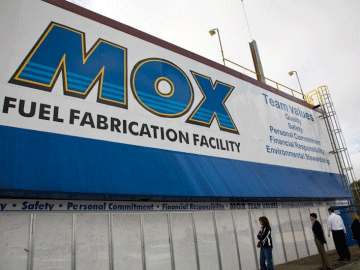 Radioactive Pork Finally on the Chopping Block Project On Government Oversight. By: Lydia Dennett 9 Feb 16 A “Sensitive But Unclassified” document from the Secretary of Energy, obtained by the Project On Government Oversight, indicates that the Department is concerned that parochial interests in Congress may thwart their plans to kill the MOX program.
The Mixed Oxide Fuel Fabrication Facility (MOX) is the result of a bilateral agreement with Russia in which both countries agreed to dispose of 34 metric tons of nuclear weapons grade plutonium. In 2002 the U.S. decided to construct the MOX facility to convert this dangerous material into fuel for commercial nuclear power reactors. But now, 14 years later, the MOX program is almost 3,000 percent over budget, lacks even a single potential customer for the fuel, and could actually be putting our nuclear material at risk.
The November 2015 memorandum from Secretary of Energy Ernest Moniz to President Obama states that MOX is a “high-priority ‘hot potato’ issue” for this Congress and indicates that the Department is finally beginning to shift focus and funding away from MOX and toward a plutonium disposition process that will actually work: “We are working with our appropriators and other stakeholders to shift our plutonium disposition strategy from MOX power reactor fuel to dilution and underground disposal. This is much faster and cheaper.”
Last year, an independent study performed by the Aerospace Corporation confirmed that the cost of finishing construction of MOX and operating the plant for the next 20 years will be at least $47.5 billion and could be as much as $114 billion depending on annual funding from Congress. That would be in addition to the $5 billion already spent on the project. MOX was originally expected to cost a mere $1.6 billion.
Despite the project’s long history of skyrocketing costs, safety and security concerns, and construction problems, it has been kept alive in large part by political officials who have an interest in making sure funding for the project continues.
Problems with the MOX program were first raised in the early 2000s by then-Representative David Hobsen (R-OH), who was serving as Chairman of the House Appropriations Energy and Water Subcommittee at the time. His efforts to halt construction of the MOX facility were stalled in 2006 due to pressure from the Department of Energy, the Administration, and his own party.He was told that canceling the project would hurt then-South Carolina Governor Mark Sanford’s chances of being reelected.
In 2013, Senator Lindsay Graham (R-SC)placed a hold on the president’s nomination for Secretary of Energy Ernest Moniz until Moniz promised to finish the MOX plant. Graham eventually relented and removed the hold but remains one of the most outspoken supporters for the project along with Representative Joe Wilson (R-SC) and Representative Rick Allen (R-GA).
Representatives Wilson and Allen recently denounced the dilution and underground disposal method, which would involve mixing the weapons grade plutonium with other materials before sending it to the Waste Isolation Pilot Plant (WIPP), an underground repository in New Mexico. The Aerospace Corporation found that this method would cost $17 billion over its lifetime as opposed to the $47.5 billion needed to complete the MOX project.
The Center for Public Integrity has previously detailed the long history of lobbying and campaign donations to the South Carolina members by large companies with a financial interest in the MOX project. Many of these same officials bill themselves as budget hawks, committed to limited federal spending while, at the same time, supporting this multi-billion dollar boondoggle.
Secretary Moniz’s November memo to the president references this difficult history. “While Senate appropriators agree with us, the House appropriators are concerned about alienating the South Carolina delegation.”
One of the concerns raised by Representative Wilson and others is that moving away from the MOX strategy will require re-opening negotiations with Russia, something Wilson told the Nuclear Security and Deterrence Monitor (behind a paywall) “the U.S. should avoid.” Although the Energy Department acknowledges that US-Russia relations are “complicated,” Moniz’s memo confirms that the Energy Department’s Russian partners “are amenable to discussion.”
POGO is pleased to see the Energy Department formally move away from the MOX program and begin working toward a cheaper, faster, and less risky strategy for disposing this dangerous material.
No penalty for Entergy’s faked nuclear inspections
Entergy nuclear plant avoids violations for faked inspections, By Littice Bacon-Blood, NOLA.com | The Times-Picayune April 08, 2016 Entergy‘s Waterford 3 nuclear plant on the west bank of St. Charles Parish has been given nine months to address shortcomings that let contractors falsify fire inspection records for almost a year. Company officials could face criminal prosecution and fines if they violate a new agreement that Entergy has reached with the U.S. Nuclear Regulatory Commission.

The commission said it won’t issue a violation notice or civil penalty for the faked inspections, in light of the “significant corrective actions” Entergy already has taken in addition and the targets that the commission has required the company to address in the coming months. “The NRC is satisfied that its concerns will be addressed by making Entergy’s commitments legally binding through a confirmatory order,” according to a commission letter dated Wednesday (April 6).
“Any person who willfully violates, attempts to violate or conspires to violate any provision of this confirmatory order shall be subject to criminal prosecution … Violation of this confirmatory order may also subject the person to civil monetary penalties.”
Nuclear plant contractors faked 10 months of inspection records
In disclosing the results of its investigation in December, the commission gave Entergy the opportunity of requesting a “pre-decisional enforcement conference” or an “alternative dispute resolution,” before the commission decided on enforcement penalties. Entergy chose alternative dispute resolution, and an agreement was reached in February. The confirmatory order contains the corrective actions that the company must take.
The 15-month investigation of the Waterford 3 plant at Taft indicated that seven contractors knowingly falsified the hourly fire inspection watch logs to indicate that inspections had taken place. The inspections were actually skipped and the records falsified between July 2013 and April 2014, according to the commission.
The hourly fire watch tours are required to assure that no fires break out in parts of the nuclear power plant building where sensitive equipment is located. These areas include wiring and piping that is used to operate the nuclear reactor during accidents or emergencies.
In addition, the investigation found that on Jan. 13, 2014, a contract manager “willfully failed” to provide complete and accurate information about the trustworthiness and reliability of a person applying for unescorted access to Waterford 3 as a fire watch inspector.
Entergy did not dispute those findings……… http://www.nola.com/environment/index.ssf/2016/04/entergy_avoids_violations_for.html
-
Archives
- October 2026 (129)
- September 2026 (339)
- August 2026 (330)
- July 2026 (355)
- June 2026 (287)
- May 2026 (306)
- April 2026 (356)
- March 2026 (251)
- February 2026 (267)
- January 2026 (308)
- December 2025 (358)
- November 2025 (359)
-
Categories
- 1
- 1 NUCLEAR ISSUES
- business and costs
- climate change
- culture and arts
- ENERGY
- environment
- health
- history
- indigenous issues
- Legal
- marketing of nuclear
- media
- opposition to nuclear
- PERSONAL STORIES
- politics
- politics international
- Religion and ethics
- safety
- secrets,lies and civil liberties
- spinbuster
- technology
- Uranium
- wastes
- weapons and war
- Women
- 2 WORLD
- ACTION
- AFRICA
- Atrocities
- AUSTRALIA
- Christina's notes
- Christina's themes
- culture and arts
- Events
- Fuk 2022
- Fuk 2023
- Fukushima 2017
- Fukushima 2018
- fukushima 2019
- Fukushima 2020
- Fukushima 2021
- general
- global warming
- Humour (God we need it)
- Nuclear
- RARE EARTHS
- Reference
- resources – print
- Resources -audiovicual
- Weekly Newsletter
- World
- World Nuclear
- YouTube
-
RSS
Entries RSS
Comments RSS

