Small Modular Nuclear Reactors not economically viable, but being promoted anyway
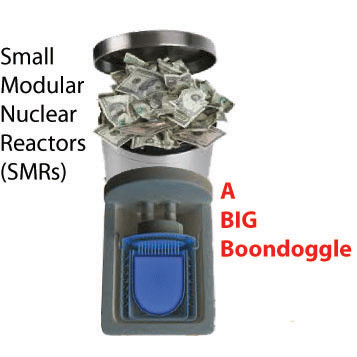 Small Modular Reactors Get Their First Chance In The US, MIT Technology Review, Richard Martin Editor 12 May 16 Small, modular reactors have long been viewed by many in the nuclear power industry as the most promising technology—indeed, as the only realistic path forward—for nuclear power in the United States. In a possible step forward for next-generation nuclear power, the Tennessee Valley Authority is applying for a permit to build one such reactor. Although the specific reactor technology has yet to be determined, the utility could have it running by the mid-2020s……..
The site chosen for the project, on the Clinch River, is notable in the checkered history of nuclear power in this country: it was to be the site of the Clinch River Breeder Reactor, on which more than $1 billion was spent in the 1970s and early 1980s. The project was finally killed by Congress in 1983, and many date the decline of the U.S. nuclear industry to its demise.
President Obama visits Hiroshima. USA builds up its nuclear arsenal
Obama to Make Historic Visit to Hiroshima as U.S. Quietly Upgrades Nuclear Arsenal Democracy Now! | May 12, 2016 President Obama will become the first serving U.S. president to visit Hiroshima, Japan, later this month. The White House said Obama will not apologize for dropping an atomic bomb on the city toward the end of World War II. The attack on Aug. 6, 1945, caused massive and widespread destruction. Shock waves, radiation and heat rays took the lives of some 140,000 people. Three days later, the U.S. dropped a second atomic bomb on Nagasaki, killing another 74,000 people.
President Obama is expected to tour the site of the world’s first nuclear attack with Japan’s prime minister, Shinzo Abe. Obama’s Communications Adviser Ben Rhodes said that Obama’s time in Hiroshima will “reaffirm America’s longstanding commitment—and the president’s personal commitment—to pursue the peace and security of a world without nuclear weapons.”
Obama’s visit comes as a report by the Alliance for Nuclear Accountability has revealed the U.S. has been quietly upgrading its nuclear arsenal to create smaller, more precise nuclear bombs as part of a massive effort that will cost up to $1 trillion over three decades. We speak with Kevin Martin, president of Peace Action…………
Kevin Martin: We’re very glad that the president is going to Hiroshima, but we don’t want it to be just another pretty speech where he talks about some day maybe having the right conditions to move towards eliminating nuclear weapons. He’s done that before. He has some accomplishments to show for his presidency, which we can talk about, but, for now, we want him to go with concrete actions. He’s got a bit of time left in his administration and he needs to take concrete action to further that goal. And we can talk about various steps.
As far as the apology is concerned, the hibakusha, the A-bomb survivors, are not asking for it. The Japanese government is not asking for it—for all kinds of reasons. The administration has ruled it out. And I think while I personally would like to see an apology, what might be more meaningful is if he meets with hibakusha and asks their forgiveness for not doing more during his term in office to move towards the elimination of nuclear weapons. But if he will take some concrete steps, then that apology—or that asking forgiveness would be unnecessary.
Amy Goodman: Can you talk about what you are demanding?
Kevin Martin: First of all, as you just mentioned, this 30-year, $1 trillion cockamamie plan—a colleague of ours called it a “trillion-dollar train wreck”—to totally upgrade all of our nuclear weapons complex, from the research laboratories to new warheads to new missiles, bombers, submarines, I can’t think of a worse misappropriation of our tax dollars. And predictably, every other nuclear-weapon state has followed suit, saying that they are going to upgrade their nuclear weapons, as well. It totally shreds any credibility that the United States has on nonproliferation. So that would be the first thing, is cancel that.
There are a lot of other steps that he could take: taking our nuclear weapons off of hair-trigger alert, separating the warheads from their delivery systems, initiating negotiations for the elimination of nuclear weapons globally, initiating talks on a Middle East zone free of weapons of mass destruction, taking unilateral executive action that doesn’t require a long treaty process—negotiations with Russia and then Senate ratification, which would be very difficult. We could cut our reserve nuclear weapons, get rid of a bunch of those. But even the current deployed nuclear weapons, we could go down to a thousand or fewer, as the Pentagon has suggested in the past and the U.S. actually wanted to do with Russia and then challenge Russia to reciprocate. Those are just some of the steps that would be meaningful and worth a trip to Hiroshima……….https://ecowatch.com/2016/05/12/obama-visit-hiroshima/
USA’s missile defense site in Romania provokes Russian anger
 U.S. activates Romanian missile defense site, angering Russia, Reuters DEVESELU, ROMANIA | BY ROBIN EMMOTT , 12 May 15, The United States switched on an $800 million missile shield in Romania on Thursday that it sees as vital to defend itself and Europe from so-called rogue states but the Kremlin says is aimed at blunting its own nuclear arsenal.
To the music of military bands at the remote Deveselu air base, senior U.S. and NATO officials declared operational the ballistic missile defense site, which is capable of shooting down rockets from countries such as Iran that Washington says could one day reach major European cities……..
When complete, the defensive umbrella will stretch from Greenland to the Azores. On Friday, the United States will break ground on a final site in Poland due to be ready by late 2018, completing the defense line first proposed almost a decade ago.
The full shield also includes ships and radars across Europe. It will be handed over to NATO in July, with command and control run from a U.S. air base in Germany.
Russia is incensed at such of show of force by its Cold War rival in formerly communist-ruled eastern Europe. Moscow says the U.S.-led alliance is trying to encircle it close to the strategically important Black Sea, home to a Russian naval fleet and where NATO is also considering increasing patrols……
Joe Cirincione, an American nuclear expert who is president of Ploughshares Fund, a global security organization, told reporters in Geneva that the shield should be scrapped.
“It was designed to protect Europe from a missile from, well, the only country we were afraid of was Iran. The system was designed to protect against an Iranian nuclear missile. There is not going to be an Iranian nuclear missile for at least 20 years. There is no reason to continue with that program.”…..
Douglas Lute, the United States’ envoy to NATO, said NATO would press ahead with NATO’s biggest modernization since the Cold War. “We are deploying at sea, on the ground and in the air across the eastern flanks of the alliance … to deter any aggressor,” Lute said.
At a cost of billions of dollars, the missile defense umbrella relies on radars to detect a ballistic missile launch into space. Sensors then measure the rocket’s trajectory and destroy it in space before it re-enters the earth’s atmosphere. The interceptors can be fired from ships or ground sites.
The Romanian shield, which is modeled on the United States’ so-called Aegis ships, was first assembled in New Jersey and then transferred to the Deveselu base in containers…….http://www.reuters.com/article/us-nato-shield-idUSKCN0Y30JX
Fort Calhoun nuclear plant no longer makes financial sense – CEO
 OPPD CEO: Shut down Fort Calhoun nuclear plant by end of the year , Omaha.com MAY 12, 2016. By Cole Epley
The Omaha Public Power District would permanently shut down its nuclear power plant at the end of the year under a plan its chief executive is presenting to the utility’s board Thursday.
That means engineers at Fort Calhoun Station would split their last atom in 2016.
Omaha Public Power District President and Chief Executive Tim Burke on Thursday morning is telling the utility’s board of directors it no longer makes financial sense to continue operations at Fort Calhoun…..
The plant’s now-rectified regulatory issues aren’t the reason for the recommendation to power down, though, Burke said. It’s simply become too expensive from a cost-benefit perspective to operate the country’s smallest nuclear plant, he said.
The utility spends $250 million each year to produce energy and maintain facilities at Fort Calhoun.
That’s a hurdle, Burke says, when it comes to achieving its goal of taking rates from about 7 percent below the regional average to 20 percent below that average.
And the utility’s revenues have been falling. First, there is lower demand for electricity as customers move toward energy efficiency. Second, the utility is getting less money for the excess power it generates that it sells on the open market.
Recently, an oversupply of natural gas and increased regional wind energy production has made it increasingly difficult for OPPD to make up for revenue shortfalls associated with flat or falling demand for electricity, Burke said…….
If the board follows through on the recommendation, OPPD’s wind and renewable generation will comprise 49 percent of the portfolio by 2020, up from 38 percent that is currently forecast.
OPPD’s relationship with renewables grew in 2014 when the utility approved a long-term generation plan that included the phase-out some of its coal-burning units, conversion of others to natural gas and added 400 megawatts of wind power from a massive wind farm near O’Neill, Nebraska.
Under the plan presented Thursday, those plans remain intact, but Burke said the most economically viable course is one that does not include nuclear power and effectively ends more than 40 years of nuclear generation…….
Burke said he expects the plant to enter a “cold shutdown” in October of this year, should the board proceed with the recommendation. In a cold shutdown, pressure and temperature conditions within the plant’s nuclear reactor are lowered to a level that prevents a nuclear chain reaction from occurring.
From there, the utility will proceed with various regulatory applications required to decommission the plant. That process includes dismantling the facility, decontaminating it and safely disposing of radiated materials.
Burke said radiated fuel rods likely would remain on the site — there is nowhere else to transport them since a proposed radioactive waste repository at Yucca Mountain in south-central Nevada is still in limbo. For now, radioactive waste from nuclear power plants is stored on-site in concrete casks.
Decommissioning can take 10 years under a process known as Decon, under which the plant is immediately dismantled and contaminated materials are either decontaminated or removed. In a deferred dismantling process known as Safstor, facilities are maintained for a period of up to 60 years and radioactivity decays to a safe level.
OPPD in its 2015 annual report estimated the costs to decommission Fort Calhoun would be about $884 million. The utility has socked away about $373 million for those costs.
The board will take 30 days to consider management’s proposal, during which time it will field concerns and suggestions from stakeholders and ratepayers.
Contact the writer: 402-444-1534, cole.epley@owh.com http://www.omaha.com/money/oppd-ceo-shut-down-fort-calhoun-nuclear-plant-by-end/article_f8b86658-184e-11e6-b852-8f5144170b67.html
Koch brothers and power utilities connive to stop solar power
 The Koch Brothers’ Dirty War on Solar Power All over the country, the Kochs and utilities have been blocking solar initiatives — but nowhere more so than in Florida, Rolling Stone, By Tim Dickinson February 11, 2016 After decades of false starts, solar power in America is finally poised for its breakthrough moment. The price of solar panels has dropped by more than 80 percent since President Obama took office, and the industry is beginning to compete with coal and natural gas on economics alone.
Nuclear safety problems, and high powered guns
 If the nuclear security people have high-powered guns, how long before the terrorists get the, and can then damage the nuclear facilities?
Bigger guns, bigger problems? How high-powered ammunition could affect nuclear power plants May 9, 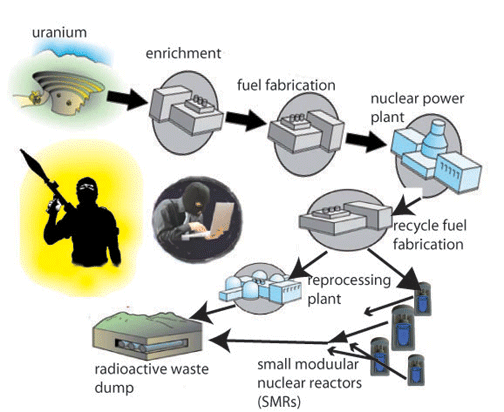 2016 By TERI SFORZA / STAFF WRITER, Orange County Register, Shortly after the horrors of 9/11, a curious package landed on Dave Lochbaum’s desk.
It was flat but heavy. Inside the bubble pack was a battered steel plate, blasted with dents and holes from semiautomatic weapons fire. Each pockmark and perforation was carefully labeled – by hand, in permanent ink – with the type of ammunition used to produce it.
Security forces at San Onofre Nuclear Generating Station and nuclear plants nationwide had increased their firepower to take on a more formidable terrorist threat. The steel plate, sent by a San Onofre security manager, graphically illustrated what Lochbaum, a nuclear engineer, considered a potentially devastating, increased risk:
More powerful ammunition meant to protect nuclear reactors was capable of piercing control panels and critical piping.
The concern doesn’t appear to have been publicly disclosed at the time, but it resurfaced recently after the Nuclear Regulatory Commission allowed nuclear security forces to override state and local gun control laws and possess high-powered weaponry that would otherwise be banned.
Government documents – provided by the Union of Concerned Scientists, a nonprofit watchdog that keeps a critical eye on the U.S. Nuclear Regulatory Commission in Washington, D.C. – offer a rare glimpse intoefforts to secure America’s nuclear power plants that occur out of the public eye and the controversies that can simmer behind the scenes.
Critics maintain that not enough is being done to protect plants and the public. Their issue is not whether those guarding nuclear plants should have high-powered weaponry, but about how much additional security training and hardening of facilities should be required to reduce the risk of collateral damage.
An accidental discharge, friendly fire or all-out firefight during a terrorist attack could potentially cripple a working reactor and release dangerous radiation, experts said.
Risks are different at shuttered plants like San Onofre Nuclear Generating Station because there’s no reactor core to melt down. But millions of pounds of nuclear waste remain on site, cooled and protected by intricate technologies that sit beyond the thick containment domes.
The NRC has allowed San Onofre to dial back its emergency plans because it no longer splits atoms, a move that many critics opposed. Operating nuclear plants must work up detailed responses to four levels of emergency, but San Onofre owner Southern California Edison no longer has to prepare for the worst two.
Nuclear power plant security is a nationwide concern. Nearly one-third of Americans – 96 million – live within 50 miles of such facilities, according to the U.S. Census Bureau………
Plant security must defend against attackers whose goal is to damage or disable safety-related equipment, the letter said. Because such attackers would likely be armed with automatic weapons with high-powered ammunition, the guards must have comparable equipment……..
Concerns remain, however.
“We have upgraded security at America’s nuclear plants and made it much harder for bad guys to cause mayhem, and that’s good,” Lochbaum said. “But there’s all kinds of equipment that could inadvertently be damaged, and not much training on what security officers should try not to hit. ”………http://www.ocregister.com/taxdollars/nuclear-715262-security-nrc.html
The 1964 nuclear bomb exploded in South Mississippi – and its effects
In 1964 a nuclear bomb was detonated in South Mississippi http://www.nola.com/health/index.ssf/2016/05/obama_hiroshima_nuclear_bombin.html By Jed Lipinski, NOLA.com | The Times-Picayune The White House announced Tuesday (May 10) that President Barack Obama later this month will visit Hiroshima, Japan, site of the world’s first atomic bombing. It’s the most familiar nuclear explosion in history, but it’s just one of more than 2,000 such explosions — most of them tests — since 1945.
It happened 2,600 feet underground in 1964, when a 5.3-kiloton bomb, one fourth the size of the bomb used on Hiroshima, was detonated deep inside the Tatum Salt Dome in Mississippi. The Tatum Salt Dome explosion was part of a nuclear test to determine whether the U.S. “had the ability to measure Soviet nuclear tests underground in caves,” reporter Mark Schleifstein wrote in The Times-Picayune in 1990.
“The Defense Department and the Atomic Energy Commission — precursor of the Nuclear Regulatory Commission and the Department of Energy — picked as their test site the Tatum Salt Dome southwest of Hattiesburg,” Schleifstein wrote. “It was huge, about a mile across, and relatively remote. Only about 250 families lived within five miles of ground zero.”
Three more blasts — one nuclear, two non-nuclear — followed over the next four years before researchers decided to abandon the site. Officials would later conduct a a massive clean-up effort, dumping 1.3 million gallons of contaminated water and 10,700 cubic yards of contaminated soil into the cavity.
Workers who participated in the clean-up said they were exposed to high levels of radiation on the job. Bill Teck, the chief of security at the site until 1971, was later diagnosed with skin cancer, which a Veterans Administration pathologist attributed to nuclear radiation.
Today, the Mississippi Department of Environmental Quality conducts annual tests of the surface water at the Tatum Dome to monitor slowly dropping levels of tritium, a mildly radioactive type of hydrogen that can seep into water supplies near nuclear power plants.
Unfolding nuclear disasters in America
Is there any nuclear site in the United States that is not currently collapsing, leaking or otherwise posing a major health or environmental risk? Certainly there are, but that number is becoming smaller and smaller.
In addition to three other nuclear disasters unfolding across the country, a fourth has now arisen. This new disaster is located in Washington state in a facility known as the Hanford site.
One week after 19 workers were sent for medical evaluation as the nuclear waste tank was being transferred because of a leak, 3 more workers are now being reported as injured at the site. According to RT, the workers inhaled radioactive fumes – the same issue facing the 19 previously hospitalized workers. This brings the injured number of workers up to 22…….
Although the facility was decommissioned at the end of the Cold War, the facility has been used to store nuclear waste. In fact, according to RT, two-thirds of America’s radioactive materials are stored at this location which makes it one of the largest facilities of its kind in the world.
The storage tanks which were built as early as 1940 and as late as 1970 contain 56 million gallons of radioactive chemicals.
According Gerry Pollet, a Washington State Representative, those tanks were never expected to last longer than 20 years.
Pollet says,
Twenty years was a dream in the first place. And, as you know, some of them didn’t last 20 years – and we had a small explosion on the 1950s. That hot waste boiled; created a steam explosion under the tank, and we were lucky that we didn’t have half of eastern Washington having to be permanently evacuated.
The company operating the facility acknowledged “higher-than-normal readings for contamination” for a certain tank, but claimed that the readings “well below the alarm level.” RT correspondent Alexey Yaroshevsky traveled to the Hanford site with a Geiger counter.
Yaroshevsky measured the radiation levels of a rock laying well outside of the containment facility and, while the readings were not considered an emergency even the reporter’s handheld device registered a higher-than-normal level of radiation.
Yaroshevsky wondered aloud whether or not the radiation levels closer to the center to the containment facility would be much higher. The reports of the Hanford site leakage now add a West Coast dimension to the nuclear crisis that has escalated in the last few weeks.
In addition to Hanford, reports West Lake Landfill in St. Louis, Missouri which houses sizable amounts of nuclear waste is facing an approaching fire from an adjacent landfill that threatens to turn West Lake into a cauldron of radioactive air pollution. In addition, a nuclear power plant in Turkey Point, Florida is reportedlyleaking polluted water into Biscayne Bay. New York’s Indian Point power plant is also threatening to become a major radioactive incident. Constant leaks, mishaps and other signs of an outright collapse have existed at Indian Point for quite some time but have increased in frequency over the last year . http://www.naturalblaze.com/2016/05/is-this-the-4th-recent-nuclear-disaster-to-strike-the-u-s.html

US lawmakers concerned about possible drone attacks on nuclear facilities
Defense Bill Has Nuclear Facilities Fighting Drones http://www.defensenews.com/story/defense/policy-budget/congress/2016/05/07/defense-bill-has-nuclear-facilities-fighting-drones/83931328/ Joe Gould, Defense News May 7, 2016 WASHINGTON — As US regulators grapple with the safety, privacy and national security concerns posed by a boom in the use of recreational drones, lawmakers worried about their use for malicious ends have advanced legislation aimed at letting Defense Department and Energy Department facilities defend themselves against them

That is a very aggressive approach, and one we have yet to see in federal regulations,” energy and infrastructure attorney Roland Backhaus, with the firm Pillsbury Winthrop Shaw Pittman, said of the bill.
While the US Federal Aviation Administration has yet to report any serious incident involving a drone at a nuclear facility, fears and speculation have been fueled by a commercial quadcopter’s crash landing on the White House lawn last year, and a Massachusetts man’s guilty plea in 2012 to plotting attacks on the Pentagon and US Capitol building with an explosive-laden model plane.
Drones reportedly buzzed nuclear facilities around France 32 times over two months in 2014, according to a report commissioned by Greenpeace, sparking concern the country’s nuclear reactors are unsafe from aerial assaults and jangling nerves in other nations about the potential threat.
Unmanned aerial systems (UAS) small enough to elude radar could be used “by criminals and terrorists” to attack or spy on “critical government and industrial facilities,” according to a Jan. 27 Congressional Research Service report. “Somewhat larger UAS could be used to carry out terrorist attacks by serving as platforms to deliver explosives or chemical, biological, radiological, or nuclear weapons,” said the report, by aviation policy specialist Bart Elias.
Taking no chances given the devastation that could be wrought at such a facility, House Armed Services Committee (HASC) strategic forces subcommittee chairman Mike Rogers, R-Ala., included the two counterdrone provisions in the 2017 NDAA, which the HASC approved April 28.
“The bottom line is the members are tracking the increased prevalence and sophistication of unmanned aerial systems around the country, and they understand the threat these can pose to certain defense facilities,” said a congressional staffer.
DoE has 10 active sites across the country that handle the US arsenal of nuclear weapons and material, while DoD controls nuclear missile fields, silos, underground storage and maintenance, as well as nuclear reactors for training and research.
The massive defense policy bill has several hurdles before it becomes law. The language would have to survive a vote on the House floor and reconciliation with the Senate bill due later this month. The reconciled bill will face a vote in both houses of Congress and must be signed by the president.
Under the bill’s mandate for DoD, the defense secretary would develop a means to disrupt, seize, confiscate, control, disable or destroy drones deemed a threat to facilities related to nuclear deterrence, missile defense or the national security space mission.
For DoE, personnel and contractors who think a drone presents “a threat to people, property, or classified information” at a facility that stores or uses special nuclear material would be allowed to “mitigate the threat from, disable, interdict, interfere with” its operation. It varies by DoE facility, but most are operated by private contractors, and physical security is generally provided by third-party companies.
Lawmakers don’t mean to encourage the shooting down of drones, and while the bill permits DoE to do it, its language discourages the use of force in favor of “appropriate escalation,” saying “non-kinetic responses should be utilized when feasible to mitigate a threat.”
An FAA spokesman declined to comment on the pending legislation, but had this to say:
“Generally, shooting at any aircraft — including unmanned aircraft — poses a significant safety hazard. An unmanned aircraft hit by gunfire could crash, causing damage to persons or property on the ground, or it could collide with other objects in the air.”
The legislation comes as federal agencies have been waiting for the FAA to carve out security-based rules for drones, a step mandated by law in 2013. In the meantime, an FAA notice strongly advises pilots of airplanes and drones to avoid — and not “circle or loiter” in — the airspace of critical infrastructure, such as power plants, military bases and prisons.
Washington nuclear waste site’s huge spike in radiation levels
TV: EPA data reveals “sharp spike in radiation level” around US nuclear site — “It’s been reportedly leaking huge amounts of radioactive materials for more than 2 weeks” — Evacuations enacted… Almost 50 workers have sought medical attention… Symptoms include bleeding ulcers, burned lungs (VIDEOS) http://enenews.com/tv-epa-data-reveals-sharp-spike-radiation-level-around-nuclear-site-leaking-huge-amounts-radioactive-materials-2-weeks-evacuations-enacted-almost-50-workers-sought-medical-attention-symtoms-incl?utm_source=feedburner&utm_medium=email&utm_campaign=
KING 5 News, May 5, 2016 (emphasis added): Record number of Hanford workers sickened by toxic vapors — An unprecedented number of workers at Hanford have been exposed to dangerous chemical vapors since Thursday, April 28. In one week’s time a total of 47 people either sought medical attention… Symptoms reported by workers include a headache, burning nose and throat, nausea, a metallic taste in the mouth, elevated blood pressure, and dizziness… [T]hose familiar with the nuclear site cannot remember so many people falling victim in such a short period… On May 4, two more evacuations were enacted at the site after workers smelled odors and experienced symptoms… “Forty-two employees have been evaluated as a precautionary measure due to reported odors or symptoms at the on-site medical facility since Thursday. Thirty-one employees reported health symptoms while 11 went for cautionary reasons. All have been released to return to work” said Rob Roxburgh of the Dept. of Energy, in a statement sent to KING 5 on Wednesday. Chemical vapor releases at Hanford come from underground nuclear waste storage tanks that vent the gasses without warning.
RT, May 7, 2016: Spike in radiation levels after toxic waste leak at Washington nuclear site — Radiation levels at the Hanford, Washington nuclear waste site have spiked to “elevated risk” after thousands of gallons of toxic waste leaked in April… The recent readings from the Environmental Protection Agency (EPA) obtained by RT have revealed that a sharp spike in the radiation level had been registered in Richland on the morning of May 5. The readings show the random jump when the toxic fume rates briefly reached around 410 CPM (counts per minute), nearly the highest possible level… As of Friday afternoon, there have been no media reports suggesting that an evacuation or other measures and guidance have been ordered for Richland… The most recent radiation spike comes less than a month after a massive leak was first detected…
RT transcript, May 5, 2016: On Thursday last week at least 19 workers at the Hanford nuclear site were hospitalized after inhaling poisonous fumes, from tasting metal in their mouth tobleeding ulcers and burned lungs.
RT transcript, May 3, 2016: At the Hanford nuclear site in Washington state… more workers sought medical attention after inhaling radioactive fumes. This adds to 19 workers hospitalized last week for the same reason — reinforcing burning concerns about the facility as it’s been reportedly leaking huge amounts of radioactive materials for more than 2 weeks… [Tom Carpenter, Executive Director of Hanford Challenge:] “It’s an environmental disaster, at some point the [Columbia] River becomes so contaminated that you can’t use the river.”… Ecologists say the situation can always get worse. They hate to think what would happen in case of even a minor earthquake in a geologically unstable area that it is. But even in the current state of thingswith tanks leaking nuclear poison into the environment, Hanford is already way past the ticking time bomb stage.
RT transcript, May 2, 2016: [Tom Carpenter, Executive Director of Hanford Challenge:] “A second double-shelled nuclear waste tank is showing signs of having failed, you find that out because there’s high radiation levels in between the two shells of the tank. There should be no radiation in that space… but instruments they have deployed there show high radiation levels,plutonium, cesium, strontium-90, etc. – well where did that come from? It probably came from the tank, meaning there’s a hole.”… So we’re looking at potentially a catastrophe, a disastrous catastrophe? [Carpenter:] “Every day we’re looking at that at Hanford – I’m totally serious.”
RT transcript, Apr 21, 2016: ‘Washington state nuke plant leaks thousands of gallons of toxic waste‘… Experts say it’s time for every American to be worried.
Government -run Tennessee Valley Authority (TVA) to sell Alabama Nuclear Complex at a big loss
 Feds To Sell Alabama Nuclear Complex,Losing 99% Of Investment, The Daily Caller , 6 May 16 ANDREW FOLLETT Energy and Environmental Reporter
The government-run Tennessee Valley Authority (TVA) voted Thursday to sell off the Bellefonte nuclear power plant in Alabama for about $36.4 million — after the agency invested $6 billion in the project that produced no electricity.
“Our analysis of the property and its potential uses, and input from public officials, customers and Valley residents, indicate that offering the property for sale could better serve the public,” Bill Johnson, the TVA’s president, told the Times Free Press…….
For the last 40 years, the TVA has tried to build two new nuclear reactors at Bellefonte, even completing the majority of the work on both of them. The agency invested $6 billion in the site before construction was shut down. The new property appraisal estimates the site and its facilities will sell for a mere $36.4 million.
Other nuclear reactors around America have suffered similar fates. Vermont and Wisconsin both lost nuclear plants due to competition from cheap natural gas and the San Onofre reactor in California was shut down due to safety concerns, as was the Crystal River reactor in Florida. The world’s largest nuclear plant operator, Électricité de France, withdrew from a joint venture in 2013 due to falling power prices after it had invested billions. If the venture had gone through, it would have created three new American nuclear plants………http://dailycaller.com/2016/05/06/feds-to-sell-alabama-nuclear-complex-losing-99-of-investment/
Nuclear station- never completed – now to be sold at big loss
Never-Completed TVA Nuclear Plant That Cost $4B for Sale http://abcnews.go.com/US/wireStory/completed-tva-nuclear-plant-cost-4b-sale-38910893 By TRAVIS LOLLER, ASSOCIATED PRESS NASHVILLE, Tenn. — May 5, 2016 The nation’s largest public utility is selling a never-completed nuclear plant that has cost more than $4 billion dollars over the past four decades.
The Tennessee Valley Authority board voted Thursday to declare the Bellefonte nuclear plant near Hollywood, Alabama, surplus. The site includes two partially finished nuclear reactors, office buildings, warehouses, parking areas, railroad spurs and a helicopter pad.
TVA President and CEO Bill Johnson said after the meeting that the 1,600 acre site has been appraised at $36 million. It will be sold at auction to the highest bidder, but the utility will consider job creation and economic impact when looking at potential buyers. “There will have to be a positive impact for the community for us to qualify you as a bidder,” he said
The decision to sell is the latest blow to the nuclear power industry, which seemed poised for resurgence a decade ago but has been stymied by cheap natural gas, high construction costs and relatively flat demand for power.
TVA recently completed construction of its long mothballed Watts Bar Unit 2 reactor in Spring City, which was first started in 1979 and then restarted in 2008. The reboot ran about $2 billion over budget and took about three years longer than anticipated.
Board member Eric Satz cited that experience in concluding that completing Bellefonte is not economically viable. He said a lot has changed in the energy market in the past 40 years, including huge improvements in energy efficiency and renewable energy technology.
And he said TVA should allow the Bellefonte site to be developed so the people of Hollywood “don’t live in limbo for the next 40 years.”
A recent TVA study concluded that the utility will not need any new large-scale facilities that can generate electricity 24 hours a day for at least 20 years.
The board met Thursday at Paris Landing State Park in Buchanan.
Widespread concern about Nuclear Reactor Baffle Bolt Problems
 Nuclear Reactor Baffle Bolt Problems Are Widespread Concern, POWER, 05/04/2016 | Aaron Larson Public Service Enterprise Group (PSEG) anticipates extending Salem Nuclear Generating Station’s Unit 1 refueling outage, which began on April 14, so it can inspect, repair, and replace damaged baffle bolts within the plant’s reactor vessel, according to information presented in the company’s first quarter earnings announcement.
A PSEG spokesperson told POWER that visual inspections at Salem had identified 18 of the metal insert liner’s 832 baffle-former bolts exhibit degradation, which means they had at least some indication of cracking. The news comes roughly a month after inspections at the Indian Point nuclear plant determined that 227 of its Unit 2 baffle-former bolts were degraded.
“As part of our license renewal commitments to the Nuclear Regulatory Commission [NRC], Salem Unit 1 was scheduled to conduct ultrasonic testing of the baffle bolts in 2019. Based on the visual inspections, we made the decision to conduct ultrasonic testing of the bolts now to determine the full extent of condition and to make appropriate repairs,” the PSEG spokesperson said.
Problems in Europe
It’s the first time that Salem has identified any problems with baffle bolts on either unit, but it is far from the first time for the industry. As far back as the 1980s, cracking was identified in French pressurized water reactor (PWR) baffle bolts.
In March 1998, the NRC issued an Information Notice to alert U.S. PWR license holders of the cracking found in reactor vessel internal baffle-former bolts at “several foreign PWRs.” The intent of the notice was to inform recipients of the problem so they could consider actions to avoid similar troubles. The suggestions in the notice were not necessarily requirements, however.
Are There More Potential Problems?
Neil Sheehan, public affairs officer for NRC Region I, told POWER that all U.S. PWRs—of which, there are currently 65 licensed to operate—utilize baffle plates as part of their reactor core internals. The baffle plates help direct water up through the nuclear fuel assemblies………
The NRC is still weighing the significance of the recent inspection findings. It expects analysis performed by both Entergy and PSEG will help in its assessment. http://www.powermag.com/nuclear-reactor-baffle-bolt-problems-are-much-more-widespread/?pagenum=2
Exelon nuclear corporation demands tax-payer bailout for its uneconomic power plants
 Exelon to Close Two Nuclear Plants if Needs Aren’t Met, WSJ By AUSTEN HUFFORD May 6, 2016 Exelon Corp. said Friday that it would close two nuclear power plants in Illinois if state officials don’t pass legislation that provides funding and support for nuclear and solar power.
The company said it would close its Clinton, Ill., nuclear power plantand its Quad Cities nuclear power plant, which is based nearCordova, Ill., if Illinois doesn’t pass “adequate legislation” by the end of the month.
Electricity producers in several states are asking for hundreds of millions of dollars in financial support to keep costly nuclear power plants in business. If successful, the legislation is likely to increase customers’ power bills……..
Abe Scarr, Director of Illinois PIRG, a public interest advocacy organization that fights against “powerful interests,” said the bill amounted to a nuclear bailout.
“Ratepayers have paid multiple times for these plants over the decades,” Mr. Scarr said. “We should be investing in the energy generation for the future. We should not be doubling down on an energy source of the past that is not competitive.”
According to Exelon, Clinton and Quad Cities have lost more than $800 million over the past six years.
In a release Thursday, Exelon said some nuclear plants are at risk of closing because wholesale energy prices are at a 15-year low……http://www.wsj.com/articles/exelon-to-close-two-nuclear-plants-if-needs-arent-met-1462544157
Global danger in transporting nuclear wastes by plane
 Whether it is transported by sea, or even by air, there is real concern over the potential for an accident or a malicious attack that would put the public at risk.
How many nuclear weapons could be made if such material got into the wrong hands? Why risk global nuclear security by transporting this waste across the Atlantic by air?
We call for this deal to be cancelled forthwith. The waste should be stored on-site at Dounreay and not moved over 6,000 miles away.
UK-US air transports of high enriched uranium: global security at risk for commercial gain, Ecologist Ernie Galsworthy / NFLA 3rd May 2016 Planned air transports of high-enriched uranium from Dounreay in Scotland to the US state of Tennessee would risk of accident or a terrorist seizure of weapon-usable nuclear material. The motive for the transport appears to be purely commercial – and would thus put the public at needless risk for the sake of a cut-price nuclear waste / fuel deal between US and UK authorities.
There has been a recent flurry of media reports suggesting that a proposed transport of radioactive materials from the Caithness Dounreay site to the United States could be sent by plane. Continue reading
-
Archives
- October 2026 (129)
- September 2026 (339)
- August 2026 (330)
- July 2026 (355)
- June 2026 (287)
- May 2026 (306)
- April 2026 (356)
- March 2026 (251)
- February 2026 (267)
- January 2026 (308)
- December 2025 (358)
- November 2025 (359)
-
Categories
- 1
- 1 NUCLEAR ISSUES
- business and costs
- climate change
- culture and arts
- ENERGY
- environment
- health
- history
- indigenous issues
- Legal
- marketing of nuclear
- media
- opposition to nuclear
- PERSONAL STORIES
- politics
- politics international
- Religion and ethics
- safety
- secrets,lies and civil liberties
- spinbuster
- technology
- Uranium
- wastes
- weapons and war
- Women
- 2 WORLD
- ACTION
- AFRICA
- Atrocities
- AUSTRALIA
- Christina's notes
- Christina's themes
- culture and arts
- Events
- Fuk 2022
- Fuk 2023
- Fukushima 2017
- Fukushima 2018
- fukushima 2019
- Fukushima 2020
- Fukushima 2021
- general
- global warming
- Humour (God we need it)
- Nuclear
- RARE EARTHS
- Reference
- resources – print
- Resources -audiovicual
- Weekly Newsletter
- World
- World Nuclear
- YouTube
-
RSS
Entries RSS
Comments RSS

