Threat of Nuclear EMP Attack on Electric Grid
Government, Industry Studying Threat of Nuclear EMP Attack on Electric Grid
High-altitude nuclear blast would cause widespread power outage, Washington Free Beacon BY: Bill Gertz May 19, 2016 American power companies are studying ways to protect electric grids against a high-altitude nuclear blast and other directed energy attacks that could severely disrupt electricity transmission, an industry representative told a Senate hearing Wednesday.
Scott Aaronson, managing director for cyber and infrastructure security at the Edison Electric Institute (EEI), stated in testimony that a consortium of U.S. electric companies is working with the Energy Department to study how to protect power grids from a nuclear blast-produced electromagnetic pulse attack or solar flares that could damage transformers and other electric components and shut down power for millions of Americans……
The hearing was called to examine threats to critical infrastructure ranging from cyber attacks and criminal activities to terrorist sabotage and nation state nuclear attacks.
Aaronson, whose institute represents all investor-owned U.S. electric companies, said in testimony that electromagnetic pulse is a concern and could be caused by a high-altitude nuclear blast or a directed energy weapon.
The Electricity Subsector Coordinating Council, a group of chief executives from 21 electric companies and nine major industry associations, is working with the Energy Department to examine the threat. Aaronson, the council’s secretary, stated that the threat study is based on research done by the Pentagon and national laboratories……..http://freebeacon.com/national-security/government-industry-studying-threat-nuclear-emp-attack-electric-grid/
Solar energy jobs growing, as oil industry jobs decline
 There Will Be More New Jobs in Solar Than Oil by the End of the Year,Fortune by Jonathan Chew @sochews APRIL 20, 2016, Indeed just released this startling info on energy jobs.
The world’s biggest oil companies are slashing jobs to cope with decreasing revenues, and one knock-on effect has been the drop in oil job postings.
Conversely, however, if the current pace of postings hold, solar would become the largest market for energy jobs by the fourth quarter of 2016, according to numbers tabulated by Indeed, the world’s highest traffic job site…….
Tara Sinclair, chief economist at Indeed. “Whether or not solar overtakes oil on Indeed, energy workers would do well to position themselves for work in renewable fields such as solar, wind, and hydroelectricity.”
This corresponds with a recent report by The Solar Foundation that highlighted the rapid growth of the U.S. clean energy sector. By the end of this year, the solar sector should have 240,000 workers under its wings, and currently employs around 77% more workers than the coal mining industry……http://fortune.com/2016/04/20/solar-oil-jobs-indeed/
The role of renewable energy in slowing climate change
Surge in renewable energy stalls world greenhouse gas emissions Falling coal use in China and the US and a shift towards renewable energy globally saw energy emissions level for the second year running, says IEA, Guardian, John Vidal, 17 March 16, Falling coal use in China and the US and a worldwide shift towards renewable energy have kept greenhouse gas emissions level for a second year running, one of the world’s leading energy analysts has said.
Preliminary data for 2015 from the International Energy Agency (IEA) showed that carbon dioxide emissions from the energy sector have levelled off at 32.1bn tonnes even as the global economy grew over 3% .
Electricity generated by renewable sources played a critical role, having accounted for around 90% of new electricity generation in 2015. Wind power produced more than half of all new electricity generation, said the IEA.
The figures are significant because they prove to traditionally sceptical treasuries that it is possible to grow economies without increasing climate emissions.
“The new figures confirm last year’s surprising but welcome news: we now have seen two straight years of greenhouse gas emissions decoupling from economic growth. Coming just a few months after the landmark COP21 agreement in Paris, this is yet another boost to the global fight against climate changem” said IEA director, Fatih Birol…….
A seperate report by the European Environment agency (EEA) shows that the EU-wide share of renewable energy has increased from 14.3% in 2012 to 15% in 2013. This allowed the EU to cut its demand for fossil fuels by 110m tonnes of oil equivalent in 2013. This, said the EEA, is the equivalent of a gross reduction of CO2 emissions of 362m tonnes in 2013. http://www.theguardian.com/environment/2016/mar/16/surge-in-renewable-energy-stalls-world-greenhouse-gas-emissions?CMP=share_btn_tw
Emotional plea from Former Prime Minister Junichiro Koizumi in support of U.S. sailors, victims of radiation
Tearful Koizumi backs U.S. vets suing over 2011 nuclear disaster THE ASAHI SHIMBUN CARLSBAD, California, 19 May 16, –Former Prime Minister Junichiro Koizumi broke down in tears as he made an emotional plea of support for U.S. Navy sailors beset by health problems they claim resulted from radioactive fallout after the 2011 nuclear disaster.
More than 400 veterans who were part of a mission called Operation Tomodachi to provide humanitarian relief after the Great East Japan Earthquake and tsunami filed a mass lawsuit in California against Tokyo Electric Power Co., operator of the crippled Fukushima No. 1 nuclear plant. They are seeking compensation and an explanation for their health problems.
Koizumi, 74, responded to a request from a group supporting the plaintiffs and flew to the United States to meet with 10 veterans.
At a news conference here on May 17, Koizumi said: “U.S. military personnel who did their utmost in providing relief are now suffering from serious illnesses. We cannot ignore the situation.”……
Some of the plaintiffs in the lawsuit were crew members of the nuclear-powered aircraft carrier USS Ronald Reagan, which anchored off the Tohoku coast to provide relief along the battered coastline.
Theodore Holcomb, an aviation mechanic on the flattop, was tasked with washing down U.S. helicopters that had operated in areas with high radiation. He was later diagnosed with synovial sarcoma, a rare form of cancer. He died in 2014 at age 35.
The Department of Veterans Affairs later cut off a study into the causal relationship between his exposure to radiation and his illness.
His best friend in the Navy, Manuel Leslie, 41, now is one of the plaintiffs in the lawsuit on behalf of Holcomb.
Leslie said he just wants the truth to come out for his friend.
Another crew member, Ron Wright, 26, worked on the deck. After finishing his shift one day, he was forced to remove his clothes after a high radiation reading. Subsequently, he developed a swelling of the testicles and underwent surgery four times after he returned to the United States. However, the pain was so intense that he had to rely on painkillers and sleeping pills.
A military doctor told him there was no relationship between his illness and exposure to radiation.
Wright said he was never given protective clothing or iodine during the mission. He also said he had no knowledge of radiation at the time.
According to the ship’s logs and the testimony of former crew members, sailors aboard the Ronald Reagan may well have been exposed to radiation as the carrier passed under a radiation plume that was generated by the Fukushima accident. In addition, the carrier used desalinated seawater for drinking and showers by crew members……… This article was written by Masato Tainaka and Ari Hirayama. http://www.asahi.com/ajw/articles/AJ201605190065.html
From soldier to climate change fighter – Solar Ready Vets
Solar Ready Vets Transforms US Military Into Climate Change Fighters, Clean Technica, May 18th, 2016 by Tina Casey
At least 190,000 veterans are expected to transition out of the US military each year over the next several years, and the federal program Solar Ready Vets is gearing up to match them with solar jobs. The Energy Department has just announced that it is adding five more military bases to the program’s roster of solar training locations. The agency will also pour $10 million into 10 new training projects that will help rev up the solar industry’s ability to absorb new workers.
Solar Jobs And A Smooth Transition
Solar Ready Vets was launched in 2014 as a pilot program to help the rapidly growing US solar industry recruit enough skilled workers to meet the demand. The idea is to establish the training programs on bases and begin the training process before veterans end their military service, so they can enter the civilian workforce as seamlessly as possible.
Each base is paired with a local community college or other solar training provider, leveraging the existing framework of the GI Bill.
The training is available to active duty personnel who are within six months of leaving the service. To sweeten the pot, there is no charge to for the training program.
The program aims at all aspects of the solar industry, including sales and management as well as installation and other technical positions.
Apparently Solar Ready Vets was a success. It has already graduated 250 trainees and, from an initial five bases, this week it doubled in size to include 10 bases. The new ones are:
Camp Pendleton in California – U.S. Marine Corps
Fort Carson in Colorado – U.S. Army
Naval Station Norfolk in Virginia – U.S. Navy
Hill Air Force Base in Utah – U.S. Air Force
Fort Drum in New York – U.S. Army
These are the existing ones:
Joint Base McGuire-Dix-Lakehurst in New Jersey – U.S. Air Force, Army, and Navy
Eglin Air Force Base in Florida – U.S. Air Force
Marine Corps Base Hawaii – U.S. Marine Corps
Joint Base San Antonio in Texas – U.S. Air Force and Army
Fort Bragg in North Carolina – U.S. Army…….http://cleantechnica.com/2016/05/18/solar-ready-vets-transforms-us-military-climate-change-fighters/
Growing opposition in both Canada and USA to nuclear waste dumping near the Great Lakes
Opposition to the project, though, has swelled. More than 180 county boards, city councils and other local elected bodies near the Great Lakes in both countries have passed proclamations urging a veto of the plan.

Plan to store nuclear waste near Great Lakes proves radioactive, WP By Steve Friess May 16 KINCARDINE, Ontario — If there was an off-key moment during the otherwise flawlessly executed trip to the U.S. Capitol this spring by the new Canadian prime minister, Justin Trudeau, it might have come when he was cornered by Rep. Debbie Dingell.
“We never want to see nuclear waste in the Great Lakes,” the freshman Democrat from Michigan sternly told Trudeau during a visit to the office of House Minority Leader Nancy Pelosi (D-Calif.). Continue reading
Big doubts about Bill Gates’ enthusiastic claims for nuclear power
Nuclear Power: Part of the Alternative Energy ‘Solution’? Differing views voiced by Microsoft founder Bill Gates and Stanford energy expert Yale Climate Connections, Mark Z. Jacobson, May 16, 2016 By Peter Sinclair
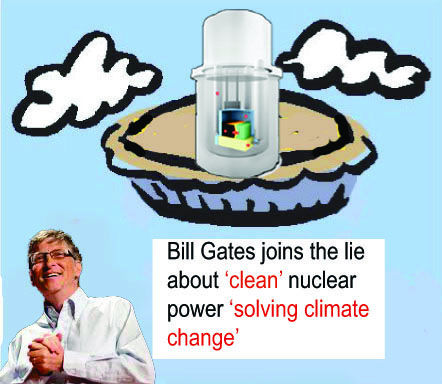 “………..“If everything goes perfectly,” Gates has told a Wall Street Journal conference, a demonstration fourth-generation design could be in place by 2022. “If everything continues to go perfectly,” that design could be replicated and built in many countries around the world by 2028.
“Big Ifs,” some might say, and a moderator suggested as much in response to Gates’ point.
In this month’s “This is Not Cool” video, Stanford University engineering professor Mark Z. Jacobson expresses reservations. His research looks at energy technologies in hand and not those he says “might be available 20, 30 years from now.” That research – as explained in an earlier related video – involves wind, solar, and water power.
To reach global carbon dioxide emissions targets, Jacobson says, 80 percent of the world’s energy infrastructure needs to be converted by 2030 and 100 percent by 2050.
Jacobson says exiting nuclear power may be cleaner than natural gas, but it is nine to 25 times more polluting per kilowatt hour generated than wind power in terms of carbon and air pollution. In addition, about 40 percent of that difference results from a need to continuously mine and refine uranium during the life time of the nuclear power plant. He says the “sole purpose” of two coal-fired power plants in the U.S. now is to refine uranium for nuclear energy and weapons.
While Gates expresses optimism about fourth-generation nuclear power technology and safety, Jacobson counters that 1.5 percent of all nuclear reactors built worldwide “have melted down seriously. So there’s a catastrophic risk problem.” A world wanting to go fully nuclear – and currently having 400 850-megawatt nuclear reactors – would need 16,000 850-megawatt reactors.
Jacobson points to relative costs as the key determinant. Unsubsidized current costs are about 12.5 cents per kilowatt hour; for wind 3.2 to 5 cents per kilowatt hour; for thin film solar 5 to 6 cents per kilowatt hour; and for utility-scale crystalline solar 5.2 to nearly 7 cents per kilowatt hour. Big differences, he says. http://www.yaleclimateconnections.org/2016/05/nuclear-power-part-of-the-alternative-energy-solution/Nuclear
America’s Nuclear Regulatory Commission set to exempt nuclear corporations from safety costs and liabilities

 US nuclear industry’s plan thanks to NRC: let taxpayers carry the can for closed power plants, Ecologist Linda Pentz Gunter13th May 2016 With five reactors closed in the last three years, the US nuclear industry is in shutdown mode, writes Linda Pentz Gunter – and that means big spending on decommissioning. But now the nuclear regulator is set to exempt owners from safety and emergency costs at their closed plants – allowing them to walk away from the costs and liabilities, and palm them onto taxpayers.
Aging and dangerous nuclear power plants are closing. This should be cause for celebration. We will all be safer now, right? Well, not exactly.
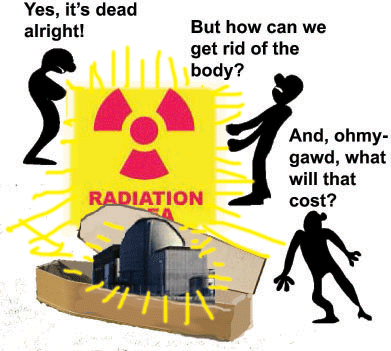 US nuclear power plant owners are currently pouring resources into efforts to circumvent the already virtually non-existent regulations for the dismantlement and decommissioning of permanently closed nuclear reactors.
And sad to say, many on the US Nuclear Regulatory Commission (NRC), the industry’s ever compliant lapdog, are trotting happily by their side.
There is an occasional lone critic. NRC Commissioner Jeff Baran, observed that the“NRC does not currently have regulations specifically tailored for this transition from operations to decommissioning. As a result, licensees with reactors transitioning to decommissioning routinely seek exemptions from many of the regulations applicable to operating reactors.”
The inevitable result is that reactor owners will successfully avoid spending money now on decommissioning as they seek to delay beginning the actual cleanup work for the next half century and maybe longer. Later, when it comes time to finish the job, the owners – and the money – could well be long gone.
US reactor owners rely on ‘decommissioning trust fund’ investments to pay for decommissioning activities. But these are failing to accrue adequate funds to do the job. Many of the trusts are incurring annual losses on their investments.
In fact, the US Government Accountability Office (GAO) has found the NRC’s financing formula for decommissioning trust funds to be fundamentally flawed, resulting in the utilities ability to accrue only 57% to 75% of the needed funds……..http://www.theecologist.org/News/news_analysis/2987679/us_nuclear_industrys_plan_thanks_to_nrc_let_taxpayers_carry_the_can_for_closed_power_plants.html
The options for decommissioning a nuclear plant
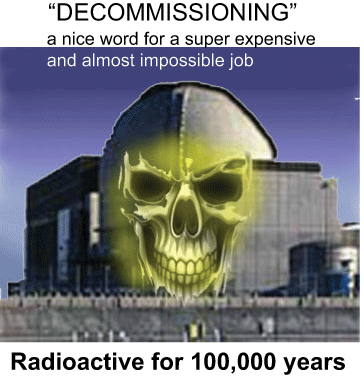 US nuclear industry’s plan thanks to NRC: let taxpayers carry the can for closed power plants, Ecologist Linda Pentz Gunter13th May 2016 “…….There are currently three decommissioning options when a reactor closes. They are known by apparent acronyms that are really just capitalized slogans, masking the flaws behind all three.
DECON refers to prompt dismantlement. This sounds promising for all sides, dispensing with the whole decommissioning process and its attendant costs, headaches and liabilities in about 10 years.
In principle DECON is supported by environmental and anti-nuclear groups, but with one giant caveat: the radioactive waste that remains on site after decommissioning of the reactor, must be adequately safeguarded.
Under the current regulatory scheme, the NRC allows the licensee to offload the irradiated nuclear fuel from the spent fuel storage pools into dry storage casks. These are not adequately protected from security threats. Nor is there any contingency to re-contain nuclear waste should it begin leaking from one of these casks.
Current casks designs are qualified for on-site nuclear waste storage for only 20 years and re-certified for four additional cycles. Some of these cask designs have already experienced degradation of protective seals and concrete shielding after less than a decade of use.
Of greatest concern, the casks are situated outside, closely congregated, on open tarmacs raising security concerns for their vulnerability to attack.
Consequently, the anti-nuclear and environmental groups that support DECON insist on the implementation of enhanced security called ‘Hardened On-Site Storage’, or HOSS to minimize these risks.
Rather than storing dozens of vulnerable dry-casks right next to each other in the open air, HOSS better secures the nuclear waste in above-ground individualized casks. These casks are fortified within modules of concentric capped silos of concrete and steel surrounded by earthen mounds.
The HOSS canisters would be dispersed over a wider area than traditional cask storage and would be better positioned to withstand a range and combination of weapons, explosives, and attacks, including anti-tank missiles, aircraft impacts, and car bombs.
Currently, reactor owners are not permitted to spend decommissioning funds on nuclear waste management as part of the DECON process. Nor do utilities want to go to the added expense of HOSS, which is not currently being considered by federal agencies, despite hundreds of petitioning groups and thousands of signatories to make HOSS a nuclear security priority at operating reactors as well as decommissioned sites.
A small number of reactors across the world have already used DECON (but without HOSS.) According to the Paris-based Organization of Economic Cooperation and Development, of the nearly 150 nuclear power reactors that have ceased operation worldwide to date, only 16 units have completed the ‘DECON’ decommissioning process with 10 of those units in the United States taking on average 10 years to complete.
What ‘SAFSTOR’ really means: ‘mothball’ and walk away
The second option, euphemistically-named SAFSTOR, or ‘safe store’, allows owners to take up to 60 years from the day the reactor closes to complete decommissioning. This would effectively enable owners to delay the start of decommissioning for 50 years, leaving the reactor and fuel pools mothballed until then and the local communities at risk.
Unsurprisingly, this is the option that is increasingly favored by reactor owners, who are petitioning the NRC for across-the-board cost cutting under SAFSTOR, regardless of the specific conditions of the individual reactor sites.
Entergy Vice President, Michael Twomey, even told Vermont state legislators in reference to the decommissioning of its Vermont Yankee nuclear reactor, that if the process is not complete in 60 years the company is fully within its rights to simply walk away, and if challenged, would litigate. Vermont Yankee closed on December 29, 2014.
The third option is ENTOMB. Without any regulatory guidance or legal framework, it allows utilities to essentially avoid decommissioning altogether. It is the option when no other options exist, as is the case at Chernobyl.
The exploded Chernobyl containment was eventually shrouded in a giant concrete sarcophagus at great expense and resulting in radiological exposure to hundreds of thousands of laborers. That structure is now being encased with a new, high-tech “Arch”, again at vast expense. However, for regular decommissioning activities, ENTOMB should be viewed as a last resort and not as a strategy for escaping liability.
Waste management is nuclear power’s most painful Achilles’ heel
The waste management aspect of the decommissioning process remains the industry’s most painful Achilles’ heel. Despite successfully suing the Department of Energy for failure to remove the waste, as promised, to a final repository site, utilities are seeking to avoid using those funds for waste management.
Instead, utilities are seeking to siphon off decommissioning trust funds to build and manage the necessary on-site Independent Spent Fuel Storage Installation (ISFSI) to house irradiated fuel from a closed reactor. An ISFSI is not currently considered part of a legitimate decommissioning process covered by the trust fund.
The delays wrought by such wrangling means that irradiated fuel sits in densely packed storage pools inside the reactor – and in the case of the 30 remaining GE Mark I and II reactors in the US, on the roof. (The GE designs are the same as those that melted down and exploded at Fukushima.)
The fuel pools are over-packed because of inadequate existing on-site storage facilities. But delays in offloading them, even while the reactor is still running, never mind when it closes, represent one of the greatest risks to public health, safety and security. A catastrophic fire, aircraft impact or other disaster that released vast amounts of radioactive fallout from the high-density storage pools could contaminate entire regions potentially indefinitely.
“The four ongoing disasters at Fukushima Daiichi have clearly shown the vulnerability of nuclear power plants that have spent nuclear fuel stored in these overcrowded and unprotected spent fuel pools”, Gundersen wrote in his comments to the NRC.
Fuel pools at closed US nuclear plants are a Fukushima waiting to happen
This is the principle reason to oppose SAFSTOR, safety experts say. Not only will the fuel remain in the pools, and in poorly protected waste casks, but protections and safety measures will be reduced. This is already exemplified in Vermont where the NRC has allowed Entergy to dismantle its emergency plan around Vermont Yankee and reduce inspections on the ventilation system near the spent fuel pool.
As Gundersen points out, the Vermont Yankee fuel pool still “contains more highly radioactive waste than was held in any of the fuel pools at Fukushima Daiichi.”
With a Fukushima-scale disaster is a real possibility even at closed reactors, critics are urging the NRC not to rubber stamp exemption requests. In the event of a nuclear catastrophe, evacuations downwind and downstream cannot be assumed to go well if emergency preparedness was discontinued months, years, or even decades earlier.
Even plans for site cleanup and decontamination are inadequate and have been watered down by the NRC itself. Site release criteria currently mandate clearing away surface soil down to three feet. But strontium-90 has been found far deeper on the Vermont Yankee site already. The NRC limit would open the way for strontium and potentially other isotopes resting deeper than three feet to migrate down into groundwater and potentially later to drinking water.
Instead, there should be more thorough post-decommissioning environmental analyses of where and how much residual radioactivity has been left behind in soil and water before power companies are allowed to walk away from accountability and liability.
To do decommissioning right, Gundersen argues that the state ratepayers should control decommissioning funds not the utility, because it is their money.
And, he says, decommissioning should be undertaken in such a way that operators “assure that those plants are promptly and safely decommissioned without unwarranted radiological contamination of the environment and extended cleanup and mitigation costs passed on to ratepayers or taxpayers.”
Linda Pentz Gunter is the international specialist at Beyond Nuclear, a Takoma Park, MD environmental advocacy group. http://www.theecologist.org/News/news_analysis/2987679/us_nuclear_industrys_plan_thanks_to_nrc_let_taxpayers_carry_the_can_for_closed_power_plants.html
Protestors demand shut-down of radiation leaky Florida Nuclear Station
 Demonstrators Demand Nuclear Plant Shut Down After Radiation Leaks May 14, 2016 MIAMI (CBSMiami) — Dozens of protesters demonstrated outside of a Florida Power & Light facility concerning leaks at the nuclear power plant at Turkey Point.
It took place Saturday morning at 4200 W. Flagler Street and comes after the company announced that customers will shell out an estimated $50 million this year alone for the cleanup of hypersaline water coming from the plant.
Environmental advocates are worried that theleaking wastewater containing radioactive isotopes is a threat to drinking water from the Biscayne aquifer.
They want the Turkey Point Nuclear Generating Station shut down.
“When our bay goes acidified, when our fish start dying, which they already are, and when are habitat goes away because of this wonderful Turkey Point plant that we have, which is a reactor that came online in 1972, an outdated reactor, it’s time to retire,” said protester Albert Gomez.
Others believe FPL is hiding something.
They’re not coming clean with what’s really going on at Turkey Point and their deceptive behavior on the solar initiatives. They sabotaged the citizen’s solar initiative and they got this scam solar amendment on the ballot in November. It’s a fake,” said Steve Malagodi, president of 350 South Florida, a group dedicated to climate change issues…….http://miami.cbslocal.com/2016/05/14/demonstrators-demand-nuclear-plant-shut-down-after-leaks/
Fears that South Carolina is to become a nuclear waste import hub
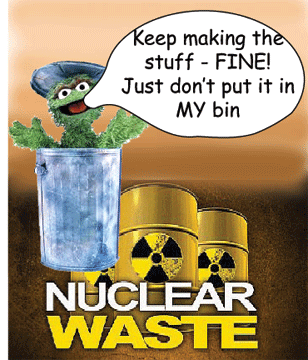 Not only are tons of highly radioactive waste still stored at SRS, the federal government continues to ship nuclear material from foreign nations to the site
Don’t let SRS serve as nuclear dump site, Post & Courier, May 15 2016
The U.S. Department of Energy made some serious promises to South Carolina when it needed a place to bring tons of highly radioactive plutonium back in 2002. And now the DOE wants to renege in nearly every way.
State officials are right to fight it all the way down the line.
Last month, DOE lawyers went to court to insist that the agency isn’t liable for a $100 million penalty owed to South Carolina for the DOE’s failure to remove nuclear waste from Savannah River Site on schedule. The federal agency contends that the agreement with the state was based on goals, not mandates.
The DOE says that its agreement with the state isn’t binding even though it is codified in federal law. In that view, the feds don’t have to pay a penalty for failing to live up to the deal’s requirement to turn weapons grade plutonium into commercial reactor fuel or to send the plutonium elsewhere.
No one who observed the intense stand-off between South Carolina and the federal government over its plans to send 34 tons of weapons grade plutonium to Savannah River Site would characterize those requirements as optional.
At the time, state leaders strongly opposed the plan, having reasonably concluded from past experience that the federal government would be more than willing to shift its nuclear waste problems permanently to South Carolina.
At one point, then-Gov. Jim Hodges threatened to stand in the middle of the highway to stop nuclear material from being trucked into South Carolina. He also ordered the S.C. National Guard to close the highways to waste shipments, if necessary.
Those histrionics were intended to underscore the state’s resolve not to willingly permit Savannah River Site to become the nation’s nuclear waste dump.
The crisis passed after the federal government pledged that the nuclear waste would be neutralized and shipped out of state on a firm timetable.
If that agreement allayed the fears of state officials in then, the situation now only intensifies the skepticism by which the DOE’s promises should be viewed in South Carolina.
Not only are tons of highly radioactive waste still stored at SRS, the federal government continues to ship nuclear material from foreign nations to the site…….http://www.postandcourier.com/20160515/160519614/dont-let-srs-serve-as-nuclear-dump-site-
True costs of nuclear-generated electricity hidden for decades
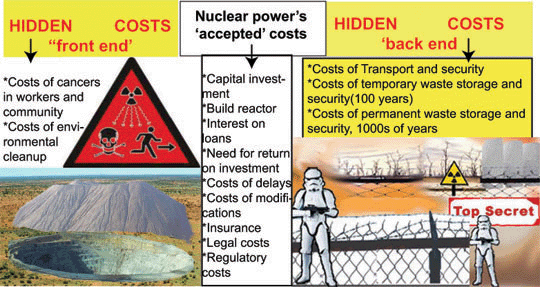
US nuclear industry’s plan thanks to NRC: let taxpayers carry the can for closed power plants, Ecologist Linda Pentz Gunter13th May 2016 “…….Using Vermont Yankee (a relatively small 620 MWe reactor) as an example, the decommissioning cost estimate in 2015 was $1.2 billion and rising. At the same time, Entergy, the plant’s owner, had just $625 million on hand.
In early May, Entergy was reprimanded (but not fined) by the NRC for violating “federal regulations last year when it prematurely took money out of the Vermont Yankee decommissioning trust fund to cover planning expenses associated with the handling of spent nuclear fuel at the closed reactor”, the Times Argus reported.
Another factor in the current struggle to pay for decommissioning is rooted in a decades-long practice by utilities of omitting the costs of decommissioning from electricity bills in order to artificially lower rates and stay competitive in the market.
Rather than preserve decommissioning trust funds for actual decommissioning work, utilities are now asking the NRC to let them raid the funds for activities outside the parameters of the reactor decommissioning process. These activities include the payment of taxes and the protracted management of orphaned nuclear waste left on site.
In addition, while at the same time delaying the start of decommissioning, the utilities have requested and received exemptions from the NRC that allow them to eliminate radiological emergency planning and drastically reduce on-site security around hundreds of tons high-level nuclear waste, all in the name of saving money.
“The Nuclear Regulatory Commission appears to be complicit in this process and is in fact providing a significant hidden subsidy to the nuclear industry when it looks the other way by allowing public trust funds to be raided in violation of the Code of Federal Regulations”, writes Arnie Gundersen of Fairewinds Associates in a document submitted to the NRC.
Gundersen, along with other groups including my own – Beyond Nuclear – have filed comments to the NRC as part of an arcane and convoluted process known as an ‘Advanced Notice of Proposed Rulemaking on Decommissioning.’ The public comment period closed on March 18, 2016.
A years long Rulemaking is underway because reactor owners are asking to streamline what were site-specific exemptions and have them issued generically instead, and across the board, without any opportunity for public review or comment. This essentially eliminates public transparency in the decommissioning process.
It further seeks to save the corporation from spending any of its electricity production profits on the costs of safety and security oversight the companies claim are no longer needed once the reactor stops power production and is defueled………..http://www.theecologist.org/News/news_analysis/2987679/us_nuclear_industrys_plan_thanks_to_nrc_let_taxpayers_carry_the_can_for_closed_power_plants.html
Radium and Lead contaminate rivers From Thousands of Fracking Wastewater Spills
Duke Study: Rivers Contaminated With Radium and Lead From Thousands of Fracking Wastewater Spills. EcoWatch Sharon Kelly, DeSmogBlog | May 9, 2016 Thousands of oil and gas industry wastewater spills in North Dakota have caused “widespread” contamination from radioactive materials, heavy metals and corrosive salts, putting the health of people and wildlife at risk, researchers from Duke University concluded in a newly released peer-reviewed study.
High levels of lead—the same heavy metal that infamously contaminated water in Flint, Michigan—as well as the radioactive element radium, were discovered near spill sites. One substance, selenium, was found in the state’s waters at levels as high as 35 times the federal thresholds set to protect fish, mussels and other wildlife, including those that people eat.
The pollution was found on land as well as in water. The soils in locations where wastewater spilled were laced with significant levels of radium and even higher levels of radium were discovered in the ground downstream from the spills’ origin points, showing that radioactive materials were soaking into the ground and building up as spills flowed over the ground, the researchers said.
The sheer number of spills in the past several years is striking. All told, the Duke University researchers mapped out a total of more than 3,900 accidental spills of oil and gas wastewater in North Dakota alone……. http://ecowatch.com/2016/05/09/radium-lead-fracking/
Degrading panel at Pilgrim Nuclear Power Station’s spent fuel pool
Report: Panel at Pilgrim degrading Problem in spent fuel pool described as ‘slow to develop’ Cape Cod Times, By Christine Legere May 14, 2016
PLYMOUTH — One of the panels designed to absorb neutrons and prevent a nuclear reaction called fission from occurring in the spent fuel rods stored in the Pilgrim Nuclear Power Station’s spent fuel pool has deteriorated, according to a report submitted by Entergy Corp. to federal regulators yesterday.
Fission would cause the rods to heat up the same way they do in a nuclear reactor. The heat would cause the water in the pool to boil and evaporate. If exposed, the rods could start a fire and release radiation.
Neil Sheehan, spokesman for the Nuclear Regulatory Commission said degradation of the panels has been a known problem for decades and one experienced by a number of nuclear plants……..It takes as little as four fuel assemblies to begin a nuclear chain reaction. Currently the racks in Pilgrim’s pool hold 3,300 spent fuel assemblies……..
The storage pools at nuclear plants, particularly older ones like the 43-year-old Pilgrim, were designed to hold spent fuel rods short term. Pilgrim’s pool was designed for about 800 assemblies. Assemblies were on large racks that relied on large spacing, about 20 inches between the spent fuel assemblies to maintain sub-critical conditions.
But as the solution to long-term storage continued to be elusive, the pools had to accommodate many more rods than “Because of the federal government’s problem to provide a disposal site for irradiated fuel, tens of thousands of tons of irradiated fuel remains where it was produced,” said David Lochbaum, director of nuclear safety for the Union of Concerned Scientists. “Spent fuel pools have been re-racked with storage racks holding irradiated fuel very close together, often closer than when it is in the reactor core. In the core, there are control rods to prevent criticality. In the spent fuel pools, other methods must be used to protect against criticality.
Solutions to the problem include the use of borated water or the insertion of sleeves containing boron over defective panels.
At this point, there is no time frame for a solution at Pilgrim. http://capecodtimes.com/article/20160513/NEWS/160519684
Unexpectedly, California Public Utilities Commission re-opens case of ratepayers funding Dan Onofre nuclear shutdown
 Public Utilities Commission reopens San Onofre case, Admits they “undermined public confidence in the agency”, San Diego reader By Don Bauder, May 9, 2016 In a surprise move, the California Public Utilities Commission today (May 9) reopened the 2014 agreement by which ratepayers got stuck with $3.3 billion of costs related to the sudden closing of the San Onofre nuclear plant. It became known as “the rape of the ratepayer” because management errors, such as those causing the San Onofre shutdown, should be charged to shareholders, not ratepayers.
The utilities regulator also banned all ex parte (one-sided) meetings with decision-makers or commissioners. As representatives of ratepayers expressed shock, past secret meetings between brass of Southern California Edison and commissioners came to light, clearly showing that the decision to plunk the burden of paying for San Onofre on ratepayers was reached through a series of clandestine, unreported meetings.
Up to now, ex parte meetings have been permitted as long as they were quickly revealed to all parties. The announcement today referred to the most infamous of those meetings — a Warsaw, Poland, huddle between former CPUC president Michael Peevey and Edison executive Stephen Pickett at which Peevey essentially sketched the strategy for fleecing ratepayers. The secret huddle was in 2013 and Edison did not report it until 2015. The commission in December noted eight such violations by Edison. This clandestine coziness “undermined public confidence in the agency,” said the commission today — a laughably euphemistic way of stating the situation…….http://www.sandiegoreader.com/news/2016/may/09/ticker-utilities-commission-reopen-san-onofre-case/#
-
Archives
- October 2026 (129)
- September 2026 (339)
- August 2026 (330)
- July 2026 (355)
- June 2026 (287)
- May 2026 (306)
- April 2026 (356)
- March 2026 (251)
- February 2026 (267)
- January 2026 (308)
- December 2025 (358)
- November 2025 (359)
-
Categories
- 1
- 1 NUCLEAR ISSUES
- business and costs
- climate change
- culture and arts
- ENERGY
- environment
- health
- history
- indigenous issues
- Legal
- marketing of nuclear
- media
- opposition to nuclear
- PERSONAL STORIES
- politics
- politics international
- Religion and ethics
- safety
- secrets,lies and civil liberties
- spinbuster
- technology
- Uranium
- wastes
- weapons and war
- Women
- 2 WORLD
- ACTION
- AFRICA
- Atrocities
- AUSTRALIA
- Christina's notes
- Christina's themes
- culture and arts
- Events
- Fuk 2022
- Fuk 2023
- Fukushima 2017
- Fukushima 2018
- fukushima 2019
- Fukushima 2020
- Fukushima 2021
- general
- global warming
- Humour (God we need it)
- Nuclear
- RARE EARTHS
- Reference
- resources – print
- Resources -audiovicual
- Weekly Newsletter
- World
- World Nuclear
- YouTube
-
RSS
Entries RSS
Comments RSS

