Continuing nuclear waste leak at Hanford
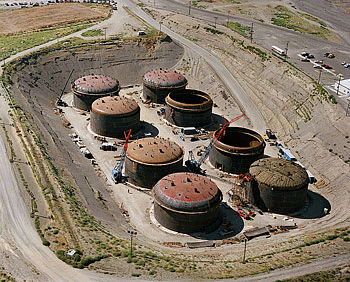 Nuclear Waste Leak Continues at ‘America’s Fukushima“ https://weather.com/news/news/nuclear-waste-leak-continues
The government has requested help from private contractors to construct a new, permanent facility that will have the capacity to hold the waste. However, the project to cover up “America’s Fukushima” will cost an estimated $100 billion and take at least 50 years to complete, according to Newsweek. 33 Left Ill by Radioactive Fumes By Andrew MacFarlane weather.com May 4 2016 A nuclear waste leak at the Hanford Site in Washington state that rapidly intensified last month has left 33 workers ill from possible exposure to chemical vapors, while others scramble to pump the remaining waste out of the storage facility.
Back in 2011, a leak was found on the inner hull of one of the site’s 28 double-wall storage tanks. The previous leak posed an insignificant threat, but workers came across an even larger leak in recent weeks while attempting to clear the inner hull of its remaining waste.
The number of those who have been reported ill as a result of the leak climbed into the 30s after six workers sought medical evaluation Monday, suspecting exposure to radioactive fumes left them unwell, according to the Tri-City Herald. A majority of the affected have been cleared to return to work, but voice a fear of suffering from long-term or neurological sickness.
Crews at the United States Department of Energy’s storage site in Hanford were alerted by leak detection alarms the morning of April 17, and after lowering a camera into the affected area, the staff found 8.4 inches of radioactive and chemically toxic waste had poured between the inner and outer walls of the tank, KING 5 reported.
This is catastrophic,” former site employee Mike Geffre said soon after the leak was found. “This is probably the biggest event to ever happen in tank farm history. The double-shell tanks were supposed to be the saviors of all saviors.”
However, a State Representative in Seattle argued that the of the 56 million gallons of radioactive chemicals stored at the Hanford site, two-thirds of the total substance is radioactive waste being held in unfit tanks made sometime between 1940 and 1970.
The tanks “were not supposed to last more than 10 to 20 years, 20 years was a dream in the first place,” Gerry Pollet told RT.com. “Some of them didn’t last twenty years and we had a small explosion in the 1950s where hot waste boiled, created a steam explosion under the tank, and we were lucky we didn’t have half of Eastern Washington permanently evacuated.”
The large puncture causing the devastating leak is thought to have occurred while the three-week long pumping was taking place. An estimated 20,000 gallons of waste remain in the 800,000-gallon AY-102 tank, Q13 FOX reports.To make matters worse, a second double-shelled tank has been reported with a leak. AY-101, a tank very similar to AY-102, has had “higher-than-expected radioactivity readings” from the tank’s continuous air monitor, according to a recent KING 5 report. The new leak is an unsettling find, considering the 45-year-old AY-101 was built with thicker steel and with advanced construction methods.
“Simply put, Hanford is nearly out of double-shell tank space,” said Hanford Challenge executive director Tom Carpenter. “[There] is no other realistic option but to begin building new tanks immediately.”
Nuclear Regulatory Commission to re-analyse costs of potential impact of severe accident At Indian Point
 NRC reverses decision on Indian Point accident analysis, Westfair By Ryan Deffenbaugh May 5, 2016 Federal regulators used the wrong data to analyze the potential impact of a severe accident at Indian Point Energy Center and will have to redo the study, a panel of commissioners with the Nuclear Regulatory Commission ruled Wednesday.
The commission reversed an earlier administrative ruling and found that the NRC analysis of the costs of a severe accident at the Buchanan nuclear facility relied on incorrect data, in violation of the National Environmental Policy Act. The decision directs NRC staff to redo its analysis using other sources of data.
“While typically we decline to second-guess the [Atomic Safety and Licensing Board] on its fact-specific conclusions, here the decision contains obvious material factual errors and could be misleading, warranting clarification,” NRC officials wrote in the decision.
The NRC study was challenged by New York Attorney Eric Schneiderman, who said it systematically undercounted the costs and impacts associated with severe reactor accidents at Indian Point.
His office put out a statement Wednesday applauding the ruling.
“The commissioners’ decision requires the NRC staff to do what should have been done years ago: provide an accurate account of cost-effective upgrades at this aging nuclear plant that can prevent or minimize severe accidents,” Schneiderman said. “While some might prefer to treat severe accidents as impossibilities, the millions of people who live and work near Indian Point deserve nothing less than a full and fair assessment of the plant upgrades needed to protect them against such accidents.”……..
The federal licenses for both Indian Point’s reactors have expired and Entergy has applied for a 20-year renewal from the NRC. Gov. Andrew Cuomo has fought against the renewal, arguing that Indian Point’s location in a densely populated area makes it unsafe. He reiterated that view in a statement following the NRC’s decision Wednesday.
“Clearly, this facility poses too great a risk to the millions of people who live and work nearby,” Cuomo said. “We will work closely with NRC staff and continue to monitor Indian Point’s daily operations to ensure that a proper analysis is done regarding any unacceptable dangers to ensure that the public is protected at all times.”http://westfaironline.com/79195/nrc-reverses-decision-on-indian-point-accident-analysis/
Respiratory diseases, radioactive fumes – concerns in St Louis County, USA
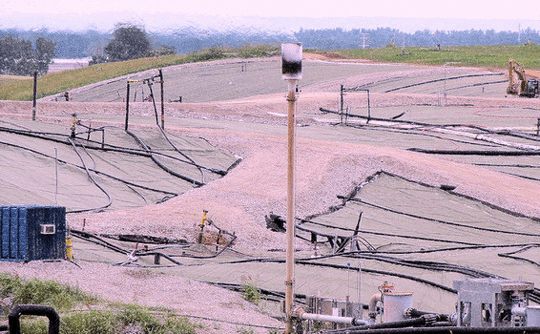 AIR POLLUTION, ATOMIC RISKS GROW AS TOXIC DUMP SMOLDER , URBAN NEWS SERVICE, Part 2 of a 2 part series. For part 1 visit “Near Ferguson, Ghosts of Hiroshima Haunt Fuming Landfill“.
BRIDGETON, Missouri – They can’t breathe.
Residents of this community near Ferguson — site of 2014’s police-involved shooting death of teenager Michael Brown — have complained for years about lung troubles caused by toxic fumes tied to radioactive waste linked to the atomic bombs that flattened Hiroshima and Nagasaki.
Missouri’s Department of Health and Senior Services will release a study in June to gauge these concerns. Many here call this step positive, small and too late; a slow-moving, subterranean landfill fire that began in 2010, could boost the site’s toxic-gas emissions.
Some locals have been diagnosed with cancer, which they connect to nuclear waste illegally dumped at the West Lake Landfill by the Cotter Corporation in 1973. This radioactive refuse is from World War II’s top-secret Manhattan Project.
Thanks to these conditions, residents who seek government-assisted relocation feel abandoned. Lengthy fights over who ultimately should control the site have slowed cleanup efforts……..
The Centers for Disease Control and Prevention is reportedly investigating the issue following a September 2014 study by Missouri’s health department. It found that, between 1996 and 2011, the ZIP codes around the landfill included statistically significant, higher incidences of leukemia plus cancers of the colon, prostate, kidney, bladder and brain.
“[The] recent study by St. Louis County is actually the first time that a government entity has asked people if they feel ill,” said Laura Barrett, executive director for the Center for Health, Environment and Justice…….
A 1988 Nuclear Regulatory Commission study revealed that its inspectors discovered in 1974 that the Cotter Corporation — which agreed to buy the atomic refuse from the federal government and dispose of it — mixed this waste with 39,000 tons of topsoil. Cotter illegally covered the West Lake Landfill with this irradiated earth in 1973, according to the nuclear agency’s report.
“It’s not in barrels. Some of it’s mixed in the soil and the garbage,” said Chapman. “Some of it’s just lying on the surface for over 40 years, and none of us knew about this.”……https://urbannewsservice.com/investigations/air-pollution-atomic-risks-grow-toxic-dump-smolder/
Leaked TTIP documents cast doubt on EU-US trade deal
Greenpeace says internal documents show US attempts to lower or circumvent EU protection for environment and public health, Guardian, Arthur Neslen , 2 May 16, Talks for a free trade deal between Europe and the US face a serious impasse with “irreconcilable” differences in some areas, according to leaked negotiating texts.
The two sides are also at odds over US demands that would require the EU to break promises it has made on environmental protection.
President Obama said last week he was confident a deal could be reached. But the leaked negotiating drafts and internal positions, which were obtained byGreenpeace and seen by the Guardian, paint a very different picture………
Jorgo Riss, the director of Greenpeace EU, said: “These leaked documents give us an unparalleled look at the scope of US demands to lower or circumvent EU protections for environment and public health as part of TTIP. The EU position is very bad, and the US position is terrible. The prospect of a TTIP compromising within that range is an awful one. The way is being cleared for a race to the bottom in environmental, consumer protection and public health standards.”
US proposals include an obligation on the EU to inform its industries of any planned regulations in advance, and to allow them the same input into EU regulatory processes as European firms.
American firms could influence the content of EU laws at several points along the regulatory line, including through a plethora of proposed technical working groups and committees.
“Before the EU could even pass a regulation, it would have to go through a gruelling impact assessment process in which the bloc would have to show interested US parties that no voluntary measures, or less exacting regulatory ones, were possible,” Riss said……. https://www.theguardian.com/business/2016/may/01/leaked-ttip-documents-cast-doubt-on-eu-us-trade-deal
USA’s Energy Det program ‘Orange Button’ will bring down costs of solar power
Department of Energy Program Aims to Bump Solar Costs Even Lower A clean energy initiative goes beyond declining hardware costs to address the remaining barriers to embracing solar over fossil fuels. Inside Climate News BY DAVID J. UNGER MAY 2, 2016 While the solar industry trumpets the rapidly declining costs of solar panels—which have paved the way for solar energy capacity in the U.S. to GROW NEARLY TWENTY-FOLD SINCE 2008—those numbers don’t account for all the costs involved in the transition to clean energy. That is why a new government initiative aims to slash the overall price tag by better managing the reams of data associated with financing, building and operating solar installations.
The U.S. Department of Energy’s (DOE) Orange Button, a $4 million program launched earlier this month, seeks to streamline what experts say can be a costly, complicated and time-consuming path to bringing more solar panels online. By developing an easily downloadable, standardized set of data about individual solar installations, the DOE hopes to lower the bureaucratic barriers—as well as the excessive costs—that discourage investors, utilities and consumers from embracing solar.
Orange Button is part of the DOE’s SunShot Initiative, which launched in 2011 with the goal of making solar energy cost competitive with coal, natural gas and other traditional sources of electricity such as nuclear and hydroelectric power. If SunShot reaches its goal of reducing utility solar costs to $1 per watt by 2020, it will enable solar-generated power to expand from less than 2 percent of the nation’s electricity generation portfolio to roughly 14 percent by 2030 and 27 percent by 2050, according to the program’s vision study.
Similar programs have already been launched in other industries. The DOE’sGreen Button was launched in 2012, allowing utility customers to download standardized, consumer-friendly data about their energy usage. The Department of Health and Human Services’ Blue Button program offers people help accessing and transferring their health records.
Part of the challenge for solar is a lack of information. Compared to housing and other well-established markets, solar is relatively new, so banks, utilities, solar companies and other constituencies do not have a standardized set of metrics to share. The U.S. energy market has 18,000 jurisdictions and 3,000 utilities in regulated and unregulated markets, so navigating its idiosyncrasies costs time and money, said Elaine Ulrich, program manager at the DOE.
“When you look at the cost of financing for these solar projects, it’s artificially high,” Ulrich told InsideClimate News. “Solar is a long-term asset that has pretty well-known characteristics, but it’s treated as a higher-risk asset because there isn’t sufficient data available to help folks in the financial industry to know how to assess the risk of [a] portfolio of assets.”…….http://insideclimatenews.org/news/02052016/department-energy-program-aims-bump-solar-costs-even-lower
Parents near nuclear plant concerned about evacuation plans
I-TEAM: WAKE COUNTY PARENTS QUESTION SECRETIVE NUCLEAR EVACUATION PLAN abc Eyewitness News, By Jon Camp, 5 May 16, NEW HILL, N.C. (WTVD) —
That’s what parents living near the Harris Nuclear Plant want to know about their children’s schools. 23 schools are less than 10 miles from the Shearon Harris nuclear powerplant. If those schools had to evacuate, where would the kids go? The school system knows, but the parents don’t, and they asked the I-Team to get answers, tonight at 5:30
Robke lives in one of the many neighborhoods within the 10-mile Emergency Planning Zone around the Harris plant. It’s located in New Hill, N.C. about 20 miles south of Raleigh. Like her neighbors, Robke has never been told by the school system what the plan would be if anything were to go wrong at the nuclear facility.
That’s because in Wake County the plans are secret. A spokesperson for the school system emailed the reasoning:
“Apex Friendship High School does have an evacuation plan in place to respond to an emergency situation at Shearon Harris Power Plant. Wake County government oversees the emergency planning and response for those situations. Our part of the emergency response plan is outlined in the Wake County Public School System- Emergency Operations Plan. Since it contains sensitive safety information, it is not a public record. FEMA has reviewed and approved our emergency response plans.”
State law expressly prohibits schools from making emergency plans public. It’s spelled out in North Carolina’s educational statutes. Still, some parents say that’s little comfort.
Robke’s neighbor, Chris Young remembers getting potassium iodide pills from the school system and county about 15 years ago and says she can’t remember hearing from the schools since.
“What’s going to happen if something happens during a school day?” Young wanted to know. “What are the parents supposed to do? What are their kids supposed to do? The school system should be providing the parents with some kind of information.”
There are 23 schools from four districts in the 10-mile Emergency Planning Zone around the nuclear plant. The EPZ represents the area folks are most at risk of plume exposure in a disaster. The risk zone for ingestion exposure goes out to 50 miles.
Radiation from Santa Susana Field Laboratory in California causing cancers, but this is hushed up

 Compensation denied to US nuclear workers to hush up Santa Susana radiation dangers – fmr employee Rt.com 3 May, 2016 Cancer-struck workers at the Santa Susana Field Laboratory in California have been denied state compensation in order to keep the danger posed by the nuclear site to nearby residential areas out of the public eye, a former employee told RT.Hundreds of workers at the nuclear and aeronautical facility in Simi Valley, which was instrumental in the US space program from 1949 to 2006, have died or fallen ill due to exposure to radiation.
However, when those people applied for compensation in accordance with a US government program, their claims were denied, McClatchy DC reported. The Department of Energy (DOE) explained the refusal by saying that the sick employees were unable to prove that they had worked in ‘Area IV’ at Santa Susana.
Only staff from this section are eligible for compensations as ‘Area IV’ was the location of nuclear reactor experimentations and development, according to the Department of Labor, which is responsible for making payments.
The workers argue that their “fluid” contracts allowed for them to be regularly dispatched to the radioactive section, but the government failed to maintain records of their movements.
The lawyers believe that laboratory staff should not prove their presence in Area IV at all as DOE contractors used the entirety of the site. Former Santa Susana employee, William Shepler, who suffers from skin cancer and anxiety problems, was among those, who were denied their pay.
The management of Boeing, which acquired the California facility in 1996, made the decision to leaving sick and dying people without compensation because “they don’t know anything,” he told RT.
“And I think the DOE, probably, made a decision for Boeing and just told Boeing: ‘We know what to do and we’ll go along with it’,” the nuclear worker stressed.
The authorities “want to keep this small” because of the danger posed by the radioactive site, he explained.
“There are civilians living in Simi Valley and in the canyons near Santa Susana. And even in the [San Fernando] Valley. The evidence is there – there are high rates of rare cancers that are above the norm in the US,” Shepler stressed.
The situation would become “unmanageable” for DOE if the truth about the threat posed by the nuclear lab was made public, he added.
Since all reactors were considered experimental, they did not have containment structures, causing radiation leaks. “Santa Susana had no containment vessels. Chernobyl was like Santa Susana, I don’t believe it had containment for radiation,” the nuclear worker said……..
According to the 1997 Epidemiologic Study to Determine Possible Adverse Effects, Santa Susana Field Lab workers showed higher rates of some cancers.
The study said that from 1988 through 1995, the rate of some types of cancer was more than 60 percent greater among those residents living within 2 miles of the field lab than among people living within 5 miles. These people suffered more from thyroid, upper digestive tract, bladder, and blood and lymph tissue cancers. https://www.rt.com/usa/341636-us-nuclear-workers-compensation/
What’s Wrong with The Bill Gates Nuclear Vision? Well, a lot, actually
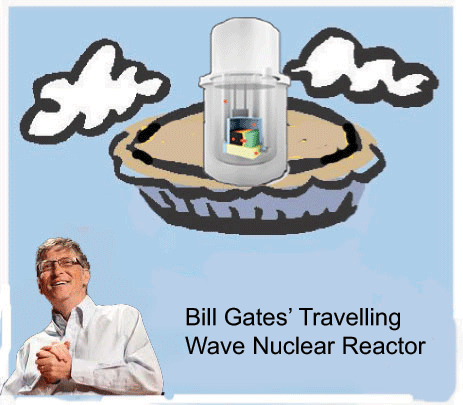 Bill Gates Still Trying To Corral The “Wild” Nuclear Unicorn, Clean Technica May 3rd, 2016 by Tina Casey Legendary tech billionaire Bill Gates has been pitching the idea that nuclear energy is the only technology that can be deployed quickly enough to ward off catastrophic global warming. However, Gate’s favored nuclear technology is not nearly ready to come off the drawing board. Meanwhile, solar, wind, and other clean technologies are already sweeping into the real world.
Nevertheless, Gates continues to soldier on. In the latest development, he made the case for a nuclear energy “miracle” to the readers of MIT Technology Review.
The Bill Gates Nuclear Vision
One should expect an ultra-savvy marketer like Bill Gates to come up with a far-reaching strategy for his nuclear vision, and he has. In 2006 he formed a nuclear company called TerraPower with the aim of providing the world with “a more affordable, secure and environmentally friendly form of nuclear energy.”
Gates bumped his strategy up to the next level in December 2015. In a splashy media event coordinated with the COP21 Paris climate talks, he launched a new investment group called the Breakthrough Energy Coalition.
BEC was designed as private sector companion to Mission Innovation, which also launched at COP21. Mission Innovation is a coalition of energy-producing governments that have pledged to increase public sector investment in clean energy.
Given Gate’s interest in TerraPower’s success, we’re thinking that BEC is also designed to deflect investment toward nuclear. Although Gates has positioned BEC as source-neutral, in a blog post during COP21 he laid down a pretty big hint that nuclear was the way to go:
The renewable technologies we have today, like wind and solar, have made a lot of progress and could be one path to a zero-carbon energy future. But given the scale of the challenge, we need to be exploring many different paths—and that means we also need to invent new approaches.
What’s Wrong With A Little Nuclear Energy?
Joe Romm of Think Progress has picked apart Gates’s most recent pro-nuclear pitch, concluding that:
…Gates is just wrong about everything here. He is wrong that energy miracles are needed by the industrialized countries to achieve CO2 levels in 2050 consistent with beating the 2°C target. He is wrong that achieving that target requires focusing on R&D rather than deployment. He is wrong that there is some sort of consensus to that effect. He is wrong that a carbon price isn’t important in achieving the rapid reduction the rich countries need. He is wrong to make it seem like boosting energy efficiency is not as vital a strategy as reducing carbon intensity.
Ouch!
Romm’s basic point is that clean energy solutions are already here and now, just not in the form that Gates would prefer to invest in.
The solar industry, of course, is one place where you’ll find a lot of agreement with Romm. One example is the graphic above, which represents the winnowing-out process used by the company Siva Power to settle on its market-ready thin film solar technology.
Last December, Siva CTO Markus E. Beck, a recognized leader in thin film technology, shared some thoughts with CleanTechnica about Gates’s nuclear solution. He emphasized that solar insiders are not the only skeptics:
The Breakthrough Energy Coalition’s premise is flawed. The BEC argues that at present there are no workable solutions to tackle the world’s increasing need for energy while reducing carbon emissions at an affordable level. Studies by Goldman Sachs, MIT, McKinsey, the IEA, Shell and others provide data supporting a counter argument — i.e. the solutions exist: namely solar (PV) and wind.
Tough Row To Hoe For Nuclear Energy
We’ll give the last word on TerraPower to the Senior Editor of MIT Technology Review, Richard Martin.
In a brief but eyebrow-raising article last fall, Martin raised some questions aboutTerraPower’s choice of nuclear technology, the traveling wave reactor. Apparently, after spending a considerable amount of time and money on traveling wave R&D, the company has modified its course and is now experimenting with a molten chloride design:
Many nuclear industry observers have been skeptical about the concept from the outset. The traveling wave is a subspecies of a sodium-cooled fast reactor, and the track record of those reactors is not encouraging.
Martin also cites M.V. Ramana, a Princeton nuclear physicist:
“The problem with sodium is that it has been pretty much impossible to prevent leaks… Fast reactors in general have never been commercially viable, and I haven’t seen anything from TerraPower that suggests that their design will fare any better………..http://cleantechnica.com/2016/05/03/bill-gates-still-trying-corral-wild-nuclear-unicorn/
City of San Diego’s bi-partisan plan for 100% renewable energy
San Diego is not waiting for Washington to get its act together on climate change. The southern California city is moving forward with an ambitious plan to run on 100% renewable energy and cut greenhouse gas emissions in half by 2035 – and it’s doing so in a bipartisan manner. Republican Mayor Kevin Faulconer endorsed the Climate Action Plan that was unanimously approved by the Democrat-dominated city council in December.
Renewables, including solar and wind, would be increased to achieve the target. San Diego alreadyplaces second in the nation for solar power with solar installations growing 76.6 percent in two years to 189 megawatts of installed photovoltaic capacity at the end of 2015.
Related: Vancouver will be powered by 100 percent renewable energy
The plan also includes an initiative to increase the urban tree canopy to 35 percent by 2035 – perhaps even more important than the clean energy and greenhouse gas emissions targets because trees sequester carbon. More climate scientists are recognizing the importance of restoring ecosystems to draw down atmospheric carbon in order to reverse global warming and protect biodiversity. Restoring water cycles, soil, grasslands, wetlands and forests could remove gigatons of carbon from the atmosphere, returning the atmosphere to pre-industrial levels of safety and stability, according to Biodiversity for a Livable Climate………
In going 100 percent renewable, San Diego joins a growing list of cities around the world committing to powering their economies completely with clean energy. They include Vancouver, San Francisco, Sydney and Copenhagen.
+ San Diego Climate Action Plan http://inhabitat.com/san-diego-to-become-largest-u-s-city-to-run-on-100-renewable-energy/
Documents reveal poor performance of Mixed Oxide Fuel Fabrication Facility (MOX)
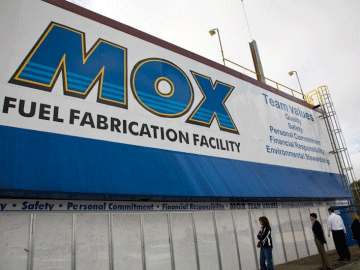 MOX Contractor Slammed for Poor Performance http://www.pogo.org/blog/2016/05/mox-contractor-slammed-for-poor-performance.html?referrer=http://paper.li/artmackay/1324257026?edition_id=94aab260-1141-11e6-9ab7-002590a5ba2d By: Lydia Dennett, 2 May 16 Investigator, POGO Documents obtained by Savannah River Site Watch are providing even more evidence than is already out there that it is time for Congress to follow the Department of Energy’s recommendation and cancel the Mixed Oxide Fuel Fabrication Facility (MOX) for good.
“Overall performance is below the level needed for successful project completion, as culminated in cost overruns and schedule delays,” the National Nuclear Security Administration (NNSA) wrote in its analysis of the contractor in charge of constructing MOX.
According to the NNSA documents obtained via the Freedom of Information Act and released by Savannah River Site Watch, the MOX contractor, CB&I AREVA MOX Services (CB&I), received only 49 percent of the possible award fee. This dock in award fee was due to concerning findings regarding DB&I’s management of the project, including the fact that the contractor failed to adequately perform random drug testing of its employees. However, CB&I still received $4.33 million of the possible $8.86 million in award fees.
CB&I has now been the MOX contractor for over nine years. The project’s estimated total life-cycle cost (which includes construction and operating the plant for 20 years) has gone from $4 billion to a whopping $25 billion. But even $25 billion may not be enough.Independent cost estimates have found that unless annual appropriations more than double over the next few years, the whole MOX project could cost as much as $110 billion and won’t be complete until 2100. Government officials have further noted that the contractor is running at a 25 percent rework rate, meaning approximately one quarter of the work done on the MOX facility will have to be re-done.
The MOX project is a multi-billion dollar boondoggle that, even if completed, will not be able to complete its mission. Just this year the Administration announced they believe it would be in the best interest of taxpayers to pursue an alternative plan, but it’s up to Congress to make the final cut. With the contractor performing so poorly, and the cost mounting with every delay and mistake, it’s time to make the fiscally responsible decision and end MOX.
Transatlantic Trade and Investment Partnership (TTIP) damaging to environment and consumer safety
US-EU trade deal ‘risks’ emerge in leak, West Australian, May 2, 2016, Brussels (AFP) – A massive US-EU trade deal would harm the environment and consumer safety, Greenpeace said Monday citing secret documents it leaked, as Brussels dismissed the release as a “storm in a teacup”.
The campaign group published 248 pages online to “shine a light” on the closed-door talks to forge a so-called Transatlantic Trade and Investment Partnership (TTIP), which would be the world’s largest ever bilateral trade pact.
Greenpeace said the deal would place corporate interests above the environment and consumer safety, and inflict a dangerous lack of standards on US and European consumers.
“This treaty is threatening to have far reaching implications for the environment and the lives of more than 800 million citizens in the EU and US,” said Greenpeace as it presented the documents in Berlin.
Washington and Brussels have been negotiating the mega-deal since 2013 and want it completed this year before US President Barack Obama leaves office, but it has faced mounting opposition on both sides of the Atlantic…….
In Europe there is deep suspicion that TTIP will erode ecological and health regulations to the advantage of big business with officials in France and Germany also increasingly voicing doubts about the deal.
Greenpeace said the papers show, for example, that the US wants to be able to scrap existing EU rules in areas such as food labelling or approval of dangerous chemicals if it they spell barriers to free trade.
“TTIP is about a huge transfer of power from people to big business,” the group said……
Greenpeace meanwhile decried the lack of mention at all in the proposed text of global goals to reduce greenhouse gas emissions.
“These leaked documents confirm what we have been saying for a long time,” said Greenpeace EU director Jorgo Riss. “TTIP would put corporations at the centre of policy-making, to the detriment of environment and public health.” https://au.news.yahoo.com/thewest/a/31488372/greenpeace-to-release-secret-documents-on-contested-eu-us-trade-deal/
USA Defence Secretary accuses Russia of sabre-rattling
US accuses Russia of nuclear sabre-rattling, amid Nato tensions US Defence Secretary Ash Carter has accused Russia of “nuclear sabre-rattling” and of being intent on eroding international order.BBC News, 3 May 16
He said he regretted strained relations with Moscow but said the US had to “prioritise deterrence” on Nato’s eastern flank.
US-Russian ties have been strained by the Ukraine crisis and recent military encounters in the Baltic Sea.
Russia has accused Nato of threatening its national security……http://www.bbc.com/news/world-europe-36197856
A second double-shell tank leaking radiation at Hanford?
 Signs emerge of a second double-shell tank leaking at Hanford , Susannah Frame, KING 5.com 27 Apr 16, Radioactive particles have been measured at elevated levels for the first time in the outer safety space of the Hanford double-shell tank known as AY-101. The contractor that manages the tank told employees “we recently discovered higher-than-expected radioactivity readings” from filters that are part of the tank’s continuous air monitor (CAM).
“The filter contained traces of radioactive americium, cesium and plutonium, raising the possibility that the material is from tank waste that has escaped from the primary shell of the double-shell tank,” wrote Rob Gregory, chief operating officer of Washington River Protection Solutions.
Sources tell KING 5 that alarms went off last week to alert staff of the presence of “hot” (radioactive) particles trapped in filters of the tank’s continuous air monitor (CAM). The sources say this is the first time readings of this sort have been detected in AY-101.
The U.S. Department of Energy confirmed to the state that radioactive particles had been detected by filters circulating air from inside AY-101, according to officials with the Washington Department of Ecology.
But DOE’s Office of River Protection, which oversees the tank farms at Hanford, said no alarms went off indicating radioactive particles had been detected………
The citizen watchdog group Hanford Challenge also said sources of its own confirmed the detection of elevated radiation levels outside the primary liner of AY-101. The group’s sources say the by-products confirmed include Cesium-137, plutonium, and a high-beta emitter (most likely Strontium-90) that are all constituents commonly found in Hanford’s underground tanks.
The executive director of Hanford Challenge, Tom Carpenter, said this recent event has “serious implications” for the Hanford Site.
“Simply put, Hanford is nearly out of double-shell tank space, especially after pumping out AY-102 and emptying some of the shakier single-shell tanks…This is no other realistic option but to begin building new tanks immediately,” said Carpenter.
Elevated radiation and radioactive materials found in the CAM filters was the first indication that AY-102 was leaking. This was a red flag for the Department of Energy (DOE), which owns Hanford, 15 years before confirmation of the leak. Those high CAM filter readings in the 1990s were dismissed by DOE and its contractors at the time……..http://www.king5.com/mb/news/local/investigations/signs-emerge-of-a-second-double-shell-tank-leaking-at-hanford/154338445
Idaho in danger from nuclear waste, and must be protected
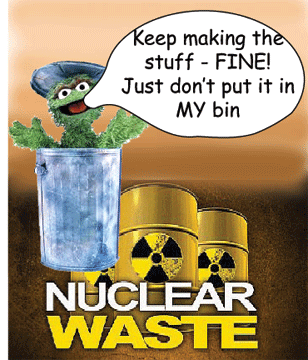 Idaho must be protected from nuclear waste HTTP://WWW.IDAHOSTATESMAN.COM/OPINION/READERS-OPINION/ARTICLE74125087.HTML BY WENDY WILSON, 28 Apr 16, Houston, we have a problem.” Although engineers and workers at the Idaho National Laboratory in Southeast Idaho have always tried to handle nuclear material safely, it doesn’t always work. Since 2005, accidents and inadvertent releases have happened with alarming regularity. In 2012, Department of Energy investigators told the Snake River Alliance that they had significant concerns and that INL was not handling plutonium safely.
Although the DOE has failed to meet countless deadlines to clean up what is already here, new proposals to import spent nuclear fuel from commercial power plants have swept safety concerns under the rug. DOE’s reputation for missed deadlines once led former Gov. Cecil Andrus to compare the agency to the Boise used car dealership “Fairly Reliable Bob’s.”
The most current missed deadline is that the DOE has failed to treat 900,000 gallons of intensely radioactive liquid waste stored at INL. Recent failures at the plant have cost taxpayers hundreds of millions of dollars in cost overruns and the system may never work.
In the meantime, this extremely dangerous waste is stored in buried tanks decades old. INL’s tanks have never leaked, as far as we know, but the pipes and valves connecting them have. The waste from those leaks may never be cleaned up and may always be in our soil and groundwater.
The McClatchy News Agency, parent company of the Idaho Statesman, recently reported that there have been nearly 400 nuclear-related deaths associated with the INL. Far more people have been sickened by their work there.
Twenty-five years ago, a Magic Valley fish farmer raised the alarm about plutonium shipments from Colorado to be buried on top of the Eastern Snake Plain Aquifer. The public was outraged. Former Gov. Andrus stepped up and Gov. Phil Batt forged a nuclear waste agreement with the DOE banning future imports of spent fuel from commercial nuclear power plants until specific timetables for clean up were met.
Today, the Byron nuclear waste proposed to come to INL falls under this ban. It is being stored safely in Indiana and it is unfathomable why Idaho would sign a “waiver” to allow the feds to bring it here and put Idahoans at risk.
Our land and water will continue to be contaminated until our political leaders put the health and safety of Idahoans ahead of DOE’s broken promises. There is still plutonium buried above the Snake River Aquifer, perhaps till the end of time. Let’s not forget.
Idahoans shouldn’t become lab animals for nuclear malfunction. Idaho Attorney General Lawrence Wasden is doing the right thing forcing the DOE to follow its own deadlines. Without a permanent national repository for nuclear waste, what comes to Idaho will stay here for decades, if not forever. Idahoans should stand together and tell the federal government to focus on INL’s existing nuclear experiment — cleaning up what is already here.
Wendy Wilson is interim executive director of the Snake River Alliance, Idaho’s nuclear watchdog and advocate for clean energy, found at www.snakeriveralliance.org.
California State Senate demands removal of stored nuclear waste from San Onofre power plant
 State Senate approves removing stored nuclear waste from San Onofre power plant http://www.cbs8.com/story/31842881/state-senate-approves-removing-stored-nuclear-waste-from-san-onofre-power-plantPosted: Apr 29, 2016 SAN ONOFRE (CNS) – A resolution demanding that the U.S. Department of Energy remove stored nuclear waste at the shuttered San Onofre Nuclear Generating Station was approved by the state Senate Thursday.
The resolution authored by Sen. Patricia Bates, R-Laguna Niguel, urges President Barack Obama and Congress to approve a bill in the House of Representatives that would consolidate the storage of nuclear waste. The bill is in the House Energy and Commerce Committee’s Subcommittee on Environment and the Economy.
“It’s way past time for the federal government to move the nuclear waste stored at San Onofre to a location away from densely populated and environmentally sensitive areas,” Bates said. “I’m pleased that my state Senate colleagues have endorsed my call to Washington D.C. to approve pending legislation that would help make Orange and San Diego County residents safer.”
The San Onofre plant has been shut down since a small, non-injury leak occurred in a steam generator in January 2012. Operator and majority owner Southern California Edison later decided to retire the plant’s two reactors,
rather than follow a costly start-up process.
Closing the facility is expected to take a couple of decades, however, so Edison recently received permission to expand nuclear waste storage tanks at San Onofre, despite opposition from environmental groups and local politicians.
-
Archives
- October 2026 (129)
- September 2026 (339)
- August 2026 (330)
- July 2026 (355)
- June 2026 (287)
- May 2026 (306)
- April 2026 (356)
- March 2026 (251)
- February 2026 (267)
- January 2026 (308)
- December 2025 (358)
- November 2025 (359)
-
Categories
- 1
- 1 NUCLEAR ISSUES
- business and costs
- climate change
- culture and arts
- ENERGY
- environment
- health
- history
- indigenous issues
- Legal
- marketing of nuclear
- media
- opposition to nuclear
- PERSONAL STORIES
- politics
- politics international
- Religion and ethics
- safety
- secrets,lies and civil liberties
- spinbuster
- technology
- Uranium
- wastes
- weapons and war
- Women
- 2 WORLD
- ACTION
- AFRICA
- Atrocities
- AUSTRALIA
- Christina's notes
- Christina's themes
- culture and arts
- Events
- Fuk 2022
- Fuk 2023
- Fukushima 2017
- Fukushima 2018
- fukushima 2019
- Fukushima 2020
- Fukushima 2021
- general
- global warming
- Humour (God we need it)
- Nuclear
- RARE EARTHS
- Reference
- resources – print
- Resources -audiovicual
- Weekly Newsletter
- World
- World Nuclear
- YouTube
-
RSS
Entries RSS
Comments RSS

